oil level FIAT DUCATO 2016 Owner handbook (in English)
[x] Cancel search | Manufacturer: FIAT, Model Year: 2016, Model line: DUCATO, Model: FIAT DUCATO 2016Pages: 387, PDF Size: 20.76 MB
Page 119 of 387
KNOWING THE INSTRUMENT PANEL
This section of the booklet gives you all
the information you need to
understand, interpret and use the
instrument panel correctly.CONTROL PANEL AND
INSTRUMENTS ...............................116
DISPLAY ........................................122
TRIP COMPUTER ...........................131
WARNING LIGHTS AND
MESSAGES ....................................134
- LOW BRAKE FLUID/HANDBRAKE
ENGAGED .......................................... 134
- EBD FAILURE .................................. 135
- AIRBAG FAILURE ............................. 135
- SEAT BELTS NOT FASTENED .......... 136
- ENGINE COOLANT TEMPERATURE
TOO HIGH .......................................... 137
- LOW BATTERY CHARGE ................. 137
- LOW ENGINE OIL PRESSURE ......... 138
-ENGINE OIL DETERIORATED ........... 138
-INCOMPLETE DOOR/LOAD
COMPARTMENT CLOSURE ............... 139
- POWER STEERING FAILURE ........... 139
-SELF-LEVELLING SUSPENSION
FAILURE ............................................. 139
- INJECTION/EOBD SYSTEM
FAILURE ............................................. 141
-UREA INJECTION SYSTEM FAILURE
............................................................ 142
- ABS FAILURE ................................... 142
-FUEL RESERVE ................................ 143
-GLOW PLUG PREHEATING / GLOW
PLUG PREHEATING FAILURE ............ 143
-INDICATION OF DIESEL EMISSIONS
ADDITIVE LOW LEVEL (UREA) ........... 144
-VEHICLE PROTECTION SYSTEM
FAILURE - FIAT CODE ........................ 144
- REAR FOG LIGHTS .......................... 144
- GENERAL FAILURE INDICATION ..... 145
-DPF (PARTICULATE FILTER)
CLEANING UNDERWAY ..................... 146
-WORN BRAKE PADS ........................ 147-DRIVING ADVISOR ........................... 147
- TPMS ............................................... 148
- DIPPED HEADLIGHTS ..................... 149
- FOLLOW ME HOME ........................ 149
- LEFT-HAND DIRECTION INDICATOR
............................................................ 149
- RIGHT-HAND DIRECTION
INDICATOR ........................................ 150
-FOG LIGHTS ..................................... 150
- CRUISE CONTROL .......................... 150
-SPEED LIMITER ................................ 150
- AUTOMATIC MAIN BEAM
HEADLIGHTS ..................................... 151
- MAIN BEAM HEADLIGHTS .............. 151
-"UP" FUNCTION ............................... 151
-EXTERIOR LIGHTS FAULT ................ 152
-BRAKE LIGHT FAILURE .................... 152
-MAIN BEAM AUTOMATISM FAULT ... 153
-POSSIBLE ICE ON ROAD ................. 153
-SPEED LIMIT EXCEEDED ................. 153
-SCHEDULED SERVICING ................. 153
-FUEL CUT-OFF DEVICE INERTIA
SWITCH TRIPPED .............................. 154
-PARKING SENSOR FAILURE ............ 154
-DRIVING ADVISOR SYSTEM
FAILURE ............................................. 154
-TRAFFIC SIGN RECOGNITION
FAILURE ............................................. 154
-LIMITED RANGE ............................... 154
-START&STOP SYSTEM
ACTIVATION/DEACTIVATION .............. 155
-START&STOP FAILURE .................... 155
-INDICATION OF DIESEL EMISSIONS
ADDITIVE LOW LEVEL (UREA) ........... 156
-WATER IN DIESEL FILTER (diesel
versions) ............................................. 156
115
Page 125 of 387
ENGINE OIL LEVEL
GAUGE
(for versions/markets, where provided)
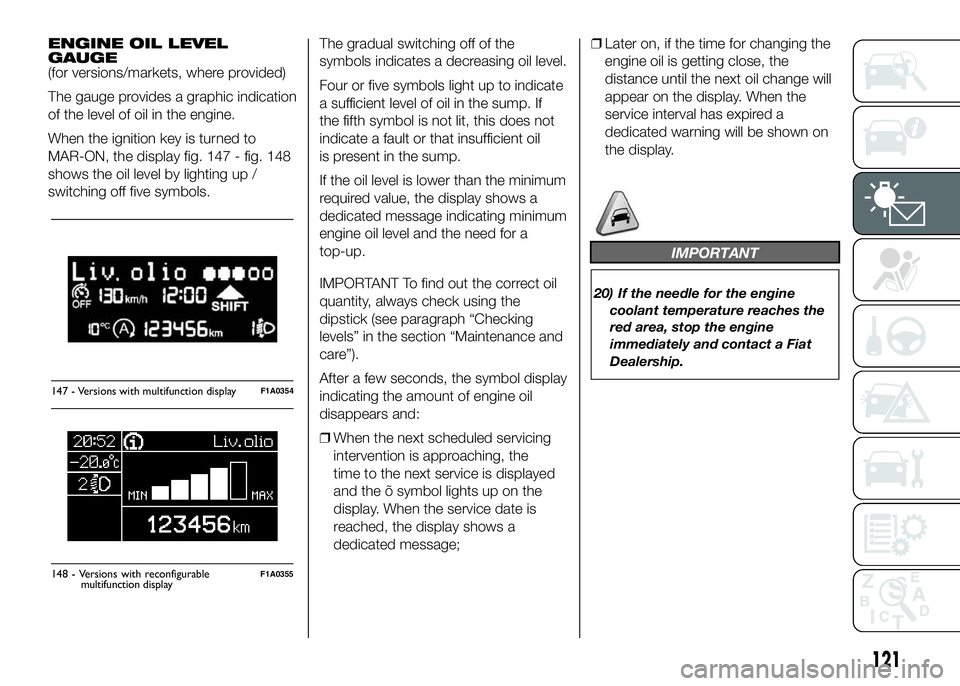
The gauge provides a graphic indication
of the level of oil in the engine.
When the ignition key is turned to
MAR-ON, the display fig. 147 - fig. 148
shows the oil level by lighting up /
switching off five symbols.The gradual switching off of the
symbols indicates a decreasing oil level.
Four or five symbols light up to indicate
a sufficient level of oil in the sump. If
the fifth symbol is not lit, this does not
indicate a fault or that insufficient oil
is present in the sump.
If the oil level is lower than the minimum
required value, the display shows a
dedicated message indicating minimum
engine oil level and the need for a
top-up.
IMPORTANT To find out the correct oil
quantity, always check using the
dipstick (see paragraph “Checking
levels” in the section “Maintenance and
care”).
After a few seconds, the symbol display
indicating the amount of engine oil
disappears and:
❒When the next scheduled servicing
intervention is approaching, the
time to the next service is displayed
and the õ symbol lights up on the
display. When the service date is
reached, the display shows a
dedicated message;❒Later on, if the time for changing the
engine oil is getting close, the
distance until the next oil change will
appear on the display. When the
service interval has expired a
dedicated warning will be shown on
the display.
IMPORTANT
20) If the needle for the engine
coolant temperature reaches the
red area, stop the engine
immediately and contact a Fiat
Dealership.
147 - Versions with multifunction displayF1A0354
Liv.olio
MAX MIN
148 - Versions with reconfigurableF1A0355
121
display
multifunction
Page 133 of 387
- briefly press the MODE button: the
previously set volume "level" will flash
on the display;
- press the
orbutton to
adjust;
- press the MODE button briefly to
return to the menu screen or hold the
button down to return to the standard
screen without storing.
Service
Scheduled servicing
Using this function you can display
information about the mileage intervals
for vehicle servicing.
To consult this information, proceed as
follows:
– briefly press the MODE button: the
display shows service requirements in
km or mi according to the previous
setting (see paragraph “Unit of
measure”);
– briefly press button MODE to go back
to the menu screen or press the button
for longer to go back to the standard
screen.
Oil change
This function displays information
regarding the remaining mileage before
the next oil change.To consult this information, proceed as
follows:
– briefly press the MODE button; the
display shows the estimated km
distance to the next oil change
(depending on the driving mode);
– briefly press button MODE to go back
to the menu screen or press the button
for longer to go back to the standard
screen.NoteThe "Scheduled Servicing Plan"
requires the vehicle to be serviced every
48,000 km (or 30,000 mi). This
indication will appear automatically, with
the key at MAR-ON, starting from
2,000 km (or 1,240 mi) and will be
displayed every 200 km (or 124 mi). Oil
change notification messages are
displayed in the same way. Use the
andbuttons to alternate
between displaying scheduled servicing
and engine oil change information.
Below 200 km servicing indications are
more frequent. The display will be in
km or mi depending on the
measurement unit settings. When the
next scheduled service is approaching,
the word “Service” will appear on the
display, followed by the number of
kilometres or miles left, when the key is
turned to MAR-ON. Contact a Fiat
Dealership to carry out any service
operation in the "Scheduled servicing
plan" and to reset the display.
129
Page 144 of 387
WARNING
98) If thewarning light does not switch on when the key is turned to MAR-ON or if it stays on when driving (together
with the message on the display), there may be a fault in the restraint systems; in this case, the airbags or
pretensioners may not deploy in the event of an accident or, in a lower number of cases, they could deploy
erroneously. Before continuing, contact a Fiat Dealership immediately to have the system checked.
99) The failure of the
warning light is indicated by thewarning light flashing or, depending on the version, by the
symbol constantly on in the display. In this case, thewarning light may not indicate a fault in the restraint
systems. Before continuing, contact a Fiat Dealership immediately to have the system checked.
100) Deteriorated engine oil must be replaced as soon as possible after the
warning light comes on, and never more
than 500 km after it first switches on. Failure to observe the above indications may result in severe damage to the
engine and invalidate the warranty. Remember that when the warning light comes on, it does not mean that the level
of engine oil is low, so if it flashes you do not need to top up the engine oil.
101) If the
warning light flashes when driving, contact a Fiat Dealership.
140
KNOWING THE INSTRUMENT PANEL
Page 193 of 387
Roof rack/ski rack
Remove the roof rack or the ski rack
from the roof after use. These
accessories decrease aerodynamic
penetration of the vehicle and have a
negative effect on fuel consumption.
When transporting particularly large
objects, use a trailer if possible.
Electric devices
Use electrical devices only for the
amount of time needed. The heated
rear window, additional headlights,
windscreen/rear window wipers and
heater fan need a considerable amount
of energy, therefore increasing fuel
consumption (by up to 25% in
the urban cycle).
Climate control system
Air conditioning leads to higher fuel
consumption (on average up to +20%).
If the temperature outside permits, try
and use the ventilation only.
Devices for
aerodynamic control
The use of non-certified spoilers may
adversely affect air drag and fuel
consumption.DRIVING STYLE
The main driving styles that affect fuel
consumption are listed below.
Cranking
Do not warm up the engine at low or
high revs when the vehicle is stationary;
this causes the engine to warm up
more slowly, thereby increasing fuel
consumption and emissions. It is
therefore advisable to move off
immediately, slowly, avoiding high
speeds: in this way the engine will
warm up more quickly.
Unnecessary actions
Avoid accelerating when stopped at
traffic lights or before switching off the
engine. This action and also double
declutching is absolutely pointless on
modern cars and also increases
consumption and pollution.
Gear selection
As soon as the conditions of the traffic
and road permit, use a higher gear.
Using a low gear for faster acceleration
will increase consumption.
In the same way improper use of a high
gear increases consumption, emissions
and engine wear.Max. speed
Fuel consumption increases
considerably with speed. Maintain a
constant speed, avoiding unnecessary
braking and acceleration, which cost
in terms of both fuel consumption and
emissions.
Acceleration
Accelerating violently will greatly affect
consumption and emissions:
acceleration should be gradual.
USAGE CONDITIONS
The main usage conditions that
negatively affect fuel consumption are
listed below.
Cold starting
Short journeys and frequent cold starts
do not allow the engine to reach
optimum operating temperature.
This results in a significant increase in
consumption levels (from +15 to +30%
on the urban cycle) and emissions.
189
Page 244 of 387
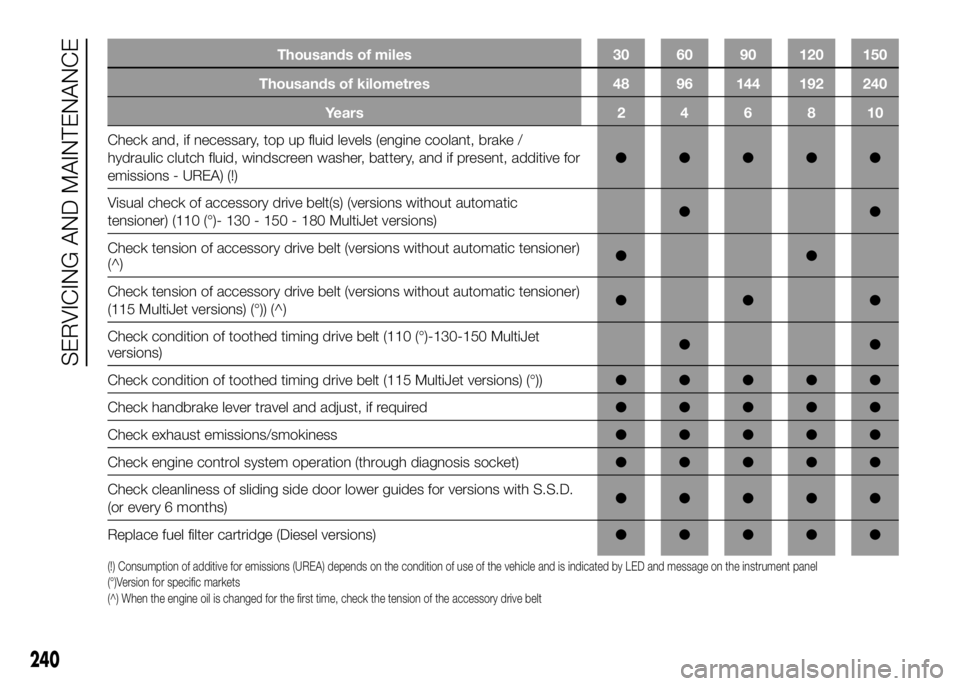
Thousands of miles 30 60 90 120 150
Thousands of kilometres 48 96 144 192 240
Years246810
Check and, if necessary, top up fluid levels (engine coolant, brake /
hydraulicclutch fluid, windscreen washer, battery, and if present, additive for
emissions - UREA) (!)●●●●●
Visual check of accessory drive belt(s) (versions without automatic
tensioner) (110 (°)- 130 - 150 - 180 MultiJet versions)●●
Check tension of accessory drive belt (versions without automatic tensioner)
(^)●●
Check tension of accessory drive belt (versions without automatic tensioner)
(115 MultiJet versions) (°)) (^)●●●
Check condition of toothed timing drive belt (110 (°)-130-150 MultiJet
versions)●●
Check condition of toothed timing drive belt (115 MultiJet versions) (°))●●●●●
Check handbrake lever travel and adjust, if required●●●●●
Check exhaust emissions/smokiness●●●●●
Check engine control system operation (through diagnosis socket)●●●●●
Check cleanliness of sliding side door lower guides for versions with S.S.D.
(or every 6 months)●●●●●
Replace fuel filter cartridge (Diesel versions)●●●●●
(!) Consumption of additive for emissions (UREA) depends on the condition of use of the vehicle and is indicated by LED and message on the instrument panel
(°)Version for specific markets
(^) When the engine oil is changed for the first time, check the tension of the accessory drive belt
240
SERVICING AND MAINTENANCE
Page 246 of 387
PERIODIC CHECKS
Before long journeys, check and, if
necessary, restore:
❒engine coolant level;
❒brake fluid level;
❒control and recovery of additive level
for AdBlue Diesel emissions (UREA)
(for versions/markets, where
provided);
❒windscreen washer fluid level;
❒tyre inflation pressure and condition;
❒operation of lighting system
(headlamps, direction indicators,
hazard warning lights, etc.);
❒operation of screen washer/wiper
system and positioning/wear of
windscreen/rear window wiper
blades.
To ensure that the vehicle is always
efficient and well maintained, it is
advisable to make sure that you carry
out the above operations regularly
(approximately every 1000 km and
every 3000 km for checking and
topping up engine oil is advisable).
DEMANDING
VEHICLE USE
If the vehicle is mostly used in one of
the following conditions:
❒towing a trailer or caravan;
❒dusty roads;
❒short, repeated journeys (less than
7-8 km) at sub-zero outside
temperatures;
❒engine often idling or driving long
distances at low speeds or long
periods of inactivity;
the following checks must be carried
out more often than indicated in the
Scheduled Servicing Plan:
❒check front disc brake pad
conditions and wear;
❒check cleanliness of bonnet and boot
locks, cleanliness and lubrication of
linkage;
❒visually inspect conditions of: engine,
gearbox, transmission, pipes and
hoses (exhaust - fuel system -
brakes) and rubber elements (boots -
sleeves - bushes - etc.);
❒check battery charge and battery
fluid level (electrolyte);
❒visually inspect condition of the
accessory drive belts;❒check and, if necessary, change
engine oil and replace oil filter;
❒Restore additive level for AdBlue
Diesel emissions (UREA) (for versions
/ markets where applicable), at the
ignition of the lamp or the message
on the instrument panel;
❒check and, if necessary, replace
pollen filter.
242
SERVICING AND MAINTENANCE
Page 247 of 387
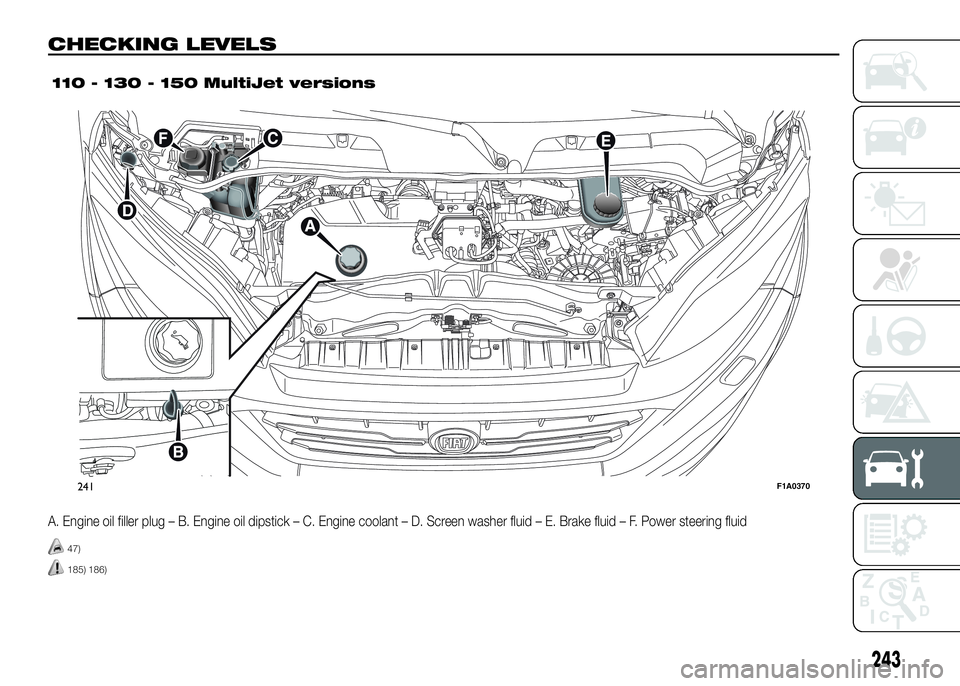
CHECKING LEVELS.
A. Engine oil filler plug – B. Engine oil dipstick – C. Engine coolant – D. Screen washer fluid – E. Brake fluid – F. Power steering fluid
47)
185) 186)
241F1A0370
243
110 - 130 - 150 MultiJet versions
Page 251 of 387
ENGINE OIL
48)
Check the oil level a few minutes (about
5) after the engine has stopped, with
the vehicle parked on level ground.
Check the level is within the MIN. and
MAX. marks on the dipstick B fig. 241 -
fig. 242 - fig. 243 - fig. 244.
The range between the MIN and MAX
marks corresponds to about 1 litre
of oil.
If the oil level is near or under the MIN
line, add oil through the filler A fig. 241 -
fig. 242 - fig. 243 - fig. 244 until it
reaches the MAX line.
The oil level must never exceed the
MAX mark.
Engine oil consumption
The maximum engine oil consumption
is usually 400 grams every 1000 km.
When the vehicle is new, the engine
needs to be run in, therefore the engine
oil consumption can only be considered
stabilised after the first 5,000–6,000
km.
IMPORTANT The oil consumption
depends on driving style and the
conditions under which the vehicle is
used.IMPORTANT After adding or changing
the oil, let the engine run for a few
seconds and wait a few minutes after
switching it off before checking the
level.
IMPORTANT Always top up using
engine oil of the same specifications as
that already in the engine.
ENGINE COOLANT
49)187)
The coolant level must be checked
when the engine is cold and must
range between the MIN and MAX
marks on the reservoir.
If the level is to low, operate as follows:
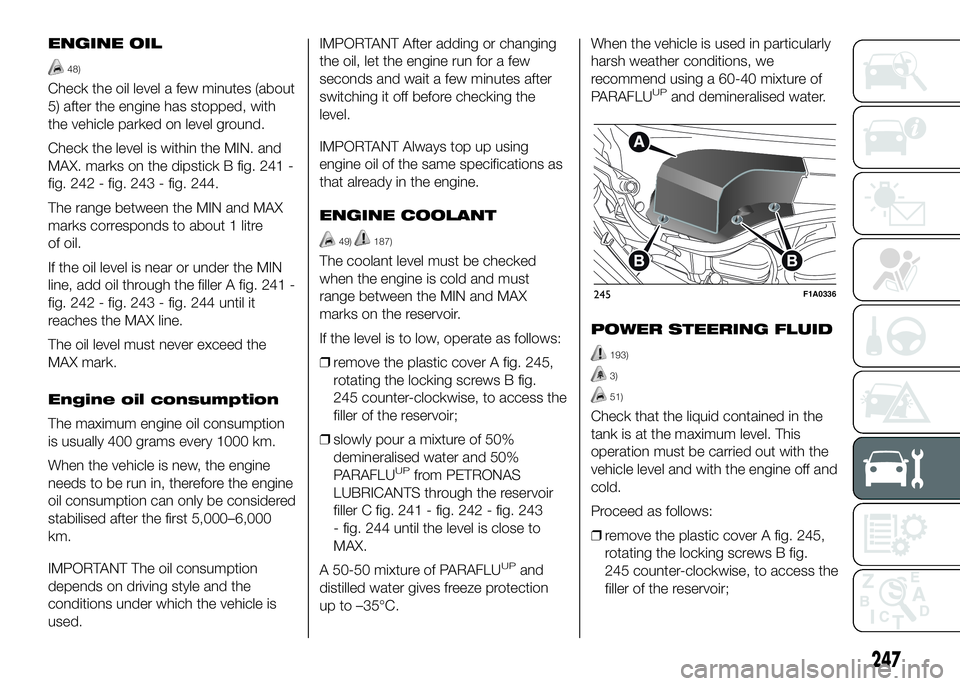
❒remove the plastic cover A fig. 245,
rotating the locking screws B fig.
245 counter-clockwise, to access the
filler of the reservoir;
❒slowly pour a mixture of 50%
demineralised water and 50%
PARAFLU
UPfrom PETRONAS
LUBRICANTS through the reservoir
filler C fig. 241 - fig. 242 - fig. 243
- fig. 244 until the level is close to
MAX.
A 50-50 mixture of PARAFLU
UPand
distilled water gives freeze protection
up to –35°C.When the vehicle is used in particularly
harsh weather conditions, we
recommend using a 60-40 mixture of
PARAFLU
UPand demineralised water.
POWER STEERING FLUID
193)
3)
51)
Check that the liquid contained in the
tank is at the maximum level. This
operation must be carried out with the
vehicle level and with the engine off and
cold.
Proceed as follows:
❒remove the plastic cover A fig. 245,
rotating the locking screws B fig.
245 counter-clockwise, to access the
filler of the reservoir;
245F1A0336
247
Page 253 of 387
BRAKE FLUID
191) 192)
50)
Undo cap E fig. 241 - fig. 242 - fig. 243
- fig. 244 and check that the liquid in
the reservoir is at the maximum level.
The fluid level in the reservoir must not
exceed the MAX mark.
Use the brake fluid shown in the "Fluids
and lubricants" table (see "Technical
Specifications").
NOTE Carefully clean the cap of the
reservoir and the surrounding surface.
Take great care to ensure that
impurities do not enter the reservoir
when the plug is opened.
For topping-up, always use a funnel
with integrated filter with mesh equal to
or lower than 0.12 mm.
IMPORTANT Brake fluid absorbs
moisture. For this reason, if the vehicle
is mainly used in areas with a high
degree of atmospheric humidity, the
fluid should be replaced at more
frequent intervals than specified in the
“Scheduled Servicing Plan”.IMPORTANT
47) When topping up, take care not
to mix up the various types of
fluids: they are not compatible
with each other and could
seriously damage the car.
48) The used engine oil and the filter
that has been replaced contain
substances that are harmful to
the environment. To change the
oil and filters, we advise you to
contact a Fiat Dealership.
49) PARAFLU
UPantifreeze is used in
the engine cooling system. Use
fluid of the same type as that
contained in the cooling system
for any top-ups. PARAFLU
UP
cannot be mixed with any other
type of fluid. If this happens, do
not start the engine and contact a
Fiat Dealership.
50) Avoid allowing brake fluid, which
is extremely corrosive, to come
into contact with painted areas.
Should it happen, wash
immediately with water.51) Do not press the power steering
end of travel lock for longer than 8
consecutive seconds with the
engine running because it will
cause noise and risk damaging
the system.
WARNING
185) Never smoke when performing
operations in the engine
compartment. Flammable gases
and fumes may be present and
risk igniting.
186) Be very careful when working in
the engine compartment when
the engine is hot: you may get
burned. Remember that the fan
may start up if the engine is hot:
this could injure you. Scarves, ties
and other loose clothing might
be pulled by moving parts.
187) The cooling system is
pressurised. If necessary, only
replace the plug with another
original one or the operation of
the system may be adversely
affected. Do not remove the
reservoir plug when the engine is
hot: risk of burns.
249