TECHNICAL FIAT DUCATO 2018 Owner handbook (in English)
[x] Cancel search | Manufacturer: FIAT, Model Year: 2018, Model line: DUCATO, Model: FIAT DUCATO 2018Pages: 304, PDF Size: 14.93 MB
Page 212 of 304
WHEELS AND TYRES
Check the pressure of each tyre,
including the space-saver wheel,
approximately every two weeks and
before long journeys: the pressure
should be checked with the tyre rested
and cold.
It is normal for the pressure to increase
when the vehicle is used; for the correct
tyre inflation pressure, see “Wheels” in
the “Technical specifications” section.
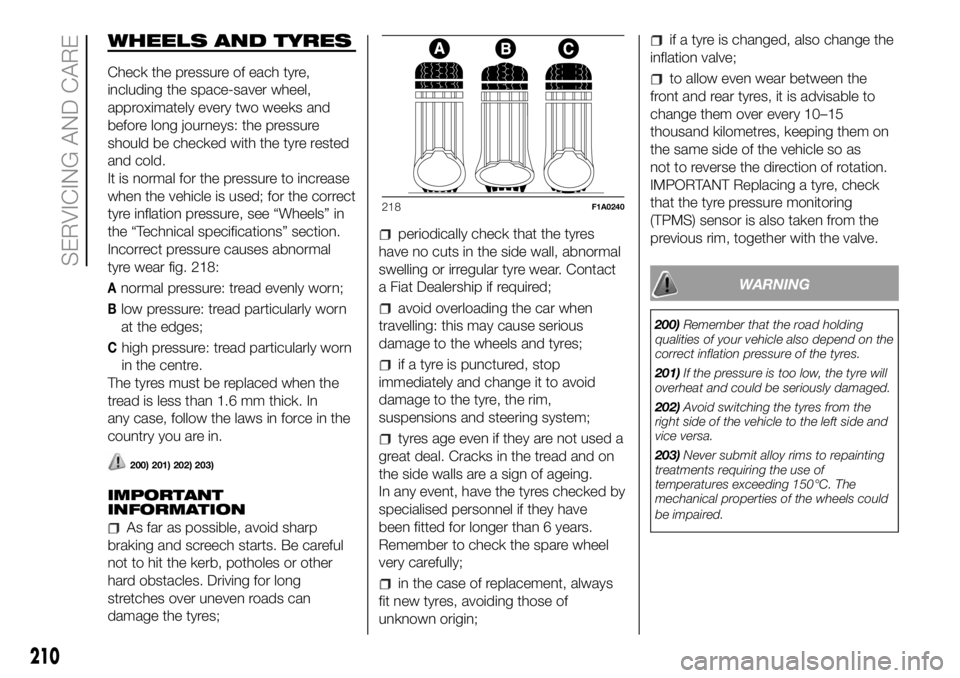
Incorrect pressure causes abnormal
tyre wear fig. 218:
Anormal pressure: tread evenly worn;
Blow pressure: tread particularly worn
at the edges;
Chigh pressure: tread particularly worn
in the centre.
The tyres must be replaced when the
tread is less than 1.6 mm thick. In
any case, follow the laws in force in the
country you are in.
200) 201) 202) 203)
IMPORTANT
INFORMATION
As far as possible, avoid sharp
braking and screech starts. Be careful
not to hit the kerb, potholes or other
hard obstacles. Driving for long
stretches over uneven roads can
damage the tyres;
periodically check that the tyres
have no cuts in the side wall, abnormal
swelling or irregular tyre wear. Contact
a Fiat Dealership if required;
avoid overloading the car when
travelling: this may cause serious
damage to the wheels and tyres;
if a tyre is punctured, stop
immediately and change it to avoid
damage to the tyre, the rim,
suspensions and steering system;
tyres age even if they are not used a
great deal. Cracks in the tread and on
the side walls are a sign of ageing.
In any event, have the tyres checked by
specialised personnel if they have
been fitted for longer than 6 years.
Remember to check the spare wheel
very carefully;
in the case of replacement, always
fit new tyres, avoiding those of
unknown origin;
if a tyre is changed, also change the
inflation valve;
to allow even wear between the
front and rear tyres, it is advisable to
change them over every 10–15
thousand kilometres, keeping them on
the same side of the vehicle so as
not to reverse the direction of rotation.
IMPORTANT Replacing a tyre, check
that the tyre pressure monitoring
(TPMS) sensor is also taken from the
previous rim, together with the valve.
WARNING
200)Remember that the road holding
qualities of your vehicle also depend on the
correct inflation pressure of the tyres.
201)If the pressure is too low, the tyre will
overheat and could be seriously damaged.
202)Avoid switching the tyres from the
right side of the vehicle to the left side and
vice versa.
203)Never submit alloy rims to repainting
treatments requiring the use of
temperatures exceeding 150°C. The
mechanical properties of the wheels could
be impaired.
218F1A0240
210
SERVICING AND CARE
Page 214 of 304

BODYWORK
PROTECTION AGAINST
ATMOSPHERIC AGENTS
The main causes of corrosion are the
following:
atmospheric pollution;
salty air and humidity (coastal areas,
or hot humid climates);
seasonal environmental conditions.
ADVICE FOR
PRESERVING THE
BODYWORK
Paintwork
Paintwork does not only serve an
aesthetic purpose, but also protects the
underlying sheet metal.
Touch up abrasions and scratches
immediately to prevent rust formation.
Use only original paint products for
touch-ups (see “Bodywork paint
identification plate” in the “Technical
specifications” section).
Normal maintenance of paintwork
consists in washing the car: the
frequency depends on the conditions
and environment where the car is used.
For example, it is advisable to wash
the vehicle more often in areas with
high levels of environmental pollution or
on roads spread with salt.To correctly wash the vehicle, proceed
as follows:
wash the bodywork using a low
pressure jet of water;
wipe a sponge with a slightly soapy
solution over the bodywork, frequently
rinsing the sponge;
rinse well with water and dry with a
jet of air or a chamois leather.
If you put the vehicle through a car
wash, follow these recommendations:
remove the aerial from the roof
so it does not get damaged;
the vehicle should be washed with
water added to a soapy solution;
rinse thoroughly to avoid soap
marks remaining on the bodywork or
less visible parts.
Windows
To clean glasses, use specific cleaning
products. Use clean cloths to avoid
scratching the glass or altering the
transparency.
IMPORTANT Wipe the rear window
inside gently with a cloth following the
direction of the filaments to avoid
damaging the heating device.Front headlights
IMPORTANT Never use aromatic
substances (e.g. petrol) or ketones (e.g.
acetone) for cleaning the plastic lenses
of the headlights.
59)
6)
WARNING
59)Some automatic systems equipped
with old generation blades and/or with
a poor maintenance can damage the paint,
promoting the creation of microscoring
which give an opaque/coated appearance
to the paint, especially on dark colours.
In this case, just lightly polish with specific
products.
WARNING
6)Detergents pollute the water. The
vehicle should be washed in areas
equipped for collecting and purifying the
liquid used in the washing process.
212
SERVICING AND CARE
Page 216 of 304

TECHNICAL DATA
Everything you may find useful for
understanding how your vehicle
is made and works is contained in this
chapter and illustrated with data, tables
and graphics. For the enthusiasts and
the technician, but also just for those
who want to know every detail of their
vehicle.IDENTIFICATION DATA....................215
ENGINE CODES - BODYWORK
VERSION ........................................217
ENGINE ..........................................219
STEERING SYSTEM .......................222
WHEELS .........................................223
DIMENSIONS ..................................227
PERFORMANCE .............................237
WEIGHTS AND LOADS...................240
REFUELLING ..................................243
FLUIDS AND LUBRICANTS ............248
FUEL CONSUMPTION ....................251
CO2 EMISSIONS ...........................258
214
TECHNICAL DATA
Page 218 of 304
ENGINE MARKING
It is stamped on the cylinder block and
includes the type and the engine serial
number.
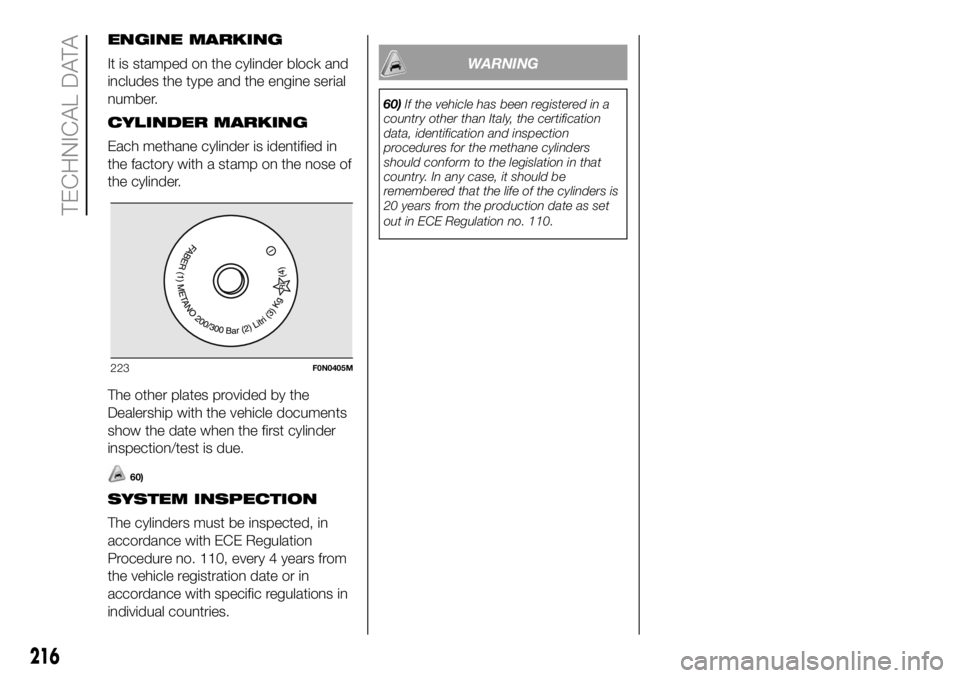
CYLINDER MARKING
Each methane cylinder is identified in
the factory with a stamp on the nose of
the cylinder.
The other plates provided by the
Dealership with the vehicle documents
show the date when the first cylinder
inspection/test is due.
60)
SYSTEM INSPECTION
The cylinders must be inspected, in
accordance with ECE Regulation
Procedure no. 110, every 4 years from
the vehicle registration date or in
accordance with specific regulations in
individual countries.
WARNING
60)If the vehicle has been registered in a
country other than Italy, the certification
data, identification and inspection
procedures for the methane cylinders
should conform to the legislation in that
country. In any case, it should be
remembered that the life of the cylinders is
20 years from the production date as set
out in ECE Regulation no. 110.
223F0N0405M
216
TECHNICAL DATA
Page 220 of 304

There is an example of a bodywork
version code below by way of
explanation with a key which is valid for
all bodywork version codes.
Example:
250AMMFADX
250MODEL
AGVW
MENGINE
MENGINE TRANSMISSION/AXLES
FBODY
AWHEELBASE
RHVERSION
GVW
A3000 kg
B3300kg
C3500 kg
D3500 kg MAXI
E3995/4005/4250/4300 kg MAXI
F2800 kg
G3650 kg
H3510 kg MAXI
L3510 kg
M4400 kg MAXIENGINE
42.3 150 ECOJET with AdBlue
52.0 115 Multijet 2
62.3 130 Multijet 2 with AdBlue
72.3 130 Multijet 2
82.3 150 Multijet 2
92.3 180 Multijet 2 Power
W140 Natural Power
TRANSMISSION
MMechanical gearbox
AAutomatic transmission
WHEELBASE
AShort wheelbase
BMedium wheelbase
CLong wheelbase
DMedium-long wheelbase
UAll wheelbases (incomplete vehicles)
BODY
ACab chassis
BChassis without cab
CPlatform chassis cab
DBox truck
EPrimary school bus
FVa n
GLong cab tipper
HLong cab chassis
MMinibus
PPanorama
RCombinato 6/9-seater
218
TECHNICAL DATA
Page 222 of 304

General
information2.3 150 ECOJET 2.3 130 Multijet 22.3 130 Multijet 2
with AdBlue2.3 150 Multijet 22.3 180 Multijet 2
Power
Type code F1AGL411 F1AGL411D F1AGL411M F1AGL411C F1AGL411B
Cycle Diesel Diesel Diesel Diesel Diesel
Number and position
of cylinders4 in line 4 in line 4 in line 4 in line 4 in line
Piston bore and
stroke (mm)88×94 88×94 88×94 88×94 88×94
Total displacement
(cm³)2287 2287 2287 2287 2287
Compression ratio 16.2 : 1 16.2 : 1 16.2 : 1 16.2 : 1 16.2 : 1
Maximum power
(EC) (kW)110 96 96 110 130
Maximum power
(EEC) (HP)150 130 130 150 177
Corresponding
engine speed (rpm)3600 3600 3600 3600 3500
Maximum torque
(EC) (Nm)380 320 320 380 400
Corresponding
engine speed (rpm)1500 1800 1800 1500 1500
Fuel Diesel for motor vehicles (EN 590 Specification)
220
TECHNICAL DATA
Page 224 of 304

STEERING SYSTEM
Versions Kerb-to-kerb turning circle (m) Type
Short wheelbase11.06
For Standard versions: rack and pinion hydraulic
power steering
For ECOJET versions: rack and pinion
electrohydraulic power steering Medium wheelbase12.46
Medium-long wheelbase13.54
Long wheelbase14.28
Extra-long wheelbase15.3
222
TECHNICAL DATA
Page 226 of 304

RIMS AND TYRES PROVIDED
2.0 115 Multijet 2
Versions Wheels Tyres provided Winter tyres
LIGHT 15”(*)6 Jx15-68 215/70 R15 C (109/107 S) 225/70 R15 C (112/110 S) 225/70 R15 C (112/110 R) M+S
LIGHT (TEMPO
LIBERO) 15”
(**)6 Jx15-68 215/70 R15 CP (109 Q) – 225/70 R15 C (112/110 R) M+S
LIGHT 16”
(*)6 Jx16-68 215/75 R16 C (116/114 R) 225/75 R16 C (118/116 R) 225/75 R16 C (116/114 R) M+S
LIGHT (TEMPO
LIBERO) 16”
(***)6 Jx16-68 225/75 R16 CP (116 Q) – 225/75 R16 C (116/114 R) M+S
(*) 3000 / 3300 / 3500 kg GVW
(**) 3000 / 3300 / 3500 / 3650 kg GVW
(***) 3000 / 3500 kg GVW
224
TECHNICAL DATA
Page 228 of 304

COLD TYRE INFLATION PRESSURE (bar)
Tyres provided Use Front Rear
215/70 R153000 GVW
(*)with basic tyres, except
PANORAMA4.0 4.0
3300 GVW
(*)/ 3500 GVW(*)with basic
tyres4.1 4.5
215/70 R15 PANORAMA with basic tyres 4.1 4.5
225/70 R153000 GVW
(*)with oversized tyres,
except PANORAMA4.0 4.0
3300 GVW
(*)/ 3500 GVW(*)with
oversized tyres4.1 4.5
225/70 R15 C M+S class C tyres on Camping vehicle 4.3 4.8
225/70 R15 PANORAMA with oversized tyres 4.1 4.5
215/70 R15 CP Vehicles with Camping tyres 5.0 5.5
215/75 R16 For all versions/trim levels 4.5 5.0
225/75 R16For all versions/trim levels excluding the
lines below4.5 5.0
225/75 R16 C M+S class C tyres on Camping vehicle 5.2 5.2
225/75 R16 CP Vehicles with Camping tyres 5.5 5.5
225/75 R16 C4400 GVW Maxi Range
(*)except
Camping4.7 5.5
225/75 R16 CP4400 GVW Maxi Range
(*)with Camping
tyres (for versions/markets, where
provided)5.5 5.5
(*)Gross vehicle weight
The pressure value can be up to +1.0 bar more than the recommended one when the tyres are warm. However, recheck that
the value is correct with the tyre cold.
226
TECHNICAL DATA
Page 230 of 304

COMBI - PANORAMA
CH1 MH2 LH2
A948 948 948
B3000 3450 4035
C1015 1015
1015 - 1380
(*)
D4963 5413
5998 - 6363(*)
E2254 2524 2524
F1810 1810 1810
G2050 2050 2050
I1790 1790 1790
(*) MINIBUS version, 16 + 1 seats
The sizes vary according to the various versions within the limits indicated above
228
TECHNICAL DATA