Seats FIAT DUCATO 244 2005 3.G User Guide
[x] Cancel search | Manufacturer: FIAT, Model Year: 2005, Model line: DUCATO 244, Model: FIAT DUCATO 244 2005 3.GPages: 258, PDF Size: 4.05 MB
Page 47 of 258
46GETTING TO KNOW YOUR VEHICLE
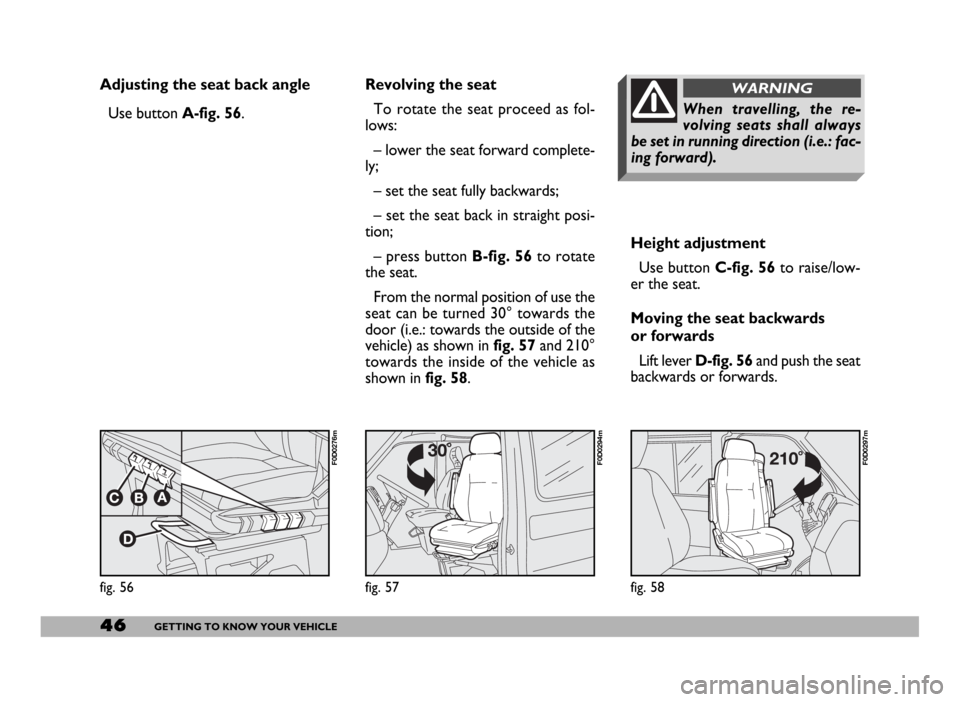
Adjusting the seat back angle
Use button A-fig. 56.
Height adjustment
Use button C-fig. 56to raise/low-
er the seat.
Moving the seat backwards
or forwards
Lift lever D-fig. 56and push the seat
backwards or forwards.
fig. 56
F0D0276m
Revolving the seat
To rotate the seat proceed as fol-
lows:
– lower the seat forward complete-
ly;
– set the seat fully backwards;
– set the seat back in straight posi-
tion;
– press button B-fig. 56to rotate
the seat.
From the normal position of use the
seat can be turned 30° towards the
door (i.e.: towards the outside of the
vehicle) as shown in fig. 57and 210°
towards the inside of the vehicle as
shown in fig. 58.
fig. 57
F0D0294m
fig. 58
F0D0297m
When travelling, the re-
volving seats shall always
be set in running direction (i.e.: fac-
ing forward).
WARNING
Page 58 of 258
57GETTING TO KNOW YOUR VEHICLE
CLIMATE CONTROL
SYSTEM
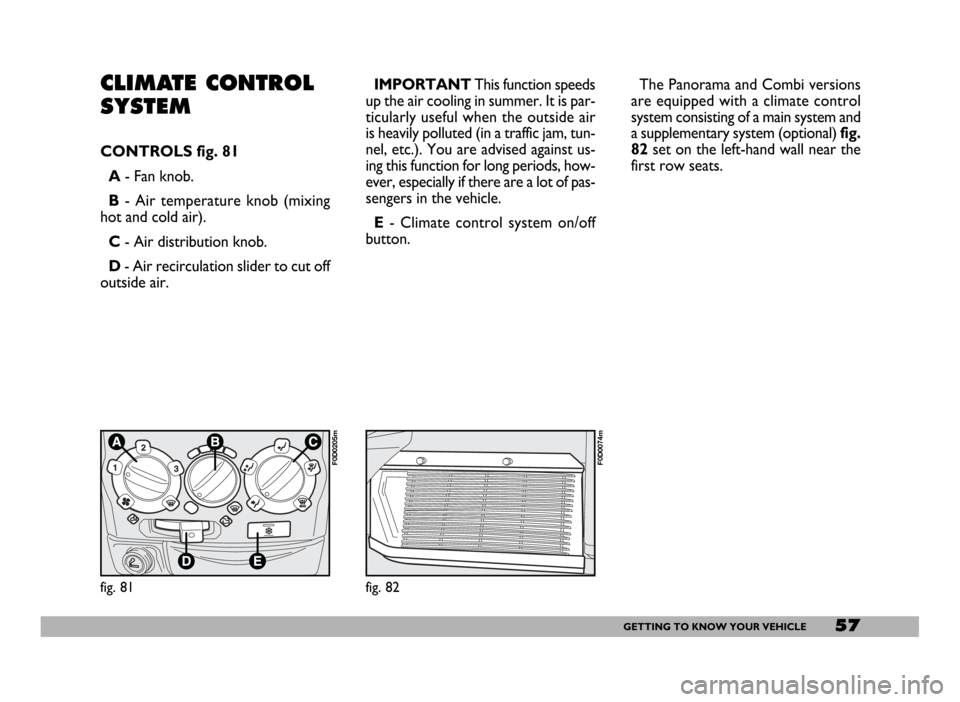
CONTROLS fig. 81
A- Fan knob.
B- Air temperature knob (mixing
hot and cold air).
C- Air distribution knob.
D- Air recirculation slider to cut off
outside air.IMPORTANTThis function speeds
up the air cooling in summer. It is par-
ticularly useful when the outside air
is heavily polluted (in a traffic jam, tun-
nel, etc.). You are advised against us-
ing this function for long periods, how-
ever, especially if there are a lot of pas-
sengers in the vehicle.
E- Climate control system on/off
button.The Panorama and Combi versions
are equipped with a climate control
system consisting of a main system and
a supplementary system (optional) fig.
82set on the left-hand wall near the
first row seats.
fig. 81
F0D0205m
fig. 82
F0D0074m
Page 75 of 258
74GETTING TO KNOW YOUR VEHICLE
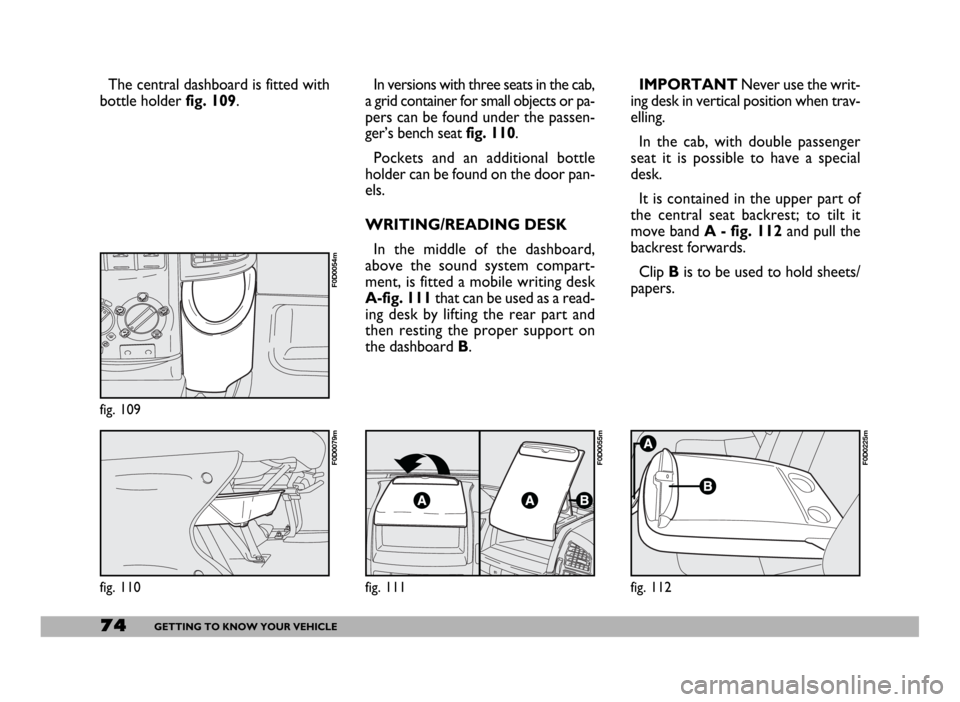
The central dashboard is fitted with
bottle holder fig. 109.In versions with three seats in the cab,
a grid container for small objects or pa-
pers can be found under the passen-
ger’s bench seat fig. 110.
Pockets and an additional bottle
holder can be found on the door pan-
els.
WRITING/READING DESK
In the middle of the dashboard,
above the sound system compart-
ment, is fitted a mobile writing desk
A-fig. 111that can be used as a read-
ing desk by lifting the rear part and
then resting the proper support on
the dashboard B.
fig. 109
F0D0054m
fig. 110
F0D0079m
fig. 111
F0D0055m
IMPORTANTNever use the writ-
ing desk in vertical position when trav-
elling.
In the cab, with double passenger
seat it is possible to have a special
desk.
It is contained in the upper part of
the central seat backrest; to tilt it
move band A - fig. 112and pull the
backrest forwards.
Clip Bis to be used to hold sheets/
papers.
fig. 112
F0D0225m
Page 88 of 258
87GETTING TO KNOW YOUR VEHICLE
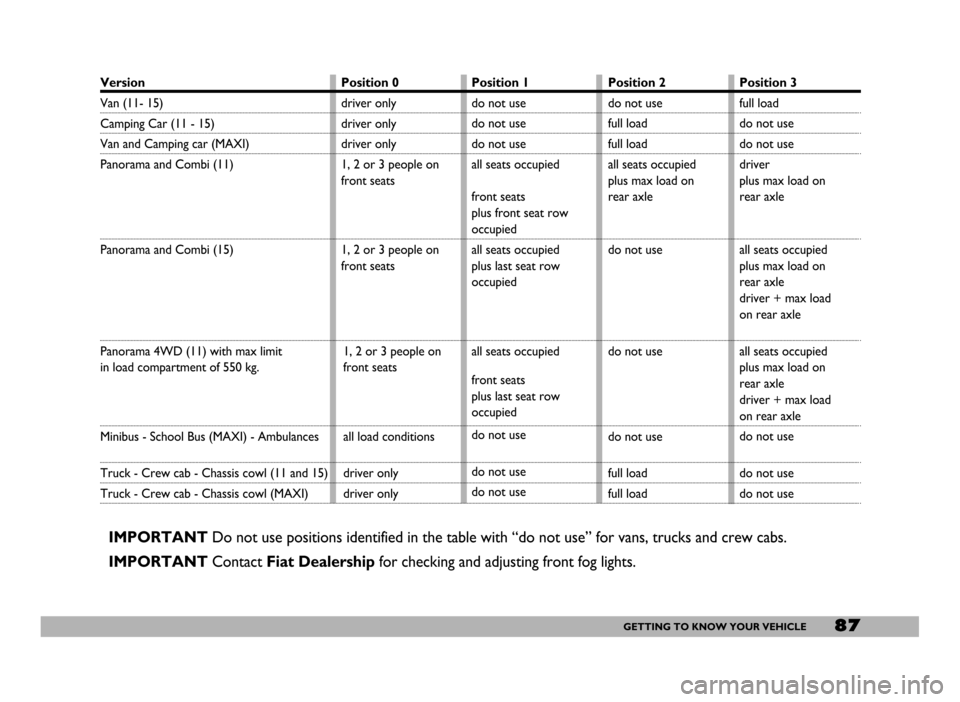
Version
Van (11- 15)
Camping Car (11 - 15)
Van and Camping car (MAXI)
Panorama and Combi (11)
Panorama and Combi (15)
Panorama 4WD (11) with max limit
in load compartment of 550 kg.
Minibus - School Bus (MAXI) - Ambulances
Truck - Crew cab - Chassis cowl (11 and 15)
Truck - Crew cab - Chassis cowl (MAXI)Position 0
driver only
driver only
driver only
1, 2 or 3 people on
front seats
1, 2 or 3 people on
front seats
1, 2 or 3 people on
front seats
all load conditions
driver only
driver onlyPosition 1
do not use
do not use
do not use
all seats occupied
front seats
plus front seat row
occupied
all seats occupied
plus last seat row
occupied
all seats occupied
front seats
plus last seat row
occupied
do not use
do not use
do not usePosition 2
do not use
full load
full load
all seats occupied
plus max load on
rear axle
do not use
do not use
do not use
full load
full loadPosition 3
full load
do not use
do not use
driver
plus max load on
rear axle
all seats occupied
plus max load on
rear axle
driver + max load
on rear axle
all seats occupied
plus max load on
rear axle
driver + max load
on rear axle
do not use
do not use
do not use
IMPORTANTDo not use positions identified in the table with “do not use” for vans, trucks and crew cabs.
IMPORTANTContact Fiat Dealershipfor checking and adjusting front fog lights.
Page 92 of 258
91GETTING TO KNOW YOUR VEHICLE
Therefore, failure to come into ac-
tion in the above circumstances does
not mean that the system is not work-
ing properly.
Airbag system efficiency is constant-
ly monitored by an electronic control
unit.
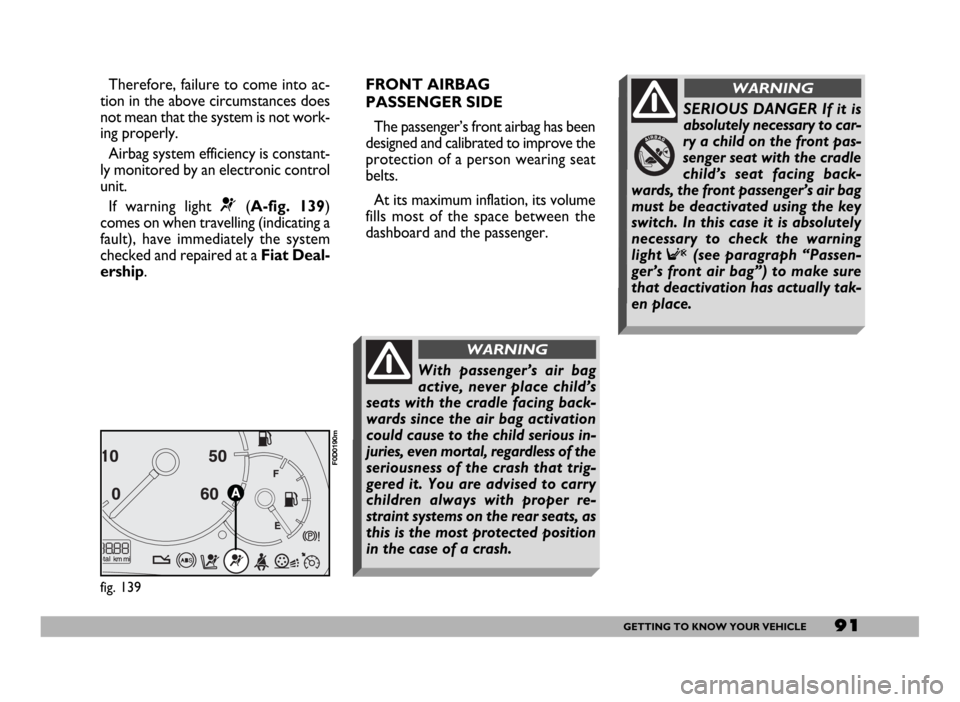
If warning light
¬(A-fig. 139)
comes on when travelling (indicating a
fault), have immediately the system
checked and repaired at a Fiat Deal-
ership.FRONT AIRBAG
PASSENGER SIDE
The passenger’s front airbag has been
designed and calibrated to improve the
protection of a person wearing seat
belts.
At its maximum inflation, its volume
fills most of the space between the
dashboard and the passenger.
fig. 139
F0D0190m
SERIOUS DANGER If it is
absolutely necessary to car-
ry a child on the front pas-
senger seat with the cradle
child’s seat facing back-
wards, the front passenger’s air bag
must be deactivated using the key
switch. In this case it is absolutely
necessary to check the warning
light
F(see paragraph “Passen-
ger’s front air bag”) to make sure
that deactivation has actually tak-
en place.
WARNING
With passenger’s air bag
active, never place child’s
seats with the cradle facing back-
wards since the air bag activation
could cause to the child serious in-
juries, even mortal, regardless of the
seriousness of the crash that trig-
gered it. You are advised to carry
children always with proper re-
straint systems on the rear seats, as
this is the most protected position
in the case of a crash.
WARNING
Page 96 of 258
95GETTING TO KNOW YOUR VEHICLE
The correct operation of
front and side airbags and
pretensioners is only ensured if the
vehicle is not overloaded.
WARNINGEOBD SYSTEM
(petrol versions only)
The EOBD (European On Board Di-
agnosis) system fitted on the vehicle
complies with Directive 98/69/CE
(EURO 3).
This system continuously monitors
the engine emission system compo-
nents. Furthermore, the system warns
the driver of deterioration concerning
the emission system components by
means of the Uwarning light on the
instrument panel.
The objective is to:
– monitor system efficiency;
– warn when failures can increase
emissions over the threshold estab-
lished by the European regulations;
– warn of the need to replace dete-
riorated components.
Remember that with the
key engaged and in the
MAR position, even with the en-
gine not running, the airbags may
be triggered on a stationary vehi-
cle if it is bumped by another mov-
ing vehicle. Therefore, never seat
children on the front seat even
when the vehicle is stationary. On
the other hand, remember that
with the vehicle stationary, with-
out the key engaged and turned,
the airbags are not triggered in the
event of an impact; in these cases,
failure to come into action of the
airbags cannot be considered as a
sign that the system is not working
properly.
WARNING
On vehicles equipped with
side bags, do not cover the
backrest of the front seats with
trims or covers.
WARNING
The airbag does not substi-
tute the seat belts, but on-
ly increases their effectiveness.
Moreover, since the front airbags
do not come into operation in the
event of front impact at low speed,
side collisions, bumps from behind
or overturning, in these circum-
stances the occupants would only
be protected by the seat belts which
must therefore always be fastened.
WARNING
Do not wash the seat back
in vehicles with side bags
with pressurised steam or water in
automatic seat washing station.
WARNING
Page 121 of 258
120GETTING THE BEST OUT OF YOUR VEHICLE
BEFORE GETTING BEHIND
THE WHEEL
– Make sure all light, including the
headlights, are working properly;
– adjust the position of seats and dri-
ving and door mirrors properly for the
best driving position;
– make sure that nothing (mats, etc.)
gets in the way of the pedals when
they are pushed down;
– make sure that any child restraint
systems (child seats, cradles, etc.) are
properly fixed;
– place any objects in the load com-
partment in such a way that they can-
not be thrown forwards in the event
of an accident;
– light eating will help keep your re-
flexes prompt. Above all, do not have
anything alcoholic to drink.
Remember to periodically check:
– tyre pressure,
– engine oil level,
– engine coolant level and cooling
system conditions,– brake fluid level,
– windscreen washer fluid level.
WHEN TRAVELLING
– The first rule of safe driving is pru-
dence;
– prudence also means putting your-
self into a position where you can pre-
dict wrong or imprudent behaviour
from other drivers;
– stick closely to the rules of the
road in the particular country where
the vehicle is being driven and, above
all, do not exceed speed limits;
– ensure that, besides yourself, all the
other passengers in the vehicle have
their seat belts fastened, that children
are sitting in the appropriate child
seats and any animals in the vehicle are
placed in suitable compartment;
– you should be physically fit and
mentally alert before setting out on
long journeys.
Always fasten both front
and back seat belts
(Panorama, Minibus, Combi and
Crew Cab versions). Travelling with
the seat belts unfastened increas-
es the risk of injury or death if you
are in a collision.
WARNING
Driving while drunk or un-
der the influence of drugs
or certain medicines is dangerous
for both you and other road users.
WARNING
Page 139 of 258
138IN AN EMERGENCY
1. STOP THE VEHICLE
– Stop the vehicle in a position that
is not dangerous for oncoming traffic
where you can change the wheel safe-
ly. The ground should be flat and ad-
equately firm. If you have to change
the wheel at night, choose a lit area if
possible.
– Turn the engine off and pull up the
handbrake.
– Engage first or reverse gear.
– Alert other drivers that the vehicle
is stationary in compliance with local
regulations: hazard warning lights,
warning triangle, etc.
Any passengers should get out and
wait as far away as possible from the
danger of traffic.
If the road is sloping or bumpy, place
wedges or other suitable material to
prevent the vehicle from moving, un-
der the wheels.2. TAKE OUT THE TOOLS,
JACK AND SPARE WHEEL
The tools are in the cab near the
seats.
Please note:
– the jack weights 4.2 kg;
– the jack requires no adjustments;
– the jack cannot be repaired. If it
breaks it must be replaced with a new
jack;
– no other tool, apart from the ex-
tension and the ratchet wrench shown
in this chapter can be fitted to the jack.
The spare wheel is located under the
rear part of the load bed.
Do not lubricate the bolt
threads before fitting
them back: they could come
loose.
WARNING
Check tyre pressure and
spare wheel pressure regu-
larly. Refer to section “Technical
Specifications”.
WARNING
Page 141 of 258
140IN AN EMERGENCY
The moving parts of the jack (screw
and joints) may also cause injury if
touched. Clean off any grease.
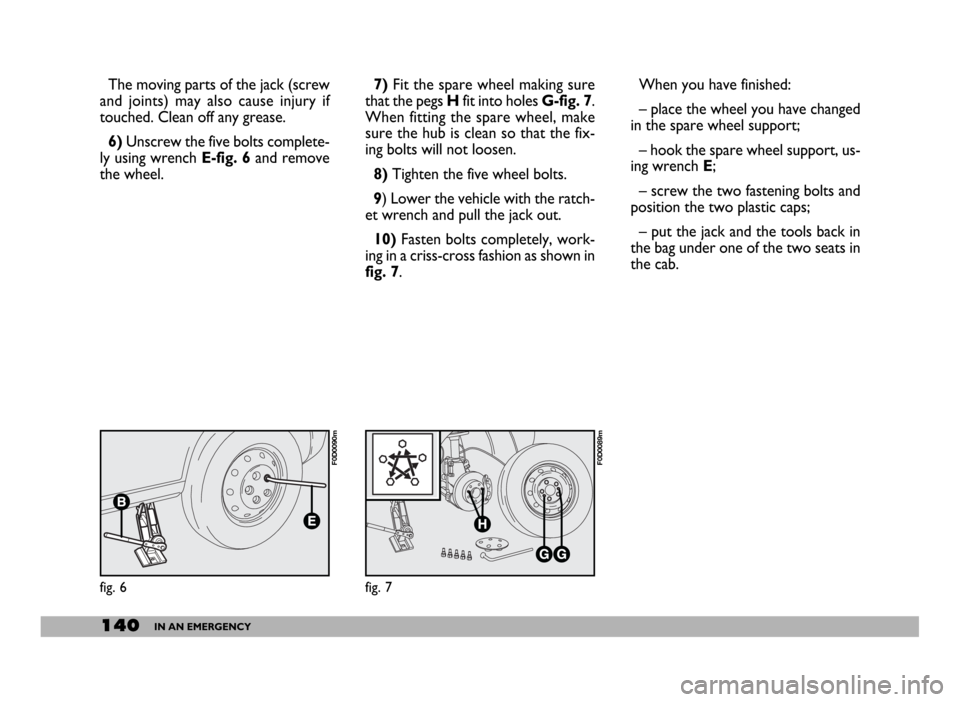
6)Unscrew the five bolts complete-
ly using wrench E-fig. 6and remove
the wheel.7) Fit the spare wheel making sure
that the pegs Hfit into holes G-fig. 7.
When fitting the spare wheel, make
sure the hub is clean so that the fix-
ing bolts will not loosen.
8)Tighten the five wheel bolts.
9) Lower the vehicle with the ratch-
et wrench and pull the jack out.
10)Fasten bolts completely, work-
ing in a criss-cross fashion as shown in
fig. 7.
fig. 6
F0D0090m
fig. 7
F0D0089m
When you have finished:
– place the wheel you have changed
in the spare wheel support;
– hook the spare wheel support, us-
ing wrench E;
– screw the two fastening bolts and
position the two plastic caps;
– put the jack and the tools back in
the bag under one of the two seats in
the cab.
Page 185 of 258
184VEHICLE MAINTENANCE
INTERIORS
From time to time check that water
has not collected under the mats
(from dripping shoes, umbrellas, etc.)
which could cause the steel to rust.
CLEANING SEATS
AND FABRICS
Remove dust with a soft brush and
vacuum cleaner. For velvet seats use
a damp brush.
Brush the seats with a damp sponge
with water and neutral soap.PLASTIC PARTS INSIDE
THE VEHICLE
Clean plastic parts with damp cloth
with water and non-abrasive neutral
soap. To remove grease or hard
stains, use special solvent-free prod-
ucts designed not to alter the appear-
ance and colour of components.
IMPORTANTDo not use alcohol
or petrol to clean the instrument
panel.
Never use flammable prod-
ucts (petroleum ether or
petrol) to clean the inside of the ve-
hicle. Electrostatic charges gener-
ated by rubbing while cleaning
could cause fires.
WARNING
Do not keep aerosol cans in
the vehicle. There is the risk
they might explode. Aerosol cans
must never be exposed to a tem-
perature above 50°C; when the
weather starts to get hot the tem-
perature inside the vehicle might go
well beyond that figure.
WARNING