Wheels FIAT DUCATO 244 2005 3.G User Guide
[x] Cancel search | Manufacturer: FIAT, Model Year: 2005, Model line: DUCATO 244, Model: FIAT DUCATO 244 2005 3.GPages: 258, PDF Size: 4.05 MB
Page 133 of 258
132GETTING THE BEST OUT OF YOUR VEHICLE
SNOW TYRES
Use snow tyres specified in the
“Snow tyres” table in section “Tech-
nical Specifications”.
Fiat Dealershipwill be happy to
provide advice concerning the most
suitable type of tyre for the customer’s
requirements.
For the type of tyre to be used, in-
flation pressures and the specifications
of snow tyres, follow the instructions
given at paragraph “Wheels” in section
“Technical Specifications”.The winter features of these tyres
are reduced considerably when the
tread depth is below 4 mm. In this
case, they should be replaced.
Due to the snow tyre features, un-
der normal conditions of use or on
long motorway journeys, the perfor-
mance of these tyres is lower than that
of normal tyres.
It is therefore necessary to limit their
use to the purposes for which they are
certified.
IMPORTANT When snow tyres
are used with a max. speed index be-
low the one that can be reached by
the vehicle (increased by 5%), place a
notice in the passenger compartment,
plainly in the driver’s view which states
the max. permissible speed of the
snow tyres (as per EC Directive).All four tyres should be the same
(brand and track) to ensure greater
safety when driving and braking and
better driveability.
Remember that it is inappropriate to
change the direction of rotation of
tyres.
The max. speed for snow
tyres with “Q” marking is
160 km/h. The Road Traffic Code
speed limits must however be al-
ways strictly observed.
WARNING
Page 134 of 258
133GETTING THE BEST OUT OF YOUR VEHICLE
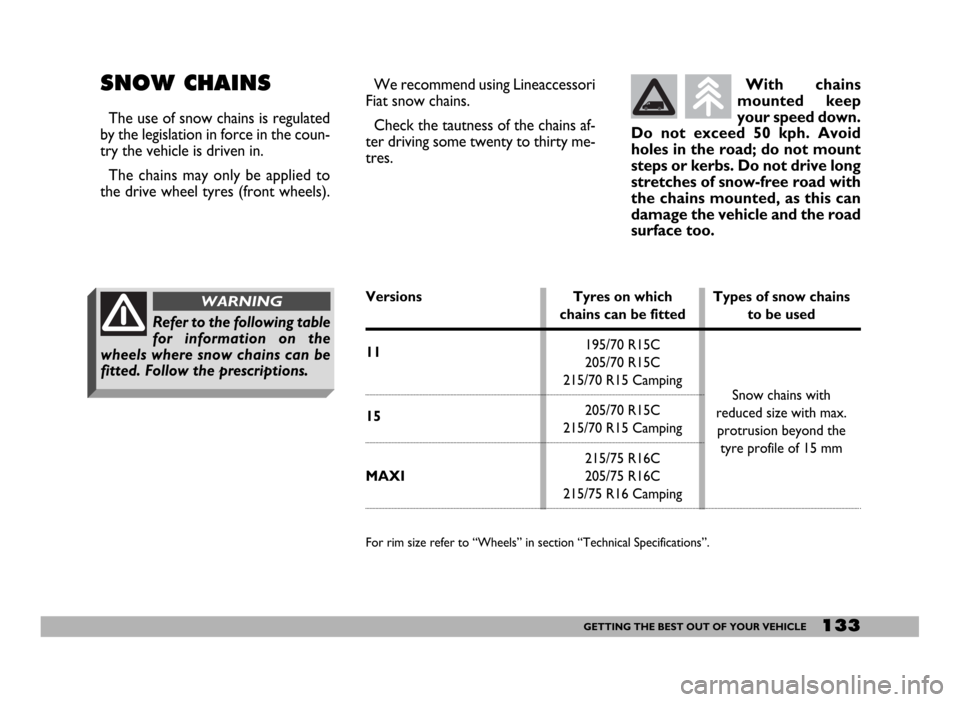
SNOW CHAINS
The use of snow chains is regulated
by the legislation in force in the coun-
try the vehicle is driven in.
The chains may only be applied to
the drive wheel tyres (front wheels).We recommend using Lineaccessori
Fiat snow chains.
Check the tautness of the chains af-
ter driving some twenty to thirty me-
tres.With chains
mounted keep
your speed down.
Do not exceed 50 kph. Avoid
holes in the road; do not mount
steps or kerbs. Do not drive long
stretches of snow-free road with
the chains mounted, as this can
damage the vehicle and the road
surface too.
Versions
11
15
MAXI
Tyres on which
chains can be fitted
195/70 R15C
205/70 R15C
215/70 R15 Camping
205/70 R15C
215/70 R15 Camping
215/75 R16C
205/75 R16C
215/75 R16 CampingTypes of snow chains
to be used
Snow chains with
reduced size with max.
protrusion beyond the
tyre profile of 15 mm
For rim size refer to “Wheels” in section “Technical Specifications”.
Refer to the following table
for information on the
wheels where snow chains can be
fitted. Follow the prescriptions.
WARNING
Page 139 of 258
138IN AN EMERGENCY
1. STOP THE VEHICLE
– Stop the vehicle in a position that
is not dangerous for oncoming traffic
where you can change the wheel safe-
ly. The ground should be flat and ad-
equately firm. If you have to change
the wheel at night, choose a lit area if
possible.
– Turn the engine off and pull up the
handbrake.
– Engage first or reverse gear.
– Alert other drivers that the vehicle
is stationary in compliance with local
regulations: hazard warning lights,
warning triangle, etc.
Any passengers should get out and
wait as far away as possible from the
danger of traffic.
If the road is sloping or bumpy, place
wedges or other suitable material to
prevent the vehicle from moving, un-
der the wheels.2. TAKE OUT THE TOOLS,
JACK AND SPARE WHEEL
The tools are in the cab near the
seats.
Please note:
– the jack weights 4.2 kg;
– the jack requires no adjustments;
– the jack cannot be repaired. If it
breaks it must be replaced with a new
jack;
– no other tool, apart from the ex-
tension and the ratchet wrench shown
in this chapter can be fitted to the jack.
The spare wheel is located under the
rear part of the load bed.
Do not lubricate the bolt
threads before fitting
them back: they could come
loose.
WARNING
Check tyre pressure and
spare wheel pressure regu-
larly. Refer to section “Technical
Specifications”.
WARNING
Page 160 of 258
159IN AN EMERGENCY
WITH A SHOP JACK
The vehicle can be raised on a shop
jack if it is empty. This is only possi-
ble from the side by placing the jack at
the points provided in the underbody
as indicated infig. 41.
WITH AN ARM HOIST
The vehicle must be raised by plac-
ing the ends of the arms at the points
indicated in fig. 41.TOWING THE
VEHICLE
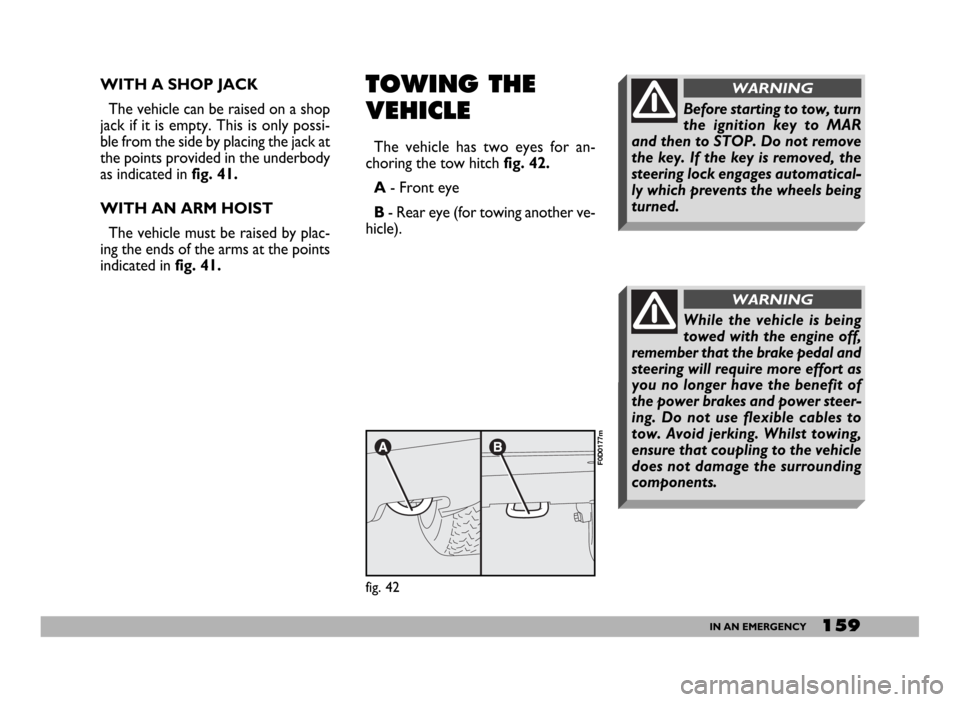
The vehicle has two eyes for an-
choring the tow hitch fig. 42.
A- Front eye
B- Rear eye (for towing another ve-
hicle).
fig. 42
F0D0177m
Before starting to tow, turn
the ignition key to MAR
and then to STOP. Do not remove
the key. If the key is removed, the
steering lock engages automatical-
ly which prevents the wheels being
turned.
WARNING
While the vehicle is being
towed with the engine off,
remember that the brake pedal and
steering will require more effort as
you no longer have the benefit of
the power brakes and power steer-
ing. Do not use flexible cables to
tow. Avoid jerking. Whilst towing,
ensure that coupling to the vehicle
does not damage the surrounding
components.
WARNING
Page 161 of 258
160IN AN EMERGENCY
IF AN ACCIDENT
OCCURS
– It is important to keep calm.
– If you are not directly involved in
the accident, stop at least ten metres
away from the accident.
– If you are on a motorway, do not
obstruct the emergency lane with
your vehicle.
– Turn the engine off and the haz-
ard lights on.
– At night, illuminate the scene of the
accident with your headlights.
– Act carefully, you must not risk be-
ing run over.
– Mark the accident by putting the
red triangle at the regulatory distance
from the vehicle where it can be clear-
ly see.
– If the doors are blocked, do not at-
tempt to smash the windscreen to get
out of the vehicle. It is made of layered
glass and is very hard. Side and rear
windows are much more easily bro-
ken. VEHICLE WITH AUTOMATIC
GEARBOX
If towing is not due to gearbox faults,
proceed as follows:
– gearshift lever to N;
– do not exceed 50 km/h;
– the vehicle should not be towed
for more than 200 km.
If towing is due to gearbox faults or
the vehicle should be towed for more
than 200 km, tow the vehicle raising
the front wheels from the ground.– Call for rescue making the infor-
mation you give as accurate as you
can.On the motorway use the special
column-mounted emergency phones.
– In pile-ups on the motorway, par-
ticularly when the visibility is bad,
there is a high risk of other vehicles
running into those already
stopped.Get out of the vehicle imme-
diately and take refuge behind the
guard rail.
– Remove the ignition keys from the
vehicles involved.
– If you can smell petrol or other
chemicals, do not smoke and make
sure all cigarettes are extinguished.
– Use a fire extinguisher, blanket, sand
or earth to put out fires no matter how
small they are. Never use water.
When towing the vehicle
you must comply with the
specific traffic regulations regard-
ing the tow hitch and how to tow
on the road.
WARNING
Page 179 of 258
178VEHICLE MAINTENANCE
WHEELS AND
TYRES
Check the pressure of each tyre, in-
cluding the spare, every two weeks
and before long journeys.
The pressure must be checked when
the tyre is rested and cold.
It is normal for pressure to rise
when you are driving. If you have to
check or restore the pressure when
the tyres are warm, remember that
the pressure value must be 0.3 bar
above the specified value.
See “Wheels” in “Technical specifi-
cations” chapter for the correct tyre
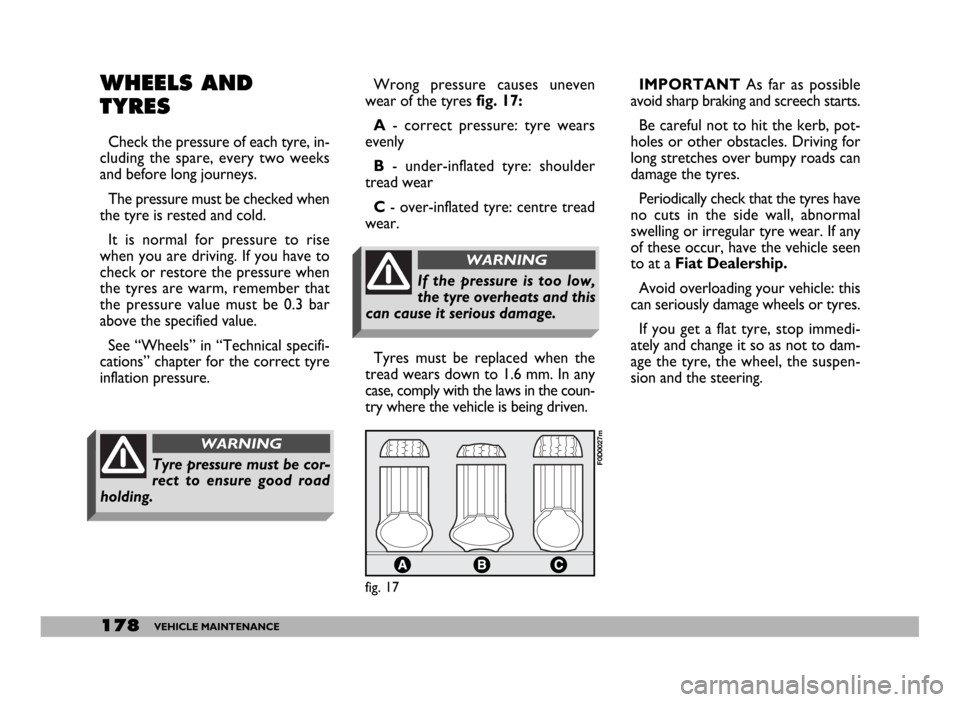
inflation pressure.Wrong pressure causes uneven
wear of the tyres fig. 17:
A- correct pressure: tyre wears
evenly
B- under-inflated tyre: shoulder
tread wear
C- over-inflated tyre: centre tread
wear.IMPORTANTAs far as possible
avoid sharp braking and screech starts.
Be careful not to hit the kerb, pot-
holes or other obstacles. Driving for
long stretches over bumpy roads can
damage the tyres.
Periodically check that the tyres have
no cuts in the side wall, abnormal
swelling or irregular tyre wear. If any
of these occur, have the vehicle seen
to at a Fiat Dealership.
Avoid overloading your vehicle: this
can seriously damage wheels or tyres.
If you get a flat tyre, stop immedi-
ately and change it so as not to dam-
age the tyre, the wheel, the suspen-
sion and the steering.
fig. 17
F0D0027m
If the pressure is too low,
the tyre overheats and this
can cause it serious damage.
WARNING
Tyre pressure must be cor-
rect to ensure good road
holding.
WARNING
Tyres must be replaced when the
tread wears down to 1.6 mm. In any
case, comply with the laws in the coun-
try where the vehicle is being driven.
Page 180 of 258
179VEHICLE MAINTENANCE
Tyres age even if they are not used
very much. Cracking of the tread rub-
ber and the side walls are a sign of this
ageing. In any case, if the tyres have
been fitted for more than six years
they should be examined by an expert
who can judge whether they are still
fit for use. Remember to check the
spare tyre particularly carefully too.
If a replacement is necessary, always
use new tyres and avoid using ones
the origin of which you are not cer-
tain about.
The Ducato uses tubeless tyres. Un-
der no circumstances use an inner
tube with these tyres.
If you replace a tyre it is a good idea
to change the inflation valve, too.To ensure the front and rear tyres all
wear evenly, you are advised to change
the tyres over every 10 - 15 thousand
kilometres keeping them on the same
side of the vehicle so as not to reverse
the direction of rotation.RUBBER TUBING
Follow the Service Schedule carefully
in the case of braking and fuel supply
system rubber tubing.
Ozone, high temperatures and long
absence of fluid in the system can in
fact cause the hardening and cracking
of the pipes with possible loss of fluid.
A careful check is therefore essential.
Do not change the tyres
over in criss-cross fashion
by moving a tyre from the left-hand
side of the vehicle to the right and
vice versa.
WARNING
Never submit alloy rims to
repainting treatments re-
quiring to use temperatures ex-
ceeding 150°C since the mechani-
cal properties of the wheels could
be impaired.
WARNING
Page 217 of 258
216TECHNICAL SPECIFICATIONS
BRAKES
SERVICE AND EMERGENCY
BRAKES
Front: disc, floating caliper with two
operating cylinders for each wheel and
pad wear warning light.
Rear: self-centring shoes and micro-
metric mechanism for clearance take-
up.
Certain versions are fitted with rear
disc brakes with Drum in hat device
(i.e. drum on disc to block the vehicle
when parked with handbrake en-
gaged).
Cross-over hydraulic circuit control.
Four sensors ABS system with EBD.
Automatic recovery of the friction
gasket wear; versions with rear disc
brake excluded (Drum in hat ver-
sions).
Lacking ABS system brakeforce dis-
tributor acting on rear brake hydraulic
circuit according to rear axle load.HANDBRAKE
Controlled by a lever, it works me-
chanically on the rear brake shoes.
For versions with rear disc brakes,
the handbrake works on the Drum in
hat device shoes.
IMPORTANTPull the handbrake
lever only when the vehicle is at a
standstill, or when the vehicle is run-
ning, but however only in case of a
failure of the hydraulic system.
Should the handbrake be exception-
ally used when the vehicle is running,
it is suggested to keep a moderate
traction to avoid causing the rear axle
block, entailing vehicle side skidding.
TRANSMISSION
CLUTCH
Hydraulically controlled without
travel-free pedal.
MECHANICAL GEARBOX
AND DIFFERENTIAL
Five forward gears and reverse with
synchromesh for front gear engage-
ment.
Cyclical gear reduction and differen-
tial assembly incorporated in the gear-
box.
Drive transmission to the front
wheels by means of drive shafts con-
nected to the differential assembly and
the wheels with CV joints.
Water, ice or salt on road
surfaces can deposit on
brake discs, reducing braking effi-
ciency on the first braking.
WARNING
Page 219 of 258
218TECHNICAL SPECIFICATIONS
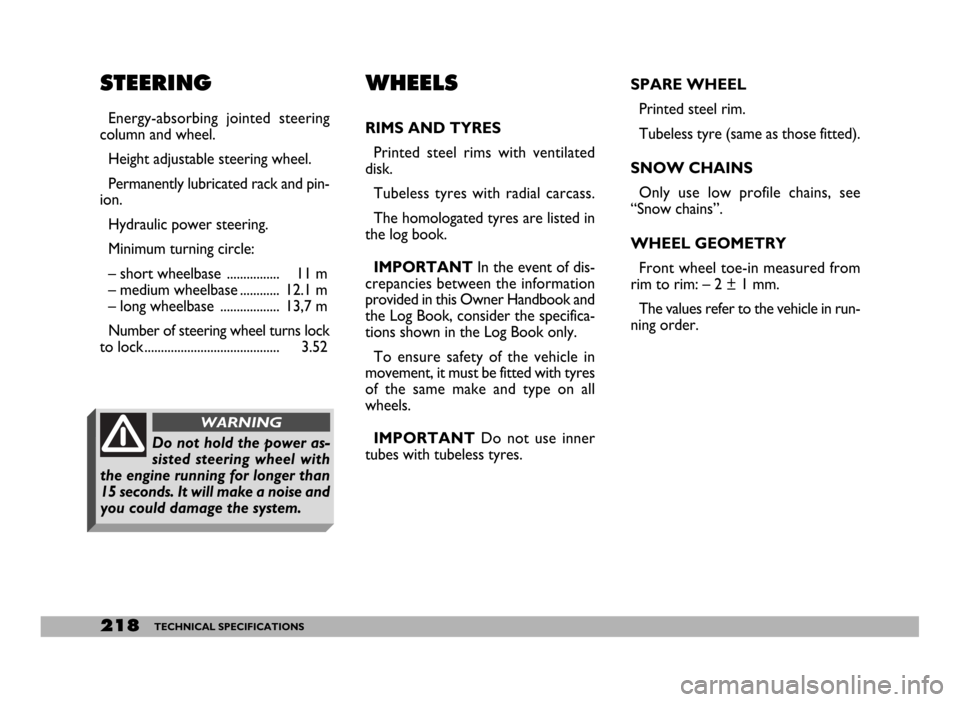
WHEELS
RIMS AND TYRES
Printed steel rims with ventilated
disk.
Tubeless tyres with radial carcass.
The homologated tyres are listed in
the log book.
IMPORTANT In the event of dis-
crepancies between the information
provided in this Owner Handbook and
the Log Book, consider the specifica-
tions shown in the Log Book only.
To ensure safety of the vehicle in
movement, it must be fitted with tyres
of the same make and type on all
wheels.
IMPORTANT Do not use inner
tubes with tubeless tyres.SPARE WHEEL
Printed steel rim.
Tubeless tyre (same as those fitted).
SNOW CHAINS
Only use low profile chains, see
“Snow chains”.
WHEEL GEOMETRY
Front wheel toe-in measured from
rim to rim: – 2 ± 1 mm.
The values refer to the vehicle in run-
ning order.
STEERING
Energy-absorbing jointed steering
column and wheel.
Height adjustable steering wheel.
Permanently lubricated rack and pin-
ion.
Hydraulic power steering.
Minimum turning circle:
– short wheelbase ................ 11 m
– medium wheelbase ............ 12.1 m
– long wheelbase .................. 13,7 m
Number of steering wheel turns lock
to lock ......................................... 3.52
Do not hold the power as-
sisted steering wheel with
the engine running for longer than
15 seconds. It will make a noise and
you could damage the system.
WARNING
Page 252 of 258

251INDEX
Understanding rim markings ... 219
Understanding tyre markings ... 219
Using the automatic gearbox ... 110
Using the manual gearbox ........ 109
Vehicle maintenance........... 162
Vehicle storage ............................. 134
Ventilation...................................... 56
Warming up the engine
after it has just started ............. 107
Warning lights ............................. 35
Washing the vehicle ................... 182
Weights ......................................... 227
Wheel geometry ......................... 218
Wheels and tyres ........................ 178
- changing a wheel .................... 137
- inflation pressure ................... 220
- snow chains ............................ 133
- snow tyres .............................. 132
- spare wheel ............................. 218- understanding tyre
markings ................................... 219
- wheel geometry ..................... 218
Windows ...................................... 183
Windscreen washer ............ 66-181
Windscreen washer
fluid level .................................... 171
Windscreen
wiper (blades) ..................... 66-180
Writing/reading desk ................. 74