stop start FIAT DUCATO 244 2005 3.G User Guide
[x] Cancel search | Manufacturer: FIAT, Model Year: 2005, Model line: DUCATO 244, Model: FIAT DUCATO 244 2005 3.GPages: 258, PDF Size: 4.05 MB
Page 106 of 258
105GETTING THE BEST OUT OF YOUR VEHICLE
G G
E E
T T
T T
I I
N N
G G
T T
H H
E E
B B
E E
S S
T T
O O
U U
T T
O O
F F
Y Y
O O
U U
R R
V V
E E
H H
I I
C C
L L
E E
STARTING
THE ENGINE HOW TO START PETROL
VERSIONS
IMPORTANT Do not press the
accelerator until the engine has start-
ed.
1) Ensure that the handbrake is up.
2)Put the gear lever into neutral.
3)Press the clutch pedal down to
the floor without touching the accel-
erator.
4) Turn the ignition key to AVVand
release it as soon as the engine starts.
If the engine does not start at the
first attempt, return the ignition key
to STOP before trying to start the
engine again.
If the warning light Ystays on when
the ignition key is at MAR, turn the
key to STOPand then to MAR; if the
warning light stays on, try with the
other keys provided.
If you are still unable to start the en-
gine, go to a Fiat Dealership.IMPORTANTDo not leave the ig-
nition key at MAR when the engine is
off.
Minibus and School Bus versions:
press the ignition enable button lo-
cated to the left of the steering col-
umn as shown in the specific supple-
ment to this handbook.
Never touch the high volt-
age cables (spark plug ca-
bles) when the engine is running.
WARNING
It is dangerous to let the en-
gine run in a garage of oth-
er closed area. The engine con-
sumes oxygen and gives off carbon
dioxide, carbon monoxide and oth-
er poisonous fumes.
WARNING
Page 107 of 258
106GETTING THE BEST OUT OF YOUR VEHICLE
HOW TO START DIESEL
VERSIONS
1) Ensure that the handbrake is up.
2)Put the gear lever into neutral.
3)Press the clutch pedal down to
the floor without touching the accel-
erator.
4) Turn the ignition key to MAR. In-
strument panel warning lights mand
Ywill come on.
5)Wait for the instrument panel
warning light Yto go out.
6) Wait for the instrument panel
warning light mto go out. The hot-
ter the engine is, the quicker this will
happen.
7) Turn the key to AVVimmediate-
ly after the mwarning light goes out.
If you wait too long, you will lose the
benefit of the work done by the glow
plugs.
Release the key as soon as the engine
starts.Intake air heater (Heat Flange)
An air heating device is fitted on the
intake manifold inlet in 2.8 JTD ver-
sions to facilitate starting the engine in
cold weather.
This device will be switched on au-
tomatically when the key is turned to
MAR.
The heater is fitted in all 2.8 JTD ver-
sions with EGR system. It is optional
for other JTD versions.
The engine start-up procedure is the
same with and without the heater.GENERAL NOTES
If the engine does not start first time,
return the key to STOPbefore try-
ing to start the engine again.
If warning light Yremains lit when
the ignition key is at MAR, turn the
key to STOPand then to MAR; if the
warning light stays on, try with the
other keys provided. The warning light m
will flash (for approxi-
mately 60 seconds) at
start-up or during prolonged
cranking to signal a fault in the
glow plug heating system. You
can use the vehicle as usual if the
engine starts but you should con-
tact a Fiat Dealership as soon as
possible to have problem seen to.
SELENIA 20K (petrol en-
gines) is recommended
when the vehicle is mainly
used in relatively mild climates. If
however, the vehicle is mainly
used where the climate is partic-
ularly severe, the use of SELENIA
PERFORMER MULTIPOWER
(petrol engines) or SELENIA WR
(diesel engines) is recommended.
Page 111 of 258
110GETTING THE BEST OUT OF YOUR VEHICLE
STARTING
After starting the engine, with the en-
gine idling and keeping the brake ped-
al pressed, move the gearshift lever to
position D. Release the brake pedal
and gradually press the accelerator
pedal.
IMPORTANT Movement of the
lever from position Pis allowed only
with the ignition key at MARand the
button on the lever and the brake ped-
al pressed. STOPPING THE VEHICLE
To stop the vehicle, simply press the
brake pedal regardless of the position
of the gearshift lever.
IMPORTANTRemoving the igni-
tion key is only allowed with the
gearshift lever in position Pand for a
maximum time of 30 seconds from
when the engine is turned off P, when
the door is opened a buzzer will sound
for about 15 seconds to alert the dri-
ver.
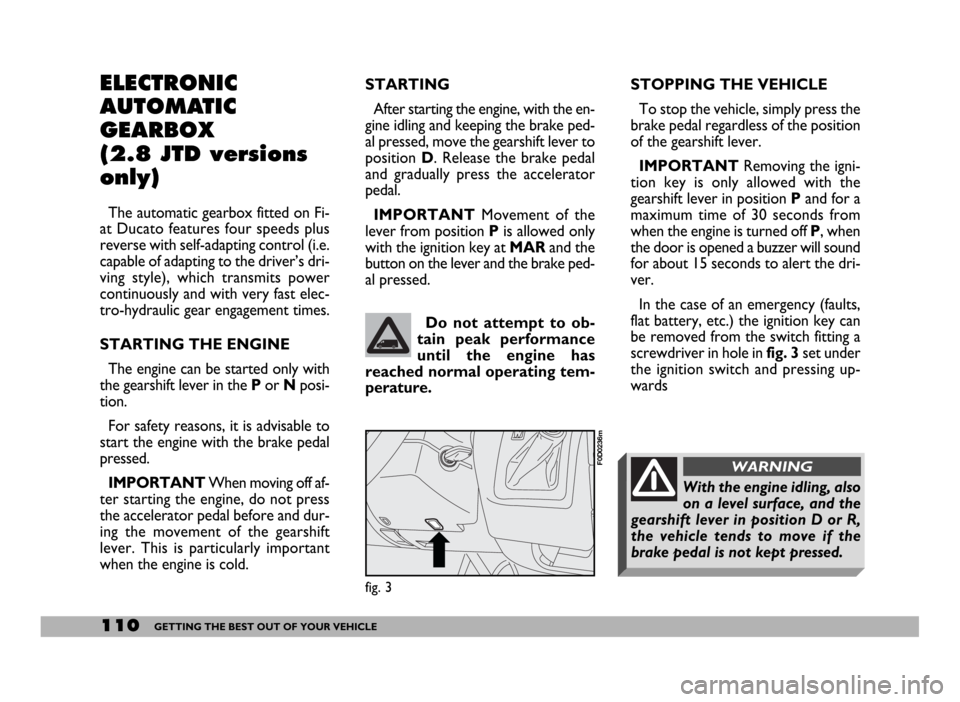
In the case of an emergency (faults,
flat battery, etc.) the ignition key can
be removed from the switch fitting a
screwdriver in hole infig. 3set under
the ignition switch and pressing up-
wards Do not attempt to ob-
tain peak performance
until the engine has
reached normal operating tem-
perature.
fig. 3
F0D0236m
With the engine idling, also
on a level surface, and the
gearshift lever in position D or R,
the vehicle tends to move if the
brake pedal is not kept pressed.
WARNING
ELECTRONIC
AUTOMATIC
GEARBOX
(2.8 JTD versions
only)
The automatic gearbox fitted on Fi-
at Ducato features four speeds plus
reverse with self-adapting control (i.e.
capable of adapting to the driver’s dri-
ving style), which transmits power
continuously and with very fast elec-
tro-hydraulic gear engagement times.
STARTING THE ENGINE
The engine can be started only with
the gearshift lever in the P or Nposi-
tion.
For safety reasons, it is advisable to
start the engine with the brake pedal
pressed.
IMPORTANTWhen moving off af-
ter starting the engine, do not press
the accelerator pedal before and dur-
ing the movement of the gearshift
lever. This is particularly important
when the engine is cold.
Page 122 of 258
121GETTING THE BEST OUT OF YOUR VEHICLE
– Do not drive too many hours at a
time but stop at intervals to stretch
your legs and recoup your energy;
– make sure the air in the passenger’s
compartment is being changed
continuously;
– never coast downhill (i.e. with the
engine off): if you do, you lose the aid
of engine braking, power brakes and
power steering so that braking re-
quires greater effort on the pedal and
steering requires greater effort on the
steering wheel.DRIVING AT NIGHT
These are the main rules to follow
when you are driving at night:
– drive especially carefully: it is hard-
er to drive at night;
– slow down especially if the road is
not lit;
– at the first signs of sleepiness, stop:
continuing would be a risk for yourself
and everybody else. Only start driving
again when you have had enough rest;
– keep a greater safety distance from
the vehicles in front of you than dur-
ing daylight hours: it is hard to judge
how fast other vehicles are going when
all you can see are their lights;
– make sure the headlights beams are
properly positioned: if they are too
low, they reduce visibility and strain
your eyes. If they are too high they can
dazzle other drivers. Adjust headlight
beam according to transported load;
– only use main beam headlights
when you are driving outside town
and when you are sure they do not an-
noy other drivers. dip your headlights
Water, ice or salt sprinkled
on the road can deposit on
the brake discs and reduce effi-
ciency of the first braking.
WARNING
Do not drive with objects
on the floor in front of the
driver’s seat: they could caught un-
der the pedals making braking or
accelerating impossible.
WARNING
Pay attention to the mats:
even a small problem to the
braking system may require in-
creased brake pedal stroke with re-
spect to normal.
WARNING
Page 123 of 258
122GETTING THE BEST OUT OF YOUR VEHICLE
as soon as you see vehicles coming in
the other direction and pass them with
the headlights dipped;
– keep all lights clean;
– be careful of animals crossing the
road when driving in the country. Slow
down to avoid the risk of running
them over.
DRIVING IN THE RAIN
Rain and wet road surfaces spell dan-
ger. All manoeuvres are more difficult
on a wet road because the grip of the
wheels on the tarmac is greatly re-
duced. This is why braking distances
are much longer and road-holding is
lower.
Here is some advice for driving in the
rain:
– reduce speed and maintain a
greater safety distance from the vehi-
cles in front;
– If it is raining particularly heavily,
visibility is also reduced. In these cas-
es, switch on the dipped headlights
even if it is still daylight so you can be
seen more easily;– Do not drive through puddles at
speed and hold on tightly to the wheel
if you do: a puddle taken at high speed
might cause you to lose control of the
vehicle (aquaplaning);
– Position the ventilation controls for
demisting (see section “Getting to
know your vehicle”), to prevent visi-
bility from worsening;
– Routinely check the conditions of
the windscreen wiper blades.
DRIVING IN FOG
– If the fog is thick, do not start out
on a journey unless you absolutely
have to.
If driving in mist, blanket fog or when
there is the danger of fog patches:
– keep your speed down;
– turn on the dipped headlights, rear
fog lights and front fog lights, if fitted,
even during the day. Do not drive with
your headlights at main beam.IMPORTANT On stretches of
road with good visibility, switch off
your rear foglights; the brightness of
these lights could annoy the people
travelling in the vehicles behind.
– Remember that fog also means the
taramac is wet and therefore ma-
noeuvres of all kinds are more difficult
and stopping distances are longer;
– keep a good distance from the ve-
hicles in front of you;
– as far as possible, avoid spurts of
speed or sudden deceleration;
– do not overtake other vehicles if
possible;
Page 126 of 258
125GETTING THE BEST OUT OF YOUR VEHICLE
Electric devices
Use electric devices for the neces-
sary time only. The heated rear win-
dow, fog lights, windscreen wipers,
heater fan require large amounts of
electricity and increasing the request
for power will also increase fuel con-
sumption (up to +25% when driving in
towns).
Climate control system
The climate control system is an ad-
ditional load which greatly affects the
engine leading to higher consumption.
When the temperature outside the
vehicle allows it, use the air vents
where possible.
DRIVING STYLE
Starting
Do not warm the engine when the
vehicle is stationary or at high or low
speed: in this way the engine will warm
up gradually increasing consumption
and emissions. You should drive off
slowly straight away avoiding high revs
so that the engine will warm up more
quickly.Unnecessary actions
Avoid revving the engine when
stopped at traffic lights or before
switching off the engine and avoid dou-
bling the clutch as these actions have
no purpose on modern vehicles and
serve only to increase consumption
and pollution.
Gear selections
As soon as the traffic and road con-
ditions allow it, shift to a higher gear.
Using a low gear to liven up accelera-
tion greatly increases consumption. In
the same way improper use of high
gears will increase consumption, emis-
sions and engine wear.
On passenger transportation versions
fitted with 2.3, 2.8 JTD and 2.8 JTD
POWER engines, fuel consumption can
be optimised by starting (on level road)
in 2nd gear instead of 1st gear.Top speeds
Fuel consumption increases consid-
erably as speed increases. Your speed
should be kept as even as possible and
superfluous braking and acceleration
avoided as this increases both con-
sumption and emissions.
Acceleration
Accelerating violently increasing the
revs will greatly affect consumption
and emissions; acceleration should be
gradual and should not exceed the
maximum torque.
Page 127 of 258
126GETTING THE BEST OUT OF YOUR VEHICLE
CONDITIONS OF USE
Cold starting
Frequent cold starting will not enable
the engine to reach optimal running
temperature. It follows, therefore,
that consumption will be higher (from
+15 to +30% in towns) as will the
production of toxic emissions.
Traffic and road conditions
Heavy traffic and higher consumption
are synonymous: for example, when
driving slowly with frequent use of low-
er gears or in towns where there are
numerous traffic lights.
Winding roads, mountain roads and
bumpy roads also have a negative effect
on consumption.
Enforced halts
During prolonged stops (traffic lights,
level crossings, etc.) the engine should
be switched off.LOAD
RECOMMENDATIONS
The version of the Ducato you are
driving has been designed and ap-
proved on the basis of several set
maximum weights (see the tables
“Weights” in section “Technical spec-
ifications”):
– kerb weight
– payload
– total weight
– total weight on the front axle
– total weight on the rear axle
– towable weight
fig. 10
F0D0047m
Each of these limits must be
borne in mind and MUST
NEVER BE EXCEEDED under any
circumstances. In particular, never
exceed the maximum weight per-
mitted on the front and rear axles
when arranging loads in vehicle (es-
pecially for special version vehicles).
WARNING
Chance knocks or sudden
braking can cause sudden
shifts of the load which could jeop-
ardise the safety of the driver and
the passengers: before you start off
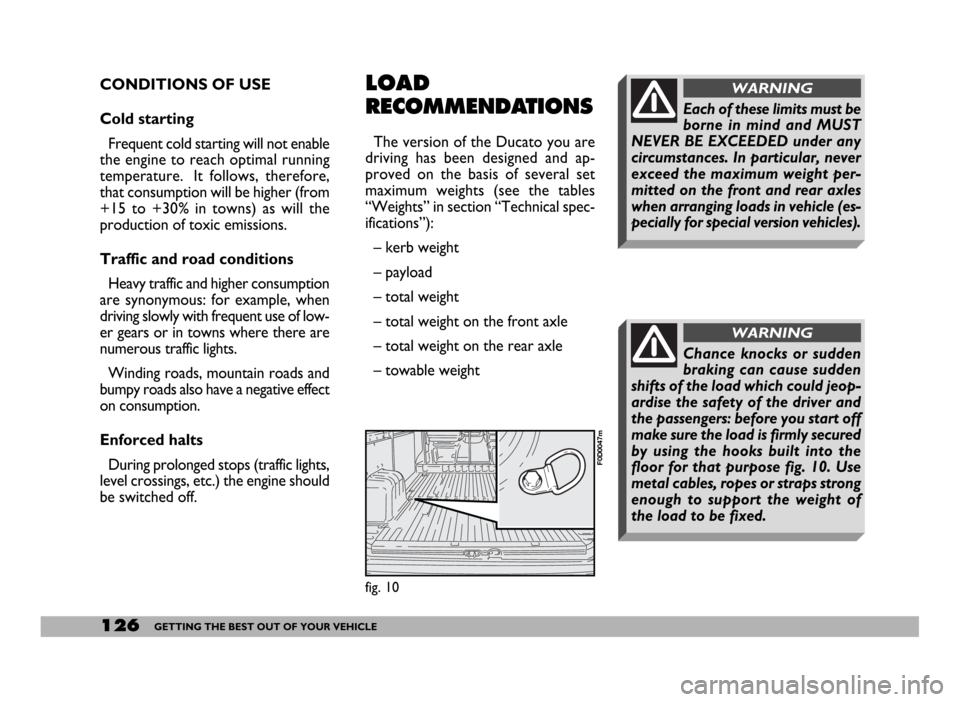
make sure the load is firmly secured
by using the hooks built into the
floor for that purpose fig. 10. Use
metal cables, ropes or straps strong
enough to support the weight of
the load to be fixed.
WARNING
Page 136 of 258
135IN AN EMERGENCY
I I
N N
A A
N N
E E
M M
E E
R R
G G
E E
N N
C C
Y Y
EMERGENCY
START-UP
DIESEL VERSIONS
Emergency start-ups cannot be per-
formed on versions with a diesel en-
gine; contact aFiat Dealership.
PETROL VERSIONS
If the Fiat CODE cannot deactivate
the engine immobiliser, the Yand
Uwarning lights stay on and the en-
gine will not start. Follow the emer-
gency start-up procedure to start the
engine.
Read the whole procedure care-
fully before trying to carry it out.
If you make a mistake, you must turn
the ignition key back to STOPand re-
peat the whole operation from the be-
ginning (step 1).1) Read the 5-figure electronic code
given on the CODE card.
2) Turn the ignition key to MAR.
3)Press and hold down the accel-
erator pedal. Warning light
Uwill
come on for about 8 seconds, and
then go out. At this point release the
accelerator pedal and get ready to
count the flashes of the warning light
U.
4) Count the number of flashes that
corresponds to the first figure of the
code on the CODE card, then press
the accelerator pedal and keep it there
until the warning light
Ucomes on
for four seconds and then goes out;
release the accelerator pedal.
5) Warning light
Uwill start flash-
ing again: after it has flashed the num-
ber of times that corresponds to the
second figure on the CODE card,
press the accelerator pedal and keep
it pressed.
6) Do the same for the remaining fig-
ures on the CODE card.7) Once the final figure has been en-
tered, keep the accelerator pedal
pressed. Warning light
Uwill light up
for four seconds and then go out; re-
lease the accelerator pedal.
8)Warning light
Uwill flash rapid-
ly for about 4 seconds to indicate that
the operation has been completed
correctly.
9) Start the engine by turning the ig-
nition key from MARto AVV.
If, however, the warning light
U
stays on, turn the ignition key to
STOPan repeat the procedure from
step 1).
IMPORTANT After an emergency
start-up, you should contact a Fiat
Dealership otherwise you will have
to repeat the procedure described
each time you want to start the en-
gine.
Page 160 of 258
159IN AN EMERGENCY
WITH A SHOP JACK
The vehicle can be raised on a shop
jack if it is empty. This is only possi-
ble from the side by placing the jack at
the points provided in the underbody
as indicated infig. 41.
WITH AN ARM HOIST
The vehicle must be raised by plac-
ing the ends of the arms at the points
indicated in fig. 41.TOWING THE
VEHICLE
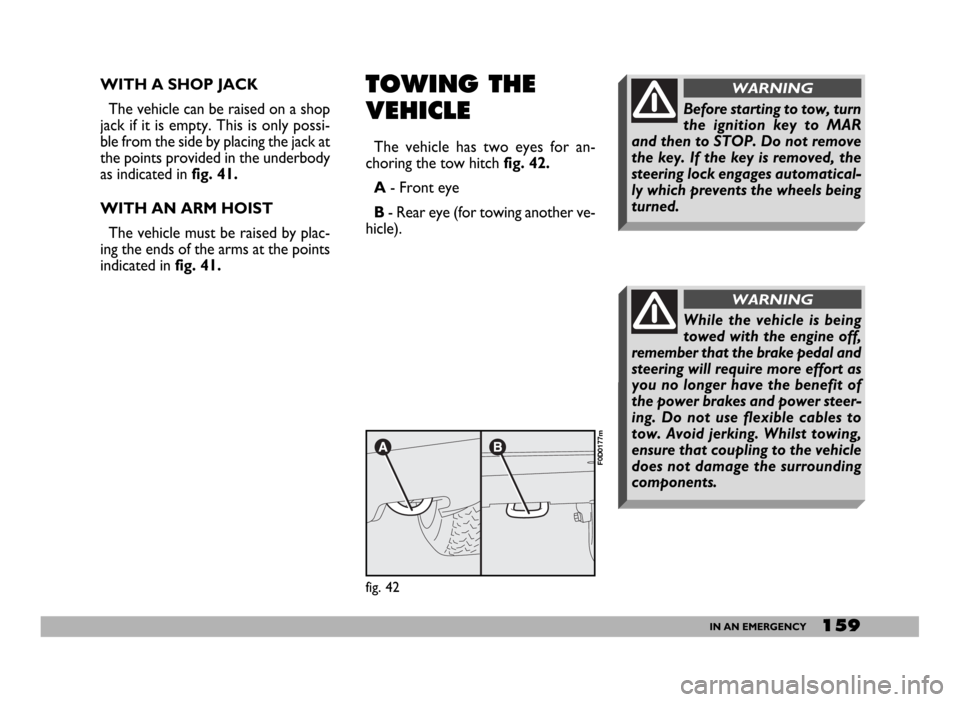
The vehicle has two eyes for an-
choring the tow hitch fig. 42.
A- Front eye
B- Rear eye (for towing another ve-
hicle).
fig. 42
F0D0177m
Before starting to tow, turn
the ignition key to MAR
and then to STOP. Do not remove
the key. If the key is removed, the
steering lock engages automatical-
ly which prevents the wheels being
turned.
WARNING
While the vehicle is being
towed with the engine off,
remember that the brake pedal and
steering will require more effort as
you no longer have the benefit of
the power brakes and power steer-
ing. Do not use flexible cables to
tow. Avoid jerking. Whilst towing,
ensure that coupling to the vehicle
does not damage the surrounding
components.
WARNING
Page 170 of 258
169VEHICLE MAINTENANCE
Do not add oil with dif-
ferent specifications from
the oil already in the en-
gine.
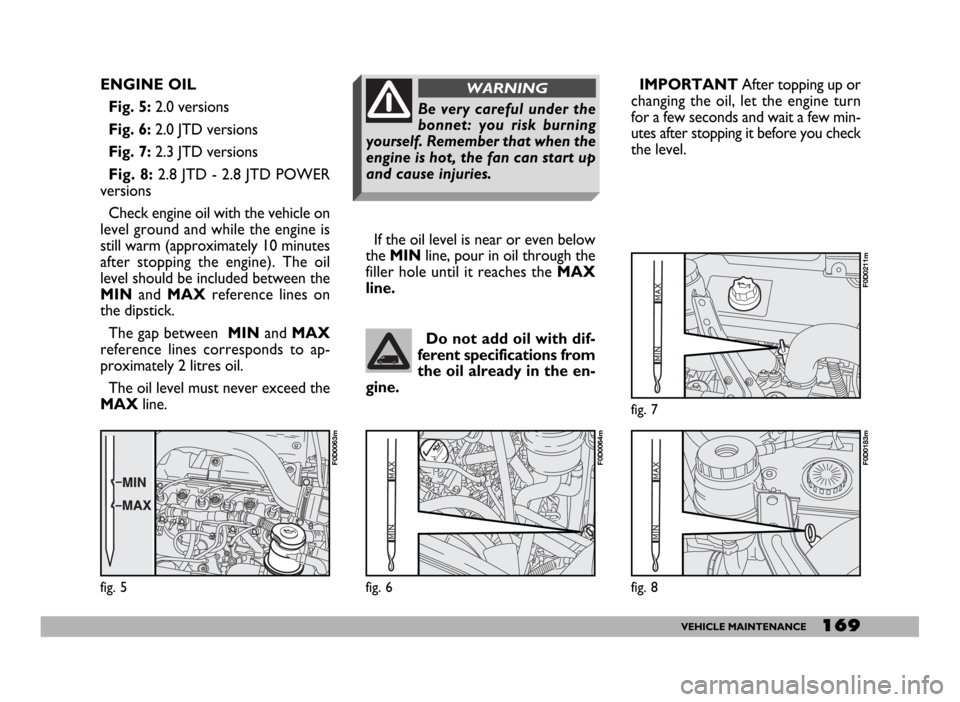
ENGINE OIL
Fig. 5:2.0 versions
Fig. 6:2.0 JTD versions
Fig. 7:2.3 JTD versions
Fig. 8: 2.8 JTD - 2.8 JTD POWER
versions
Check engine oil with the vehicle on
level ground and while the engine is
still warm (approximately 10 minutes
after stopping the engine). The oil
level should be included between the
MINand MAXreference lines on
the dipstick.
The gap between MINand MAX
reference lines corresponds to ap-
proximately 2 litres oil.
The oil level must never exceed the
MAXline.If the oil level is near or even below
the MINline, pour in oil through the
filler hole until it reaches the MAX
line.
fig. 5
F0D0063m
fig. 6
F0D0064m
fig. 7
F0D0211m
fig. 8
F0D0183m
Be very careful under the
bonnet: you risk burning
yourself. Remember that when the
engine is hot, the fan can start up
and cause injuries.
WARNINGIMPORTANT After topping up or
changing the oil, let the engine turn
for a few seconds and wait a few min-
utes after stopping it before you check
the level.