tow FIAT DUCATO 244 2005 3.G User Guide
[x] Cancel search | Manufacturer: FIAT, Model Year: 2005, Model line: DUCATO 244, Model: FIAT DUCATO 244 2005 3.GPages: 258, PDF Size: 4.05 MB
Page 122 of 258
121GETTING THE BEST OUT OF YOUR VEHICLE
– Do not drive too many hours at a
time but stop at intervals to stretch
your legs and recoup your energy;
– make sure the air in the passenger’s
compartment is being changed
continuously;
– never coast downhill (i.e. with the
engine off): if you do, you lose the aid
of engine braking, power brakes and
power steering so that braking re-
quires greater effort on the pedal and
steering requires greater effort on the
steering wheel.DRIVING AT NIGHT
These are the main rules to follow
when you are driving at night:
– drive especially carefully: it is hard-
er to drive at night;
– slow down especially if the road is
not lit;
– at the first signs of sleepiness, stop:
continuing would be a risk for yourself
and everybody else. Only start driving
again when you have had enough rest;
– keep a greater safety distance from
the vehicles in front of you than dur-
ing daylight hours: it is hard to judge
how fast other vehicles are going when
all you can see are their lights;
– make sure the headlights beams are
properly positioned: if they are too
low, they reduce visibility and strain
your eyes. If they are too high they can
dazzle other drivers. Adjust headlight
beam according to transported load;
– only use main beam headlights
when you are driving outside town
and when you are sure they do not an-
noy other drivers. dip your headlights
Water, ice or salt sprinkled
on the road can deposit on
the brake discs and reduce effi-
ciency of the first braking.
WARNING
Do not drive with objects
on the floor in front of the
driver’s seat: they could caught un-
der the pedals making braking or
accelerating impossible.
WARNING
Pay attention to the mats:
even a small problem to the
braking system may require in-
creased brake pedal stroke with re-
spect to normal.
WARNING
Page 126 of 258

125GETTING THE BEST OUT OF YOUR VEHICLE
Electric devices
Use electric devices for the neces-
sary time only. The heated rear win-
dow, fog lights, windscreen wipers,
heater fan require large amounts of
electricity and increasing the request
for power will also increase fuel con-
sumption (up to +25% when driving in
towns).
Climate control system
The climate control system is an ad-
ditional load which greatly affects the
engine leading to higher consumption.
When the temperature outside the
vehicle allows it, use the air vents
where possible.
DRIVING STYLE
Starting
Do not warm the engine when the
vehicle is stationary or at high or low
speed: in this way the engine will warm
up gradually increasing consumption
and emissions. You should drive off
slowly straight away avoiding high revs
so that the engine will warm up more
quickly.Unnecessary actions
Avoid revving the engine when
stopped at traffic lights or before
switching off the engine and avoid dou-
bling the clutch as these actions have
no purpose on modern vehicles and
serve only to increase consumption
and pollution.
Gear selections
As soon as the traffic and road con-
ditions allow it, shift to a higher gear.
Using a low gear to liven up accelera-
tion greatly increases consumption. In
the same way improper use of high
gears will increase consumption, emis-
sions and engine wear.
On passenger transportation versions
fitted with 2.3, 2.8 JTD and 2.8 JTD
POWER engines, fuel consumption can
be optimised by starting (on level road)
in 2nd gear instead of 1st gear.Top speeds
Fuel consumption increases consid-
erably as speed increases. Your speed
should be kept as even as possible and
superfluous braking and acceleration
avoided as this increases both con-
sumption and emissions.
Acceleration
Accelerating violently increasing the
revs will greatly affect consumption
and emissions; acceleration should be
gradual and should not exceed the
maximum torque.
Page 127 of 258
126GETTING THE BEST OUT OF YOUR VEHICLE
CONDITIONS OF USE
Cold starting
Frequent cold starting will not enable
the engine to reach optimal running
temperature. It follows, therefore,
that consumption will be higher (from
+15 to +30% in towns) as will the
production of toxic emissions.
Traffic and road conditions
Heavy traffic and higher consumption
are synonymous: for example, when
driving slowly with frequent use of low-
er gears or in towns where there are
numerous traffic lights.
Winding roads, mountain roads and
bumpy roads also have a negative effect
on consumption.
Enforced halts
During prolonged stops (traffic lights,
level crossings, etc.) the engine should
be switched off.LOAD
RECOMMENDATIONS
The version of the Ducato you are
driving has been designed and ap-
proved on the basis of several set
maximum weights (see the tables
“Weights” in section “Technical spec-
ifications”):
– kerb weight
– payload
– total weight
– total weight on the front axle
– total weight on the rear axle
– towable weight
fig. 10
F0D0047m
Each of these limits must be
borne in mind and MUST
NEVER BE EXCEEDED under any
circumstances. In particular, never
exceed the maximum weight per-
mitted on the front and rear axles
when arranging loads in vehicle (es-
pecially for special version vehicles).
WARNING
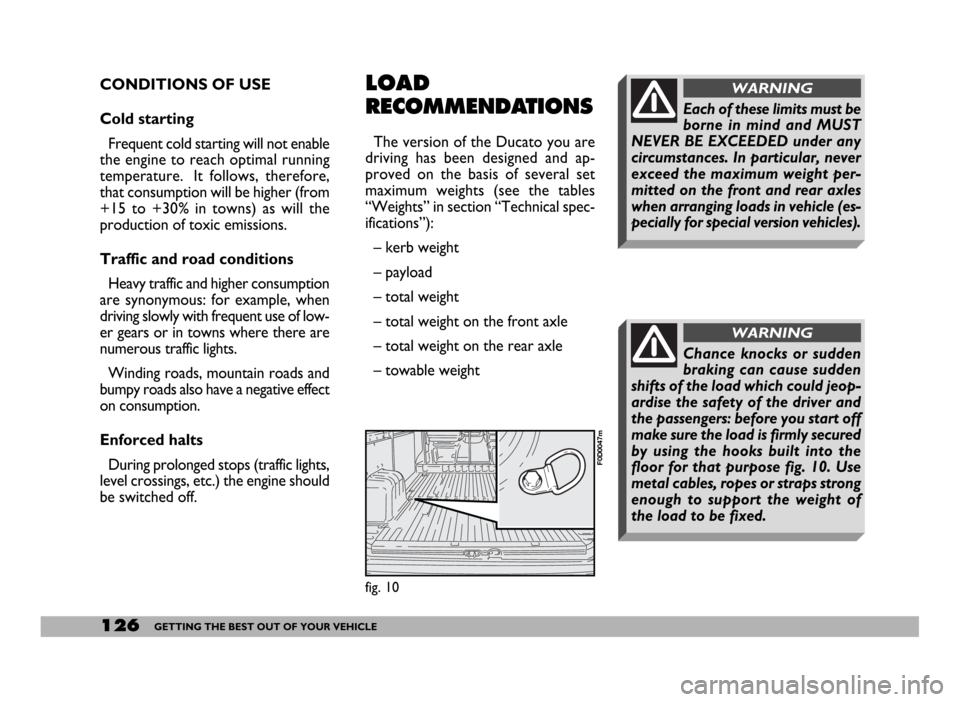
Chance knocks or sudden
braking can cause sudden
shifts of the load which could jeop-
ardise the safety of the driver and
the passengers: before you start off
make sure the load is firmly secured
by using the hooks built into the
floor for that purpose fig. 10. Use
metal cables, ropes or straps strong
enough to support the weight of
the load to be fixed.
WARNING
Page 129 of 258
128GETTING THE BEST OUT OF YOUR VEHICLE
LOOKING AFTER EMISSION
CONTROL DEVICES
The correct use of pollution control
devices not only ensures respect for
the environment but also has an effect
on the vehicle’s performance.
Keeping these devices in good con-
ditions is therefore a fundamental rule
for driving that is easy on your pock-
et and on the environment too.
The first step to take is to follow the
Service Schedule to the letter.
If your vehicle has a petrol engine
with catalytic converter use only un-
leaded petrol.
if you have trouble starting, do not
keep turning the ignition key for long
periods. Be especially careful to avoid
bump starting the vehicle by pushing,
towing or rolling downhill: these are
all manoeuvres that can damage the
catalyst.
Use an auxiliary battery for start-ups
only.If the engine begins to “loose its
smoothness” when travelling, contin-
ue your journey but reduce the de-
mands you are making on the engine
and have the vehicle seen to at a Fi-
at Dealershipas soon as you can.
When the instrument panel fuel re-
serve warning light comes on, fill up as
soon as possible. A low fuel level may
cause an uneven supply of fuel to the
engine with inevitable increase in the
temperature of the exhaust gas and se-
rious damage to the catalytic con-
verter.
Never run the engine with one or
more spark plugs disconnected, even
for testing purposes.
Do not warm up the engine by let-
ting it idle for a while before moving
off unless the outside temperature is
very low and, even in this case, only
do so for less than thirty seconds.
Do not install heat shields and do not
remove those already fitted to the cat-
alytic converter and exhaust pipe.
Do not allow anything to
be sprayed onto the cat-
alytic converter, lambda sensor and
exhaust pipe.
WARNING
Ignoring the above rules
may lead to fire.
WARNING
When functioning normal-
ly the catalytic converter
reaches high temperatures. For this
reason do not park the vehicle over
inflammable material (grass, dry
leaves, pine needles, etc.): fire haz-
ard.
WARNING
Page 130 of 258
129GETTING THE BEST OUT OF YOUR VEHICLE
TOWING A TRAILER
IMPORTANT
The vehicle must be fitted with a ho-
mologated tow hitch and suitable elec-
trical system for towing a caravan or
trailer. Have the tow hitch fitted by an
expert who will issue specific docu-
mentation for use on roads.
Fit special wing mirrors in accor-
dance with the highway code.
Remember that towing a trailer
makes it harder for the vehicle to
climb the maximum gradients speci-
fied, increases braking and overtaking
distance, proportionally to the overall
weight of the trailer.
Engage a low gear when driving
downhill rather than constantly brak-
ing.
The weight the trailer exerts on the
vehicle’s tow hitch coupling reduces
the vehicle’s payload by the same
amount.In order to be sure you are not ex-
ceeding the maximum towing weight
(shown in the log book) you have to
take into account the trailer weight ful-
ly laden including the accessories and
personal luggage.
Do not exceed the speed limits for
towing a trailer in the country you are
driving in. In any case, do not exceed
the top speed of 100 km/h.TOW HITCH INSTALLATION
The tow hitch must be fixed to the
body by an expert in accordance with
the following instructions and re-
specting the additional and/or integra-
tive information provided by the tow
hitch manufacturer.
The tow hitch to be fitted must com-
ply with the current regulations in
force, with reference to Directive
94/20/CEE and subsequent modifica-
tions.
Use a tow hitch suited for the maxi-
mum towable load of the vehicle version
on which the tow hitch is to be fitted.
Use a unified coupling for the elec-
trical connections. The coupling is gen-
erally fitted on a specific mount fas-
tened to the tow hitch.
For the electrical connections, a 7 or
13 pole 12VDC coupling must be used
(CUNA/UNI and ISO/DIN standards).
Follow the instructions provided by
the manufacturer of the vehicle and/or
the tow hitch.
For the electric connections use the
proper trailer light control unit.
Under no circumstances
modify the vehicle’s braking
system for trailer braking control.
The trailer braking system must be
completely independent from the
vehicle hydraulic system.
WARNING
Where your vehicle is
equipped with ABS, re-
member that this has no effect over
the trailer braking system. Particu-
lar care must be taken on slippery
surfaces.
WARNING
Page 131 of 258
130GETTING THE BEST OUT OF YOUR VEHICLE
The electrical brake or other device
(electrical winch, etc.) must be pow-
ered directly from the battery by
means of a lead with a cross-section
area not smaller than 2.5 mm
2.
In addition to the electrical connec-
tions, only the power wire for an ad-
ditional electrical brake and for inter-
nal trailer lighting with a power not
exceeding 15W can be connected to
the vehicle’s electrical system.
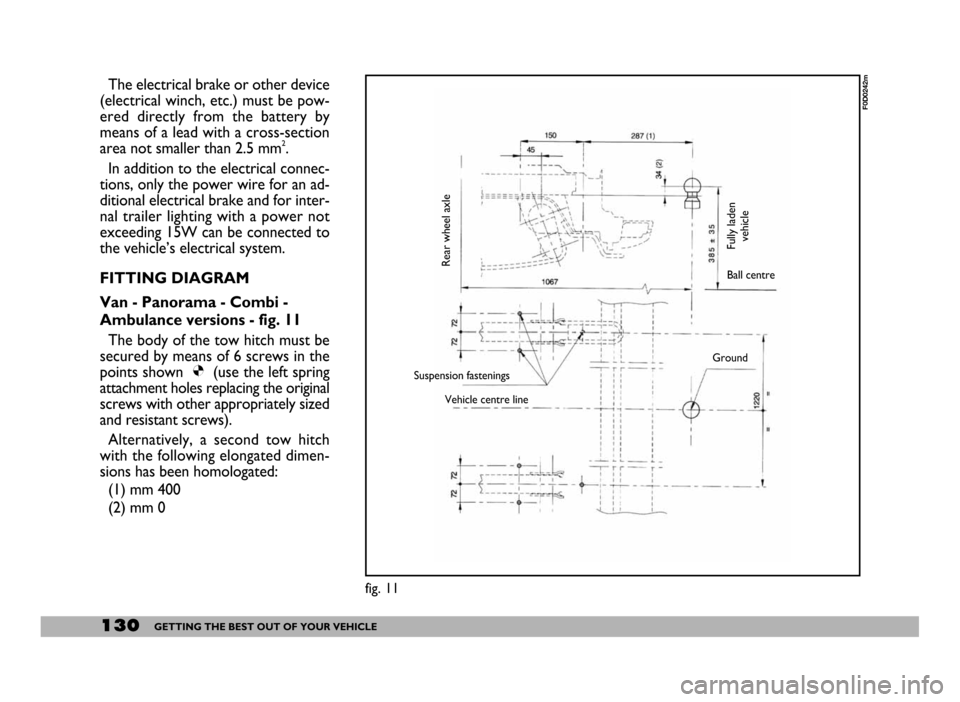
FITTING DIAGRAM
Van - Panorama - Combi -
Ambulance versions - fig. 11
The body of the tow hitch must be
secured by means of 6 screws in the
points shown Ø(use the left spring
attachment holes replacing the original
screws with other appropriately sized
and resistant screws).
Alternatively, a second tow hitch
with the following elongated dimen-
sions has been homologated:
(1) mm 400
(2) mm 0
fig. 11
F0D0242m
Rear wheel axle
Fully laden
vehicleBall centre
Suspension fastenings
Vehicle centre lineGround
Page 132 of 258
131GETTING THE BEST OUT OF YOUR VEHICLE
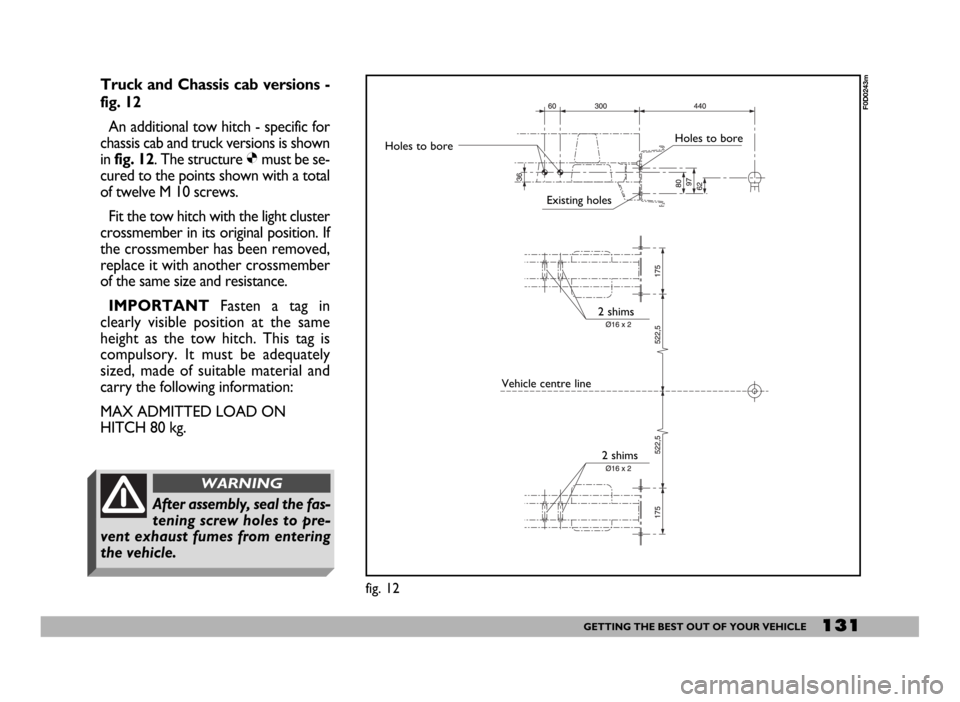
Truck and Chassis cab versions -
fig. 12
An additional tow hitch - specific for
chassis cab and truck versions is shown
in fig. 12. The structure Ømust be se-
cured to the points shown with a total
of twelve M 10 screws.
Fit the tow hitch with the light cluster
crossmember in its original position. If
the crossmember has been removed,
replace it with another crossmember
of the same size and resistance.
IMPORTANTFasten a tag in
clearly visible position at the same
height as the tow hitch. This tag is
compulsory. It must be adequately
sized, made of suitable material and
carry the following information:
MAX ADMITTED LOAD ON
HITCH 80 kg.
fig. 12
F0D0243m
Holes to boreHoles to bore
Existing holes
2 shims
Vehicle centre line
2 shims
After assembly, seal the fas-
tening screw holes to pre-
vent exhaust fumes from entering
the vehicle.
WARNING
Page 138 of 258
137IN AN EMERGENCY
BUMP STARTING IF A TYRE IS
PUNCTURED
General instructions
Observe the instruc-
tions on this and the fol-
lowing pages to use the
jack and spare wheel correctly.Catalysed vehicles must
not be bump started
(pushed, towed or
coasted downhill) as this could
cause fuel to flow into the cat-
alytic exhaust system and dam-
age it beyond repair.
Never start the engine
when the vehicle is jacked
up.
WARNING
Remember that until the
engine has started the
brake booster and power steering
systems will not work and a greater
effort will therefore be required to
depress the brake pedal or turn the
steering wheel.
WARNING
If you are towing a trailer,
remove the trailer before
jacking up the vehicle.
WARNING
The jack should only be
used to changed a wheel on
the vehicle for which it was de-
signed. It should not be put to oth-
er uses or employed to raise other
models. Under no circumstances
should it be used when carrying out
repairs under the vehicle. An incor-
rectly positioned jack may cause
the vehicle to fall. Do not use the
jack to lift loads exceeding that in-
dicated on the label attached to the
to the jack itself.
WARNING
Page 159 of 258
158IN AN EMERGENCY
JACKING
THE VEHICLE
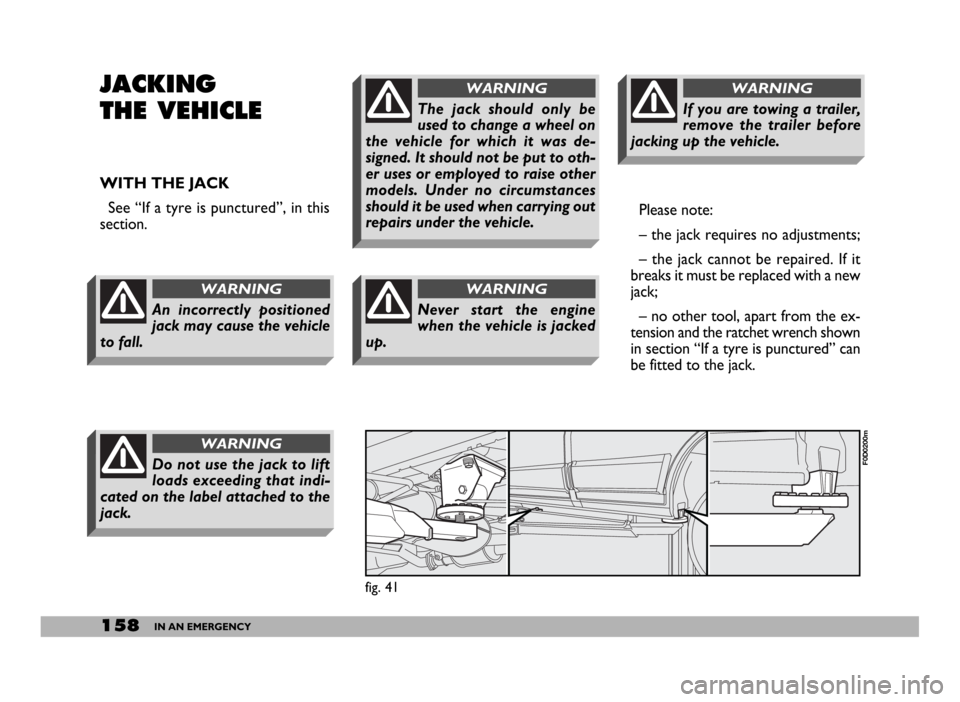
WITH THE JACK
See “If a tyre is punctured”, in this
section.Please note:
– the jack requires no adjustments;
– the jack cannot be repaired. If it
breaks it must be replaced with a new
jack;
– no other tool, apart from the ex-
tension and the ratchet wrench shown
in section “If a tyre is punctured” can
be fitted to the jack.
fig. 41
F0D0200mDo not use the jack to lift
loads exceeding that indi-
cated on the label attached to the
jack.
WARNING
The jack should only be
used to change a wheel on
the vehicle for which it was de-
signed. It should not be put to oth-
er uses or employed to raise other
models. Under no circumstances
should it be used when carrying out
repairs under the vehicle.
WARNING
Never start the engine
when the vehicle is jacked
up.
WARNING
An incorrectly positioned
jack may cause the vehicle
to fall.
WARNING
If you are towing a trailer,
remove the trailer before
jacking up the vehicle.
WARNING
Page 160 of 258
159IN AN EMERGENCY
WITH A SHOP JACK
The vehicle can be raised on a shop
jack if it is empty. This is only possi-
ble from the side by placing the jack at
the points provided in the underbody
as indicated infig. 41.
WITH AN ARM HOIST
The vehicle must be raised by plac-
ing the ends of the arms at the points
indicated in fig. 41.TOWING THE
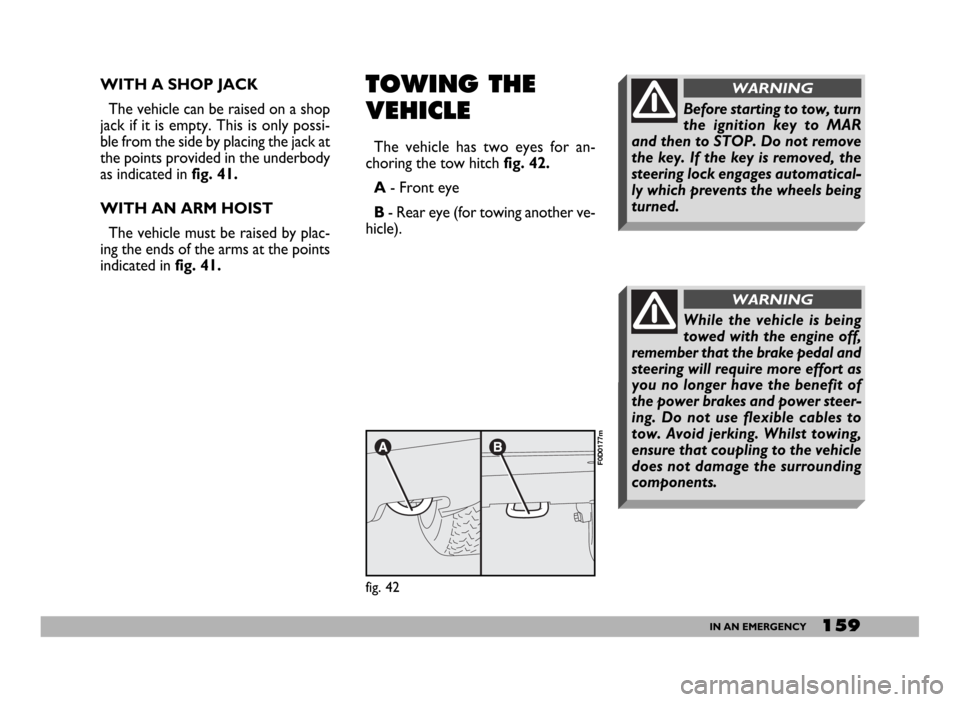
VEHICLE
The vehicle has two eyes for an-
choring the tow hitch fig. 42.
A- Front eye
B- Rear eye (for towing another ve-
hicle).
fig. 42
F0D0177m
Before starting to tow, turn
the ignition key to MAR
and then to STOP. Do not remove
the key. If the key is removed, the
steering lock engages automatical-
ly which prevents the wheels being
turned.
WARNING
While the vehicle is being
towed with the engine off,
remember that the brake pedal and
steering will require more effort as
you no longer have the benefit of
the power brakes and power steer-
ing. Do not use flexible cables to
tow. Avoid jerking. Whilst towing,
ensure that coupling to the vehicle
does not damage the surrounding
components.
WARNING