Temperature FIAT DUCATO 244 2005 3.G Owner's Manual
[x] Cancel search | Manufacturer: FIAT, Model Year: 2005, Model line: DUCATO 244, Model: FIAT DUCATO 244 2005 3.GPages: 258, PDF Size: 4.05 MB
Page 120 of 258

119GETTING THE BEST OUT OF YOUR VEHICLE
Manual sequential programme
This function enables manual se-
quential use of the gearbox merely
moving the selector lever to the left.
Each time the lever is pressed only
one gear is shifted: more than one shift
cannot be obtained.
To avoid overevving or excessively
low engine rpm, the control unit in-
hibits requests for gearshifting that
would cause such situations.
Winter driving programme
This programme is engaged by press-
ing button WINTERnear the
gearshift lever,
in case of driving wheel skidding and
it changes to specific gears.
Starting is possible only in 2
ndgear.
On snowy roads use however snow
chains and/or tyres.
The WINTERfunction shall always
be off on slopes.Engine warming up programme
This programme allows the engine to
reach normal operating temperature
in the shortest time possible (de-
pending on the outside temperature)
highering the gearshifting points, in re-
lation to engine temperature.
The programme engages automati-
cally after starting, if the engine tem-
perature is below 30 °C and it remains
active up to 34 °C.
Excessive gearbox oil
temperature programme
This is activated when the gearbox
oil temperature reaches 120 °C and it
remains active down to 117 °C.
To facilitate oil cooling, this pro-
gramme inhibits gearshifting, either up
or down. It is however possible to use
the manual programme.
SAFE DRIVING
In designing Ducato, Fiat has made
every effort to come up with a vehicle
able to provide driver and passengers
with top-class levels of safety. Never-
theless it is always the behaviour of the
person at the wheel that determines
road safety.
In the following pages you will find
some simple tips to help you travel in
safety under different conditions. You
will no doubt be familiar with many of
them already but it will be useful to
read them all carefully.
Page 126 of 258

125GETTING THE BEST OUT OF YOUR VEHICLE
Electric devices
Use electric devices for the neces-
sary time only. The heated rear win-
dow, fog lights, windscreen wipers,
heater fan require large amounts of
electricity and increasing the request
for power will also increase fuel con-
sumption (up to +25% when driving in
towns).
Climate control system
The climate control system is an ad-
ditional load which greatly affects the
engine leading to higher consumption.
When the temperature outside the
vehicle allows it, use the air vents
where possible.
DRIVING STYLE
Starting
Do not warm the engine when the
vehicle is stationary or at high or low
speed: in this way the engine will warm
up gradually increasing consumption
and emissions. You should drive off
slowly straight away avoiding high revs
so that the engine will warm up more
quickly.Unnecessary actions
Avoid revving the engine when
stopped at traffic lights or before
switching off the engine and avoid dou-
bling the clutch as these actions have
no purpose on modern vehicles and
serve only to increase consumption
and pollution.
Gear selections
As soon as the traffic and road con-
ditions allow it, shift to a higher gear.
Using a low gear to liven up accelera-
tion greatly increases consumption. In
the same way improper use of high
gears will increase consumption, emis-
sions and engine wear.
On passenger transportation versions
fitted with 2.3, 2.8 JTD and 2.8 JTD
POWER engines, fuel consumption can
be optimised by starting (on level road)
in 2nd gear instead of 1st gear.Top speeds
Fuel consumption increases consid-
erably as speed increases. Your speed
should be kept as even as possible and
superfluous braking and acceleration
avoided as this increases both con-
sumption and emissions.
Acceleration
Accelerating violently increasing the
revs will greatly affect consumption
and emissions; acceleration should be
gradual and should not exceed the
maximum torque.
Page 127 of 258
126GETTING THE BEST OUT OF YOUR VEHICLE
CONDITIONS OF USE
Cold starting
Frequent cold starting will not enable
the engine to reach optimal running
temperature. It follows, therefore,
that consumption will be higher (from
+15 to +30% in towns) as will the
production of toxic emissions.
Traffic and road conditions
Heavy traffic and higher consumption
are synonymous: for example, when
driving slowly with frequent use of low-
er gears or in towns where there are
numerous traffic lights.
Winding roads, mountain roads and
bumpy roads also have a negative effect
on consumption.
Enforced halts
During prolonged stops (traffic lights,
level crossings, etc.) the engine should
be switched off.LOAD
RECOMMENDATIONS
The version of the Ducato you are
driving has been designed and ap-
proved on the basis of several set
maximum weights (see the tables
“Weights” in section “Technical spec-
ifications”):
– kerb weight
– payload
– total weight
– total weight on the front axle
– total weight on the rear axle
– towable weight
fig. 10
F0D0047m
Each of these limits must be
borne in mind and MUST
NEVER BE EXCEEDED under any
circumstances. In particular, never
exceed the maximum weight per-
mitted on the front and rear axles
when arranging loads in vehicle (es-
pecially for special version vehicles).
WARNING
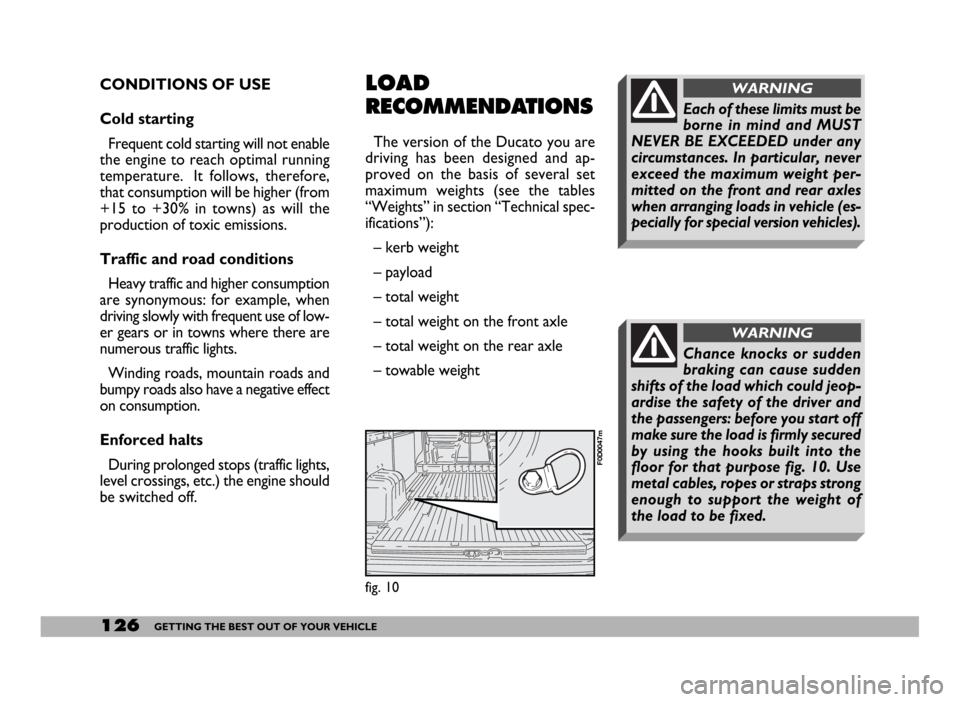
Chance knocks or sudden
braking can cause sudden
shifts of the load which could jeop-
ardise the safety of the driver and
the passengers: before you start off
make sure the load is firmly secured
by using the hooks built into the
floor for that purpose fig. 10. Use
metal cables, ropes or straps strong
enough to support the weight of
the load to be fixed.
WARNING
Page 129 of 258
128GETTING THE BEST OUT OF YOUR VEHICLE
LOOKING AFTER EMISSION
CONTROL DEVICES
The correct use of pollution control
devices not only ensures respect for
the environment but also has an effect
on the vehicle’s performance.
Keeping these devices in good con-
ditions is therefore a fundamental rule
for driving that is easy on your pock-
et and on the environment too.
The first step to take is to follow the
Service Schedule to the letter.
If your vehicle has a petrol engine
with catalytic converter use only un-
leaded petrol.
if you have trouble starting, do not
keep turning the ignition key for long
periods. Be especially careful to avoid
bump starting the vehicle by pushing,
towing or rolling downhill: these are
all manoeuvres that can damage the
catalyst.
Use an auxiliary battery for start-ups
only.If the engine begins to “loose its
smoothness” when travelling, contin-
ue your journey but reduce the de-
mands you are making on the engine
and have the vehicle seen to at a Fi-
at Dealershipas soon as you can.
When the instrument panel fuel re-
serve warning light comes on, fill up as
soon as possible. A low fuel level may
cause an uneven supply of fuel to the
engine with inevitable increase in the
temperature of the exhaust gas and se-
rious damage to the catalytic con-
verter.
Never run the engine with one or
more spark plugs disconnected, even
for testing purposes.
Do not warm up the engine by let-
ting it idle for a while before moving
off unless the outside temperature is
very low and, even in this case, only
do so for less than thirty seconds.
Do not install heat shields and do not
remove those already fitted to the cat-
alytic converter and exhaust pipe.
Do not allow anything to
be sprayed onto the cat-
alytic converter, lambda sensor and
exhaust pipe.
WARNING
Ignoring the above rules
may lead to fire.
WARNING
When functioning normal-
ly the catalytic converter
reaches high temperatures. For this
reason do not park the vehicle over
inflammable material (grass, dry
leaves, pine needles, etc.): fire haz-
ard.
WARNING
Page 142 of 258
141IN AN EMERGENCY
GENERAL INSTRUCTIONS
When a light is not working, check
that it has not fused before changing
the bulb.
For the location of the fuses, refer to
“If a fuse blows” in this section.
Before replacing a bulb that does not
work, check that the contacts are not
oxidised.
Burnt-out bulbs must be replaced
with ones of the same type. Light from
bulbs with insufficient power is dim
while those which are too powerful
use too much electricity. Always check
the height of the headlight beam after
changing a bulb. Only touch the metal
part when handling halo-
gen bulbs. If the transpar-
ent bulb is touched it reduces the
intensity of the light emitted and
can also reduce the life of the
bulb. If you touch the bulb acci-
dentally, rub it with a cloth
moistened with alcohol and leave
it to dry.IF A BULB
BURNS OUT
Modifications or repairs to
the electrical system car-
ried out incorrectly and without
bearing the features of the system
in mind can cause malfunctions
with the risk of fire.
WARNING
You should have the bulbs
replaced at a Fiat Dealer-
ship, if possible. Correct operation
and proper beam height are essen-
tial for safe driving and compliance
with law requirements.
WARNING
Halogen bulbs contain
pressurised gas which, if
broken, may cause small fragments
of glass to be projected outwards.
WARNING
IMPORTANTOn the inside sur-
face of the headlight there could ap-
pear a slight coat of fogging; this does
not show a defect, since it is a natur-
al occurrence due to low temperature
and to the degree of humidity in the
air; it will disappear as soon as the
lights are turned on. The presence of
drops inside the headlight shows wa-
ter seepage, contact Fiat Dealership.
Page 172 of 258
171VEHICLE MAINTENANCE
WINDSCREEN WASHER
FLUID
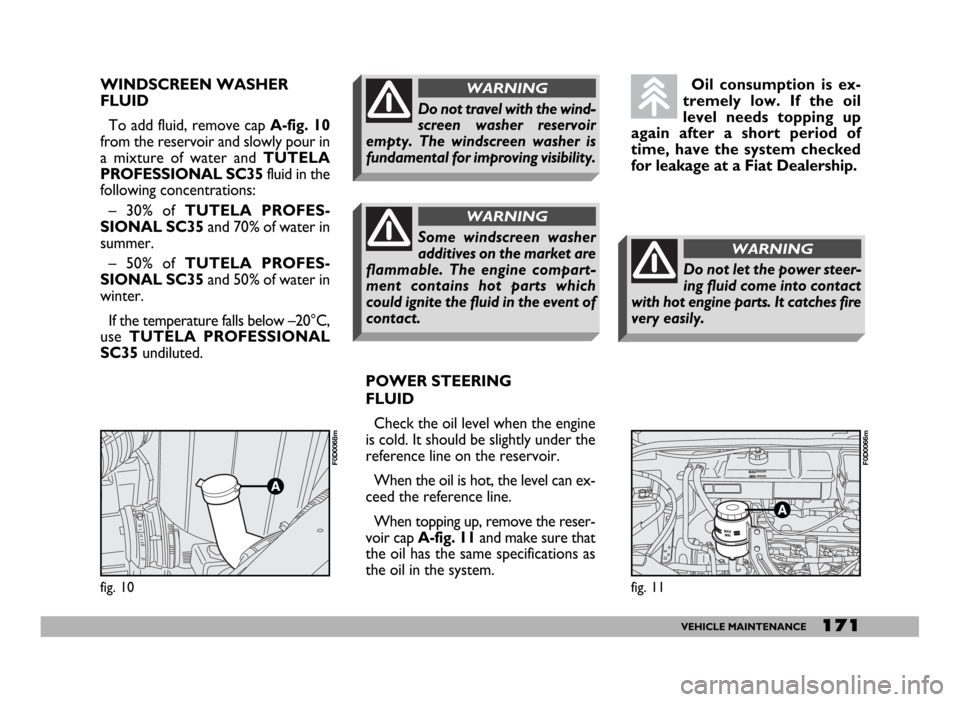
To add fluid, remove cap A-fig. 10
from the reservoir and slowly pour in
a mixture of water and TUTELA
PROFESSIONAL SC35fluid in the
following concentrations:
– 30% ofTUTELA PROFES-
SIONAL SC35and 70% of water in
summer.
– 50% ofTUTELA PROFES-
SIONAL SC35and 50% of water in
winter.
If the temperature falls below –20°C,
useTUTELA PROFESSIONAL
SC35undiluted.
POWER STEERING
FLUID
Check the oil level when the engine
is cold. It should be slightly under the
reference line on the reservoir.
When the oil is hot, the level can ex-
ceed the reference line.
When topping up, remove the reser-
voir cap A-fig. 11 and make sure that
the oil has the same specifications as
the oil in the system.Oil consumption is ex-
tremely low. If the oil
level needs topping up
again after a short period of
time, have the system checked
for leakage at a Fiat Dealership.
fig. 10
F0D0068m
fig. 11
F0D0066m
Do not let the power steer-
ing fluid come into contact
with hot engine parts. It catches fire
very easily.
WARNINGSome windscreen washer
additives on the market are
flammable. The engine compart-
ment contains hot parts which
could ignite the fluid in the event of
contact.
WARNING
Do not travel with the wind-
screen washer reservoir
empty. The windscreen washer is
fundamental for improving visibility.
WARNING
Page 180 of 258
179VEHICLE MAINTENANCE
Tyres age even if they are not used
very much. Cracking of the tread rub-
ber and the side walls are a sign of this
ageing. In any case, if the tyres have
been fitted for more than six years
they should be examined by an expert
who can judge whether they are still
fit for use. Remember to check the
spare tyre particularly carefully too.
If a replacement is necessary, always
use new tyres and avoid using ones
the origin of which you are not cer-
tain about.
The Ducato uses tubeless tyres. Un-
der no circumstances use an inner
tube with these tyres.
If you replace a tyre it is a good idea
to change the inflation valve, too.To ensure the front and rear tyres all
wear evenly, you are advised to change
the tyres over every 10 - 15 thousand
kilometres keeping them on the same
side of the vehicle so as not to reverse
the direction of rotation.RUBBER TUBING
Follow the Service Schedule carefully
in the case of braking and fuel supply
system rubber tubing.
Ozone, high temperatures and long
absence of fluid in the system can in
fact cause the hardening and cracking
of the pipes with possible loss of fluid.
A careful check is therefore essential.
Do not change the tyres
over in criss-cross fashion
by moving a tyre from the left-hand
side of the vehicle to the right and
vice versa.
WARNING
Never submit alloy rims to
repainting treatments re-
quiring to use temperatures ex-
ceeding 150°C since the mechani-
cal properties of the wheels could
be impaired.
WARNING
Page 181 of 258
180VEHICLE MAINTENANCE
WINDSCREEN
WIPER
BLADES
Periodically clean the rubber part
with suitable products. We recom-
mend TUTELA PROFESSIONAL
SC35.
Change the blades if the rubber edge
is warped or worn out. You should in
any case change them approximately
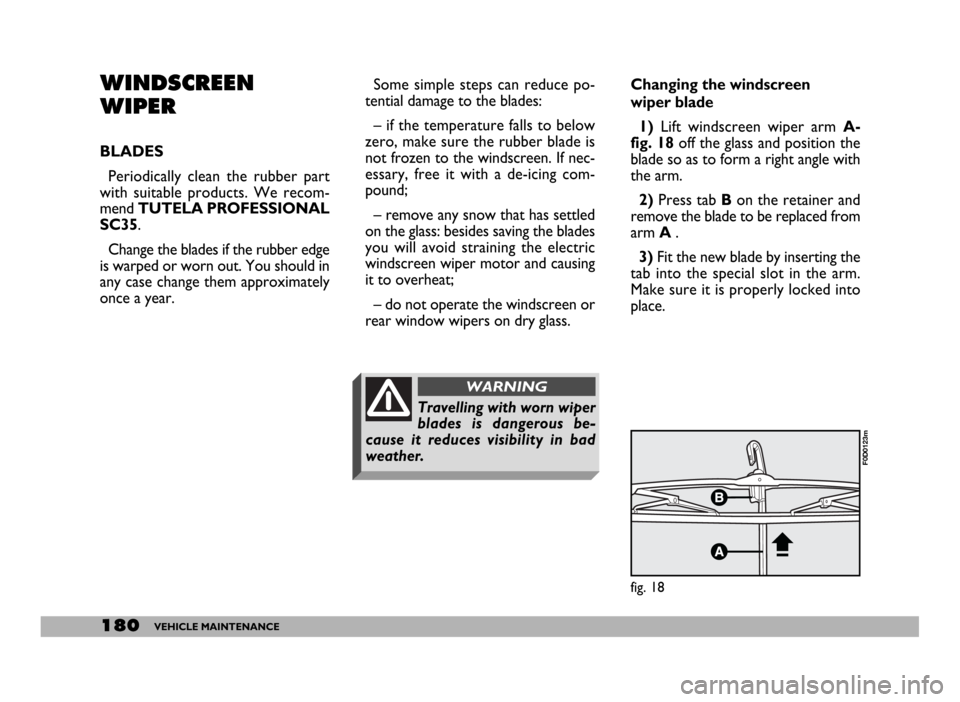
once a year.Changing the windscreen
wiper blade
1)Lift windscreen wiper arm A-
fig. 18off the glass and position the
blade so as to form a right angle with
the arm.
2) Press tab Bon the retainer and
remove the blade to be replaced from
arm A .
3)Fit the new blade by inserting the
tab into the special slot in the arm.
Make sure it is properly locked into
place.
fig. 18
F0D0123m
Some simple steps can reduce po-
tential damage to the blades:
– if the temperature falls to below
zero, make sure the rubber blade is
not frozen to the windscreen. If nec-
essary, free it with a de-icing com-
pound;
– remove any snow that has settled
on the glass: besides saving the blades
you will avoid straining the electric
windscreen wiper motor and causing
it to overheat;
– do not operate the windscreen or
rear window wipers on dry glass.
Travelling with worn wiper
blades is dangerous be-
cause it reduces visibility in bad
weather.
WARNING
Page 240 of 258

239TECHNICAL SPECIFICATIONS
CAPACITIES
Fuel tank:
including a reserve of:
Engine cooling system:
Engine sump:
Transaxle:
Hydraulic power steering:
Front and rear hydraulic brake circuit:
11-15 versions
MAXI versions
Hydraulic brake circuit
with ABS:
11-15 versions
MAXI versions
Windscreen and rear window
liquid reservoir:
(▲) For particularly cold temperatures use SELENIA PERFORMER MULTIPOWER SAE 5W-30.
Prescribed fuel
Recommended products
Premium unleaded petrol with
a RON not lower than 95
Mixture of distilled water and
PARAFLU 11(blue) at 50% or
PARAFLU UP(red) at 50%
SELENIA 20K (▲)
TUTELA CAR MATRYX
TUTELA GI/A
TUTELA TOP 4
TUTELA TOP 4
Mixture of water andTUTELA
PROFESSIONAL SC 35 2000 BZ
Litres
80
8 ÷ 10
9
5
2.4
1.3
0.59
0.62
0.62
0.66
4.2 kg
–
–
–
4.5
2.16
–
–
–
–
–
–
Page 242 of 258
241TECHNICAL SPECIFICATIONS
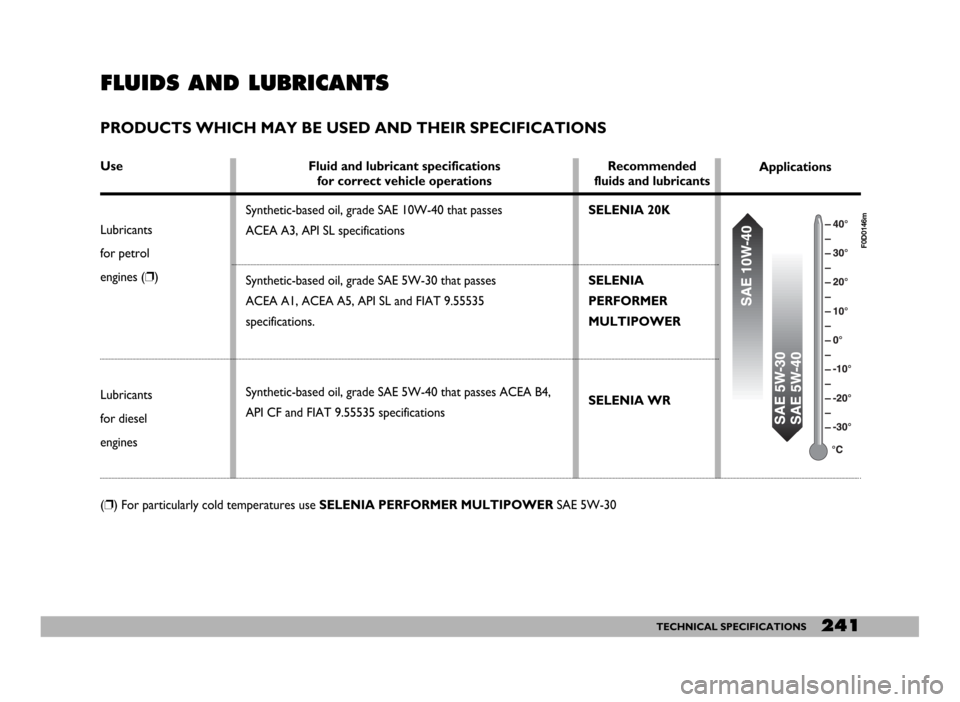
FLUIDS AND LUBRICANTS
PRODUCTS WHICH MAY BE USED AND THEIR SPECIFICATIONS
Use
Lubricants
for petrol
engines (❐)
Lubricants
for diesel
engines
(❐) For particularly cold temperatures use SELENIA PERFORMER MULTIPOWER SAE 5W-30Applications
F0D0146m
Fluid and lubricant specifications
for correct vehicle operations
Synthetic-based oil, grade SAE 10W-40 that passes
ACEA A3, API SL specifications
Synthetic-based oil, grade SAE 5W-30 that passes
ACEA A1, ACEA A5, API SL and FIAT 9.55535
specifications.
Synthetic-based oil, grade SAE 5W-40 that passes ACEA B4,
API CF and FIAT 9.55535 specificationsRecommended
fluids and lubricants
SELENIA 20K
SELENIA
PERFORMER
MULTIPOWER
SELENIA WR