control unit FIAT DUCATO 244 2005 3.G Owner's Manual
[x] Cancel search | Manufacturer: FIAT, Model Year: 2005, Model line: DUCATO 244, Model: FIAT DUCATO 244 2005 3.GPages: 258, PDF Size: 4.05 MB
Page 120 of 258
119GETTING THE BEST OUT OF YOUR VEHICLE
Manual sequential programme
This function enables manual se-
quential use of the gearbox merely
moving the selector lever to the left.
Each time the lever is pressed only
one gear is shifted: more than one shift
cannot be obtained.
To avoid overevving or excessively
low engine rpm, the control unit in-
hibits requests for gearshifting that
would cause such situations.
Winter driving programme
This programme is engaged by press-
ing button WINTERnear the
gearshift lever,
in case of driving wheel skidding and
it changes to specific gears.
Starting is possible only in 2
ndgear.
On snowy roads use however snow
chains and/or tyres.
The WINTERfunction shall always
be off on slopes.Engine warming up programme
This programme allows the engine to
reach normal operating temperature
in the shortest time possible (de-
pending on the outside temperature)
highering the gearshifting points, in re-
lation to engine temperature.
The programme engages automati-
cally after starting, if the engine tem-
perature is below 30 °C and it remains
active up to 34 °C.
Excessive gearbox oil
temperature programme
This is activated when the gearbox
oil temperature reaches 120 °C and it
remains active down to 117 °C.
To facilitate oil cooling, this pro-
gramme inhibits gearshifting, either up
or down. It is however possible to use
the manual programme.
SAFE DRIVING
In designing Ducato, Fiat has made
every effort to come up with a vehicle
able to provide driver and passengers
with top-class levels of safety. Never-
theless it is always the behaviour of the
person at the wheel that determines
road safety.
In the following pages you will find
some simple tips to help you travel in
safety under different conditions. You
will no doubt be familiar with many of
them already but it will be useful to
read them all carefully.
Page 130 of 258
129GETTING THE BEST OUT OF YOUR VEHICLE
TOWING A TRAILER
IMPORTANT
The vehicle must be fitted with a ho-
mologated tow hitch and suitable elec-
trical system for towing a caravan or
trailer. Have the tow hitch fitted by an
expert who will issue specific docu-
mentation for use on roads.
Fit special wing mirrors in accor-
dance with the highway code.
Remember that towing a trailer
makes it harder for the vehicle to
climb the maximum gradients speci-
fied, increases braking and overtaking
distance, proportionally to the overall
weight of the trailer.
Engage a low gear when driving
downhill rather than constantly brak-
ing.
The weight the trailer exerts on the
vehicle’s tow hitch coupling reduces
the vehicle’s payload by the same
amount.In order to be sure you are not ex-
ceeding the maximum towing weight
(shown in the log book) you have to
take into account the trailer weight ful-
ly laden including the accessories and
personal luggage.
Do not exceed the speed limits for
towing a trailer in the country you are
driving in. In any case, do not exceed
the top speed of 100 km/h.TOW HITCH INSTALLATION
The tow hitch must be fixed to the
body by an expert in accordance with
the following instructions and re-
specting the additional and/or integra-
tive information provided by the tow
hitch manufacturer.
The tow hitch to be fitted must com-
ply with the current regulations in
force, with reference to Directive
94/20/CEE and subsequent modifica-
tions.
Use a tow hitch suited for the maxi-
mum towable load of the vehicle version
on which the tow hitch is to be fitted.
Use a unified coupling for the elec-
trical connections. The coupling is gen-
erally fitted on a specific mount fas-
tened to the tow hitch.
For the electrical connections, a 7 or
13 pole 12VDC coupling must be used
(CUNA/UNI and ISO/DIN standards).
Follow the instructions provided by
the manufacturer of the vehicle and/or
the tow hitch.
For the electric connections use the
proper trailer light control unit.
Under no circumstances
modify the vehicle’s braking
system for trailer braking control.
The trailer braking system must be
completely independent from the
vehicle hydraulic system.
WARNING
Where your vehicle is
equipped with ABS, re-
member that this has no effect over
the trailer braking system. Particu-
lar care must be taken on slippery
surfaces.
WARNING
Page 137 of 258
136IN AN EMERGENCY
JUMP STARTING
If the battery is flat, you can use an-
other battery to start the engine. Its
capacity must be the same or slightly
greater than the flat battery.
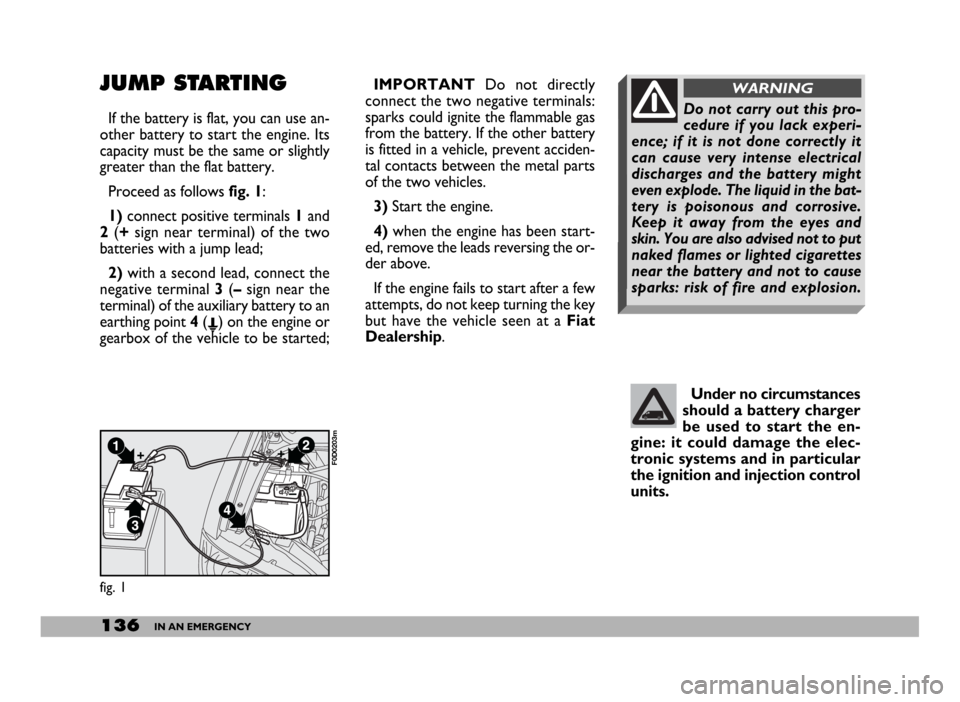
Proceed as follows fig. 1:
1) connect positive terminals1and
2 (+sign near terminal) of the two
batteries with a jump lead;
2) with a second lead, connect the
negative terminal 3(– sign near the
terminal) of the auxiliary battery to an
earthing point 4(E) on the engine or
gearbox of the vehicle to be started;IMPORTANTDo not directly
connect the two negative terminals:
sparks could ignite the flammable gas
from the battery. If the other battery
is fitted in a vehicle, prevent acciden-
tal contacts between the metal parts
of the two vehicles.
3) Start the engine.
4)when the engine has been start-
ed, remove the leads reversing the or-
der above.
If the engine fails to start after a few
attempts, do not keep turning the key
but have the vehicle seen at a Fiat
Dealership.
fig. 1
F0D0203m
Under no circumstances
should a battery charger
be used to start the en-
gine: it could damage the elec-
tronic systems and in particular
the ignition and injection control
units.
Do not carry out this pro-
cedure if you lack experi-
ence; if it is not done correctly it
can cause very intense electrical
discharges and the battery might
even explode. The liquid in the bat-
tery is poisonous and corrosive.
Keep it away from the eyes and
skin. You are also advised not to put
naked flames or lighted cigarettes
near the battery and not to cause
sparks: risk of fire and explosion.
WARNING
Page 154 of 258
153IN AN EMERGENCY
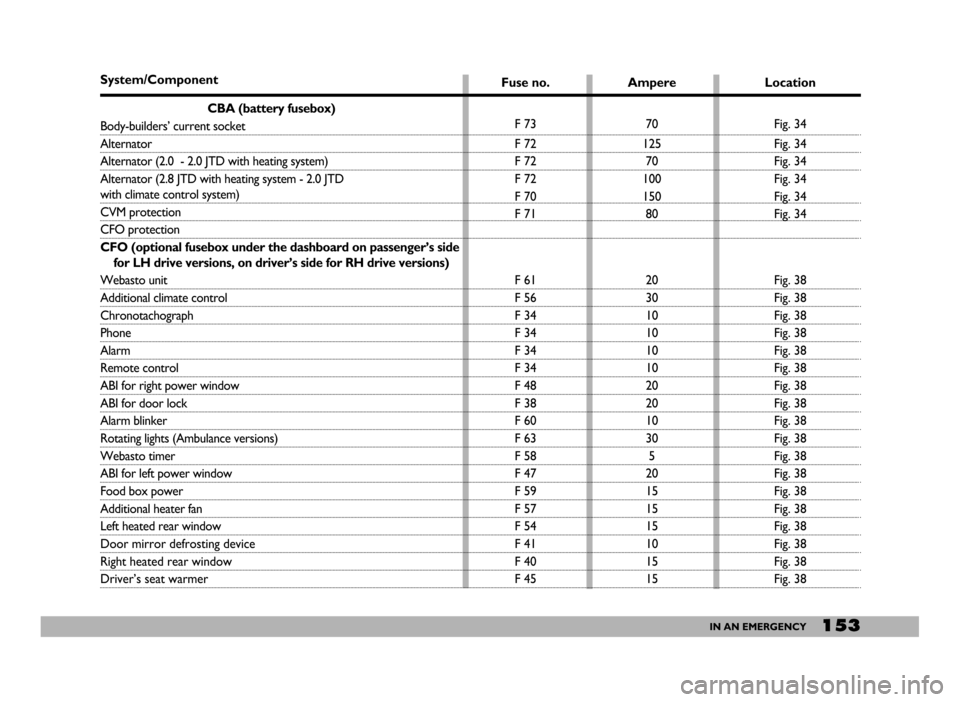
System/Component
CBA (battery fusebox)
Body-builders’ current socket
Alternator
Alternator (2.0 - 2.0 JTD with heating system)
Alternator (2.8 JTD with heating system - 2.0 JTD
with climate control system)
CVM protection
CFO protection
CFO (optional fusebox under the dashboard on passenger’s side
for LH drive versions, on driver’s side for RH drive versions)
Webasto unit
Additional climate control
Chronotachograph
Phone
Alarm
Remote control
ABI for right power window
ABI for door lock
Alarm blinker
Rotating lights (Ambulance versions)
Webasto timer
ABI for left power window
Food box power
Additional heater fan
Left heated rear window
Door mirror defrosting device
Right heated rear window
Driver’s seat warmerFuse no.
F 73
F 72
F 72
F 72
F 70
F 71
F 61
F 56
F 34
F 34
F 34
F 34
F 48
F 38
F 60
F 63
F 58
F 47
F 59
F 57
F 54
F 41
F 40
F 45Ampere
70
125
70
100
150
80
20
30
10
10
10
10
20
20
10
30
5
20
15
15
15
10
15
15Location
Fig. 34
Fig. 34
Fig. 34
Fig. 34
Fig. 34
Fig. 34
Fig. 38
Fig. 38
Fig. 38
Fig. 38
Fig. 38
Fig. 38
Fig. 38
Fig. 38
Fig. 38
Fig. 38
Fig. 38
Fig. 38
Fig. 38
Fig. 38
Fig. 38
Fig. 38
Fig. 38
Fig. 38
Page 156 of 258
155IN AN EMERGENCY
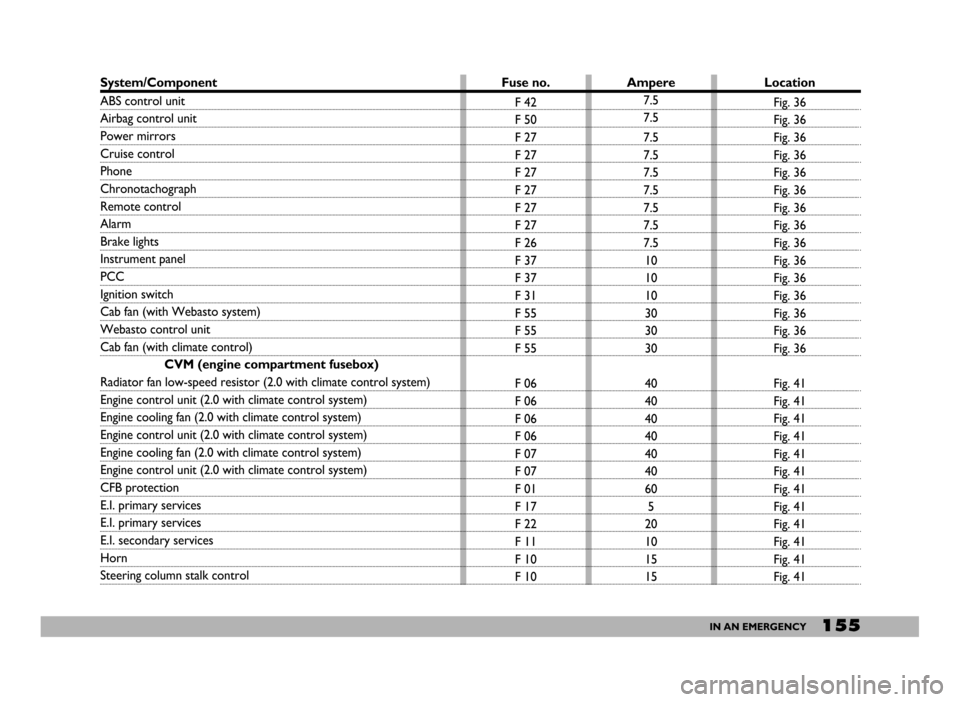
System/Component
ABS control unit
Airbag control unit
Power mirrors
Cruise control
Phone
Chronotachograph
Remote control
Alarm
Brake lights
Instrument panel
PCC
Ignition switch
Cab fan (with Webasto system)
Webasto control unit
Cab fan (with climate control)
CVM (engine compartment fusebox)
Radiator fan low-speed resistor (2.0 with climate control system)
Engine control unit (2.0 with climate control system)
Engine cooling fan (2.0 with climate control system)
Engine control unit (2.0 with climate control system)
Engine cooling fan (2.0 with climate control system)
Engine control unit (2.0 with climate control system)
CFB protection
E.I. primary services
E.I. primary services
E.I. secondary services
Horn
Steering column stalk controlFuse no.
F 42
F 50
F 27
F 27
F 27
F 27
F 27
F 27
F 26
F 37
F 37
F 31
F 55
F 55
F 55
F 06
F 06
F 06
F 06
F 07
F 07
F 01
F 17
F 22
F 11
F 10
F 10Ampere
7.5
7.5
7.5
7.5
7.5
7.5
7.5
7.5
7.5
10
10
10
30
30
30
40
40
40
40
40
40
60
5
20
10
15
15Location
Fig. 36
Fig. 36
Fig. 36
Fig. 36
Fig. 36
Fig. 36
Fig. 36
Fig. 36
Fig. 36
Fig. 36
Fig. 36
Fig. 36
Fig. 36
Fig. 36
Fig. 36
Fig. 41
Fig. 41
Fig. 41
Fig. 41
Fig. 41
Fig. 41
Fig. 41
Fig. 41
Fig. 41
Fig. 41
Fig. 41
Fig. 41
Page 157 of 258
156IN AN EMERGENCY
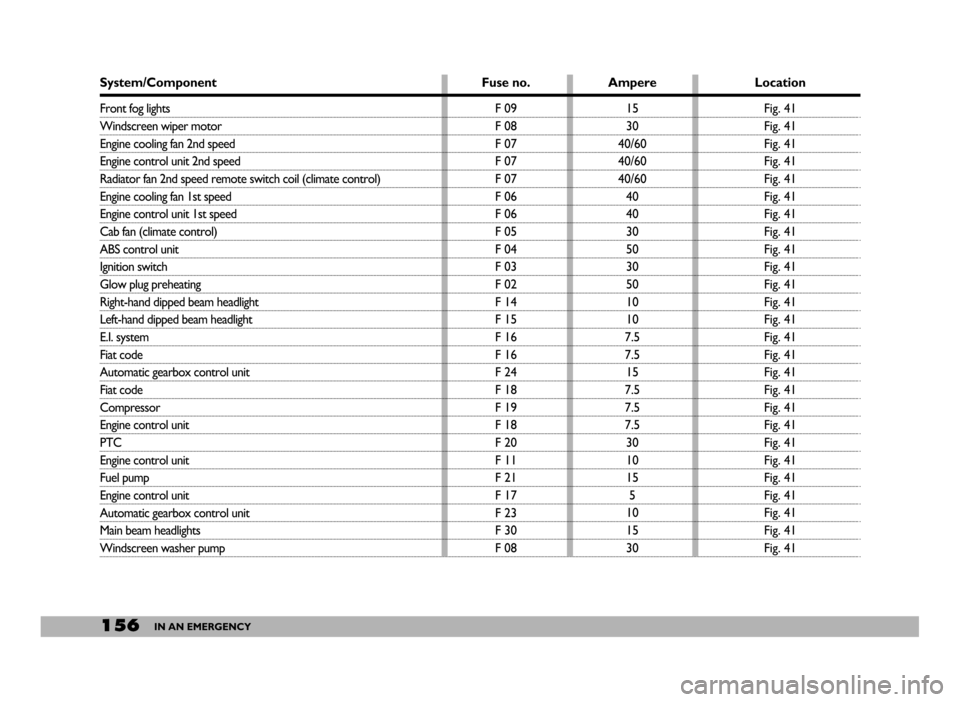
System/Component
Front fog lights
Windscreen wiper motor
Engine cooling fan 2nd speed
Engine control unit 2nd speed
Radiator fan 2nd speed remote switch coil (climate control)
Engine cooling fan 1st speed
Engine control unit 1st speed
Cab fan (climate control)
ABS control unit
Ignition switch
Glow plug preheating
Right-hand dipped beam headlight
Left-hand dipped beam headlight
E.I. system
Fiat code
Automatic gearbox control unit
Fiat code
Compressor
Engine control unit
PTC
Engine control unit
Fuel pump
Engine control unit
Automatic gearbox control unit
Main beam headlights
Windscreen washer pumpFuse no.
F 09
F 08
F 07
F 07
F 07
F 06
F 06
F 05
F 04
F 03
F 02
F 14
F 15
F 16
F 16
F 24
F 18
F 19
F 18
F 20
F 11
F 21
F 17
F 23
F 30
F 08Ampere
15
30
40/60
40/60
40/60
40
40
30
50
30
50
10
10
7.5
7.5
15
7.5
7.5
7.5
30
10
15
5
10
15
30Location
Fig. 41
Fig. 41
Fig. 41
Fig. 41
Fig. 41
Fig. 41
Fig. 41
Fig. 41
Fig. 41
Fig. 41
Fig. 41
Fig. 41
Fig. 41
Fig. 41
Fig. 41
Fig. 41
Fig. 41
Fig. 41
Fig. 41
Fig. 41
Fig. 41
Fig. 41
Fig. 41
Fig. 41
Fig. 41
Fig. 41
Page 178 of 258
177VEHICLE MAINTENANCE
ELECTRONIC
CONTROL UNIT
When the vehicle is being used nor-
mally, special measures are not nec-
essary.
The following instructions must be
followed very carefully however, if
you work on the electrical system or
in cases where emergency starting is
necessary:
– never disconnect the battery from
the electric system while the engine is
running;
– disconnect the battery from the
electric system if you are recharging it;
– never perform emergency starting
with a battery charger. Always use an
auxiliary battery;
– be particularly careful when con-
necting the battery to the electric sys-
tem. Make sure that the polarity is
correct and that the connection is ef-
ficient;
– do not connect or disconnect the
terminals of the electronic units while
the ignition key is at MAR;
– do not check polarity through
sparking;– disconnect the electronic control
units if you are electrically welding the
vehicle body. Remove the units if tem-
peratures exceed 80 °C (special op-
erations on the bodywork, etc.).
IMPORTANTIf the sound system
or vehicle alarm systems are not in-
stalled correctly, they can interfere
with the working of the electronic
control units.
Modifications or repairs to
the electrical system car-
ried out incorrectly and without
bearing the features of the system
in mind can cause malfunctions
with the risk of fire.
WARNING
SPEED LIMITER
On certain version, the injection con-
trol unit is set to limit the vehicle
speed at a max. preset limit.
Speed limits are the following:
– for Minibus versions (M2 homolo-
gation category): 100 km/h;
– for good Transport versions (ve-
hicle dead weight: > 3.5 t) (N2 ho-
mologation category): 90 km/h;
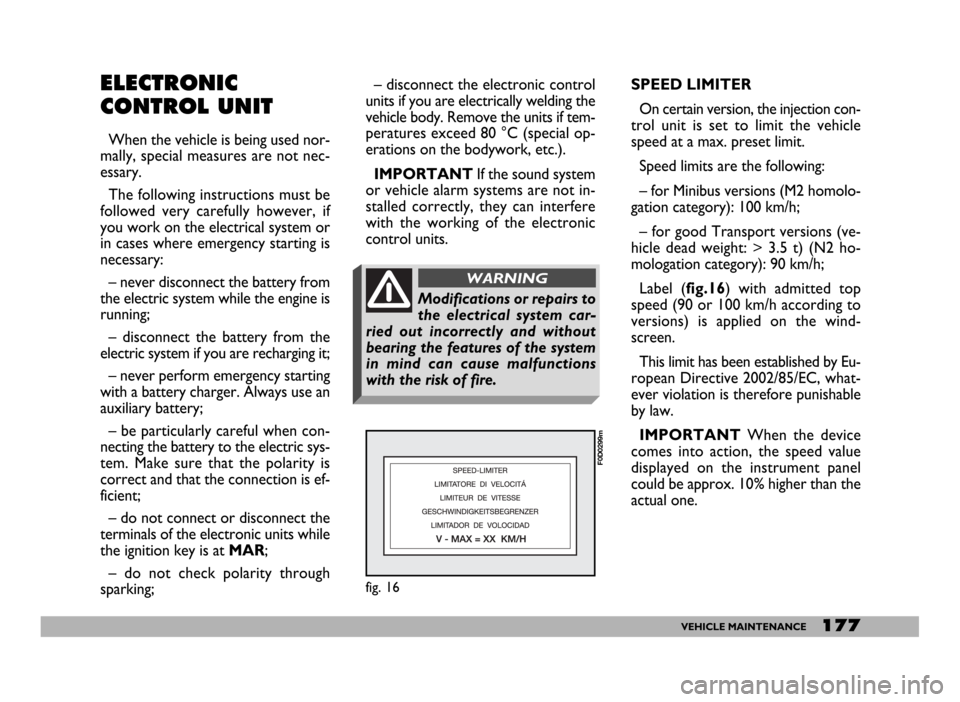
Label (fig.16) with admitted top
speed (90 or 100 km/h according to
versions) is applied on the wind-
screen.
This limit has been established by Eu-
ropean Directive 2002/85/EC, what-
ever violation is therefore punishable
by law.
IMPORTANTWhen the device
comes into action, the speed value
displayed on the instrument panel
could be approx. 10% higher than the
actual one.
fig. 16
F0D0299m
Page 249 of 258

248INDEX
Cruise Control ............................ 68
Current socket ............................ 76
Dashboard ................................. 5
Demisting ...................................... 56
Diesel fuel filter ........................... 173
Differential .................................... 216
Digital clock .................................. 32
Dimensions ........................... 222-224
Dipped beam headlights ............ 65
- bulb replacement ................... 143
Direction indicators ................... 66
- front bulb replacement ......... 145
- rear bulb replacement .......... 146
- side bulb replacement ........... 145
Doors ............................................ 79
- 270° opening ........................... 82
- central door locking .............. 83
- driver’s cab doors .................. 79
- rear door ................................. 81
- remote control ....................... 9- side sliding door ..................... 80
- window regulators ................ 83
Driving style affecting fuel
consumption .............................. 124
Electric windows ....................... 83
Electronic alarm .......................... 11
Electronic automatic gearbox .. 110
Electronic control units ............. 177
- speed limiter ........................... 177
Emergency starting .............. 107-135
Emission control devices ........... 128
Engine ............................................ 214
- starting diesel engines ........... 106
- starting petrol engines .......... 105
- stopping the engine ............... 108
- supply/ignition ......................... 215
- warming up the engine ......... 107
Engine/bodywork codes ............ 187
Engine compartment .................. 183
Engine coolant gauge .................. 30
Engine coolant level .................... 170Engine marking ............................ 185
Engine oil ....................................... 169
- consumption ........................... 170
Engine oil level ............................. 169
Engine oil level gauge ................. 32
EOBD system .............................. 95
Fiat Code (system) ................... 7
First aid kit .................................... 161
Flashing the headlights ............... 66
Fluids and lubricants ................... 241
Front/rear ceiling light
replacement ............................... 148
Front fog light replacement ...... 145
Fuel cut-off switch ...................... 72
Fuel gauge ..................................... 31
Fuses (replacement) ................... 149
Getting to know
your vehicle............................ 5
Getting the best out of
your vehicle............................ 105