control unit FIAT DUCATO 244 2005 3.G User Guide
[x] Cancel search | Manufacturer: FIAT, Model Year: 2005, Model line: DUCATO 244, Model: FIAT DUCATO 244 2005 3.GPages: 258, PDF Size: 4.05 MB
Page 84 of 258
83GETTING TO KNOW YOUR VEHICLE
CENTRAL DOOR LOCKING
IMPORTANTCentral door locking
is active on all doors if front doors (cab
doors) are used for opening/closing.
When operating one of the rear or
side door lock, only that door will be
locked/unlocked.
From the outside
When the doors are closed, insert
and turn the key in the lock of one of
the driver’s cab doors.
From the inside
When the doors are closed, press
(to lock) or lift (to unlock) one of the
driver’s cab door safety sill buttons.
IMPORTANT If one of the cab
doors is not shut properly or there is
a failure in the system, the central
locking feature will not work and, af-
ter some attempts, the device will stop
working for about 2 minutes. In these
two minutes, the doors can be locked
or unlocked manually without the
electrical system coming into play.After the two minutes, the control
unit is ready to receive commands
once more. If the reason for the mal-
functioning has been removed, the de-
vice will start to work properly again.
If not, it will cut once more.
FRONT DOOR WINDOW
REGULATORS
Manual control
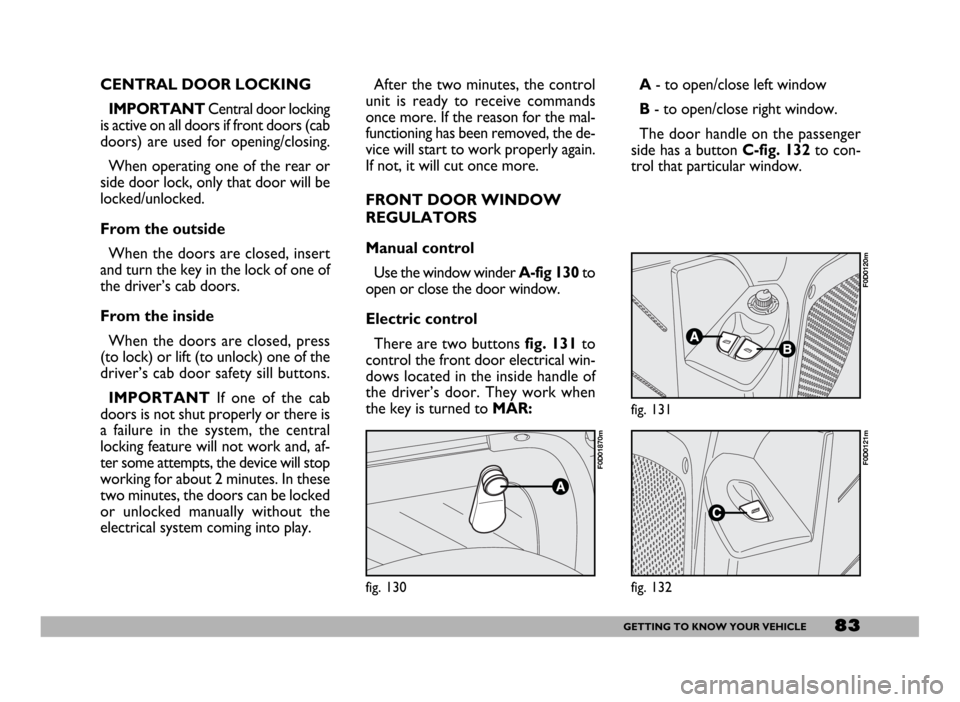
Use the window winderA-fig 130to
open or close the door window.
Electric control
There are two buttons fig. 131to
control the front door electrical win-
dows located in the inside handle of
the driver’s door. They work when
the key is turned to MAR:A- to open/close left window
B- to open/close right window.
The door handle on the passenger
side has a button C-fig. 132to con-
trol that particular window.
fig. 130
F0D01870m
fig. 131
F0D0120m
fig. 132
F0D0121m
Page 90 of 258
89GETTING TO KNOW YOUR VEHICLE
Warning light >alone,
with the engine running,
normally indicates a fault in the
ABS system only. In this case, the
braking system is still efficient,
though without the anti-locking de-
vice. Under these conditions, per-
formance of the EBD system may
be reduced. In this case too, you are
advised to go immediately to the
nearest Fiat Dealership, driving in
such a way to avoid sharp braking
to have the system checked over.
WARNING
If the xbrake fluid low
warning light comes on,
stop the vehicle immediately and
contact the nearest Fiat Dealership.
Fluid leaks from the hydraulic sys-
tem, in fact, can compromise brake
system operation, both traditional
systems and systems with ABS.
WARNING
Braking while cornering always re-
quires extreme care even when using
ABS.
The most important advice to follow
is this:
If you follow these tips you will be
able to brake better in any situation.
IMPORTANTVehicles fitted with
ABS shall only be fitted with wheel rims,
tyres and brake pads of the make and
model approved by the vehicle manu-
facturer.The system is completed with an elec-
tronic brakeforce distributor called
EBD which improves braking system
performance by means of the ABSsys-
tem control unit and sensors.
When the ABS cuts in, and
you feel the brake pedal
pulsating, do not remove your foot,
but keep it pressed. In doing so you
will stop in the shortest amount of
space possible under the current
road conditions.
WARNING
The vehicle is fitted with an
electronic brakeforce dis-
tributor (EBD). The >and x
warning lights come on at the same
time when the engine is running to
indicate that there is an EBD sys-
tem failure. In this case violent
braking may be accompanied by
early rear wheel locking with the
possibility of skidding. Drive ex-
tremely carefully to the nearest Fi-
at Dealership to have the system
checked.
WARNING
Page 92 of 258
91GETTING TO KNOW YOUR VEHICLE
Therefore, failure to come into ac-
tion in the above circumstances does
not mean that the system is not work-
ing properly.
Airbag system efficiency is constant-
ly monitored by an electronic control
unit.
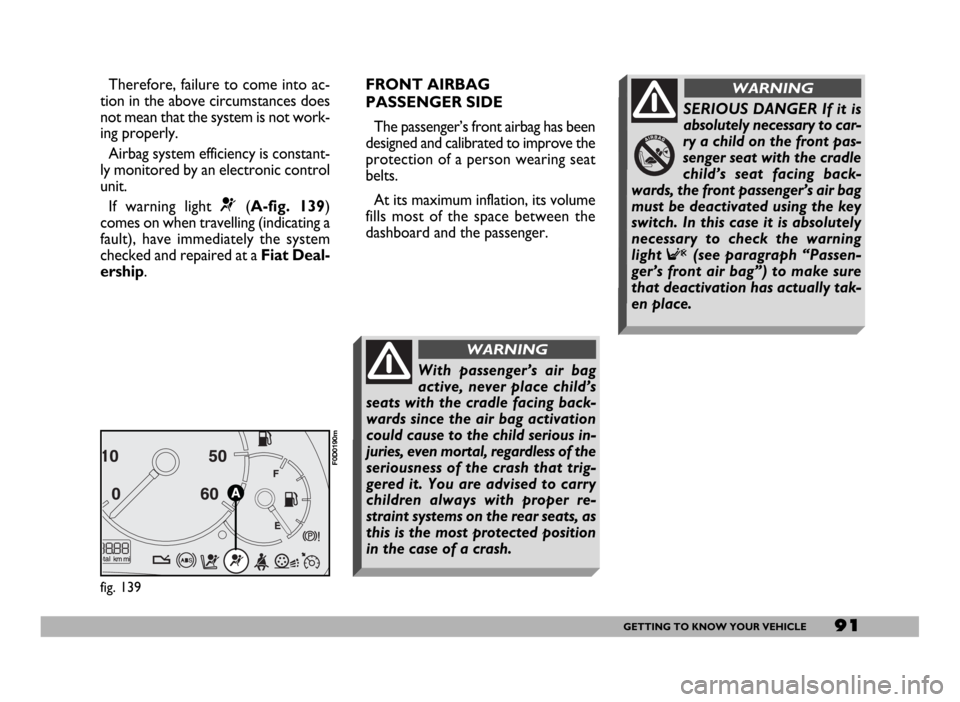
If warning light
¬(A-fig. 139)
comes on when travelling (indicating a
fault), have immediately the system
checked and repaired at a Fiat Deal-
ership.FRONT AIRBAG
PASSENGER SIDE
The passenger’s front airbag has been
designed and calibrated to improve the
protection of a person wearing seat
belts.
At its maximum inflation, its volume
fills most of the space between the
dashboard and the passenger.
fig. 139
F0D0190m
SERIOUS DANGER If it is
absolutely necessary to car-
ry a child on the front pas-
senger seat with the cradle
child’s seat facing back-
wards, the front passenger’s air bag
must be deactivated using the key
switch. In this case it is absolutely
necessary to check the warning
light
F(see paragraph “Passen-
ger’s front air bag”) to make sure
that deactivation has actually tak-
en place.
WARNING
With passenger’s air bag
active, never place child’s
seats with the cradle facing back-
wards since the air bag activation
could cause to the child serious in-
juries, even mortal, regardless of the
seriousness of the crash that trig-
gered it. You are advised to carry
children always with proper re-
straint systems on the rear seats, as
this is the most protected position
in the case of a crash.
WARNING
Page 94 of 258

93GETTING TO KNOW YOUR VEHICLE
In the event of low speed side colli-
sions (for which seat belts are suffi-
cient protection), the airbag is not trig-
gered. Also in this case, it is important
to wear seat belts at all times. This will
ensure correct positioning of the pas-
senger and prevent being projected
from the vehicle in the event of very
violent crashes.
The side bag (driver and passenger)
is therefore not a replacement of but
is complementary to the use of belts,
which should always be worn, as spec-
ified by law in Europe and most non-
European countries.GENERAL WARNINGS
The front and/or side airbags
may be deployed if the vehicle is
subject to heavy knocks or acci-
dents involving the underbody
area, such as for example violent
shocks against steps, kerbs or low
obstacles, falling of the vehicle in
big holes or sags in the road.
Triggering of the airbags re-
leases a small amount of powder.
This powder is not harmful and
does not indicate the start of fire.
The unfold cushion surface and
the vehicle interiors could be cov-
ered by dusty remains: this dust
could irritate skin and eyes. In
case of contact, wash yourself us-
ing neutral soap and water.The airbag system has a validity
of 14 years as to the pyrotechnic
charge and 10 years as to the coil
contact (see the plate set on the
left front door post near hinges).
As these dates approach, con-
tact Fiat Dealership for replace-
ment.
If an accident has triggered the
airbag, contact a Fiat Dealership
so that the whole safety device,
electronic control unit, belt, pre-
tensioners can be replaced and
have the electric system checked
over.
All control, repair and replace-
ment operations concerning the
airbags must only be carried out
at a Fiat Dealership.
If you are having the vehicle
scrapped, have the airbag system
deactivated at a Fiat Dealership
first.
Page 95 of 258
94GETTING TO KNOW YOUR VEHICLE
If the vehicle changes owner-
ship, the new owner must be in-
formed of the method of use of
airbags and the above warnings
and also be given this Owner
Handbook.
The triggering of pretensioners
and front and side airbags is de-
cided in a differentiated manner
by the electronic control unit, de-
pending on the type of crash. The
failure to deploy one or more of
them does not mean that the sys-
tem is not working properly.
If the ¬warning light does
not turn on when turning
the ignition key to MAR or if it stays
on when travelling, this could indi-
cate a failure in safety retaining sys-
tems; under this condition air bags
or pretensioners could not trigger
in the event of collision or, in a re-
stricted number of cases, they could
trigger accidentally. Stop the car
and contact Fiat Dealership to have
the system checked immediately.
WARNING
If the vehicle has been
stolen or an attempt to
steal it has been made, if it has
been subjected to vandals or floods,
have the airbag system checked by
Fiat Dealership.
WARNING
Do not apply stickers or
other objects to the steer-
ing wheel or to the airbag console
on the passenger’s side. Never trav-
el with objects on your lap, in front
of your chest or with a pipe, pencil,
etc. between your lips; injury may
result in the event of the airbag be-
ing triggered.
WARNING
Always keep your hands on
the steering wheel rim
when driving, so that if the airbag
is triggered, it can inflate without
meeting any obstacles which could
cause serious harm to you. Do not
drive with the body bent forwards,
keep the seat back rest in the erect
position and lean your back well
against it.
WARNING
When the passenger’s front
airbag is active (passenger
front airbag deactivation switch at
ON), the
Fwarning light will
come on for approx. 4 seconds and
flash for other four seconds when
the ignition key is turned to MAR to
remind the driver that the passen-
ger’s front and side airbags (where
provided) will be fired in the event
of a crash. The warning light should
go off immediately afterwards.
WARNING
Page 97 of 258
96GETTING TO KNOW YOUR VEHICLE
The action of the ASR is particularly
helpful in the following circumstances:
– slipping of the inner wheel due to
the effect of dynamic load changes or
excessive acceleration.
– too much power transmitted to
the wheels also in relation to the con-
ditions of the road surface.
– acceleration on slippery, snowy or
frozen surfaces.
– in the case of loss of grip on a wet
surface (aquaplaning). Furthermore, the system is equipped
with a connector for interfacing with
specific tools used to read the error
codes stored in the control unit mem-
ory along with a set of diagnostic and
engine specific parameters.ASR SYSTEM
(Antislip Regulation)
The ASR system controls the vehicle
drive and cuts in automatically every
time one or both driving wheels slip.
In slipping conditions, two different
control systems are activated:
– if the slipping involves both the dri-
ving wheels, the ASR function inter-
venes reducing the power transmitted
by the engine;
– if slipping involves only one driving
wheel, the ASR system cuts in auto-
matically braking the wheel that is slip-
ping.
IMPORTANTAfter eliminating the
problem, your Fiat Dealershipwill
run a bench test to fully check the sys-
tem. In some cases, a long road test
may be required.Contact a Fiat Dealer-
ship as soon as possible if
the Uwarning light ei-
ther does not come on when the
key is turned to MAR or comes
on, with fixed or flashing light,
when travelling. Warning light U
operation can be checked by
means of special equipment by
traffic agents. Always comply
with the road traffic regulations
in force in the Country where you
are travelling.
The performance of the
system, in terms of active
safety should not induce the driver
to take pointless and unnecessary
risks. The style of driving must in
any case always be adapted to the
conditions of the road surface, vis-
ibility and traffic. Road safety is al-
ways the driver’s responsibility.
WARNING
Page 114 of 258
113GETTING THE BEST OUT OF YOUR VEHICLE
N - Neutral
This corresponds to the neutral po-
sition of a standard manual gearbox.
This position is to be used if the ve-
hicle is to be pushed or towed.
With the engine idling and
the gearshift lever at N the
vehicle tends to move by inertia if
it is not on a level surface: keep the
brake pedal pressed when the lever
is at N.
WARNING
D - Forward gear
This is the position to be used when
driving forward normally. The elec-
tronic control unit controls automat-
ic engagement of the 4 gears depend-
ing on the position of the accelerator,
driving speed, engine rpm, longitudinal
and transversal acceleration and the
type of road.
The electronic gearbox can chose
between different operating pro-
grammes, which range between com-
fortable economy driving and sporty
driving coming into operation between
the lowest and the highest speed.
Pressing the accelerator pedal quick-
ly the gearbox will immediately select
the sportier programme to meet the
request for increased performance. To
disengage the function release the ac-
celerator by at least 1/4 of the stroke. In the same way, during braking a
lower gear is engaged to better exploit
the braking action of the engine. If
there is another bend the new ratio
will be engaged already when slowing
down before the bend, this way at the
end of the bend the gearbox will not
have to shift gear to cope with accel-
eration.
Kickdown
To obtain optimum acceleration, for
example when overtaking, the gearbox
will kickdown by two gears simply by
quickly pressing fully home the accel-
erator pedal (in 1/10 of a second).
Engagement of the next longer ratio
will take place when the maximum
rpm limit is reached.
With the engine at idle
speed and the gearshift
lever at D, the vehicle tends to move
also on a level surface: keep the
brake pedal pressed until moving off.
WARNING
Page 115 of 258
114GETTING THE BEST OUT OF YOUR VEHICLE
SEQUENTIAL MANUAL
OPERATION
For the sequential manual operation
mode, move the lever to the left sec-
tor B-fig. 4with two positions:
(+) = engagement of the higher ra-
tio;
(–) = engagement of the lower ratio.
Moving the gearshift lever to the
manual sector is only possible from
position D: the ratio selected by the
automatic gearbox when the lever is
moved will remain engaged.
When the sequential manual mode is
selected, the display shows the en-
gaged gear fig. 6.
To select the higher ratio move the
lever in the (+) direction and to shift
down move the lever to (–).IMPORTANTIf the request to
downshift would cause engine
overevving, this is eliminated by the
electronic control unit. Moreover, if
the manually engaged gear causes en-
gine overevving, the electronic control
unit will shift gear automatically to the
most appropriate one (AUTO-UP).
When the sequential man-
ual mode has been set and
a high gear is engaged, to acceler-
ate rapidly, for example to over-
take, it is necessary to downshift
by hand: the kickdown feature
cannot be engaged!
WARNING
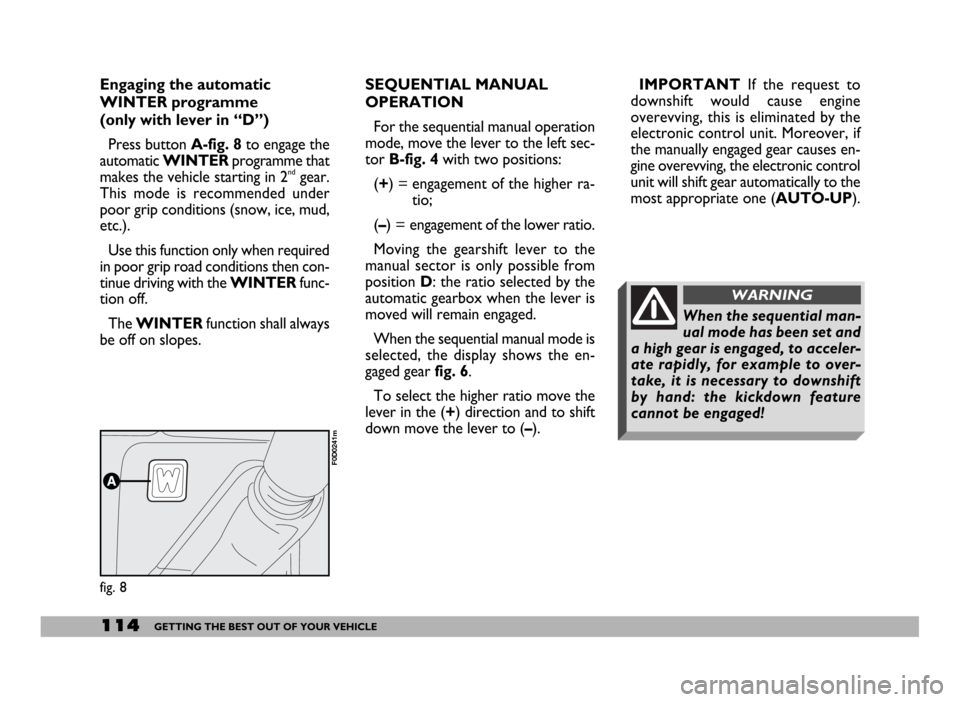
Engaging the automatic
WINTER programme
(only with lever in “D”)
Press button A-fig. 8to engage the
automatic WINTERprogramme that
makes the vehicle starting in 2
ndgear.
This mode is recommended under
poor grip conditions (snow, ice, mud,
etc.).
Use this function only when required
in poor grip road conditions then con-
tinue driving with the WINTERfunc-
tion off.
The WINTERfunction shall always
be off on slopes.
fig. 8
F0D0241m
Page 118 of 258

117GETTING THE BEST OUT OF YOUR VEHICLE
CONSTRUCTION FEATURES
DUCATO automatic gearbox is con-
trolled electronically with four for-
ward gears and reverse.
It is controlled by an electronic con-
trol unit which handles:
– the torque distributor;
– gearshifting;
– specific programmes.
The gearbox is coupled with a flow
power torque distributor with piloted
antislip device which makes it possible
to obtain demultiplication ratios.
The characteristic of this gearbox
which works without idle gear enables:
– higher compactness and weight re-
duction;
– improved output due to less fric-
tion;
– lower stress of transmission com-
ponents.GENERAL FEATURES
Electronic gearbox control makes it
possible to obtain gearshifting suited
to momentary engine characteristics
with a certain elasticity.
The electronic control unit has the
following task:
– adapting the oil pressure for
gearshifting to the engine torque;
– activating safety functions;
– defining the manual gearshifting
programme;
– system diagnostics.
For controlling these operating log-
ics the control unit uses the follow-
ing signals:
– engine rpm;
– engine temperature;
– engine torque;
– vehicle speed;
– gearbox oil temperature;– gearshift lever position;
– accelerator pedal position;
– brake pedal position.
The control unit also communicates
with the injection system electronic
control unit.
Conditions of use analysed by
the control unit
The control unit analyses each single
condition of use of the vehicle, dis-
criminating it on the basis of the sig-
nals received from the various sensors.
Analysed conditions are the follow-
ing:
– starting (position/accelerator ped-
al changing speed);
– acceleration (accelerator pedal
completely pushing down speed);
– full load (number of engine full load
kickdown signals or position mainte-
nance time);
Page 119 of 258

118GETTING THE BEST OUT OF YOUR VEHICLE
– braking (accelerator pedal release
time and braking system operation);
– type of programme (gearshift se-
lector lever position);
– winter driving (driving wheel
torque reduction);
– driving with trailer or uphill (vehi-
cle speed in relation to transmitted
torque)
– driving downhill (vehicle accelera-
tion in relation to the position of the
accelerator pedal);
– driving in towns or queues (accel-
erator pedal position and vehicle
speed);
– gear required by the driver
(gearshift lever position);
– cold starting (engine temperature).Gearshift programme control
To optimise vehicle handling the
electronic control unit has the fol-
lowing memorised programmes:
– automatic operation;
– manual operation;
– winter driving (to be selected
through buttonWINTER);
– engine warming up;
– protection against excessive gear-
box oil temperature .Automatic programme
This comprises 16 gearshifting pro-
grammes.
In relation to the vehicle speed and
torque transmitted, the control unit
detects the slope of the road surface
and depending on the sporty features
chosen, it autonomously chooses the
programme most suited to the situa-
tion.
During gearshifting, the gearbox con-
trol unit asks the injection control unit
to momentarily reduce the torque.
The duration of torque reduction
varies depending on the travelling con-
ditions.