starting FIAT DUCATO 244 2005 3.G Owner's Manual
[x] Cancel search | Manufacturer: FIAT, Model Year: 2005, Model line: DUCATO 244, Model: FIAT DUCATO 244 2005 3.GPages: 258, PDF Size: 4.05 MB
Page 127 of 258
126GETTING THE BEST OUT OF YOUR VEHICLE
CONDITIONS OF USE
Cold starting
Frequent cold starting will not enable
the engine to reach optimal running
temperature. It follows, therefore,
that consumption will be higher (from
+15 to +30% in towns) as will the
production of toxic emissions.
Traffic and road conditions
Heavy traffic and higher consumption
are synonymous: for example, when
driving slowly with frequent use of low-
er gears or in towns where there are
numerous traffic lights.
Winding roads, mountain roads and
bumpy roads also have a negative effect
on consumption.
Enforced halts
During prolonged stops (traffic lights,
level crossings, etc.) the engine should
be switched off.LOAD
RECOMMENDATIONS
The version of the Ducato you are
driving has been designed and ap-
proved on the basis of several set
maximum weights (see the tables
“Weights” in section “Technical spec-
ifications”):
– kerb weight
– payload
– total weight
– total weight on the front axle
– total weight on the rear axle
– towable weight
fig. 10
F0D0047m
Each of these limits must be
borne in mind and MUST
NEVER BE EXCEEDED under any
circumstances. In particular, never
exceed the maximum weight per-
mitted on the front and rear axles
when arranging loads in vehicle (es-
pecially for special version vehicles).
WARNING
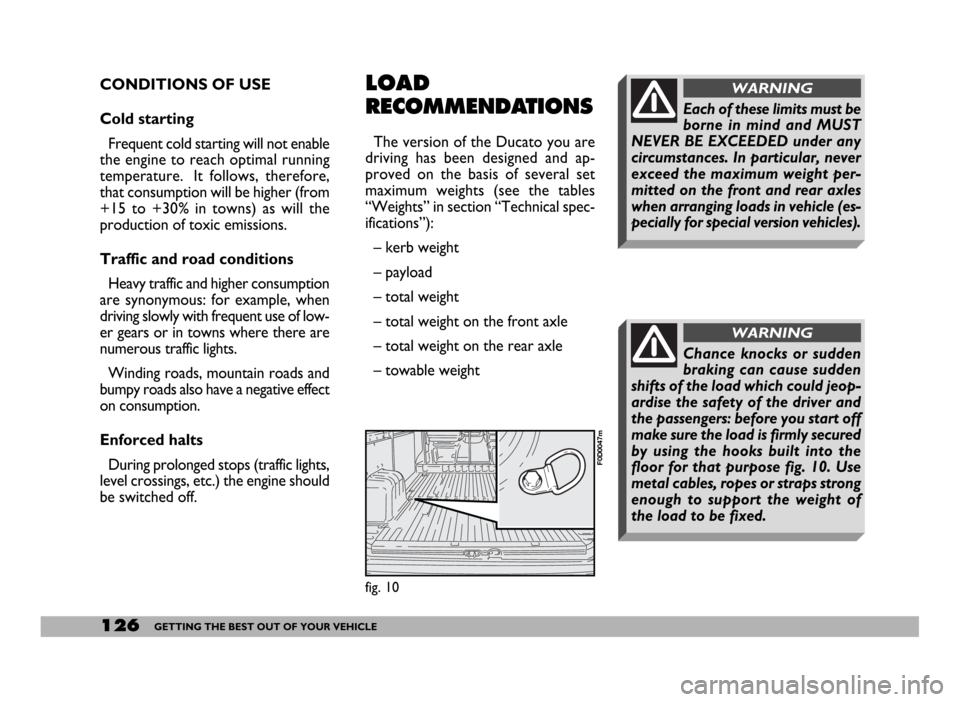
Chance knocks or sudden
braking can cause sudden
shifts of the load which could jeop-
ardise the safety of the driver and
the passengers: before you start off
make sure the load is firmly secured
by using the hooks built into the
floor for that purpose fig. 10. Use
metal cables, ropes or straps strong
enough to support the weight of
the load to be fixed.
WARNING
Page 129 of 258
128GETTING THE BEST OUT OF YOUR VEHICLE
LOOKING AFTER EMISSION
CONTROL DEVICES
The correct use of pollution control
devices not only ensures respect for
the environment but also has an effect
on the vehicle’s performance.
Keeping these devices in good con-
ditions is therefore a fundamental rule
for driving that is easy on your pock-
et and on the environment too.
The first step to take is to follow the
Service Schedule to the letter.
If your vehicle has a petrol engine
with catalytic converter use only un-
leaded petrol.
if you have trouble starting, do not
keep turning the ignition key for long
periods. Be especially careful to avoid
bump starting the vehicle by pushing,
towing or rolling downhill: these are
all manoeuvres that can damage the
catalyst.
Use an auxiliary battery for start-ups
only.If the engine begins to “loose its
smoothness” when travelling, contin-
ue your journey but reduce the de-
mands you are making on the engine
and have the vehicle seen to at a Fi-
at Dealershipas soon as you can.
When the instrument panel fuel re-
serve warning light comes on, fill up as
soon as possible. A low fuel level may
cause an uneven supply of fuel to the
engine with inevitable increase in the
temperature of the exhaust gas and se-
rious damage to the catalytic con-
verter.
Never run the engine with one or
more spark plugs disconnected, even
for testing purposes.
Do not warm up the engine by let-
ting it idle for a while before moving
off unless the outside temperature is
very low and, even in this case, only
do so for less than thirty seconds.
Do not install heat shields and do not
remove those already fitted to the cat-
alytic converter and exhaust pipe.
Do not allow anything to
be sprayed onto the cat-
alytic converter, lambda sensor and
exhaust pipe.
WARNING
Ignoring the above rules
may lead to fire.
WARNING
When functioning normal-
ly the catalytic converter
reaches high temperatures. For this
reason do not park the vehicle over
inflammable material (grass, dry
leaves, pine needles, etc.): fire haz-
ard.
WARNING
Page 137 of 258
136IN AN EMERGENCY
JUMP STARTING
If the battery is flat, you can use an-
other battery to start the engine. Its
capacity must be the same or slightly
greater than the flat battery.
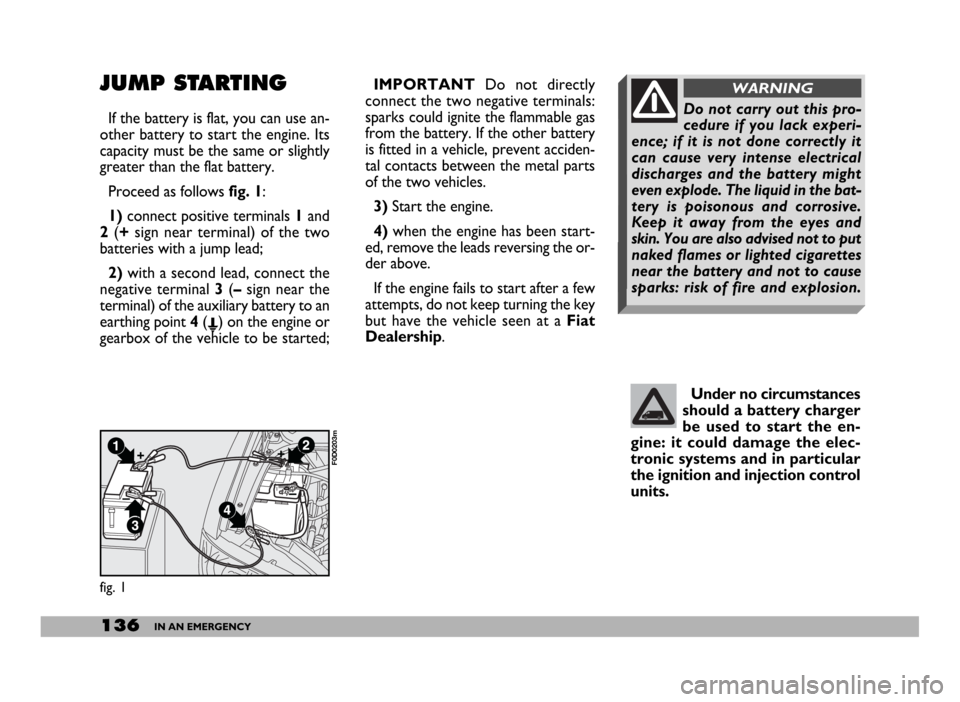
Proceed as follows fig. 1:
1) connect positive terminals1and
2 (+sign near terminal) of the two
batteries with a jump lead;
2) with a second lead, connect the
negative terminal 3(– sign near the
terminal) of the auxiliary battery to an
earthing point 4(E) on the engine or
gearbox of the vehicle to be started;IMPORTANTDo not directly
connect the two negative terminals:
sparks could ignite the flammable gas
from the battery. If the other battery
is fitted in a vehicle, prevent acciden-
tal contacts between the metal parts
of the two vehicles.
3) Start the engine.
4)when the engine has been start-
ed, remove the leads reversing the or-
der above.
If the engine fails to start after a few
attempts, do not keep turning the key
but have the vehicle seen at a Fiat
Dealership.
fig. 1
F0D0203m
Under no circumstances
should a battery charger
be used to start the en-
gine: it could damage the elec-
tronic systems and in particular
the ignition and injection control
units.
Do not carry out this pro-
cedure if you lack experi-
ence; if it is not done correctly it
can cause very intense electrical
discharges and the battery might
even explode. The liquid in the bat-
tery is poisonous and corrosive.
Keep it away from the eyes and
skin. You are also advised not to put
naked flames or lighted cigarettes
near the battery and not to cause
sparks: risk of fire and explosion.
WARNING
Page 138 of 258
137IN AN EMERGENCY
BUMP STARTING IF A TYRE IS
PUNCTURED
General instructions
Observe the instruc-
tions on this and the fol-
lowing pages to use the
jack and spare wheel correctly.Catalysed vehicles must
not be bump started
(pushed, towed or
coasted downhill) as this could
cause fuel to flow into the cat-
alytic exhaust system and dam-
age it beyond repair.
Never start the engine
when the vehicle is jacked
up.
WARNING
Remember that until the
engine has started the
brake booster and power steering
systems will not work and a greater
effort will therefore be required to
depress the brake pedal or turn the
steering wheel.
WARNING
If you are towing a trailer,
remove the trailer before
jacking up the vehicle.
WARNING
The jack should only be
used to changed a wheel on
the vehicle for which it was de-
signed. It should not be put to oth-
er uses or employed to raise other
models. Under no circumstances
should it be used when carrying out
repairs under the vehicle. An incor-
rectly positioned jack may cause
the vehicle to fall. Do not use the
jack to lift loads exceeding that in-
dicated on the label attached to the
to the jack itself.
WARNING
Page 158 of 258
157IN AN EMERGENCY
IF THE BATTERY
IS FLAT
IMPORTANTBattery recharging
procedure is given as information on-
ly since this operation shall be only
performed at a Fiat Dealership.
RECHARGING THE BATTERY
You are advised to recharge the bat-
tery slowly for a period of approxi-
mately 24 hours at a low amperage.
Charging for too long could damage
the battery.
Proceed as follows:
1) disconnect the electrical system
from the battery terminals;
IMPORTANTIf the vehicle is fit-
ted with the alarm system, deactivate
it by the remote control (see “Elec-
tronic alarm” in chapter “Getting to
know your vehicle”).JUMP STARTING
See “Jump starting” in this section. 2)connect the charger cables to the
battery terminals;
3)turn the charger on;
4)when you have finished, turn the
charger off before disconnecting the
battery;
5) reconnect the cables to the bat-
tery terminals. Make sure the polari-
ty is correct.
The liquid in the battery is
poisonous and corrosive.
Do not let it touch the skin or eyes.
Recharging the battery should be
done in a well-ventilated area away
from naked flames or possible
sources of sparks: explosion and fire
risk.
WARNING
Do not attempt to recharge
a frozen battery. Thaw it
first otherwise it could explode. If
the battery froze, make sure the in-
ternal elements are not broken
(short-circuit risk) and that the cas-
ing is not cracked (risk of spilling
the poisonous and corrosive fluid.
WARNING
Page 160 of 258
159IN AN EMERGENCY
WITH A SHOP JACK
The vehicle can be raised on a shop
jack if it is empty. This is only possi-
ble from the side by placing the jack at
the points provided in the underbody
as indicated infig. 41.
WITH AN ARM HOIST
The vehicle must be raised by plac-
ing the ends of the arms at the points
indicated in fig. 41.TOWING THE
VEHICLE
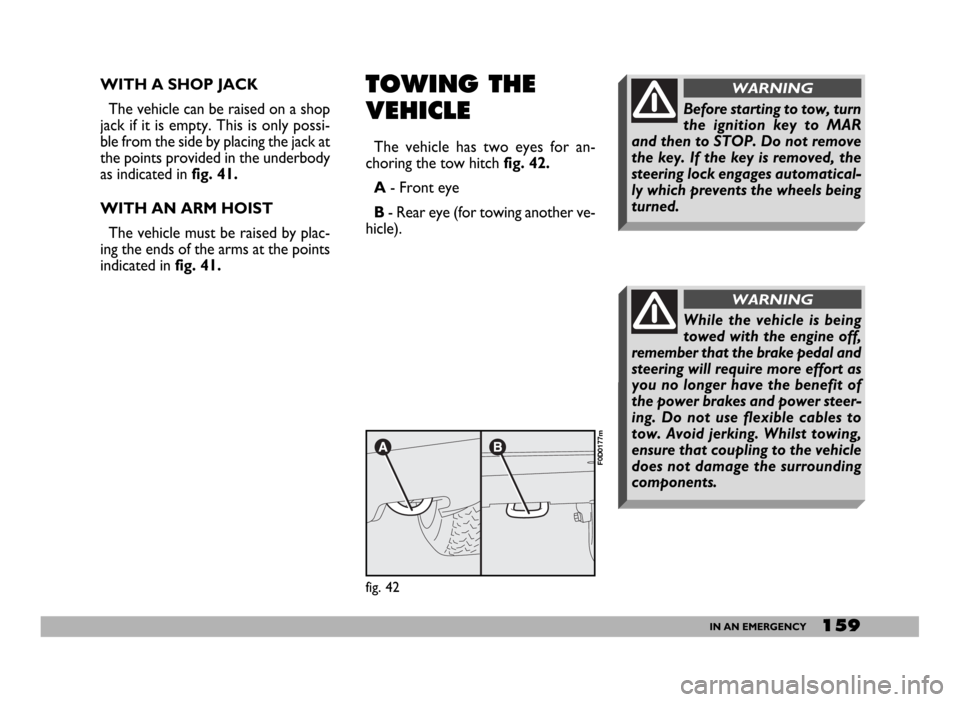
The vehicle has two eyes for an-
choring the tow hitch fig. 42.
A- Front eye
B- Rear eye (for towing another ve-
hicle).
fig. 42
F0D0177m
Before starting to tow, turn
the ignition key to MAR
and then to STOP. Do not remove
the key. If the key is removed, the
steering lock engages automatical-
ly which prevents the wheels being
turned.
WARNING
While the vehicle is being
towed with the engine off,
remember that the brake pedal and
steering will require more effort as
you no longer have the benefit of
the power brakes and power steer-
ing. Do not use flexible cables to
tow. Avoid jerking. Whilst towing,
ensure that coupling to the vehicle
does not damage the surrounding
components.
WARNING
Page 178 of 258
177VEHICLE MAINTENANCE
ELECTRONIC
CONTROL UNIT
When the vehicle is being used nor-
mally, special measures are not nec-
essary.
The following instructions must be
followed very carefully however, if
you work on the electrical system or
in cases where emergency starting is
necessary:
– never disconnect the battery from
the electric system while the engine is
running;
– disconnect the battery from the
electric system if you are recharging it;
– never perform emergency starting
with a battery charger. Always use an
auxiliary battery;
– be particularly careful when con-
necting the battery to the electric sys-
tem. Make sure that the polarity is
correct and that the connection is ef-
ficient;
– do not connect or disconnect the
terminals of the electronic units while
the ignition key is at MAR;
– do not check polarity through
sparking;– disconnect the electronic control
units if you are electrically welding the
vehicle body. Remove the units if tem-
peratures exceed 80 °C (special op-
erations on the bodywork, etc.).
IMPORTANTIf the sound system
or vehicle alarm systems are not in-
stalled correctly, they can interfere
with the working of the electronic
control units.
Modifications or repairs to
the electrical system car-
ried out incorrectly and without
bearing the features of the system
in mind can cause malfunctions
with the risk of fire.
WARNING
SPEED LIMITER
On certain version, the injection con-
trol unit is set to limit the vehicle
speed at a max. preset limit.
Speed limits are the following:
– for Minibus versions (M2 homolo-
gation category): 100 km/h;
– for good Transport versions (ve-
hicle dead weight: > 3.5 t) (N2 ho-
mologation category): 90 km/h;
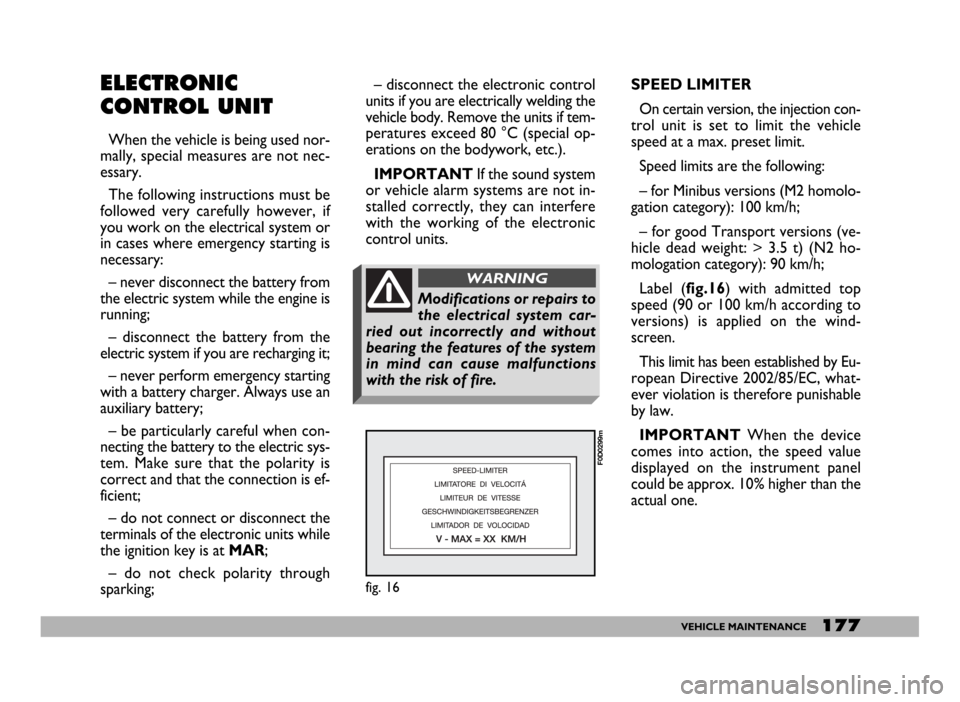
Label (fig.16) with admitted top
speed (90 or 100 km/h according to
versions) is applied on the wind-
screen.
This limit has been established by Eu-
ropean Directive 2002/85/EC, what-
ever violation is therefore punishable
by law.
IMPORTANTWhen the device
comes into action, the speed value
displayed on the instrument panel
could be approx. 10% higher than the
actual one.
fig. 16
F0D0299m
Page 244 of 258

243TECHNICAL SPECIFICATIONS
FUEL CONSUMPTION - CO2EMISSIONS
RUNNING AND USE CONDITIONS AFFECTING FUEL CONSUMPTION
(examples and differences with respect to goods transportation vehicle data)
IMPORTANT
Although fuel consumption mea-
surements procedure aim at defining
realistic values, fuel consumption is in-
fluenced by factors such as:
Driving style and vehicle usehigh
speed, frequent acceleration, frequent
gear shifting, door-to-door deliveries,
etc.
Just for passenger transportation
versions with 2.3 and 2.8 JTD engines,
reduced consumption can be obtained
by starting (on level road) in 2nd gear
instead of 1st gear.
Traffic and road conditions
queues, bending roads, steep roads,
bad road surface, etc.Weather conditions and tem-
peratures
low temperatures, thinner air, wind,
rain etc…;
Vehicle conditions
Poor maintenance (tyre pressure, fil-
ters, spark plugs, etc.), damaged body-
work
Load conditions
Heavy weights, not optimal load dis-
tribution, large weights on roof rack,
etc.
Use of electric devices
Climate control, heater and electric
devices in general
Special conditions of use
Special vehicle conditions of use: roof
rack, trailer, open side windows, type
of tyres, etc.Special trim and adaptations
caravan, motor home, mega box, can-
vas cover, etc.
Some of these conditions are illus-
trated in these figures on the next
pages.
For more information, refer to the
advice in the chapter “Cheap running
that respects the environment.
The fuel consumption values shown
in the table in following pages were de-
fined according to the type-approval
specifications in European Directives.
Consumption values are defined by
means of the following procedures:
– an urban cycle: consisting of a
cold start and a simulated drive in city
streets;
– an extra-urban cycle: consisting
in frequent accelerations, in all gears,
Page 248 of 258
247INDEX
I I
N N
D D
E E
X X
Bodywork ..................................... 181
- maintenance ............................ 181
- tips for keeping the body
in good conditions ................. 182
- versions .................................... 187
- warranty ................................... 182
Bodywork paint identification
plate ............................................. 186
Bodywork versions ..................... 187
Bonnet ........................................... 84
Bottle holder ................................ 74
Brake fluid level ........................... 172
Brake light replacement ............. 146
Brakes
- handbrake ......................... 108-216
- service and
emergency brake ................... 216
Bulb replacement ........................ 141
Bulb types ..................................... 142
Bump starting ............................... 137Capacities ................................... 239
Ceiling light .................................... 71
Cellular phone set-up ................ 100
Central door locking system .... 83
Changing a wheel ........................ 137
Cheap running that respects
the environment ....................... 127
Checking fluid levels ................... 167
Child restraint systems .............. 22
Cigar lighter ................................. 77
Cleaning seats and fabrics ......... 184
Cleaning the plastic parts .......... 184
Climate control system ............. 57
Clutch ............................................ 216
Controls ........................................ 71
Consumption
- engine oil .................................. 170
- fuel ............................................. 243
Coolant temperature gauge ..... 30ABS .............................................. 88
Additional heater ........................ 58
Adjusting the headlight beam ... 86
Airbags (front and side) ............. 90
Air cleaner .................................... 173
Air vents ........................................ 54
Annual inspection schedule ...... 165
Ashtray .......................................... 77
ASR system ................................... 96
At the filling station .................... 102
Automatic electronic gearbox .. 110
Battery ........................................ 174
- battery cut out ....................... 73
- checking the charge ............... 175
- jump starting .................... 136-157
- recharging ................................ 157
- replacement ............................ 174
- useful advice ............................ 175
Page 249 of 258

248INDEX
Cruise Control ............................ 68
Current socket ............................ 76
Dashboard ................................. 5
Demisting ...................................... 56
Diesel fuel filter ........................... 173
Differential .................................... 216
Digital clock .................................. 32
Dimensions ........................... 222-224
Dipped beam headlights ............ 65
- bulb replacement ................... 143
Direction indicators ................... 66
- front bulb replacement ......... 145
- rear bulb replacement .......... 146
- side bulb replacement ........... 145
Doors ............................................ 79
- 270° opening ........................... 82
- central door locking .............. 83
- driver’s cab doors .................. 79
- rear door ................................. 81
- remote control ....................... 9- side sliding door ..................... 80
- window regulators ................ 83
Driving style affecting fuel
consumption .............................. 124
Electric windows ....................... 83
Electronic alarm .......................... 11
Electronic automatic gearbox .. 110
Electronic control units ............. 177
- speed limiter ........................... 177
Emergency starting .............. 107-135
Emission control devices ........... 128
Engine ............................................ 214
- starting diesel engines ........... 106
- starting petrol engines .......... 105
- stopping the engine ............... 108
- supply/ignition ......................... 215
- warming up the engine ......... 107
Engine/bodywork codes ............ 187
Engine compartment .................. 183
Engine coolant gauge .................. 30
Engine coolant level .................... 170Engine marking ............................ 185
Engine oil ....................................... 169
- consumption ........................... 170
Engine oil level ............................. 169
Engine oil level gauge ................. 32
EOBD system .............................. 95
Fiat Code (system) ................... 7
First aid kit .................................... 161
Flashing the headlights ............... 66
Fluids and lubricants ................... 241
Front/rear ceiling light
replacement ............................... 148
Front fog light replacement ...... 145
Fuel cut-off switch ...................... 72
Fuel gauge ..................................... 31
Fuses (replacement) ................... 149
Getting to know
your vehicle............................ 5
Getting the best out of
your vehicle............................ 105