Switch FIAT DUCATO 244 2005 3.G Owner's Guide
[x] Cancel search | Manufacturer: FIAT, Model Year: 2005, Model line: DUCATO 244, Model: FIAT DUCATO 244 2005 3.GPages: 258, PDF Size: 4.05 MB
Page 109 of 258
108GETTING THE BEST OUT OF YOUR VEHICLE
SWITCHING OFF
THE ENGINE
Turn the ignition key to STOPwhile
the engine is idling.
IMPORTANTAfter a taxing drive
you should allow the engine to “catch
its breath” before turning it off by let-
ting it idle to allow temperature in the
engine compartment to fall.PARKING
Switch off the engine, pull up the
handbrake and engage a gear (1st gear
or reverse, according to whether the
vehicle is facing up or downhill) and
leave the wheels turned. If the vehi-
cle is left on a steep slope, wedges or
a rock should be used to lock the
wheels.
Do not leave the ignition key at
MAR to prevent running the battery
down. Always remove the key when
you leave the vehicle.HANDBRAKE
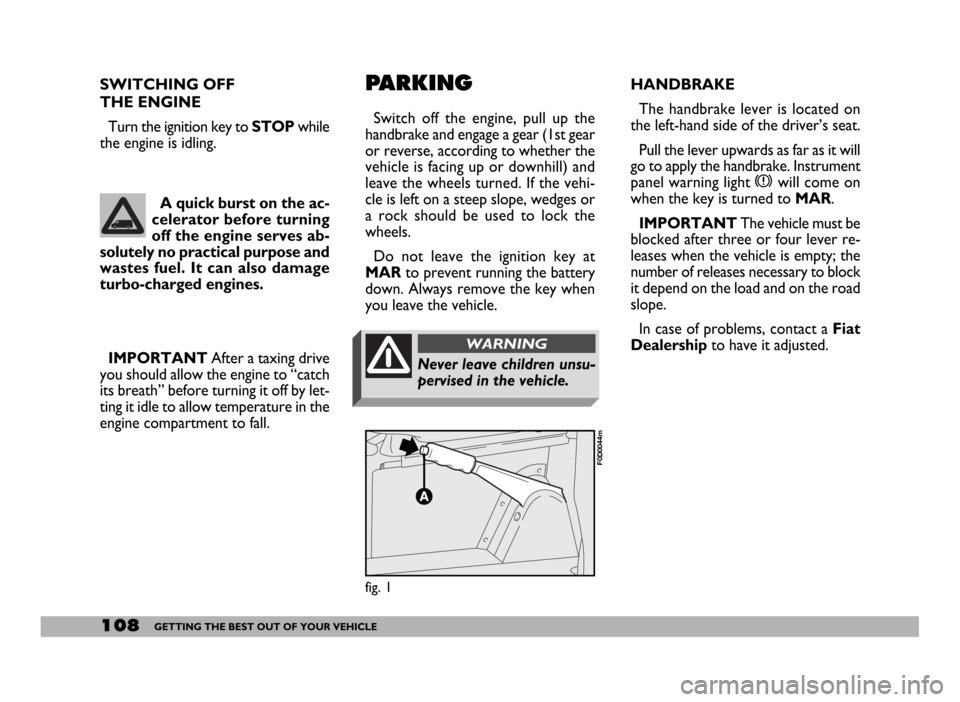
The handbrake lever is located on
the left-hand side of the driver’s seat.
Pull the lever upwards as far as it will
go to apply the handbrake. Instrument
panel warning light xwill come on
when the key is turned to MAR.
IMPORTANTThe vehicle must be
blocked after three or four lever re-
leases when the vehicle is empty; the
number of releases necessary to block
it depend on the load and on the road
slope.
In case of problems, contact a Fiat
Dealershipto have it adjusted. A quick burst on the ac-
celerator before turning
off the engine serves ab-
solutely no practical purpose and
wastes fuel. It can also damage
turbo-charged engines.
fig. 1
F0D0044m
Never leave children unsu-
pervised in the vehicle.
WARNING
Page 111 of 258
110GETTING THE BEST OUT OF YOUR VEHICLE
STARTING
After starting the engine, with the en-
gine idling and keeping the brake ped-
al pressed, move the gearshift lever to
position D. Release the brake pedal
and gradually press the accelerator
pedal.
IMPORTANT Movement of the
lever from position Pis allowed only
with the ignition key at MARand the
button on the lever and the brake ped-
al pressed. STOPPING THE VEHICLE
To stop the vehicle, simply press the
brake pedal regardless of the position
of the gearshift lever.
IMPORTANTRemoving the igni-
tion key is only allowed with the
gearshift lever in position Pand for a
maximum time of 30 seconds from
when the engine is turned off P, when
the door is opened a buzzer will sound
for about 15 seconds to alert the dri-
ver.
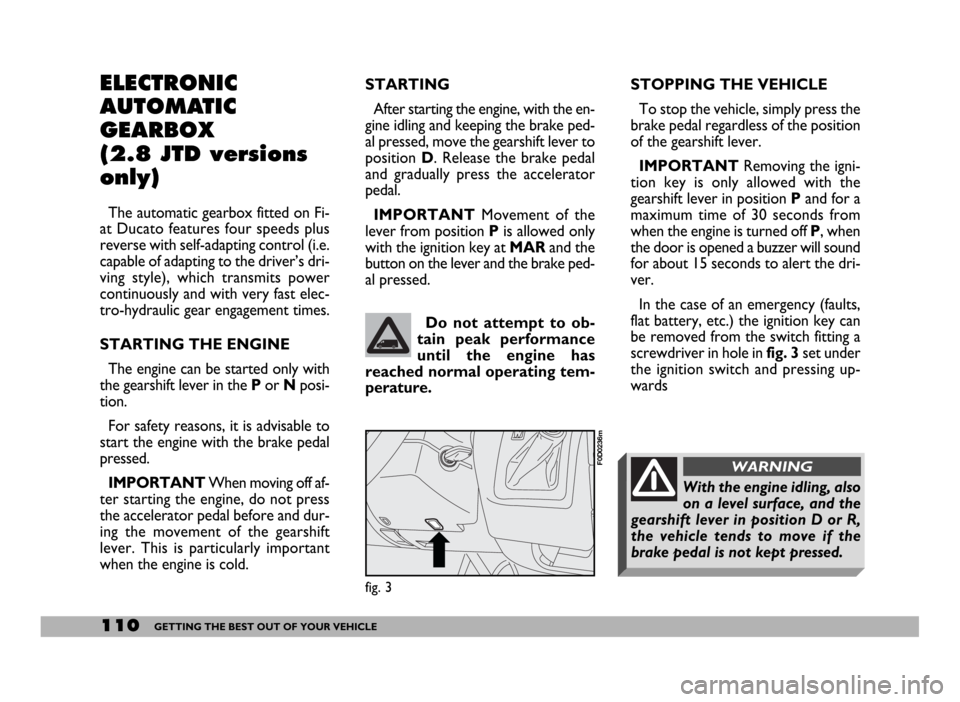
In the case of an emergency (faults,
flat battery, etc.) the ignition key can
be removed from the switch fitting a
screwdriver in hole infig. 3set under
the ignition switch and pressing up-
wards Do not attempt to ob-
tain peak performance
until the engine has
reached normal operating tem-
perature.
fig. 3
F0D0236m
With the engine idling, also
on a level surface, and the
gearshift lever in position D or R,
the vehicle tends to move if the
brake pedal is not kept pressed.
WARNING
ELECTRONIC
AUTOMATIC
GEARBOX
(2.8 JTD versions
only)
The automatic gearbox fitted on Fi-
at Ducato features four speeds plus
reverse with self-adapting control (i.e.
capable of adapting to the driver’s dri-
ving style), which transmits power
continuously and with very fast elec-
tro-hydraulic gear engagement times.
STARTING THE ENGINE
The engine can be started only with
the gearshift lever in the P or Nposi-
tion.
For safety reasons, it is advisable to
start the engine with the brake pedal
pressed.
IMPORTANTWhen moving off af-
ter starting the engine, do not press
the accelerator pedal before and dur-
ing the movement of the gearshift
lever. This is particularly important
when the engine is cold.
Page 113 of 258
112GETTING THE BEST OUT OF YOUR VEHICLE
IMPORTANTRemoving the igni-
tion key is only allowed with the
gearshift lever in position Pand for a
maximum time of 30 seconds from
when the engine is turned off P, when
the door is opened a buzzer will sound
for about 15 seconds to alert the dri-
ver.
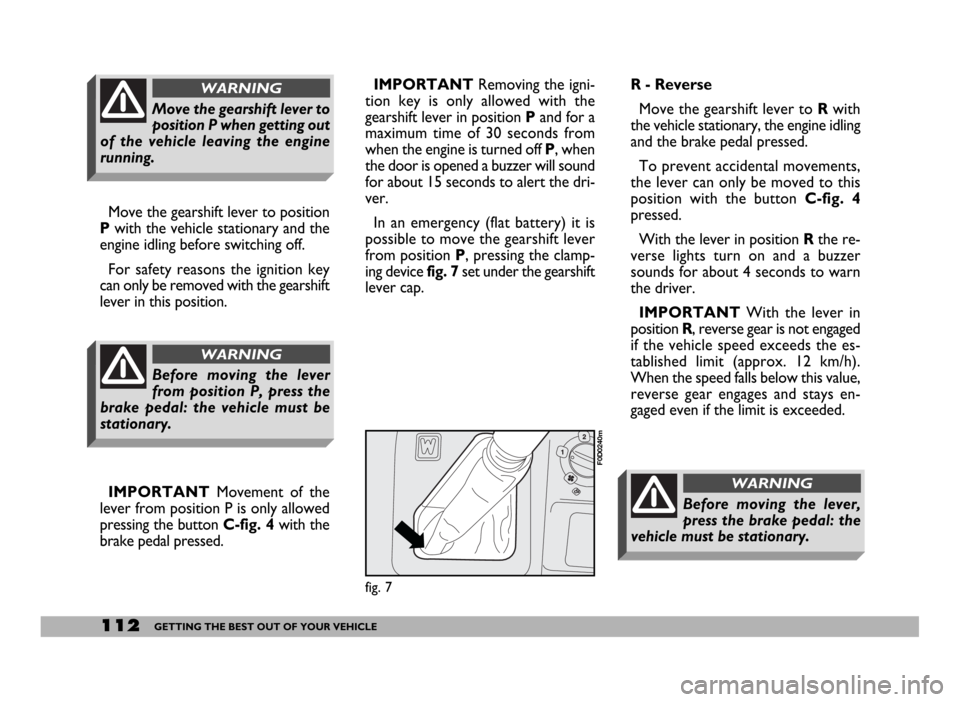
In an emergency (flat battery) it is
possible to move the gearshift lever
from position P, pressing the clamp-
ing device fig. 7set under the gearshift
lever cap.R - Reverse
Move the gearshift lever to Rwith
the vehicle stationary, the engine idling
and the brake pedal pressed.
To prevent accidental movements,
the lever can only be moved to this
position with the button C-fig. 4
pressed.
With the lever in position Rthe re-
verse lights turn on and a buzzer
sounds for about 4 seconds to warn
the driver.
IMPORTANTWith the lever in
position R, reverse gear is not engaged
if the vehicle speed exceeds the es-
tablished limit (approx. 12 km/h).
When the speed falls below this value,
reverse gear engages and stays en-
gaged even if the limit is exceeded.
fig. 7
F0D0240m
Before moving the lever,
press the brake pedal: the
vehicle must be stationary.
WARNING
Move the gearshift lever to position
Pwith the vehicle stationary and the
engine idling before switching off.
For safety reasons the ignition key
can only be removed with the gearshift
lever in this position.
IMPORTANTMovement of the
lever from position P is only allowed
pressing the button C-fig. 4with the
brake pedal pressed.
Move the gearshift lever to
position P when getting out
of the vehicle leaving the engine
running.
WARNING
Before moving the lever
from position P, press the
brake pedal: the vehicle must be
stationary.
WARNING
Page 116 of 258
115GETTING THE BEST OUT OF YOUR VEHICLE
Moving the lever back to position D
the gearbox instantly resumes the au-
tomatic mode selecting the ratio ac-
cording to the driving characteristics.
IMPORTANTThe electronic con-
trol unit is programmed to change
gear one at a time, therefore repeat-
ed fast actuations will not result in re-
peated engagements of the gears. The
higher or lower gear is engaged mov-
ing the lever to the (+) or (–) position
when the previous request has been
performed.
In the event of a fault to the sequen-
tial manual system, the system will se-
lect the automatic mode.FAILURE INDICATIONS
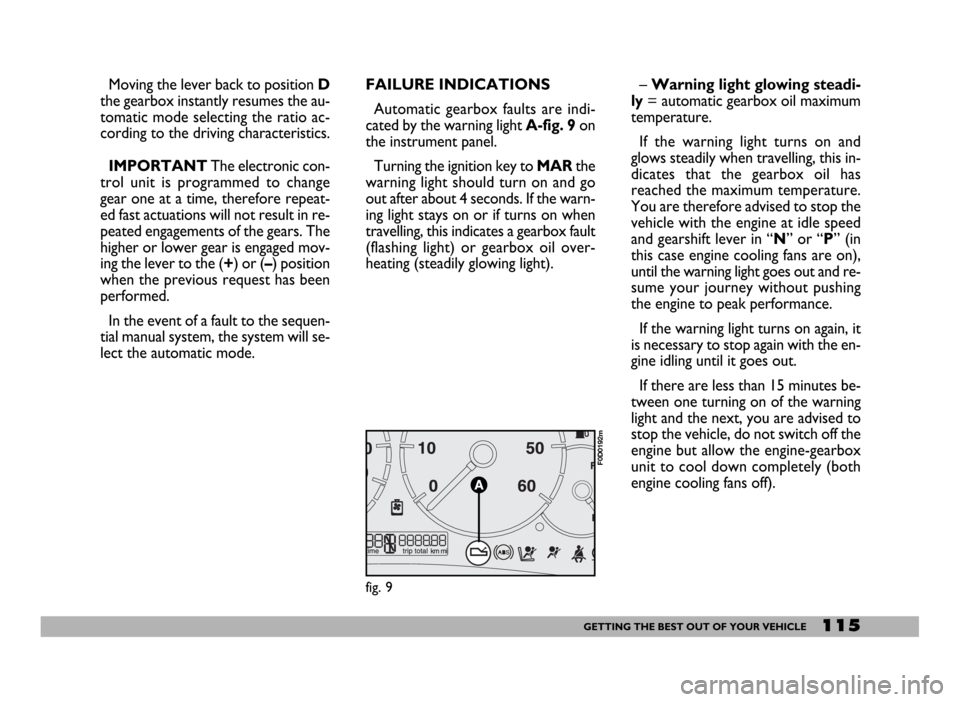
Automatic gearbox faults are indi-
cated by the warning light A-fig. 9 on
the instrument panel.
Turning the ignition key to MARthe
warning light should turn on and go
out after about 4 seconds. If the warn-
ing light stays on or if turns on when
travelling, this indicates a gearbox fault
(flashing light) or gearbox oil over-
heating (steadily glowing light).– Warning light glowing steadi-
ly= automatic gearbox oil maximum
temperature.
If the warning light turns on and
glows steadily when travelling, this in-
dicates that the gearbox oil has
reached the maximum temperature.
You are therefore advised to stop the
vehicle with the engine at idle speed
and gearshift lever in “N” or “P” (in
this case engine cooling fans are on),
until the warning light goes out and re-
sume your journey without pushing
the engine to peak performance.
If the warning light turns on again, it
is necessary to stop again with the en-
gine idling until it goes out.
If there are less than 15 minutes be-
tween one turning on of the warning
light and the next, you are advised to
stop the vehicle, do not switch off the
engine but allow the engine-gearbox
unit to cool down completely (both
engine cooling fans off).
fig. 9
F0D0192m
Page 117 of 258
116GETTING THE BEST OUT OF YOUR VEHICLE
BUMP STARTING
Starting by pushing or towing the ve-
hicle is not possible. In the event of an
emergency, when the battery is flat,
start the vehicle with a suitable emer-
gency battery, following the instruc-
tions given in section “In an emer-
gency” at paragraph “Jump starting”.
TOWING THE VEHICLE
IMPORTANTFor towing the ve-
hicle comply with current local regu-
lations and follow the instructions giv-
en in section “In an emergency” at
paragraph “Towing the vehicle”.If the vehicle is to be towed, adhere
to the following recommendations:
– if possible, carry the vehicle on the
floor of a rescue vehicle;
– if this is not possible, tow the ve-
hicle raising the driving wheels (front)
from the ground;
– if this, too, is not possible, the ve-
hicle should not be towed for more
than 200 km at a speed of no more
than 50 km/h.
When towing, the gearshift lever
should be at N.
Do not start the engine
while the vehicle is being
towed.
The failure to comply
with these instructions
may cause serious dam-
age to the automatic gearbox.
When travelling with the
gearbox faulty, drive with
the utmost care in consideration of
the limited performance (in terms
of acceleration and speed) that the
vehicle can offer.
WARNING
When travelling with the
gearbox faulty, the revers-
ing gear lock might not be active:
absolutely never move the lever to
the R position with the vehicle on
the move.
WARNING– Warning light flashing= auto-
matic gearbox fault.
Warning light flashing at starting or
when travelling indicates a fault in the
automatic gearbox.
The automatic control system sets
an “emergency programme” engaging
the 3
rdgear.
Switching the engine off and then on
again, the self-test system could ex-
clude the fault and therefore turn off
the warning light. The failure is how-
ever stored and the automatic gear-
box shall be checked at a Fiat Deal-
ership.
Page 123 of 258
122GETTING THE BEST OUT OF YOUR VEHICLE
as soon as you see vehicles coming in
the other direction and pass them with
the headlights dipped;
– keep all lights clean;
– be careful of animals crossing the
road when driving in the country. Slow
down to avoid the risk of running
them over.
DRIVING IN THE RAIN
Rain and wet road surfaces spell dan-
ger. All manoeuvres are more difficult
on a wet road because the grip of the
wheels on the tarmac is greatly re-
duced. This is why braking distances
are much longer and road-holding is
lower.
Here is some advice for driving in the
rain:
– reduce speed and maintain a
greater safety distance from the vehi-
cles in front;
– If it is raining particularly heavily,
visibility is also reduced. In these cas-
es, switch on the dipped headlights
even if it is still daylight so you can be
seen more easily;– Do not drive through puddles at
speed and hold on tightly to the wheel
if you do: a puddle taken at high speed
might cause you to lose control of the
vehicle (aquaplaning);
– Position the ventilation controls for
demisting (see section “Getting to
know your vehicle”), to prevent visi-
bility from worsening;
– Routinely check the conditions of
the windscreen wiper blades.
DRIVING IN FOG
– If the fog is thick, do not start out
on a journey unless you absolutely
have to.
If driving in mist, blanket fog or when
there is the danger of fog patches:
– keep your speed down;
– turn on the dipped headlights, rear
fog lights and front fog lights, if fitted,
even during the day. Do not drive with
your headlights at main beam.IMPORTANT On stretches of
road with good visibility, switch off
your rear foglights; the brightness of
these lights could annoy the people
travelling in the vehicles behind.
– Remember that fog also means the
taramac is wet and therefore ma-
noeuvres of all kinds are more difficult
and stopping distances are longer;
– keep a good distance from the ve-
hicles in front of you;
– as far as possible, avoid spurts of
speed or sudden deceleration;
– do not overtake other vehicles if
possible;
Page 126 of 258
125GETTING THE BEST OUT OF YOUR VEHICLE
Electric devices
Use electric devices for the neces-
sary time only. The heated rear win-
dow, fog lights, windscreen wipers,
heater fan require large amounts of
electricity and increasing the request
for power will also increase fuel con-
sumption (up to +25% when driving in
towns).
Climate control system
The climate control system is an ad-
ditional load which greatly affects the
engine leading to higher consumption.
When the temperature outside the
vehicle allows it, use the air vents
where possible.
DRIVING STYLE
Starting
Do not warm the engine when the
vehicle is stationary or at high or low
speed: in this way the engine will warm
up gradually increasing consumption
and emissions. You should drive off
slowly straight away avoiding high revs
so that the engine will warm up more
quickly.Unnecessary actions
Avoid revving the engine when
stopped at traffic lights or before
switching off the engine and avoid dou-
bling the clutch as these actions have
no purpose on modern vehicles and
serve only to increase consumption
and pollution.
Gear selections
As soon as the traffic and road con-
ditions allow it, shift to a higher gear.
Using a low gear to liven up accelera-
tion greatly increases consumption. In
the same way improper use of high
gears will increase consumption, emis-
sions and engine wear.
On passenger transportation versions
fitted with 2.3, 2.8 JTD and 2.8 JTD
POWER engines, fuel consumption can
be optimised by starting (on level road)
in 2nd gear instead of 1st gear.Top speeds
Fuel consumption increases consid-
erably as speed increases. Your speed
should be kept as even as possible and
superfluous braking and acceleration
avoided as this increases both con-
sumption and emissions.
Acceleration
Accelerating violently increasing the
revs will greatly affect consumption
and emissions; acceleration should be
gradual and should not exceed the
maximum torque.
Page 127 of 258
126GETTING THE BEST OUT OF YOUR VEHICLE
CONDITIONS OF USE
Cold starting
Frequent cold starting will not enable
the engine to reach optimal running
temperature. It follows, therefore,
that consumption will be higher (from
+15 to +30% in towns) as will the
production of toxic emissions.
Traffic and road conditions
Heavy traffic and higher consumption
are synonymous: for example, when
driving slowly with frequent use of low-
er gears or in towns where there are
numerous traffic lights.
Winding roads, mountain roads and
bumpy roads also have a negative effect
on consumption.
Enforced halts
During prolonged stops (traffic lights,
level crossings, etc.) the engine should
be switched off.LOAD
RECOMMENDATIONS
The version of the Ducato you are
driving has been designed and ap-
proved on the basis of several set
maximum weights (see the tables
“Weights” in section “Technical spec-
ifications”):
– kerb weight
– payload
– total weight
– total weight on the front axle
– total weight on the rear axle
– towable weight
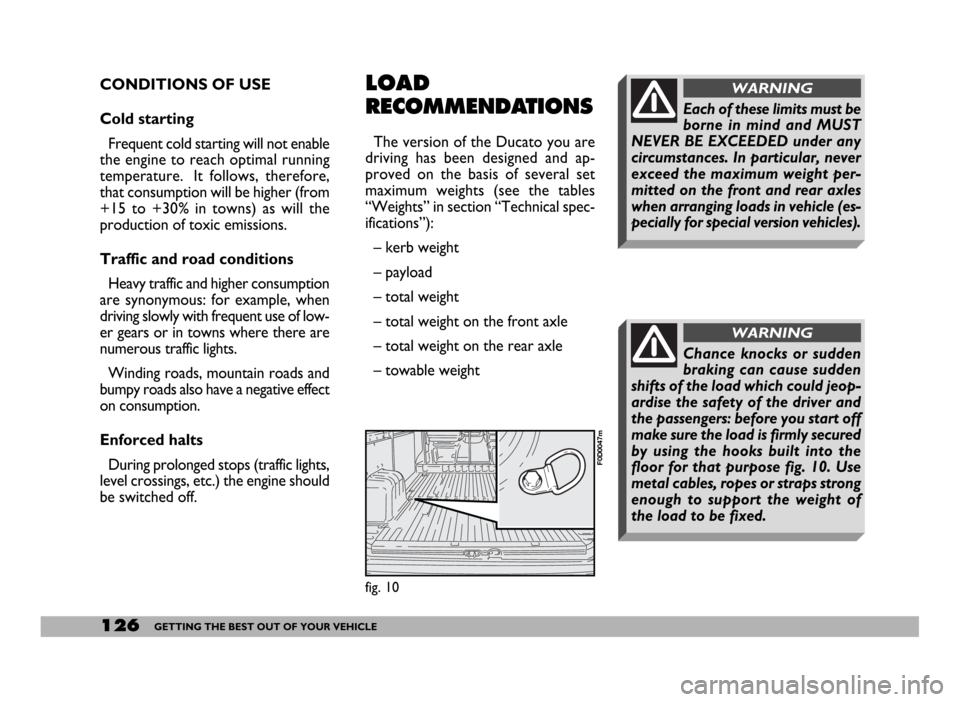
fig. 10
F0D0047m
Each of these limits must be
borne in mind and MUST
NEVER BE EXCEEDED under any
circumstances. In particular, never
exceed the maximum weight per-
mitted on the front and rear axles
when arranging loads in vehicle (es-
pecially for special version vehicles).
WARNING
Chance knocks or sudden
braking can cause sudden
shifts of the load which could jeop-
ardise the safety of the driver and
the passengers: before you start off
make sure the load is firmly secured
by using the hooks built into the
floor for that purpose fig. 10. Use
metal cables, ropes or straps strong
enough to support the weight of
the load to be fixed.
WARNING
Page 135 of 258
134GETTING THE BEST OUT OF YOUR VEHICLE
VEHICLE STORAGE
The following precautions should be
taken if the vehicle will not be used for
several months:
– park the vehicle in covered, dry and
if possible well-ventilated premises;
– engage a gear;
– remove the cables from the battery
(first remove the cable to the negative
terminal) and check the battery
charge. If the vehicle is to be stored
for long periods the charge of the bat-
tery should be checked every month
and recharged if it falls below 12.5 V;– make sure the handbrake is not en-
gaged;
– clean and protect the painted parts
using protective wax;
– clean and protect the shiny metal
parts using special compounds readi-
ly available;
– sprinkle talcum powder on the rub-
ber windscreen and rear window
wiper blades and lift them off the glass;
– slightly open the windows;
– cover the vehicle with a cloth or
perforated plastic sheet. Do not use
sheets of non-perforated plastic as
they do not allow moisture on the ve-
hicle body to evaporate;– inflate the tyres to 0.5 bar above
the normal specified pressure and
check it at intervals;
– do not drain the engine cooling sys-
tem.
IMPORTANTWhere relevant,
switch off the electronic vehicle alarm
with the remote control and deacti-
vate the system by turning the emer-
gency key to OFF (see “Electronic
alarm” in section “Getting to know
your vehicle”).
Page 156 of 258
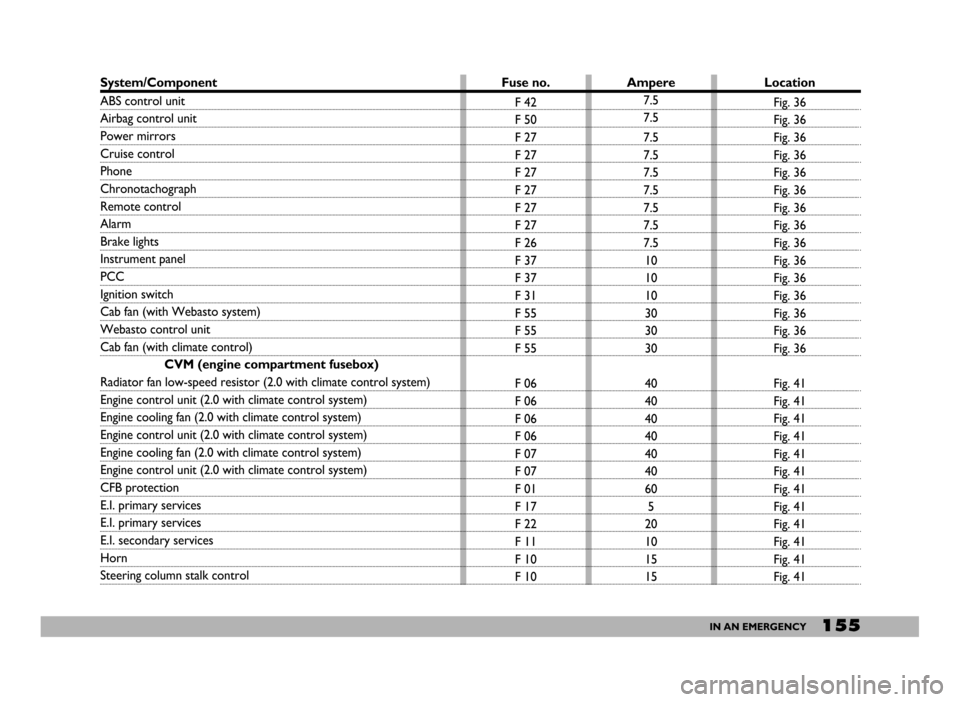
155IN AN EMERGENCY
System/Component
ABS control unit
Airbag control unit
Power mirrors
Cruise control
Phone
Chronotachograph
Remote control
Alarm
Brake lights
Instrument panel
PCC
Ignition switch
Cab fan (with Webasto system)
Webasto control unit
Cab fan (with climate control)
CVM (engine compartment fusebox)
Radiator fan low-speed resistor (2.0 with climate control system)
Engine control unit (2.0 with climate control system)
Engine cooling fan (2.0 with climate control system)
Engine control unit (2.0 with climate control system)
Engine cooling fan (2.0 with climate control system)
Engine control unit (2.0 with climate control system)
CFB protection
E.I. primary services
E.I. primary services
E.I. secondary services
Horn
Steering column stalk controlFuse no.
F 42
F 50
F 27
F 27
F 27
F 27
F 27
F 27
F 26
F 37
F 37
F 31
F 55
F 55
F 55
F 06
F 06
F 06
F 06
F 07
F 07
F 01
F 17
F 22
F 11
F 10
F 10Ampere
7.5
7.5
7.5
7.5
7.5
7.5
7.5
7.5
7.5
10
10
10
30
30
30
40
40
40
40
40
40
60
5
20
10
15
15Location
Fig. 36
Fig. 36
Fig. 36
Fig. 36
Fig. 36
Fig. 36
Fig. 36
Fig. 36
Fig. 36
Fig. 36
Fig. 36
Fig. 36
Fig. 36
Fig. 36
Fig. 36
Fig. 41
Fig. 41
Fig. 41
Fig. 41
Fig. 41
Fig. 41
Fig. 41
Fig. 41
Fig. 41
Fig. 41
Fig. 41
Fig. 41