Bar FIAT DUCATO 244 2005 3.G Owners Manual
[x] Cancel search | Manufacturer: FIAT, Model Year: 2005, Model line: DUCATO 244, Model: FIAT DUCATO 244 2005 3.GPages: 258, PDF Size: 4.05 MB
Page 44 of 258
43GETTING TO KNOW YOUR VEHICLE
E
fig. 48
F0D0104m
Lumbar adjustment
This feature ensures better back sup-
port.
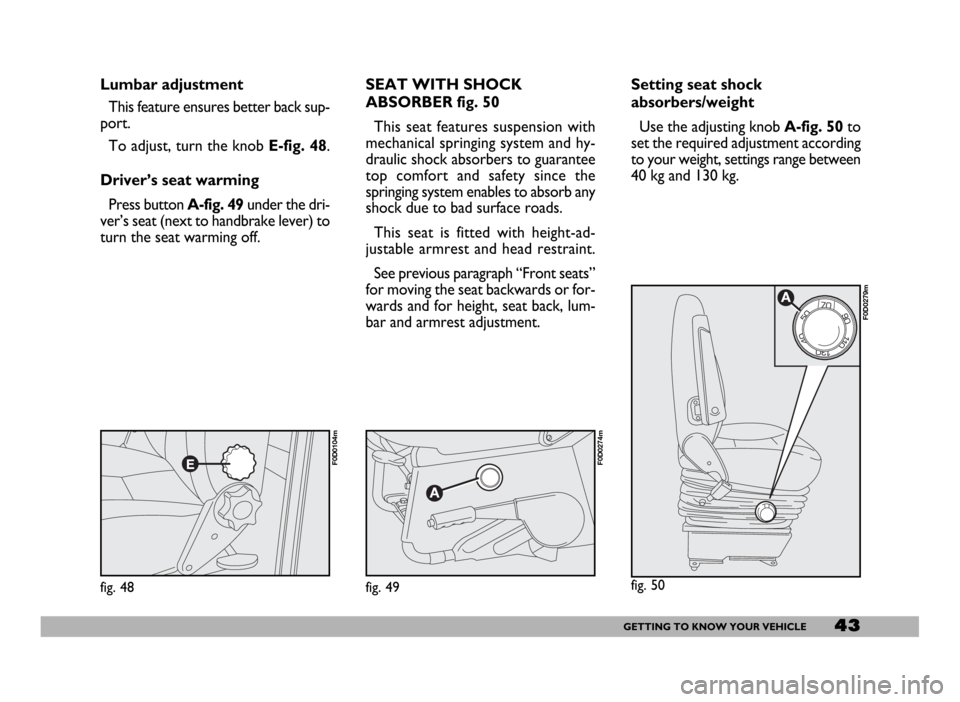
To adjust, turn the knob E-fig. 48.
Driver’s seat warming
Press button A-fig. 49under the dri-
ver’s seat (next to handbrake lever) to
turn the seat warming off.SEAT WITH SHOCK
ABSORBER fig. 50
This seat features suspension with
mechanical springing system and hy-
draulic shock absorbers to guarantee
top comfort and safety since the
springing system enables to absorb any
shock due to bad surface roads.
This seat is fitted with height-ad-
justable armrest and head restraint.
See previous paragraph “Front seats”
for moving the seat backwards or for-
wards and for height, seat back, lum-
bar and armrest adjustment.Setting seat shock
absorbers/weight
Use the adjusting knob A-fig. 50to
set the required adjustment according
to your weight, settings range between
40 kg and 130 kg.
fig. 49
F0D0274m
F0D0279m
fig. 50
Page 48 of 258
47GETTING TO KNOW YOUR VEHICLE
Adjusting the armrest
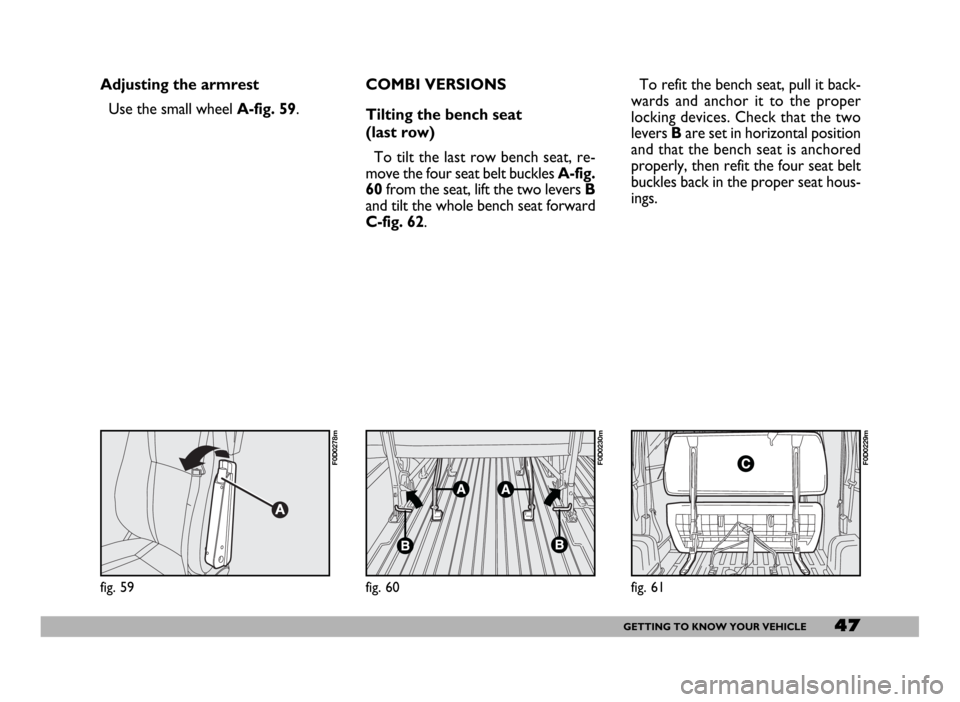
Use the small wheel A-fig. 59.
fig. 61
F0D0229m
fig. 60
F0D0230m
fig. 59
F0D0278m
COMBI VERSIONS
Tilting the bench seat
(last row)
To tilt the last row bench seat, re-
move the four seat belt buckles A-fig.
60from the seat, lift the two levers B
and tilt the whole bench seat forward
C-fig. 62.To refit the bench seat, pull it back-
wards and anchor it to the proper
locking devices. Check that the two
levers Bare set in horizontal position
and that the bench seat is anchored
properly, then refit the four seat belt
buckles back in the proper seat hous-
ings.
Page 91 of 258
90GETTING TO KNOW YOUR VEHICLE
FRONT AND SIDE
AIRBAGS
FRONT AIRBAGS
Description and operation
The front airbag (driver’s and passen-
ger’s) is a safety device which comes in-
to action in the event of a head-on col-
lision.
It consists of a cushion that inflates
instantaneously contained in a special
recess:
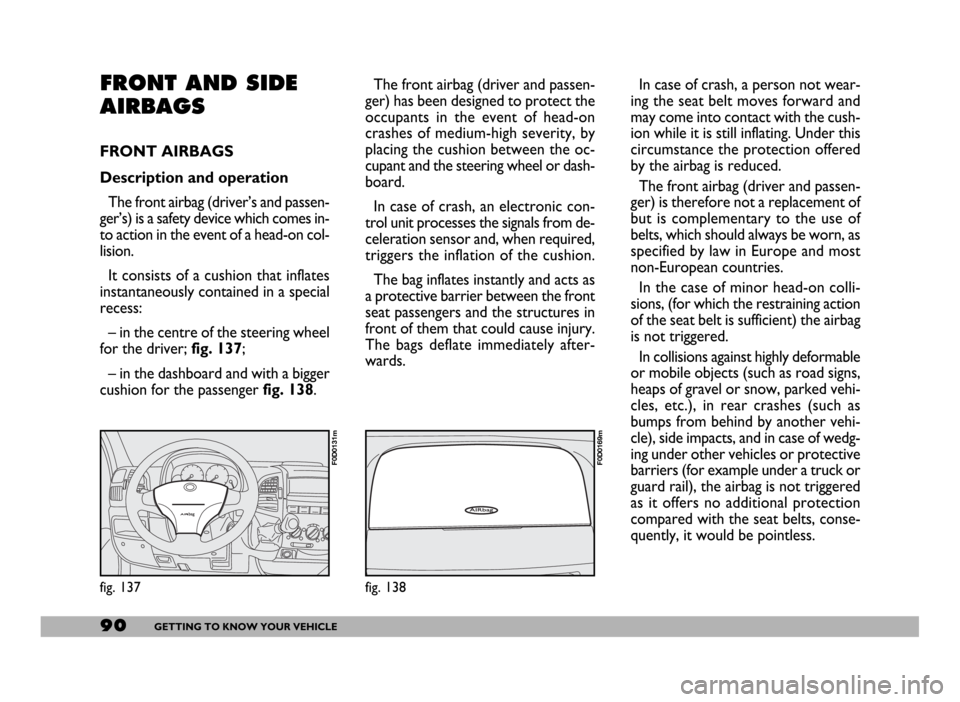
– in the centre of the steering wheel
for the driver; fig. 137;
– in the dashboard and with a bigger
cushion for the passenger fig. 138.The front airbag (driver and passen-
ger) has been designed to protect the
occupants in the event of head-on
crashes of medium-high severity, by
placing the cushion between the oc-
cupant and the steering wheel or dash-
board.
In case of crash, an electronic con-
trol unit processes the signals from de-
celeration sensor and, when required,
triggers the inflation of the cushion.
The bag inflates instantly and acts as
a protective barrier between the front
seat passengers and the structures in
front of them that could cause injury.
The bags deflate immediately after-
wards.
fig. 137
F0D0131m
fig. 138
F0D0169m
In case of crash, a person not wear-
ing the seat belt moves forward and
may come into contact with the cush-
ion while it is still inflating. Under this
circumstance the protection offered
by the airbag is reduced.
The front airbag (driver and passen-
ger) is therefore not a replacement of
but is complementary to the use of
belts, which should always be worn, as
specified by law in Europe and most
non-European countries.
In the case of minor head-on colli-
sions, (for which the restraining action
of the seat belt is sufficient) the airbag
is not triggered.
In collisions against highly deformable
or mobile objects (such as road signs,
heaps of gravel or snow, parked vehi-
cles, etc.), in rear crashes (such as
bumps from behind by another vehi-
cle), side impacts, and in case of wedg-
ing under other vehicles or protective
barriers (for example under a truck or
guard rail), the airbag is not triggered
as it offers no additional protection
compared with the seat belts, conse-
quently, it would be pointless.
Page 93 of 258
92GETTING TO KNOW YOUR VEHICLE
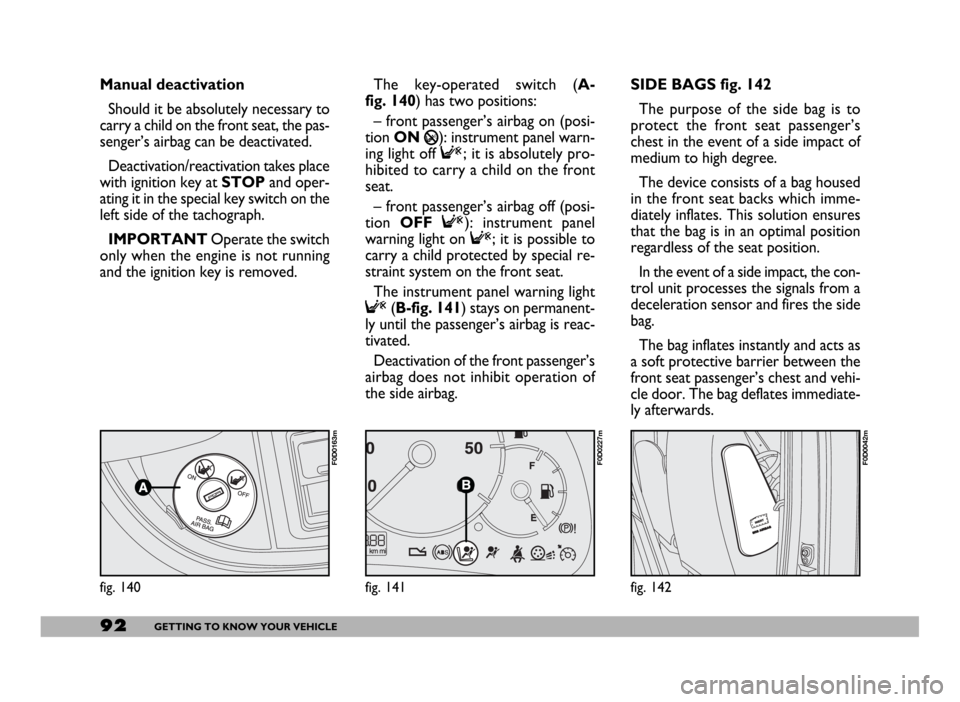
SIDE BAGS fig. 142
The purpose of the side bag is to
protect the front seat passenger’s
chest in the event of a side impact of
medium to high degree.
The device consists of a bag housed
in the front seat backs which imme-
diately inflates. This solution ensures
that the bag is in an optimal position
regardless of the seat position.
In the event of a side impact, the con-
trol unit processes the signals from a
deceleration sensor and fires the side
bag.
The bag inflates instantly and acts as
a soft protective barrier between the
front seat passenger’s chest and vehi-
cle door. The bag deflates immediate-
ly afterwards.
fig. 142
F0D0042m
fig. 140
F0D0163m
Manual deactivation
Should it be absolutely necessary to
carry a child on the front seat, the pas-
senger’s airbag can be deactivated.
Deactivation/reactivation takes place
with ignition key at STOPand oper-
ating it in the special key switch on the
left side of the tachograph.
IMPORTANTOperate the switch
only when the engine is not running
and the ignition key is removed.The key-operated switch (A-
fig. 140) has two positions:
– front passenger’s airbag on (posi-
tion ON
P): instrument panel warn-
ing light off F; it is absolutely pro-
hibited to carry a child on the front
seat.
– front passenger’s airbag off (posi-
tion OFF F): instrument panel
warning light on F; it is possible to
carry a child protected by special re-
straint system on the front seat.
The instrument panel warning light
F(B-fig. 141) stays on permanent-
ly until the passenger’s airbag is reac-
tivated.
Deactivation of the front passenger’s
airbag does not inhibit operation of
the side airbag.
fig. 141
F0D0227m
Page 102 of 258
101GETTING TO KNOW YOUR VEHICLE
RADIO
TRANSMITTERS AND
CELLULAR
TELEPHONES
Cellular telephones and other radio
transceiver equipment (e.g. HAM ra-
dio system) must not be used inside
the vehicle unless a separate aerial is
mounted on the outside of the vehicle.
IMPORTANTThe use of cellular
telephones, HAM transmitters or oth-
er similar devices inside the passenger
compartment (without external aeri-
al) produces RF electromagnetic fields
which, amplified by the resonance ef-
fects inside the passenger compart-
ment may cause vehicle electrical sys-
tem to malfunction.
Moreover, the transmission and re-
ceiving quality deteriorates due to the
screening effect of the vehicle body. Have the cellular phone and the con-
nections to the system installed by a
Fiat Dealership.
The hands-free tele-
phone you purchase will
need to be compatible
with your cellular telephone.
Have the cellular tele-
phone and the connec-
tions to the system in-
stalled by a Fiat Dealership only.
This will ensure the best results
and prevent problems which
could impair vehicle safety.
ROOF RACK/
SKI RACK
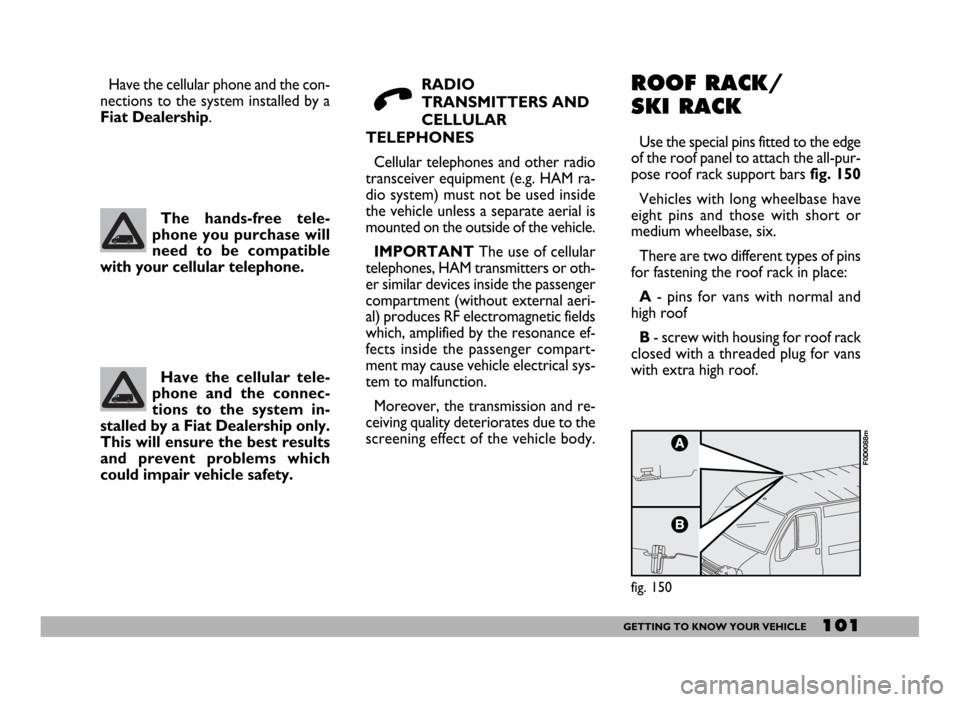
Use the special pins fitted to the edge
of the roof panel to attach the all-pur-
pose roof rack support bars fig. 150
Vehicles with long wheelbase have
eight pins and those with short or
medium wheelbase, six.
There are two different types of pins
for fastening the roof rack in place:
A- pins for vans with normal and
high roof
B- screw with housing for roof rack
closed with a threaded plug for vans
with extra high roof.
fig. 150
F0D0088m
Page 135 of 258

134GETTING THE BEST OUT OF YOUR VEHICLE
VEHICLE STORAGE
The following precautions should be
taken if the vehicle will not be used for
several months:
– park the vehicle in covered, dry and
if possible well-ventilated premises;
– engage a gear;
– remove the cables from the battery
(first remove the cable to the negative
terminal) and check the battery
charge. If the vehicle is to be stored
for long periods the charge of the bat-
tery should be checked every month
and recharged if it falls below 12.5 V;– make sure the handbrake is not en-
gaged;
– clean and protect the painted parts
using protective wax;
– clean and protect the shiny metal
parts using special compounds readi-
ly available;
– sprinkle talcum powder on the rub-
ber windscreen and rear window
wiper blades and lift them off the glass;
– slightly open the windows;
– cover the vehicle with a cloth or
perforated plastic sheet. Do not use
sheets of non-perforated plastic as
they do not allow moisture on the ve-
hicle body to evaporate;– inflate the tyres to 0.5 bar above
the normal specified pressure and
check it at intervals;
– do not drain the engine cooling sys-
tem.
IMPORTANTWhere relevant,
switch off the electronic vehicle alarm
with the remote control and deacti-
vate the system by turning the emer-
gency key to OFF (see “Electronic
alarm” in section “Getting to know
your vehicle”).
Page 179 of 258
178VEHICLE MAINTENANCE
WHEELS AND
TYRES
Check the pressure of each tyre, in-
cluding the spare, every two weeks
and before long journeys.
The pressure must be checked when
the tyre is rested and cold.
It is normal for pressure to rise
when you are driving. If you have to
check or restore the pressure when
the tyres are warm, remember that
the pressure value must be 0.3 bar
above the specified value.
See “Wheels” in “Technical specifi-
cations” chapter for the correct tyre
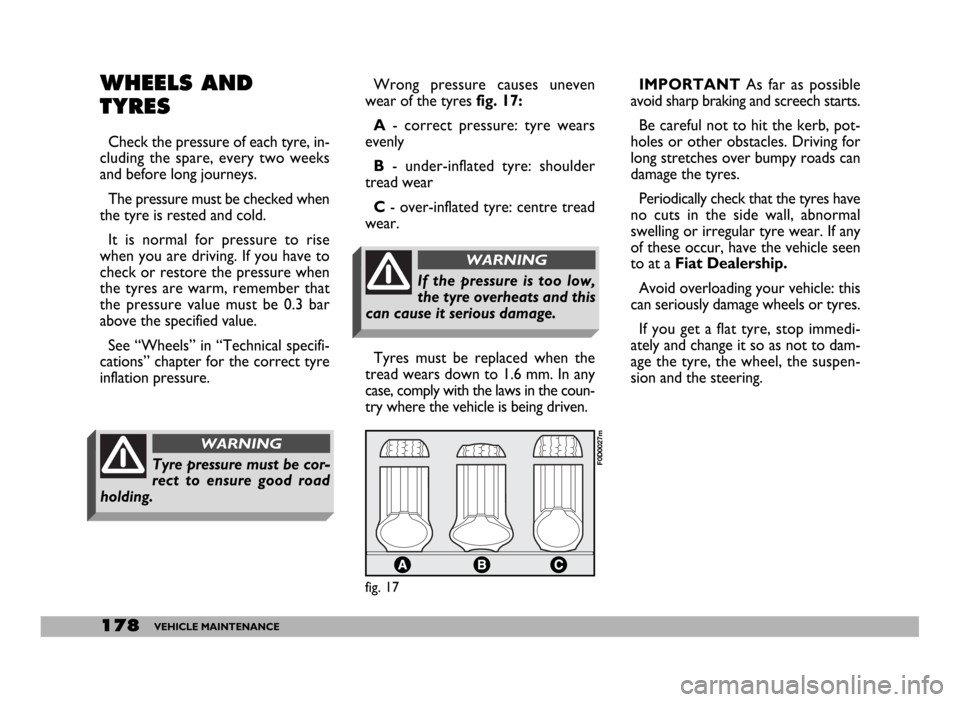
inflation pressure.Wrong pressure causes uneven
wear of the tyres fig. 17:
A- correct pressure: tyre wears
evenly
B- under-inflated tyre: shoulder
tread wear
C- over-inflated tyre: centre tread
wear.IMPORTANTAs far as possible
avoid sharp braking and screech starts.
Be careful not to hit the kerb, pot-
holes or other obstacles. Driving for
long stretches over bumpy roads can
damage the tyres.
Periodically check that the tyres have
no cuts in the side wall, abnormal
swelling or irregular tyre wear. If any
of these occur, have the vehicle seen
to at a Fiat Dealership.
Avoid overloading your vehicle: this
can seriously damage wheels or tyres.
If you get a flat tyre, stop immedi-
ately and change it so as not to dam-
age the tyre, the wheel, the suspen-
sion and the steering.
fig. 17
F0D0027m
If the pressure is too low,
the tyre overheats and this
can cause it serious damage.
WARNING
Tyre pressure must be cor-
rect to ensure good road
holding.
WARNING
Tyres must be replaced when the
tread wears down to 1.6 mm. In any
case, comply with the laws in the coun-
try where the vehicle is being driven.
Page 221 of 258

220TECHNICAL SPECIFICATIONS
COLD TYRE INFLATION PRESSURE (bar)
Version
11
All types
Camping Car
15
All types (**)
2.8 JTD POWER
Camping Car
MAXI
All types (**)
2.8 JTD POWER
Camping Car
(*) 4.75 bar for vehicles with maximum admitted load on rear axle over 2000 kg.
(**) Except 2.8 JTD POWER versions
For warm tyres the pressure should be +0.3 bar in relation to the prescribed value.
Check again the correct pressure when the tyres are cold.Tyre
195/70 R15C 103/101 Q
205/70 R15C 106/104 Q
215/70 R15C 109/107 Q Camping
205/70 R15C 106/104 Q
205/70 R15C 106/104 R
215/70 R15C 109/107 Q Camping
205/75 R16C 110/108 Q
215/75 R16C 113/111 Q
205/75 R16C 110/108 R
215/75 R16C 113/111 R
215/75 R16C 113/111 Q Camping Rim
6J x 15” - H2
6J x 15” - H2
6J x 15” - H2
6J x 15” - H2
6J x 15” - H2
6J x 16” - H2
6J x 16” - H2
6J x 16” - H2Inflation pressure (bar)
Unladen and fully loaded
Front
4.0
4.0
5.0
4.1
4.1
5.0
4.5
4.5
4.5
4.5
5.5Rear
4.0
4.0
5.0
4.5
4.5
5.0
4.5 (*)
4.5
4.5 (*)
4.5
5.5
Page 222 of 258
221TECHNICAL SPECIFICATIONS
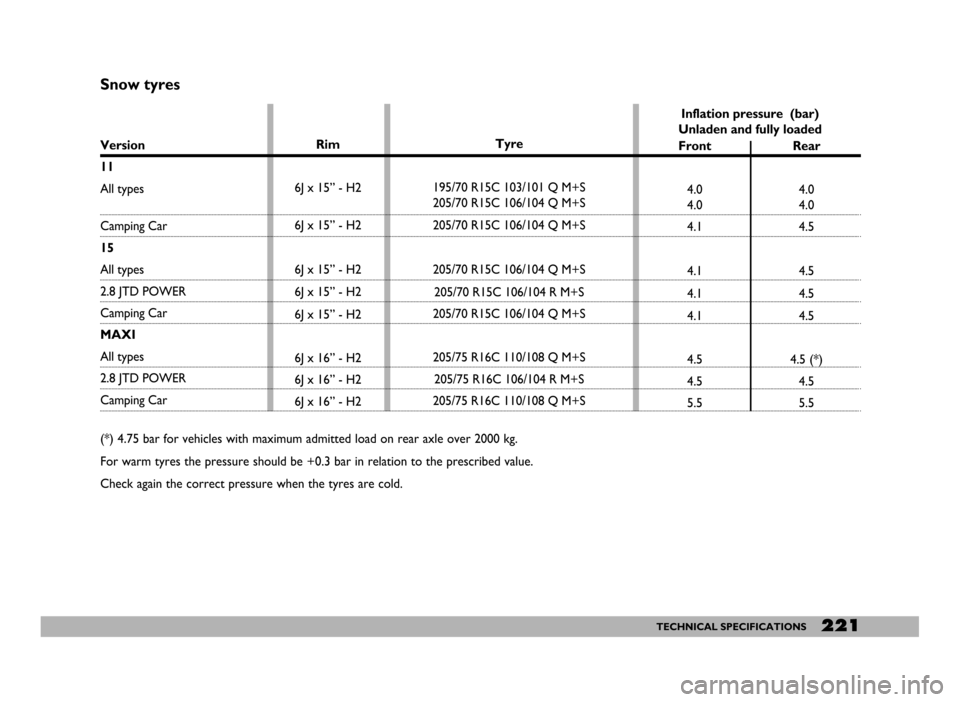
Snow tyres
Version
11
All types
Camping Car
15
All types
2.8 JTD POWER
Camping Car
MAXI
All types
2.8 JTD POWER
Camping Car
(*) 4.75 bar for vehicles with maximum admitted load on rear axle over 2000 kg.
For warm tyres the pressure should be +0.3 bar in relation to the prescribed value.
Check again the correct pressure when the tyres are cold.Tyre
195/70 R15C 103/101 Q M+S
205/70 R15C 106/104 Q M+S
205/70 R15C 106/104 Q M+S
205/70 R15C 106/104 Q M+S
205/70 R15C 106/104 R M+S
205/70 R15C 106/104 Q M+S
205/75 R16C 110/108 Q M+S
205/75 R16C 106/104 R M+S
205/75 R16C 110/108 Q M+S Rim
6J x 15” - H2
6J x 15” - H2
6J x 15” - H2
6J x 15” - H2
6J x 15” - H2
6J x 16” - H2
6J x 16” - H2
6J x 16” - H2Inflation pressure (bar)
Unladen and fully loaded
Front
4.0
4.0
4.1
4.1
4.1
4.1
4.5
4.5
5.5Rear
4.0
4.0
4.5
4.5
4.5
4.5
4.5 (*)
4.5
5.5
Page 257 of 258
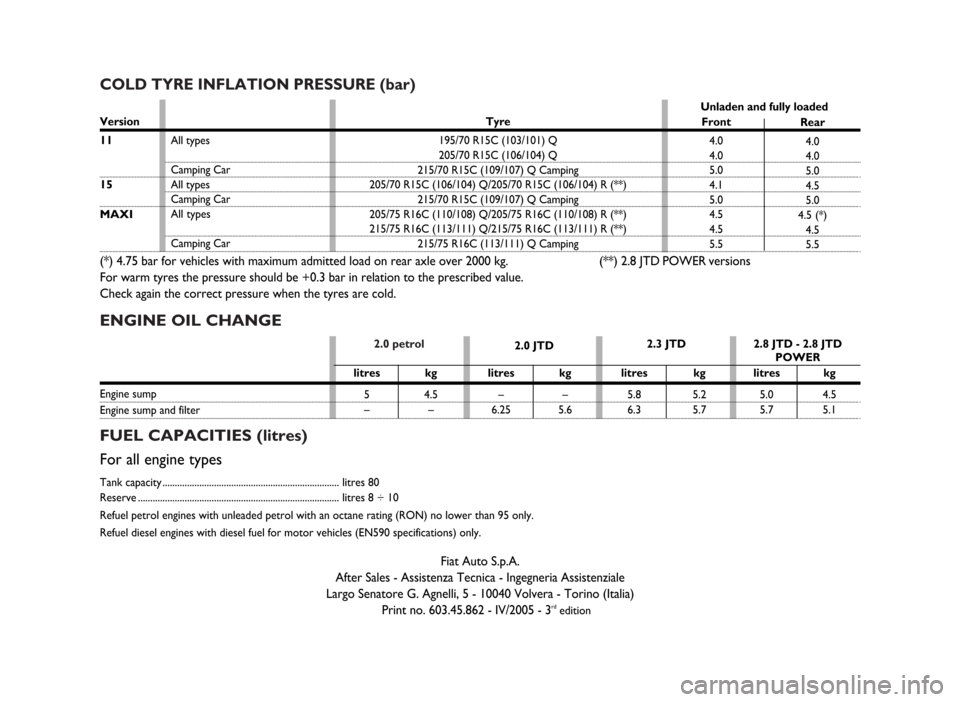
2.0 petrol
COLD TYRE INFLATION PRESSURE (bar)
ENGINE OIL CHANGE
FUEL CAPACITIES (litres)
For all engine types
Tank capacity ........................................................................ litres 80
Reserve .................................................................................. litres 8 ÷ 10
Refuel petrol engines with unleaded petrol with an octane rating (RON) no lower than 95 only.
Refuel diesel engines with diesel fuel for motor vehicles (EN590 specifications) only.
Version
11
15
MAXI
(*) 4.75 bar for vehicles with maximum admitted load on rear axle over 2000 kg. (**) 2.8 JTD POWER versions
For warm tyres the pressure should be +0.3 bar in relation to the prescribed value.
Check again the correct pressure when the tyres are cold.
Unladen and fully loaded
Rear
4.0
4.0
5.0
4.5
5.0
4.5 (*)
4.5
5.5 Front
4.0
4.0
5.0
4.1
5.0
4.5
4.5
5.5 All types
Camping Car
All types
Camping Car
All types
Camping CarTyre
195/70 R15C (103/101) Q
205/70 R15C (106/104) Q
215/70 R15C (109/107) Q Camping
205/70 R15C (106/104) Q/205/70 R15C (106/104) R (**)
215/70 R15C (109/107) Q Camping
205/75 R16C (110/108) Q/205/75 R16C (110/108) R (**)
215/75 R16C (113/111) Q/215/75 R16C (113/111) R (**)
215/75 R16C (113/111) Q Camping
2.8 JTD - 2.8 JTD
POWER
litres
5
–kg
4.5
–kg
–
5.6litres
5.0
5.7 kg
5.2
5.7kg
4.5
5.1 2.3 JTD
Fiat Auto S.p.A.
After Sales - Assistenza Tecnica - Ingegneria Assistenziale
Largo Senatore G. Agnelli, 5 - 10040 Volvera - Torino (Italia)
Print no. 603.45.862 - IV/2005 - 3
rdedition 2.0 JTD
litres
–
6.25litres
5.8
6.3
Engine sump
Engine sump and filter