axle FIAT DUCATO 244 2005 3.G Owners Manual
[x] Cancel search | Manufacturer: FIAT, Model Year: 2005, Model line: DUCATO 244, Model: FIAT DUCATO 244 2005 3.GPages: 258, PDF Size: 4.05 MB
Page 88 of 258
87GETTING TO KNOW YOUR VEHICLE
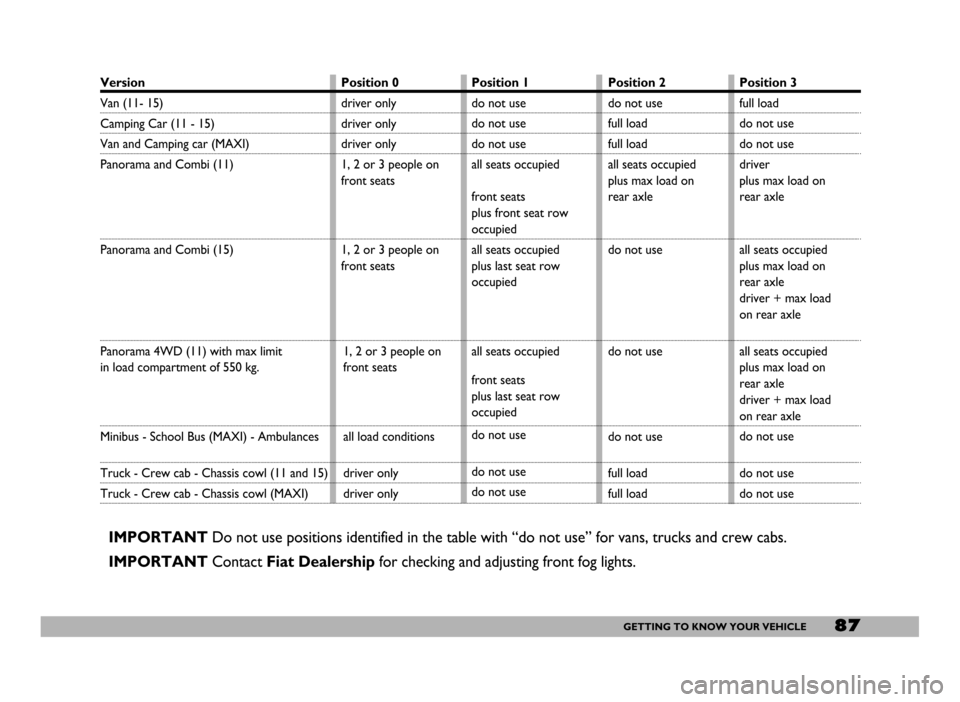
Version
Van (11- 15)
Camping Car (11 - 15)
Van and Camping car (MAXI)
Panorama and Combi (11)
Panorama and Combi (15)
Panorama 4WD (11) with max limit
in load compartment of 550 kg.
Minibus - School Bus (MAXI) - Ambulances
Truck - Crew cab - Chassis cowl (11 and 15)
Truck - Crew cab - Chassis cowl (MAXI)Position 0
driver only
driver only
driver only
1, 2 or 3 people on
front seats
1, 2 or 3 people on
front seats
1, 2 or 3 people on
front seats
all load conditions
driver only
driver onlyPosition 1
do not use
do not use
do not use
all seats occupied
front seats
plus front seat row
occupied
all seats occupied
plus last seat row
occupied
all seats occupied
front seats
plus last seat row
occupied
do not use
do not use
do not usePosition 2
do not use
full load
full load
all seats occupied
plus max load on
rear axle
do not use
do not use
do not use
full load
full loadPosition 3
full load
do not use
do not use
driver
plus max load on
rear axle
all seats occupied
plus max load on
rear axle
driver + max load
on rear axle
all seats occupied
plus max load on
rear axle
driver + max load
on rear axle
do not use
do not use
do not use
IMPORTANTDo not use positions identified in the table with “do not use” for vans, trucks and crew cabs.
IMPORTANTContact Fiat Dealershipfor checking and adjusting front fog lights.
Page 110 of 258
109GETTING THE BEST OUT OF YOUR VEHICLE
To release the handbrake:
1)slightly lift the handbrake and press
release button A-fig. 1;
2)keep the button pressed and low-
er the lever. Warning light xwill go
out;
3)press the brake pedal when car-
rying out this operation to prevent the
vehicle moving accidentally.
IMPORTANTPull the handbrake
lever only when the vehicle is at a
standstill, or when the vehicle is run-
ning, but however only in case of a fail-
ure of the hydraulic system.
Should the handbrake be exception-
ally used when the vehicle is running, it
is suggested to keep a moderate trac-
tion to avoid causing the rear axle
block, entailing vehicle side skidding.USING THE
MANUAL GEARBOX
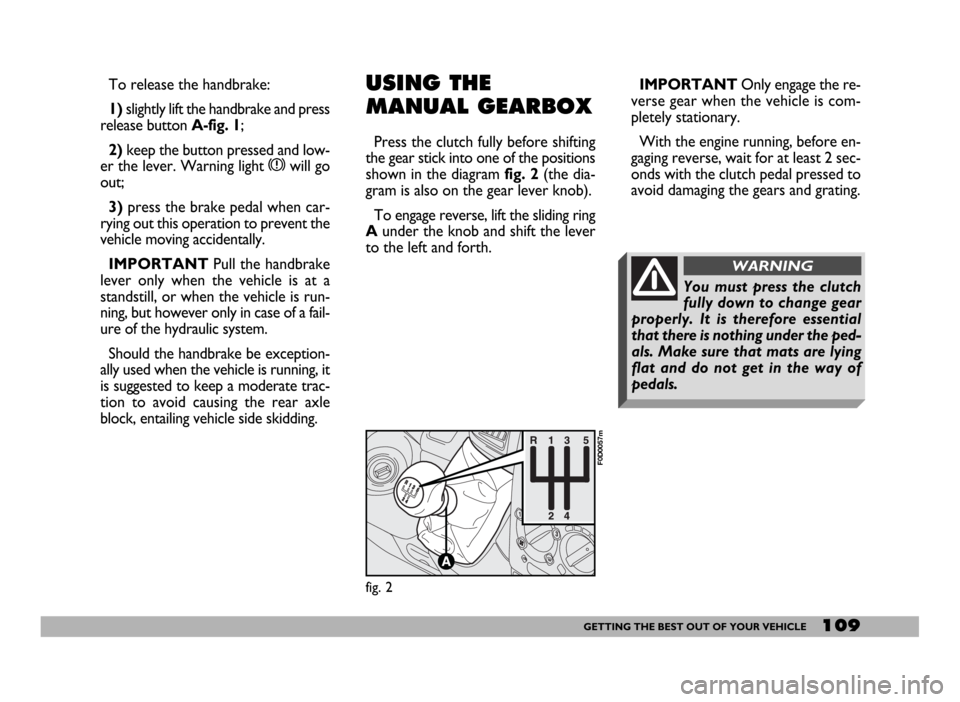
Press the clutch fully before shifting
the gear stick into one of the positions
shown in the diagram fig. 2(the dia-
gram is also on the gear lever knob).
To engage reverse, lift the sliding ring
Aunder the knob and shift the lever
to the left and forth.IMPORTANTOnly engage the re-
verse gear when the vehicle is com-
pletely stationary.
With the engine running, before en-
gaging reverse, wait for at least 2 sec-
onds with the clutch pedal pressed to
avoid damaging the gears and grating.
fig. 2
F0D0057m
You must press the clutch
fully down to change gear
properly. It is therefore essential
that there is nothing under the ped-
als. Make sure that mats are lying
flat and do not get in the way of
pedals.
WARNING
Page 127 of 258
126GETTING THE BEST OUT OF YOUR VEHICLE
CONDITIONS OF USE
Cold starting
Frequent cold starting will not enable
the engine to reach optimal running
temperature. It follows, therefore,
that consumption will be higher (from
+15 to +30% in towns) as will the
production of toxic emissions.
Traffic and road conditions
Heavy traffic and higher consumption
are synonymous: for example, when
driving slowly with frequent use of low-
er gears or in towns where there are
numerous traffic lights.
Winding roads, mountain roads and
bumpy roads also have a negative effect
on consumption.
Enforced halts
During prolonged stops (traffic lights,
level crossings, etc.) the engine should
be switched off.LOAD
RECOMMENDATIONS
The version of the Ducato you are
driving has been designed and ap-
proved on the basis of several set
maximum weights (see the tables
“Weights” in section “Technical spec-
ifications”):
– kerb weight
– payload
– total weight
– total weight on the front axle
– total weight on the rear axle
– towable weight
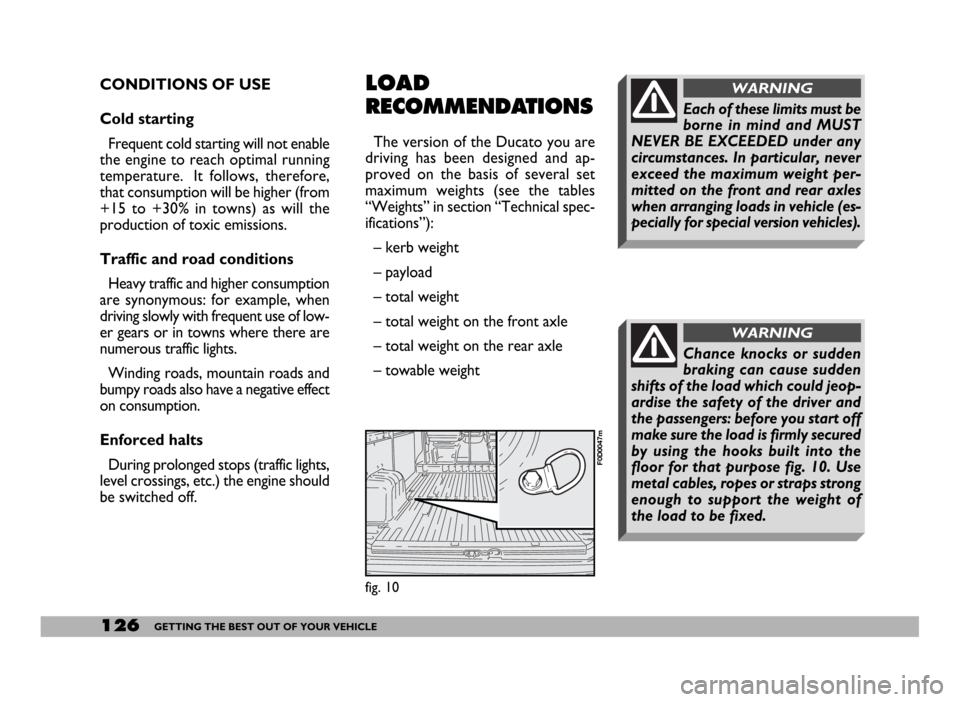
fig. 10
F0D0047m
Each of these limits must be
borne in mind and MUST
NEVER BE EXCEEDED under any
circumstances. In particular, never
exceed the maximum weight per-
mitted on the front and rear axles
when arranging loads in vehicle (es-
pecially for special version vehicles).
WARNING
Chance knocks or sudden
braking can cause sudden
shifts of the load which could jeop-
ardise the safety of the driver and
the passengers: before you start off
make sure the load is firmly secured
by using the hooks built into the
floor for that purpose fig. 10. Use
metal cables, ropes or straps strong
enough to support the weight of
the load to be fixed.
WARNING
Page 128 of 258
127GETTING THE BEST OUT OF YOUR VEHICLE
In addition to these general precau-
tions, some simple measures could en-
hance driving safety, comfort and the
length of the vehicle’s life:
– distribute the load evenly over the
load floor: if you need to concentrate
it all in one point choose the part be-
tween the axles;
– remember that the lower the load
is, the lower the vehicle’s centre of
gravity will be, contributing to a safe
drive; you should therefore always po-
sition the heavier goods at the bottom;
– finally, remember that the way in
which the vehicle moves is influenced
by the weight being carried. In partic-
ular, stopping distance lengthens par-
ticularly at high speed.CHEAP RUNNING
THAT RESPECTS
THE ENVIRONMENT
Environmental protection has been
one of the guiding principles in the
production of the Ducato. It is no ac-
cident that its pollution control equip-
ment is much more effective than that
required by current legislation.
Nonetheless, the environment can-
not get by without a concerted effort
from everyone. By following a few sim-
ple rules you can avoid harming the
environment and often cut down fuel
consumption at the same time.
On this subject, a few useful tips have
been given below to supplement those
marked by symbol #at various points
of the handbook. You are asked to
read both the former and latter care-
fully.
Even if the vehicle is sta-
tionary on a steep hill or
sideways incline, goods not proper-
ly secured could fall out when the
back or side doors are opened.
WARNING
Observe the enforced rules
if you need to carry a spare
can of petrol. Only use a homolo-
gated can and secure it to the load
anchoring eyebolts. Even given
these precautions, the risk of fire in
the event of an accident is in-
creased.
WARNING
Page 131 of 258
130GETTING THE BEST OUT OF YOUR VEHICLE
The electrical brake or other device
(electrical winch, etc.) must be pow-
ered directly from the battery by
means of a lead with a cross-section
area not smaller than 2.5 mm
2.
In addition to the electrical connec-
tions, only the power wire for an ad-
ditional electrical brake and for inter-
nal trailer lighting with a power not
exceeding 15W can be connected to
the vehicle’s electrical system.
FITTING DIAGRAM
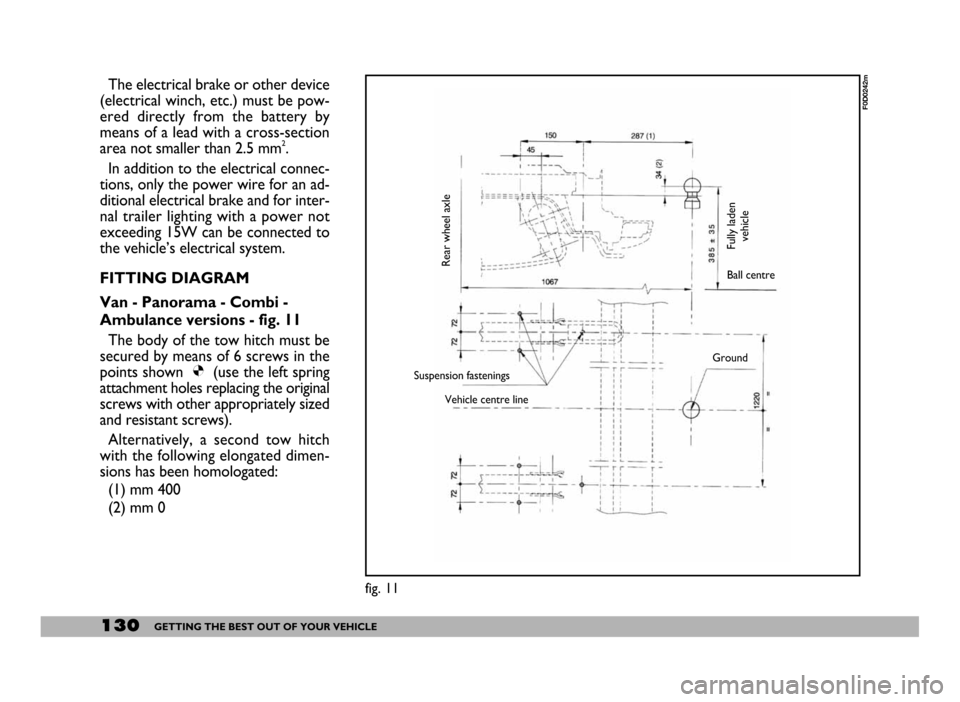
Van - Panorama - Combi -
Ambulance versions - fig. 11
The body of the tow hitch must be
secured by means of 6 screws in the
points shown Ø(use the left spring
attachment holes replacing the original
screws with other appropriately sized
and resistant screws).
Alternatively, a second tow hitch
with the following elongated dimen-
sions has been homologated:
(1) mm 400
(2) mm 0
fig. 11
F0D0242m
Rear wheel axle
Fully laden
vehicleBall centre
Suspension fastenings
Vehicle centre lineGround
Page 165 of 258
164VEHICLE MAINTENANCE
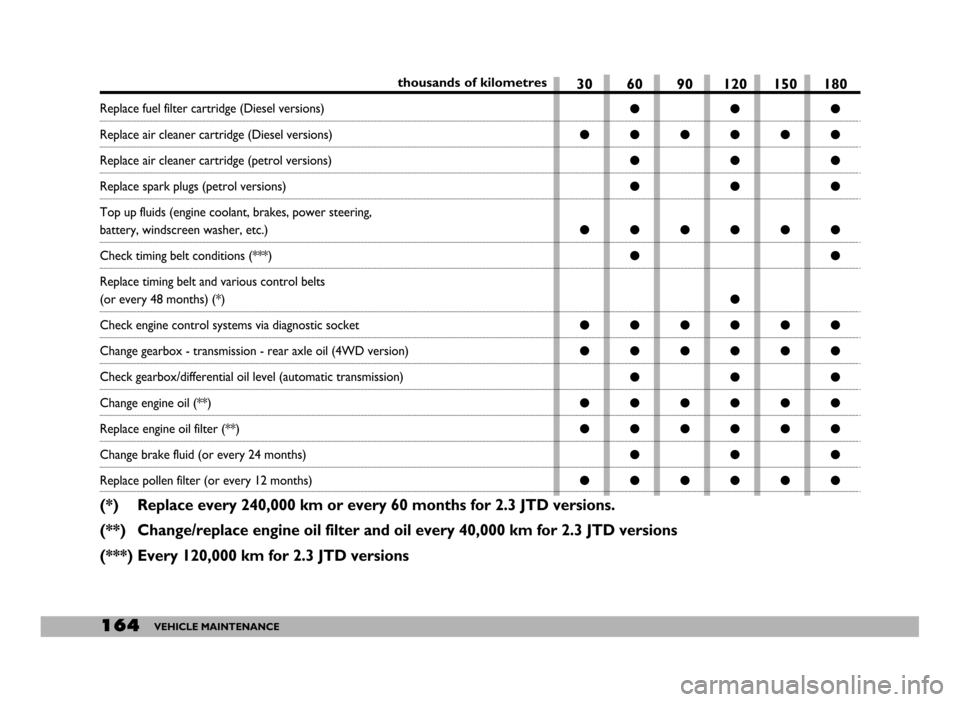
thousands of kilometres
Replace fuel filter cartridge (Diesel versions)
Replace air cleaner cartridge (Diesel versions)
Replace air cleaner cartridge (petrol versions)
Replace spark plugs (petrol versions)
Top up fluids (engine coolant, brakes, power steering,
battery, windscreen washer, etc.)
Check timing belt conditions (***)
Replace timing belt and various control belts
(or every 48 months) (*)
Check engine control systems via diagnostic socket
Change gearbox - transmission - rear axle oil (4WD version)
Check gearbox/differential oil level (automatic transmission)
Change engine oil (**)
Replace engine oil filter (**)
Change brake fluid (or every 24 months)
Replace pollen filter (or every 12 months)
(*) Replace every 240,000 km or every 60 months for 2.3 JTD versions.
(**) Change/replace engine oil filter and oil every 40,000 km for 2.3 JTD versions
(***) Every 120,000 km for 2.3 JTD versions
30 60 90 120 150 180
●●●
●●●●●●
●●●
●●●
●●●●●●
●●
●
●●●●●●
●●●●●●
●●●
●●●●●●
●●●●●●
●●●
●●●●●●
Page 187 of 258
186TECHNICAL SPECIFICATIONS
E- Maximum vehicle weight fully
loaded
F - Maximum vehicle weight fully
loaded with trailer
G - Maximum vehicle weight on
front axle
H - Maximum vehicle weight on rear
axle
I - Engine type
L - Body version code
M - Smoke opacity index (for diesel
engines).
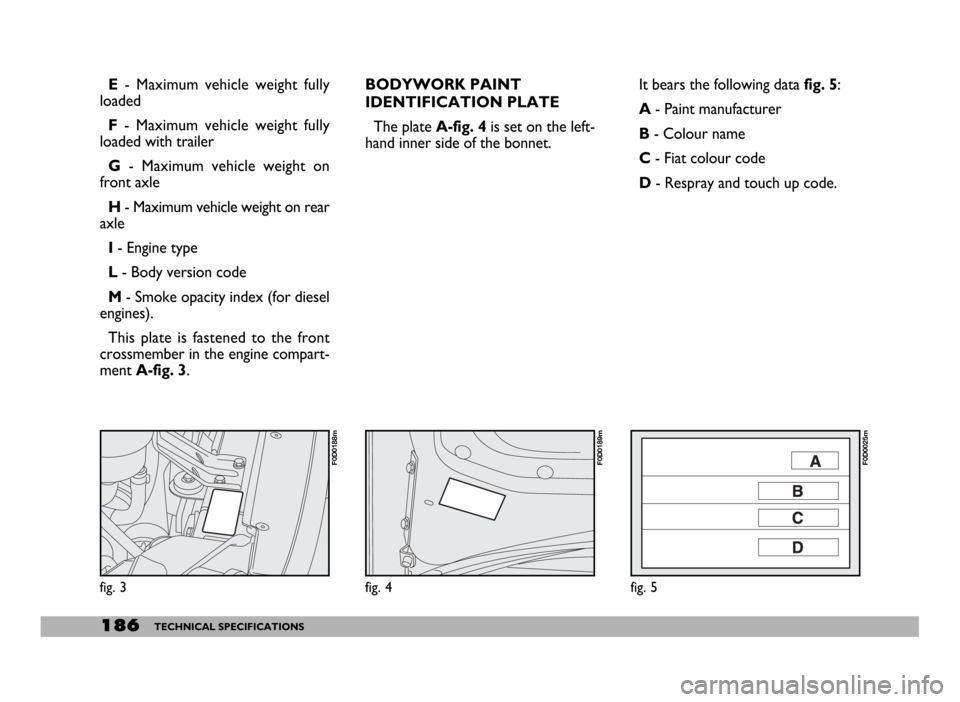
This plate is fastened to the front
crossmember in the engine compart-
ment A-fig. 3.BODYWORK PAINT
IDENTIFICATION PLATE
The plateA-fig. 4 is set on the left-
hand inner side of the bonnet.It bears the following data fig. 5:
A - Paint manufacturer
B - Colour name
C - Fiat colour code
D- Respray and touch up code.
fig. 3
F0D0188m
fig. 4
F0D0189m
fig. 5
F0D0025m
Page 204 of 258
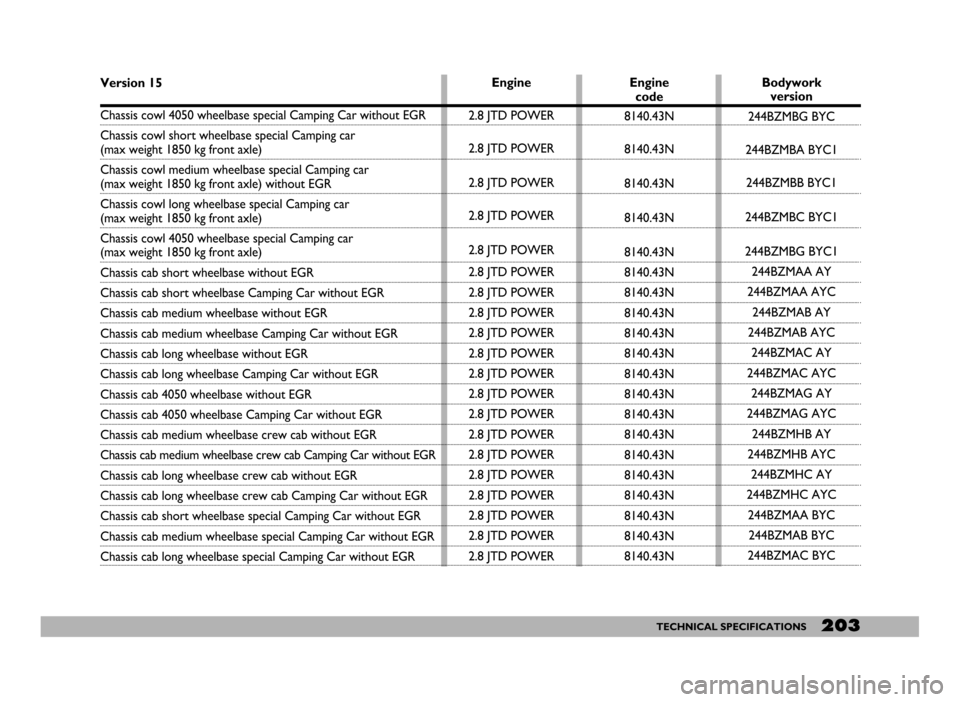
203TECHNICAL SPECIFICATIONS
Version 15
Chassis cowl 4050 wheelbase special Camping Car without EGR
Chassis cowl short wheelbase special Camping car
(max weight 1850 kg front axle)
Chassis cowl medium wheelbase special Camping car
(max weight 1850 kg front axle) without EGR
Chassis cowl long wheelbase special Camping car
(max weight 1850 kg front axle)
Chassis cowl 4050 wheelbase special Camping car
(max weight 1850 kg front axle)
Chassis cab short wheelbase without EGR
Chassis cab short wheelbase Camping Car without EGR
Chassis cab medium wheelbase without EGR
Chassis cab medium wheelbase Camping Car without EGR
Chassis cab long wheelbase without EGR
Chassis cab long wheelbase Camping Car without EGR
Chassis cab 4050 wheelbase without EGR
Chassis cab 4050 wheelbase Camping Car without EGR
Chassis cab medium wheelbase crew cab without EGR
Chassis cab medium wheelbase crew cab Camping Car without EGR
Chassis cab long wheelbase crew cab without EGR
Chassis cab long wheelbase crew cab Camping Car without EGR
Chassis cab short wheelbase special Camping Car without EGR
Chassis cab medium wheelbase special Camping Car without EGR
Chassis cab long wheelbase special Camping Car without EGREngine
2.8 JTD POWER
2.8 JTD POWER
2.8 JTD POWER
2.8 JTD POWER
2.8 JTD POWER
2.8 JTD POWER
2.8 JTD POWER
2.8 JTD POWER
2.8 JTD POWER
2.8 JTD POWER
2.8 JTD POWER
2.8 JTD POWER
2.8 JTD POWER
2.8 JTD POWER
2.8 JTD POWER
2.8 JTD POWER
2.8 JTD POWER
2.8 JTD POWER
2.8 JTD POWER
2.8 JTD POWEREngine
code
8140.43N
8140.43N
8140.43N
8140.43N
8140.43N
8140.43N
8140.43N
8140.43N
8140.43N
8140.43N
8140.43N
8140.43N
8140.43N
8140.43N
8140.43N
8140.43N
8140.43N
8140.43N
8140.43N
8140.43NBodywork
version
244BZMBG BYC
244BZMBA BYC1
244BZMBB BYC1
244BZMBC BYC1
244BZMBG BYC1
244BZMAA AY
244BZMAA AYC
244BZMAB AY
244BZMAB AYC
244BZMAC AY
244BZMAC AYC
244BZMAG AY
244BZMAG AYC
244BZMHB AY
244BZMHB AYC
244BZMHC AY
244BZMHC AYC
244BZMAA BYC
244BZMAB BYC
244BZMAC BYC
Page 205 of 258
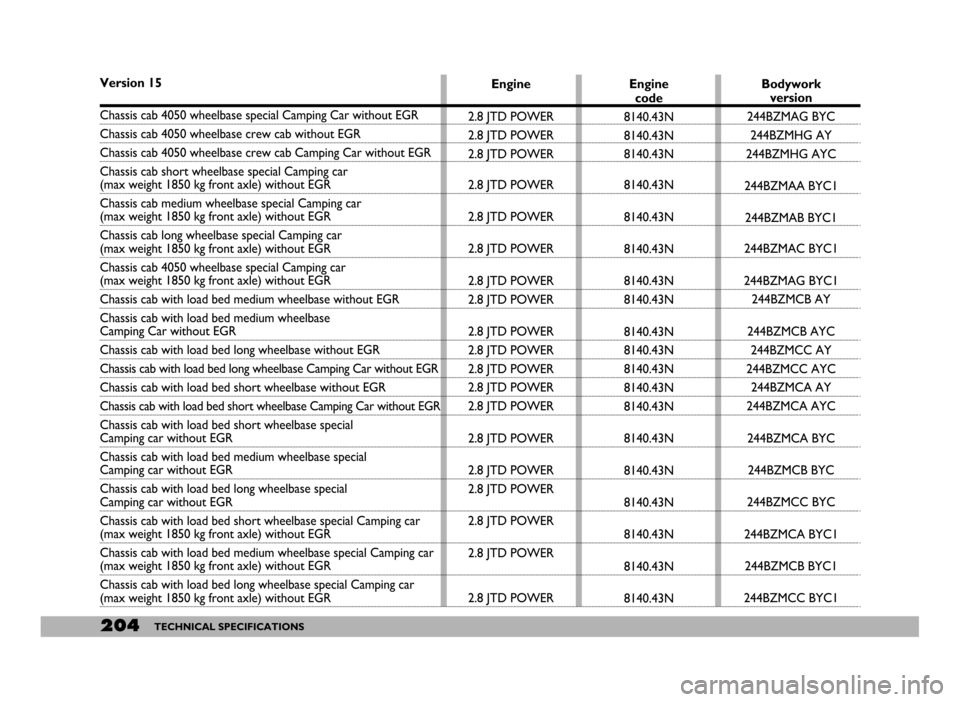
204TECHNICAL SPECIFICATIONS
Version 15
Chassis cab 4050 wheelbase special Camping Car without EGR
Chassis cab 4050 wheelbase crew cab without EGR
Chassis cab 4050 wheelbase crew cab Camping Car without EGR
Chassis cab short wheelbase special Camping car
(max weight 1850 kg front axle) without EGR
Chassis cab medium wheelbase special Camping car
(max weight 1850 kg front axle) without EGR
Chassis cab long wheelbase special Camping car
(max weight 1850 kg front axle) without EGR
Chassis cab 4050 wheelbase special Camping car
(max weight 1850 kg front axle) without EGR
Chassis cab with load bed medium wheelbase without EGR
Chassis cab with load bed medium wheelbase
Camping Car without EGR
Chassis cab with load bed long wheelbase without EGR
Chassis cab with load bed long wheelbase Camping Car without EGR
Chassis cab with load bed short wheelbase without EGR
Chassis cab with load bed short wheelbase Camping Car without EGR
Chassis cab with load bed short wheelbase special Camping car without EGR
Chassis cab with load bed medium wheelbase special
Camping car without EGR
Chassis cab with load bed long wheelbase special
Camping car without EGR
Chassis cab with load bed short wheelbase special Camping car
(max weight 1850 kg front axle) without EGR
Chassis cab with load bed medium wheelbase special Camping car
(max weight 1850 kg front axle) without EGR
Chassis cab with load bed long wheelbase special Camping car
(max weight 1850 kg front axle) without EGREngine
2.8 JTD POWER
2.8 JTD POWER
2.8 JTD POWER
2.8 JTD POWER
2.8 JTD POWER
2.8 JTD POWER
2.8 JTD POWER
2.8 JTD POWER
2.8 JTD POWER
2.8 JTD POWER
2.8 JTD POWER
2.8 JTD POWER
2.8 JTD POWER
2.8 JTD POWER
2.8 JTD POWER
2.8 JTD POWER
2.8 JTD POWER
2.8 JTD POWER
2.8 JTD POWEREngine
code
8140.43N
8140.43N
8140.43N
8140.43N
8140.43N
8140.43N
8140.43N
8140.43N
8140.43N
8140.43N
8140.43N
8140.43N
8140.43N
8140.43N
8140.43N
8140.43N
8140.43N
8140.43N
8140.43NBodywork
version
244BZMAG BYC
244BZMHG AY
244BZMHG AYC
244BZMAA BYC1
244BZMAB BYC1
244BZMAC BYC1
244BZMAG BYC1
244BZMCB AY
244BZMCB AYC
244BZMCC AY
244BZMCC AYC
244BZMCA AY
244BZMCA AYC
244BZMCA BYC
244BZMCB BYC
244BZMCC BYC
244BZMCA BYC1
244BZMCB BYC1
244BZMCC BYC1
Page 217 of 258
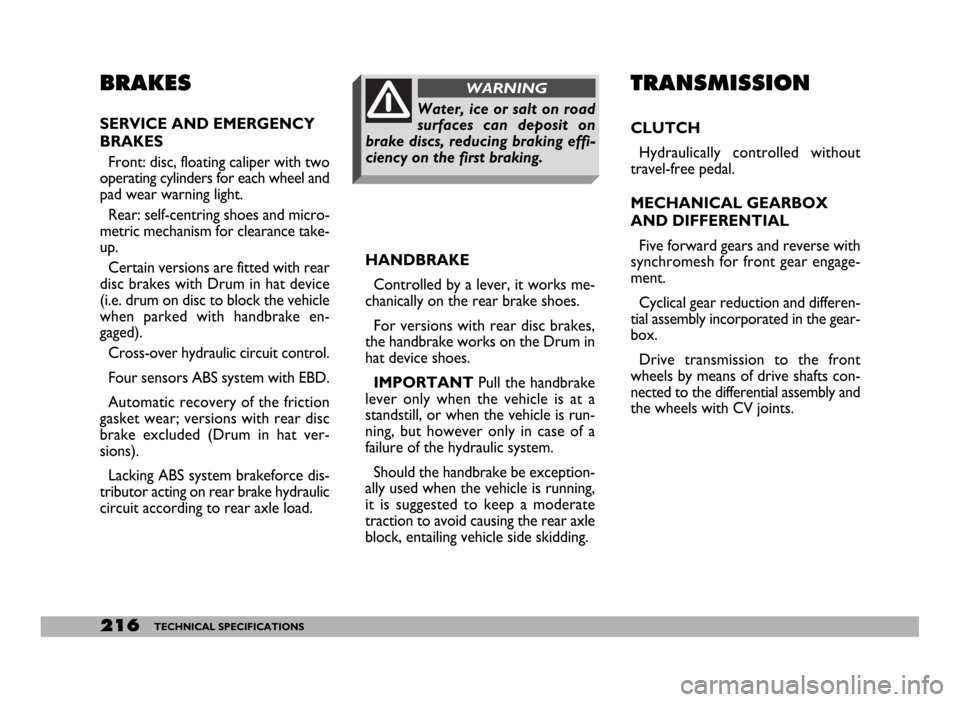
216TECHNICAL SPECIFICATIONS
BRAKES
SERVICE AND EMERGENCY
BRAKES
Front: disc, floating caliper with two
operating cylinders for each wheel and
pad wear warning light.
Rear: self-centring shoes and micro-
metric mechanism for clearance take-
up.
Certain versions are fitted with rear
disc brakes with Drum in hat device
(i.e. drum on disc to block the vehicle
when parked with handbrake en-
gaged).
Cross-over hydraulic circuit control.
Four sensors ABS system with EBD.
Automatic recovery of the friction
gasket wear; versions with rear disc
brake excluded (Drum in hat ver-
sions).
Lacking ABS system brakeforce dis-
tributor acting on rear brake hydraulic
circuit according to rear axle load.HANDBRAKE
Controlled by a lever, it works me-
chanically on the rear brake shoes.
For versions with rear disc brakes,
the handbrake works on the Drum in
hat device shoes.
IMPORTANTPull the handbrake
lever only when the vehicle is at a
standstill, or when the vehicle is run-
ning, but however only in case of a
failure of the hydraulic system.
Should the handbrake be exception-
ally used when the vehicle is running,
it is suggested to keep a moderate
traction to avoid causing the rear axle
block, entailing vehicle side skidding.
TRANSMISSION
CLUTCH
Hydraulically controlled without
travel-free pedal.
MECHANICAL GEARBOX
AND DIFFERENTIAL
Five forward gears and reverse with
synchromesh for front gear engage-
ment.
Cyclical gear reduction and differen-
tial assembly incorporated in the gear-
box.
Drive transmission to the front
wheels by means of drive shafts con-
nected to the differential assembly and
the wheels with CV joints.
Water, ice or salt on road
surfaces can deposit on
brake discs, reducing braking effi-
ciency on the first braking.
WARNING