reverse FIAT DUCATO 244 2005 3.G Owners Manual
[x] Cancel search | Manufacturer: FIAT, Model Year: 2005, Model line: DUCATO 244, Model: FIAT DUCATO 244 2005 3.GPages: 258, PDF Size: 4.05 MB
Page 29 of 258
28GETTING TO KNOW YOUR VEHICLE
IGNITION SWITCH
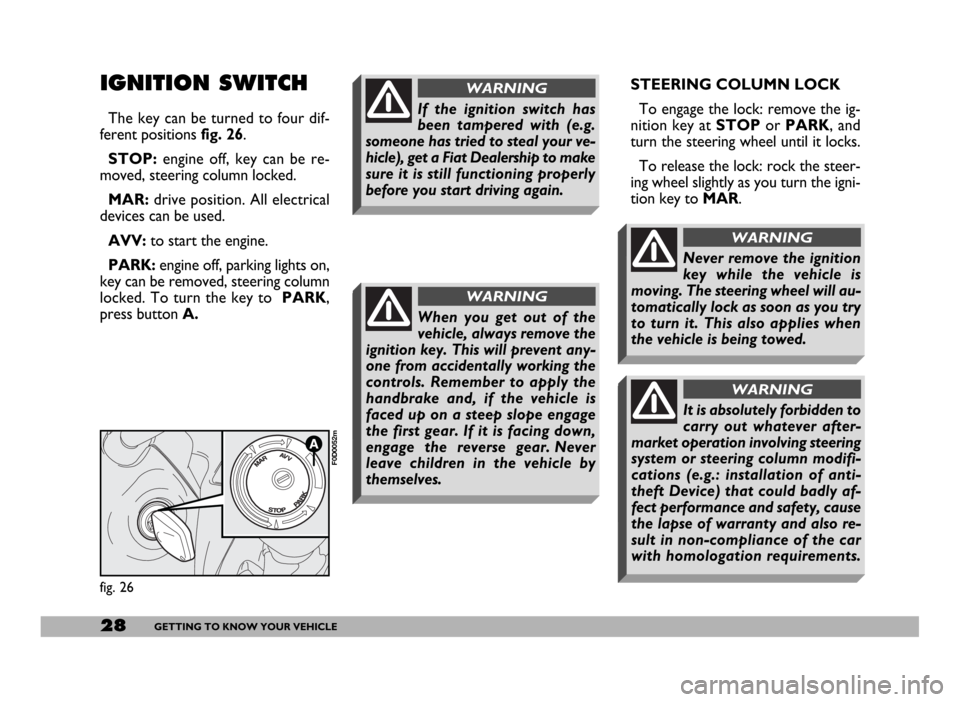
The key can be turned to four dif-
ferent positions fig. 26.
STOP:engine off, key can be re-
moved, steering column locked.
MAR:drive position. All electrical
devices can be used.
AVV:to start the engine.
PARK:engine off, parking lights on,
key can be removed, steering column
locked. To turn the key to PARK,
press button A.STEERING COLUMN LOCK
To engage the lock: remove the ig-
nition key at STOPor PARK, and
turn the steering wheel until it locks.
To release the lock: rock the steer-
ing wheel slightly as you turn the igni-
tion key to MAR.
fig. 26
F0D0052m
If the ignition switch has
been tampered with (e.g.
someone has tried to steal your ve-
hicle), get a Fiat Dealership to make
sure it is still functioning properly
before you start driving again.
WARNING
When you get out of the
vehicle, always remove the
ignition key. This will prevent any-
one from accidentally working the
controls. Remember to apply the
handbrake and, if the vehicle is
faced up on a steep slope engage
the first gear. If it is facing down,
engage the reverse gear. Never
leave children in the vehicle by
themselves.
WARNING
Never remove the ignition
key while the vehicle is
moving. The steering wheel will au-
tomatically lock as soon as you try
to turn it. This also applies when
the vehicle is being towed.
WARNING
It is absolutely forbidden to
carry out whatever after-
market operation involving steering
system or steering column modifi-
cations (e.g.: installation of anti-
theft Device) that could badly af-
fect performance and safety, cause
the lapse of warranty and also re-
sult in non-compliance of the car
with homologation requirements.
WARNING
Page 68 of 258
67GETTING TO KNOW YOUR VEHICLE
REARVIEW
CAMERA
Vehicles equipped with CONNECT
NAV+ can be fitted with an optional
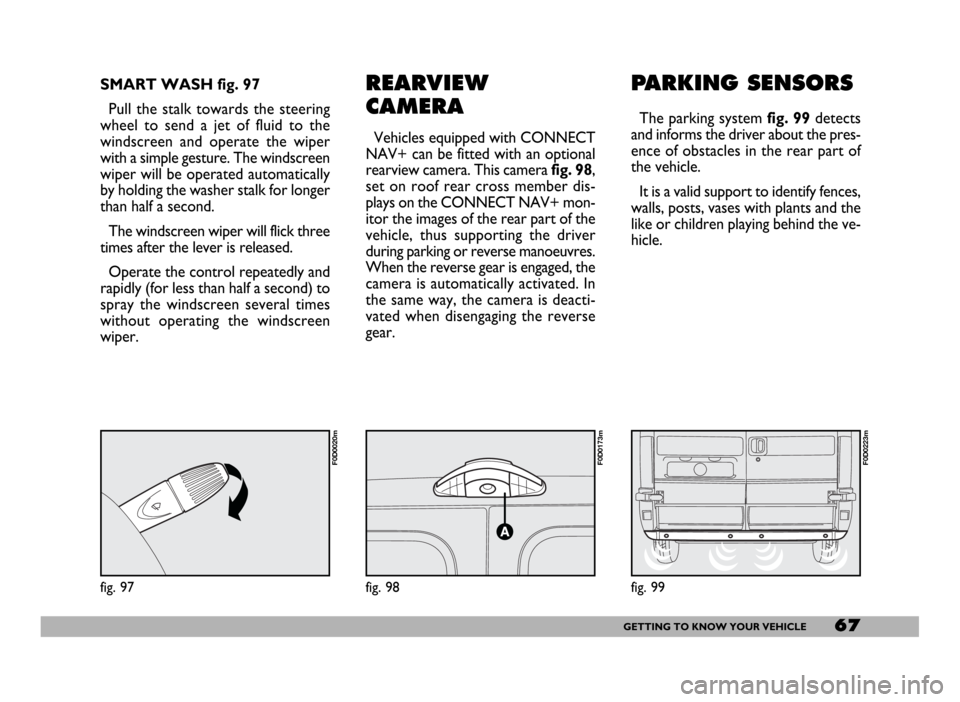
rearview camera. This camerafig. 98,
set on roof rear cross member dis-
plays on the CONNECT NAV+ mon-
itor the images of the rear part of the
vehicle, thus supporting the driver
during parking or reverse manoeuvres.
When the reverse gear is engaged, the
camera is automatically activated. In
the same way, the camera is deacti-
vated when disengaging the reverse
gear.
PARKING SENSORS
The parking system fig. 99detects
and informs the driver about the pres-
ence of obstacles in the rear part of
the vehicle.
It is a valid support to identify fences,
walls, posts, vases with plants and the
like or children playing behind the ve-
hicle.
fig. 98
F0D0173m
SMART WASH fig. 97
Pull the stalk towards the steering
wheel to send a jet of fluid to the
windscreen and operate the wiper
with a simple gesture. The windscreen
wiper will be operated automatically
by holding the washer stalk for longer
than half a second.
The windscreen wiper will flick three
times after the lever is released.
Operate the control repeatedly and
rapidly (for less than half a second) to
spray the windscreen several times
without operating the windscreen
wiper.
fig. 97
F0D0020m
fig. 99
F0D0223m
Page 69 of 258
68GETTING TO KNOW YOUR VEHICLE
IMPORTANTThe cruise control
can be engaged only with speeds high-
er than 40 km/h.
The device is automatically discon-
nected in one of the following cases:
– pressing the brake pedal;
– pressing the clutch pedal;
– inadvertently moving the automat-
ic gearbox selector to N. A special horn warns any people near
the vehicle that the driver is manoeu-
vring it.
Through four sensors located in the
bumper, the system detects the dis-
tance between the vehicle and possi-
ble obstacles; the driver is warned by
an intermittent acoustic signal with in-
creasing frequency, which is automat-
ically activated when the reverse gear
is engaged.CRUISE CONTROL
GENERAL FEATURES
The cruise control, with electronic
control, allows driving the vehicle at
a desired speed, without pressing the
accelerator pedal. This allows reduc-
ing the driving fatigue on motorways,
especially during long journeys, be-
cause the memorised speed is auto-
matically maintained.
Never set gear selector to
N (vehicles fitted with au-
tomatic gearbox) when the vehicle
is moving.
WARNING
The Cruise Control must be
activated only when the
traffic and the path allow keeping,
for a distance long enough, a con-
stant speed in complete safety.
WARNING
Page 109 of 258
108GETTING THE BEST OUT OF YOUR VEHICLE
SWITCHING OFF
THE ENGINE
Turn the ignition key to STOPwhile
the engine is idling.
IMPORTANTAfter a taxing drive
you should allow the engine to “catch
its breath” before turning it off by let-
ting it idle to allow temperature in the
engine compartment to fall.PARKING
Switch off the engine, pull up the
handbrake and engage a gear (1st gear
or reverse, according to whether the
vehicle is facing up or downhill) and
leave the wheels turned. If the vehi-
cle is left on a steep slope, wedges or
a rock should be used to lock the
wheels.
Do not leave the ignition key at
MAR to prevent running the battery
down. Always remove the key when
you leave the vehicle.HANDBRAKE
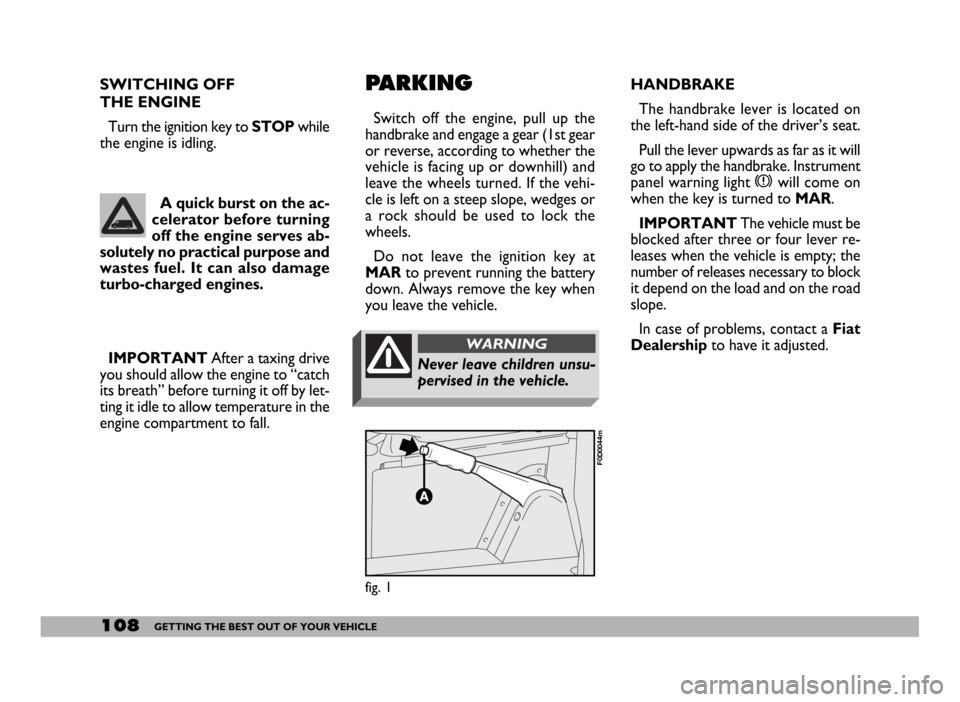
The handbrake lever is located on
the left-hand side of the driver’s seat.
Pull the lever upwards as far as it will
go to apply the handbrake. Instrument
panel warning light xwill come on
when the key is turned to MAR.
IMPORTANTThe vehicle must be
blocked after three or four lever re-
leases when the vehicle is empty; the
number of releases necessary to block
it depend on the load and on the road
slope.
In case of problems, contact a Fiat
Dealershipto have it adjusted. A quick burst on the ac-
celerator before turning
off the engine serves ab-
solutely no practical purpose and
wastes fuel. It can also damage
turbo-charged engines.
fig. 1
F0D0044m
Never leave children unsu-
pervised in the vehicle.
WARNING
Page 110 of 258
109GETTING THE BEST OUT OF YOUR VEHICLE
To release the handbrake:
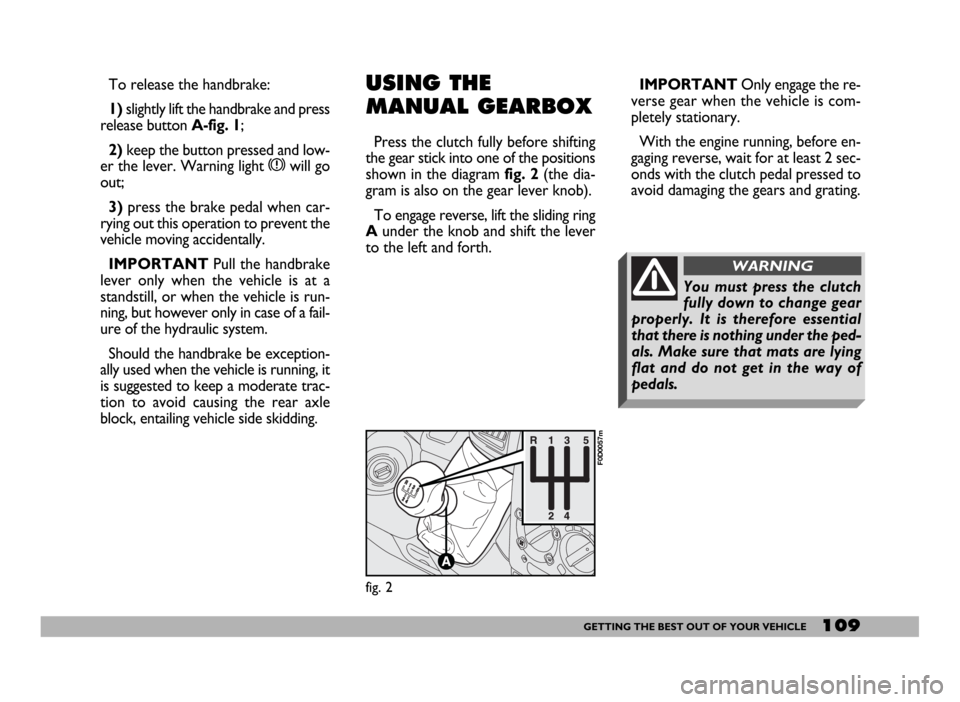
1)slightly lift the handbrake and press
release button A-fig. 1;
2)keep the button pressed and low-
er the lever. Warning light xwill go
out;
3)press the brake pedal when car-
rying out this operation to prevent the
vehicle moving accidentally.
IMPORTANTPull the handbrake
lever only when the vehicle is at a
standstill, or when the vehicle is run-
ning, but however only in case of a fail-
ure of the hydraulic system.
Should the handbrake be exception-
ally used when the vehicle is running, it
is suggested to keep a moderate trac-
tion to avoid causing the rear axle
block, entailing vehicle side skidding.USING THE
MANUAL GEARBOX
Press the clutch fully before shifting
the gear stick into one of the positions
shown in the diagram fig. 2(the dia-
gram is also on the gear lever knob).
To engage reverse, lift the sliding ring
Aunder the knob and shift the lever
to the left and forth.IMPORTANTOnly engage the re-
verse gear when the vehicle is com-
pletely stationary.
With the engine running, before en-
gaging reverse, wait for at least 2 sec-
onds with the clutch pedal pressed to
avoid damaging the gears and grating.
fig. 2
F0D0057m
You must press the clutch
fully down to change gear
properly. It is therefore essential
that there is nothing under the ped-
als. Make sure that mats are lying
flat and do not get in the way of
pedals.
WARNING
Page 111 of 258
110GETTING THE BEST OUT OF YOUR VEHICLE
STARTING
After starting the engine, with the en-
gine idling and keeping the brake ped-
al pressed, move the gearshift lever to
position D. Release the brake pedal
and gradually press the accelerator
pedal.
IMPORTANT Movement of the
lever from position Pis allowed only
with the ignition key at MARand the
button on the lever and the brake ped-
al pressed. STOPPING THE VEHICLE
To stop the vehicle, simply press the
brake pedal regardless of the position
of the gearshift lever.
IMPORTANTRemoving the igni-
tion key is only allowed with the
gearshift lever in position Pand for a
maximum time of 30 seconds from
when the engine is turned off P, when
the door is opened a buzzer will sound
for about 15 seconds to alert the dri-
ver.
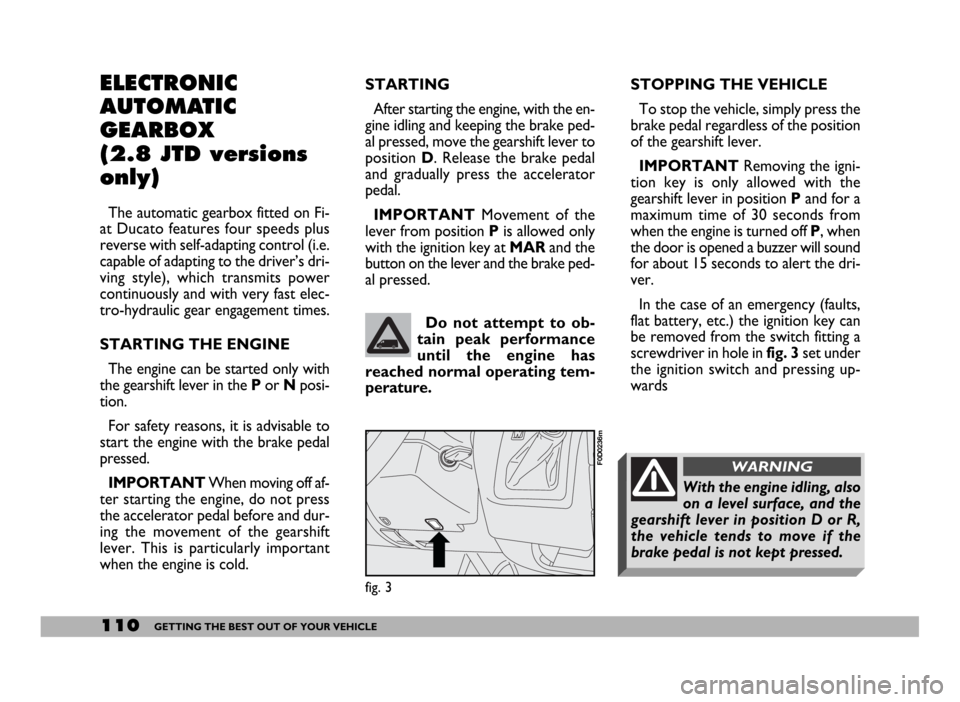
In the case of an emergency (faults,
flat battery, etc.) the ignition key can
be removed from the switch fitting a
screwdriver in hole infig. 3set under
the ignition switch and pressing up-
wards Do not attempt to ob-
tain peak performance
until the engine has
reached normal operating tem-
perature.
fig. 3
F0D0236m
With the engine idling, also
on a level surface, and the
gearshift lever in position D or R,
the vehicle tends to move if the
brake pedal is not kept pressed.
WARNING
ELECTRONIC
AUTOMATIC
GEARBOX
(2.8 JTD versions
only)
The automatic gearbox fitted on Fi-
at Ducato features four speeds plus
reverse with self-adapting control (i.e.
capable of adapting to the driver’s dri-
ving style), which transmits power
continuously and with very fast elec-
tro-hydraulic gear engagement times.
STARTING THE ENGINE
The engine can be started only with
the gearshift lever in the P or Nposi-
tion.
For safety reasons, it is advisable to
start the engine with the brake pedal
pressed.
IMPORTANTWhen moving off af-
ter starting the engine, do not press
the accelerator pedal before and dur-
ing the movement of the gearshift
lever. This is particularly important
when the engine is cold.
Page 112 of 258
111GETTING THE BEST OUT OF YOUR VEHICLE
SELECTING AUTOMATIC/
SEQUENTIAL MANUAL
OPERATION
The main feature of this gearbox is
the possibility of being used in the au-
tomatic or sequential manual mode.
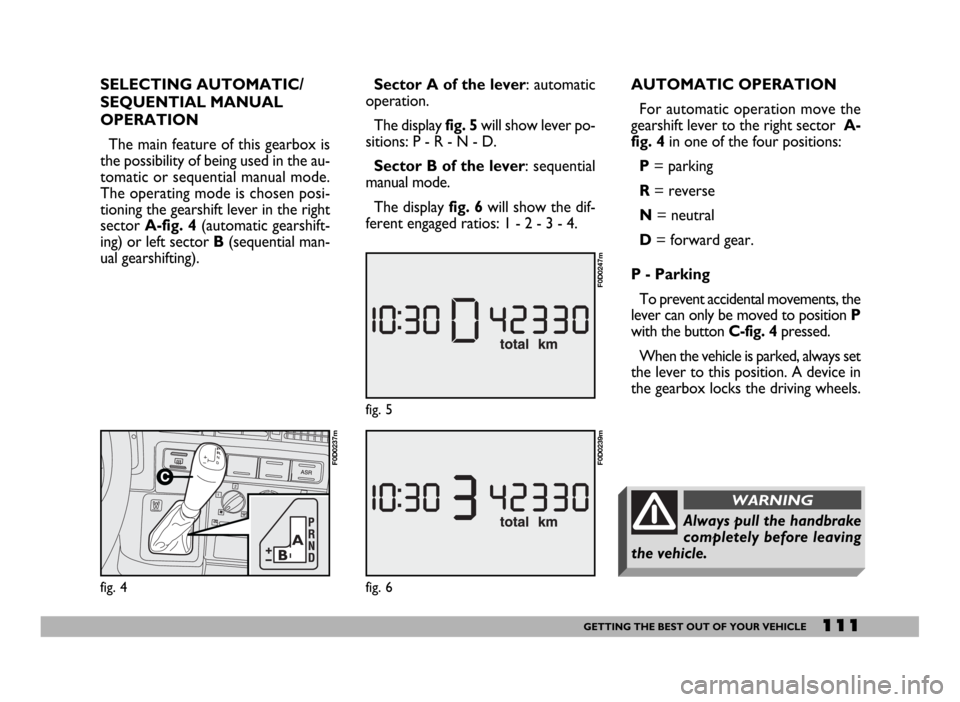
The operating mode is chosen posi-
tioning the gearshift lever in the right
sector A-fig. 4(automatic gearshift-
ing) or left sector B(sequential man-
ual gearshifting).
fig. 4
F0D0237m
Sector A of the lever: automatic
operation.
The display fig. 5will show lever po-
sitions: P - R - N - D.
Sector B of the lever: sequential
manual mode.
The display fig. 6will show the dif-
ferent engaged ratios: 1 - 2 - 3 - 4.AUTOMATIC OPERATION
For automatic operation move the
gearshift lever to the right sector A-
fig. 4in one of the four positions:
P= parking
R= reverse
N= neutral
D= forward gear.
P - Parking
To prevent accidental movements, the
lever can only be moved to position P
with the button C-fig. 4pressed.
When the vehicle is parked, always set
the lever to this position. A device in
the gearbox locks the driving wheels.
fig. 6
F0D0239m
fig. 5
F0D0247m
Always pull the handbrake
completely before leaving
the vehicle.
WARNING
Page 113 of 258
112GETTING THE BEST OUT OF YOUR VEHICLE
IMPORTANTRemoving the igni-
tion key is only allowed with the
gearshift lever in position Pand for a
maximum time of 30 seconds from
when the engine is turned off P, when
the door is opened a buzzer will sound
for about 15 seconds to alert the dri-
ver.
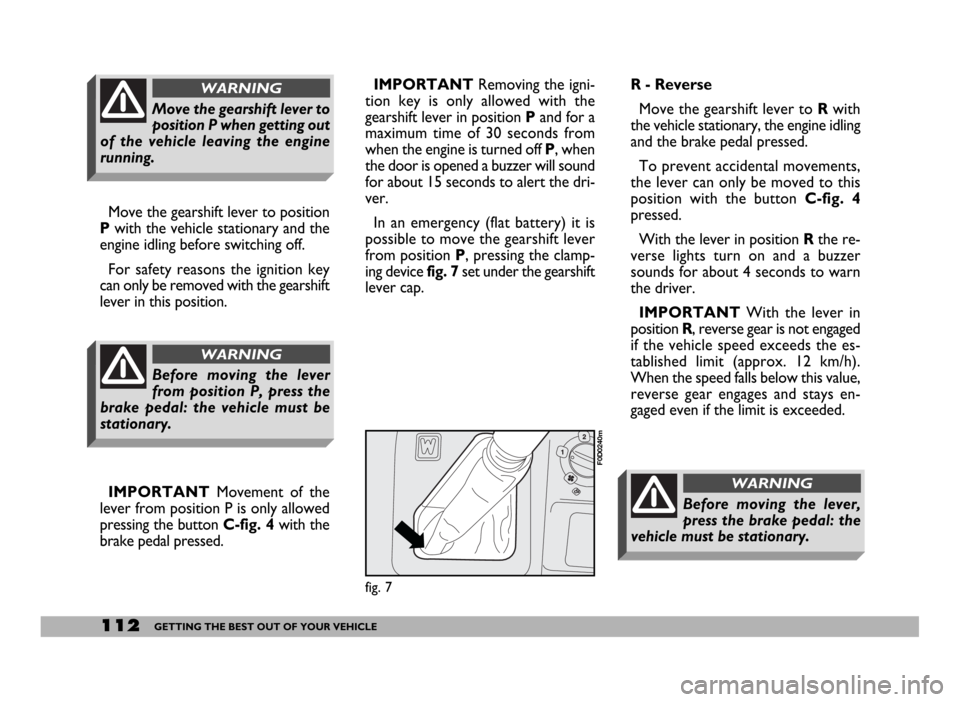
In an emergency (flat battery) it is
possible to move the gearshift lever
from position P, pressing the clamp-
ing device fig. 7set under the gearshift
lever cap.R - Reverse
Move the gearshift lever to Rwith
the vehicle stationary, the engine idling
and the brake pedal pressed.
To prevent accidental movements,
the lever can only be moved to this
position with the button C-fig. 4
pressed.
With the lever in position Rthe re-
verse lights turn on and a buzzer
sounds for about 4 seconds to warn
the driver.
IMPORTANTWith the lever in
position R, reverse gear is not engaged
if the vehicle speed exceeds the es-
tablished limit (approx. 12 km/h).
When the speed falls below this value,
reverse gear engages and stays en-
gaged even if the limit is exceeded.
fig. 7
F0D0240m
Before moving the lever,
press the brake pedal: the
vehicle must be stationary.
WARNING
Move the gearshift lever to position
Pwith the vehicle stationary and the
engine idling before switching off.
For safety reasons the ignition key
can only be removed with the gearshift
lever in this position.
IMPORTANTMovement of the
lever from position P is only allowed
pressing the button C-fig. 4with the
brake pedal pressed.
Move the gearshift lever to
position P when getting out
of the vehicle leaving the engine
running.
WARNING
Before moving the lever
from position P, press the
brake pedal: the vehicle must be
stationary.
WARNING
Page 118 of 258

117GETTING THE BEST OUT OF YOUR VEHICLE
CONSTRUCTION FEATURES
DUCATO automatic gearbox is con-
trolled electronically with four for-
ward gears and reverse.
It is controlled by an electronic con-
trol unit which handles:
– the torque distributor;
– gearshifting;
– specific programmes.
The gearbox is coupled with a flow
power torque distributor with piloted
antislip device which makes it possible
to obtain demultiplication ratios.
The characteristic of this gearbox
which works without idle gear enables:
– higher compactness and weight re-
duction;
– improved output due to less fric-
tion;
– lower stress of transmission com-
ponents.GENERAL FEATURES
Electronic gearbox control makes it
possible to obtain gearshifting suited
to momentary engine characteristics
with a certain elasticity.
The electronic control unit has the
following task:
– adapting the oil pressure for
gearshifting to the engine torque;
– activating safety functions;
– defining the manual gearshifting
programme;
– system diagnostics.
For controlling these operating log-
ics the control unit uses the follow-
ing signals:
– engine rpm;
– engine temperature;
– engine torque;
– vehicle speed;
– gearbox oil temperature;– gearshift lever position;
– accelerator pedal position;
– brake pedal position.
The control unit also communicates
with the injection system electronic
control unit.
Conditions of use analysed by
the control unit
The control unit analyses each single
condition of use of the vehicle, dis-
criminating it on the basis of the sig-
nals received from the various sensors.
Analysed conditions are the follow-
ing:
– starting (position/accelerator ped-
al changing speed);
– acceleration (accelerator pedal
completely pushing down speed);
– full load (number of engine full load
kickdown signals or position mainte-
nance time);
Page 139 of 258
138IN AN EMERGENCY
1. STOP THE VEHICLE
– Stop the vehicle in a position that
is not dangerous for oncoming traffic
where you can change the wheel safe-
ly. The ground should be flat and ad-
equately firm. If you have to change
the wheel at night, choose a lit area if
possible.
– Turn the engine off and pull up the
handbrake.
– Engage first or reverse gear.
– Alert other drivers that the vehicle
is stationary in compliance with local
regulations: hazard warning lights,
warning triangle, etc.
Any passengers should get out and
wait as far away as possible from the
danger of traffic.
If the road is sloping or bumpy, place
wedges or other suitable material to
prevent the vehicle from moving, un-
der the wheels.2. TAKE OUT THE TOOLS,
JACK AND SPARE WHEEL
The tools are in the cab near the
seats.
Please note:
– the jack weights 4.2 kg;
– the jack requires no adjustments;
– the jack cannot be repaired. If it
breaks it must be replaced with a new
jack;
– no other tool, apart from the ex-
tension and the ratchet wrench shown
in this chapter can be fitted to the jack.
The spare wheel is located under the
rear part of the load bed.
Do not lubricate the bolt
threads before fitting
them back: they could come
loose.
WARNING
Check tyre pressure and
spare wheel pressure regu-
larly. Refer to section “Technical
Specifications”.
WARNING