warning FIAT FIORINO 2018 Owner handbook (in English)
[x] Cancel search | Manufacturer: FIAT, Model Year: 2018, Model line: FIORINO, Model: FIAT FIORINO 2018Pages: 196, PDF Size: 4.99 MB
Page 139 of 196
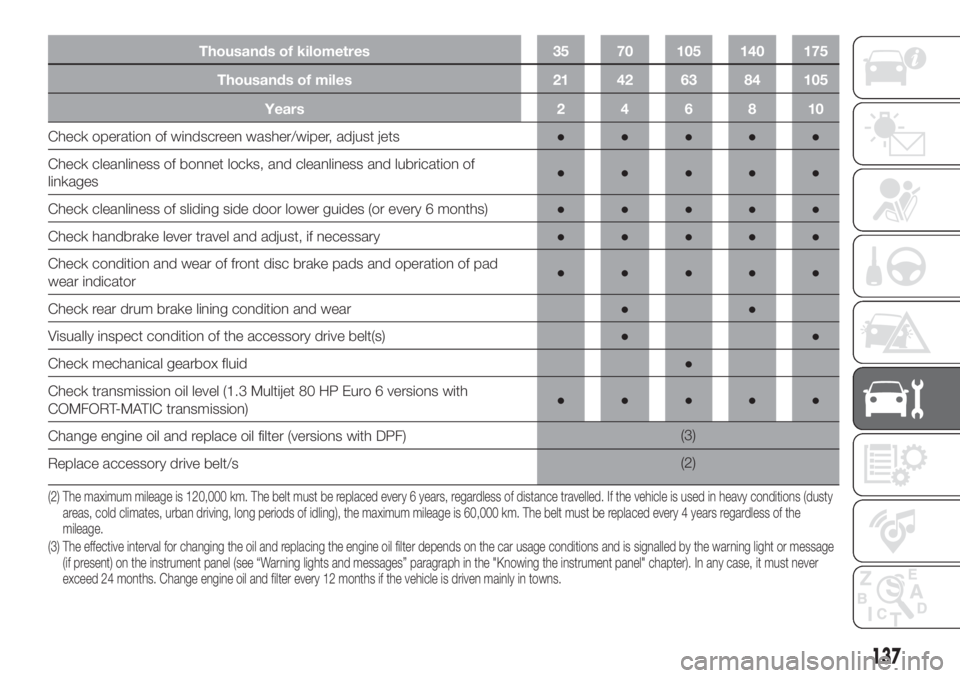
Thousands of kilometres 35 70 105 140 175
Thousands of miles 21 42 63 84 105
Years 2 4 6 8 10
Check operation of windscreen washer/wiper, adjust jets●●●●●
Check cleanliness of bonnet locks, and cleanliness and lubrication of
linkages●●●●●
Check cleanliness of sliding side door lower guides (or every 6 months)●●●●●
Check handbrake lever travel and adjust, if necessary●●●●●
Check condition and wear of front disc brake pads and operation of pad
wear indicator●●●●●
Check rear drum brake lining condition and wear●●
Visually inspect condition of the accessory drive belt(s)●●
Check mechanical gearbox fluid●
Check transmission oil level (1.3 Multijet 80 HP Euro 6 versions with
COMFORT-MATIC transmission)●●●●●
Change engine oil and replace oil filter (versions with DPF)(3)
Replace accessory drive belt/s(2)
(2) The maximum mileage is 120,000 km. The belt must be replaced every 6 years, regardless of distance travelled. If the vehicle is used in heavy conditions (dusty
areas, cold climates, urban driving, long periods of idling), the maximum mileage is 60,000 km. The belt must be replaced every 4 years regardless of the
mileage.
(3) The effective interval for changing the oil and replacing the engine oil filter depends on the car usage conditions and is signalled by the warning light or message
(if present) on the instrument panel (see “Warning lights and messages” paragraph in the "Knowing the instrument panel" chapter). In any case, it mustnever
exceed 24 months. Change engine oil and filter every 12 months if the vehicle is driven mainly in towns.
137
Page 141 of 196
PERIODIC CHECKS
Every 1,000 km or before long
journeys, check and, if necessary, top
up:
engine coolant level;
brake fluid level;
windscreen washer fluid level;
tyre inflation pressure and condition;
operation of lighting system
(headlights, direction indicators, hazard
warning lights, etc.);
operation of windscreen washer/
wiper system and positioning/wear of
rear window wiper blades.
To ensure that the vehicle is always
efficient and well maintained, it is
advisable to make sure that you carry
out the above operations regularly
(approximately every 1000 km and
every 3000 km for checking and
topping up engine oil is advisable).
DEMANDING
VEHICLE USE
If the vehicle is mostly used in one of
the following conditions:
towing a trailer or caravan;
dusty roads;
short, repeated journeys (less than
7-8 km) at sub-zero temperatures;
engine often idling or driving long
distances at low speeds or long periods
of inactivity;
the following checks must be carried
out more often than indicated in the
Scheduled Servicing Plan:
check front disc brake pad condition
and wear;
check cleanliness of bonnet and
luggage compartment locks,
cleanliness and lubrication of linkage;
visually inspect the conditions of:
engine, gearbox, transmission, pipes
and hoses (exhaust/fuel supply/brakes),
rubber parts (boots/sleeves/bushes,
etc.);
check battery charge and battery
fluid level (electrolyte);
visually inspect conditions of the
accessory drive belts;
check and, if necessary, change
engine oil and replace oil filter;
check and, if necessary, replace
pollen filter;
check and, if necessary, replace air
cleaner.
139
Page 146 of 196
IMPORTANT Brake fluid absorbs
moisture. For this reason, if the vehicle
is mainly used in areas with a high
degree of atmospheric humidity, the
fluid should be replaced at more
frequent intervals than specified in the
“Scheduled Servicing Plan”.
138) 139)
46)
POWER STEERING FLUID
Unscrew the cap 6 and check that the
fluid in the reservoir is between the
MIN and MAX marks on the reservoir.
The level may exceed the MAX mark
when the oil is hot. If topping up is
required, make sure the oil you use has
the same specifications as that already
in the system.
140)
3)
COMFORT-MATIC
TRANSMISSION
HYDRAULIC SYSTEM
FLUID
To check the transmission oil level and
to check/change the clutch hydraulic
system fluid, go to a Fiat Dealership.
4)
BATTERY
The battery does not require the
electrolyte to be topped up with distilled
water. A periodic check carried out at
a Fiat Dealership is, however, necessary
to check efficiency.
IMPORTANT If the charge level remains
under 50% for a long time, the battery
is damaged by sulphation, reducing
its capacity and efficiency at start-up.
141) 142)
Replacing the battery
If required, replace the battery with an
original spare part with the same
specifications.
If a battery with different specifications
is fitted, the service intervals given in
the “Scheduled Servicing Plan” will no
longer be valid.
Follow the battery manufacturer's
instructions for maintenance.
143)
47) 48)
5)
WARNING
133)Never smoke while working in the
engine compartment: inflammable gases
and vapours may be present, constituting
a fire risk.
134)Be very careful working in the engine
compartment when the engine is hot:
you may get burned. Remember that the
fan may start up if the engine is hot: this
could injure you. Scarves, ties and other
loose clothing might be pulled by moving
parts.
135)Do not remove the reservoir cap
when the engine is very hot as there is a
risk of scalding. The cooling system is
pressurised. If the cap needs replacing, do
so with another original or the effectiveness
of the system may be compromised.
136)Do not travel if the windscreen washer
reservoir is empty: using the windscreen
washer is essential for improving visibility.
137)Some commercial windscreen washer
additives are flammable. The engine
compartment contains hot parts which
could start a fire if they come into contact.
138)Brake fluid is poisonous and highly
corrosive. In the event of accidental
contact, immediately wash the affected
parts with water and mild soap. Then rinse
thoroughly. Call a doctor immediately if
swallowed.
139)The symbol
, on the brake fluid
container indicates if a brake fluid is
synthetic or mineralbased. Use of mineral
type fluids will damage the special rubber
seals of the braking system beyond repair.
144
SERVICING AND CARE
Page 147 of 196
140)Prevent power steering fluid from
coming into contact with hot engine parts:
it is flammable.
141)Battery fluid is poisonous and
corrosive. Avoid contact with skin and
eyes. Keep naked flames and sources of
sparks away from the battery: risk of
explosion and fire.
142)Using the battery with insufficient
battery fluid may irreparably damage the
battery and may cause an explosion.
143)When performing any operation on
the battery or near it, always protect your
eyes with special goggles.
WARNING
43)When topping up, take care not to mix
up the various types of fluids: they are
not compatible with each other and could
seriously damage the vehicle.
44)Used engine oil and replaced oil filters
contain substances which are harmful to
the environment. To change oil and filters,
we advise you to contact a Fiat Dealership.
45)PARAFLU
UPanti-freeze fluid is used
in the cooling system. Use fluid of the
same type as that contained in the cooling
system for any top-ups. PARAFLU
UP
fluid cannot be mixed with any other type
of fluid. If this occurs, do not start the
engine and contact your Fiat Dealership
immediately.
46)Prevent brake fluid, which is highly
corrosive, from coming into contact with
painted parts. Should it happen,
immediately wash with water.47)Incorrect installation of electric and
electronic devices may cause severe
damage to your vehicle. After purchasing
your vehicle, if you wish to install any
accessories (anti-theft, radio phone, etc.),
go to a Fiat Dealership, which will suggest
the most suitable devices and advise
you whether a higher capacity battery
needs to be installed.
48)If the vehicle will be unused for an
extended period of time in extremely cold
weather conditions, remove the battery
and store it in a heated area to prevent it
from freezing.
WARNING
3)Power steering fluid consumption is
extremely low; if another top-up is required
after only a short period of time, have the
system checked for leaks at a Fiat
Dealership.
4)Used transmission fluid contains
substances that are harmful to the
environment. It is advisable to have the oil
changed by a Fiat Dealership where it
will be disposed of respecting the
environment and according to legal
requirements.
5)Batteries contain substances which are
very dangerous for the environment. You
are recommended to go to a Fiat
Dealership to have the battery replaced
where the old battery will be disposed of
respecting both the environment and
the laws in force.
BATTERY
RECHARGING
IMPORTANT The battery recharging
procedure is given as information only.
You are advised to contact a Fiat
Dealership to have this operation
carried out.
We recommend recharging the battery
slowly for approximately 24 hours at
low amperage. Charging for a longer
time may damage the battery.
To recharge, proceed as follows:
without Start&Stop system:
disconnect the terminal from the
negative battery pole;
connect the charger cables to the
battery terminals, observing the polarity;
turn on the battery charger;
when it is recharged, turn the
charger off before disconnecting it from
the battery;
reconnect the terminal to the
negative battery pole.
145
Page 148 of 196
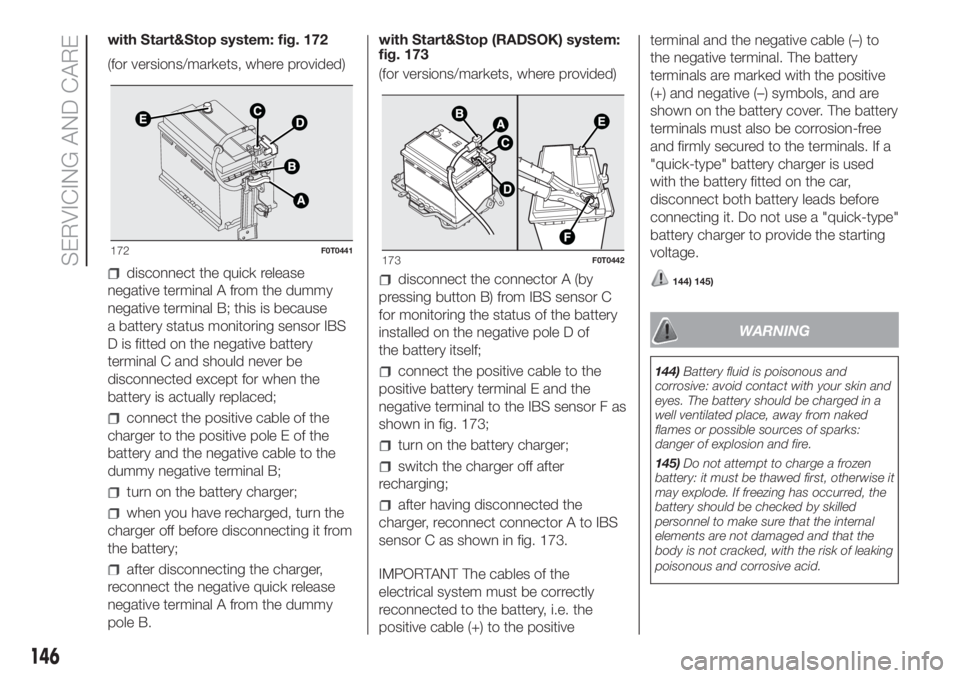
with Start&Stop system: fig. 172
(for versions/markets, where provided)
disconnect the quick release
negative terminal A from the dummy
negative terminal B; this is because
a battery status monitoring sensor IBS
D is fitted on the negative battery
terminal C and should never be
disconnected except for when the
battery is actually replaced;
connect the positive cable of the
charger to the positive pole E of the
battery and the negative cable to the
dummy negative terminal B;
turn on the battery charger;
when you have recharged, turn the
charger off before disconnecting it from
the battery;
after disconnecting the charger,
reconnect the negative quick release
negative terminal A from the dummy
pole B.with Start&Stop (RADSOK) system:
fig. 173
(for versions/markets, where provided)
disconnect the connector A (by
pressing button B) from IBS sensor C
for monitoring the status of the battery
installed on the negative pole D of
the battery itself;
connect the positive cable to the
positive battery terminal E and the
negative terminal to the IBS sensor F as
shown in fig. 173;
turn on the battery charger;
switch the charger off after
recharging;
after having disconnected the
charger, reconnect connector A to IBS
sensor C as shown in fig. 173.
IMPORTANT The cables of the
electrical system must be correctly
reconnected to the battery, i.e. the
positive cable (+) to the positiveterminal and the negative cable (–) to
the negative terminal. The battery
terminals are marked with the positive
(+) and negative (–) symbols, and are
shown on the battery cover. The battery
terminals must also be corrosion-free
and firmly secured to the terminals. If a
"quick-type" battery charger is used
with the battery fitted on the car,
disconnect both battery leads before
connecting it. Do not use a "quick-type"
battery charger to provide the starting
voltage.
144) 145)
WARNING
144)Battery fluid is poisonous and
corrosive: avoid contact with your skin and
eyes. The battery should be charged in a
well ventilated place, away from naked
flames or possible sources of sparks:
danger of explosion and fire.
145)Do not attempt to charge a frozen
battery: it must be thawed first, otherwise it
may explode. If freezing has occurred, the
battery should be checked by skilled
personnel to make sure that the internal
elements are not damaged and that the
body is not cracked, with the risk of leaking
poisonous and corrosive acid.
172F0T0441173F0T0442
146
SERVICING AND CARE
Page 149 of 196

WINDSCREEN /
REAR WINDOW
WIPERS
(for versions/markets, where provided)
146)
Replacing the
windscreen wiper
blades
Proceed as follows:
lift up the windscreen wiper arm and
position the blade so that it forms a
90° angle with the arm;
press tabs A fig. 174 and remove
the blade from the arm;
install the new blade by inserting the
straps into the supplied housings of
the arm. Make sure that the new blade
is secured in position.Replacing the rear
window wiper blade
(for versions/markets, where provided)
Proceed as follows:
raise the cover A fig. 175 and
remove the arm from the vehicle by
loosening nut B that fastens it to the
pivot pin;
correctly position the new arm and
tighten the nut fully;
lower the cover.
WARNING
146)Driving with worn windscreen wiper
blades is a serious hazard, because
visibility is reduced in bad weather
conditions.
LIFTING THE
VEHICLE
If the vehicle needs to be lifted, go to a
Fiat Dealership which is equipped
with the arm hoist or workshop lift.
174F0T0087
175F0T0088
147
Page 150 of 196
WHEELS AND TYRES
RIMS AND TYRES
For the type of wheel rims and tyres
fitted on the vehicle see the "Wheels"
paragraph in the "Technical data"
chapter.
IMPORTANT NOTES
As far as possible, avoid sharp
braking, screech starts and violent
shocks against pavements, potholes or
other hard obstacles. Driving for long
stretches over uneven roads can
damage the tyres;
periodically check that the tyres
have no cuts in the side wall, abnormal
swelling or irregular tyre tread wear.
Go to a Fiat Dealership if required;
avoid overloading the car when
travelling: this may cause serious
damage to the wheels and tyres;
if a tyre is punctured, stop
immediately and replace it to avoid
damage to the tyre, the rim, suspension
and steering system;
tyres age even if they are not used
much. Cracks in the tread and on
the sidewalls are a sign of ageing. In
any event, have the tyres checked
by specialised technicians if they have
been fitted for longer than 6 years.
Remember to check the spare wheel
very carefully;
in the case of replacement, always
fit new tyres, avoiding those of
unknown origin;
if a tyre is changed, also change the
inflation valve;
to allow even wear between the
front and rear tyres, it is advisable to
change them over every 10–15
thousand kilometres, keeping them on
the same side of the vehicle so as
not to reverse the direction of rotation.
147) 148) 149) 150)
SNOW CHAINS
The use of snow chains should be in
compliance with local regulations of
each country. The snow chains may be
applied only onto the front wheel (drive
wheels). Check the tension of the
snow chains after the first few metres
have been driven.
151)
WARNING
147)Remember that the road holding
qualities of your vehicle also depend on the
correct inflation pressure of the tyres.
148)If tyre pressure is too low, the tyre
may overheat and be severely damaged as
a result.
149)Do not switch tyres from the
righthand side of the vehicle to the
lefthand side, and vice versa.
150)Never submit alloy rims to repainting
treatments requiring the use of
temperatures exceeding 150°C. The
mechanical properties of the wheels could
be impaired.
151)Keep the vehicle's speed down when
snow chains are fitted; never exceed 50
km/h. Avoid potholes, do not drive over
steps or pavements, and do not drive long
distances over roads without snow, to
avoid damaging both your vehicle and the
road surface.
148
SERVICING AND CARE
Page 153 of 196

151
ENGINE MARKING
It is stamped on the cylinder block and
includes the type and the engine serial
number.
CYLINDER MARKING
49)
Each methane cylinder is identified in
the plant by information stamped on
the cylinder cone.
The other plates (provided with the
vehicle documentation) contain the date
for the first inspection of the cylinders.
179F0T0361
WARNING
49)If the vehicle has been registered in a
country other than Italy, the certification
data, identification and inspection
procedures for the methane cylinders
should conform to the legislation in that
country. In any case, it should be
remembered that the life of the cylinders is
20 years from the production date as set
out in ECE Regulation no. 110.
SYSTEM INSPECTION
The cylinders must be inspected, in
accordance with ECE Regulation
Procedure no. 110, every 4 years from
the vehicle registration date or in
accordance with specific regulations in
individual countries.
Page 157 of 196
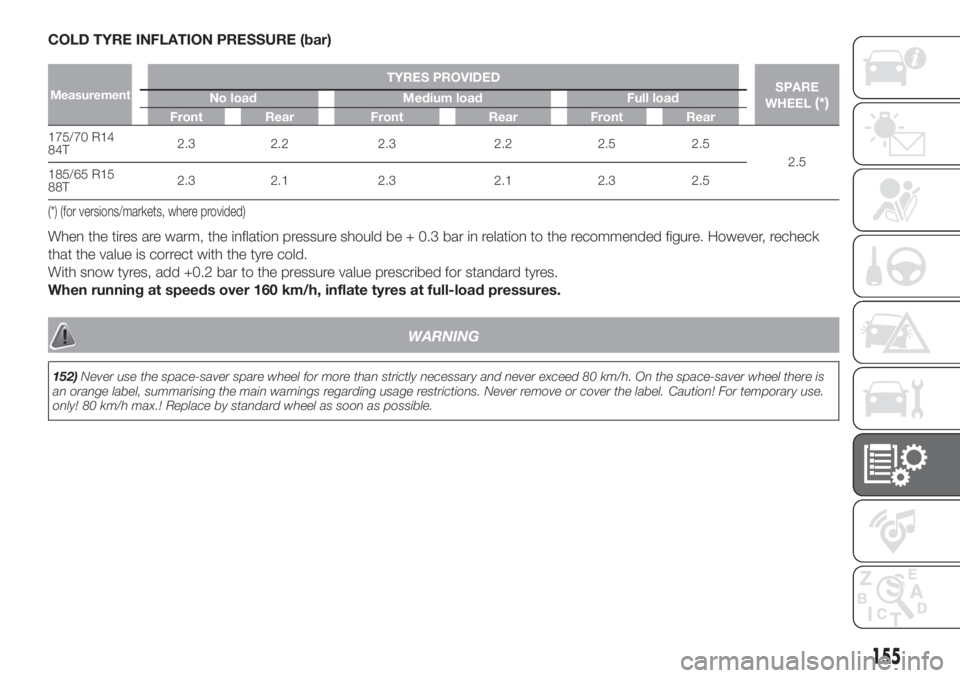
COLD TYRE INFLATION PRESSURE (bar)
Measurement
TYRES PROVIDED
SPARE
WHEEL
(*)No load Medium load Full load
Front Rear Front Rear Front Rear
175/70 R14
84T2.3 2.2 2.3 2.2 2.5 2.5
2.5
185/65 R15
88T2.3 2.1 2.3 2.1 2.3 2.5
(*) (for versions/markets, where provided)
When the tires are warm, the inflation pressure should be + 0.3 bar in relation to the recommended figure. However, recheck
that the value is correct with the tyre cold.
With snow tyres, add +0.2 bar to the pressure value prescribed for standard tyres.
When running at speeds over 160 km/h, inflate tyres at full-load pressures.
WARNING
152)Never use the space-saver spare wheel for more than strictly necessary and never exceed 80 km/h. On the space-saver wheel there is
an orange label, summarising the main warnings regarding usage restrictions. Never remove or cover the label.
only! 80 km/h max.! Replace by standard wheel as soon as possible.
155
Caution! For temporary use.
Page 168 of 196

Use Features SpecificationOriginal fluids and
lubricantsApplications /
Replacement frequency
Protective agent for
radiatorsRed protective with
antifreeze action, based
on inhibited monoethyl
glycol with organic
formula. Exceeds CUNA
NC 956-16, ASTM D
3306 specifications.9.55523orMS.90032PARAFLUUP(*)
Contractual Technical
Reference N° F101.M01Percentage of use: 50%
demineralised water 50%
PARAFLU
UP(**)
Fuel additiveAdditive for diesel
antifreeze, protecting
diesel engines.—PETRONAS DURANCE
DIESEL ART(***)Contractual Technical
Reference N° F601.C06To be mixed with diesel
(25 cc per 10 litres)
Windscreen/rear
window washer fluidMixture of alcohol, water
and surfactants CUNA NC
956-II.9.55522orMS.90043PETRONAS DURANCE
SC 35
Contractual Technical
Reference N° F001.D16To be used diluted or
undiluted in windscreen
washer/wiper systems
(*)IMPORTANT Do not top up or mix with other fluids which have different specifications from those described.
(**)When the vehicle is used in particularly harsh weather conditions, we recommend using a mixture of 60%PARAFLUUPand 40% demineralised water.
(***) Recommended product.
If lubricants conforming to the specific request are not available, products that meet the indicated specifications can be used to
top up; in this case optimal performance of the engine is not guaranteed.
For petrol engines running on methane, we recommend using the original product formulated specifically for this type of use.
The use of products with specifications below SAE 5W-40 ACEA C3 could cause damage to the engine not covered by the
warranty.
WARNING
50)The use of products with different specifications than those indicated above could cause damage to the engine not covered by the
warranty.
166
TECHNICAL DATA