fuel tank capacity FIAT FIORINO 2018 Owner handbook (in English)
[x] Cancel search | Manufacturer: FIAT, Model Year: 2018, Model line: FIORINO, Model: FIAT FIORINO 2018Pages: 196, PDF Size: 4.99 MB
Page 36 of 196
For this reason there must always
be petrol in the tank.
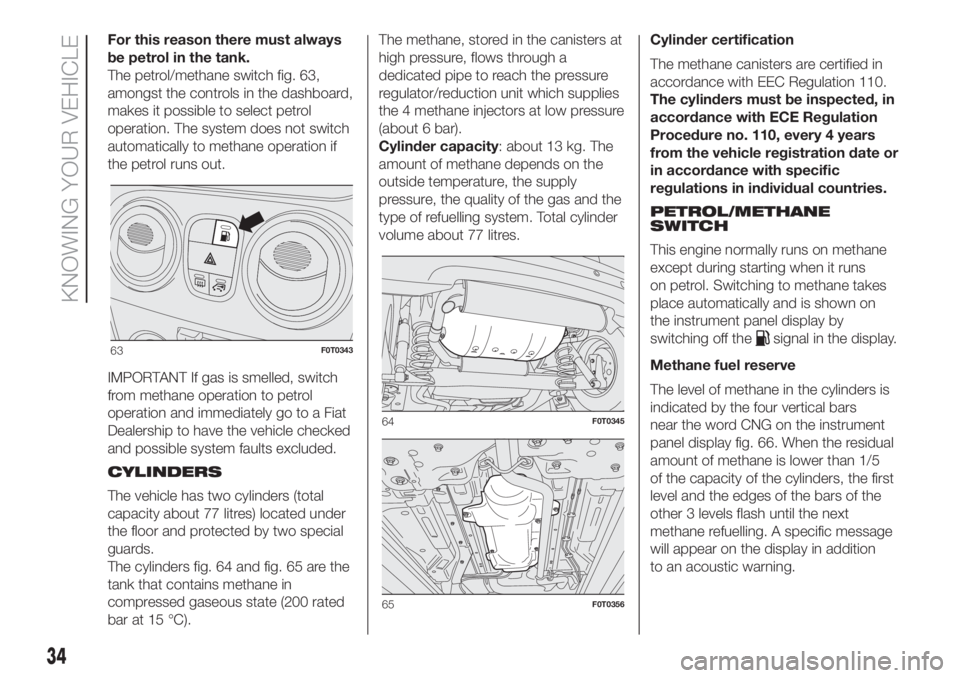
The petrol/methane switch fig. 63,
amongst the controls in the dashboard,
makes it possible to select petrol
operation. The system does not switch
automatically to methane operation if
the petrol runs out.
IMPORTANT If gas is smelled, switch
from methane operation to petrol
operation and immediately go to a Fiat
Dealership to have the vehicle checked
and possible system faults excluded.
CYLINDERS
The vehicle has two cylinders (total
capacity about 77 litres) located under
the floor and protected by two special
guards.
The cylinders fig. 64 and fig. 65 are the
tank that contains methane in
compressed gaseous state (200 rated
bar at 15 °C).The methane, stored in the canisters at
high pressure, flows through a
dedicated pipe to reach the pressure
regulator/reduction unit which supplies
the 4 methane injectors at low pressure
(about 6 bar).
Cylinder capacity: about 13 kg. The
amount of methane depends on the
outside temperature, the supply
pressure, the quality of the gas and the
type of refuelling system. Total cylinder
volume about 77 litres.Cylinder certification
The methane canisters are certified in
accordance with EEC Regulation 110.
The cylinders must be inspected, in
accordance with ECE Regulation
Procedure no. 110, every 4 years
from the vehicle registration date or
in accordance with specific
regulations in individual countries.
PETROL/METHANE
SWITCH
This engine normally runs on methane
except during starting when it runs
on petrol. Switching to methane takes
place automatically and is shown on
the instrument panel display by
switching off the
signal in the display.
Methane fuel reserve
The level of methane in the cylinders is
indicated by the four vertical bars
near the word CNG on the instrument
panel display fig. 66. When the residual
amount of methane is lower than 1/5
of the capacity of the cylinders, the first
level and the edges of the bars of the
other 3 levels flash until the next
methane refuelling. A specific message
will appear on the display in addition
to an acoustic warning.63F0T0343
64F0T0345
65F0T0356
34
KNOWING YOUR VEHICLE
Page 105 of 196
Operation at low temperatures
In order to avoid these problems,
different types of diesel are distributed
according to the season: summer type,
winter type and arctic type (cold/
mountain areas). If refuelling with diesel
whose specifications are not suitable
for the usage temperature, it is
advisable to mix PETRONAS
DURANCE DIESEL ART additive in the
proportions shown on the container
with the fuel. Pour the additive into the
tank before the fuel.
When using or parking the vehicle for a
long time in the mountains or cold
areas, it is advisable to refuel using
locally available diesel fuel.
In this case, it is also advisable to keep
the tank over 50% full.
REFUELLING CAPACITY
To ensure that you fill the tank
completely, top up twice after the first
click of the fuel supply gun. Further
top-ups could cause faults in the fuel
feeding system.
FUEL TANK CAP
Opening
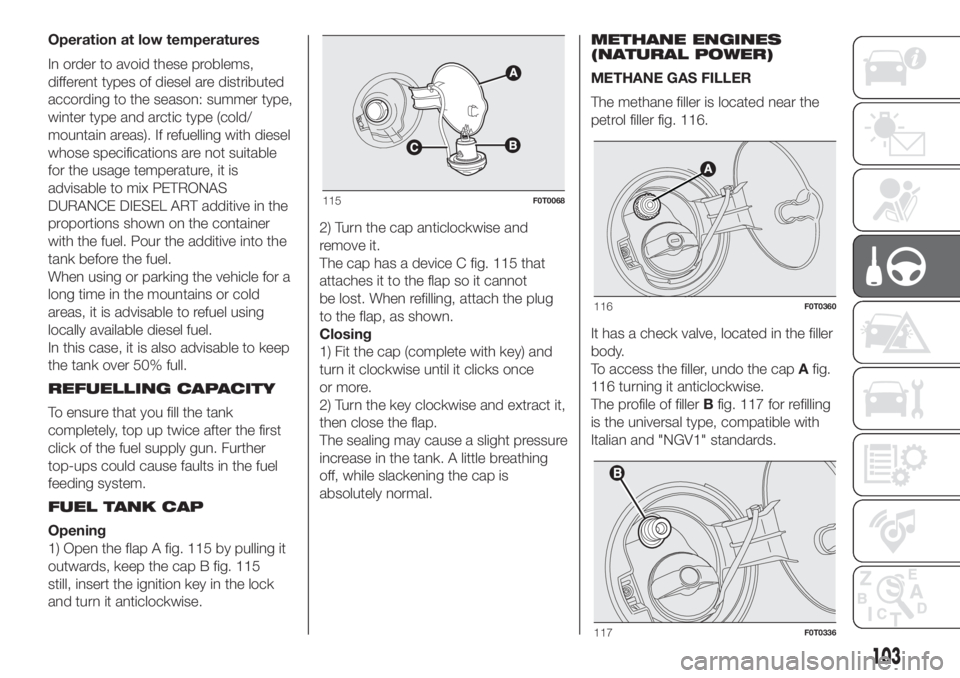
1) Open the flap A fig. 115 by pulling it
outwards, keep the cap B fig. 115
still, insert the ignition key in the lock
and turn it anticlockwise.2) Turn the cap anticlockwise and
remove it.
The cap has a device C fig. 115 that
attaches it to the flap so it cannot
be lost. When refilling, attach the plug
to the flap, as shown.
Closing
1) Fit the cap (complete with key) and
turn it clockwise until it clicks once
or more.
2) Turn the key clockwise and extract it,
then close the flap.
The sealing may cause a slight pressure
increase in the tank. A little breathing
off, while slackening the cap is
absolutely normal.METHANE ENGINES
(NATURAL POWER)
METHANE GAS FILLER
The methane filler is located near the
petrol filler fig. 116.
It has a check valve, located in the filler
body.
To access the filler, undo the capAfig.
116 turning it anticlockwise.
The profile of fillerBfig. 117 for refilling
is the universal type, compatible with
Italian and "NGV1" standards.
115F0T0068
116F0T0360
117F0T0336
103
Page 107 of 196
WARNING
32)For diesel engines, use only diesel fuel
for motor vehicles in accordance with
EN590 European specifications. The use of
other products or mixtures may damage
the engine beyond repair and
consequently invalidate the warranty, due
to the damage caused. If you accidentally
introduce other types of fuel into the tank,
do not start the engine. Empty the tank.
If the engine has been run for even an
extremely limited amount of time, you must
not only drain the fuel tank, but the rest of
the supply circuit as well.
33)You must not open the right sliding side
door with the fuel cap open while
refuelling. Check that the fuel cap is closed
while opening/closing the sliding side
door.
34)Methane refuelling stations are not
authorised to refill the cylinders when the
inspection date has expired. The check
valve prevents the methane from flowing
back to the fuel filler.
TOWING TRAILERS
IMPORTANT NOTES
The vehicle must be equipped with a
type-approved tow hook and adequate
electrical system to tow trailers.
Installation should be carried out by
specialised technicians who will issue
the required papers for travelling on
roads.
Install any specific and/or additional
door mirrors as specified by the
Highway Code.
Remember that, when towing a trailer,
steep hills are harder to climb, braking
distances increase and overtaking
takes longer depending on the overall
weight of the trailer.
Engage a low gear when driving
downhill, rather than constantly using
the brake.
The weight of the trailer on the vehicle
tow hook will reduce the loading
capacity of the vehicle by the same
amount.
To make sure that the maximum
towable weight is not exceeded (given
in the vehicle registration document)
account should be taken of the fully
laden trailer, including accessories and
luggage.Do not exceed the speed limits specific
to each country you are driving in, in
the case of vehicles towing trailers.
In all cases, the top speed must not
exceed 80 km/h.
IMPORTANT For Natural Power
versions, trailers cannot be towed so
there are no provisions for fitting a tow
hook.
106) 107)
WARNING
106)The ABS with which the vehicle may
be equipped will not control the trailer's
braking system. Particular caution is
required on slippery roads.
107)Never modify the braking system of
the vehicle to control the trailer brake. The
trailer braking system must be fully
independent from the hydraulic system of
the vehicle.
105
Page 164 of 196
REFUELLING
1.4 Euro 6 1.4 Natural Power
Recommended fuels and
original lubricants
litres kg litres kg
Fuel tank: 45 - 45 -Unleaded petrol with R.O.N. no
lower than 95 (EN228
specifications) including a reserve of: 6/7 - 6/7 -
Methane cylinder capacity
(#):---13
(approximately)Methane
Engine cooling system: 6.64 - 6.6 -Mixture of distilled water and
PARAFLU
UPliquid at 50%(*)
Engine sump: - 2.1 2.4 -SELENIA K P.E.(1.4 Euro 6
version) /SELENIA
MULTIPOWER GAS 5W-40
(1.4 Natural Power version) Engine sump and filter: - 2.25 2.6 -
Gearbox casing/differential: - 1.5 - 1.5TUTELA TRANSMISSION
TECHNYX
Hydraulic power steering: 0.38 0.35 0.38 0.35TUTELA TRANSMISSION
GI/E
Hydraulic brake circuit: - 0.50 - 0.5TUTELA TOP 4orTUTELA
TOP 4/S
Windscreen and rear window washer
fluid reservoir:3.0 - 3.0 -Water and fluid mixture
PETRONAS DURANCE SC 35
(#) The amount of methane depends on the outside temperature, the supply pressure, the quality of the gas and the type of refuelling system.
(#) Total cylinder volume about 77 litres.
(*)When the vehicle is used in particularly harsh weather conditions, we recommend using a 60-40 mixture of PARAFLU
UPand demineralised water.
IMPORTANT Note that when using a fuel like methane, the range is extremely variable because in addition to the vehicle
maintenance and driving conditions it also depends on the temperature of the gas in the cylinder.
The methane actually heats up during the refuelling and cools down whilst driving, undergoing variations in pressure that
reduce the quantity that can be used.
It should also be pointed out that whilst the vehicle is being run in (up to around 3000 km) the fuel consumption may be higher
than the figures given.
162
TECHNICAL DATA