window FIAT FIORINO 2018 Owner handbook (in English)
[x] Cancel search | Manufacturer: FIAT, Model Year: 2018, Model line: FIORINO, Model: FIAT FIORINO 2018Pages: 196, PDF Size: 4.99 MB
Page 31 of 196

lower the bonnet to approximately
20 centimetres from the engine
compartment and let it drop. Make sure
that the bonnet is completely closed
and not only fastened by the safety
catch by trying to open it. If it is not
perfectly closed, do not try to press the
bonnet down but open it and repeat
the procedure.
IMPORTANT A plate summarising the
described bonnet opening/closing
operations is affixed under the bonnet
(see fig. 46).
23)
WARNING
22)Before opening the bonnet, make sure
that windscreen wiper arm is not raised,
but is rather positioned against the
windscreen.
23)For safety reasons, the bonnet must
always be properly closed while the car is
travelling. Make sure that the bonnet is
properly closed and that the lock is
engaged. If you notice when driving that
the bonnet has not been properly locked,
stop immediately and close the bonnet
correctly.
PARTITIONS
(for versions/markets, where provided)
CARGO VERSIONS
Fixed partition fig. 47
Separates the passenger area from the
load compartment.
Glazed fixed partition fig. 48
This is provided with window in the
middle so you can observe load
stability.
46F0T0215
47F0T0179
48F0T0167
29
Page 117 of 196

Light bulbs
Light bulbs Type Power Figure ref.
Main beam headlights H4 55W E
Dipped headlights H4 60W D
Front side lights W5W 5W A
Front direction indicators PY21W 2IW B
Side turn light WY5W 5W A
Rear direction indicators PY2IW 21W B
Tail lights/rear fog lights P4/21W 4W/21W B
Stop P21W 21W B
Number plate W5W 5W C
3rd brake light
(*)W5W 5W A
Reversing light P21W 21W B
Front fog lights (for versions/markets where provided) H1 55W E
Front roof light with movable lens C 10W C
Front ceiling light with spot lights (for versions/
markets, where provided)C 10W C
Rear roof light (for versions/markets, where provided) C 10W C
(*)IMPORTANT For versions/markets, where provided, in the versions with tinted windows replace the whole light unit, as it is sealed.
115
Page 125 of 196
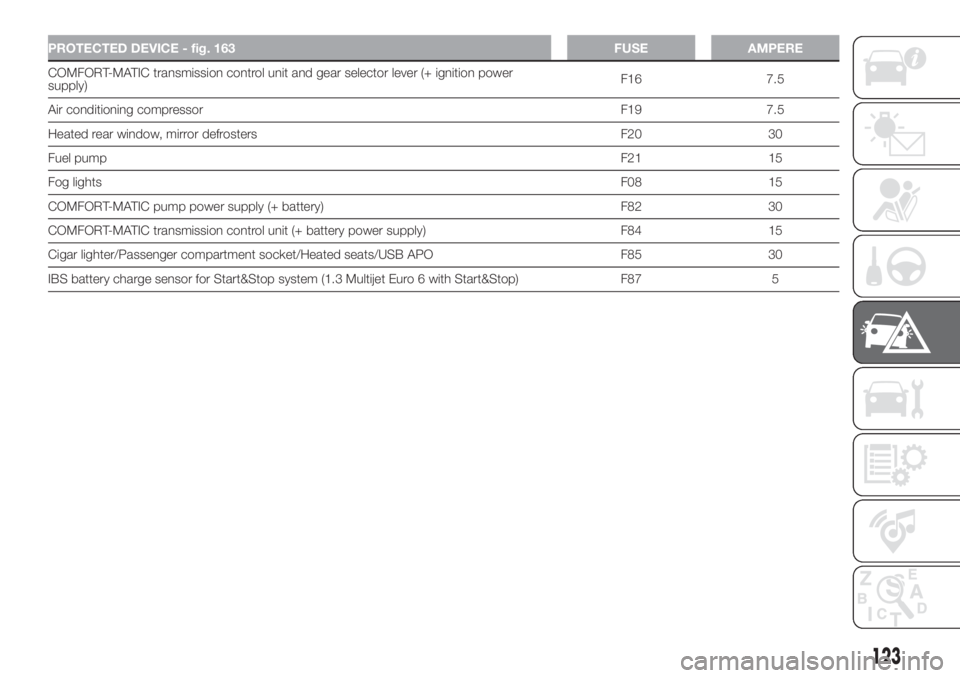
PROTECTED DEVICE - fig. 163 FUSE AMPERE
COMFORT-MATIC transmission control unit and gear selector lever (+ ignition power
supply)F16 7.5
Air conditioning compressorF19 7.5
Heated rear window, mirror defrosters F20 30
Fuel pumpF21 15
Fog lightsF08 15
COMFORT-MATIC pump power supply (+ battery) F82 30
COMFORT-MATIC transmission control unit (+ battery power supply) F84 15
Cigar lighter/Passenger compartment socket/Heated seats/USB APO F85 30
IBS battery charge sensor for Start&Stop system (1.3 Multijet Euro 6 with Start&Stop) F87 5
123
Page 127 of 196
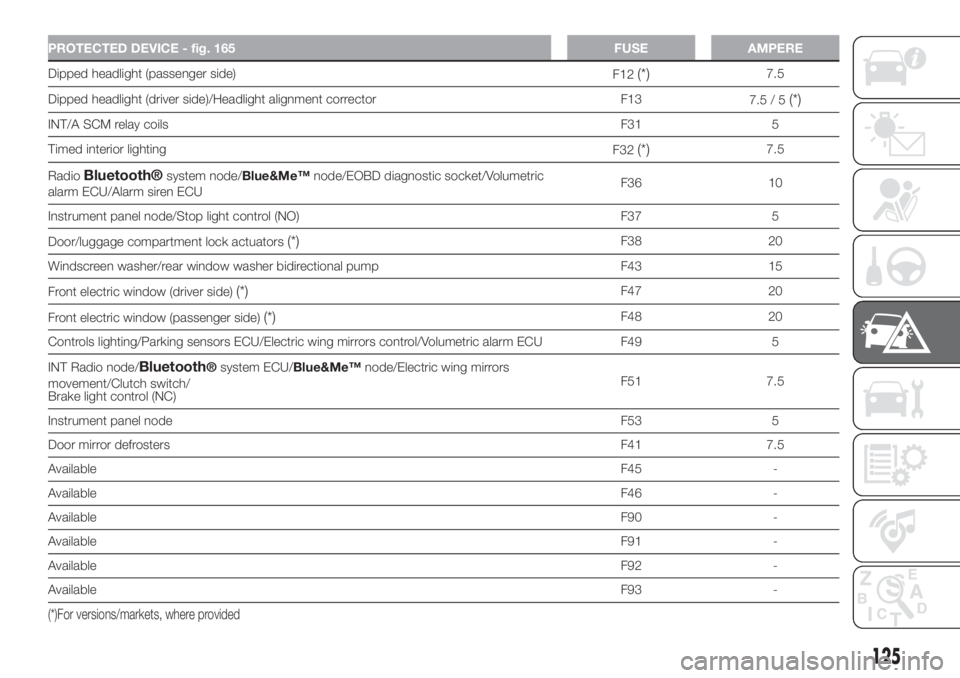
PROTECTED DEVICE - fig. 165 FUSE AMPERE
Dipped headlight (passenger side)
F12(*)7.5
Dipped headlight (driver side)/Headlight alignment corrector F13
7.5 / 5
(*)
INT/A SCM relay coilsF31 5
Timed interior lighting
F32
(*)7.5
Radio
Bluetooth®system node/Blue&Me™node/EOBD diagnostic socket/Volumetric
alarm ECU/Alarm siren ECUF36 10
Instrument panel node/Stop light control (NO) F37 5
Door/luggage compartment lock actuators
(*)F38 20
Windscreen washer/rear window washer bidirectional pump F43 15
Front electric window (driver side)
(*)F47 20
Front electric window (passenger side)
(*)F48 20
Controls lighting/Parking sensors ECU/Electric wing mirrors control/Volumetric alarm ECU F49 5
INT Radio node/
Bluetooth®system ECU/Blue&Me™node/Electric wing mirrors
movement/Clutch switch/
Brake light control (NC)F51 7.5
Instrument panel nodeF53 5
Door mirror defrostersF41 7.5
AvailableF45 -
AvailableF46 -
AvailableF90 -
AvailableF91 -
AvailableF92 -
AvailableF93 -
(*)For versions/markets, where provided
125
Page 132 of 196

SERVICING AND CARE
Correct maintenance permits the
performance of the vehicle to be
maintained over time, as well as limited
running costs and safeguarding the
efficiency of the safety systems.
This chapter explains how.SCHEDULED SERVICING ...............131
SCHEDULED SERVICING PLAN .....132
PERIODIC CHECKS ........................139
DEMANDING VEHICLE USE ...........139
CHECKING LEVELS........................140
BATTERY RECHARGING ................145
WINDSCREEN / REAR WINDOW
WIPERS ..........................................147
LIFTING THE VEHICLE....................147
WHEELS AND TYRES.....................148
130
SERVICING AND CARE
Page 135 of 196

Thousands of kilometres 30 60 90 120 150 180
Thousands of miles 18 36 54 72 90 108
Years 2 4 6 8 10 12
Check windscreen/rear window wiper blade position/wear (where
provided)●●●●●●
Check operation of windscreen washer/wiper, adjust jets●●●●●●
Check cleanliness of bonnet locks, and cleanliness and lubrication of
linkages●●●●●●
Check cleanliness of sliding side door lower guides (or every 6
months)●●●●●●
Check handbrake lever travel and adjust, if necessary●●●●●●
Check and adjust clutch pedal, if required●●●●●●
Check condition and wear of front disc brake pads and operation of
pad wear indicator●●●●●●
Check rear drum brake lining condition and wear●●●
Visually inspect condition of the accessory drive belt(s) (2)●●●
Visually inspect the condition of the toothed timing belt (Natural
Power versions)●●●
Check the accessory drive belt (for versions without automatic
tensioner) (or every 2 years)●●
(2) The maximum mileage is 120,000 km. The belt must be replaced every 6 years, regardless of distance travelled. If the vehicle is used in heavy conditions (dusty
areas, cold climates, urban driving, long periods of idling), the maximum mileage is 60,000 km. The belt must be replaced every 4 years regardless of the
mileage.
133
Page 138 of 196
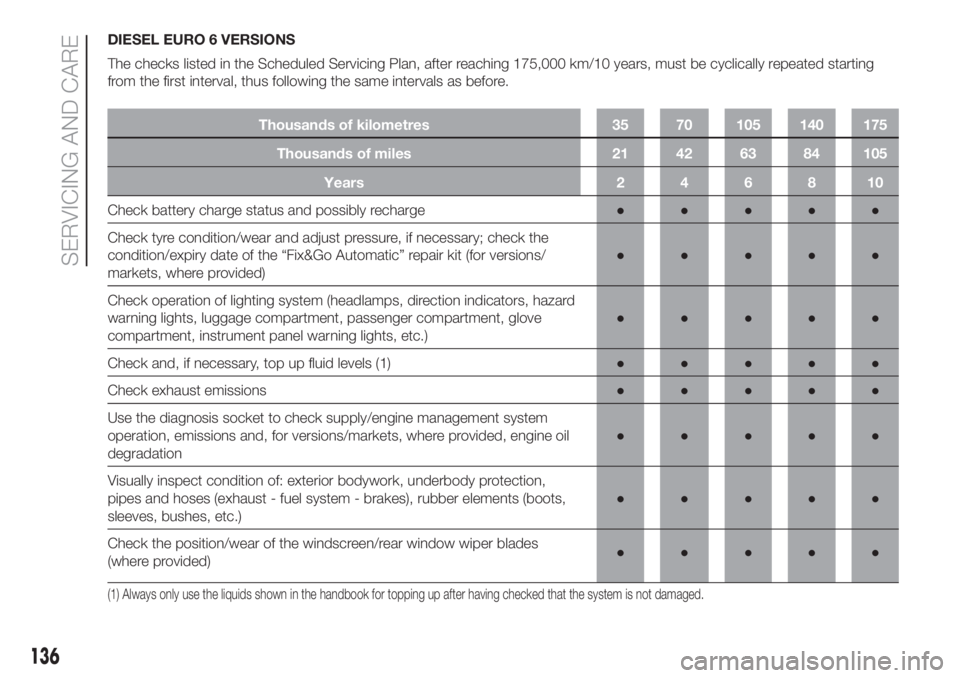
DIESEL EURO 6 VERSIONS
The checks listed in the Scheduled Servicing Plan, after reaching 175,000 km/10 years, must be cyclically repeated starting
from the first interval, thus following the same intervals as before.
Thousands of kilometres 35 70 105 140 175
Thousands of miles 21 42 63 84 105
Years 2 4 6 8 10
Check battery charge status and possibly recharge●●●●●
Check tyre condition/wear and adjust pressure, if necessary; check the
condition/expiry date of the “Fix&Go Automatic” repair kit (for versions/
markets, where provided)●●●●●
Check operation of lighting system (headlamps, direction indicators, hazard
warning lights, luggage compartment, passenger compartment, glove
compartment, instrument panel warning lights, etc.)●●●●●
Check and, if necessary, top up fluid levels (1)●●●●●
Check exhaust emissions●●●●●
Use the diagnosis socket to check supply/engine management system
operation, emissions and, for versions/markets, where provided, engine oil
degradation●●●●●
Visually inspect condition of: exterior bodywork, underbody protection,
pipes and hoses (exhaust - fuel system - brakes), rubber elements (boots,
sleeves, bushes, etc.)●●●●●
Check the position/wear of the windscreen/rear window wiper blades
(where provided)●●●●●
(1) Always only use the liquids shown in the handbook for topping up after having checked that the system is not damaged.
136
SERVICING AND CARE
Page 141 of 196
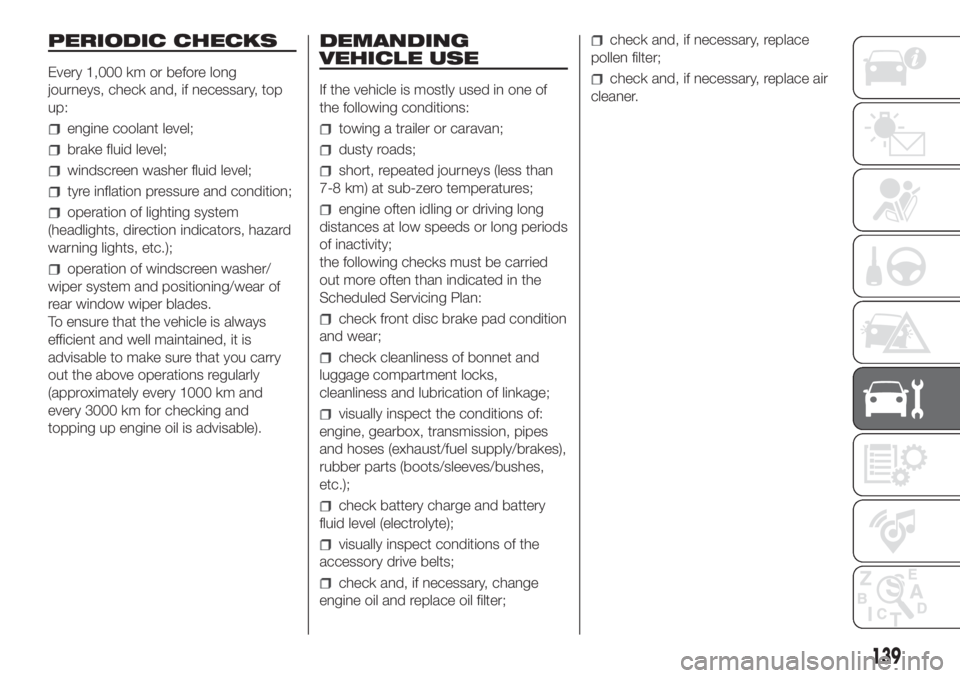
PERIODIC CHECKS
Every 1,000 km or before long
journeys, check and, if necessary, top
up:
engine coolant level;
brake fluid level;
windscreen washer fluid level;
tyre inflation pressure and condition;
operation of lighting system
(headlights, direction indicators, hazard
warning lights, etc.);
operation of windscreen washer/
wiper system and positioning/wear of
rear window wiper blades.
To ensure that the vehicle is always
efficient and well maintained, it is
advisable to make sure that you carry
out the above operations regularly
(approximately every 1000 km and
every 3000 km for checking and
topping up engine oil is advisable).
DEMANDING
VEHICLE USE
If the vehicle is mostly used in one of
the following conditions:
towing a trailer or caravan;
dusty roads;
short, repeated journeys (less than
7-8 km) at sub-zero temperatures;
engine often idling or driving long
distances at low speeds or long periods
of inactivity;
the following checks must be carried
out more often than indicated in the
Scheduled Servicing Plan:
check front disc brake pad condition
and wear;
check cleanliness of bonnet and
luggage compartment locks,
cleanliness and lubrication of linkage;
visually inspect the conditions of:
engine, gearbox, transmission, pipes
and hoses (exhaust/fuel supply/brakes),
rubber parts (boots/sleeves/bushes,
etc.);
check battery charge and battery
fluid level (electrolyte);
visually inspect conditions of the
accessory drive belts;
check and, if necessary, change
engine oil and replace oil filter;
check and, if necessary, replace
pollen filter;
check and, if necessary, replace air
cleaner.
139
Page 142 of 196
CHECKING LEVELS
133)
43).
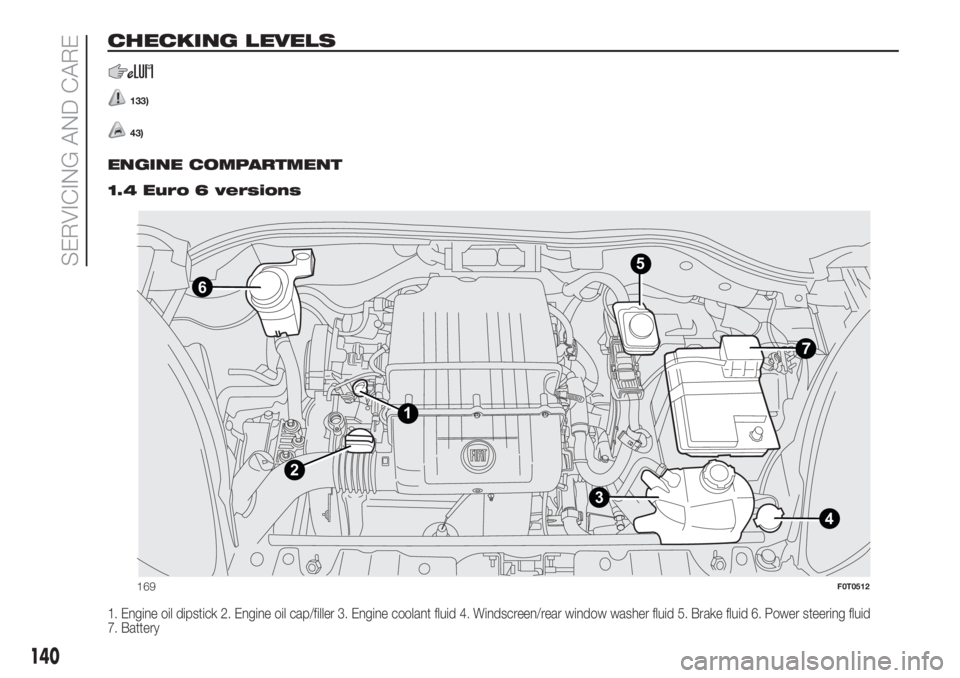
ENGINE COMPARTMENT.
1.4 Euro 6 versions
1. Engine oil dipstick 2. Engine oil cap/filler 3. Engine coolant fluid 4. Windscreen/rear window washer fluid 5. Brake fluid 6. Power steering fluid
7. Battery
4
6
1
2
35
169F0T0512
140
SERVICING AND CARE
Page 143 of 196
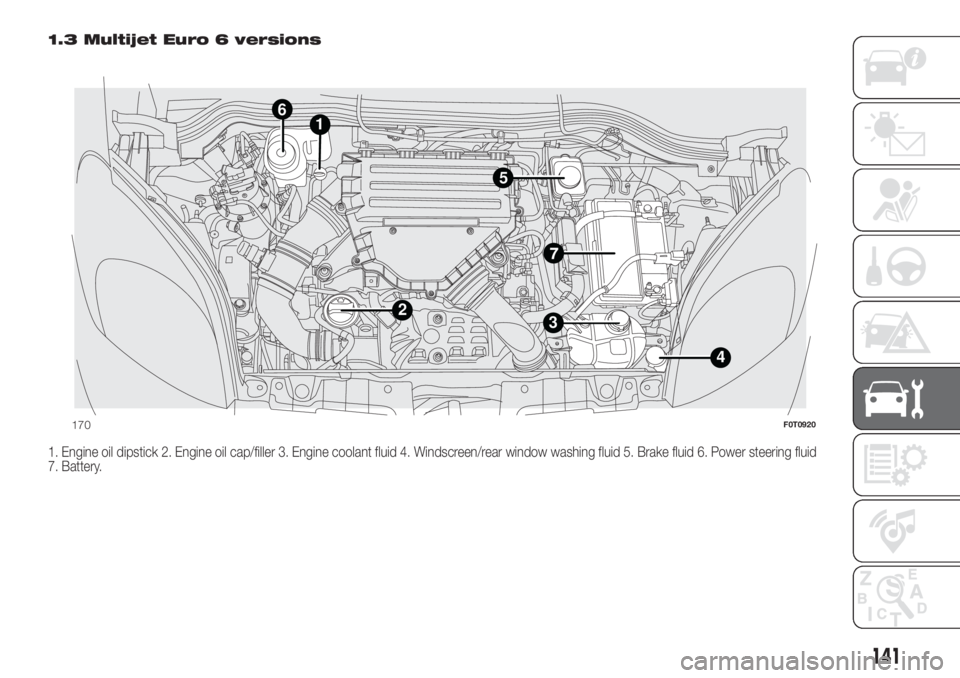
1.3 Multijet Euro 6 versions
1. Engine oil dipstick 2. Engine oil cap/filler 3. Engine coolant fluid 4. Windscreen/rear window washing fluid 5. Brake fluid 6. Power steering fluid
7. Battery.
1
32
4
5
6
170F0T0920
141