handbrake FIAT FIORINO 2018 Owner handbook (in English)
[x] Cancel search | Manufacturer: FIAT, Model Year: 2018, Model line: FIORINO, Model: FIAT FIORINO 2018Pages: 196, PDF Size: 4.99 MB
Page 4 of 196
READ THIS CAREFULLY
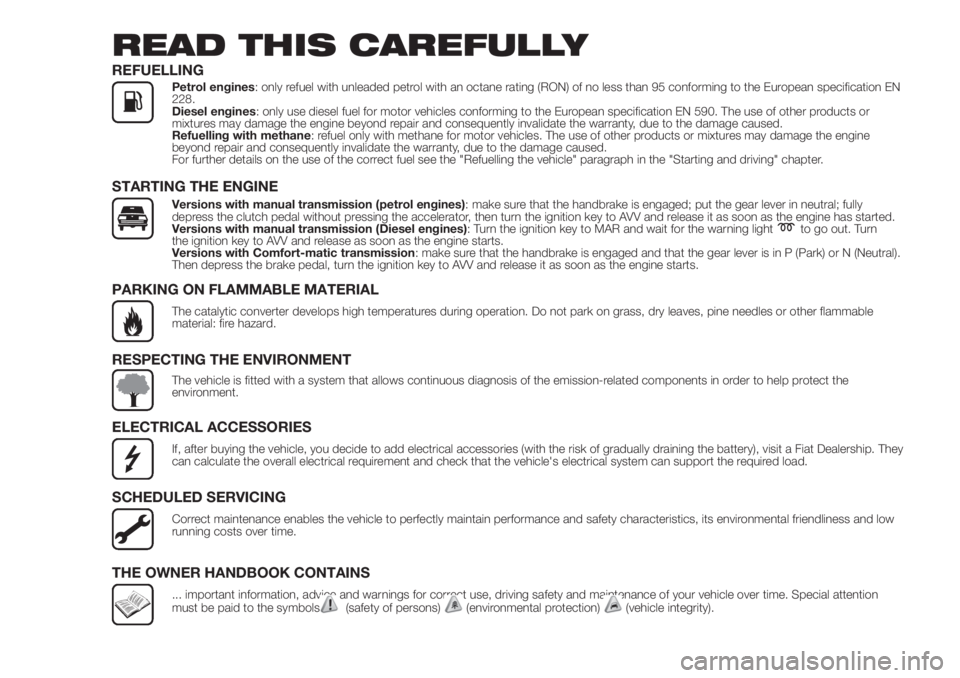
REFUELLINGPetrol engines: only refuel with unleaded petrol with an octane rating (RON) of no less than 95 conforming to the European specification EN
228.
Diesel engines: only use diesel fuel for motor vehicles conforming to the European specification EN 590. The use of other products or
mixtures may damage the engine beyond repair and consequently invalidate the warranty, due to the damage caused.
Refuelling with methane: refuel only with methane for motor vehicles. The use of other products or mixtures may damage the engine
beyond repair and consequently invalidate the warranty, due to the damage caused.
For further details on the use of the correct fuel see the "Refuelling the vehicle" paragraph in the "Starting and driving" chapter.
STARTING THE ENGINE
Versions with manual transmission (petrol engines): make sure that the handbrake is engaged; put the gear lever in neutral; fully
depress the clutch pedal without pressing the accelerator, then turn the ignition key to AVV and release it as soon as the engine has started.
Versions with manual transmission (Diesel engines): Turn the ignition key to MAR and wait for the warning light
to go out. Turn
the ignition key to AVV and release as soon as the engine starts.
Versions with Comfort-matic transmission: make sure that the handbrake is engaged and that the gear lever is in P (Park) or N (Neutral).
Then depress the brake pedal, turn the ignition key to AVV and release it as soon as the engine starts.
PARKING ON FLAMMABLE MATERIAL
The catalytic converter develops high temperatures during operation. Do not park on grass, dry leaves, pine needles or other flammable
material: fire hazard.
RESPECTING THE ENVIRONMENT
The vehicle is fitted with a system that allows continuous diagnosis of the emission-related components in order to help protect the
environment.
ELECTRICAL ACCESSORIES
If, after buying the vehicle, you decide to add electrical accessories (with the risk of gradually draining the battery), visit a Fiat Dealership. They
can calculate the overall electrical requirement and check that the vehicle's electrical system can support the required load.
SCHEDULED SERVICING
Correct maintenance enables the vehicle to perfectly maintain performance and safety characteristics, its environmental friendliness and low
running costs over time.
THE OWNER HANDBOOK CONTAINS
... important information, advice and warnings for correct use, driving safety and maintenance of your vehicle over time. Special attention
must be paid to the symbols(safety of persons)(environmental protection)(vehicle integrity).
Page 39 of 196
KNOWING THE INSTRUMENT PANEL
This section of the handbook gives you
all the information you need to
understand, interpret and use the
instrument panel correctly.INSTRUMENT PANEL ..................... 38
DIGITAL DISPLAY............................ 42
MULTIFUNCTION DISPLAY ............. 43
TRIP COMPUTER ........................... 44
WARNING LIGHTS AND
MESSAGES .................................... 46
-LOW BRAKE FLUID/HANDBRAKE
ENGAGED........................................... 46
-EBD FAILURE .................................... 47
-AIR BAG FAILURE .............................. 47
-SEAT BELTS REMINDER.................... 48
-GEARBOX FAILURE ........................... 48
-ENGINE COOLANT TEMPERATURE
TOO HIGH........................................... 49
-LOW BATTERY CHARGE ................... 49
-INSUFFICIENT ENGINE OIL
PRESSURE/ENGINE OIL
DETERIORATED .................................. 50
-LOW ENGINE OIL LEVEL ................... 51
-DOOR OPEN ..................................... 51
-POWER STEERING FAILURE ............. 51
-INJECTION SYSTEM FAULT (Multijet
versions) - EOBD ENGINE CONTROL
SYSTEM FAULT (petrol versions) ......... 52
-ABS FAILURE..................................... 53
-FUEL RESERVE ................................. 54
-PLUG PREHEATING (Multijet
versions) - PLUG PREHEATING FAULT
(Multijet versions) ................................. 54
-WATER IN DIESEL FILTER (Multijet
versions) .............................................. 55
-VEHICLE PROTECTION SYSTEM
FAULT - FIAT CODE - ALARM FAULT
(for versions/markets, where provided
- amber) - BREAK-IN ATTEMPT .......... 56
-GENERAL FAILURE INDICATION ....... 57-DPF (PARTICULATE FILTER)
CLEANING UNDERWAY ...................... 59
-HILL HOLDER FAILURE ..................... 59
-iTPMS ................................................ 60
-BRAKE PAD WEAR ............................ 60
-PARKING SENSOR FAILURE ............. 60
-START&STOP SYSTEM FAILURE....... 60
-ASR SYSTEM DEACTIVATED ............. 61
-TRACTION PLUS SYSTEM
ACTIVATION ........................................ 61
-REAR FOG LIGHTS............................ 61
-SIDE LIGHTS - FOLLOW ME HOME .. 62
-LEFT-HAND DIRECTION INDICATOR
(blinking) .............................................. 62
-RIGHT-HAND DIRECTION
INDICATOR (blinking) ........................... 63
-FRONT FOG LIGHTS ......................... 63
-CRUISE CONTROL ............................ 63
-MAIN BEAM HEADLIGHTS ................ 63
-GEAR SHIFT INDICATION .................. 64
-CNG SYSTEM FAILURE ..................... 64
37
Page 48 of 196
WARNING LIGHTS AND MESSAGES
The warning light switches on together with (where the instrument panel permits) a specific message and/or acoustic warning.
These indications are indicative and precautionary and as such must not be considered as exhaustive and/or alternative to
the information contained in the Owner Handbook, which you are advised to read carefully in all cases. In the event of a failure
indication, always refer to the contents of this chapter.
IMPORTANT The failure indicators appearing on the display are divided into two categories: very serious and less serious faults.
Serious faults are indicated by a repeated and prolonged warning "cycle". Less serious faults are indicated by a warning
"cycle" with a shorter duration. Press the
SETbutton to stop the warning cycle in both cases. The warning light (or the
symbol on the display) on the instrument panel will stay on until the cause of the failure is eliminated.
WARNING LIGHTS ON INSTRUMENT PANEL
Red warning lights
What it means What to do
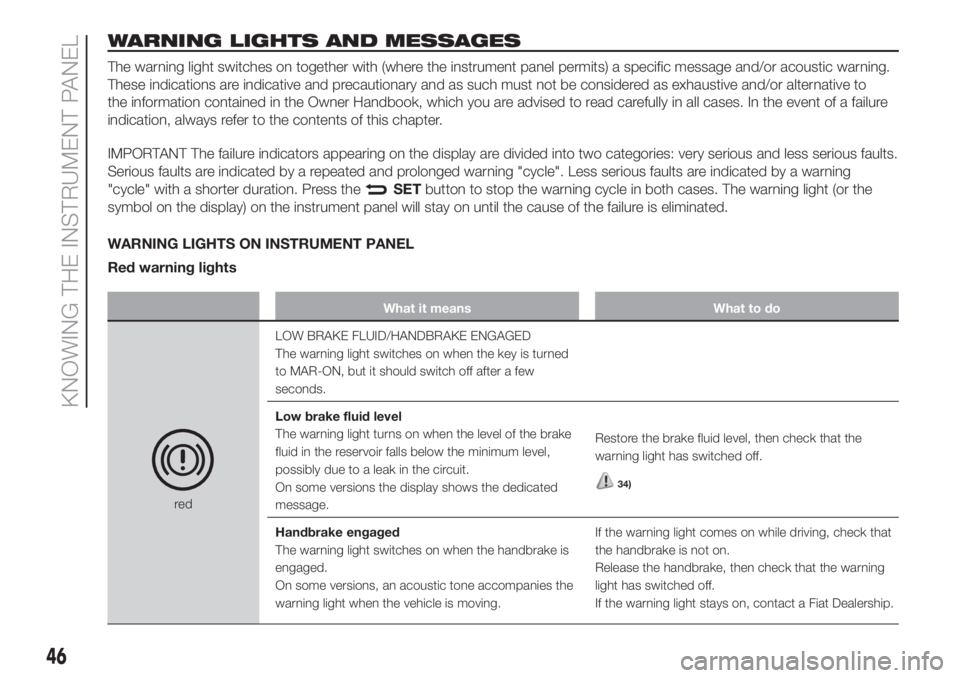
redLOW BRAKE FLUID/HANDBRAKE ENGAGED
The warning light switches on when the key is turned
to MAR-ON, but it should switch off after a few
seconds.
Low brake fluid level
The warning light turns on when the level of the brake
fluid in the reservoir falls below the minimum level,
possibly due to a leak in the circuit.
On some versions the display shows the dedicated
message.Restore the brake fluid level, then check that the
warning light has switched off.
34)
Handbrake engaged
The warning light switches on when the handbrake is
engaged.
On some versions, an acoustic tone accompanies the
warning light when the vehicle is moving.If the warning light comes on while driving, check that
the handbrake is not on.
Release the handbrake, then check that the warning
light has switched off.
If the warning light stays on, contact a Fiat Dealership.
46
KNOWING THE INSTRUMENT PANEL
Page 70 of 196
ESC (Electronic
Stability Control)
SYSTEM
(for versions/markets, where provided)
This is an electronic system that
controls vehicle stability in the event of
tyre grip loss, helping to maintain
directional control. The system
is capable of recognising potentially
dangerous situations in terms of vehicle
stability and intervenes automatically
on the brakes in a differentiated manner
for the four wheels in order to provide
a stabilizing torque.
The ESC system switches on
automatically when the engine is
started and cannot be switched off.
The ESC system also includes the
following systems:
Hill Holder
ASR
MSR
HBA
SYSTEM INTERVENTION
This is signalled by the flashing of the
warning light in the instrument panel,
to inform the driver that the vehicle is
in critical stability and grip conditions.
Switching the system on
The ESC system is automatically
activated when the vehicle is started
and cannot be deactivated.Fault warnings
In the event of a failure, the ESC will be
automatically switched off and the
warning light
will come on constantly
in the instrument panel along with a
message in the multifunction display
(for versions/markets where provided)
(see “Warning lights and messages”
section in the "Knowing the instrument
panel" chapter). Contact a Fiat
Dealership as soon as possible.
44) 45) 46)
HILL HOLDER SYSTEM
(for versions/markets, where provided)
It is an integral part of the ESC system
and facilitates starting on an incline.
It is automatically activated in the
following conditions:
uphill: vehicle stationary on a road
with a gradient higher than 5%, engine
running, brake pedal pressed and
gearbox in neutral or gear other than
reverse;
downhill: vehicle stationary on a road
with a gradient higher than 5%, engine
running, brake pedal pressed and
reverse gear engaged.
When setting off, the ESC system
control unit maintains the braking
pressure on the wheels until the torque
necessary for starting is reached, or
in any case for a maximum of 2seconds, allowing your right foot to be
moved easily from the brake pedal to
the accelerator. When the 2 seconds
have elapsed, without starting, the
system is automatically deactivated,
gradually releasing the braking
pressure. During this release stage, the
typical brake disengagement noise
indicating that the vehicle is going to
move imminently will be heard.
Fault warnings
System failure is indicated by
instrument panel warning light
with
digital display and warning light
on
the instrument panel with multifunction
display (for versions/markets, where
provided) (see section “Warning lights
and messages” in the "Knowing the
instrument panel" chapter).
IMPORTANT The Hill Holder system is
not a parking brake, therefore do not
leave the vehicle without activating the
handbrake, switching off the engine
and engaging first gear.
47)
ASR SYSTEM (Antislip
Regulation)
(for versions/markets, where provided)
This is a traction control system that
cuts in automatically every time one or
both drive wheels slip.
68
SAFETY
Page 93 of 196
STARTING AND DRIVING
Let’s get to the core of the vehicle:
seeing how you can exploit all of its
potential to the full.
We’ll look at how to drive it safely in any
situation, so that it can be a welcome
companion, with our comfort and
our wallets in mind.STARTING THE ENGINE ................. 92
HANDBRAKE .................................. 93
WHEN PARKED .............................. 94
USING THE MANUAL
TRANSMISSION ............................. 95
“COMFORT-MATIC”
TRANSMISSION ............................. 96
CRUISE CONTROL (CONSTANT
SPEED REGULATOR) ..................... 97
SPEED BLOCK ............................... 99
PARKING SENSORS....................... 99
START&STOP SYSTEM ..................100
REFUELLING THE VEHICLE ...........102
TOWING TRAILERS ........................105
91
Page 94 of 196
STARTING THE
ENGINE
The vehicle is fitted with an electronic
engine lock device: if the engine fails to
start, see the paragraph “The Fiat
CODE system” in section “Know your
vehicle”.
90) 91)
22) 23) 27) 28)
PROCEDURE FOR
PETROL VERSIONS
Proceed as follows:
engage the handbrake;
put the gear lever into neutral;
fully depress the clutch pedal
without touching the accelerator;
turn the ignition key to AVV and
release it as soon as the engine starts.
PROCEDURE FOR DIESEL
VERSIONS
Proceed as follows:
engage the handbrake;
put the gear lever into neutral;
turn the ignition key to MAR
position: the
warning light will light
up on instrument panel;
wait for the warning lightsand
to turn off, which will happen faster
the warmer the engine is;
fully depress the clutch pedal
without touching the accelerator;
turn the ignition key to the AVV
position as soon as the warning light
turns off. Waiting too long will waste
the heating work carried out by the
plugs.
Release the key as soon as the engine
starts.
With cold engine, the accelerator must
be entirely released when turning the
ignition key to position AVV.
24)
PROCEDURE FOR
NATURAL POWER
VERSIONS
The engine always starts up on petrol
independently of the previously
selected mode.
25)
PROCEDURE FOR
VERSIONS WITH
COMFORT-MATIC
TRANSMISSION
The system allows the engine to be
started both with a gear engaged and
with the transmission in neutral (N).
Always press the brake pedal with the
gear engaged.It is advisable to place the gear lever in
neutral (N) before starting the engine.
26)
IMPORTANT If the engine does not
start at the first attempt, return the
ignition key to STOP before repeating
the starting procedure. If the warning
light remains on together with warning
light
when the ignition key is at
MAR, turn the key to STOP and then
back to MAR; if the warning light stays
on, try with the other keys provided
with the vehicle. If you still cannot start
the engine, perform an emergency
start (see “Emergency starting” in the
“In an emergency” section) and go to a
Fiat Dealership.
IMPORTANT If start-up is requested
with the gearbox faulty, carry out the
"Delayed start-up" procedure (see
associated messages): turn the key to
the AVV position for at least 7 seconds
with the brake depressed and the
engine will start. The system will be in
recovery mode (maximum permitted
gear: 3
rd, Automatic mode not
available). If the engine does not start,
contact a Fiat Dealership.
92
STARTING AND DRIVING
Page 95 of 196
WARNING
90)It is dangerous to run the engine in
enclosed areas. The engine consumes
oxygen and engine exhaust contains
carbon dioxide, carbon monoxide and
other toxic gasses.
91)Remember that the brake servo and
electrical power steering system are not
operational until the engine is started,
therefore a greater effort will be required to
press the brake pedal or turn the steering
wheel.
WARNING
22)It is advisable not to demand maximum
performance from your vehicle (e.g.
excessive acceleration, long distances at
high speeds, excessive intense braking,
etc.) during the initial period of use.
23)When the engine is switched off never
leave the key turned to MAR-ON to prevent
useless current absorption from draining
the battery.
24)If the warning light
flashes for 60
seconds after starting or during an
extended towing period, this indicates a
problem in the glow plug preheating
system. Use the vehicle normally if the
engine starts, but contact a Fiat Dealership
as soon as possible.25)There must therefore always be
enough petrol in the tank to protect the
petrol pump and to guarantee temporary
switching from methane to petrol
operation, if high performance is required.
26)If the engine fails to start with a gear
engaged, the potentially dangerous
situation due to the fact that the gearbox is
automatically placed in neutral will be
signalled by a buzzer.
27)Never, under any circumstances, jump
start the engine by pushing, towing or
coasting downhill. This could cause fuel to
flow into the catalytic converter and
damage it beyond repair.
28)A quick burst on the accelerator before
turning off the engine serves absolutely
no practical purpose, it wastes fuel and is
especially damaging to turbocharged
engines.
HANDBRAKE
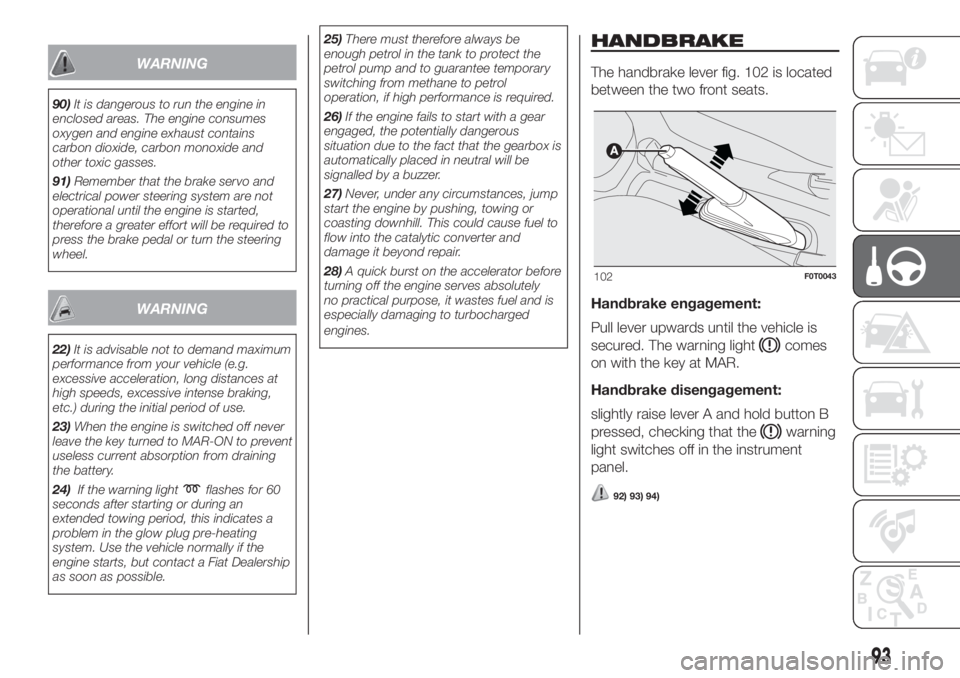
The handbrake lever fig. 102 is located
between the two front seats.
Handbrake engagement:
Pull lever upwards until the vehicle is
secured. The warning light
comes
on with the key at MAR.
Handbrake disengagement:
slightly raise lever A and hold button B
pressed, checking that the
warning
light switches off in the instrument
panel.
92) 93) 94)
102F0T0043
93
Page 96 of 196
WARNING
92)Never leave children unattended in the
vehicle. Always remove the ignition key
when leaving the vehicle and take it out
with you.
93)The vehicle should be secured after
several clicks of the lever. If it is not,
contact a Fiat Dealership to have it
adjusted.
94)In the case of parking manoeuvres on
roads on a gradient, the front wheels
must be steered towards the pavement
(when parking downhill), or in the opposite
direction if the vehicle is parked uphill. If
the vehicle is parked on a steep slope, it is
advisable to block the wheels with a wedge
or stone.
WHEN PARKED
95)
Proceed as follows when parking and
leaving the vehicle:
engage a gear (1stgear if facing
uphill or reverse if facing downhill) and
leave the wheels turned;
stop the engine and engage the
handbrake;
always remove the ignition key.
If the vehicle is parked on a steep
slope, it is advisable to block the
wheels with a wedge or stone.
Do not leave the key in the MAR
position to prevent the battery from
running down.
Versions with COMFORT-MATIC
transmission
To park safely, keeping a foot on the
brake pedal, the 1
stor reverse (R) gear
must be engaged and, in case of
parking uphills/downhills, the
handbrake must be engaged.
IMPORTANT NEVER leave the vehicle
with the transmission in neutral (N)
or, on versions equipped with automatic
(Comfort matic) transmission, before
putting the shift lever in thePposition.IMPORTANT NOTES
With the vehicle stationary and a
gear engaged, always keep the brake
pedal pressed until you decide to
set off, then release the brake and
accelerate gently;
during prolonged stops with the
engine running, it is advisable to keep
the gearbox in neutral (N);
In order to safeguard the efficiency
of the clutch, do not use the
accelerator to keep the vehicle
stationary (e.g. when stopped on an
incline);
the clutch could overheat and be
damaged; use the brake pedal and only
operate the accelerator pedal when
you decide to set off;
only use second gear when you
need greater control for starting
manoeuvres on surfaces with poor grip;
if, with reverse gear (R) engaged,
you have to engage first gear or vice
versa, only do this when the vehicle is
completely stationary and with the
brake pedal pressed;
94
STARTING AND DRIVING
Page 109 of 196
HAZARD WARNING
LIGHTS
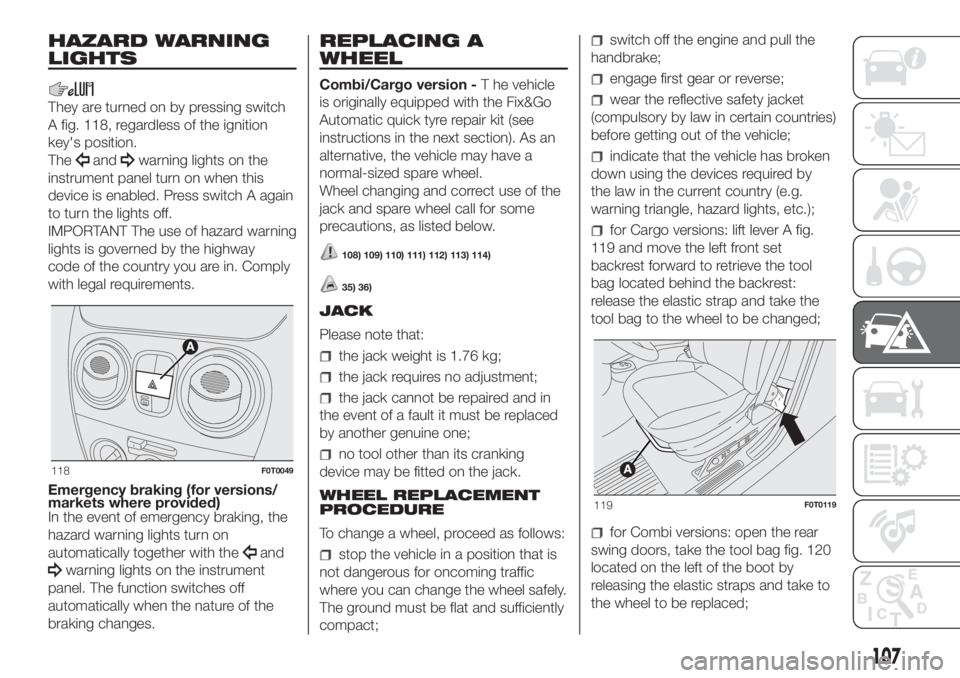
They are turned on by pressing switch
A fig. 118, regardless of the ignition
key's position.
The
andwarning lights on the
instrument panel turn on when this
device is enabled. Press switch A again
to turn the lights off.
IMPORTANT The use of hazard warning
lights is governed by the highway
code of the country you are in. Comply
with legal requirements.
Emergency braking (for versions/
markets where provided)
In the event of emergency braking, the
hazard warning lights turn on
automatically together with the
and
warning lights on the instrument
panel. The function switches off
automatically when the nature of the
braking changes.
REPLACING A
WHEEL
Combi/Cargo version -T he vehicle
is originally equipped with the Fix&Go
Automatic quick tyre repair kit (see
instructions in the next section). As an
alternative, the vehicle may have a
normal-sized spare wheel.
Wheel changing and correct use of the
jack and spare wheel call for some
precautions, as listed below.
108) 109) 110) 111) 112) 113) 114)
35) 36)
JACK
Please note that:
the jack weight is 1.76 kg;
the jack requires no adjustment;
the jack cannot be repaired and in
the event of a fault it must be replaced
by another genuine one;
no tool other than its cranking
device may be fitted on the jack.
WHEEL REPLACEMENT
PROCEDURE
To change a wheel, proceed as follows:
stop the vehicle in a position that is
not dangerous for oncoming traffic
where you can change the wheel safely.
The ground must be flat and sufficiently
compact;
switch off the engine and pull the
handbrake;
engage first gear or reverse;
wear the reflective safety jacket
(compulsory by law in certain countries)
before getting out of the vehicle;
indicate that the vehicle has broken
down using the devices required by
the law in the current country (e.g.
warning triangle, hazard lights, etc.);
for Cargo versions: lift lever A fig.
119 and move the left front set
backrest forward to retrieve the tool
bag located behind the backrest:
release the elastic strap and take the
tool bag to the wheel to be changed;
for Combi versions: open the rear
swing doors, take the tool bag fig. 120
located on the left of the boot by
releasing the elastic straps and take to
the wheel to be replaced;
118F0T0049
119F0T0119
107
Page 114 of 196
operate the compressor by pressing
the ON-OFF button E fig. 133. When
the pressure shown in the Owner
Handbook or on the specific label
appears on the pressure gauge G, stop
the compressor by pressing the
ON-OFF button E again;
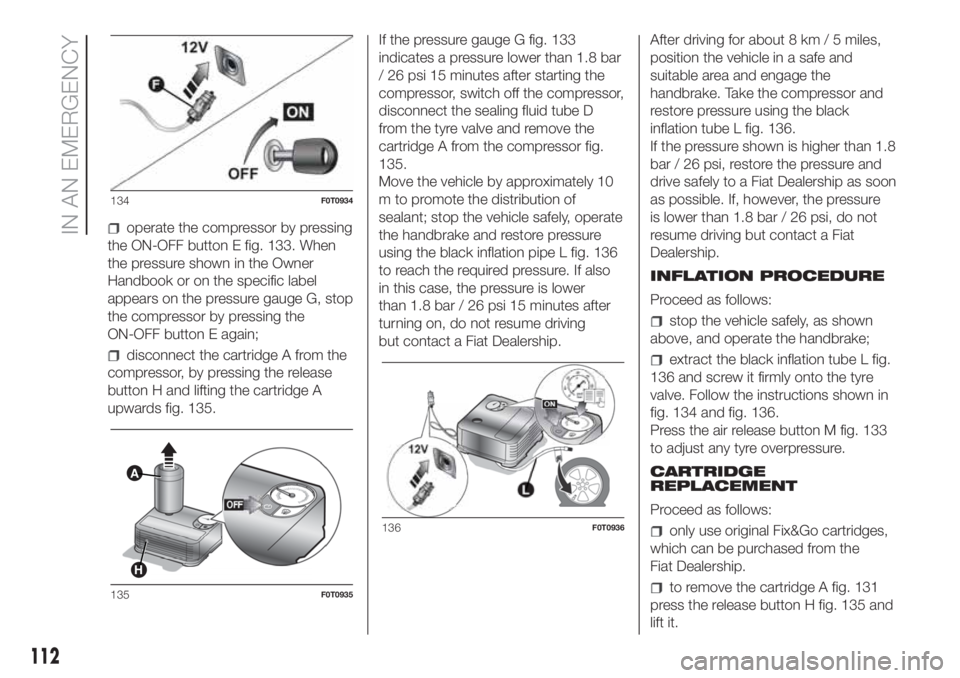
disconnect the cartridge A from the
compressor, by pressing the release
button H and lifting the cartridge A
upwards fig. 135.If the pressure gauge G fig. 133
indicates a pressure lower than 1.8 bar
/ 26 psi 15 minutes after starting the
compressor, switch off the compressor,
disconnect the sealing fluid tube D
from the tyre valve and remove the
cartridge A from the compressor fig.
135.
Move the vehicle by approximately 10
m to promote the distribution of
sealant; stop the vehicle safely, operate
the handbrake and restore pressure
using the black inflation pipe L fig. 136
to reach the required pressure. If also
in this case, the pressure is lower
than 1.8 bar / 26 psi 15 minutes after
turning on, do not resume driving
but contact a Fiat Dealership.After driving for about 8 km / 5 miles,
position the vehicle in a safe and
suitable area and engage the
handbrake. Take the compressor and
restore pressure using the black
inflation tube L fig. 136.
If the pressure shown is higher than 1.8
bar / 26 psi, restore the pressure and
drive safely to a Fiat Dealership as soon
as possible. If, however, the pressure
is lower than 1.8 bar / 26 psi, do not
resume driving but contact a Fiat
Dealership.
INFLATION PROCEDURE
Proceed as follows:
stop the vehicle safely, as shown
above, and operate the handbrake;
extract the black inflation tube L fig.
136 and screw it firmly onto the tyre
valve. Follow the instructions shown in
fig. 134 and fig. 136.
Press the air release button M fig. 133
to adjust any tyre overpressure.
CARTRIDGE
REPLACEMENT
Proceed as follows:
only use original Fix&Go cartridges,
which can be purchased from the
Fiat Dealership.
to remove the cartridge A fig. 131
press the release button H fig. 135 and
lift it.
134F0T0934
A
H
135F0T0935
136F0T0936
112
IN AN EMERGENCY