brake fluid FIAT FIORINO 2018 Owner handbook (in English)
[x] Cancel search | Manufacturer: FIAT, Model Year: 2018, Model line: FIORINO, Model: FIAT FIORINO 2018Pages: 196, PDF Size: 4.99 MB
Page 39 of 196
KNOWING THE INSTRUMENT PANEL
This section of the handbook gives you
all the information you need to
understand, interpret and use the
instrument panel correctly.INSTRUMENT PANEL ..................... 38
DIGITAL DISPLAY............................ 42
MULTIFUNCTION DISPLAY ............. 43
TRIP COMPUTER ........................... 44
WARNING LIGHTS AND
MESSAGES .................................... 46
-LOW BRAKE FLUID/HANDBRAKE
ENGAGED........................................... 46
-EBD FAILURE .................................... 47
-AIR BAG FAILURE .............................. 47
-SEAT BELTS REMINDER.................... 48
-GEARBOX FAILURE ........................... 48
-ENGINE COOLANT TEMPERATURE
TOO HIGH........................................... 49
-LOW BATTERY CHARGE ................... 49
-INSUFFICIENT ENGINE OIL
PRESSURE/ENGINE OIL
DETERIORATED .................................. 50
-LOW ENGINE OIL LEVEL ................... 51
-DOOR OPEN ..................................... 51
-POWER STEERING FAILURE ............. 51
-INJECTION SYSTEM FAULT (Multijet
versions) - EOBD ENGINE CONTROL
SYSTEM FAULT (petrol versions) ......... 52
-ABS FAILURE..................................... 53
-FUEL RESERVE ................................. 54
-PLUG PREHEATING (Multijet
versions) - PLUG PREHEATING FAULT
(Multijet versions) ................................. 54
-WATER IN DIESEL FILTER (Multijet
versions) .............................................. 55
-VEHICLE PROTECTION SYSTEM
FAULT - FIAT CODE - ALARM FAULT
(for versions/markets, where provided
- amber) - BREAK-IN ATTEMPT .......... 56
-GENERAL FAILURE INDICATION ....... 57-DPF (PARTICULATE FILTER)
CLEANING UNDERWAY ...................... 59
-HILL HOLDER FAILURE ..................... 59
-iTPMS ................................................ 60
-BRAKE PAD WEAR ............................ 60
-PARKING SENSOR FAILURE ............. 60
-START&STOP SYSTEM FAILURE....... 60
-ASR SYSTEM DEACTIVATED ............. 61
-TRACTION PLUS SYSTEM
ACTIVATION ........................................ 61
-REAR FOG LIGHTS............................ 61
-SIDE LIGHTS - FOLLOW ME HOME .. 62
-LEFT-HAND DIRECTION INDICATOR
(blinking) .............................................. 62
-RIGHT-HAND DIRECTION
INDICATOR (blinking) ........................... 63
-FRONT FOG LIGHTS ......................... 63
-CRUISE CONTROL ............................ 63
-MAIN BEAM HEADLIGHTS ................ 63
-GEAR SHIFT INDICATION .................. 64
-CNG SYSTEM FAILURE ..................... 64
37
Page 48 of 196
WARNING LIGHTS AND MESSAGES
The warning light switches on together with (where the instrument panel permits) a specific message and/or acoustic warning.
These indications are indicative and precautionary and as such must not be considered as exhaustive and/or alternative to
the information contained in the Owner Handbook, which you are advised to read carefully in all cases. In the event of a failure
indication, always refer to the contents of this chapter.
IMPORTANT The failure indicators appearing on the display are divided into two categories: very serious and less serious faults.
Serious faults are indicated by a repeated and prolonged warning "cycle". Less serious faults are indicated by a warning
"cycle" with a shorter duration. Press the
SETbutton to stop the warning cycle in both cases. The warning light (or the
symbol on the display) on the instrument panel will stay on until the cause of the failure is eliminated.
WARNING LIGHTS ON INSTRUMENT PANEL
Red warning lights
What it means What to do
redLOW BRAKE FLUID/HANDBRAKE ENGAGED
The warning light switches on when the key is turned
to MAR-ON, but it should switch off after a few
seconds.
Low brake fluid level
The warning light turns on when the level of the brake
fluid in the reservoir falls below the minimum level,
possibly due to a leak in the circuit.
On some versions the display shows the dedicated
message.Restore the brake fluid level, then check that the
warning light has switched off.
34)
Handbrake engaged
The warning light switches on when the handbrake is
engaged.
On some versions, an acoustic tone accompanies the
warning light when the vehicle is moving.If the warning light comes on while driving, check that
the handbrake is not on.
Release the handbrake, then check that the warning
light has switched off.
If the warning light stays on, contact a Fiat Dealership.
46
KNOWING THE INSTRUMENT PANEL
Page 69 of 196
ABS SYSTEM
This is an integral part of the braking
system, which prevents one or more
wheels from locking and slipping
regardless of the road surface
conditions and braking intensity,
ensuring control of the vehicle even
during emergency braking.
The Electronic Braking Force
Distribution (EBD) system completes
the system allowing the brake force to
be distributed between the front and
rear wheels.
IMPORTANT To obtain the maximum
efficiency of the braking system, a
bedding-in period of about 500 km is
needed: during this period it is better to
avoid sharp, repeated and prolonged
braking.
SYSTEM INTERVENTION
The driver can feel that the ABS has
come into action because the brake
pedal pulsates slightly and the system
gets noisier: it means that the vehicle
speed should be altered to suit the type
of road surface.
MECHANICAL BRAKE
ASSIST
(for versions/markets, where provided)
This system (which cannot be
deactivated) recognises emergency
braking conditions according to the
speed of operation of the brake pedal
and provides an additional hydraulicbraking pressure to support that
provided by the driver. This allows
faster and more powerful operation of
the braking system.
IMPORTANT When the Mechanical
Brake Assist intervenes, noises may be
heard from the system. This is normal.
In any case, while braking keep the
brake pedal firmly depressed.
40) 41) 42)
FAULT WARNINGS
ABS failure
This is indicated by turning on the
warning light on the instrument
panel together with a message on the
display on some versions (see the
“Warning lights and messages”
paragraph in the “Knowing the
instrument panel” chapter).
In this case, the braking system will still
be effective, although without the
extra capacity offered by the ABS. Drive
carefully to the nearest Fiat Dealership
to have the system checked.
EBD failure
This is indicated by turning on the
andwarning light on the
instrument panel together with
a message on the display on some
versions (see the “Warning lights and
messages” paragraph in the “Knowing
the instrument panel” chapter).In this case, the rear wheels may
suddenly lock and the vehicle may
swerve when braking sharply. Drive
carefully to the nearest Fiat Dealership
to have the system checked.
43)
WARNING
40)When the ABS cuts in and you feel the
brake pedal pulsating, do not remove
your foot, but keep the pedal pushed
down; in doing so you, will stop in the
shortest distance possible under the road
conditions at the time.
41)If the ABS system intervenes, this
indicates that the traction of the tyres on
the road is nearing its limit. You must slow
down to a speed compatible with the
available traction.
42)The ABS gets the most from the
available grip, but it cannot improve it; you
should therefore take every care when
driving on slippery surfaces and not take
unnecessary risks.
43)If only the
instrument panel
warning light comes on (with a message in
the multifunction display on some
versions), stop the vehicle immediately and
contact the nearest Fiat Dealership. Any
loss of fluid will affect the brake system
functionality, both conventional and
ant-lock wheels.
67
Page 113 of 196
FIX&GO
AUTOMATIC KIT
115) 116)
37)
The Fix&Go automatic quick tyre repair
kit is located in a special container in
the boot.
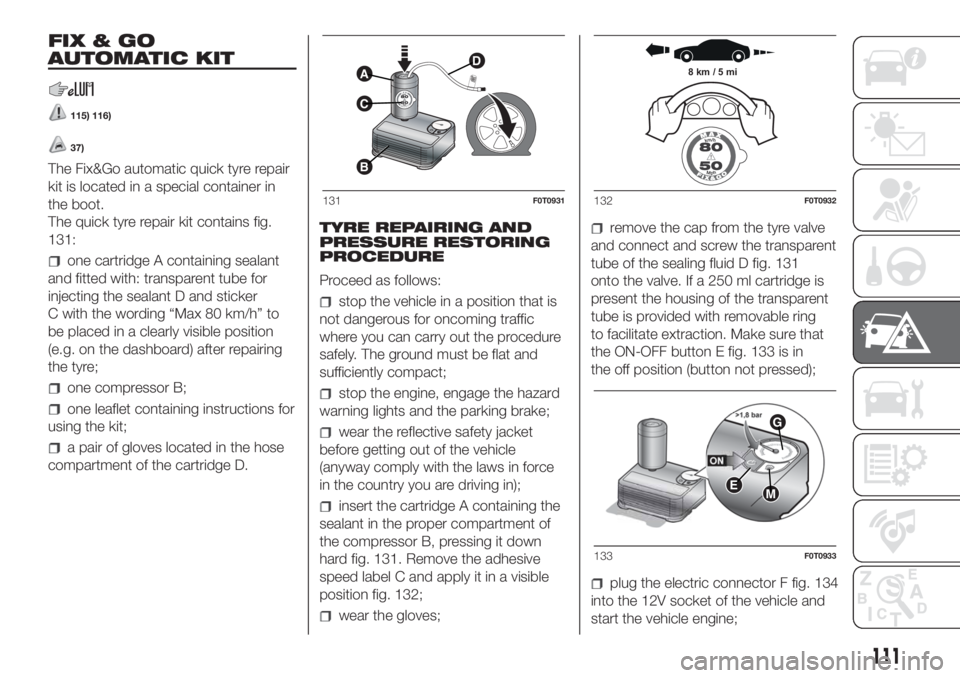
The quick tyre repair kit contains fig.
131:
one cartridge A containing sealant
and fitted with: transparent tube for
injecting the sealant D and sticker
C with the wording “Max 80 km/h” to
be placed in a clearly visible position
(e.g. on the dashboard) after repairing
the tyre;
one compressor B;
one leaflet containing instructions for
using the kit;
a pair of gloves located in the hose
compartment of the cartridge D.TYRE REPAIRING AND
PRESSURE RESTORING
PROCEDURE
Proceed as follows:
stop the vehicle in a position that is
not dangerous for oncoming traffic
where you can carry out the procedure
safely. The ground must be flat and
sufficiently compact;
stop the engine, engage the hazard
warning lights and the parking brake;
wear the reflective safety jacket
before getting out of the vehicle
(anyway comply with the laws in force
in the country you are driving in);
insert the cartridge A containing the
sealant in the proper compartment of
the compressor B, pressing it down
hard fig. 131. Remove the adhesive
speed label C and apply it in a visible
position fig. 132;
wear the gloves;
remove the cap from the tyre valve
and connect and screw the transparent
tube of the sealing fluid D fig. 131
onto the valve. If a 250 ml cartridge is
present the housing of the transparent
tube is provided with removable ring
to facilitate extraction. Make sure that
the ON-OFF button E fig. 133 is in
the off position (button not pressed);
plug the electric connector F fig. 134
into the 12V socket of the vehicle and
start the vehicle engine;
A
C
B
D
131F0T0931
8 km / 5 mi
132F0T0932
EM
G
133F0T0933
111
Page 114 of 196
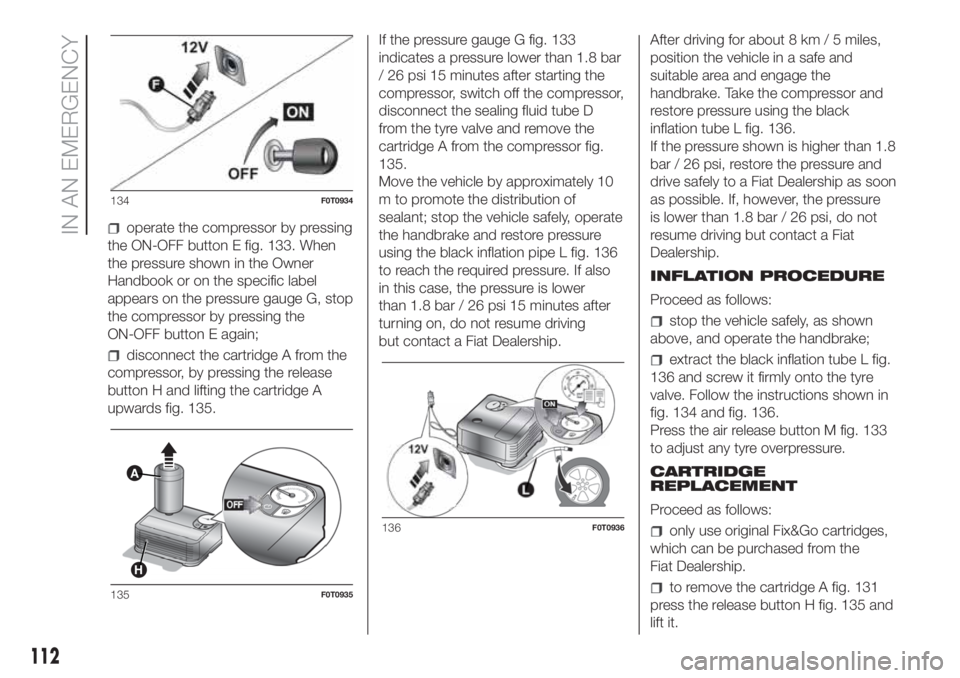
operate the compressor by pressing
the ON-OFF button E fig. 133. When
the pressure shown in the Owner
Handbook or on the specific label
appears on the pressure gauge G, stop
the compressor by pressing the
ON-OFF button E again;
disconnect the cartridge A from the
compressor, by pressing the release
button H and lifting the cartridge A
upwards fig. 135.If the pressure gauge G fig. 133
indicates a pressure lower than 1.8 bar
/ 26 psi 15 minutes after starting the
compressor, switch off the compressor,
disconnect the sealing fluid tube D
from the tyre valve and remove the
cartridge A from the compressor fig.
135.
Move the vehicle by approximately 10
m to promote the distribution of
sealant; stop the vehicle safely, operate
the handbrake and restore pressure
using the black inflation pipe L fig. 136
to reach the required pressure. If also
in this case, the pressure is lower
than 1.8 bar / 26 psi 15 minutes after
turning on, do not resume driving
but contact a Fiat Dealership.After driving for about 8 km / 5 miles,
position the vehicle in a safe and
suitable area and engage the
handbrake. Take the compressor and
restore pressure using the black
inflation tube L fig. 136.
If the pressure shown is higher than 1.8
bar / 26 psi, restore the pressure and
drive safely to a Fiat Dealership as soon
as possible. If, however, the pressure
is lower than 1.8 bar / 26 psi, do not
resume driving but contact a Fiat
Dealership.
INFLATION PROCEDURE
Proceed as follows:
stop the vehicle safely, as shown
above, and operate the handbrake;
extract the black inflation tube L fig.
136 and screw it firmly onto the tyre
valve. Follow the instructions shown in
fig. 134 and fig. 136.
Press the air release button M fig. 133
to adjust any tyre overpressure.
CARTRIDGE
REPLACEMENT
Proceed as follows:
only use original Fix&Go cartridges,
which can be purchased from the
Fiat Dealership.
to remove the cartridge A fig. 131
press the release button H fig. 135 and
lift it.
134F0T0934
A
H
135F0T0935
136F0T0936
112
IN AN EMERGENCY
Page 129 of 196
JUMP STARTING
If the warning lightremains on
continuously on the instrument panel,
contact the Fiat Dealership immediately.
JUMP STARTING
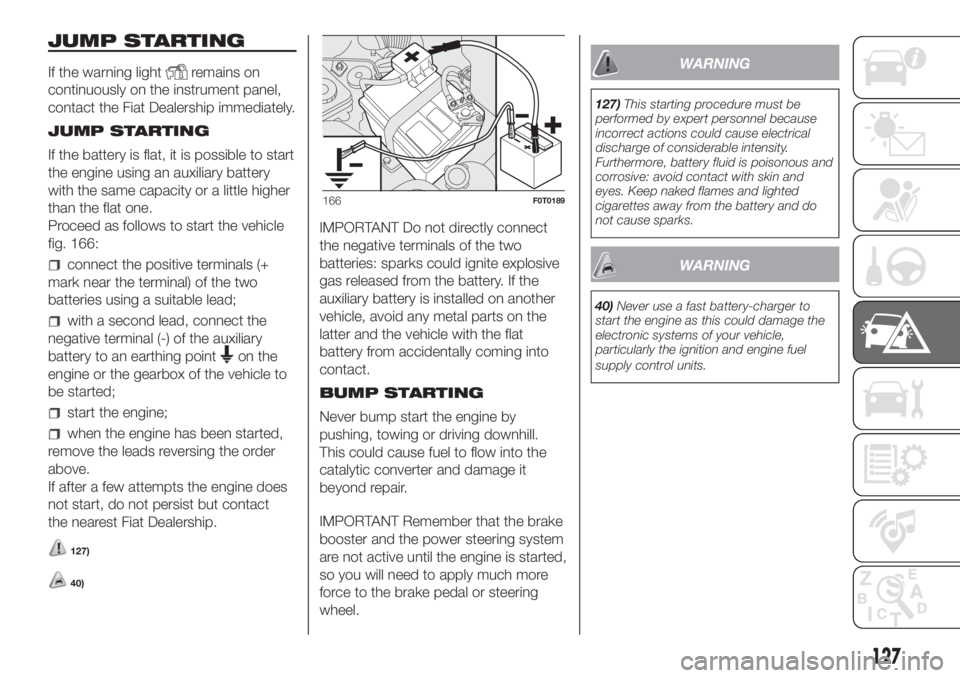
If the battery is flat, it is possible to start
the engine using an auxiliary battery
with the same capacity or a little higher
than the flat one.
Proceed as follows to start the vehicle
fig. 166:
connect the positive terminals (+
mark near the terminal) of the two
batteries using a suitable lead;
with a second lead, connect the
negative terminal (-) of the auxiliary
battery to an earthing point
on the
engine or the gearbox of the vehicle to
be started;
start the engine;
when the engine has been started,
remove the leads reversing the order
above.
If after a few attempts the engine does
not start, do not persist but contact
the nearest Fiat Dealership.
127)
40)
IMPORTANT Do not directly connect
the negative terminals of the two
batteries: sparks could ignite explosive
gas released from the battery. If the
auxiliary battery is installed on another
vehicle, avoid any metal parts on the
latter and the vehicle with the flat
battery from accidentally coming into
contact.
BUMP STARTING
Never bump start the engine by
pushing, towing or driving downhill.
This could cause fuel to flow into the
catalytic converter and damage it
beyond repair.
IMPORTANT Remember that the brake
booster and the power steering system
are not active until the engine is started,
so you will need to apply much more
force to the brake pedal or steering
wheel.
WARNING
127)This starting procedure must be
performed by expert personnel because
incorrect actions could cause electrical
discharge of considerable intensity.
Furthermore, battery fluid is poisonous and
corrosive: avoid contact with skin and
eyes. Keep naked flames and lighted
cigarettes away from the battery and do
not cause sparks.
WARNING
40)Never use a fast battery-charger to
start the engine as this could damage the
electronic systems of your vehicle,
particularly the ignition and engine fuel
supply control units.
166F0T0189
127
Page 134 of 196
SCHEDULED SERVICING PLAN
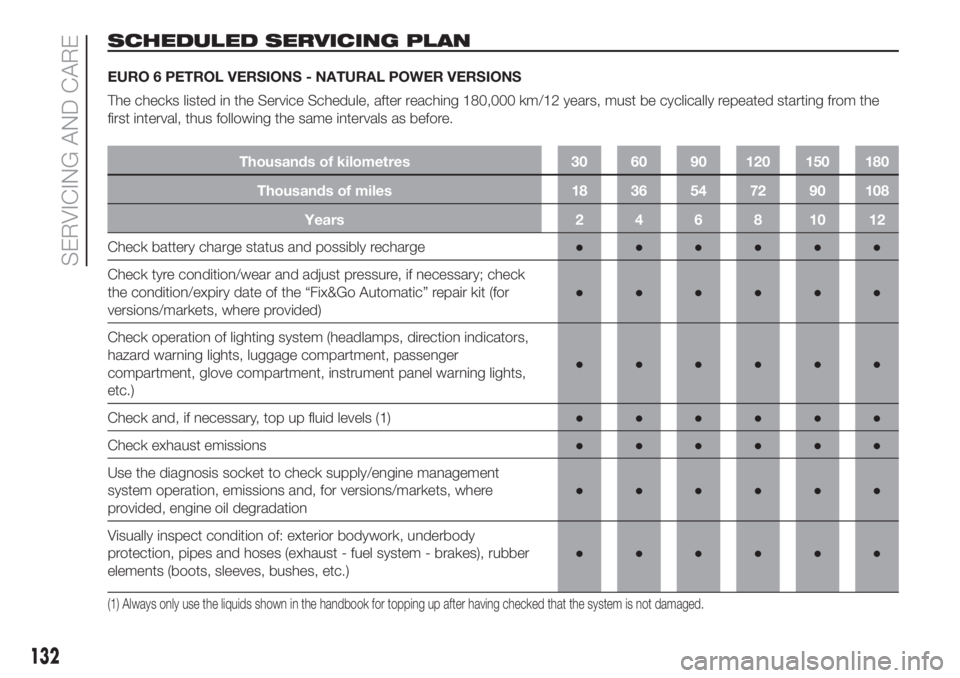
EURO 6 PETROL VERSIONS - NATURAL POWER VERSIONS
The checks listed in the Service Schedule, after reaching 180,000 km/12 years, must be cyclically repeated starting from the
first interval, thus following the same intervals as before.
Thousands of kilometres 30 60 90 120 150 180
Thousands of miles 18 36 54 72 90 108
Years 2 4 6 8 10 12
Check battery charge status and possibly recharge●●●●●●
Check tyre condition/wear and adjust pressure, if necessary; check
the condition/expiry date of the “Fix&Go Automatic” repair kit (for
versions/markets, where provided)●●●●●●
Check operation of lighting system (headlamps, direction indicators,
hazard warning lights, luggage compartment, passenger
compartment, glove compartment, instrument panel warning lights,
etc.)●●●●●●
Check and, if necessary, top up fluid levels (1)●●●●●●
Check exhaust emissions●●●●●●
Use the diagnosis socket to check supply/engine management
system operation, emissions and, for versions/markets, where
provided, engine oil degradation●●●●●●
Visually inspect condition of: exterior bodywork, underbody
protection, pipes and hoses (exhaust - fuel system - brakes), rubber
elements (boots, sleeves, bushes, etc.)●●●●●●
(1) Always only use the liquids shown in the handbook for topping up after having checked that the system is not damaged.
132
SERVICING AND CARE
Page 137 of 196
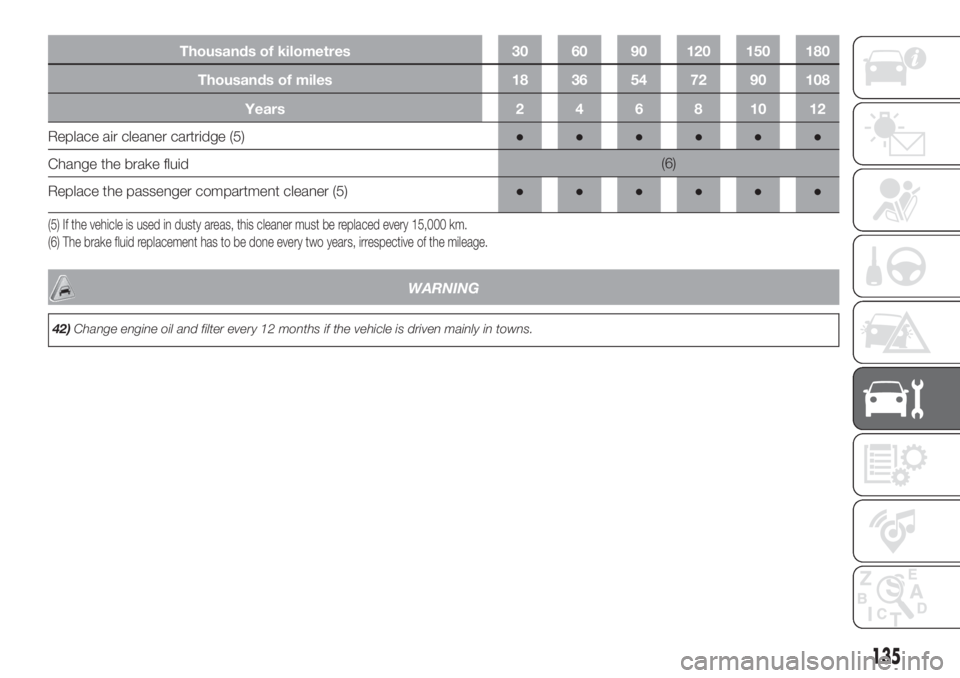
Thousands of kilometres 30 60 90 120 150 180
Thousands of miles 18 36 54 72 90 108
Years 2 4 6 8 10 12
Replace air cleaner cartridge (5)●●●●●●
Change the brake fluid(6)
Replace the passenger compartment cleaner (5)●●●●●●
(5) If the vehicle is used in dusty areas, this cleaner must be replaced every 15,000 km.
(6) The brake fluid replacement has to be done every two years, irrespective of the mileage.
WARNING
42)Change engine oil and filter every 12 months if the vehicle is driven mainly in towns.
135
Page 138 of 196
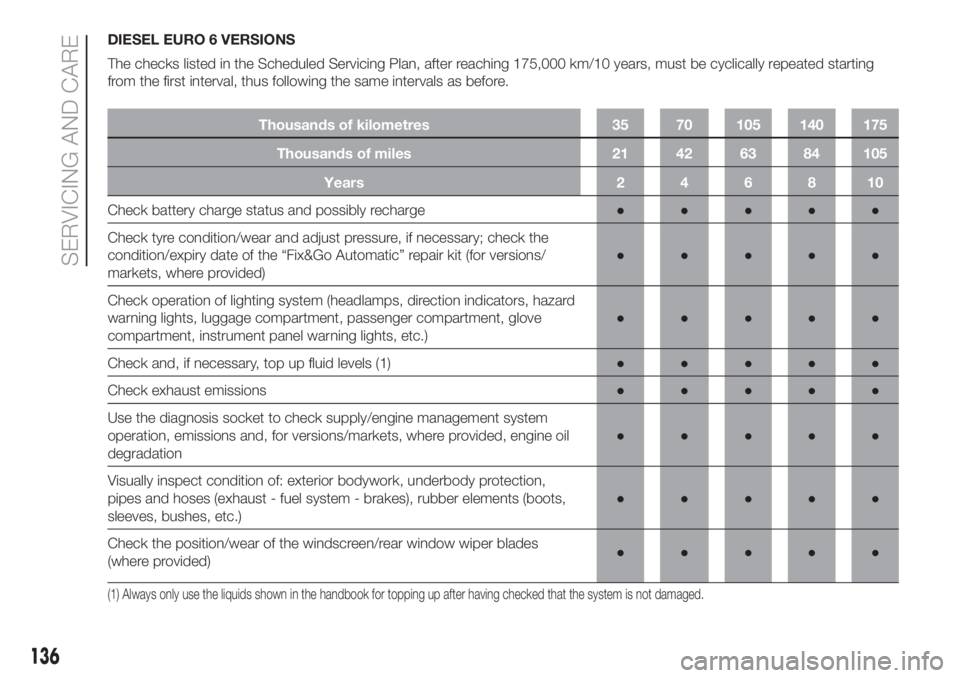
DIESEL EURO 6 VERSIONS
The checks listed in the Scheduled Servicing Plan, after reaching 175,000 km/10 years, must be cyclically repeated starting
from the first interval, thus following the same intervals as before.
Thousands of kilometres 35 70 105 140 175
Thousands of miles 21 42 63 84 105
Years 2 4 6 8 10
Check battery charge status and possibly recharge●●●●●
Check tyre condition/wear and adjust pressure, if necessary; check the
condition/expiry date of the “Fix&Go Automatic” repair kit (for versions/
markets, where provided)●●●●●
Check operation of lighting system (headlamps, direction indicators, hazard
warning lights, luggage compartment, passenger compartment, glove
compartment, instrument panel warning lights, etc.)●●●●●
Check and, if necessary, top up fluid levels (1)●●●●●
Check exhaust emissions●●●●●
Use the diagnosis socket to check supply/engine management system
operation, emissions and, for versions/markets, where provided, engine oil
degradation●●●●●
Visually inspect condition of: exterior bodywork, underbody protection,
pipes and hoses (exhaust - fuel system - brakes), rubber elements (boots,
sleeves, bushes, etc.)●●●●●
Check the position/wear of the windscreen/rear window wiper blades
(where provided)●●●●●
(1) Always only use the liquids shown in the handbook for topping up after having checked that the system is not damaged.
136
SERVICING AND CARE
Page 139 of 196
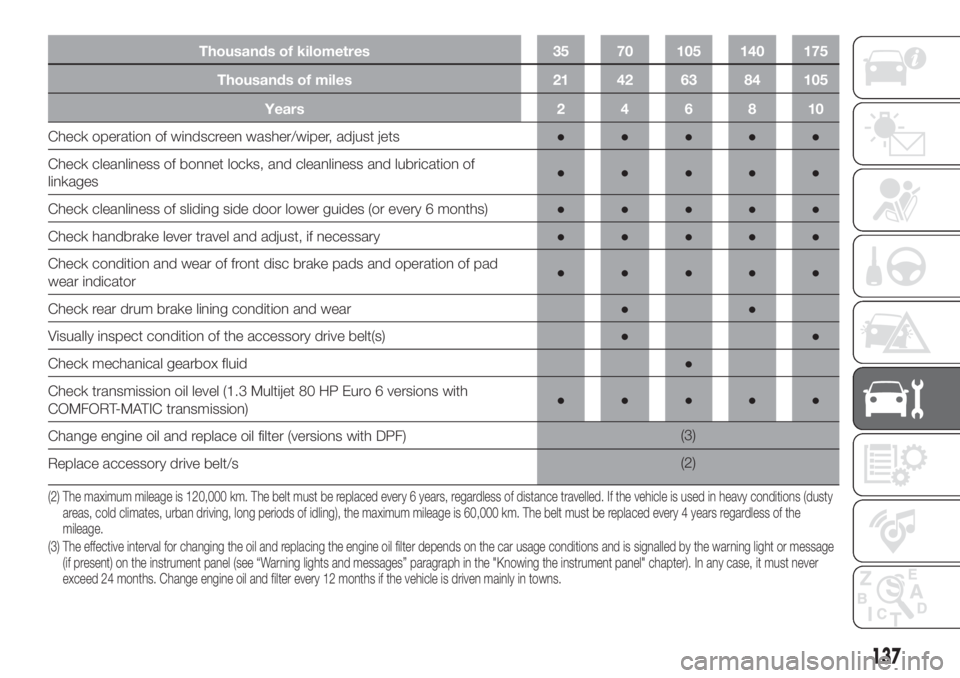
Thousands of kilometres 35 70 105 140 175
Thousands of miles 21 42 63 84 105
Years 2 4 6 8 10
Check operation of windscreen washer/wiper, adjust jets●●●●●
Check cleanliness of bonnet locks, and cleanliness and lubrication of
linkages●●●●●
Check cleanliness of sliding side door lower guides (or every 6 months)●●●●●
Check handbrake lever travel and adjust, if necessary●●●●●
Check condition and wear of front disc brake pads and operation of pad
wear indicator●●●●●
Check rear drum brake lining condition and wear●●
Visually inspect condition of the accessory drive belt(s)●●
Check mechanical gearbox fluid●
Check transmission oil level (1.3 Multijet 80 HP Euro 6 versions with
COMFORT-MATIC transmission)●●●●●
Change engine oil and replace oil filter (versions with DPF)(3)
Replace accessory drive belt/s(2)
(2) The maximum mileage is 120,000 km. The belt must be replaced every 6 years, regardless of distance travelled. If the vehicle is used in heavy conditions (dusty
areas, cold climates, urban driving, long periods of idling), the maximum mileage is 60,000 km. The belt must be replaced every 4 years regardless of the
mileage.
(3) The effective interval for changing the oil and replacing the engine oil filter depends on the car usage conditions and is signalled by the warning light or message
(if present) on the instrument panel (see “Warning lights and messages” paragraph in the "Knowing the instrument panel" chapter). In any case, it mustnever
exceed 24 months. Change engine oil and filter every 12 months if the vehicle is driven mainly in towns.
137