spare wheel FIAT FIORINO 2018 Owner handbook (in English)
[x] Cancel search | Manufacturer: FIAT, Model Year: 2018, Model line: FIORINO, Model: FIAT FIORINO 2018Pages: 196, PDF Size: 4.99 MB
Page 109 of 196
HAZARD WARNING
LIGHTS
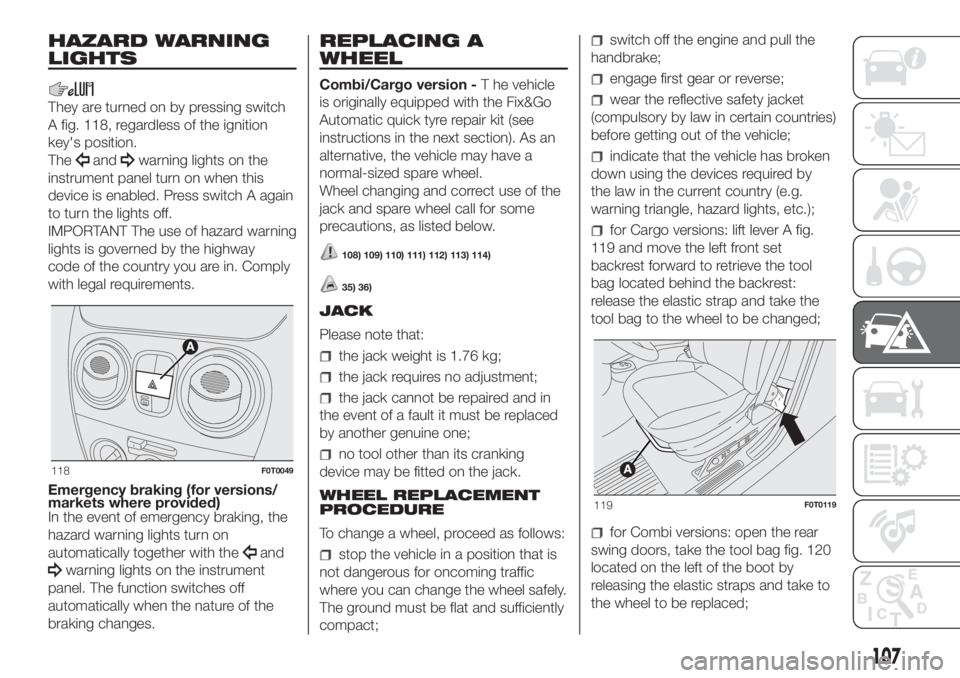
They are turned on by pressing switch
A fig. 118, regardless of the ignition
key's position.
The
andwarning lights on the
instrument panel turn on when this
device is enabled. Press switch A again
to turn the lights off.
IMPORTANT The use of hazard warning
lights is governed by the highway
code of the country you are in. Comply
with legal requirements.
Emergency braking (for versions/
markets where provided)
In the event of emergency braking, the
hazard warning lights turn on
automatically together with the
and
warning lights on the instrument
panel. The function switches off
automatically when the nature of the
braking changes.
REPLACING A
WHEEL
Combi/Cargo version -T he vehicle
is originally equipped with the Fix&Go
Automatic quick tyre repair kit (see
instructions in the next section). As an
alternative, the vehicle may have a
normal-sized spare wheel.
Wheel changing and correct use of the
jack and spare wheel call for some
precautions, as listed below.
108) 109) 110) 111) 112) 113) 114)
35) 36)
JACK
Please note that:
the jack weight is 1.76 kg;
the jack requires no adjustment;
the jack cannot be repaired and in
the event of a fault it must be replaced
by another genuine one;
no tool other than its cranking
device may be fitted on the jack.
WHEEL REPLACEMENT
PROCEDURE
To change a wheel, proceed as follows:
stop the vehicle in a position that is
not dangerous for oncoming traffic
where you can change the wheel safely.
The ground must be flat and sufficiently
compact;
switch off the engine and pull the
handbrake;
engage first gear or reverse;
wear the reflective safety jacket
(compulsory by law in certain countries)
before getting out of the vehicle;
indicate that the vehicle has broken
down using the devices required by
the law in the current country (e.g.
warning triangle, hazard lights, etc.);
for Cargo versions: lift lever A fig.
119 and move the left front set
backrest forward to retrieve the tool
bag located behind the backrest:
release the elastic strap and take the
tool bag to the wheel to be changed;
for Combi versions: open the rear
swing doors, take the tool bag fig. 120
located on the left of the boot by
releasing the elastic straps and take to
the wheel to be replaced;
118F0T0049
119F0T0119
107
Page 111 of 196
warn anybody nearby that the
vehicle is about to be lifted. They must
stay clear and not touch the vehicle
until it is back on the ground;
operate the jack and lift the vehicle
until the wheel is several centimetres off
the ground. When turning the crank,
ensure that it rotates freely in order
to avoid grazing your hands against the
ground. The moving components of
the jack (screws and joints) can also
cause injuries: avoid touching them. If
you come into contact with lubricating
grease, clean yourself thoroughly;
fully loosen the four fastening bolts
and remove the wheel;
make sure the contact surfaces
between spare wheel and hub are
clean so that the fastening bolts will not
come loose;
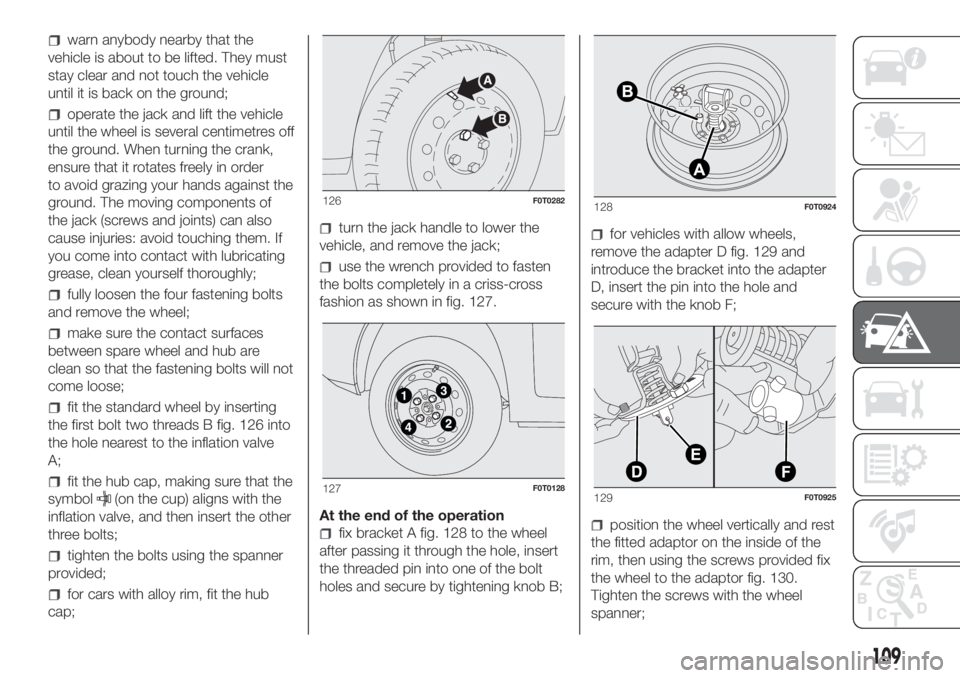
fit the standard wheel by inserting
the first bolt two threads B fig. 126 into
the hole nearest to the inflation valve
A;
fit the hub cap, making sure that the
symbol
(on the cup) aligns with the
inflation valve, and then insert the other
three bolts;
tighten the bolts using the spanner
provided;
for cars with alloy rim, fit the hub
cap;
turn the jack handle to lower the
vehicle, and remove the jack;
use the wrench provided to fasten
the bolts completely in a criss-cross
fashion as shown in fig. 127.
At the end of the operation
fix bracket A fig. 128 to the wheel
after passing it through the hole, insert
the threaded pin into one of the bolt
holes and secure by tightening knob B;
for vehicles with allow wheels,
remove the adapter D fig. 129 and
introduce the bracket into the adapter
D, insert the pin into the hole and
secure with the knob F;
position the wheel vertically and rest
the fitted adaptor on the inside of the
rim, then using the screws provided fix
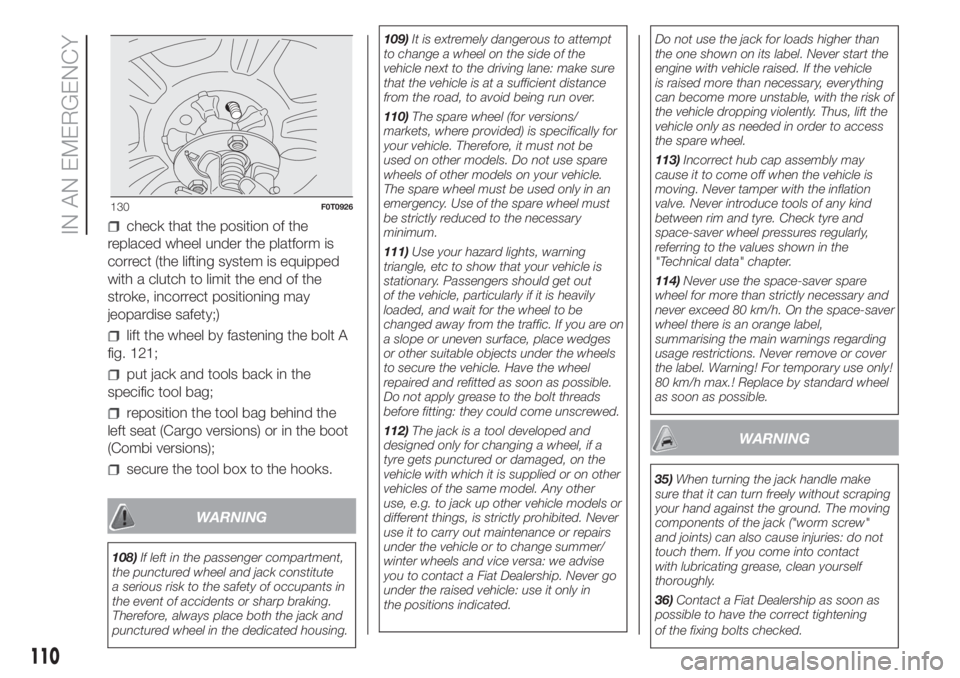
the wheel to the adaptor fig. 130.
Tighten the screws with the wheel
spanner;
126F0T0282
127F0T0128
128F0T0924
129F0T0925
109
Page 112 of 196
check that the position of the
replaced wheel under the platform is
correct (the lifting system is equipped
with a clutch to limit the end of the
stroke, incorrect positioning may
jeopardise safety;)
lift the wheel by fastening the bolt A
fig. 121;
put jack and tools back in the
specific tool bag;
reposition the tool bag behind the
left seat (Cargo versions) or in the boot
(Combi versions);
secure the tool box to the hooks.
WARNING
108)If left in the passenger compartment,
the punctured wheel and jack constitute
a serious risk to the safety of occupants in
the event of accidents or sharp braking.
Therefore, always place both the jack and
punctured wheel in the dedicated housing.109)It is extremely dangerous to attempt
to change a wheel on the side of the
vehicle next to the driving lane: make sure
that the vehicle is at a sufficient distance
from the road, to avoid being run over.
110)The spare wheel (for versions/
markets, where provided) is specifically for
your vehicle. Therefore, it must not be
used on other models. Do not use spare
wheels of other models on your vehicle.
The spare wheel must be used only in an
emergency. Use of the spare wheel must
be strictly reduced to the necessary
minimum.
111)Use your hazard lights, warning
triangle, etc to show that your vehicle is
stationary. Passengers should get out
of the vehicle, particularly if it is heavily
loaded, and wait for the wheel to be
changed away from the traffic. If you are on
a slope or uneven surface, place wedges
or other suitable objects under the wheels
to secure the vehicle. Have the wheel
repaired and refitted as soon as possible.
Do not apply grease to the bolt threads
before fitting: they could come unscrewed.
112)The jack is a tool developed and
designed only for changing a wheel, if a
tyre gets punctured or damaged, on the
vehicle with which it is supplied or on other
vehicles of the same model. Any other
use, e.g. to jack up other vehicle models or
different things, is strictly prohibited. Never
use it to carry out maintenance or repairs
under the vehicle or to change summer/
winter wheels and vice versa: we advise
you to contact a Fiat Dealership. Never go
under the raised vehicle: use it only in
the positions indicated.Do not use the jack for loads higher than
the one shown on its label. Never start the
engine with vehicle raised. If the vehicle
is raised more than necessary, everything
can become more unstable, with the risk of
the vehicle dropping violently. Thus, lift the
vehicle only as needed in order to access
the spare wheel.
113)Incorrect hub cap assembly may
cause it to come off when the vehicle is
moving. Never tamper with the inflation
valve. Never introduce tools of any kind
between rim and tyre. Check tyre and
space-saver wheel pressures regularly,
referring to the values shown in the
"Technical data" chapter.
114)Never use the space-saver spare
wheel for more than strictly necessary and
never exceed 80 km/h. On the space-saver
wheel there is an orange label,
summarising the main warnings regarding
usage restrictions. Never remove or cover
the label. Warning! For temporary use only!
80 km/h max.! Replace by standard wheel
as soon as possible.
WARNING
35)When turning the jack handle make
sure that it can turn freely without scraping
your hand against the ground. The moving
components of the jack ("worm screw"
and joints) can also cause injuries: do not
touch them. If you come into contact
with lubricating grease, clean yourself
thoroughly.
36)Contact a Fiat Dealership as soon as
possible to have the correct tightening
of the fixing bolts checked.
130F0T0926
110
IN AN EMERGENCY
Page 150 of 196
WHEELS AND TYRES
RIMS AND TYRES
For the type of wheel rims and tyres
fitted on the vehicle see the "Wheels"
paragraph in the "Technical data"
chapter.
IMPORTANT NOTES
As far as possible, avoid sharp
braking, screech starts and violent
shocks against pavements, potholes or
other hard obstacles. Driving for long
stretches over uneven roads can
damage the tyres;
periodically check that the tyres
have no cuts in the side wall, abnormal
swelling or irregular tyre tread wear.
Go to a Fiat Dealership if required;
avoid overloading the car when
travelling: this may cause serious
damage to the wheels and tyres;
if a tyre is punctured, stop
immediately and replace it to avoid
damage to the tyre, the rim, suspension
and steering system;
tyres age even if they are not used
much. Cracks in the tread and on
the sidewalls are a sign of ageing. In
any event, have the tyres checked
by specialised technicians if they have
been fitted for longer than 6 years.
Remember to check the spare wheel
very carefully;
in the case of replacement, always
fit new tyres, avoiding those of
unknown origin;
if a tyre is changed, also change the
inflation valve;
to allow even wear between the
front and rear tyres, it is advisable to
change them over every 10–15
thousand kilometres, keeping them on
the same side of the vehicle so as
not to reverse the direction of rotation.
147) 148) 149) 150)
SNOW CHAINS
The use of snow chains should be in
compliance with local regulations of
each country. The snow chains may be
applied only onto the front wheel (drive
wheels). Check the tension of the
snow chains after the first few metres
have been driven.
151)
WARNING
147)Remember that the road holding
qualities of your vehicle also depend on the
correct inflation pressure of the tyres.
148)If tyre pressure is too low, the tyre
may overheat and be severely damaged as
a result.
149)Do not switch tyres from the
righthand side of the vehicle to the
lefthand side, and vice versa.
150)Never submit alloy rims to repainting
treatments requiring the use of
temperatures exceeding 150°C. The
mechanical properties of the wheels could
be impaired.
151)Keep the vehicle's speed down when
snow chains are fitted; never exceed 50
km/h. Avoid potholes, do not drive over
steps or pavements, and do not drive long
distances over roads without snow, to
avoid damaging both your vehicle and the
road surface.
148
SERVICING AND CARE
Page 156 of 196
WHEELS
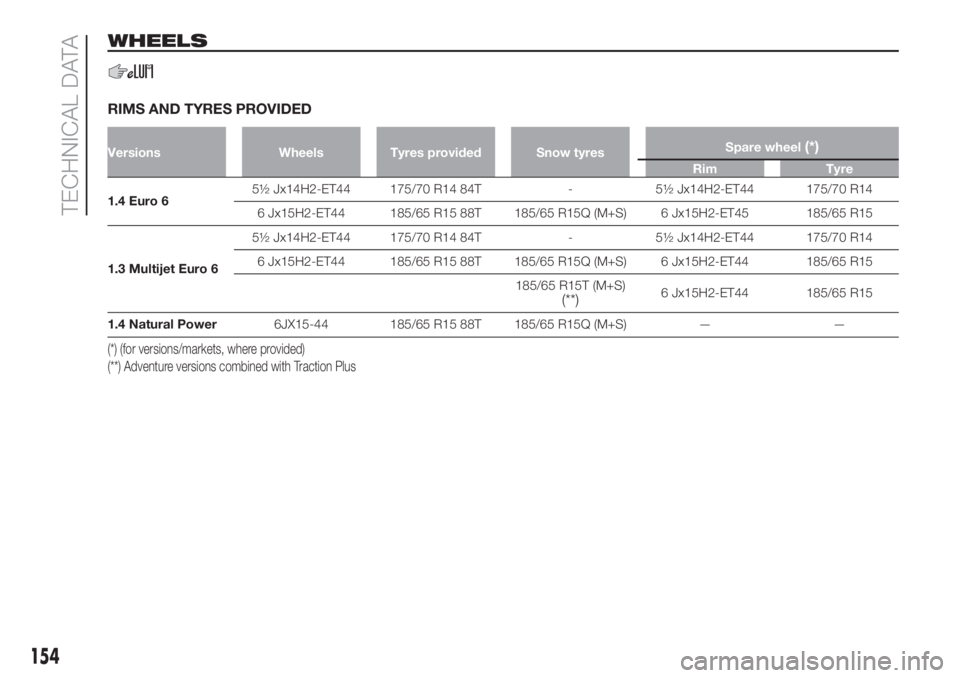
RIMS AND TYRES PROVIDED
Versions Wheels Tyres provided Snow tyresSpare wheel(*)
Rim Tyre
1.4 Euro 65½ Jx14H2-ET44 175/70 R14 84T - 5½ Jx14H2-ET44 175/70 R14
6 Jx15H2-ET44 185/65 R15 88T 185/65 R15Q (M+S) 6 Jx15H2-ET45 185/65 R15
1.3 Multijet Euro 65½ Jx14H2-ET44 175/70 R14 84T - 5½ Jx14H2-ET44 175/70 R14
6 Jx15H2-ET44 185/65 R15 88T 185/65 R15Q (M+S) 6 Jx15H2-ET44 185/65 R15
185/65 R15T (M+S)
(**)6 Jx15H2-ET44 185/65 R15
1.4 Natural Power6JX15-44 185/65 R15 88T 185/65 R15Q (M+S) — —
(*) (for versions/markets, where provided)
(**) Adventure versions combined with Traction Plus
154
TECHNICAL DATA
Page 157 of 196
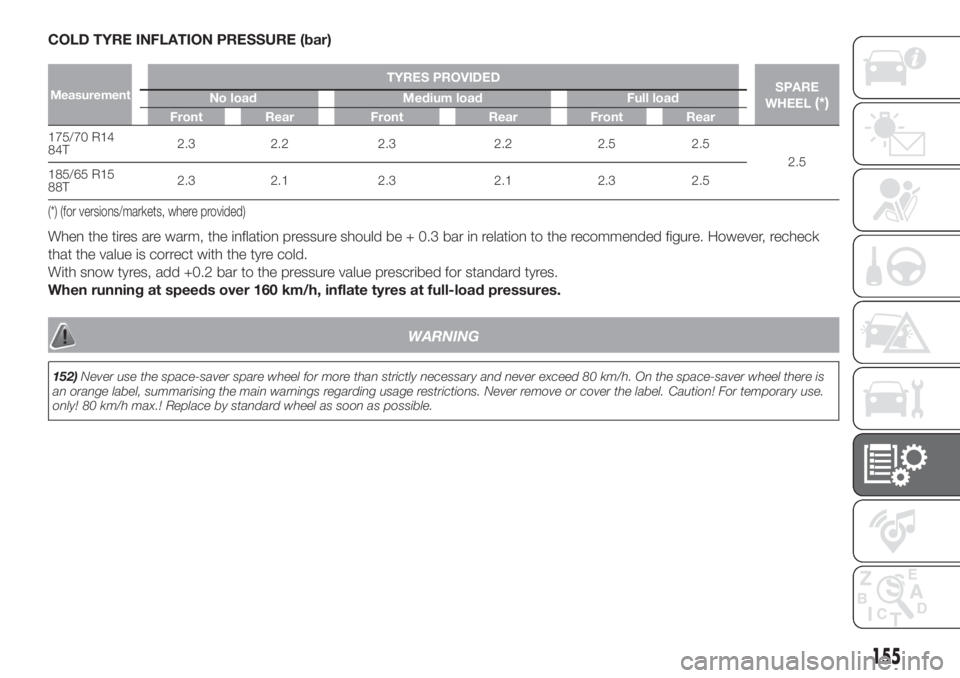
COLD TYRE INFLATION PRESSURE (bar)
Measurement
TYRES PROVIDED
SPARE
WHEEL
(*)No load Medium load Full load
Front Rear Front Rear Front Rear
175/70 R14
84T2.3 2.2 2.3 2.2 2.5 2.5
2.5
185/65 R15
88T2.3 2.1 2.3 2.1 2.3 2.5
(*) (for versions/markets, where provided)
When the tires are warm, the inflation pressure should be + 0.3 bar in relation to the recommended figure. However, recheck
that the value is correct with the tyre cold.
With snow tyres, add +0.2 bar to the pressure value prescribed for standard tyres.
When running at speeds over 160 km/h, inflate tyres at full-load pressures.
WARNING
152)Never use the space-saver spare wheel for more than strictly necessary and never exceed 80 km/h. On the space-saver wheel there is
an orange label, summarising the main warnings regarding usage restrictions. Never remove or cover the label.
only! 80 km/h max.! Replace by standard wheel as soon as possible.
155
Caution! For temporary use.