air conditioning FIAT FREEMONT 2012 Owner handbook (in English)
[x] Cancel search | Manufacturer: FIAT, Model Year: 2012, Model line: FREEMONT, Model: FIAT FREEMONT 2012Pages: 332, PDF Size: 5.61 MB
Page 14 of 332
The gauge pointer will likely indicate a high tempera-
ture when driving in hot weather, up mountain grades,
in heavy traffic, or when towing a trailer. If the pointer
rises to the “H” mark, safely pull over and stop the
vehicle. If the Air Conditioning A/C system is on, turn
it off. Also, shift the transmission into NEUTRAL and
idle the vehicle. If the needle remains on the “H” mark,
turn the engine OFF immediately and call for service.
Do not leave your vehicle unattended
with the engine running, as you would not
be able to react to the temperature indi-
cator light if the engine overheats. A WORD ABOUT YOUR KEYS
Your vehicle uses a keyless ignition system. This system
consists of a Key Fob with Remote Keyless Entry (RKE)
transmitter and a Keyless Ignition Node (KIN).
Keyless Enter-N-Go Feature
This vehicle is equipped with the Keyless Enter-N-Go
feature, refer to “Starting Procedure” in “Starting And
Driving” for further information.
KEYLESS IGNITION NODE (KIN)
This feature allows the driver to operate the ignition
switch with the push of a button, as long as the Remote
Keyless Entry (RKE) transmitter is in the passenger
compartment.
The Keyless Ignition Node (KIN) has four operating
positions, three of which are labeled and will illuminate
when in position. The three positions are OFF, ACC,
and ON/RUN. The fourth position is START, during
start RUN will illuminate.
NOTE:
In case the ignition switch does not change
with the push of a button, the RKE transmitter (Key
Fob) may have a low or dead battery. In this situation a
back up method can be used to operate the ignition
switch. Put the nose side (side opposite of the emer-
gency key) of the Key Fob against the ENGINE START/
STOP button and push to operate the ignition switch.
(fig. 4)
8
KNOWING YOUR
VEHICLE
SAFETY
STARTING AND
DRIVING
WARNING LIGHTSAND
MESSAGES
IN AN
EMERGENCY
SERVICING AND
CARETECHNICAL
SPECIFICATIONSCONTENTS
Page 65 of 332
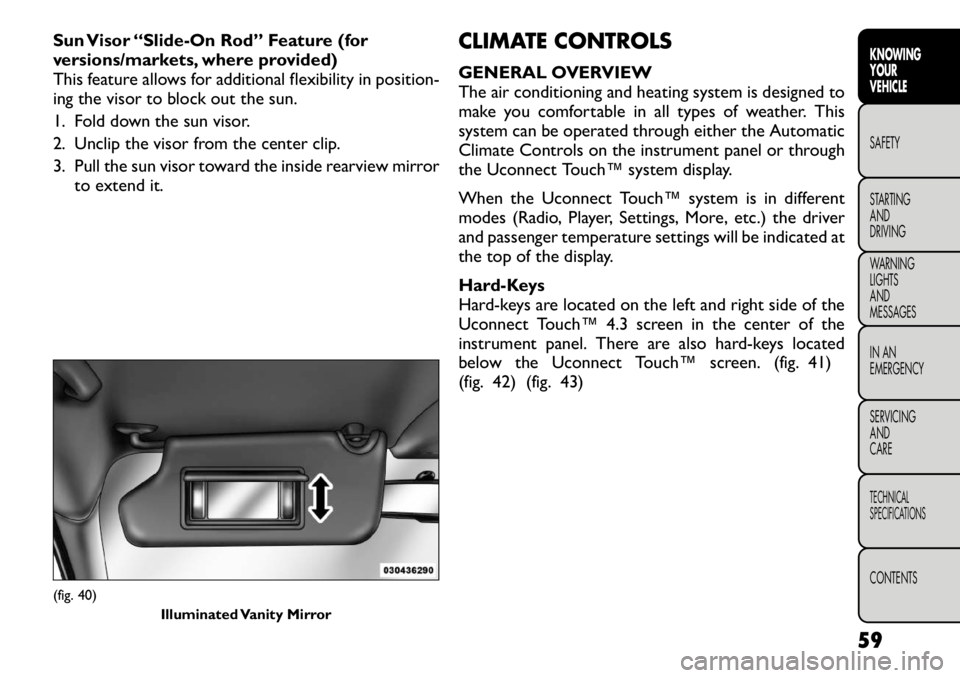
Sun Visor “Slide-On Rod” Feature (for
versions/markets, where provided)
This feature allows for additional flexibility in position-
ing the visor to block out the sun.
1. Fold down the sun visor.
2. Unclip the visor from the center clip.
3. Pull the sun visor toward the inside rearview mirrorto extend it. CLIMATE CONTROLS
GENERAL OVERVIEW
The air conditioning and heating system is designed to
make you comfortable in all types of weather. This
system can be operated through either the Automatic
Climate Controls on the instrument panel or through
the Uconnect Touch™ system display.
When the Uconnect Touch™ system is in different
modes (Radio, Player, Settings, More, etc.) the driver
and passenger temperature settings will be indicated at
the top of the display.
Hard-Keys
Hard-keys are located on the left and right side of the
Uconnect Touch™ 4.3 screen in the center of the
instrument panel. There are also hard-keys located
below the Uconnect Touch™ screen. (fig. 41)
(fig. 42) (fig. 43)(fig. 40)
Illuminated Vanity Mirror
59
KNOWING
YOURVEHICLESAFETY
STARTING ANDDRIVING
WARNING LIGHTSAND
MESSAGES
IN AN
EMERGENCY
SERVICING AND
CARETECHNICAL
SPECIFICATIONSCONTENTS
Page 70 of 332
Defrost Mode
Air comes from the windshield and side window
demist outlets. Use Defrost mode with maxi-
mum temperature settings for best windshield and side
window defrosting and defogging. When the Defrost
mode is selected, the blower level may increase.
13. SYNC
Press the Sync soft-key to toggle the Sync feature
On/Off. The Sync indicator is illuminated when this
feature is enabled. Sync is used to synchronize the
passenger and rear temperature setting with the driver
temperature setting. Changing the passenger tempera-
ture setting while in Sync will automatically exit this
feature.
NOTE: When SYNC is ON and the driver selects
Mix or Defrost Mode, Rear mode will be Floor.
14. Temperature Control (Manual Temperature
Control Only)
Press the temperature soft-key to regulate the tem-
perature of the air inside the passenger compartment.
Moving the temperature bar into the red area, indicates
warmer temperatures. Moving the temperature bar
into the blue area indicates cooler temperatures.
CLIMATE CONTROL FUNCTIONS
A/C (Air Conditioning)
The Air Conditioning (A/C) button allows the opera-
tor to manually activate or deactivate the air condition-
ing system. When the air conditioning system is turned on, cool dehumidified air will flow through the outlets
into the cabin. For improved fuel economy, press the
A/C button to turn off the air conditioning and manu-
ally adjust the blower and airflow mode settings.
NOTE:
• For Manual Climate Controls, if the system is in Mix
or Defrost Mode, the A/C can be turned off.
• If fog or mist appears on the windshield or side glass,
select Defrost mode and increase blower speed.
• If your air conditioning performance seems lower
than expected, check the front of the A/C condenser
(located in front of the radiator), for an accumulation of
dirt or insects. Clean with a gentle water spray from
behind the radiator and through the condenser. Fabric
front fascia protectors may reduce airflow to the con-
denser, reducing air conditioning performance.
Recirculation Control
When outside air contains smoke, odors, or
high humidity, or if rapid cooling is desired,
you may wish to recirculate interior air by
pressing the Recirculation control button.
The recirculation indicator will illuminate when this
button is selected. Push the button a second time to
turn off the Recirculation mode and allow outside air
into the vehicle.
64
KNOWING YOUR
VEHICLE
SAFETY
STARTING AND
DRIVING
WARNING LIGHTSAND
MESSAGES
IN AN
EMERGENCY
SERVICING AND
CARETECHNICAL
SPECIFICATIONSCONTENTS
Page 74 of 332
temperature. The rear temperature settings are dis-
played in the Uconnect Touch™ system.
When rear controls are locked by the Uconnect
Touch™ system , the Rear Temperature Lock symbol
on the temperature knob is illuminated and any rear
overhead adjustments are ignored.
REAR MODE CONTROL
Auto Mode
The rear system automatically maintains the correct
mode and comfort level desired by the rear seat occu-pants.
Headliner ModeAir comes from the outlets in the headliner. Each
of these outlets can be individually adjusted to
direct the flow of air. Moving the air vanes of the
outlets to one side will shut off the airflow.
Bi-Level Mode
Air comes from both the headliner outlets and
the floor outlets.
NOTE: In many temperature positions, the BI-LEVEL
mode is designed to provide cooler air out of the
headliner outlets and warmer air from the floor out-lets.
Floor Mode Air comes from the floor outlets. OPERATING TIPS
NOTE:
Refer to the chart at the end of this section
for suggested control settings for various weather conditions.
Summer Operation
The engine cooling system in air-conditioned vehicles
must be protected with a high-quality antifreeze cool-
ant to provide proper corrosion protection and to
protect against engine overheating. A solution of 50%
ethylene glycol antifreeze coolant and 50% water is
recommended. Refer to “Maintenance Procedures” in
“Servicing And Care” for proper coolant selection.
Winter Operation
Use of the air Recirculation mode during Winter
months is not recommended because it may cause
window fogging.
Vacation Storage
Any time you store your vehicle or keep it out of
service (i.e., vacation) for two weeks or more, run the
air conditioning system at idle for about five minutes in
the fresh air and high blower setting. This will ensure
adequate system lubrication to minimize the possibility
of compressor damage when the system is started
again.
68
KNOWING YOUR
VEHICLE
SAFETY
STARTING AND
DRIVING
WARNING LIGHTSAND
MESSAGES
IN AN
EMERGENCY
SERVICING AND
CARETECHNICAL
SPECIFICATIONSCONTENTS
Page 227 of 332
Automatic Transmission (for versions/markets,
where provided)
The DRIVE range can be selected when towing. How-
ever, if frequent shifting occurs while in this range,
select a lower gear (using the AutoStick
®
shift con-
trol).
NOTE: Using a lower gear while operating the ve-
hicle under heavy operating conditions will improve
performance and extend transmission life by reducing
excessive shifting and heat build up. This action will also
provide better engine braking.
If you REGULARLY tow a trailer for more than 45 min-
utes of continuous operation, then change the trans-
mission fluid and automatic transmission filter accord-
ing to the interval specified for “police, taxi, fleet, or
frequent trailer towing.” Refer to the “Maintenance
Schedule” for the proper maintenance intervals.
Electronic Speed Control (for versions/
markets, where provided)
Do not use in hilly terrain or with heavy loads.
When using the speed control, if you experience speed drops greater than 16 km/h, disengage until you can get
back to cruising speed.
Use speed control in flat terrain and with light loads to maximize fuel efficiency.
AutoStick
®
By using the AutoStick
®shift control to select a specific
gear, frequent shifting can be avoided. Select the highest
gear that allows for adequate performance. For example,
choose “4” if the desired speed can be maintained.
Choose “3” or “2” if needed to maintain the desiredspeed.
Extended driving at high RPM should be avoided to pr e-
vent excess heat generation. A reduction in vehicle speed
may be required to avoid extended driving at high RPM.
Return to a higher gear or vehicle speed when road
conditions and RPM level allows.
Cooling System
To reduce potential for engine and transmission over-
heating, take the following actions: City DrivingWhen stopped for short periods, shift the transmission
into NEUTRAL and increase engine idle speed. Highway DrivingReduce speed. Air ConditioningTurn off temporarily.
TRAILER HITCH ATTACHING POINTS
Your vehicle will require extra equipment to tow a
trailer safely and efficiently. The trailer tow hitch must
be attached to your vehicle using the provided attach-
ing points on the vehicle's frame. Refer to the following
221
KNOWING
YOURVEHICLE SAFETYSTARTING ANDDRIVINGWARNING LIGHTSAND
MESSAGES
IN AN
EMERGENCY
SERVICING AND
CARETECHNICAL
SPECIFICATIONSCONTENTS
Page 278 of 332
MAINTENANCE PROCEDURES
The pages that follow contain therequiredmainte-
nance services determined by the engineers who de-
signed your vehicle.
Besides those maintenance items specified in the fixed
maintenance schedule, there are other components
which may require servicing or replacement in the
future.
Failure to properly maintain your ve-
hicle or perform repairs and service when
necessary could result in more costly re-
pairs, damage to other components or negatively
impact vehicle performance. Immediately have
potential malfunctions examined by an autho-
rized dealership or qualified repair center.
Your vehicle has been built with improved fluids
that protect the performance and durability of
your vehicle and also allow extended mainte-
nance intervals. Do not use chemical flushes in
these components as the chemicals can damage
your engine, transmission, power steering or air
conditioning. Such damage is not covered by the
New Vehicle Limited Warranty. If a flush is needed
because of component malfunction, use only the
specified fluid for the flushing procedure. ENGINE OIL
Checking Oil Level – Gasoline Engine
To assure proper engine lubrication, the engine oil
must be maintained at the correct level. Check the oil
level at regular intervals, such as every fuel stop.
The best time to check the engine oil level is about five
minutes after a fully warmed engine is shut off. Do not
check oil level before starting the engine after it has sat
overnight. Checking engine oil level when the engine is
cold will give you an incorrect reading.
Checking the oil while the vehicle is on level ground
and only when the engine is hot, will improve the
accuracy of the oil level readings. Maintain the oil level
between the range markings on the dipstick. Either the
range markings consist of a crosshatch zone marked
SAFE or a crosshatch zone marked with MIN at the low
end of the range and MAX at the high end of the range.
Adding 1 Liter of oil when the reading is at the low end
of the range marking will raise the oil level to the high
end of the range marking.
Do not overfill the engine. Overfilling the
engine will cause oil aeration, which can
lead to loss of oil pressure and an in-
crease in oil temperature.This could damage your
engine.Also, be sure the oil fill cap is replaced and
tightened after adding oil.
272
KNOWING YOUR
VEHICLE
SAFETY
STARTING AND
DRIVING
WARNING LIGHTSAND
MESSAGES
IN AN
EMERGENCYSERVICING AND
CARETECHNICAL
SPECIFICATIONSCONTENTS
Page 281 of 332
It is essential when replacing the cables
on the battery that the positive cable is
attached to the positive post and the
negative cable is attached to the negative post .
Battery posts are marked positive (+) and nega-
tive (-) and identified on the battery case. Cable
clamps should be tight on the terminal posts and
free of corrosion.
If a “fast charger ” is used while the battery is in
the vehicle, disconnect both vehicle battery cables
before connecting the charger to the battery. Do
not use a “fast charger ” to provide starting volt-
age as battery damage can result .
AIR CONDITIONER MAINTENANCE
For best possible performance, your air conditioner
should be checked and serviced by an authorized
dealer at the start of each warm season. This service
should include cleaning of the condenser fins and a
performance test. Drive belt tension should also be
checked at this time.Do not use chemical flushes in your air
conditioning system as the chemicals can
damage your air conditioning compo-
nents. Such damage is not covered by the New
Vehicle Limited Warranty.
WARNING!
Use only refrigerants and compressor
lubricants approved by the manufac-
turer for your air conditioning system. Some un-
approved refrigerants are flammable and can
explode, injuring you. Other unapproved refrig-
erants or lubricants can cause the system to fail,
requiring costly repairs.
The air conditioning system contains refriger-
ant under high pressure.To avoid risk of personal
injury or damage to the system, adding refriger-
ant or any repair requiring lines to be discon-
nected should be done by an experienced
technician.
Refrigerant Recovery And Recycling
R-134a Air Conditioning Refrigerant is a hydrofluoro-
carbon (HFC) that is endorsed by the Environmental
Protection Agency and is an ozone-saving product.
However, the manufacturer recommends that air con-
ditioning service be performed by authorized dealers
or other service facilities using recovery and recyclingequipment.
NOTE: Use only manufacturer approved A/C system
sealers, stop leak products, seal conditioners, com-
pressor oil, and refrigerants.
275
KNOWING
YOURVEHICLE SAFETY
STARTING ANDDRIVING
WARNING LIGHTSAND
MESSAGES
IN AN
EMERGENCYSERVICING AND
CARETECHNICAL
SPECIFICATIONSCONTENTS
Page 289 of 332
(Continued)
Do not use a pressure cap other than the one
specified for your vehicle. Personal injury or en-
gine damage may result .
Disposal Of Used Coolant
Used ethylene glycol-based engine coolant is a regu-
lated substance requiring proper disposal. Check with
your local authorities to determine the disposal rules
for your community. To prevent ingestion by animals or
children, do not store ethylene glycol-based engine
coolant in open containers or allow it to remain in
puddles on the ground. If ingested by a child, contact a
physician immediately. Clean up any ground spills
immediately.
Coolant Level
The radiator normally remains completely full, so there
is no need to remove the radiator cap unless checking
for coolant freeze point or replacing coolant. Advise
your service attendant of this. As long as the engine
operating temperature is satisfactory, the coolant
bottle need only be checked once a month. When
additional coolant is needed to maintain the proper
level, it should be added to the coolant bottle. Do not
overfill.
Points To Remember
NOTE: When the vehicle is stopped after a few
kilometers of operation, you may observe vapor com- ing from the front of the engine compartment. This is
normally a result of moisture from rain, snow, or high
humidity accumulating on the radiator and being vapor-
ized when the thermostat opens, allowing hot coolant
to enter the radiator.
If an examination of your engine compartment shows
no evidence of radiator or hose leaks, the vehicle may
be safely driven. The vapor will soon dissipate.
• Do not overfill the coolant recovery bottle.
• Check coolant freeze point in the radiator and in the
coolant recovery bottle. If antifreeze needs to be
added, contents of coolant recovery bottle must also
be protected against freezing.
• If frequent coolant additions are required, or if the level in the coolant recovery bottle does not drop
when the engine cools, the cooling system should be
pressure tested for leaks.
• Make sure that the radiator and coolant recovery bottle overflow hoses are not kinked or obstructed.
• Keep the front of the radiator clean. If your vehicle is equipped with air conditioning, keep the front of the
condenser clean.
• Do not change the thermostat for Summer or Win- ter operation. If replacement is ever necessary, install
ONLY the correct type thermostat. Other designs
may result in unsatisfactory coolant performance,
poor gas mileage, and increased emissions.
283
KNOWING
YOURVEHICLE SAFETY
STARTING ANDDRIVING
WARNING LIGHTSAND
MESSAGES
IN AN
EMERGENCYSERVICING AND
CARETECHNICAL
SPECIFICATIONSCONTENTS
Page 313 of 332
CONTENTS
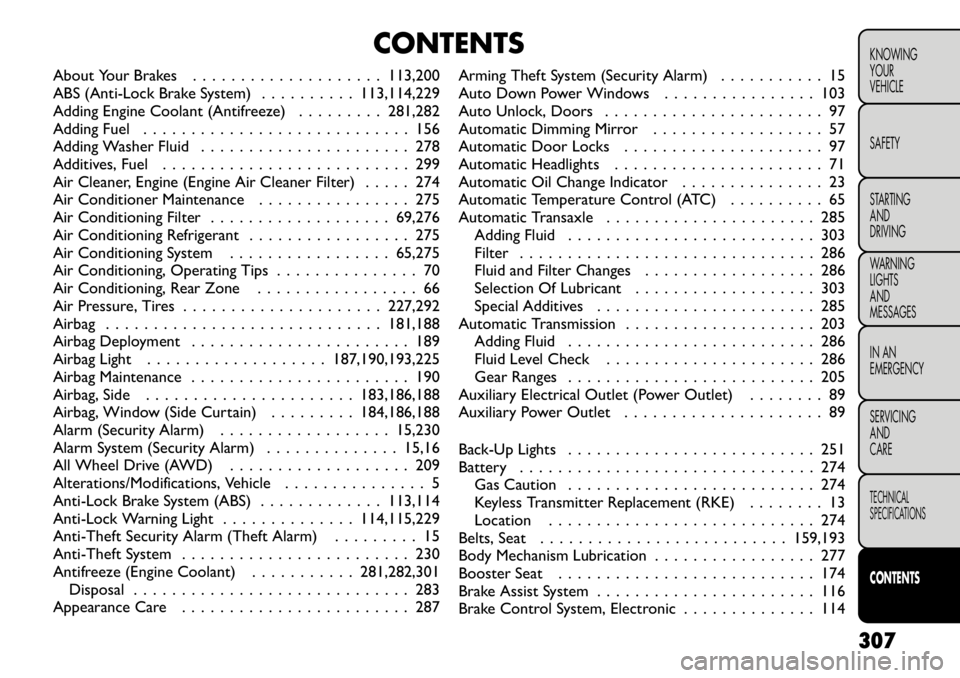
About Your Brakes . . . . . . . . . . . . . . . . . . . . 113,200
ABS (Anti-Lock Brake System) . . . . . . . . . . 113,114,229
Adding Engine Coolant (Antifreeze) . . . . . . . . . 281,282
Adding Fuel . . . . . . . . . . . . . . . . . . . . . . . . . . . . 156
Adding Washer Fluid . . . . . . . . . . . . . . . . . . . . . . 278
Additives, Fuel . . . . . . . . . . . . . . . . . . . . . . . . . . 299
Air Cleaner, Engine (Engine Air Cleaner Filter) . . . . . 274
Air Conditioner Maintenance . . . . . . . . . . . . . . . . 275
Air Conditioning Filter . . . . . . . . . . . . . . . . . . . 69,276
Air Conditioning Refrigerant . . . . . . . . . . . . . . . . . 275
Air Conditioning System . . . . . . . . . . . . . . . . . 65,275
Air Conditioning, Operating Tips . . . . . . . . . . . . . . . 70
Air Conditioning, Rear Zone . . . . . . . . . . . . . . . . . 66
Air Pressure, Tires . . . . . . . . . . . . . . . . . . . . . 227,292
Airbag . . . . . . . . . . . . . . . . . . . . . . . . . . . . . 181,188
Airbag Deployment . . . . . . . . . . . . . . . . . . . . . . . 189
Airbag Light . . . . . . . . . . . . . . . . . . . 187,190,193,225
Airbag Maintenance . . . . . . . . . . . . . . . . . . . . . . . 190
Airbag, Side . . . . . . . . . . . . . . . . . . . . . . 183,186,188
Airbag, Window (Side Curtain) . . . . . . . . . 184,186,188
Alarm (Security Alarm) . . . . . . . . . . . . . . . . . . 15,230
Alarm System (Security Alarm) . . . . . . . . . . . . . . 15,16
All Wheel Drive (AWD) . . . . . . . . . . . . . . . . . . . 209
Alterations/Modifications, Vehicle . . . . . . . . . . . . . . . 5
Anti-Lock Brake System (ABS) . . . . . . . . . . . . . 113,114
Anti-Lock Warning Light . . . . . . . . . . . . . . 114,115,229
Anti-Theft Security Alarm (Theft Alarm) . . . . . . . . . 15
Anti-Theft System . . . . . . . . . . . . . . . . . . . . . . . . 230
Antifreeze (Engine Coolant) . . . . . . . . . . . 281,282,301 Disposal . . . . . . . . . . . . . . . . . . . . . . . . . . . . . 283
Appearance Care . . . . . . . . . . . . . . . . . . . . . . . . 287 Arming Theft System (Security Alarm) . . . . . . . . . . . 15
Auto Down Power Windows . . . . . . . . . . . . . . . . 103
Auto Unlock, Doors . . . . . . . . . . . . . . . . . . . . . . . 97
Automatic Dimming Mirror . . . . . . . . . . . . . . . . . . 57
Automatic Door Locks . . . . . . . . . . . . . . . . . . . . . 97
Automatic Headlights . . . . . . . . . . . . . . . . . . . . . . 71
Automatic Oil Change Indicator . . . . . . . . . . . . . . . 23
Automatic Temperature Control (ATC) . . . . . . . . . . 65
Automatic Transaxle . . . . . . . . . . . . . . . . . . . . . . 285
Adding Fluid . . . . . . . . . . . . . . . . . . . . . . . . . . 303
Filter . . . . . . . . . . . . . . . . . . . . . . . . . . . . . . . 286
Fluid and Filter Changes . . . . . . . . . . . . . . . . . . 286
Selection Of Lubricant . . . . . . . . . . . . . . . . . . . 303
Special Additives . . . . . . . . . . . . . . . . . . . . . . . 285
Automatic Transmission . . . . . . . . . . . . . . . . . . . . 203 Adding Fluid . . . . . . . . . . . . . . . . . . . . . . . . . . 286
Fluid Level Check . . . . . . . . . . . . . . . . . . . . . . 286
Gear Ranges . . . . . . . . . . . . . . . . . . . . . . . . . . 205
Auxiliary Electrical Outlet (Power Outlet) . . . . . . . . 89
Auxiliary Power Outlet . . . . . . . . . . . . . . . . . . . . . 89
Back-Up Lights . . . . . . . . . . . . . . . . . . . . . . . . . . 251
Battery . . . . . . . . . . . . . . . . . . . . . . . . . . . . . . . 274 Gas Caution . . . . . . . . . . . . . . . . . . . . . . . . . . 274
Keyless Transmitter Replacement (RKE) . . . . . . . . 13
Location . . . . . . . . . . . . . . . . . . . . . . . . . . . . 274
Belts, Seat . . . . . . . . . . . . . . . . . . . . . . . . . . 159,193
Body Mechanism Lubrication . . . . . . . . . . . . . . . . . 277
Booster Seat . . . . . . . . . . . . . . . . . . . . . . . . . . . 174
Brake Assist System . . . . . . . . . . . . . . . . . . . . . . . 116
Brake Control System, Electronic . . . . . . . . . . . . . . 114
307
KNOWING
YOURVEHICLE SAFETY
STARTING ANDDRIVING
WARNING LIGHTSAND
MESSAGES
IN AN
EMERGENCY
SERVICING AND
CARETECHNICAL
SPECIFICATIONSCONTENTS
Page 316 of 332
Exhaust Gas Caution . . . . . . . . . . . . . . . . . 106,192
Fails to Start . . . . . . . . . . . . . . . . . . . . . . . . . . 197
Flooded, Starting . . . . . . . . . . . . . . . . . . . . . . . 197
Fuel Requirements . . . . . . . . . . . . . . . . . . . . . . 298
Jump Starting . . . . . . . . . . . . . . . . . . . . . . . . . 231
Oil . . . . . . . . . . . . . . . . . . . . . . . . . . 272,301,302
Oil Change Interval . . . . . . . . . . . . . . . . . . . 23,273
Oil Filler Cap . . . . . . . . . . . . . . . . . . . . . . 271,273
Oil Filter Disposal . . . . . . . . . . . . . . . . . . . . . . 273
Oil Selection . . . . . . . . . . . . . . . . . . . . . . . . . . 301
Operation . . . . . . . . . . . . . . . . . . . . . . . . . . . 195
Starting . . . . . . . . . . . . . . . . . . . . . . . . . . . . . 195
Temperature Gauge . . . . . . . . . . . . . . . . . . . . . . . 7
Engine Oil Viscosity . . . . . . . . . . . . . . . . . . . . . . . 273
Engine Oil Viscosity Chart . . . . . . . . . . . . . . . . . . 273
Enhanced Accident Response Feature . . . . . . . . . . . 188
Entry System, Illuminated . . . . . . . . . . . . . . . . . . . . 75
Ethanol . . . . . . . . . . . . . . . . . . . . . . . . . . . . . . . 298
Event Data Recorder . . . . . . . . . . . . . . . . . . . . . . 191
Exhaust Gas Caution . . . . . . . . . . . . . . . . 106,192,279
Exhaust System . . . . . . . . . . . . . . . . . . . . . . . 192,279
Exterior Folding Mirrors . . . . . . . . . . . . . . . . . . . . 58
Exterior Light Service . . . . . . . . . . . . . . . . . . . . . 249
Exterior Lighting . . . . . . . . . . . . . . . . . . . . . . . . . 71
Exterior Lights . . . . . . . . . . . . . . . . . . . . . . . 194,249
Fabric Care . . . . . . . . . . . . . . . . . . . . . . . . . . . . 289
Filler Location Fuel . . . . . . . . . . . . . . . . . . . . . . . 156
Filters Air Cleaner . . . . . . . . . . . . . . . . . . . . . . . . . . 274
Air Conditioning . . . . . . . . . . . . . . . . . . . . . 69,276
Automatic Transaxle . . . . . . . . . . . . . . . . . . . . 286
Engine Oil . . . . . . . . . . . . . . . . . . . . . . . . . . . 302 Engine Oil Disposal . . . . . . . . . . . . . . . . . . . . . 273
Flash-To-Pass . . . . . . . . . . . . . . . . . . . . . . . . . . . . 73Flashers Hazard Warning . . . . . . . . . . . . . . . . . . . . . . . . 85
Turn Signal . . . . . . . . . . . . . . . . . . . . . . 73,194,226
Flooded Engine Starting . . . . . . . . . . . . . . . . . . . . 197
Floor Console . . . . . . . . . . . . . . . . . . . . . . . . . . . 86
Fluid Capacities . . . . . . . . . . . . . . . . . . . . . . . . . 301
Fluid Leaks . . . . . . . . . . . . . . . . . . . . . . . . . . . . . 194
Fluid Level Checks Automatic Transmission . . . . . . . . . . . . . . . . . . 286
Brake . . . . . . . . . . . . . . . . . . . . . . . . . . . . 284,303
Cooling System . . . . . . . . . . . . . . . . . . . . . . . . 280
Engine Oil . . . . . . . . . . . . . . . . . . . . . . . . 272,273
Manual Transaxle . . . . . . . . . . . . . . . . . . . . . . . 286
Power Steering . . . . . . . . . . . . . . . . . . . . . 122,303
Fluid, Brake . . . . . . . . . . . . . . . . . . . . . . . . . . . . 303
Fluids . . . . . . . . . . . . . . . . . . . . . . . . . . . . . . . . 302
Fluids, Lubricants and Genuine Parts . . . . . . . . . . . 302
Fog Light Service . . . . . . . . . . . . . . . . . . . . . . 249,250
Fog Lights . . . . . . . . . . . . . . . . . . . . . 72,226,249,250
Fog Lights, Rear . . . . . . . . . . . . . . . . . . . . . . 230,250
Folding Rear Seat . . . . . . . . . . . . . . . . . . . . . . . 49,54
Freeing A Stuck Vehicle . . . . . . . . . . . . . . . . . . . . 259
Fuel . . . . . . . . . . . . . . . . . . . . . . . . . . . . . . 298,300 Adding . . . . . . . . . . . . . . . . . . . . . . . . . . . . . . 156
Additives . . . . . . . . . . . . . . . . . . . . . . . . . . . . 299
Conserving . . . . . . . . . . . . . . . . . . . . . . . . . . . 24
Diesel . . . . . . . . . . . . . . . . . . . . . . . . . . . 300,302
Ethanol . . . . . . . . . . . . . . . . . . . . . . . . . . . . . 298
Filler Cap (Gas Cap) . . . . . . . . . . . . . . . . . . . . . 156
Gasoline . . . . . . . . . . . . . . . . . . . . . . . . . . . . 298
Gauge . . . . . . . . . . . . . . . . . . . . . . . . . . . . . . . . 7
310
KNOWING YOUR
VEHICLE
SAFETY
STARTING AND
DRIVING
WARNING LIGHTSAND
MESSAGES
IN AN
EMERGENCY
SERVICING AND
CARETECHNICAL
SPECIFICATIONSCONTENTS