seats FIAT FREEMONT 2013 Owner handbook (in English)
[x] Cancel search | Manufacturer: FIAT, Model Year: 2013, Model line: FREEMONT, Model: FIAT FREEMONT 2013Pages: 352, PDF Size: 5.22 MB
Page 118 of 352
CARGO AREA FEATURES
RECHARGEABLE FLASHLIGHT (for
versions/markets, where provided)
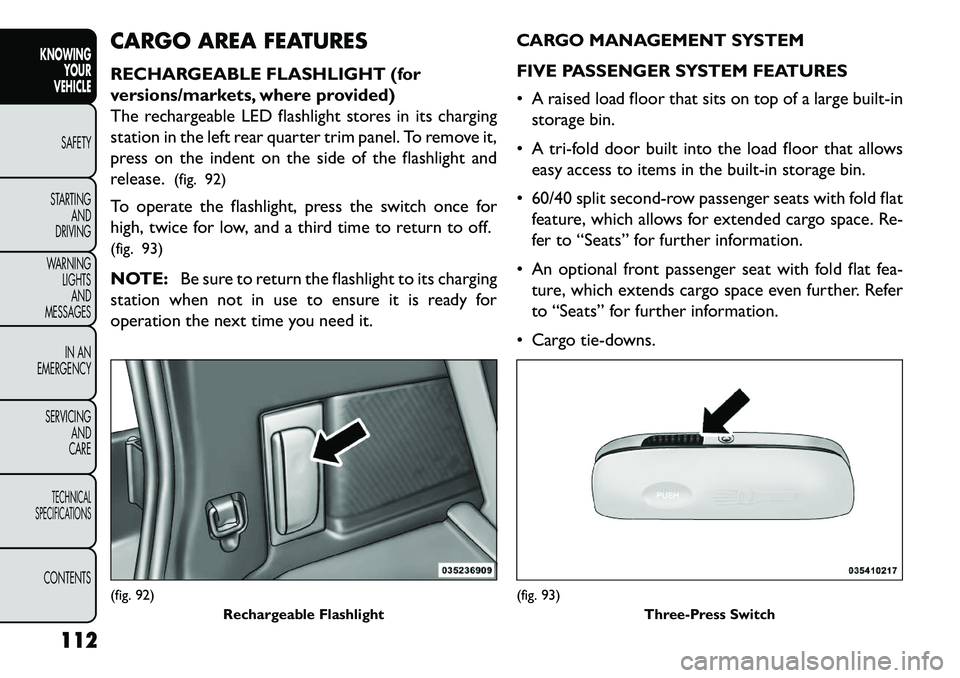
The rechargeable LED flashlight stores in its charging
station in the left rear quarter trim panel. To remove it,
press on the indent on the side of the flashlight and
release.(fig. 92)
To operate the flashlight, press the switch once for
high, twice for low, and a third time to return to off.
(fig. 93)
NOTE: Be sure to return the flashlight to its charging
station when not in use to ensure it is ready for
operation the next time you need it. CARGO MANAGEMENT SYSTEM
FIVE PASSENGER SYSTEM FEATURES
A raised load floor that sits on top of a large built-in
storage bin.
A tri-fold door built into the load floor that allows easy access to items in the built-in storage bin.
60/40 split second-row passenger seats with fold flat feature, which allows for extended cargo space. Re-
fer to “Seats” for further information.
An optional front passenger seat with fold flat fea- ture, which extends cargo space even further. Refer
to “Seats” for further information.
Cargo tie-downs.(fig. 92) Rechargeable Flashlight
(fig. 93) Three-Press Switch
112
KNOWING YOUR
VEHICLE
SAFETY
S
TARTING AND
DRIVING
WARNING LIGHTSAND
MESSAGES
IN AN
EMERGENCY
SERVICING AND
CARETECHNICAL
SPECIFICATIONSCONTENTS
Page 119 of 352
A retractable cargo area cover (for versions/markets,where provided).
SEVEN PASSENGER SYSTEM FEATURES
A large built-in storage bin with a hinged hardcover located in the floor behind the third-row passenger
seats.
60/40 split second-row passenger seats with fold flat feature, which allows for extended cargo space. Re-
fer to “Seats” in “Knowing your vehicle” for further
information.
50/50 split third-row passenger seats with fold flat feature, which allows for extended cargo space. Re-
fer to “Seats” for further information.
An optional front passenger seat with fold flat fea- ture, which extends cargo space even further. Refer
to “Seats” for further information.
Cargo tie-downs. CARGO TIE-DOWNS
WARNING!
Cargo tie-downs are not safe anchors for
a
child seat tether strap. In a sudden stop
or collision, a tie-down could pull loose and allow
the child seat to come loose. A child could be
badly injured. Use only the anchors provided for
child seat tethers.
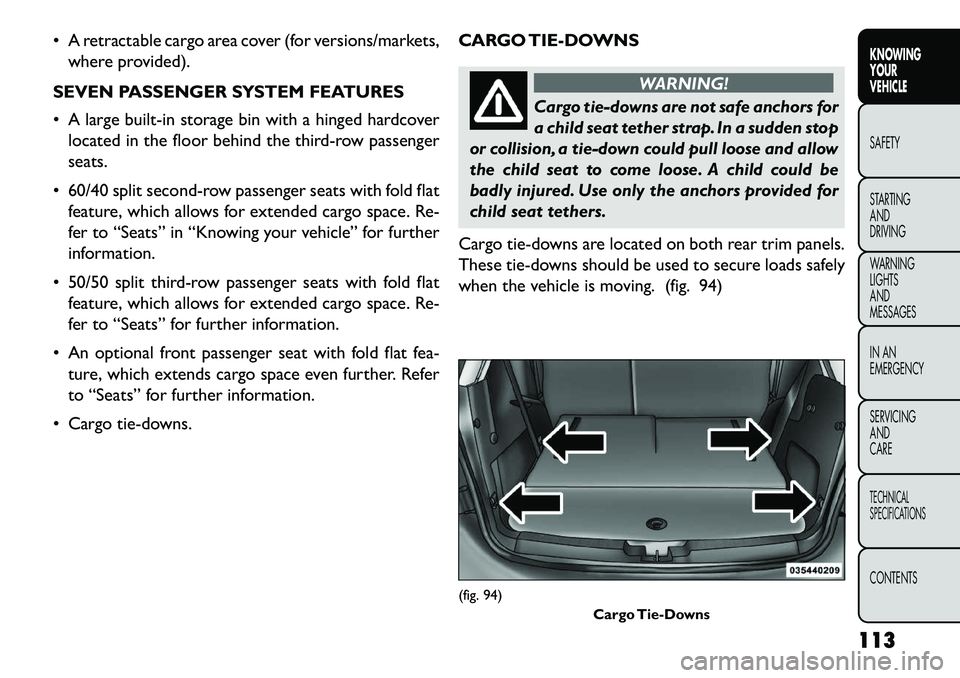
Cargo tie-downs are located on both rear trim panels.
These tie-downs should be used to secure loads safely
when the vehicle is moving. (fig. 94)
(fig. 94) Cargo Tie-Downs
113
KNOWING
YOUR
VEHICLE
SAFETY
S
TARTING
AND
DRIVING
WARNING
LIGHTS
AND
MESSAGES
IN AN
EMERGENCY
SERVICING
AND
CARETECHNICAL
SPECIFICATIONSCONTENTS
Page 120 of 352
WARNING!
The weight and position of cargo and
pass
engers can change the vehicle cen-
ter of gravity and vehicle handling.To avoid loss of
control resulting in personal injury, follow these
guidelines for loading your vehicle:
Do not carry loads that exceed the load limits de- scribed on the label attached to the left door or left
door center pillar.
Always place cargo evenly on the cargo floor. Put heavier objects as low and as far forward as possible.
Place as much cargo as possible in front of the rear axle. Too much weight or improperly placed weight
over or behind the rear axle can cause the vehicle to
sway.
Do not pile luggage or cargo higher than the top of the seatback. This could impair visibility or become a
dangerous projectile in a sudden stop or collision.
To help protect against personal injury, passengers should not be seated in the rear cargo area. The rear
cargo space is intended for load carrying purposes
only, not for passengers, who should sit in seats and
use seat belts. RETRACTABLE CARGO AREA COVER (for
versions/markets, where provided) — FIVE
PASSENGER MODELS
NOTE:
The purpose of this cover is for privacy, not
to secure loads. It will not prevent cargo from shifting
or protect passengers from loose cargo.
The removable retractable cargo area cover mounts in
the cargo area behind the top of the rear seats.
The cover, when extended, covers the cargo area to
keep items out of sight. Notches in the trim panels near
the liftgate opening secure the extended cover in place.
The cover rolls away neatly inside its housing when not
in use. You can also remove the cover from the vehicle
to make more room in the cargo area.
To install the cover, position it in the vehicle so that the
flat side of the housing faces upward. Then, insert
either the left or the right spring-loaded post (located
on the ends of the cover housing) into the left attach-
ment point or the right attachment point (shown).
(fig. 95)
114
KNOWING YOUR
VEHICLE
SAFETY
S
TARTING AND
DRIVING
WARNING LIGHTSAND
MESSAGES
IN AN
EMERGENCY
SERVICING AND
CARETECHNICAL
SPECIFICATIONSCONTENTS
Page 172 of 352
SAFETY
OCCUPANT RESTRAINTS
Some of the most important safety features in your
vehicle are the restraint systems:
Three-point lap and shoulder belts for all seating positions
Advanced Front Air Bags for driver and front passen- ger
Supplemental Active Head Restraints (AHR) located on top of the front seats (integrated into the head
restraint) (for versions/markets, where provided)
Supplemental Side Air Bag Inflatable Curtains (SABIC) that span the front, second, and third row
seating for the driver and passengers seated next to
a window
Supplemental Seat-Mounted Side Air Bags
An energy-absorbing steering column and steering wheel
Knee bolsters/blockers for front seat occupants
Front seat belts incorporate pretensioners that may enhance occupant protection by managing occupant
energy during an impact event
If you will be carrying children too small for adult-sized
seat belts, the seat belts or ISOFIX feature also can be used to hold infant and child restraint systems. For
more information, refer to ISOFIX — Child Seat An-
chorage System.
NOTE:
The Advanced Front Air Bags have a multi-
stage inflator design. This allows the air bag to have
different rates of inflation based on several factors,
including the severity and type of collision.
Please pay close attention to the information in this
section. It tells you how to use your restraint system
properly, to keep you and your passengers as safe as
possible.
WARNING!
In a collision, you and your passengers
can
suffer much greater injuries if you
are not properly buckled up. You can strike the
interior of your vehicle or other passengers, or
you can be thrown out of the vehicle. Always be
sure you and others in your vehicle are buckled
up properly.
Buckle up even though you are an excellent driver, even
on short trips. Someone on the road may be a poor
driver and cause a collision that includes you. This can
happen far away from home or on your own street.
166
KNOWING YOUR
VEHICLE
SAFETY
STARTING AND
DRIVING
W
ARNING LIGHTS AND
MESSAGES
IN AN
EMERGENCY
SERVICING AND
CARETECHNICAL
SPECIFICATIONSCONTENTS
Page 173 of 352
Research has shown that seat belts save lives, and they
can reduce the seriousness of injuries in a collision.
Some of the worst injuries happen when people are
thrown from the vehicle. Seat belts reduce the possi-
bility of ejection and the risk of injury caused by striking
the inside of the vehicle. Everyone in a motor vehicle
should be belted at all times.
LAP/SHOULDER BELTS
All seating positions in your vehicle are equipped with
a combination lap/shoulder belts.
The belt webbing retractor is designed to lock during
very sudden stops or impacts. This feature allows the
shoulder part of the belt to move freely with you under
normal conditions. However, in a collision, the belt will
lock and reduce your risk of striking the inside of the
vehicle or being thrown out.
WARNING!
It
is dangerous to ride in a cargo area,
inside or outside of a vehicle. In a colli-
sion, people riding in these areas are more likely
to be seriously injured or killed.
Do not allow people to ride in any area of your
vehicle that is not equipped with seats and seat
belts.
(Continued)(Continued)
Be sure everyone in your vehicle is in a seat
and using a seat belt properly.
Wearing a seat belt incorrectly is dangerous.
Seat belts are designed to go around the large
bones of your body.These are the strongest parts
of your body and can take the forces of a collision
the best . Wearing your belt in the wrong place
could make your injuries in a collision much
worse. You might suffer internal injuries, or you
could even slide out of part of the belt . Follow
these instructions to wear your seat belt safely
and to keep your passengers safe, too.
Two people should never be belted into a single
seat belt . People belted together can crash into
one another in a collision, hurting one another
badly. Never use a lap/shoulder belt or a lap belt
for more than one person, no matter what their
size.
Lap/Shoulder Belt Operating Instructions
1. Enter the vehicle and close the door. Sit back and adjust the front seat.
167
KNOWING
YOUR
VEHICLE
SAFETY
STARTING
AND
DRIVING
WARNING
LIGHTS
AND
MESSAGES
IN AN
EMERGENCY
SERVICING
AND
CARETECHNICAL
SPECIFICATIONSCONTENTS
Page 183 of 352
Pregnant women should wear the lap part of the belt
across the thighs and as snug across the hips as pos-
sible. Keep the belt low so that it does not come across
the abdomen. That way the strong bones of the hips
will take the force if there is a collision.
CHILD RESTRAINTS
Everyone in your vehicle needs to be buckled up all the
time, including babies and children.
Children 12 years or younger should ride properly
buckled up in a rear seat, if available. According to crash
statistics, children are safer when properly restrained
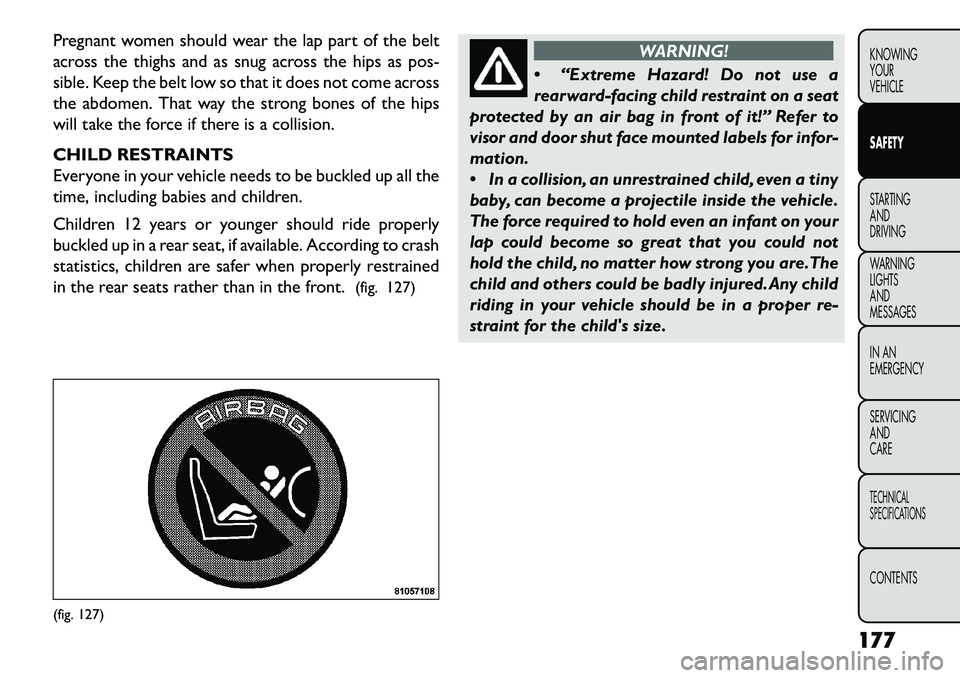
in the rear seats rather than in the front.(fig. 127)
WARNING!
“E
xtreme Hazard! Do not use a
rearward-facing child restraint on a seat
protected by an air bag in front of it!” Refer to
visor and door shut face mounted labels for infor-
mation.
In a collision, an unrestrained child, even a tiny
baby, can become a projectile inside the vehicle.
The force required to hold even an infant on your
lap could become so great that you could not
hold the child, no matter how strong you are.The
child and others could be badly injured. Any child
riding in your vehicle should be in a proper re-
straint for the child's size.
(fig. 127)
177
KNOWING
YOUR
VEHICLE
SAFETY
STARTING
AND
DRIVING
W
ARNING
LIGHTS
AND
MESSAGES
IN AN
EMERGENCY
SERVICING
AND
CARETECHNICAL
SPECIFICATIONSCONTENTS
Page 186 of 352
Key of letters used in the table above:
(1) = For the CRS which do not carry the ISO/XX size
class identification (A to G), for the applicable mass
group, the car manufacturer shall indicate the vehicle
specific ISOFIX child restraint system(s) recommended
for each position.
IUF = Suitable for ISOFIX forward child restraints
systems of universal category approved for use in the
mass group.
IL = Suitable for particular ISOFIX child restraint sys-
tems (CRS) given in the attached list. These ISOFIX
CRS are those of the “specific vehicle”, “restricted” or
“semi-universal” catagories.
X = ISOFIX position not suitable for ISOFIX child
restraint systems in this mass group and / or this size
class.
* = Seats in front of child restraint seats may need to be
adjusted forward to install the child restraint seat.
** = No access to 3rd row seating positions if Carrycot
is installed in vehicle.
There are different sizes and types of restraints for
children from newborn size to the child almost large
enough for an adult safety belt. Always check the child
seat Owner's Manual to ensure you have the correctseat for your child. Use the restraint that is correct for
your child.
Infants And Child Restraints
Safety experts recommend that children ride
rearward-facing in the vehicle until they are two years
old or until they reach either the height or weight limit
of their rear facing child safety seat. Two types of child
restraints can be used rearward-facing: infant carriers
and convertible child seats.
The infant carrier is only used rearward-facing in the
vehicle. It is recommended for children from birth until
they reach the weight or height limit of the infant
carrier. Convertible child seats can be used either
rearward-facing or forward-facing in the vehicle. Con-
vertible child seats often have a higher weight limit in
the rearward-facing direction than infant carriers do, so
they can be used rearward-facing by children who have
outgrown their infant carrier but are still less than at
least two years old. Children should remain rearward-
facing until they reach the highest weight or height
allowed by their convertible child seat. Both types of
child restraints are held in the vehicle by the lap/
shoulder belt or the ISOFIX child restraint anchor
system. Refer to “ISOFIX — Child Seat Anchorage
System”.
180
KNOWING YOUR
VEHICLE
SAFETY
STARTING AND
DRIVING
W
ARNING LIGHTS AND
MESSAGES
IN AN
EMERGENCY
SERVICING AND
CARETECHNICAL
SPECIFICATIONSCONTENTS
Page 187 of 352
WARNING!
Rearward-facing child seats must never
be
used in the front seat of a vehicle with
the front passenger air bag. An air bag deploy-
ment could cause severe injury or death to in-
fants in this position.
Older Children And Child Restraints
Children who are two years old or who have outgrown
their rear-facing convertible child seat can ride
forward-facing in the vehicle. Forward-facing child
seats and convertible child seats used in the forward-
facing direction are for children who are over two years
old or who have outgrown the rear-facing weight or
height limit of their rear-facing convertible child seat.
Children should remain in a forward-facing child seat
with a harness for as long as possible, up to the highest
weight or height allowed by the child seat. These child
seats are also held in the vehicle by the lap/shoulder
belt or the ISOFIX child restraint anchorage system.
Refer to “ISOFIX — Child Seat Anchorage System”. All children whose weight or height is above the
forward-facing limit for the child seat should use a
belt-positioning booster seat until the vehicle’s seat
belts fit properly. If the child cannot sit with knees bent
over the vehicle's seat cushion while the child's back is
against the seatback, they should use a belt-positioning
booster seat. The child and belt-positioning booster
seat are held in the vehicle by the lap/shoulder belt.
Integrated Child Booster Seat (for
versions/markets, where provided)
The Integrated Child Booster Seat is located in each
outboard second-row passenger seat.
NOTE:
Refer to the Integrated Child Booster Seat
information label located on the front lower panel of
the opened Booster Seat for child weight specifica-
tions.
To position a child into the Integrated Child Booster
Seat follow these steps:
1. Slide the second row seat to the full rear position to use the Integrated Child Booster Seat.
NOTE: The second row bench with Integrated Child
Booster Seat must remain in the full rear position
during use.
181
KNOWING
YOUR
VEHICLE
SAFETY
STARTING
AND
DRIVING
WARNING
LIGHTS
AND
MESSAGES
IN AN
EMERGENCY
SERVICING
AND
CARETECHNICAL
SPECIFICATIONSCONTENTS
Page 189 of 352
WARNING!
Be certain that the seat cushion is
lock
ed securely into position before us-
ing the seat . Otherwise, the seat will not provide
the proper stability for child seats and/or passen-
gers. An improperly latched seat cushion could
cause serious injury.
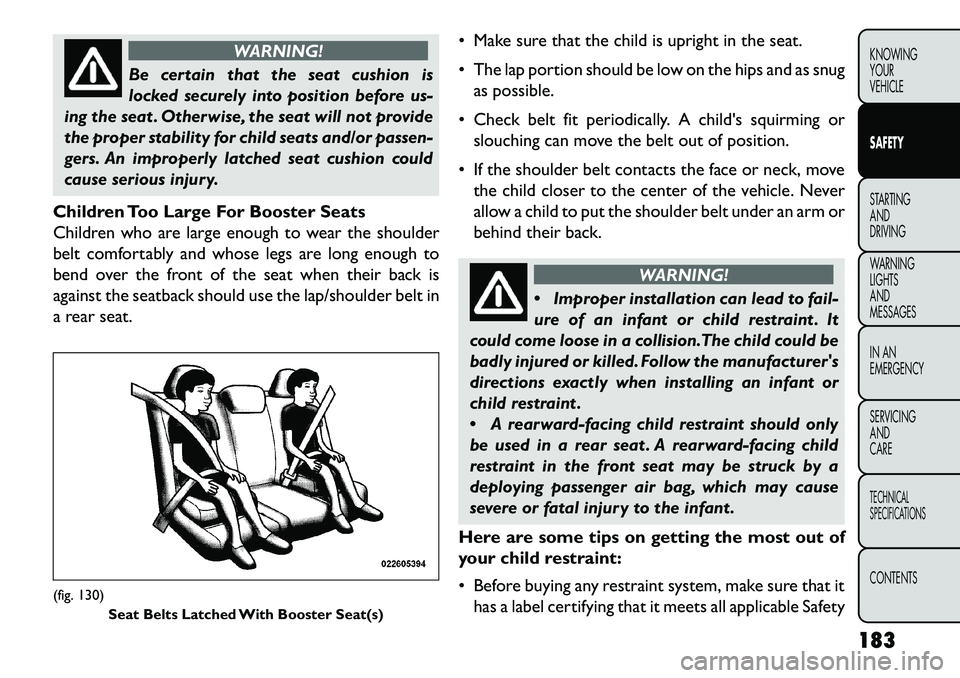
Children Too Large For Booster Seats
Children who are large enough to wear the shoulder
belt comfortably and whose legs are long enough to
bend over the front of the seat when their back is
against the seatback should use the lap/shoulder belt in
a rear seat. Make sure that the child is upright in the seat.
The lap portion should be low on the hips and as snug
as possible.
Check belt fit periodically. A child's squirming or slouching can move the belt out of position.
If the shoulder belt contacts the face or neck, move the child closer to the center of the vehicle. Never
allow a child to put the shoulder belt under an arm or
behind their back.
WARNING!
Impro
per installation can lead to fail-
ure of an infant or child restraint . It
could come loose in a collision.The child could be
badly injured or killed. Follow the manufacturer's
directions exactly when installing an infant or
child restraint .
A rearward-facing child restraint should only
be used in a rear seat . A rearward-facing child
restraint in the front seat may be struck by a
deploying passenger air bag, which may cause
severe or fatal injury to the infant .
Here are some tips on getting the most out of
your child restraint:
Before buying any restraint system, make sure that it has a label certifying that it meets all applicable Safety
(fig. 130) Seat Belts Latched With Booster Seat(s)
183
KNOWING
YOUR
VEHICLE
SAFETY
STARTING
AND
DRIVING
W
ARNING
LIGHTS
AND
MESSAGES
IN AN
EMERGENCY
SERVICING
AND
CARETECHNICAL
SPECIFICATIONSCONTENTS
Page 190 of 352
Standards. FIAT also recommends that you make
sure that you can install the child restraint in the
vehicle where you will use it before you buy it.
The restraint must be appropriate for your child's weight and height. Check the label on the restraint
for weight and height limits.
Carefully follow the instructions that come with the restraint. If you install the restraint improperly, it may
not work when you need it.
Buckle the child into the seat according to the child restraint manufacturer's directions.
WARNING!
When your child restraint is not in use,
s
ecure it in the vehicle with the seat belt
or remove it from the vehicle. Do not leave it
loose in the vehicle. In a sudden stop or collision,
it could strike the occupants or seatbacks and
cause serious personal injury.
ISOFIX — Child Seat Anchorage System
Your vehicle's second row passenger seats are
equipped with the child restraint anchorage system
called ISOFIX. The ISOFIX system provides for the
installation of the child restraint without using the
vehicle's seat belts, instead securing the child restraint using lower anchorages and upper tether straps from
the child restraint to the vehicle structure.
ISOFIX-compatible child restraint systems are now
available. However, because the lower anchorages are
to be introduced over a period of years, child restraint
systems having attachments for those anchorages will
continue to have features for installation using the
vehicle's seat belts. Child restraints having tether straps
and hooks for connection to the top tether anchorages
have been available for some time. For some older child
restraints, many child restraint manufacturers offer
add-on tether strap kits or retrofit kits. You are urged
to take advantage of all the available attachments pro-
vided with your child restraint in any vehicle.
All three second-row passenger seating positions have
lower anchorages that are capable of accommodating
ISOFIX-compatible child seats. You should never install
ISOFIX-compatible child seats so that two seats share
a common lower anchorage. If installing child seats in
adjacent seating positions, or if your child restraints are
not ISOFIX-compatible, install the restraints using the
vehicle's seat belts. (fig. 131)
184
KNOWING YOUR
VEHICLE
SAFETY
STARTING AND
DRIVING
W
ARNING LIGHTS AND
MESSAGES
IN AN
EMERGENCY
SERVICING AND
CARETECHNICAL
SPECIFICATIONSCONTENTS