lock FIAT FREEMONT 2014 1.G Owners Manual
[x] Cancel search | Manufacturer: FIAT, Model Year: 2014, Model line: FREEMONT, Model: FIAT FREEMONT 2014 1.GPages: 388, PDF Size: 4.13 MB
Page 308 of 388
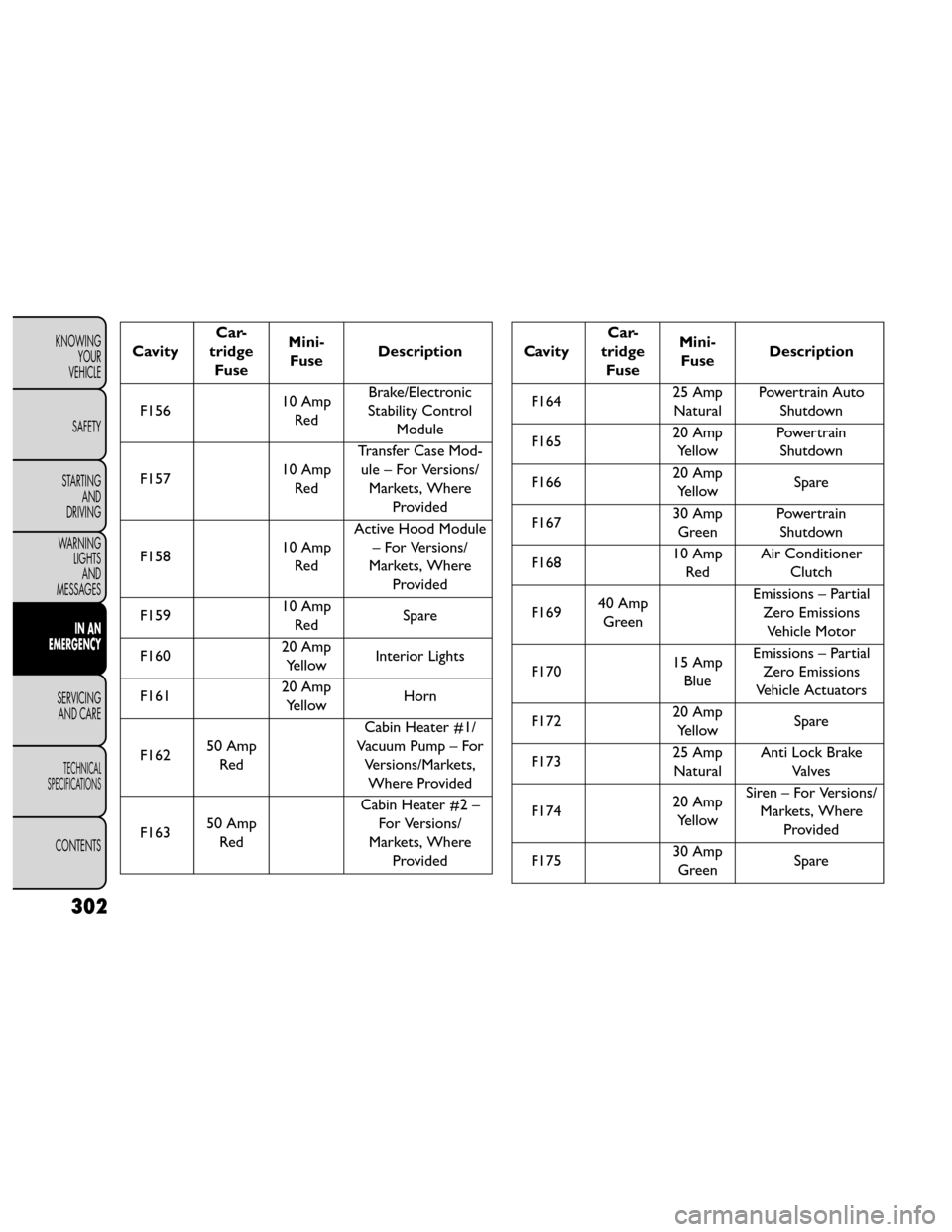
CavityCar-
tridge Fuse Mini-
Fuse Description
F156 10 Amp
Red Brake/Electronic
Stability Control Module
F157 10 Amp
Red Transfer Case Mod-
ule – For Versions/ Markets, Where Provided
F158 10 Amp
Red Active Hood Module
– For Versions/
Markets, Where Provided
F159 10 Amp
Red Spare
F160 20 Amp
Yellow Interior Lights
F161 20 Amp
Yellow Horn
F162 50 Amp
Red Cabin Heater #1/
Vacuum Pump – For Versions/Markets,Where Provided
F163 50 Amp
Red Cabin Heater #2 –
For Versions/
Markets, Where ProvidedCavity Car-
tridge Fuse Mini-
Fuse Description
F164 25 Amp
Natural Powertrain Auto
Shutdown
F165 20 Amp
Yellow Powertrain
Shutdown
F166 20 Amp
Yellow Spare
F167 30 Amp
Green Powertrain
Shutdown
F168 10 Amp
Red Air Conditioner
Clutch
F169 40 Amp
Green Emissions – Partial
Zero EmissionsVehicle Motor
F170 15 Amp
Blue Emissions – Partial
Zero Emissions
Vehicle Actuators
F172 20 Amp
Yellow Spare
F173 25 Amp
Natural Anti Lock Brake
Va l ve s
F174 20 Amp
Yellow Siren – For Versions/
Markets, Where Provided
F175 30 Amp
Green Spare
302
KNOWING
YOUR
VEHICLE
SAFETY
STARTING AND
DRIVING
WARNING LIGHTSAND
MESSAGES
IN AN
EMERGENCY
SERVICING AND CARE
TECHNICAL
SPECIFICATIONS
CONTENTS
Page 315 of 388
Proper towing or lifting equipment is required to pre-
vent damage to your vehicle. Use only tow bars and
other equipment designed for this purpose, following
equipment manufacturer’s instructions. Use of safety
chains is mandatory. Attach a tow bar or other towing
device to main structural members of the vehicle, not
to bumpers or associated brackets. State and local laws
regarding vehicles under tow must be observed.
If you must use the accessories (wipers, defrosters,
etc.) while being towed, the ignition must be in the
ON/RUN position, not the ACC position.
If the vehicle's battery is discharged, refer to "Shift Lever
Override" in this section for instructions on shifting the
automatic transmission out of PARK for towing.
•Do not use sling type equipment when
towing. Damage to the fascia will occur.
• When securing the vehicle to a flatbed
truck, do not attach to front or rear suspension
components. Damage to your vehicle may result
from improper towing.
• Do not push or tow this vehicle with another
vehicle as damage to the bumper fascia and trans-
mission may result .
• If the vehicle being towed requires steering, the
ignitionswitchmustbeintheACCorON/RUN
position, not in the LOCK/OFF position. WITHOUT THE KEY FOB
Special care must be taken when the vehicle is towed
with the ignition in the OFF position. Flatbed towing is
the preferred towing method. However, if a flatbed
towing vehicle is not available, wheel lift towing equip-
ment may be used. Rear towing (with the front wheels
on the ground) is not allowed, as transmission damage
will occur. If rear towing is the only alternative, the
front wheels must be placed on a towing dolly. Proper
towing equipment is necessary to prevent damage to
the vehicle.
ALL-WHEEL DRIVE (AWD) MODELS
The manufacturer requires towing with all four wheels
OFF
the ground. Acceptable methods are to tow the
vehicle on a flatbed, or with one end of vehicle raised
and the opposite end on a towing dolly.
Towing this vehicle in violation of the
above requirements can cause severe
transmission and/or power transfer unit
damage. Damage from improper towing is not cov-
ered under the New Vehicle Limited Warranty.
309
KNOWING
YOUR
VEHICLE
SAFETY
STARTING
AND
DRIVING
WARNING
LIGHTS
AND
MESSAGES
IN AN
EMERGENCY
SERVICING
AND CARE
TECHNICAL
SPECIFICATIONS
CONTENTS
Page 318 of 388
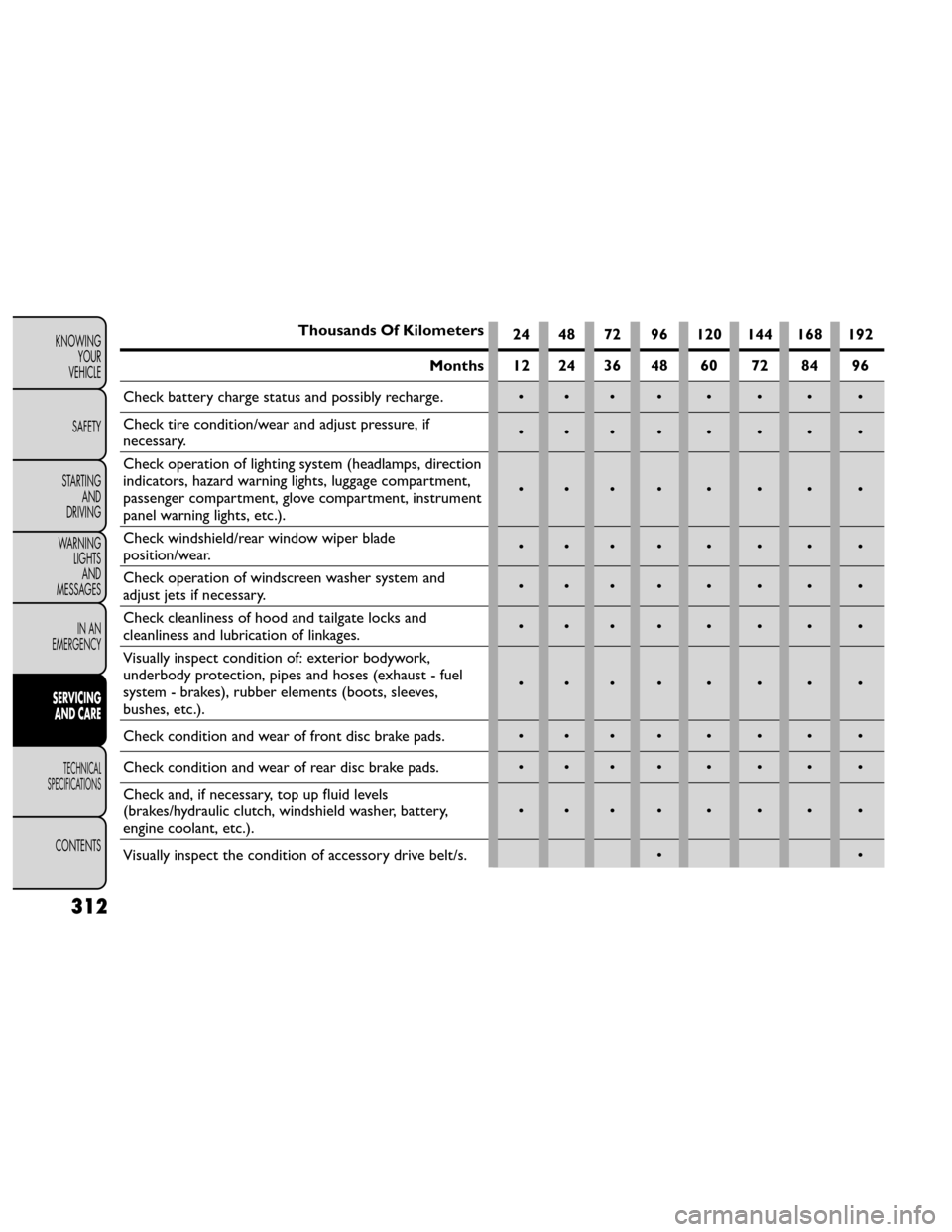
Thousands Of Kilometers24 48 72 96 120 144 168 192
Months 12 24 36 48 60 72 84 96
Check battery charge status and possibly recharge. • • • • ••••
Check tire condition/wear and adjust pressure, if
necessary. ••••••••
Check operation of lighting system (headlamps, direction
indicators, hazard warning lights, luggage compartment,
passenger compartment, glove compartment, instrument
panel warning lights, etc.). ••••••••
Check windshield/rear window wiper blade
position/wear. ••••••••
Check operation of windscreen washer system and
adjust jets if necessary. ••••••••
Check cleanliness of hood and tailgate locks and
cleanliness and lubrication of linkages. ••••••••
Visually inspect condition of: exterior bodywork,
underbody protection, pipes and hoses (exhaust - fuel
system - brakes), rubber elements (boots, sleeves,
bushes, etc.). ••••••••
Check condition and wear of front disc brake pads. • • • • ••••
Check condition and wear of rear disc brake pads. • • • •••••
Check and, if necessary, top up fluid levels
(brakes/hydraulic clutch, windshield washer, battery,
engine coolant, etc.). ••••••••
Visually inspect the condition of accessory drive belt/s. ••
312
KNOWING
YOUR
VEHICLE
SAFETY
STARTING AND
DRIVING
WARNING LIGHTSAND
MESSAGES
IN AN
EMERGENCY
SERVICING AND CARE
TECHNICAL
SPECIFICATIONS
CONTENTS
Page 320 of 388
Periodic Checks
Every1,000 km or before long journeys, check and, if
necessary, restore:
• engine coolant;
• brake fluid;
• power steering fluid;
• windshield washer fluid level;
• power steering fluid;
• tire inflation pressure and condition;
• operation of lighting system (headlights, direction indicators, hazard warning lights, etc.);
• operation of windshield washer/wiper system and positioning/wear of windshield/rear window wiper
blades.
Every 3,000 km, check and top up, if required, the
engine oil level and automatic transmission fluid level
(four-speed automatic only). Heavy-Duty Use Of The Car
If the car is used mainly under one of the following
conditions:
• towing a trailer or caravan;
• dusty roads;
• short, repeated journeys (less than 7-8 km) at sub-
zero outside temperatures;
• engine often idling or driving long distances at low speeds or long periods of idleness.
You should perform the following inspections more
frequently than shown on the Scheduled Servicing Plan:
• check front disc brake pad conditions and wear;
• check cleanliness of hood and trunk locks, cleanli- ness and lubrication of linkage;
• visually inspect conditions of: engine, transmission, pipes and hoses (exhaust - fuel system - brakes) and
rubber elements (boots - sleeves - bushes - etc.);
• check battery charge and battery fluid level (electro- lyte);
•
visually inspect condition of the accessory drive belts;
• check and, if necessary, change engine oil and replace oil filter;
• check and, if necessary, replace pollen filter;
• check and, if necessary, replace air cleaner.
314
KNOWING YOUR
VEHICLE
SAFETY
STARTING AND
DRIVING
WARNING LIGHTSAND
MESSAGES
IN AN
EMERGENCY
SERVICING AND CARE
TECHNICAL
SPECIFICATIONS
CONTENTS
Page 325 of 388
Heavy-Duty Use Of The Car
If the car is used mainly under one of the following
conditions:
• towing a trailer or caravan;
• dusty roads;
• short, repeated journeys (less than 7-8 km) at sub-zero outside temperatures;
• engine often idling or driving long distances at low speeds or long periods of idleness.
You should perform the following inspections more
frequently than shown on the Scheduled Servicing Plan:
• check front disc brake pad conditions and wear;
• check cleanliness of hood and trunk locks, cleanli- ness and lubrication of linkage; • visually inspect conditions of: engine, transmission,
pipes and hoses (exhaust - fuel system - brakes) and
rubber elements (boots - sleeves - bushes - etc.);
• check battery charge and battery fluid level (electro- lyte);
• visually inspect condition of the accessory drive belts;
• check and, if necessary, change engine oil and replace oil filter;
• check and, if necessary, replace pollen filter;
• check and, if necessary, replace air cleaner.
319
KNOWING
YOUR
VEHICLE
SAFETY
STARTING
AND
DRIVING
WARNING
LIGHTS
AND
MESSAGES
IN AN
EMERGENCY
SERVICING
AND CARE
TECHNICAL
SPECIFICATIONS
CONTENTS
Page 335 of 388
3. Pivot the glove box downward.
4. Disengage the two retaining tabs that secure thefilter cover to the HVAC housing and remove the
cover. (fig. 195)
5. Remove the A/C air filter by pulling it straight out of the housing.
6. Install the A/C air filter with the arrow on the filter pointing toward the floor. When installing the filter
cover, make sure the retaining tabs fully engage the
cover.The A/C air filter is identified with an arrow
to indicate airflow direction through the
filter. Failure to install the filter properly
will result in the need to replace it more often.
7. Reinstall the glove box door. Make sure that the hinges are seated fully as you raise the door. Other-
wise, the door latch will not align properly.
BODY LUBRICATION
Locks and all body pivot points, including such items as
seat tracks, door hinge pivot points and rollers, liftgate,
tailgate, sliding doors and hood hinges, should be
lubricated periodically with a lithium based grease to
assure quiet, easy operation and to protect against rust
and wear. Prior to the application of any lubricant, the
parts concerned should be wiped clean to remove dust
and grit; after lubricating excess oil and grease should
be removed. Particular attention should also be given
to hood latching components to ensure proper func-
tion. When performing other underhood services, the
hood latch, release mechanism and safety catch should
be cleaned and lubricated.
The external lock cylinders should be lubricated twice
a year, preferably in the Fall and Spring. Apply a small
amount of a high quality lubricant directly into the lock
cylinder.
(fig. 195) A/C Air Filter Replacement
329
KNOWING
YOUR
VEHICLE
SAFETY
STARTING
AND
DRIVING
WARNING
LIGHTS
AND
MESSAGES
IN AN
EMERGENCY
SERVICING
AND CARE
TECHNICAL
SPECIFICATIONS
CONTENTS
Page 339 of 388
WARNING!
A hot exhaust system can start a fire if
you par k
over materials that can burn.
Such materials might be grass or leaves coming
into contact with your exhaust system. Do not
park or operate your vehicle in areas where your
exhaust system can contact anything that can
burn.
In unusual situations involving grossly malfunctioning
engine operation, a scorching odor may indicate severe
and abnormal catalyst overheating. If this occurs, safely
bring the vehicle to a complete stop, shut the engine
OFF, and allow the vehicle to cool. Thereafter, obtain
service, including a tune-up to manufacturer’s specifi-
cations immediately.
To minimize the possibility of catalyst damage:
• Do not shut OFF the engine or interrupt the ignition when the transmission is in gear and the vehicle is in
motion.
• Do not try to start the engine by pushing or towing the vehicle.
• Do not idle the engine with any ignition coil connec- tors disconnected for prolonged periods. COOLING SYSTEMWARNING!
•
When working near the radiator cool-
ing fan, disconnect the fan motor lead or
turn the ignition switch to the LOCK position.
The fan is temperature controlled and can start at
any time the ignition switch is in the ON position.
• You or others can be badly burned by hot
engine coolant (antifreeze) or steam from your
radiator. If you see or hear steam coming from
under the hood, do not open the hood until the
radiator has had time to cool. Never tr y to open a
cooling system pressure cap when the radiator is
hot .
Car maintenance should be done at a
FIAT Dealership. For routine and minor
maintenance operations you wish to
carry out yourself, we do recommend you have
the proper equipment , genuine FIAT spare parts
and the necessary fluids; do not however carry out
these operations if you have no experience.
333
KNOWING
YOUR
VEHICLE
SAFETY
STARTING
AND
DRIVING
WARNING
LIGHTS
AND
MESSAGES
IN AN
EMERGENCY
SERVICING
AND CARE
TECHNICAL
SPECIFICATIONS
CONTENTS
Page 374 of 388
CONTENTS
About Your Brakes..................... 133, 234
ABS (Anti-Lock Brake System) ..........134, 135, 269
Adding Engine Coolant (Antifreeze) ..............335
Adding Fuel ..............................185
Adding Washer Fluid ........................331
Additives, Fuel ............................359
Airbag .............................. 216, 222
Airbag Deployment ........................223
Airbag Light ....................221, 224, 227, 264
Airbag, Side ....................... 218, 220, 222
Airbag, Window (Side Curtain) ..........219, 220, 222
Air Cleaner, Engine (Engine Air Cleaner Filter) ......326
Air Conditioner Maintenance ..................327
Air Conditioning Filter ....................85, 328
Air Conditioning, Operating Tips ................85
Air Conditioning, Rear Zone .................71,81
Air Conditioning Refrigerant ...............327, 328
Air Conditioning System .....................327
Air Pressure, Tires ......................266, 349
Alarm (Security Alarm) ...................15, 269
Alarm System (Security Alarm) ...............15, 17
All Wheel Drive (AWD) .....................247
Alterations/Modifications, Vehicle .................5
Antifreeze (Engine Coolant) ............334, 335, 361
Disposal .............................336
Anti-Lock Brake System (ABS) ..............134, 135
Anti-Lock Warning Light ..............135, 136, 269
Arming System (Security Alarm) .................15
Auto Down Power Windows ..................123
Automatic Dimming Mirror ....................63
Automatic Door Locks ......................115 Automatic Headlights
........................86
Automatic Oil Change Indicator .................27
Automatic Transmission .................. 238, 339
Adding Fluid ...........................340
Autostick .............................245
Fluid and Filter Changes ...................341
Fluid Level Check .......................340
Gear Ranges ...........................241
Autostick ..............................
.245
Auto Unlock, Doors ........................115
Auxiliary Electrical Outlet (Power Outlet) .........106
Auxiliary Power Outlet ......................106
Back-Up Lights ............................295
Battery .................................326
Gas Caution ...........................327
Keyless Transmitter Replacement (RKE) .........13
Location .............................326
Belts, Seat ........................... 188, 226
Body Mechanism Lubrication ..................329
Brake Assist System ........................137
Brake Control System, Electronic ...............135
Brake, Parking ............................234
Brakes ..............................133, 337
Brake System ......................... 133, 337
Anti-Lock (ABS) .....................134, 135
Fluid Check ...........................338
Master Cylinder ........................338
Parking ..............................234
Warning Light ..........................268
Brake/Transmission Interlock ..................240
368
KNOWING
YOUR
VEHICLE
SAFETY
STARTING AND
DRIVING
WARNING LIGHTSAND
MESSAGES
IN AN
EMERGENCY
SERVICING AND CARE
TECHNICAL
SPECIFICATIONS
CONTENTS
Page 375 of 388
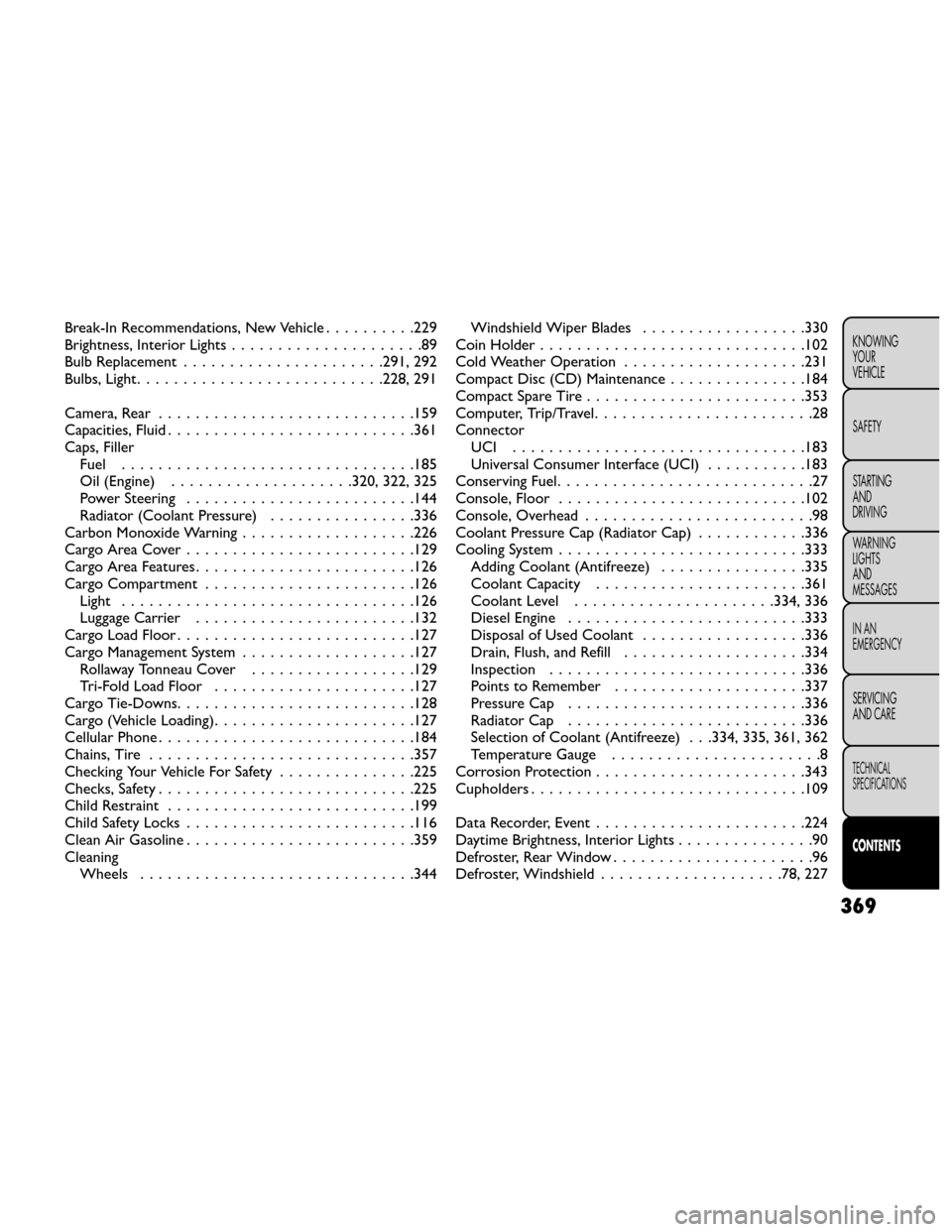
Break-In Recommendations, New Vehicle..........229
Brightness, Interior Lights .....................89
Bulb Replacement ...................... 291, 292
Bulbs, Light ...........................228, 291
Camera, Rear ............................159
Capacities, Fluid ...........................361
Caps, Filler Fuel ................................185
Oil (Engine) ....................320, 322, 325
Power Steering .........................144
Radiator (Coolant Pressure) ................336
Carbon Monoxide Warning ...................226
CargoAreaCover.........................129
Cargo Area Features ........................126
CargoCompartment .......................126 Light ................................126
Luggage Carrier ........................132
Cargo Load Floor ..........................127
Cargo Management System ...................127
Rollaway Tonneau Cover ..................129
Tri-Fold Load Floor ......................127
Cargo Tie-Downs ..........................128
Cargo (Vehicle Loading) ......................127
Cellular Phone ............................184
Chains, Tire .............................357
Checking Your Vehicle For Safety ...............225
Checks, Safety ............................225
Child Restraint ...........................199
Child Safety Locks .........................116
Clean Air Gasoline .........................359
Cleaning Wheels ..............................344 Windshield Wiper Blades
..................330
Coin Holder .............................102
Cold Weather Operation ....................231
Compact Disc (CD) Maintenance ...............184
Compact Spare Tire ........................353
Computer, Trip/Travel ........................28
Connector UCI ............................... .183
Universal Consumer Int
erface (UCI) ...........183
Conserving Fuel ............................27
Console, Floor ...........................102
Console, Overhead .........................98
Coolant Pressure Cap (Radiator Cap) ............336
Cooling System ...........................333
Adding Coolant (Antifreeze) ................335
Coolant Capacity .......................361
Coolant Level ......................334, 336
Diesel Engine ..........................333
Disposal of Used Coolant ..................336
Drain, Flush, and Refill ....................334
Inspection ............................336
Points to Remember .....................337
Pressure Cap ..........................336
Radiator Cap ..........................336
Selection of Coolant (Antifreeze) . . .334, 335, 361, 362
Temperature Gauge .......................8
Corrosion Protection .......................343
Cupholders ..............................109
Data Recorder, Event .......................224
Daytime Brightness, Interior Lights ...............90
Defroster, Rear Window ......................96
Defroster, Windshield ....................78, 227
369
KNOWING
YOUR
VEHICLE
SAFETY
STARTING
AND
DRIVING
WARNING
LIGHTS
AND
MESSAGES
IN AN
EMERGENCY
SERVICING
AND CARE
TECHNICAL
SPECIFICATIONS
CONTENTS
Page 376 of 388
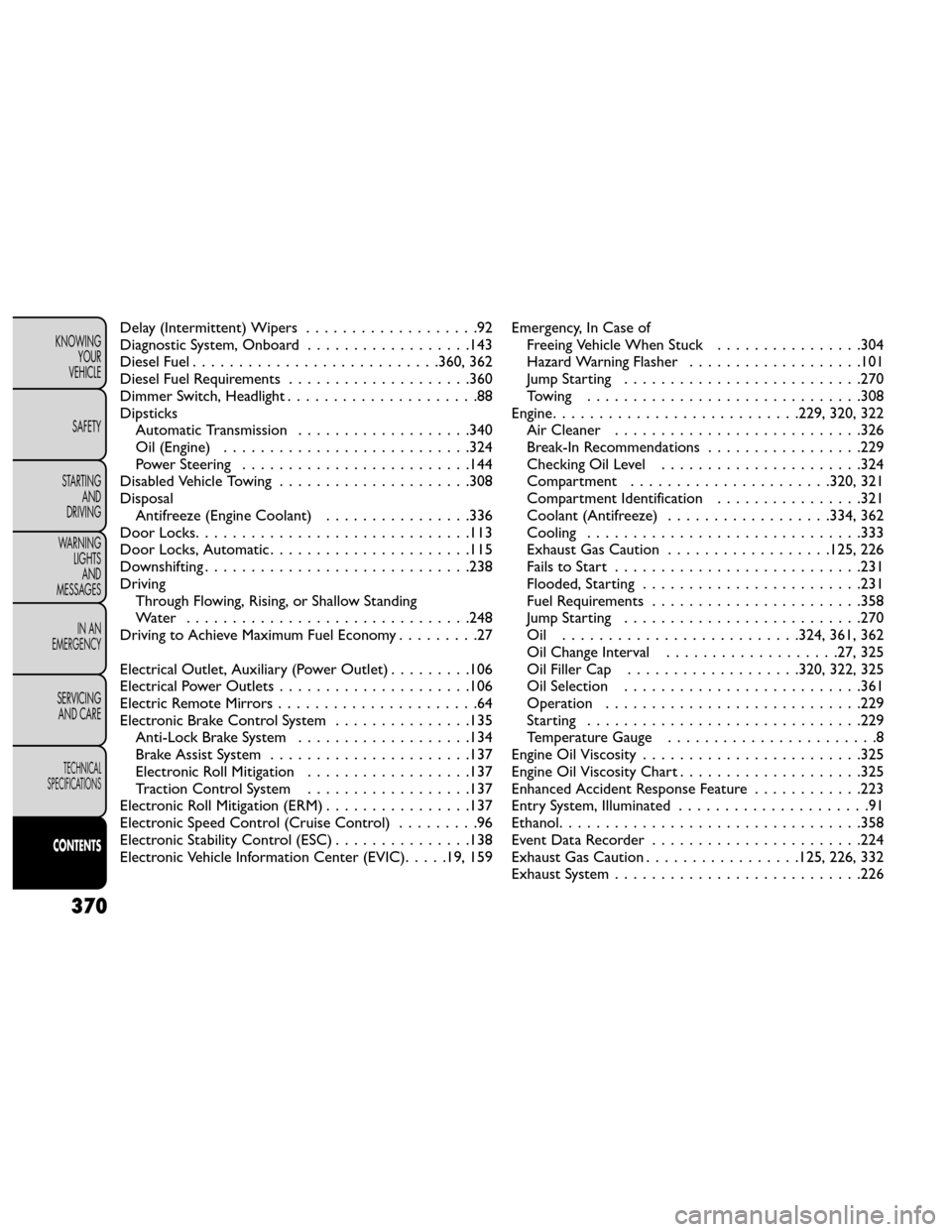
Delay (Intermittent) Wipers...................92
Diagnostic System, Onboard ..................143
Diesel Fuel ...........................360, 362
Diesel Fuel Requirements ....................360
Dimmer Switch, Headlight .....................88
Dipsticks Automatic Transmission ...................340
Oil (Engine) ...........................324
Power Steering .........................144
Disabled Vehicle Towing .....................308
Disposal Antifreeze (Engine Coolant) ................336
Door Locks ..............................113
Door Locks, Automatic ......................115
Downshifting .............................238
Driving Through Flowing, Rising, or Shallow Standing
Water ...............................248
Driving to Achieve Maximum Fuel Economy .........27
Electrical Outlet, Auxiliary (Power Outlet) .........106
Electrical Power Outlets .....................106
Electric Remote Mirrors ......................64
Electronic Brake Control System ...............135
Anti-Lock Brake System ...................134
Brake Assist System ......................137
Electronic Roll Mitigation ..................137
Traction Control System ..................137
Electronic Roll Mitigation (ERM) ................137
Electronic Speed Control (Cruise Control) .........96
Electronic Stability Control (ESC) ...............138
Electronic Vehicle Information Center (EVIC) .....19, 159Emergency, In Case of
Freeing Vehicle When Stuck ................304
Hazard Warning Flasher ...................101
Jump Starting ..........................270
Towing ..............................308
Engine ...........................229, 320, 322
Air Cleaner ...........................326
Break-In Recommendations .................229
Checking Oil Level ......................324
Compartment ......................320, 321
Compartment Identification ................321
Coolant (Antifreeze) .................. 334, 362
Cooling ..............................33 3
Exhaust
Gas Caution .................. 125, 226
Fails to Start ...........................231
Flooded, Starting ........................231
Fuel Requirements .......................358
Jump Starting ..........................270
Oil ..........................324, 361, 362
Oil Change Interval ...................27, 325
Oil Filler Cap ................... 320, 322, 325
Oil Selection ..........................361
Operation ............................229
Starting ..............................229
Temperature Gauge .......................8
Engine Oil Viscosity ........................325
Engine Oil Viscosity Chart ....................325
Enhanced Accident Response Feature ............223
Entry System, Illuminated .....................91
Ethanol .................................358
Event Data Recorder .......................224
Exhaust Gas Caution .................125, 226, 332
Exhaust System ...........................226
370
KNOWING
YOUR
VEHICLE
SAFETY
STARTING AND
DRIVING
WARNING LIGHTSAND
MESSAGES
IN AN
EMERGENCY
SERVICING AND CARE
TECHNICAL
SPECIFICATIONS
CONTENTS