belt FIAT FREEMONT 2014 1.G User Guide
[x] Cancel search | Manufacturer: FIAT, Model Year: 2014, Model line: FREEMONT, Model: FIAT FREEMONT 2014 1.GPages: 388, PDF Size: 4.13 MB
Page 194 of 388
Research has shown that seat belts save lives, and they
can reduce the seriousness of injuries in a collision.
Some of the worst injuries happen when people are
thrown from the vehicle. Seat belts reduce the possi-
bility of ejection and the risk of injury caused by striking
the inside of the vehicle. Everyone in a motor vehicle
should be belted at all times.
Lap/Shoulder Belts
All seating positions in your vehicle are equipped with
a combination lap/shoulder belt.
The belt webbing retractor is designed to lock during
very sudden stops or impacts. This feature allows the
shoulder part of the belt to move freely with you under
normal conditions. However, in a collision, the belt will
lock and reduce your risk of striking the inside of the
vehicle or being thrown out.
WARNING!
• It is dangerous to ride in a cargo area,
inside or
outside of a vehicle. In a colli-
sion, people riding in these areas are more likely
to be seriously injured or killed.
• Donotallowpeopletorideinanyareaofyour
vehicle that is not equipped with seats and seat
belts.
(Continued)(Continued)
• Be sure everyone in your vehicle is in a seat and
using a seat belt properly.
• Wearing a seat belt incorrectly is dangerous.
Seat belts are designed to go around the large
bones of your body.These are the strongest parts
of your body and can take the forces of a collision
the best . Wearing your belt in the wrong place
could make your injuries in a collision much
worse. You might suffer internal injuries, or you
could even slide out of part of the belt . Follow
these instructions to wear your seat belt safely
and to keep your passengers safe, too.
• Two people should never be belted into a single
seat belt . People belted together can crash into
one another in a collision, hurting one another
badly. Never use a lap/shoulder belt or a lap belt
for more than one person, no matter what their
size.
188
KNOWING YOUR
VEHICLE
SAFETY
STARTING AND
DRIVING
WARNING LIGHTSAND
MESSAGES
IN AN
EMERGENCY
SERVICING AND CARE
TECHNICAL
SPECIFICATIONS
CONTENTS
Page 195 of 388
Lap/Shoulder Belt Operating Instructions
1. Enter the vehicle and close the door. Sit back andadjust the front seat.
2. The seat belt latch plate is along side the pillar near the back of your seat. Grasp the latch plate and pull
out the belt. Slide the latch plate up the webbing as
far as necessary to make the belt go around your lap.
(fig. 129) 3. When the belt is long enough to fit, insert the latch
plate into the buckle until you hear a “click.”
(fig. 130)
(fig. 129)
Pulling Out Lap/Shoulder Belt(fig. 130)Connecting Latch PlateTo Buckle
189
KNOWING
YOUR
VEHICLE
SAFETY
STARTING
AND
DRIVING
WARNING
LIGHTS
AND
MESSAGES
IN AN
EMERGENCY
SERVICING
AND CARE
TECHNICAL
SPECIFICATIONS
CONTENTS
Page 196 of 388
WARNING!
• Abeltthatisbuckledintothewrong
buckle will
not protect you properly.The
lap portion could ride too high on your body,
possibly causing internal injuries. Always buckle
your belt into the buckle nearest you.
• Abeltthatistooloosewillnotprotectyou
properly. In a sudden stop you could move too far
forward, increasing the possibility of injury.Wear
your seat belt snugly.
• A belt that is worn under your arm is danger-
ous.Your body could strike the inside surfaces of
the vehicle in a collision, increasing head and
neck injury. A belt worn under the arm can cause
internal injuries. Ribs aren't as strong as shoulder
bones. Wear the belt over your shoulder so that
your strongest bones will take the force in a
collision.
• A shoulder belt placed behind you will not
protect you from injury during a collision.You are
more likely to hit your head in a collision if you do
not wear your shoulder belt .The lap and shoulder
belt are meant to be used together. 4. Position the lap belt across your thighs, below your
abdomen. To remove slack in the lap belt portion,
pull up a bit on the shoulder belt. To loosen the lap
belt if it is too tight, tilt the latch plate and pull on
the lap belt. A snug belt reduces the risk of sliding
under the belt in a collision. (fig. 131)
(fig. 131)
Removing Slack From Belt
190
KNOWINGYOUR
VEHICLE
SAFETY
STARTING AND
DRIVING
WARNING LIGHTSAND
MESSAGES
IN AN
EMERGENCY
SERVICING AND CARE
TECHNICAL
SPECIFICATIONS
CONTENTS
Page 197 of 388
WARNING!
• A lap belt worn too high can increase
th e
risk of internal injury in a collision.
Thebeltforceswon'tbeatthestronghipand
pelvic bones, but across your abdomen. Always
wear the lap belt as low as possible and keep it
snug.
• A twisted belt may not protect you properly. In
a collision, it could even cut into you. Be sure the
belt is straight . If you can't straighten a belt in
your vehicle, take it to your authorized dealer
immediately and have it fixed.
5. Position the shoulder belt on your chest so that it is comfortable and not resting on your neck. The
retractor will withdraw any slack in the belt.
6. To release the belt, push the red button on the buckle. The belt will automatically retract to its
stowed position. If necessary, slide the latch plate
down the webbing to allow the belt to retract fully.
WARNING!
A frayed or torn belt could rip apart in a
collision an
d leave you with no protec-
tion. Inspect the belt system periodically, check-
ing for cuts, frays, or loose parts. Damaged parts
(Continued)(Continued)
must be replaced immediately. Do not disas-
semble or modify the system. Seat belt assem-
blies must be replaced after a collision if they
have been damaged (bent retractor, torn web-
bing, etc .).
Adjustable Upper Shoulder Belt Anchorage
In the driver's seat and front passenger's seat, the
shoulder belt can be adjusted upward or downward to
position the belt away from your neck. Push and fully
depress the button above the webbing to release the
anchorage, then move it up or down to the position
that fits you best.
(fig. 132)
(fig. 132) Adjusting Upper Shoulder Belt
191
KNOWING
YOUR
VEHICLE
SAFETY
STARTING
AND
DRIVING
WARNING
LIGHTS
AND
MESSAGES
IN AN
EMERGENCY
SERVICING
AND CARE
TECHNICAL
SPECIFICATIONS
CONTENTS
Page 198 of 388
As a guide, if you are shorter than average you will
prefer a lower position and if you are taller than
average you will prefer a higher position. When you
release the anchorage try to move it up and down to
make sure that it is locked in position.
In the rear seat, move toward the center of the seat to
position the belt away from your neck.
Lap/Shoulder Belt Untwisting Procedure
Use the following procedure to untwist a twisted
lap/shoulder belt:
1. Position the latch plate as close as possible to theanchor point.
2. At about 15 to 30 cm above the latch plate, grasp and twist the belt webbing 180 degrees to create a
fold that begins immediately above the latch plate.
3. Slide the latch plate upward over the folded web- bing. The folded webbing must enter the slot at the
top of the latch plate.
4. Continue to slide the latch plate up until it clears the folded webbing.
SEAT BELT PRETENSIONERS
The seat belts for both front seating positions are
equipped with pretensioning devices that are designed
to remove slack from the seat belt in the event of a
collision. These devices may improve the performance of the seat belt by assuring that the belt is tight about
the occupant early in a collision. Pretensioners work
for all size occupants, including those in child restraints.
NOTE:
These devices are not a substitute for proper
seat belt placement by the occupant. The seat belt still
must be worn snugly and positioned properly.
The pretensioners are triggered by the Occupant Re-
straint Controller (ORC). Like the air bags, the preten-
sioners are single use items. A deployed pretensioner
or a deployed air bag must be replaced immediately.
Supplemental Active Head Restraints (AHR)
These head restraints are passive, deployable compo-
nents, and vehicles with this equipment cannot be
readily identified by any markings, only through visual
inspection of the head restraint. The head restraint will
be split in two halves, with the front half being soft
foam and trim, the back half being decorative plastic.
How The Active Head Restraints (AHR) Work
The Occupant Restraint Controller (ORC) determines
whether the severity, or type of rear impact will require
the Active Head Restraints (AHR) to deploy. If a rear
impact requires deployment, both the driver and front
passenger seat AHRs will be deployed.
When AHRs deploy during a rear impact, the front half
of the head restraint extends forward to minimize the
gap between the back of the occupant’s head and the
192
KNOWING YOUR
VEHICLE
SAFETY
STARTING AND
DRIVING
WARNING LIGHTSAND
MESSAGES
IN AN
EMERGENCY
SERVICING AND CARE
TECHNICAL
SPECIFICATIONS
CONTENTS
Page 204 of 388
Enhanced Seat Belt Use Reminder System
(BeltAlert®)
BeltAlert® is a feature intended to remind the driver
and front passenger (for versions/markets, where pro-
vided with front passenger BeltAlert®) to fasten their
seatbelts. The feature is active whenever the ignition is
on. If the driver or front seat passenger is unbelted, the
Seat Belt Reminder Light will turn on and remain on
until both front seatbelts are fastened.
The BeltAlert® warning sequence begins after the
vehicle speed is over 8 km/h, by blinking the Seat Belt
Reminder Light and sounding an intermittent chime.
Once the sequence starts, it will continue for the
entire duration or until the respective seatbelts are
fastened. After the sequence completes, the Seatbelt
Reminder Light remains illuminated until the respective
seatbelts are fastened. The driver should instruct all
other occupants to fasten their seatbelts. If a front
seatbelt is unbuckled while traveling at speeds greater
than 8 km/h, BeltAlert® will provide both audio and
visual notification.
The front passenger seat BeltAlert® is not active when
the front passenger seat is unoccupied. BeltAlert® may
be triggered when an animal or heavy object is on thefront passenger seat or when the seat is folded flat (for
versions/markets, where provided). It is recommended
that pets be restrained in the rear seat in pet harnesses
or pet carriers that are secured by seat belts, and cargo
is properly stowed.
BeltAlert® can be enabled or disabled by your autho-
rized dealer.
NOTE:
Although BeltAlert® has been deactivated,
the Seat Belt Reminder Light will continue to illuminate
while the driver’s or front passenger (for versions/
markets, where provided with BeltAlert®) seat belt
remains unfastened.
Seat Belts And Pregnant Women
We recommend that pregnant women use the seat
belts throughout their pregnancy. Keeping the mother
safe is the best way to keep the baby safe.
Pregnant women should wear the lap part of the belt
across the thighs and as snug across the hips as pos-
sible. Keep the belt low so that it does not come across
the abdomen. That way the strong bones of the hips
will take the force if there is a collision.
198
KNOWING YOUR
VEHICLE
SAFETY
STARTING AND
DRIVING
WARNING LIGHTSAND
MESSAGES
IN AN
EMERGENCY
SERVICING AND CARE
TECHNICAL
SPECIFICATIONS
CONTENTS
Page 205 of 388
Child Restraints
(fig. 139)
Everyone in your vehicle needs to be buckled up at all
times, including babies and children.
Children 12 years or younger should ride properly
buckled up in a rear seat, if available. According to crash
statistics, children are safer when properly restrained
in the rear seats rather than in the front.
There are different sizes and types of restraints for
children from newborn size to the child almost large
enough for an adult safety belt. Always check the child
seat Owner’s Manual to make sure you have the cor-
rect seat for your child.Before buying any restraint system, make sure that it
has a label certifying that it meets all applicable Safety
Standards. You should also make sure that you can
install it in the vehicle where you will use it.
WARNING!
• “Extreme Hazard! Do not use a
rearw ard-f
acing child restraint on a seat
protected by an air bag in front of it!” Refer to
visor and door shut face mounted labels for infor-
mation.
• In a collision, an unrestrained child, even a tiny
baby, can become a projectile inside the vehicle.
The force required to hold even an infant on your
lap could become so great that you could not
hold the child, no matter how strong you are.
The child and others could be badly injured. Any
child riding in your vehicle should be in a proper
restraint for the child's size.
(fig. 139)
199
KNOWING
YOUR
VEHICLE
SAFETY
STARTING
AND
DRIVING
WARNING
LIGHTS
AND
MESSAGES
IN AN
EMERGENCY
SERVICING
AND CARE
TECHNICAL
SPECIFICATIONS
CONTENTS
Page 209 of 388
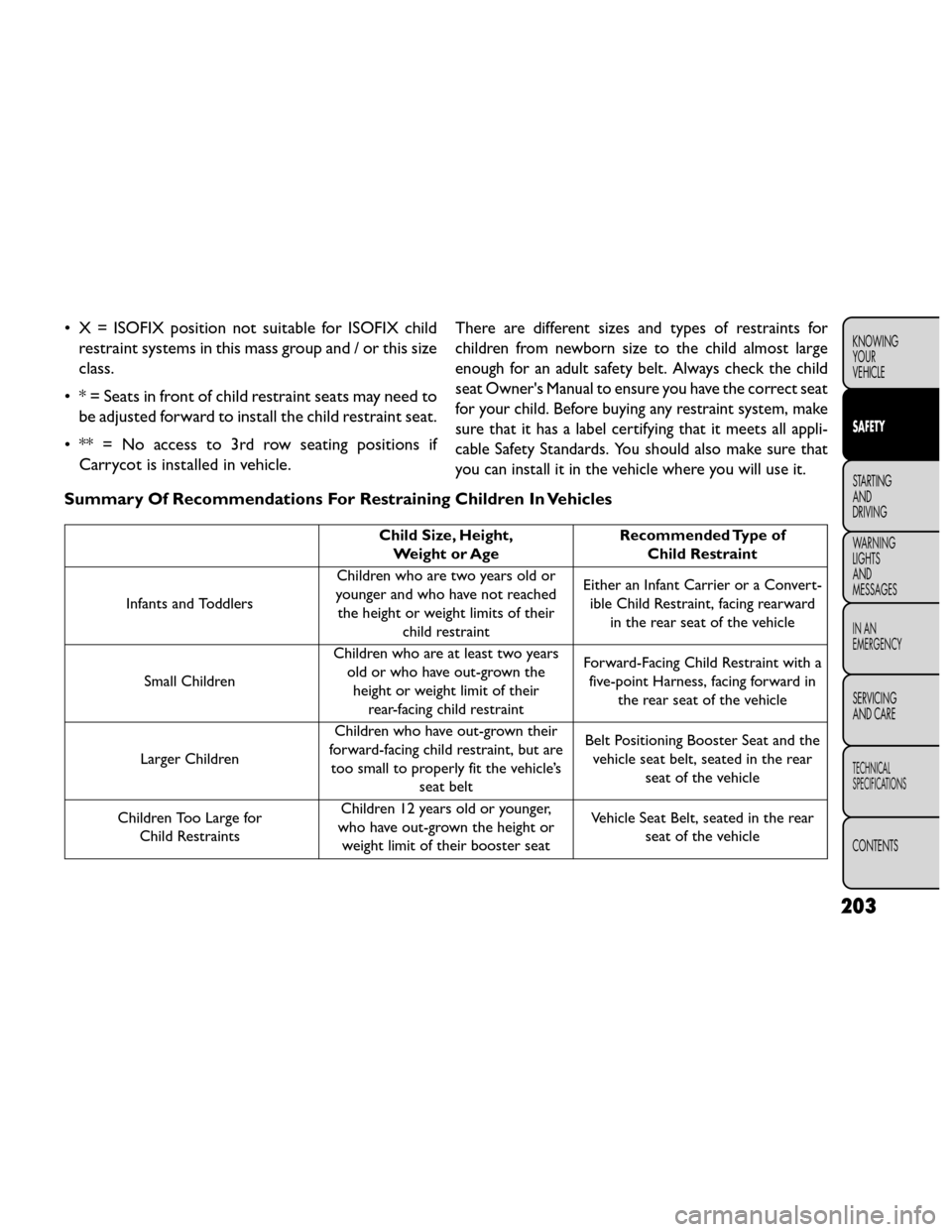
• X = ISOFIX position not suitable for ISOFIX childrestraint systems in this mass group and / or this size
class.
• * = Seats in front of child restraint seats may need to be adjusted forward to install the child restraint seat.
• ** = No access to 3rd row seating positions if Carrycot is installed in vehicle.There are different sizes and types of restraints for
children from newborn size to the child almost large
enough for an adult safety belt. Always check the child
seat Owner's Manual to ensure you have the correct seat
for your child. Before buying any restraint system, make
sure that it has a label certifying that it meets all appli-
cable Safety Standards. You should also make sure that
you can install it in the vehicle where you will use it.
Summary Of Recommendations For Restraining Children In Vehicles
Child Size, Height,
Weight or Age Recommended Type of
Child Restraint
Infants and Toddlers Children who are two years old or
younger and who have not reached the height or weight limits of their child restraint Either an Infant Carrier or a Convert-
ible Child Restraint, facing rearward in the rear seat of the vehicle
Small Children Children who are at least two years
old or who have out-grown theheight or weight limit of their rear-facing child restraint Forward-Facing Child Restraint with a
five-point Harness, facing forward in the rear seat of the vehicle
Larger Children Children who have out-grown their
forward-facing child restraint, but are too small to properly fit the vehicle’s seat belt Belt Positioning Booster Seat and the
vehicle seat belt, seated in the rear seat of the vehicle
Children Too Large for Child Restraints Children 12 years old or younger,
who have out-grown the height or weight limit of their booster seat Vehicle Seat Belt, seated in the rear
seat of the vehicle
203
KNOWING
YOUR
VEHICLE
SAFETY
STARTING
AND
DRIVING
WARNING
LIGHTS
AND
MESSAGES
IN AN
EMERGENCY
SERVICING
AND CARE
TECHNICAL
SPECIFICATIONS
CONTENTS
Page 210 of 388
Infants And Child Restraints
Safety experts recommend that children ride
rearward-facing in the vehicle until they are two years
old or until they reach either the height or weight limit
of their rear facing child safety seat. Two types of child
restraints can be used rearward-facing: infant carriers
and convertible child seats.
The infant carrier is only used rearward-facing in the
vehicle. It is recommended for children from birth until
they reach the weight or height limit of the infant
carrier. Convertible child seats can be used either
rearward-facing or forward-facing in the vehicle. Con-
vertible child seats often have a higher weight limit in
the rearward-facing direction than infant carriers do, so
they can be used rearward-facing by children who have
outgrown their infant carrier but are still less than at
least two years old. Children should remain rearward-
facing until they reach the highest weight or height
allowed by their convertible child seat.WARNING!
• Never place a rear facing infant seat in
front of
an air bag. A deploying Passen-
ger Advanced Front Air Bag can cause death or
serious injury to a child 12 years or younger,
including a child in a rearward facing infant seat .
• Only use a rearward-facing child restraint in a
vehicle with a rear seat .
Older Children And Child Restraints
Children who are two years old or who have outgrown
their rear-facing convertible child seat can ride
forward-facing in the vehicle. Forward-facing child
seats and convertible child seats used in the forward-
facing direction are for children who are over two years
old or who have outgrown the rear-facing weight or
height limit of their rear-facing convertible child seat.
Children should remain in a forward-facing child seat
with a harness for as long as possible, up to the highest
weight or height allowed by the child seat.
All children whose weight or height is above the
forward-facing limit for the child seat should use a
belt-positioning booster seat until the vehicle’s seat
204
KNOWING YOUR
VEHICLE
SAFETY
STARTING AND
DRIVING
WARNING LIGHTSAND
MESSAGES
IN AN
EMERGENCY
SERVICING AND CARE
TECHNICAL
SPECIFICATIONS
CONTENTS
Page 211 of 388
belts fit properly. If the child cannot sit with knees bent
over the vehicle’s seat cushion while the child’s back is
against the seatback, they should use a belt-positioning
booster seat. The child and belt-positioning booster
seat are held in the vehicle by the seat belt.
WARNING!
• Improper installation can lead to fail-
ur eo
faninfantorchildrestraint.It
could come loose in a collision.The child could be
badly injured or killed. Follow the child restraint
manufacturer ’s directions exactly when install-
ing an infant or child restraint .
• When your child restraint is not in use, secure
it in the vehicle with the seat belt or ISOFIX
anchorages, or remove it from the vehicle. Do not
leave it loose in the vehicle. In a sudden stop or
accident , it could strike the occupants or seat-
backs and cause serious personal injury.
Integrated Child Booster Seat — for
versions/markets, where provided
The Integrated Child Booster Seat is located in each
outboard second-row passenger seat. The Booster
Seat is designed for children weighing between 22 and
39 kg and between 119 cm and 145 cm tall. To position a child into the Integrated Child Booster
Seat follow these steps:
1. Slide the second row seat to the full rear position to
use the Integrated Child Booster Seat.
NOTE: The second row bench with Integrated Child
Booster Seat must remain in the full rear position
during use.
2. Pull the release loop forward to release the latch and seat cushion. (fig. 140)
(fig. 140)
Release Loop
205
KNOWING
YOUR
VEHICLE
SAFETY
STARTING
AND
DRIVING
WARNING
LIGHTS
AND
MESSAGES
IN AN
EMERGENCY
SERVICING
AND CARE
TECHNICAL
SPECIFICATIONS
CONTENTS