cooling FIAT FREEMONT 2014 1.G User Guide
[x] Cancel search | Manufacturer: FIAT, Model Year: 2014, Model line: FREEMONT, Model: FIAT FREEMONT 2014 1.GPages: 388, PDF Size: 4.13 MB
Page 341 of 388
Selection Of Coolant – Diesel Engine
Use only the manufacturer's recommended coolant
(antifreeze). Refer to “Fluids, Lubricants, and Genuine
Parts” in “Technical Specifications” for further informa-
tion.
•Do not use HOAT (Hybrid Organic Ad-
ditive Technology) products in the Diesel
Engine.
• Do not use OAT (Organic Additive Technology)
products containing 2-EH (2–ethyl hexanol).
• Do not use plain water alone or alcohol base
engine coolant (antifreeze) products. Do not use
additional rust inhibitors or antirust products, as
they may not be compatible with the radiator
engine coolant and may plug the radiator.
• This vehicle has not been designed for use with
Propylene Glycol based coolants. Use of Propyl-
ene Glycol based coolants is not recommended.
Adding Coolant – Gasoline Engine
Your vehicle has been built with an improved engine
coolant (antifreeze) that allows extended maintenance
intervals. This coolant (antifreeze) can be used up to
ten years or 240 000 km before replacement. To
prevent reducing this extended maintenance period, it
is important that you use the same coolant throughout
the life of your vehicle. Use only high purity water such as distilled or deion-
ized water when mixing the water/engine coolant
(antifreeze) solution. The use of lower quality water
will reduce the amount of corrosion protection in the
engine cooling system.
Please note that it is the owner's responsibility to
maintain the proper level of protection against freezing
according to the temperatures occurring in the area
where the vehicle is operated.
NOTE:
Mixing coolant types will decrease the life of
the engine coolant (antifreeze) and will require more
frequent coolant changes.
Adding Coolant – Diesel Engine
Your vehicle has been built with an improved engine
coolant (antifreeze) that allows extended maintenance
intervals. To prevent reducing this extended mainte-
nance period, it is important that you use the same
coolant throughout the life of your vehicle.
Please note that it is the owner's responsibility to
maintain the proper level of protection against freezing
according to the temperatures occurring in the area
where the vehicle is operated.
NOTE: Mixing coolant types will decrease the life of
the engine coolant (antifreeze) and will require more
frequent coolant changes.
335
KNOWING
YOUR
VEHICLE
SAFETY
STARTING
AND
DRIVING
WARNING
LIGHTS
AND
MESSAGES
IN AN
EMERGENCY
SERVICING
AND CARE
TECHNICAL
SPECIFICATIONS
CONTENTS
Page 342 of 388
Cooling System Pressure Cap
The cap must be fully tightened to prevent loss of
engine coolant (antifreeze), and to ensure that engine
coolant (antifreeze) will return to the radiator from the
coolant recovery tank.
The cap should be inspected and cleaned if there is any
accumulation of foreign material on the sealing sur-
faces.
WARNING!
• The warning words “DO NOT OPEN
HO T
” on the cooling system pressure
cap are a safety precaution. Never add engine
coolant (antifreeze) when the engine is over-
heated. Do not loosen or remove the cap to cool
an overheated engine. Heat causes pressure to
build up in the cooling system.To prevent scalding
or injury, do not remove the pressure cap while
the system is hot or under pressure.
• Do not use a pressure cap other than the one
specified for your vehicle. Personal injury or en-
gine damage may result . Disposal Of Used Coolant
Used ethylene glycol-based engine coolant is a regu-
lated substance requiring proper disposal. Check with
your local authorities to determine the disposal rules
for your community. To prevent ingestion by animals or
children, do not store ethylene glycol-based engine
coolant in open containers or allow it to remain in
puddles on the ground. If ingested by a child, contact a
physician immediately. Clean up any ground spills im-
mediately.
Coolant Level
The radiator normally remains completely full, so there
is no need to remove the radiator cap unless checking
for coolant freeze point or replacing coolant. Advise
your service attendant of this. As long as the engine
operating temperature is satisfactory, the coolant
bottle need only be checked once a month. When
additional coolant is needed to maintain the proper
level, it should be added to the coolant bottle. Do not
overfill.
336
KNOWING
YOUR
VEHICLE
SAFETY
STARTING AND
DRIVING
WARNING LIGHTSAND
MESSAGES
IN AN
EMERGENCY
SERVICING AND CARE
TECHNICAL
SPECIFICATIONS
CONTENTS
Page 343 of 388
Points To Remember
NOTE:When the vehicle is stopped after a few
kilometers of operation, you may observe vapor com-
ing from the front of the engine compartment. This is
normally a result of moisture from rain, snow, or high
humidity accumulating on the radiator and being vapor-
ized when the thermostat opens, allowing hot coolant
to enter the radiator.
If an examination of your engine compartment shows
no evidence of radiator or hose leaks, the vehicle may
be safely driven. The vapor will soon dissipate.
• Do not overfill the coolant recovery bottle.
• Check coolant freeze point in the radiator and in the coolant recovery bottle. If antifreeze needs to be
added, contents of coolant recovery bottle must also
be protected against freezing.
• If frequent coolant additions are required, or if the level in the coolant recovery bottle does not drop
when the engine cools, the cooling system should be
pressure tested for leaks.
• Make sure that the radiator and coolant recovery bottle overflow hoses are not kinked or obstructed.
• Keep the front of the radiator clean. If your vehicle is equipped with air conditioning, keep the front of the
condenser clean. • Do not change the thermostat for Summer or Win-
ter operation. If replacement is ever necessary, install
ONLY the correct type thermostat. Other designs
may result in unsatisfactory coolant performance,
poor gas mileage, and increased emissions.
BRAKE SYSTEM
In order to assure brake system performance, all brake
system components should be inspected periodically.
Refer to the “Maintenance Schedule” for the proper
maintenance intervals.
WARNING!
Riding the brakes can lead to brake fail-
ure and possibly
an accident . Driving
with your foot resting or riding on the brake
pedal can result in abnormally high brake tem-
peratures, excessive lining wear, and possible
brake damage.You would not have your full brak-
ing capacity in an emergency.
Car maintenance should be done at a
FIAT Dealership. For routine and minor
maintenance operations you wish to
carry out yourself, we do recommend you have
the proper equipment , genuine FIAT spare parts
and the necessary fluids; do not however carry out
these operations if you have no experience.
337
KNOWING
YOUR
VEHICLE
SAFETY
STARTING
AND
DRIVING
WARNING
LIGHTS
AND
MESSAGES
IN AN
EMERGENCY
SERVICING
AND CARE
TECHNICAL
SPECIFICATIONS
CONTENTS
Page 367 of 388
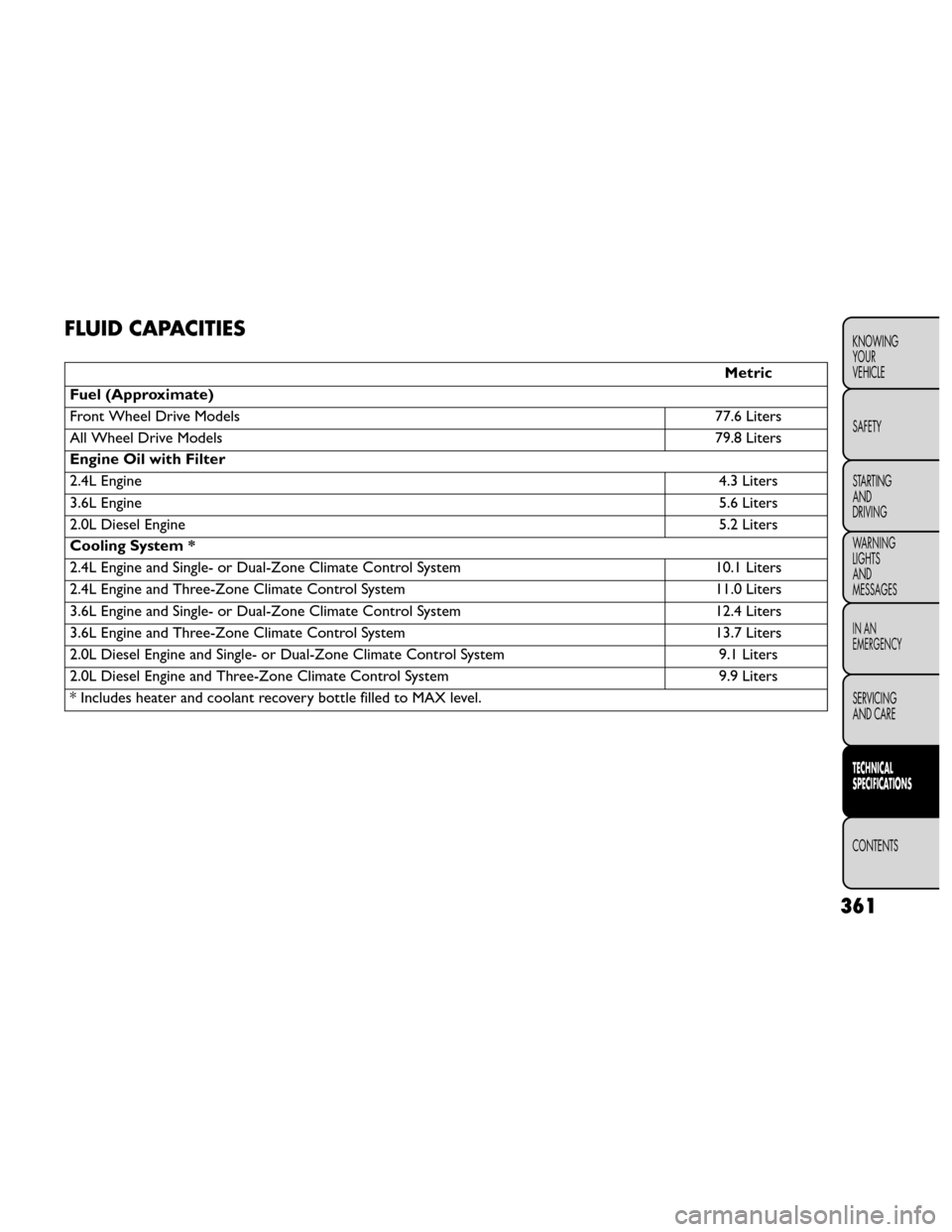
FLUID CAPACITIES
Metric
Fuel (Approximate)
Front Wheel Drive Models 77.6 Liters
All Wheel Drive Models 79.8 Liters
Engine Oil with Filter
2.4L Engine 4.3 Liters
3.6L Engine 5.6 Liters
2.0L Diesel Engine 5.2 Liters
Cooling System *
2.4L Engine and Single- or Dual-Zone Climate Control System 10.1 Liters
2.4L Engine and Three-Zone Climate Control System 11.0 Liters
3.6L Engine and Single- or Dual-Zone Climate Control System 12.4 Liters
3.6L Engine and Three-Zone Climate Control System 13.7 Liters
2.0L Diesel Engine and Single- or Dual-Zone Climate Control System 9.1 Liters
2.0L Diesel Engine and Three-Zone Climate Control System 9.9 Liters
* Includes heater and coolant recovery bottle filled to MAX level.
361
KNOWING
YOUR
VEHICLE
SAFETY
STARTING
AND
DRIVING
WARNING
LIGHTS
AND
MESSAGES
IN AN
EMERGENCY
SERVICING
AND CARE
TECHNICAL
SPECIFICATIONS
CONTENTS
Page 368 of 388
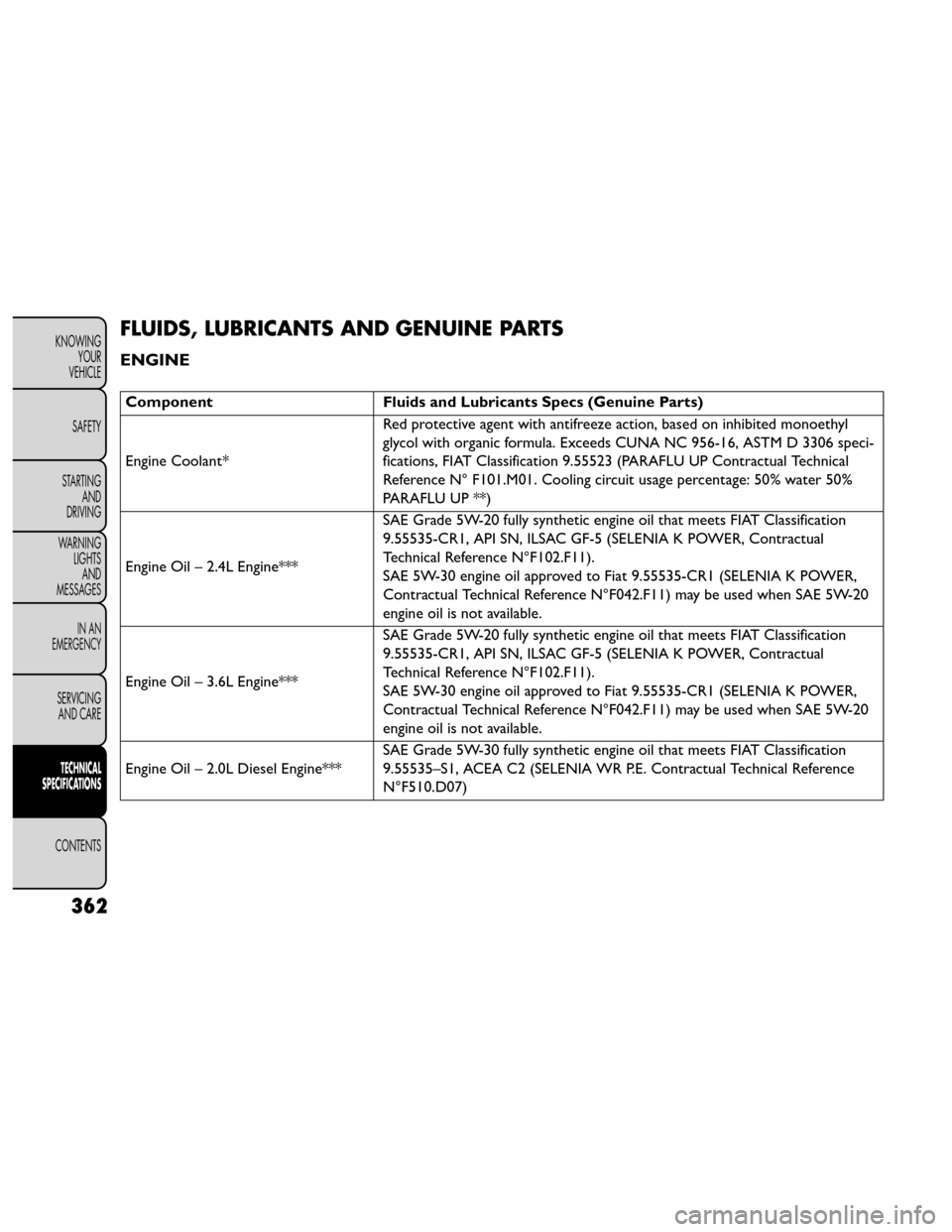
FLUIDS, LUBRICANTS AND GENUINE PARTS
ENGINE
ComponentFluids and Lubricants Specs (Genuine Parts)
Engine Coolant* Red protective agent with antifreeze action, based on inhibited monoethyl
glycol with organic formula. Exceeds CUNA NC 956-16, ASTM D 3306 speci-
fications, FIAT Classification 9.55523 (PARAFLU UP Contractual Technical
Reference N° F101.M01. Cooling circuit usage percentage: 50% water 50%
PARAFLU UP **)
Engine Oil – 2.4L Engine*** SAE Grade 5W-20 fully synthetic engine oil that meets FIAT Classification
9.55535-CR1, API SN, ILSAC GF-5 (SELENIA K POWER, Contractual
Technical Reference N°F102.F11).
SAE 5W-30 engine oil approved to Fiat 9.55535-CR1 (SELENIA K POWER,
Contractual Technical Reference N°F042.F11) may be used when SAE 5W-20
engine oil is not available.
Engine Oil – 3.6L Engine*** SAE Grade 5W-20 fully synthetic engine oil that meets FIAT Classification
9.55535-CR1, API SN, ILSAC GF-5 (SELENIA K POWER, Contractual
Technical Reference N°F102.F11).
SAE 5W-30 engine oil approved to Fiat 9.55535-CR1 (SELENIA K POWER,
Contractual Technical Reference N°F042.F11) may be used when SAE 5W-20
engine oil is not available.
Engine Oil – 2.0L Diesel Engine*** SAE Grade 5W-30 fully synthetic engine oil that meets FIAT Classification
9.55535–S1, ACEA C2 (SELENIA WR P.E. Contractual Technical Reference
N°F510.D07)
362
KNOWING
YOUR
VEHICLE
SAFETY
STARTING AND
DRIVING
WARNING LIGHTSAND
MESSAGES
IN AN
EMERGENCY
SERVICING AND CARE
TECHNICAL
SPECIFICATIONS
CONTENTS
Page 375 of 388
Break-In Recommendations, New Vehicle..........229
Brightness, Interior Lights .....................89
Bulb Replacement ...................... 291, 292
Bulbs, Light ...........................228, 291
Camera, Rear ............................159
Capacities, Fluid ...........................361
Caps, Filler Fuel ................................185
Oil (Engine) ....................320, 322, 325
Power Steering .........................144
Radiator (Coolant Pressure) ................336
Carbon Monoxide Warning ...................226
CargoAreaCover.........................129
Cargo Area Features ........................126
CargoCompartment .......................126 Light ................................126
Luggage Carrier ........................132
Cargo Load Floor ..........................127
Cargo Management System ...................127
Rollaway Tonneau Cover ..................129
Tri-Fold Load Floor ......................127
Cargo Tie-Downs ..........................128
Cargo (Vehicle Loading) ......................127
Cellular Phone ............................184
Chains, Tire .............................357
Checking Your Vehicle For Safety ...............225
Checks, Safety ............................225
Child Restraint ...........................199
Child Safety Locks .........................116
Clean Air Gasoline .........................359
Cleaning Wheels ..............................344 Windshield Wiper Blades
..................330
Coin Holder .............................102
Cold Weather Operation ....................231
Compact Disc (CD) Maintenance ...............184
Compact Spare Tire ........................353
Computer, Trip/Travel ........................28
Connector UCI ............................... .183
Universal Consumer Int
erface (UCI) ...........183
Conserving Fuel ............................27
Console, Floor ...........................102
Console, Overhead .........................98
Coolant Pressure Cap (Radiator Cap) ............336
Cooling System ...........................333
Adding Coolant (Antifreeze) ................335
Coolant Capacity .......................361
Coolant Level ......................334, 336
Diesel Engine ..........................333
Disposal of Used Coolant ..................336
Drain, Flush, and Refill ....................334
Inspection ............................336
Points to Remember .....................337
Pressure Cap ..........................336
Radiator Cap ..........................336
Selection of Coolant (Antifreeze) . . .334, 335, 361, 362
Temperature Gauge .......................8
Corrosion Protection .......................343
Cupholders ..............................109
Data Recorder, Event .......................224
Daytime Brightness, Interior Lights ...............90
Defroster, Rear Window ......................96
Defroster, Windshield ....................78, 227
369
KNOWING
YOUR
VEHICLE
SAFETY
STARTING
AND
DRIVING
WARNING
LIGHTS
AND
MESSAGES
IN AN
EMERGENCY
SERVICING
AND CARE
TECHNICAL
SPECIFICATIONS
CONTENTS
Page 376 of 388
Delay (Intermittent) Wipers...................92
Diagnostic System, Onboard ..................143
Diesel Fuel ...........................360, 362
Diesel Fuel Requirements ....................360
Dimmer Switch, Headlight .....................88
Dipsticks Automatic Transmission ...................340
Oil (Engine) ...........................324
Power Steering .........................144
Disabled Vehicle Towing .....................308
Disposal Antifreeze (Engine Coolant) ................336
Door Locks ..............................113
Door Locks, Automatic ......................115
Downshifting .............................238
Driving Through Flowing, Rising, or Shallow Standing
Water ...............................248
Driving to Achieve Maximum Fuel Economy .........27
Electrical Outlet, Auxiliary (Power Outlet) .........106
Electrical Power Outlets .....................106
Electric Remote Mirrors ......................64
Electronic Brake Control System ...............135
Anti-Lock Brake System ...................134
Brake Assist System ......................137
Electronic Roll Mitigation ..................137
Traction Control System ..................137
Electronic Roll Mitigation (ERM) ................137
Electronic Speed Control (Cruise Control) .........96
Electronic Stability Control (ESC) ...............138
Electronic Vehicle Information Center (EVIC) .....19, 159Emergency, In Case of
Freeing Vehicle When Stuck ................304
Hazard Warning Flasher ...................101
Jump Starting ..........................270
Towing ..............................308
Engine ...........................229, 320, 322
Air Cleaner ...........................326
Break-In Recommendations .................229
Checking Oil Level ......................324
Compartment ......................320, 321
Compartment Identification ................321
Coolant (Antifreeze) .................. 334, 362
Cooling ..............................33 3
Exhaust
Gas Caution .................. 125, 226
Fails to Start ...........................231
Flooded, Starting ........................231
Fuel Requirements .......................358
Jump Starting ..........................270
Oil ..........................324, 361, 362
Oil Change Interval ...................27, 325
Oil Filler Cap ................... 320, 322, 325
Oil Selection ..........................361
Operation ............................229
Starting ..............................229
Temperature Gauge .......................8
Engine Oil Viscosity ........................325
Engine Oil Viscosity Chart ....................325
Enhanced Accident Response Feature ............223
Entry System, Illuminated .....................91
Ethanol .................................358
Event Data Recorder .......................224
Exhaust Gas Caution .................125, 226, 332
Exhaust System ...........................226
370
KNOWING
YOUR
VEHICLE
SAFETY
STARTING AND
DRIVING
WARNING LIGHTSAND
MESSAGES
IN AN
EMERGENCY
SERVICING AND CARE
TECHNICAL
SPECIFICATIONS
CONTENTS
Page 377 of 388
Exterior Folding Mirrors......................65
Exterior Lighting ...........................86
Exterior Lights ............................228
Fabric Care ..............................345
Filler Location Fuel .........................185
Filters Air Cleaner ...........................326
Air Conditioning .....................85, 328
Engine Oil ............................362
Engine Oil Disposal ......................326
Flashers Hazard Warning ........................101
Turn Signal ......................88, 228, 265
Flash-To-Pass .............................89
Flooded Engine Starting ......................231
Floor Console ............................102
Fluid Capacities ...........................361
Fluid Leaks ..............................228
Fluid Level Checks Automatic Transmission ...................340
Brake ...............................338
Cooling System .........................334
Engine Oil ............................324
Power Steering .........................144
Fluids, Lubricants and Genuine Parts .............362
Fog Lights ......................87, 265, 293, 294
Fog Light Service .......................293, 294
Fog Lights, Rear ........................269, 294
Folding Rear Seat ........................54, 58
Freeing A Stuck Vehicle ......................304
Fuel ................................ 358, 360
Adding ..............................185 Additives
.............................359
Conserving ............................27
Diesel ............................360, 362
Ethanol ..............................358
Filler Cap (Gas Cap) .....................185
Gasoline ............................ .358
Gauge .................................7
Light .................................23
Oct
ane Rating ......................358, 362
Requirements ..........................358
SaverMode ............................27
Specifications ..........................362
Tank Capacity ..........................361
Fueling .................................185
Fuel Optimizer ............................27
Fuel Saver ................................27
Fuel System Caution ........................185
Fuses ..................................298
Gas Cap (Fuel Filler Cap) .................143, 185
Gas Gauge (Fuel Gauge) .......................7
Gasoline, Clean Air ........................359
Gasoline (Fuel) ...........................358
Conserving ............................27
Gauges Coolant Temperature ......................8
Fuel ..................................7
Speedometer ............................7
Tachometer .............................7
Gear Ranges .............................241
Gear Select Lever Override ...................303
General Information ...................12, 15, 152
General Maintenance .......................323
371
KNOWING
YOUR
VEHICLE
SAFETY
STARTING
AND
DRIVING
WARNING
LIGHTS
AND
MESSAGES
IN AN
EMERGENCY
SERVICING
AND CARE
TECHNICAL
SPECIFICATIONS
CONTENTS
Page 383 of 388
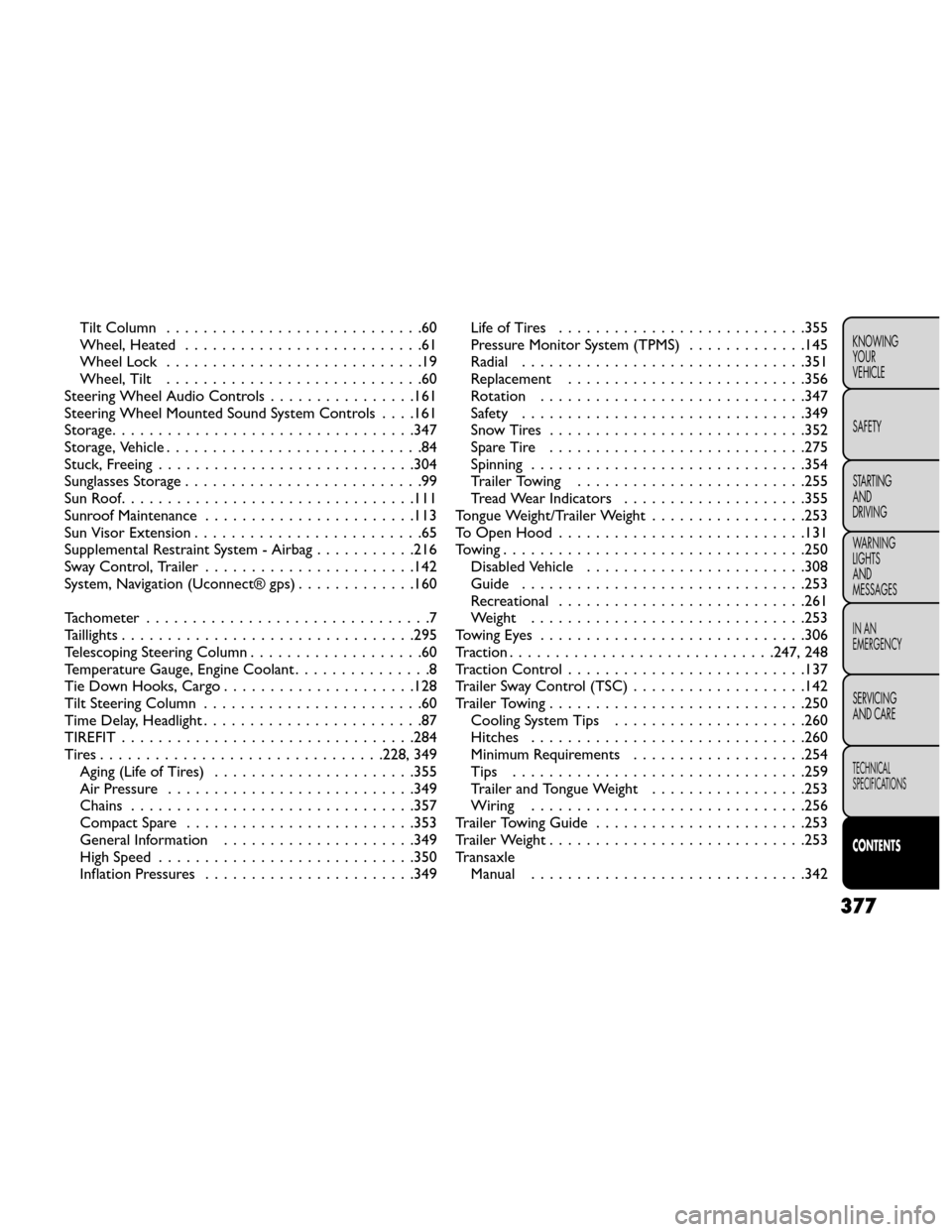
Tilt Column............................60
Wheel, Heated ..........................61
Wheel Lock ............................19
Wheel, Tilt ............................60
Steering Wheel Audio Controls ................161
Steering Wheel Mounted Sound System Controls . . . .161
Storage .................................347
Storage, Vehicle ............................84
Stuck, Freeing ............................304
Sunglasses Storage ..........................99
SunRoof................................111
Sunroof Maintenance .......................113
Sun Visor Extension .........................65
Supplemental Restraint System - Airbag ...........216
Sway Control, Trailer .......................142
System, Navigation (Uconnect® gps) .............160
Tachometer ...............................7
Taillights ................................295
Telescoping Steering Column ...................60
Temperature Gauge, Engine Coolant ...............8
Tie Down Hooks, Cargo .....................128
Tilt Steering Column ........................60
Time Delay, Headlight ........................87
TIREFIT ................................284
Tires...............................228, 349 Aging (Life of Tires) ......................355
Air Pressure ...........................349
Chains ...............................357
Compact Spare .........................353
General Information .....................349
High Speed ............................350
Inflation Pressures .......................349 LifeofTires ...........................355
Pressure Monitor System (TPMS)
.............145
Radial ...............................351
Replacement ..........................356
Rotation .............................347
Safety ...............................349
SnowTires ............................352
Spare Tire ............................275
Spinning ..............................354
Trailer Towing .........................255
Tread Wear Indicators ....................355
Tongue W eight/T
railer Weight .................253
ToOpenHood ...........................131
Towing.................................250 Disabled Vehicle ........................308
Guide ...............................253
Recreational ...........................261
Weight ..............................253
TowingEyes .............................306
Traction ............................. 247, 248
Traction Control ..........................137
Trailer Sway Control (TSC) ...................142
Trailer Towing ............................250
Cooling System Tips .....................260
Hitches ..............................260
Minimum Requirements ...................254
Tips ................................259
Trailer and Tongue Weight .................253
Wiring ..............................256
Trailer Towing Guide .......................253
Trailer Weight ............................253
Transaxle Manual ..............................342
377
KNOWING
YOUR
VEHICLE
SAFETY
STARTING
AND
DRIVING
WARNING
LIGHTS
AND
MESSAGES
IN AN
EMERGENCY
SERVICING
AND CARE
TECHNICAL
SPECIFICATIONS
CONTENTS