technical specifications FIAT FREEMONT 2014 1.G Owners Manual
[x] Cancel search | Manufacturer: FIAT, Model Year: 2014, Model line: FREEMONT, Model: FIAT FREEMONT 2014 1.GPages: 388, PDF Size: 4.13 MB
Page 197 of 388
WARNING!
• A lap belt worn too high can increase
th e
risk of internal injury in a collision.
Thebeltforceswon'tbeatthestronghipand
pelvic bones, but across your abdomen. Always
wear the lap belt as low as possible and keep it
snug.
• A twisted belt may not protect you properly. In
a collision, it could even cut into you. Be sure the
belt is straight . If you can't straighten a belt in
your vehicle, take it to your authorized dealer
immediately and have it fixed.
5. Position the shoulder belt on your chest so that it is comfortable and not resting on your neck. The
retractor will withdraw any slack in the belt.
6. To release the belt, push the red button on the buckle. The belt will automatically retract to its
stowed position. If necessary, slide the latch plate
down the webbing to allow the belt to retract fully.
WARNING!
A frayed or torn belt could rip apart in a
collision an
d leave you with no protec-
tion. Inspect the belt system periodically, check-
ing for cuts, frays, or loose parts. Damaged parts
(Continued)(Continued)
must be replaced immediately. Do not disas-
semble or modify the system. Seat belt assem-
blies must be replaced after a collision if they
have been damaged (bent retractor, torn web-
bing, etc .).
Adjustable Upper Shoulder Belt Anchorage
In the driver's seat and front passenger's seat, the
shoulder belt can be adjusted upward or downward to
position the belt away from your neck. Push and fully
depress the button above the webbing to release the
anchorage, then move it up or down to the position
that fits you best.
(fig. 132)
(fig. 132) Adjusting Upper Shoulder Belt
191
KNOWING
YOUR
VEHICLE
SAFETY
STARTING
AND
DRIVING
WARNING
LIGHTS
AND
MESSAGES
IN AN
EMERGENCY
SERVICING
AND CARE
TECHNICAL
SPECIFICATIONS
CONTENTS
Page 198 of 388
As a guide, if you are shorter than average you will
prefer a lower position and if you are taller than
average you will prefer a higher position. When you
release the anchorage try to move it up and down to
make sure that it is locked in position.
In the rear seat, move toward the center of the seat to
position the belt away from your neck.
Lap/Shoulder Belt Untwisting Procedure
Use the following procedure to untwist a twisted
lap/shoulder belt:
1. Position the latch plate as close as possible to theanchor point.
2. At about 15 to 30 cm above the latch plate, grasp and twist the belt webbing 180 degrees to create a
fold that begins immediately above the latch plate.
3. Slide the latch plate upward over the folded web- bing. The folded webbing must enter the slot at the
top of the latch plate.
4. Continue to slide the latch plate up until it clears the folded webbing.
SEAT BELT PRETENSIONERS
The seat belts for both front seating positions are
equipped with pretensioning devices that are designed
to remove slack from the seat belt in the event of a
collision. These devices may improve the performance of the seat belt by assuring that the belt is tight about
the occupant early in a collision. Pretensioners work
for all size occupants, including those in child restraints.
NOTE:
These devices are not a substitute for proper
seat belt placement by the occupant. The seat belt still
must be worn snugly and positioned properly.
The pretensioners are triggered by the Occupant Re-
straint Controller (ORC). Like the air bags, the preten-
sioners are single use items. A deployed pretensioner
or a deployed air bag must be replaced immediately.
Supplemental Active Head Restraints (AHR)
These head restraints are passive, deployable compo-
nents, and vehicles with this equipment cannot be
readily identified by any markings, only through visual
inspection of the head restraint. The head restraint will
be split in two halves, with the front half being soft
foam and trim, the back half being decorative plastic.
How The Active Head Restraints (AHR) Work
The Occupant Restraint Controller (ORC) determines
whether the severity, or type of rear impact will require
the Active Head Restraints (AHR) to deploy. If a rear
impact requires deployment, both the driver and front
passenger seat AHRs will be deployed.
When AHRs deploy during a rear impact, the front half
of the head restraint extends forward to minimize the
gap between the back of the occupant’s head and the
192
KNOWING YOUR
VEHICLE
SAFETY
STARTING AND
DRIVING
WARNING LIGHTSAND
MESSAGES
IN AN
EMERGENCY
SERVICING AND CARE
TECHNICAL
SPECIFICATIONS
CONTENTS
Page 199 of 388
AHR. This system is designed to help prevent or
reduce the extent of injuries to the driver and front
passenger in certain types of rear impacts.
NOTE:The Active Head Restraints (AHR) may or
may not deploy in the event of a front or side impact.
However if during a front impact, a secondary rear
impact occurs, the AHR may deploy based on several
factors, including the severity and type of the impact.
(fig. 133)
All occupants, including the driver, should
not operate a vehicle or sit in a vehicle's
seat until the head restraints are placed
in their proper positions in order to minimize the
risk of neck injury in the event of a collision.
NOTE: For more information on properly adjusting
and positioning the head restraint, refer to “Adjusting
Active Head Restraints” in “Knowing Your Vehicle”.
(fig. 133)
Active Head Restraint (AHR) Components
1 — Head Restraint Front
Half (Soft Foam and Trim) 3 — Head Restraint Back
Half (Decorative Plastic Rear
Cover)
2 — Seatback
4 — Head Restraint Guide
Tubes
193
KNOWING
YOUR
VEHICLE
SAFETY
STARTING
AND
DRIVING
WARNING
LIGHTS
AND
MESSAGES
IN AN
EMERGENCY
SERVICING
AND CARE
TECHNICAL
SPECIFICATIONS
CONTENTS
Page 200 of 388
Resetting Active Head Restraints (AHR)
If the Active Head Restraints are triggered in a collision,
you must reset the head restraint on the driver’s and
front passenger seat. You can recognize when the
Active Head Restraint has been triggered by the fact
that they have moved forward (as shown in step three
of the resetting procedure).
1. Grasp the deployed AHR from the rear seat.(fig. 134)
2. Position the hands on the top of the deployed AHR at a comfortable position. 3. Pull
downthenrearward towards the rear of the
vehicle then downto engage the locking mecha-
nism. (fig. 135) (fig. 136)
(fig. 134)
Hand Positioning Points On AHR
(fig. 135)
1 — Downward Movement
2 — Rearward Movement
194
KNOWINGYOUR
VEHICLE
SAFETY
STARTING AND
DRIVING
WARNING LIGHTSAND
MESSAGES
IN AN
EMERGENCY
SERVICING AND CARE
TECHNICAL
SPECIFICATIONS
CONTENTS
Page 201 of 388
4. The AHR front soft foam and trim half should lockinto the back decorative plastic half. (fig. 137)
NOTE:
• If you have difficulties or problems resetting the Active Head Restraints, see an authorized dealer.
• For safety reasons, have the Active Head Restraints checked by a qualified specialist at an authorized
dealer. ACTIVE HOOD SYSTEM (for versions/
markets, where provided)
The Active Hood system is intended to enhance pe-
destrian protection by elevating the vehicle’s hood
upon an impact with a pedestrian or other object. The
system is automatically activated when the vehicle is
moving within a specified vehicle speed range. In order
to detect a range of pedestrians, other objects that are
impacted may result in an Active Hood deployment.
Deployment Sensors And Controls
The Electronic Pedestrian Protection Module (EPPM)
determines if deployment of the actuators in a frontal
impact is required. Based on the impact sensors signals,
the EPPM determines when to deploy the actuators.
(fig. 136)
3 — Final Downward Movement To Engage Locking
Mechanism
(fig. 137)
AHR In Reset Position
195
KNOWING
YOUR
VEHICLE
SAFETY
STARTING
AND
DRIVING
WARNING
LIGHTS
AND
MESSAGES
IN AN
EMERGENCY
SERVICING
AND CARE
TECHNICAL
SPECIFICATIONS
CONTENTS
Page 202 of 388
The impact sensors are located within the front bum-
per area.
The EPPM monitors the readiness of the electronic
parts of the Active Hood system whenever the ignition
switch is in the START or ON/RUN position. If the key
is in the LOCK position, in the ACC position, or not in
the ignition, the Active Hood system is not on and the
Active Hood will not deploy.
The EPPM contains a backup power supply system that
may deploy the actuators even if the battery loses
power or it becomes disconnected prior to deploy-
ment.
Service Active Hood System
If the EPPM has deployed the Active Hood, or if it
detects a malfunction in any part of the system, it turns
on the Air Bag Warning Light and it will display the
“SERVICE ACTIVE HOOD” message in the Electronic
Vehicle Information Center (EVIC), for versions/
markets, where provided. A single chime will sound if
the Air Bag Warning Light comes on again after initial
startup. It also includes diagnostics that will illuminate
the Air Bag Warning Light if a malfunction is noted that
could affect the Active Hood system. The diagnostics
also record the nature of the malfunction. If the Air Bag
Warning Light is illuminated, or if “SERVICE ACTIVE
HOOD” appears in the EVIC, see your authorized
dealer.In the event of an Active Hood deployment, the vehicle
should be serviced by an authorized dealer. The hood
hinges must be serviced and the actuator assemblies
replaced to restore system functionality.
Following an Active Hood deployment, the hood posi-
tion can be temporarily reset by pushing down at the
rear edge over the hood hinges as the internal pressure
of each actuator is relieved. The temporary hood reset
position is intended to improve forward driving visibil-
ity over the hood until the vehicle can be serviced. The
temporary hood reset position will leave the hood
approximately 5 mm above the fender surface.
(fig. 138)
(fig. 138)
Temporary Hood Reset Position
196
KNOWINGYOUR
VEHICLE
SAFETY
STARTING AND
DRIVING
WARNING LIGHTSAND
MESSAGES
IN AN
EMERGENCY
SERVICING AND CARE
TECHNICAL
SPECIFICATIONS
CONTENTS
Page 203 of 388
The front bumper assembly may affect proper opera-
tion of the Active Hood system. The front bumper
components should be inspected for damage and re-
placed if necessary in the event of a frontal impact, even
if it occurs at a low rate of speed.
NOTE:After any Active Hood deployment, the ve-
hicle should be taken to an authorized dealer immedi-
ately.
To prevent possible damage, do not slam
the rear of the hood to reset it . Press the
rear of the hood down until an audible
and tactile detent is detected (approximately 5 mm
above the fender). This should secure both hood
hinge reset mechanisms.
WARNING!
•
Ignoring the Air Bag Warning Light in
your instrument panel or the “SERVICE
ACTIVE HOOD” message in the EVIC could mean
you won’t have the Active Hood to enhance pedes-
trian protection. If the light does not come on as a
bulb check when the ignition is first turned on,
stays on after you start the vehicle, or if it comes
on as you drive, see your authorized dealer.
(Continued) (Continued)
• Modifications to any part of the Active Hood
system could cause it to fail when you need it . Do
not modify the components or wiring. Do not
modify the front bumper, vehicle body structure,
or add an aftermarket front bumper or cover.
• It is dangerous to try to repair any part of the
Active Hood system yourself. Be sure to tell any-
one who works on your vehicle that it has an
Active Hood system.
• Do not attempt to modify any part of your
Active Hood system.The Active Hood may deploy
accidentally or may not function properly if
modifications are made. Take your vehicle to an
authorized dealer for any hood service.
• Drivers must be aware of pedestrians. Always
be sure to check for pedestrians, animals, other
vehicles, and obstructions.You are responsible for
safety and must continue to pay attention to
your surroundings. Failure to do so can result in
serious injury or death.
197
KNOWING
YOUR
VEHICLE
SAFETY
STARTING
AND
DRIVING
WARNING
LIGHTS
AND
MESSAGES
IN AN
EMERGENCY
SERVICING
AND CARE
TECHNICAL
SPECIFICATIONS
CONTENTS
Page 204 of 388
Enhanced Seat Belt Use Reminder System
(BeltAlert®)
BeltAlert® is a feature intended to remind the driver
and front passenger (for versions/markets, where pro-
vided with front passenger BeltAlert®) to fasten their
seatbelts. The feature is active whenever the ignition is
on. If the driver or front seat passenger is unbelted, the
Seat Belt Reminder Light will turn on and remain on
until both front seatbelts are fastened.
The BeltAlert® warning sequence begins after the
vehicle speed is over 8 km/h, by blinking the Seat Belt
Reminder Light and sounding an intermittent chime.
Once the sequence starts, it will continue for the
entire duration or until the respective seatbelts are
fastened. After the sequence completes, the Seatbelt
Reminder Light remains illuminated until the respective
seatbelts are fastened. The driver should instruct all
other occupants to fasten their seatbelts. If a front
seatbelt is unbuckled while traveling at speeds greater
than 8 km/h, BeltAlert® will provide both audio and
visual notification.
The front passenger seat BeltAlert® is not active when
the front passenger seat is unoccupied. BeltAlert® may
be triggered when an animal or heavy object is on thefront passenger seat or when the seat is folded flat (for
versions/markets, where provided). It is recommended
that pets be restrained in the rear seat in pet harnesses
or pet carriers that are secured by seat belts, and cargo
is properly stowed.
BeltAlert® can be enabled or disabled by your autho-
rized dealer.
NOTE:
Although BeltAlert® has been deactivated,
the Seat Belt Reminder Light will continue to illuminate
while the driver’s or front passenger (for versions/
markets, where provided with BeltAlert®) seat belt
remains unfastened.
Seat Belts And Pregnant Women
We recommend that pregnant women use the seat
belts throughout their pregnancy. Keeping the mother
safe is the best way to keep the baby safe.
Pregnant women should wear the lap part of the belt
across the thighs and as snug across the hips as pos-
sible. Keep the belt low so that it does not come across
the abdomen. That way the strong bones of the hips
will take the force if there is a collision.
198
KNOWING YOUR
VEHICLE
SAFETY
STARTING AND
DRIVING
WARNING LIGHTSAND
MESSAGES
IN AN
EMERGENCY
SERVICING AND CARE
TECHNICAL
SPECIFICATIONS
CONTENTS
Page 205 of 388
Child Restraints
(fig. 139)
Everyone in your vehicle needs to be buckled up at all
times, including babies and children.
Children 12 years or younger should ride properly
buckled up in a rear seat, if available. According to crash
statistics, children are safer when properly restrained
in the rear seats rather than in the front.
There are different sizes and types of restraints for
children from newborn size to the child almost large
enough for an adult safety belt. Always check the child
seat Owner’s Manual to make sure you have the cor-
rect seat for your child.Before buying any restraint system, make sure that it
has a label certifying that it meets all applicable Safety
Standards. You should also make sure that you can
install it in the vehicle where you will use it.
WARNING!
• “Extreme Hazard! Do not use a
rearw ard-f
acing child restraint on a seat
protected by an air bag in front of it!” Refer to
visor and door shut face mounted labels for infor-
mation.
• In a collision, an unrestrained child, even a tiny
baby, can become a projectile inside the vehicle.
The force required to hold even an infant on your
lap could become so great that you could not
hold the child, no matter how strong you are.
The child and others could be badly injured. Any
child riding in your vehicle should be in a proper
restraint for the child's size.
(fig. 139)
199
KNOWING
YOUR
VEHICLE
SAFETY
STARTING
AND
DRIVING
WARNING
LIGHTS
AND
MESSAGES
IN AN
EMERGENCY
SERVICING
AND CARE
TECHNICAL
SPECIFICATIONS
CONTENTS
Page 206 of 388
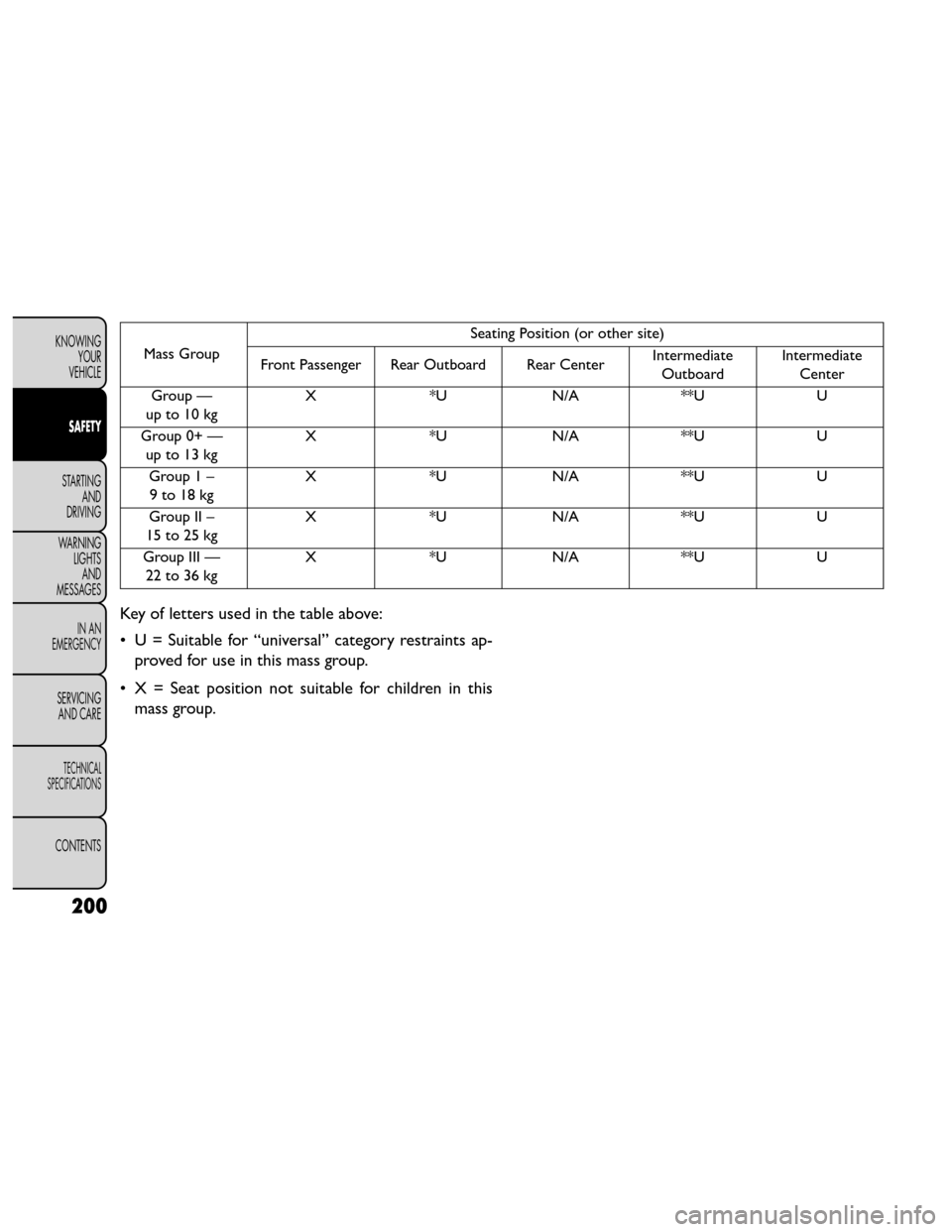
Mass GroupSeating Position (or other site)
Front Passenger Rear Outboard Rear Center Intermediate
Outboard Intermediate
Center
Group —
up to 10 kg X
*UN/A **U U
Group 0+ — up to 13 kg X
*UN/A **U U
Group1– 9to18kg X
*UN/A **U U
Group II –
15 to 25 kg X
*UN/A **U U
Group III — 22 to 36 kg X
*UN/A **U U
Key of letters used in the table above:
• U = Suitable for “universal” category restraints ap-
proved for use in this mass group.
• X = Seat position not suitable for children in this mass group.
200
KNOWING YOUR
VEHICLE
SAFETY
STARTING AND
DRIVING
WARNING LIGHTSAND
MESSAGES
IN AN
EMERGENCY
SERVICING AND CARE
TECHNICAL
SPECIFICATIONS
CONTENTS