seats FIAT FREEMONT 2014 1.G Owner's Manual
[x] Cancel search | Manufacturer: FIAT, Model Year: 2014, Model line: FREEMONT, Model: FIAT FREEMONT 2014 1.GPages: 388, PDF Size: 4.13 MB
Page 135 of 388
RETRACTABLE CARGO AREA COVER
(for versions/markets, where provided) —
FIVE PASSENGER MODELS
NOTE:The purpose of this cover is for privacy, not to
secure loads. It will not prevent cargo from shifting or
protect passengers from loose cargo.
The removable retractable cargo area cover mounts in
the cargo area behind the top of the rear seats.
The cover, when extended, covers the cargo area to
keep items out of sight. Notches in the trim panels near
the liftgate opening secure the extended cover in place.
The cover rolls away neatly inside its housing when not
in use. You can also remove the cover from the vehicle
to make more room in the cargo area. To install the cover, position it in the vehicle so that the
flat side of the housing faces upward. Then, insert
either the left or the right spring-loaded post (located
on the ends of the cover housing) into the left attach-
ment point or the right attachment point (shown).
(fig. 109)
(fig. 109)
Installing Retractable Cargo Area Cover
129
KNOWING
YOUR
VEHICLE
SAFETY
STARTING
AND
DRIVING
W
ARNING
LIGHTS
AND
MESSAGES
IN AN
EMERGENCY
SERVICING
AND CARE
TECHNICAL
SPECIFICATIONS
CONTENTS
Page 193 of 388
SAFETY
OCCUPANT RESTRAINTS
Some of the most important safety features in your
vehicle are the restraint systems:
• Three-point lap and shoulder belts for all seatingpositions
•
Advanced Front Air Bags for driver and front passenger
• Supplemental Active Head Restraints (AHR) located on top of the front seats (integrated into the head
restraint) (for versions/markets, where provided)
• Supplemental Side Air Bag Inflatable Curtains (SABIC) that span the front, second, and third row
seating for the driver and passengers seated next to
a window
• Supplemental Seat-Mounted Side Air Bags
• An energy-absorbing steering column and steering wheel
• Knee bolsters/blockers for front seat occupants
• Front seat belts incorporate pretensioners that may enhance occupant protection by managing occupant
energy during an impact event
If you will be carrying children too small for adult-sized
seat belts, the seat belts or ISOFIX feature also can
be used to hold infant and child restraint systems. For more information, refer to ISOFIX — Child Seat
Anchorage System.
NOTE:
The Advanced Front Air Bags have a multi-
stage inflator design. This allows the air bag to have
different rates of inflation based on several factors,
including the severity and type of collision.
Please pay close attention to the information in this
section. It tells you how to use your restraint system
properly, to keep you and your passengers as safe as
possible.
WARNING!
In a collision, you and your passengers
can suff er
much greater injuries if you
are not properly buckled up. You can strike the
interior of your vehicle or other passengers, or
you can be thrown out of the vehicle. Always be
sure you and others in your vehicle are buckled
up properly.
Buckle up even though you are an excellent driver, even
on short trips. Someone on the road may be a poor
driver and cause a collision that includes you. This can
happen far away from home or on your own street.
187
KNOWING
YOUR
VEHICLE
SAFETY
STARTING
AND
DRIVING
WARNING
LIGHTS
AND
MESSAGES
IN AN
EMERGENCY
SERVICING
AND CARE
TECHNICAL
SPECIFICATIONS
CONTENTS
Page 194 of 388
Research has shown that seat belts save lives, and they
can reduce the seriousness of injuries in a collision.
Some of the worst injuries happen when people are
thrown from the vehicle. Seat belts reduce the possi-
bility of ejection and the risk of injury caused by striking
the inside of the vehicle. Everyone in a motor vehicle
should be belted at all times.
Lap/Shoulder Belts
All seating positions in your vehicle are equipped with
a combination lap/shoulder belt.
The belt webbing retractor is designed to lock during
very sudden stops or impacts. This feature allows the
shoulder part of the belt to move freely with you under
normal conditions. However, in a collision, the belt will
lock and reduce your risk of striking the inside of the
vehicle or being thrown out.
WARNING!
• It is dangerous to ride in a cargo area,
inside or
outside of a vehicle. In a colli-
sion, people riding in these areas are more likely
to be seriously injured or killed.
• Donotallowpeopletorideinanyareaofyour
vehicle that is not equipped with seats and seat
belts.
(Continued)(Continued)
• Be sure everyone in your vehicle is in a seat and
using a seat belt properly.
• Wearing a seat belt incorrectly is dangerous.
Seat belts are designed to go around the large
bones of your body.These are the strongest parts
of your body and can take the forces of a collision
the best . Wearing your belt in the wrong place
could make your injuries in a collision much
worse. You might suffer internal injuries, or you
could even slide out of part of the belt . Follow
these instructions to wear your seat belt safely
and to keep your passengers safe, too.
• Two people should never be belted into a single
seat belt . People belted together can crash into
one another in a collision, hurting one another
badly. Never use a lap/shoulder belt or a lap belt
for more than one person, no matter what their
size.
188
KNOWING YOUR
VEHICLE
SAFETY
STARTING AND
DRIVING
WARNING LIGHTSAND
MESSAGES
IN AN
EMERGENCY
SERVICING AND CARE
TECHNICAL
SPECIFICATIONS
CONTENTS
Page 205 of 388
Child Restraints
(fig. 139)
Everyone in your vehicle needs to be buckled up at all
times, including babies and children.
Children 12 years or younger should ride properly
buckled up in a rear seat, if available. According to crash
statistics, children are safer when properly restrained
in the rear seats rather than in the front.
There are different sizes and types of restraints for
children from newborn size to the child almost large
enough for an adult safety belt. Always check the child
seat Owner’s Manual to make sure you have the cor-
rect seat for your child.Before buying any restraint system, make sure that it
has a label certifying that it meets all applicable Safety
Standards. You should also make sure that you can
install it in the vehicle where you will use it.
WARNING!
• “Extreme Hazard! Do not use a
rearw ard-f
acing child restraint on a seat
protected by an air bag in front of it!” Refer to
visor and door shut face mounted labels for infor-
mation.
• In a collision, an unrestrained child, even a tiny
baby, can become a projectile inside the vehicle.
The force required to hold even an infant on your
lap could become so great that you could not
hold the child, no matter how strong you are.
The child and others could be badly injured. Any
child riding in your vehicle should be in a proper
restraint for the child's size.
(fig. 139)
199
KNOWING
YOUR
VEHICLE
SAFETY
STARTING
AND
DRIVING
WARNING
LIGHTS
AND
MESSAGES
IN AN
EMERGENCY
SERVICING
AND CARE
TECHNICAL
SPECIFICATIONS
CONTENTS
Page 209 of 388
• X = ISOFIX position not suitable for ISOFIX childrestraint systems in this mass group and / or this size
class.
• * = Seats in front of child restraint seats may need to be adjusted forward to install the child restraint seat.
• ** = No access to 3rd row seating positions if Carrycot is installed in vehicle.There are different sizes and types of restraints for
children from newborn size to the child almost large
enough for an adult safety belt. Always check the child
seat Owner's Manual to ensure you have the correct seat
for your child. Before buying any restraint system, make
sure that it has a label certifying that it meets all appli-
cable Safety Standards. You should also make sure that
you can install it in the vehicle where you will use it.
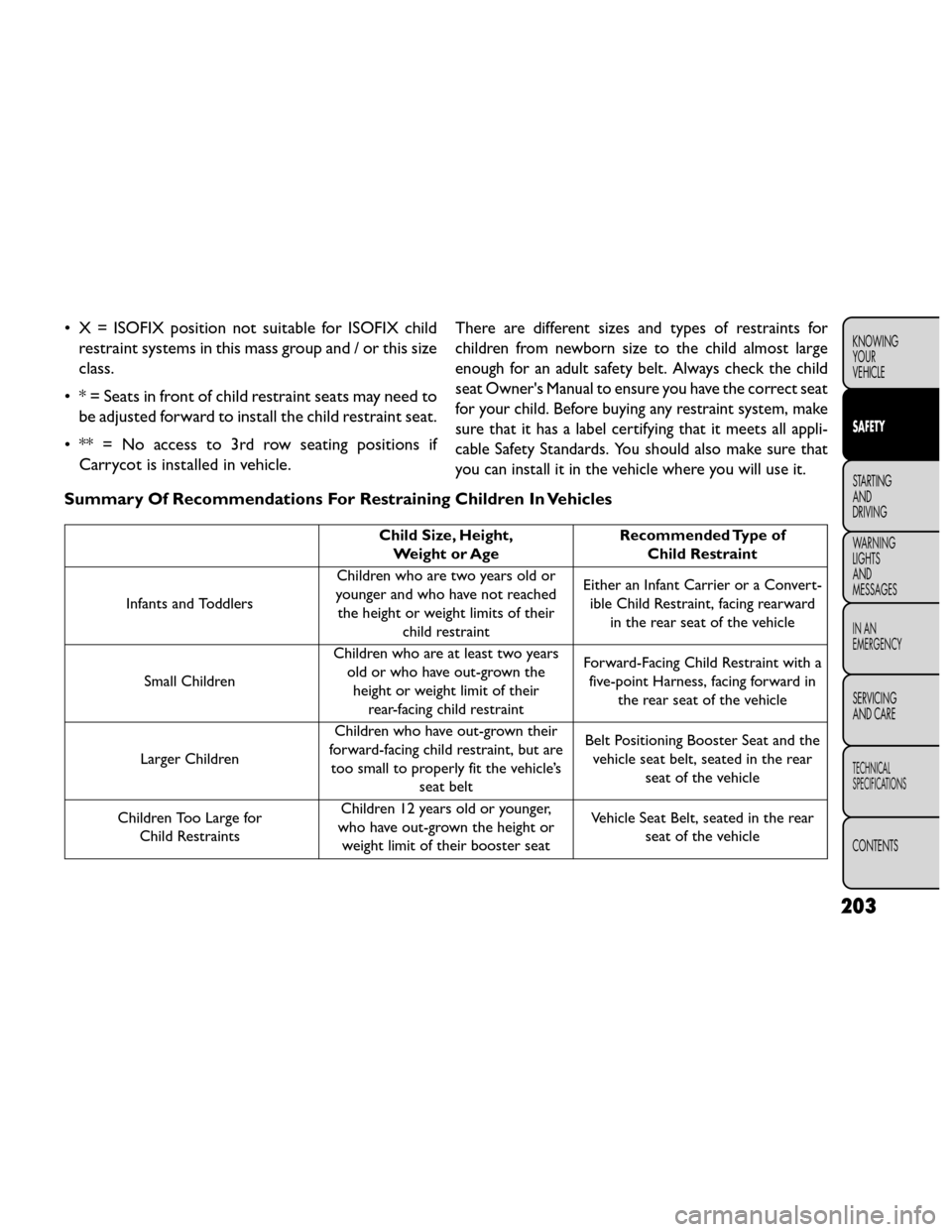
Summary Of Recommendations For Restraining Children In Vehicles
Child Size, Height,
Weight or Age Recommended Type of
Child Restraint
Infants and Toddlers Children who are two years old or
younger and who have not reached the height or weight limits of their child restraint Either an Infant Carrier or a Convert-
ible Child Restraint, facing rearward in the rear seat of the vehicle
Small Children Children who are at least two years
old or who have out-grown theheight or weight limit of their rear-facing child restraint Forward-Facing Child Restraint with a
five-point Harness, facing forward in the rear seat of the vehicle
Larger Children Children who have out-grown their
forward-facing child restraint, but are too small to properly fit the vehicle’s seat belt Belt Positioning Booster Seat and the
vehicle seat belt, seated in the rear seat of the vehicle
Children Too Large for Child Restraints Children 12 years old or younger,
who have out-grown the height or weight limit of their booster seat Vehicle Seat Belt, seated in the rear
seat of the vehicle
203
KNOWING
YOUR
VEHICLE
SAFETY
STARTING
AND
DRIVING
WARNING
LIGHTS
AND
MESSAGES
IN AN
EMERGENCY
SERVICING
AND CARE
TECHNICAL
SPECIFICATIONS
CONTENTS
Page 210 of 388
Infants And Child Restraints
Safety experts recommend that children ride
rearward-facing in the vehicle until they are two years
old or until they reach either the height or weight limit
of their rear facing child safety seat. Two types of child
restraints can be used rearward-facing: infant carriers
and convertible child seats.
The infant carrier is only used rearward-facing in the
vehicle. It is recommended for children from birth until
they reach the weight or height limit of the infant
carrier. Convertible child seats can be used either
rearward-facing or forward-facing in the vehicle. Con-
vertible child seats often have a higher weight limit in
the rearward-facing direction than infant carriers do, so
they can be used rearward-facing by children who have
outgrown their infant carrier but are still less than at
least two years old. Children should remain rearward-
facing until they reach the highest weight or height
allowed by their convertible child seat.WARNING!
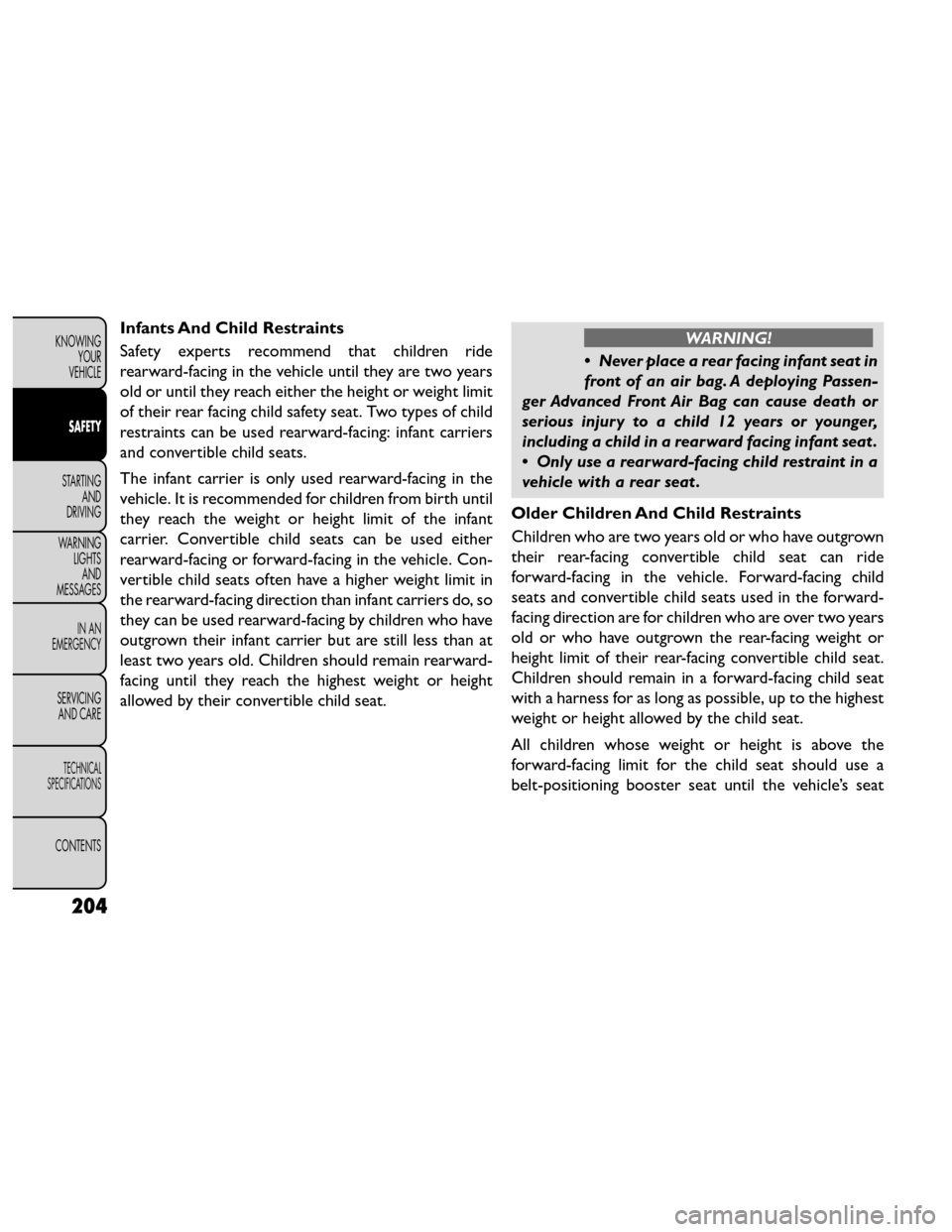
• Never place a rear facing infant seat in
front of
an air bag. A deploying Passen-
ger Advanced Front Air Bag can cause death or
serious injury to a child 12 years or younger,
including a child in a rearward facing infant seat .
• Only use a rearward-facing child restraint in a
vehicle with a rear seat .
Older Children And Child Restraints
Children who are two years old or who have outgrown
their rear-facing convertible child seat can ride
forward-facing in the vehicle. Forward-facing child
seats and convertible child seats used in the forward-
facing direction are for children who are over two years
old or who have outgrown the rear-facing weight or
height limit of their rear-facing convertible child seat.
Children should remain in a forward-facing child seat
with a harness for as long as possible, up to the highest
weight or height allowed by the child seat.
All children whose weight or height is above the
forward-facing limit for the child seat should use a
belt-positioning booster seat until the vehicle’s seat
204
KNOWING YOUR
VEHICLE
SAFETY
STARTING AND
DRIVING
WARNING LIGHTSAND
MESSAGES
IN AN
EMERGENCY
SERVICING AND CARE
TECHNICAL
SPECIFICATIONS
CONTENTS
Page 213 of 388
WARNING!
Securely lock the seat cushion into posi-
tion bef
ore using the seat . Otherwise,
the seat will not provide the proper stability for
child seats and/or passengers. An improperly
latched seat cushion could cause serious injury.
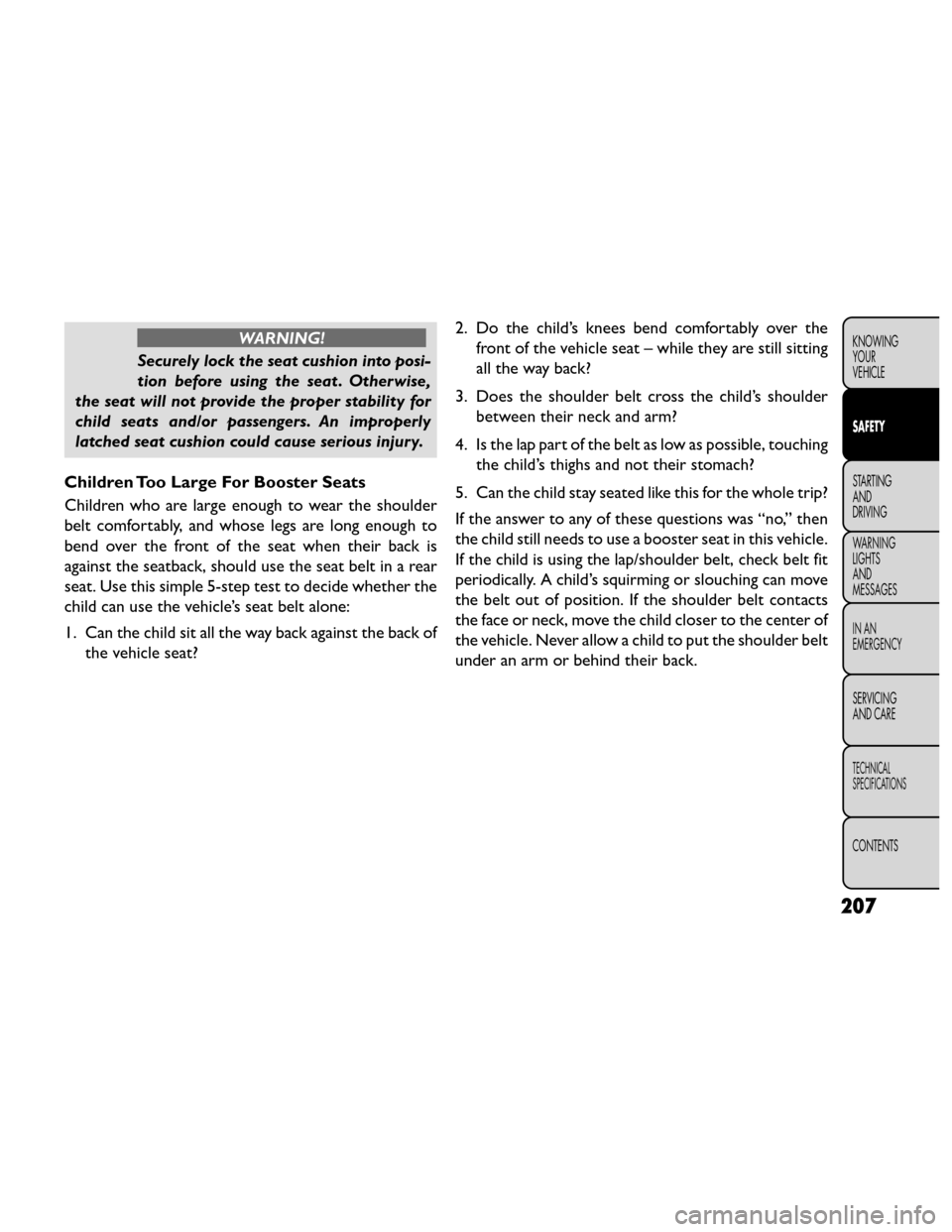
Children Too Large For Booster Seats
Children who are large enough to wear the shoulder
belt comfortably, and whose legs are long enough to
bend over the front of the seat when their back is
against the seatback, should use the seat belt in a rear
seat. Use this simple 5-step test to decide whether the
child can use the vehicle’s seat belt alone:
1. Can the child sit all the way back against the back of the vehicle seat? 2. Do the child’s knees bend comfortably over the
front of the vehicle seat – while they are still sitting
all the way back?
3. Does the shoulder belt cross the child’s shoulder between their neck and arm?
4. Is the lap part of the belt as low as possible, touching the child’s thighs and not their stomach?
5. Can the child stay seated like this for the whole trip?
If the answer to any of these questions was “no,” then
the child still needs to use a booster seat in this vehicle.
If the child is using the lap/shoulder belt, check belt fit
periodically. A child’s squirming or slouching can move
the belt out of position. If the shoulder belt contacts
the face or neck, move the child closer to the center of
the vehicle. Never allow a child to put the shoulder belt
under an arm or behind their back.
207
KNOWING
YOUR
VEHICLE
SAFETY
STARTING
AND
DRIVING
WARNING
LIGHTS
AND
MESSAGES
IN AN
EMERGENCY
SERVICING
AND CARE
TECHNICAL
SPECIFICATIONS
CONTENTS
Page 214 of 388
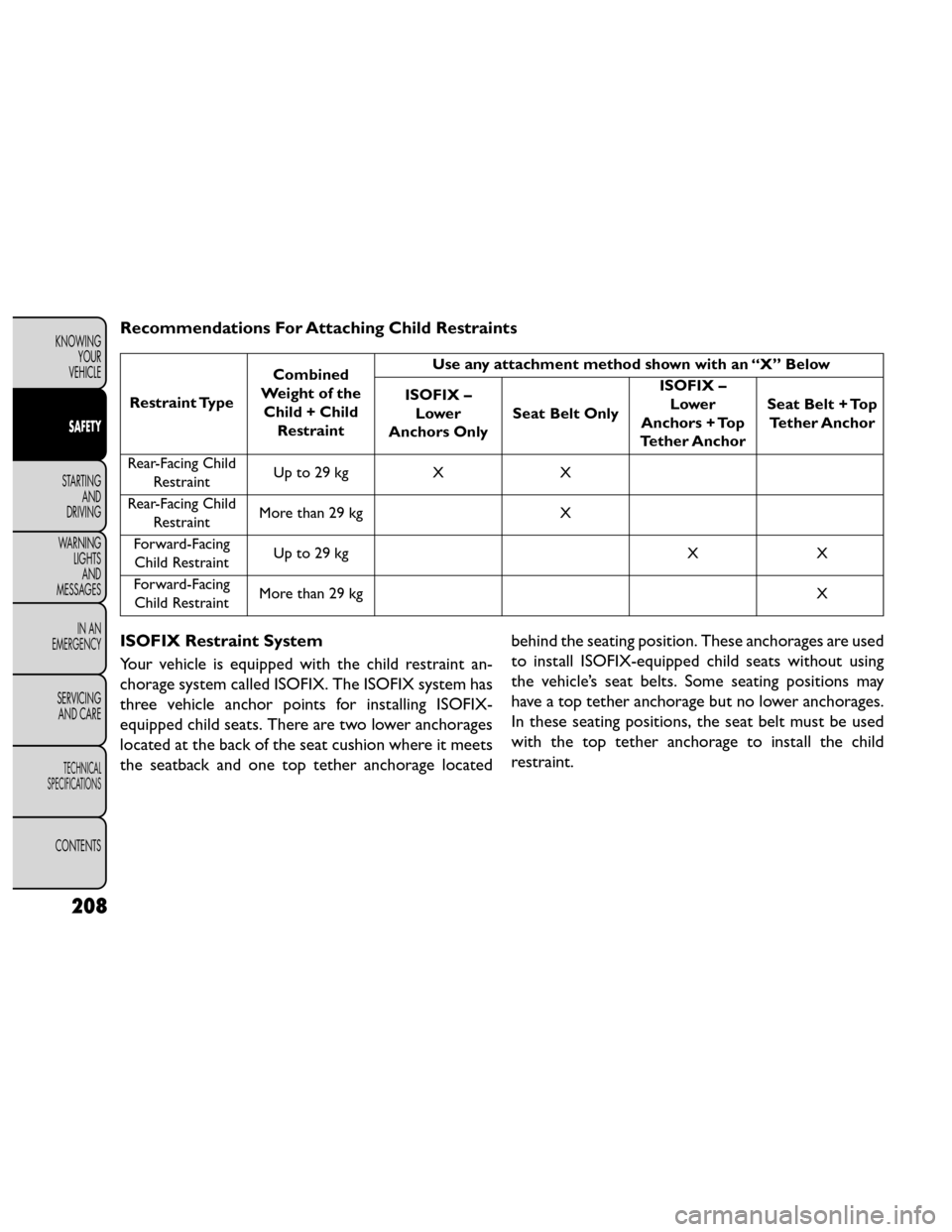
Recommendations For Attaching Child Restraints
Restraint TypeCombined
Weight of the Child + Child Restraint Use any attachment method shown with an “X” Below
ISOFIX – Lower
Anchors Only Seat Belt Only ISOFIX –
Lower
Anchors + Top
Tether Anchor Seat Belt + Top
Tether Anchor
Rear-Facing Child Restraint Up to 29 kg
XX
Rear-Facing Child Restraint More than 29 kg
X
Forward-Facing Child Restraint Up to 29 kg
XX
Forward-Facing Child Restraint More than 29 kg
X
ISOFIX Restraint System
Your vehicle is equipped with the child restraint an-
chorage system called ISOFIX. The ISOFIX system has
three vehicle anchor points for installing ISOFIX-
equipped child seats. There are two lower anchorages
located at the back of the seat cushion where it meets
the seatback and one top tether anchorage locatedbehind the seating position. These anchorages are used
to install ISOFIX-equipped child seats without using
the vehicle’s seat belts. Some seating positions may
have a top tether anchorage but no lower anchorages.
In these seating positions, the seat belt must be used
with the top tether anchorage to install the child
restraint.
208
KNOWING
YOUR
VEHICLE
SAFETY
STARTING AND
DRIVING
WARNING LIGHTSAND
MESSAGES
IN AN
EMERGENCY
SERVICING AND CARE
TECHNICAL
SPECIFICATIONS
CONTENTS
Page 216 of 388
Center Seat ISOFIX
This vehicle has 5 lower ISOFIX anchorages in the rear
seat. Anchorages A and B are used for the right out-
board position behind the front passenger (1). Anchor-
ages D and E are used for the left outboard position
behind the driver (3). Anchorages B and C are used for
the center seating position (2). Do not install an ISO-
FIX child restraint using anchorages C and D. This is
not a ISOFIX position in your vehicle.
You can install up to two child seats using the ISOFIX
system at the same time. If you are installing three child
restraints, you must use the seatbelt to install the
center child restraint. You can use either the ISOFIX
anchors for positions (1) and (3) or the vehicle’s seat
belt for installing the child seats in the outboard posi-
tions.
(fig. 145)
Options for installing two child seats using the ISOFIX
anchorages in this vehicle:
1. Right and left outboard seating positions (1 and 3):Install the child seats in the right and left outboard
seating positions using lower anchorages A and B,
and D and E. Do not use the center seat anchorage,
C. If the child seats do not block the center seat belt
webbing and buckle, the center seat belt can be
used to restraint an occupant or child restraint in
the center seating position.
2. Left outboard and center seating positions (3 and 2): Install the first child seat in the left outboard seating
position using lower anchorages D and E. Install the
second child seat using the center anchorages, B and
C. Do not use the outer anchorage closest to the
opposite door, A. Do not use the remaining right
outboard seating position (1) for any occupant. The
center child restraint will block the seat belt buckle
for this position.
(fig. 145)
210
KNOWING YOUR
VEHICLE
SAFETY
STARTING AND
DRIVING
WARNING LIGHTSAND
MESSAGES
IN AN
EMERGENCY
SERVICING AND CARE
TECHNICAL
SPECIFICATIONS
CONTENTS
Page 217 of 388
WARNING!
• UseanchoragesBandCtoinstalla
ISOFIX child
restraint in the center seat-
ing position (2). Do not install a ISOFIX child
restraint using anchorages C and D.This is not an
ISOFIX position in your vehicle.
• A child restraint installed in the center position
(2) will block the seat belt buckle for the empty
right outboard seating position (1). Do not use
this seat for another occupant .
• Never use the same lower anchorage to attach
more than one child restraint .
• If you are installing three child restraints next
to each other, you must use the seat belt and the
center tether anchor for the center position.You
can then use either the ISOFIX anchors or the
vehicle’s seat belt for installing the child seats in
the outboard positions. Please refer to “Installing
the ISOFIX Child Restraint System” for typical
installation instructions.
Always follow the directions of the child restraint
manufacturer when installing your child restraint. Not
all child restraint systems will be installed as described
here. To Install An ISOFIX Child Restraint:
1. If the selected seating position has a Switchable
Automatic Locking Retractor (ALR) seat belt, stow
the seat belt, following the instructions below. See
the section “Installing Child Restraints Using the
Vehicle Seat Belt” to check what type of seat belt
each seating position has.
2. Loosen the adjusters on the lower connectors and on the tether strap of the child seat so that you can
more easily attach the connectors to the vehicle
anchorages.
3. Place the child seat between the lower anchorages for that seating position. For some second row
seats, you may need to recline the seat and / or raise
the head restraint to get a better fit. If the rear seat
can be moved forward and rearward in the vehicle,
you may wish to move it to its rear-most position to
make room for the child seat. You may also move
the front seat forward to allow more room for the
car seat.
4. Attach the connectors of the child restraint to the lower anchorages in the selected seating position.
211
KNOWING
YOUR
VEHICLE
SAFETY
STARTING
AND
DRIVING
WARNING
LIGHTS
AND
MESSAGES
IN AN
EMERGENCY
SERVICING
AND CARE
TECHNICAL
SPECIFICATIONS
CONTENTS