technical specifications FIAT FREEMONT 2014 1.G Owners Manual
[x] Cancel search | Manufacturer: FIAT, Model Year: 2014, Model line: FREEMONT, Model: FIAT FREEMONT 2014 1.GPages: 388, PDF Size: 4.13 MB
Page 307 of 388
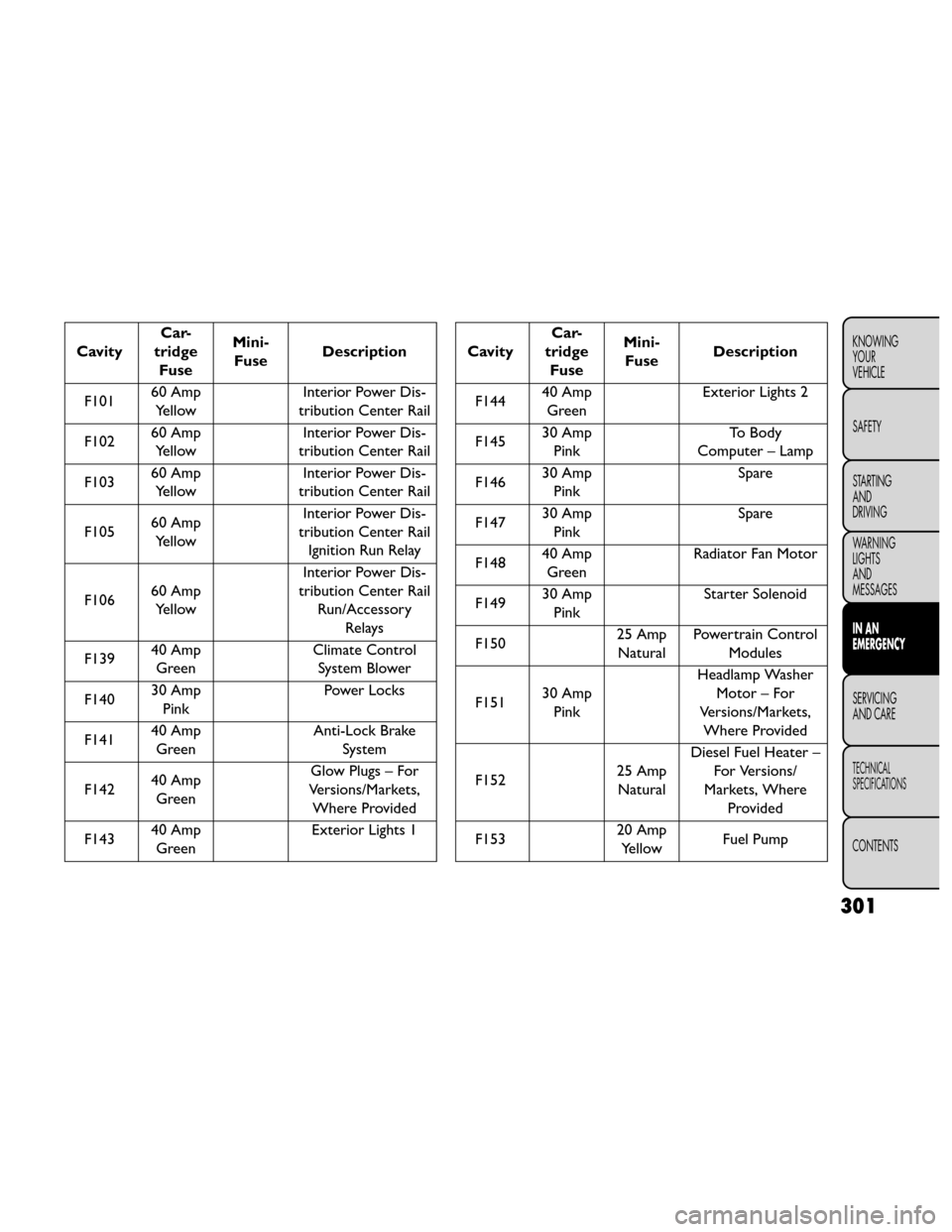
CavityCar-
tridge Fuse Mini-
Fuse Description
F101 60 Amp
Yellow Interior Power Dis-
tribution Center Rail
F102 60 Amp
Yellow Interior Power Dis-
tribution Center Rail
F103 60 Amp
Yellow Interior Power Dis-
tribution Center Rail
F105 60 Amp
Yellow Interior Power Dis-
tribution Center Rail Ignition Run Relay
F106 60 Amp
Yellow Interior Power Dis-
tribution Center Rail Run/Accessory Relays
F139 40 Amp
Green Climate Control
System Blower
F140 30 Amp
Pink Power Locks
F141 40 Amp
Green Anti-Lock Brake
System
F142 40 Amp
Green Glow Plugs – For
Versions/Markets, Where Provided
F143 40 Amp
Green Exterior Lights 1CavityCar-
tridge Fuse Mini-
Fuse Description
F144 40 Amp
Green Exterior Lights 2
F145 30 Amp
Pink To Body
Computer – Lamp
F146 30 Amp
Pink Spare
F147 30 Amp
Pink Spare
F148 40 Amp
Green Radiator Fan Motor
F149 30 Amp
Pink Starter Solenoid
F150 25 Amp
Natural Powertrain Control
Modules
F151 30 Amp
Pink Headlamp Washer
Motor–For
Versions/Markets, Where Provided
F152 25 Amp
Natural Diesel Fuel Heater –
For Versions/
Markets, Where Provided
F153 20 Amp
Yellow Fuel Pump
301
KNOWING
YOUR
VEHICLE
SAFETY
STARTING
AND
DRIVING
WARNING
LIGHTS
AND
MESSAGES
IN AN
EMERGENCY
SERVICING
AND CARE
TECHNICAL
SPECIFICATIONS
CONTENTS
Page 308 of 388
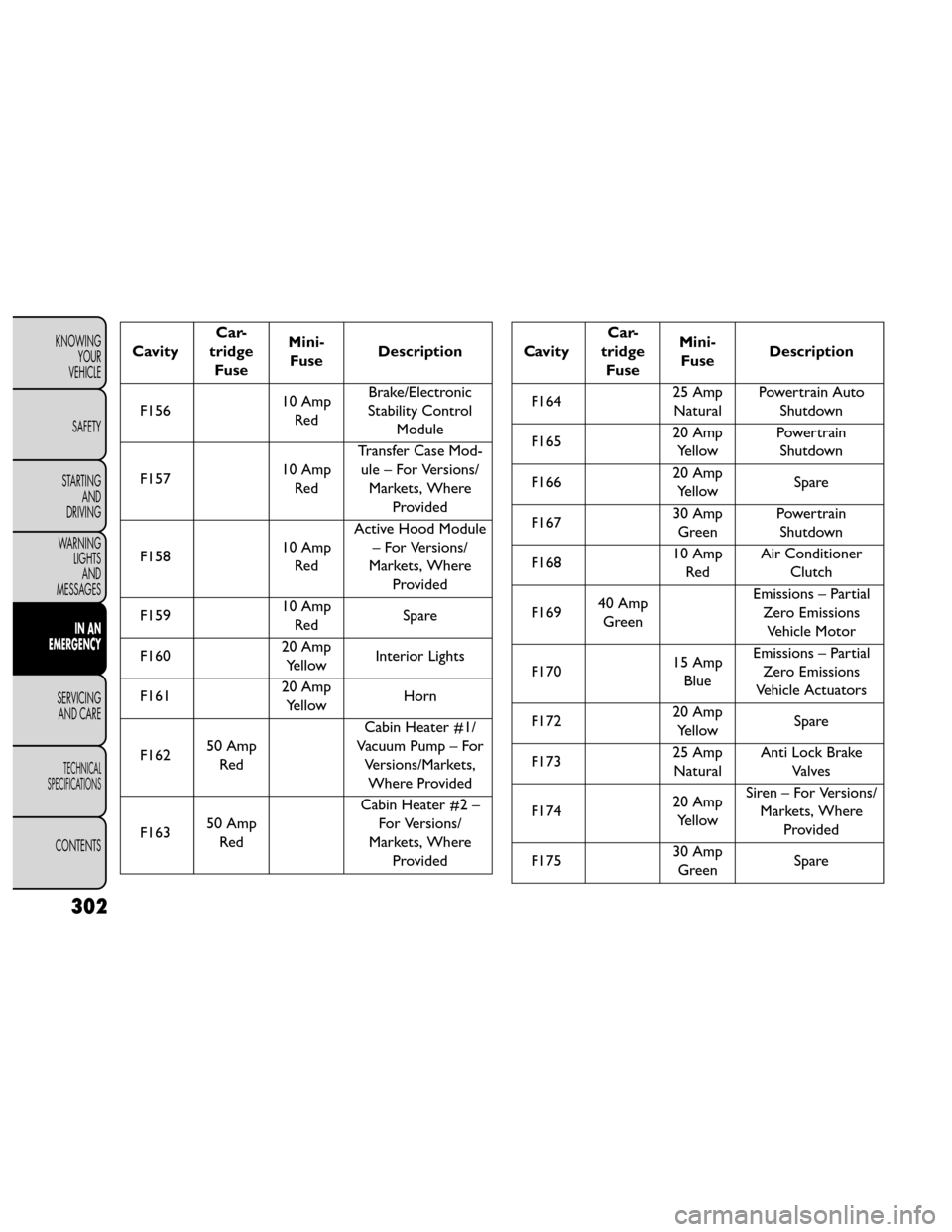
CavityCar-
tridge Fuse Mini-
Fuse Description
F156 10 Amp
Red Brake/Electronic
Stability Control Module
F157 10 Amp
Red Transfer Case Mod-
ule – For Versions/ Markets, Where Provided
F158 10 Amp
Red Active Hood Module
– For Versions/
Markets, Where Provided
F159 10 Amp
Red Spare
F160 20 Amp
Yellow Interior Lights
F161 20 Amp
Yellow Horn
F162 50 Amp
Red Cabin Heater #1/
Vacuum Pump – For Versions/Markets,Where Provided
F163 50 Amp
Red Cabin Heater #2 –
For Versions/
Markets, Where ProvidedCavity Car-
tridge Fuse Mini-
Fuse Description
F164 25 Amp
Natural Powertrain Auto
Shutdown
F165 20 Amp
Yellow Powertrain
Shutdown
F166 20 Amp
Yellow Spare
F167 30 Amp
Green Powertrain
Shutdown
F168 10 Amp
Red Air Conditioner
Clutch
F169 40 Amp
Green Emissions – Partial
Zero EmissionsVehicle Motor
F170 15 Amp
Blue Emissions – Partial
Zero Emissions
Vehicle Actuators
F172 20 Amp
Yellow Spare
F173 25 Amp
Natural Anti Lock Brake
Va l ve s
F174 20 Amp
Yellow Siren – For Versions/
Markets, Where Provided
F175 30 Amp
Green Spare
302
KNOWING
YOUR
VEHICLE
SAFETY
STARTING AND
DRIVING
WARNING LIGHTSAND
MESSAGES
IN AN
EMERGENCY
SERVICING AND CARE
TECHNICAL
SPECIFICATIONS
CONTENTS
Page 309 of 388
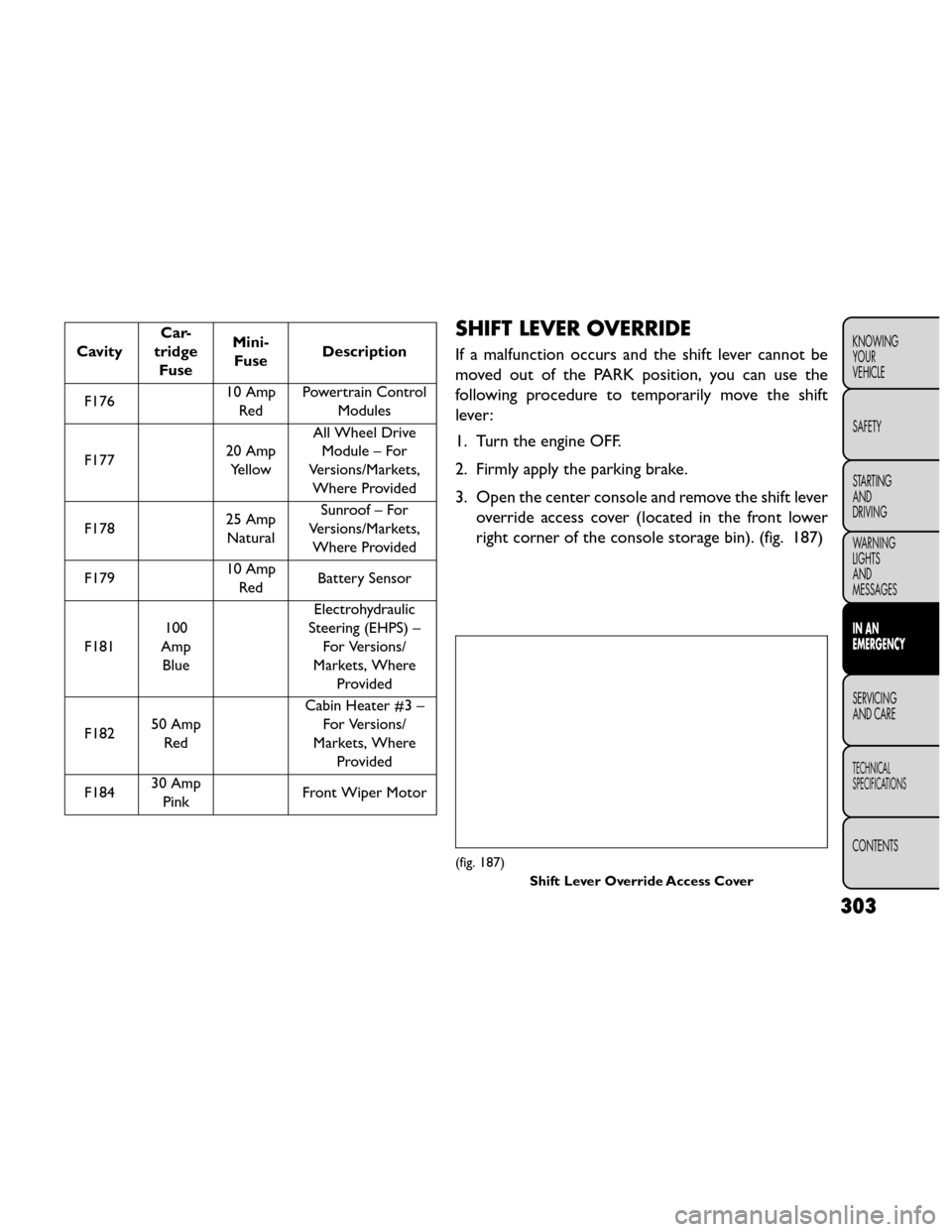
CavityCar-
tridge Fuse Mini-
Fuse Description
F176 10 Amp
Red Powertrain Control
Modules
F177 20 Amp
Yellow All Wheel Drive
Module – For
Versions/Markets, Where Provided
F178 25 Amp
Natural Sunroof – For
Versions/Markets, Where Provided
F179 10 Amp
Red Battery Sensor
F181 100
Amp Blue Electrohydraulic
Steering (EHPS) – For Versions/
Markets, Where Provided
F182 50 Amp
Red Cabin Heater #3 –
For Versions/
Markets, Where Provided
F184 30 Amp
Pink Front Wiper Motor
SHIFT LEVER OVERRIDE
If a malfunction occurs and the shift lever cannot be
moved out of the PARK position, you can use the
following procedure to temporarily move the shift
lever :
1. Turn the engine OFF.
2. Firmly apply the parking brake.
3. Open the center console and remove the shift lever
override access cover (located in the front lower
right corner of the console storage bin). (fig. 187)
(fig. 187)
Shift Lever Override Access Cover
303
KNOWING
YOUR
VEHICLE
SAFETY
STARTING
AND
DRIVING
WARNING
LIGHTS
AND
MESSAGES
IN AN
EMERGENCY
SERVICING
AND CARE
TECHNICAL
SPECIFICATIONS
CONTENTS
Page 310 of 388
4. Press and maintain firm pressure on the brake pedal.
5. Insert a screwdriver or similar small tool into theaccess port, and push and hold the override release
lever forward.
6. Move the shift lever to the NEUTRAL position.
7. The vehicle may then be started in NEUTRAL.
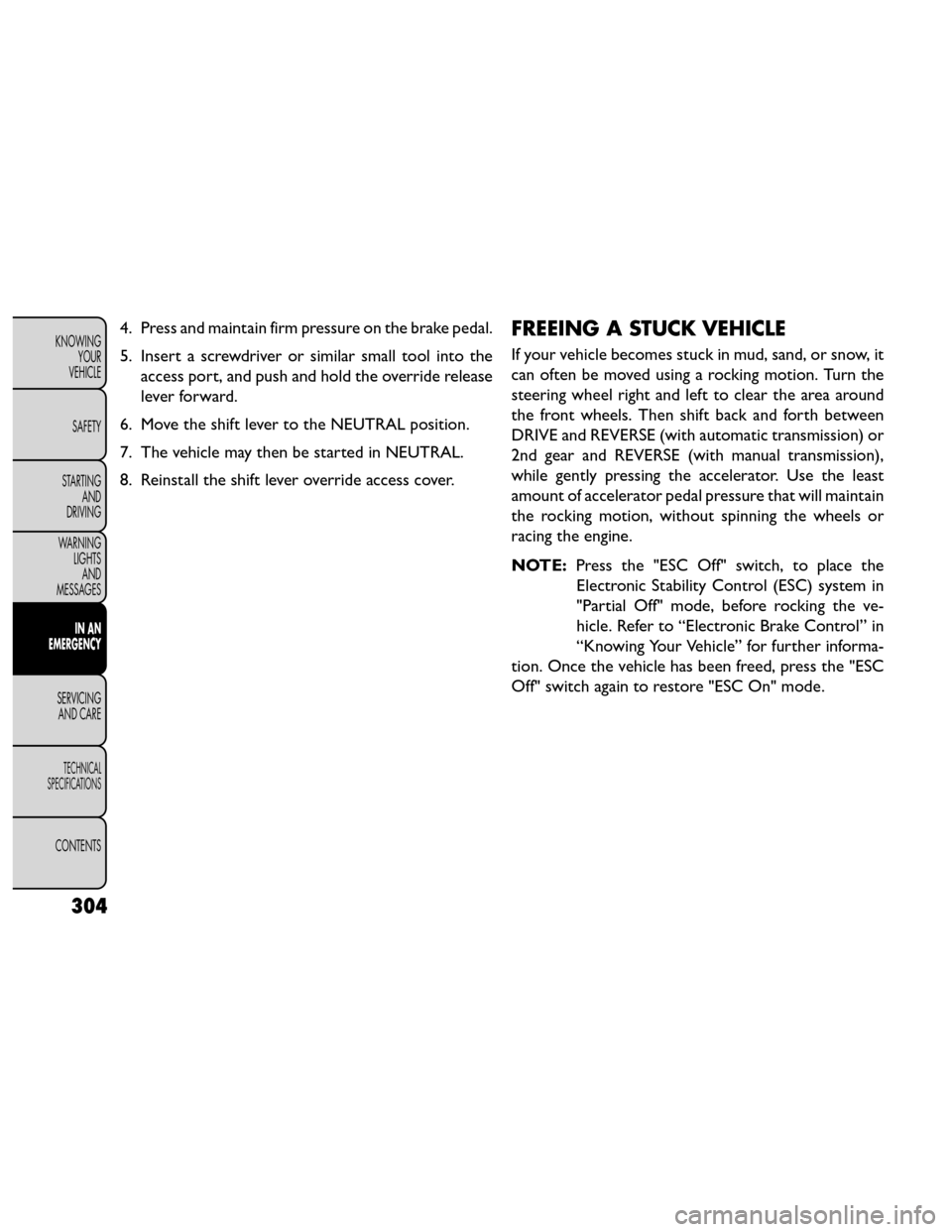
8. Reinstall the shift lever override access cover.FREEING A STUCK VEHICLE
If your vehicle becomes stuck in mud, sand, or snow, it
can often be moved using a rocking motion. Turn the
steering wheel right and left to clear the area around
the front wheels. Then shift back and forth between
DRIVE and REVERSE (with automatic transmission) or
2nd gear and REVERSE (with manual transmission),
while gently pressing the accelerator. Use the least
amount of accelerator pedal pressure that will maintain
the rocking motion, without spinning the wheels or
racing the engine.
NOTE: Press the "ESC Off" switch, to place the
Electronic Stability Control (ESC) system in
"Partial Off" mode, before rocking the ve-
hicle. Refer to “Electronic Brake Control” in
“Knowing Your Vehicle” for further informa-
tion. Once the vehicle has been freed, press the "ESC
Off" switch again to restore "ESC On" mode.
304
KNOWING YOUR
VEHICLE
SAFETY
STARTING AND
DRIVING
WARNING LIGHTSAND
MESSAGES
IN AN
EMERGENCY
SERVICING AND CARE
TECHNICAL
SPECIFICATIONS
CONTENTS
Page 311 of 388
•Racing the engine or spinning the
wheels may lead to transmission over-
heating and failure. Allow the engine to
idle with the shift lever in NEUTRAL for at least
one minute after every five rocking-motion
cycles.This will minimize overheating and reduce
the risk of transmission failure during prolonged
efforts to free a stuck vehicle.
• When “rocking” a stuck vehicle by shifting be-
tween DRIVE/2nd gear and REVERSE, do not spin
the wheels faster than 24 km/h, or drivetrain
damage may result .
• Revving the engine or spinning the wheels too
fast may lead to transmission overheating and
failure. It can also damage the tires. Do not spin
the wheels above 48 km/h while in gear (no trans-
mission shifting occurring).WARNING!
Fast spinning tires can be dangerous.
Forces gen
erated by excessive wheel
speeds may cause damage, or even failure, of the
axle and tires. A tire could explode and injure
someone. Do not spin your vehicle's wheels faster
than 48 km/h or for longer than 30 seconds
continuously without stopping when you are
stuck and do not let anyone near a spinning
wheel, no matter what the speed.
305
KNOWING
YOUR
VEHICLE
SAFETY
STARTING
AND
DRIVING
WARNING
LIGHTS
AND
MESSAGES
IN AN
EMERGENCY
SERVICING
AND CARE
TECHNICAL
SPECIFICATIONS
CONTENTS
Page 312 of 388
TOW EYE
Your vehicle is equipped with a tow eye that can be
used to tow a disabled vehicle.
(fig. 188)
Tow eyes are for emergency use only, to
rescue a vehicle stranded off road. Do not
use tow eyes for tow truck hookup or
highway towing. You could damage your vehicle.
Tow straps are recommended when towing the
vehicle; chains may cause vehicle damage.
WARNING!
Stand clear of vehicles when pulling with
tow e y
es. Tow straps and chains may
break, causing serious injury.
(fig. 188)
To w E y e
306
KNOWINGYOUR
VEHICLE
SAFETY
STARTING AND
DRIVING
WARNING LIGHTSAND
MESSAGES
IN AN
EMERGENCY
SERVICING AND CARE
TECHNICAL
SPECIFICATIONS
CONTENTS
Page 313 of 388
FRONT TOW EYE USAGE
The front tow eye receptacle is located on the lower
right side of the front fascia.
To install the tow eye, remove the rubber plug and
thread the tow eye into the receptacle.
Insert the flat end of the jack handle through the eye
and tighten, refer to “Jacking and Tire Changing” for
further information. The tow hook must be fully seated
to the attaching bracket through the lower front fascia
as shown. If the tow hook is not fully seated to the
attaching bracket, the vehicle should not be towed.
(fig. 189)
REAR TOW EYE USAGE
The rear tow eye receptacle is located behind a door,
located on the left rear bumper fascia.
To install the tow eye, open the door using the vehicle
key or a small screwdriver, and thread the tow eye into
the receptacle.
Insert the flat end of the jack handle through the eye
and tighten, refer to “Jacking and Tire Changing” for
further information. The tow hook must be fully seated
to the attaching bracket through the lower rear fascia
as shown. If the tow hook is not fully seated to the
attaching bracket, the vehicle should not be towed.
(fig. 190)
(fig. 189)Front Tow Eye Installed(fig. 190) Rear Tow Eye Installed
307
KNOWING
YOUR
VEHICLE
SAFETY
STARTING
AND
DRIVING
WARNING
LIGHTS
AND
MESSAGES
IN AN
EMERGENCY
SERVICING
AND CARE
TECHNICAL
SPECIFICATIONS
CONTENTS
Page 314 of 388
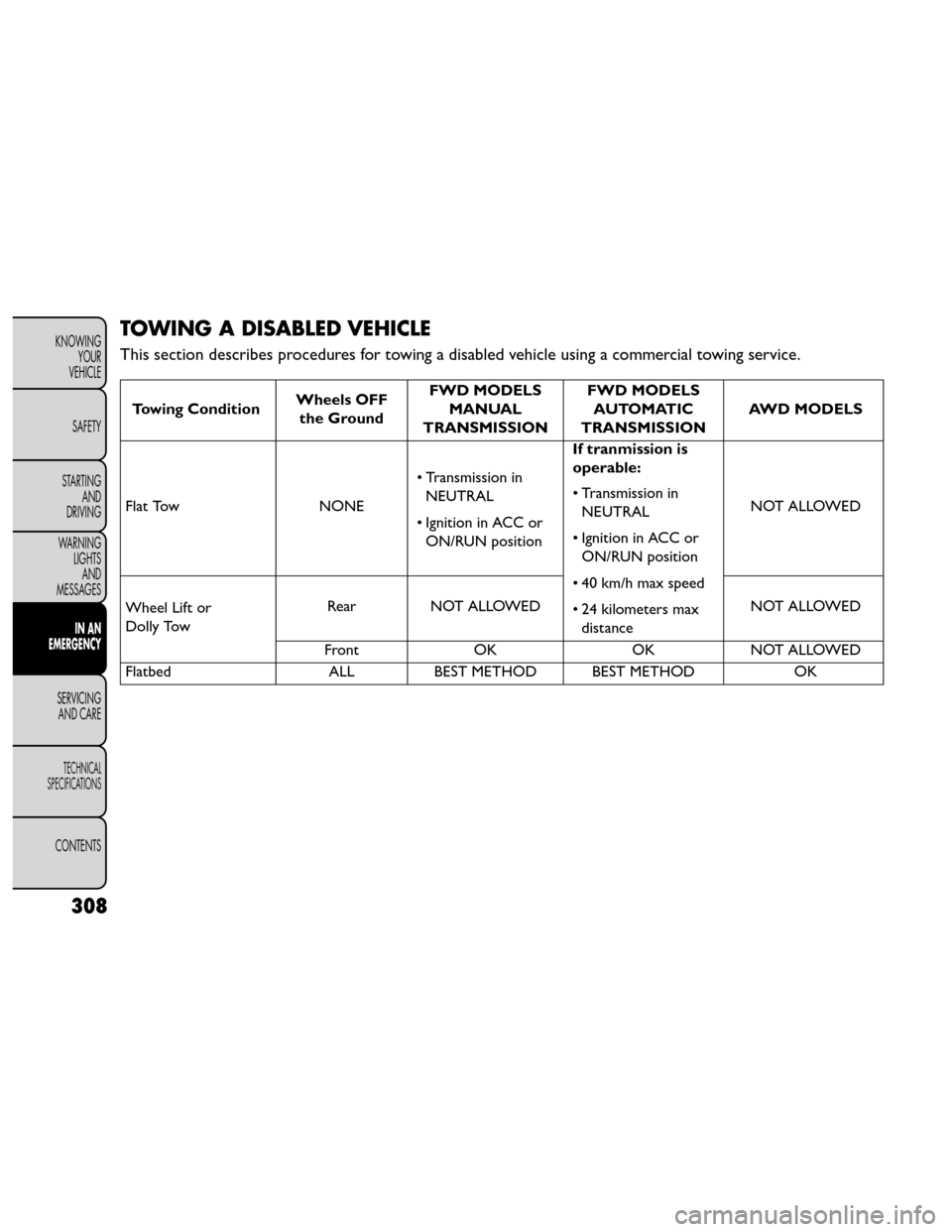
TOWING A DISABLED VEHICLE
This section describes procedures for towing a disabled vehicle using a commercial towing service.
Towing ConditionWheels OFF
the Ground FWD MODELS
MANUAL
TRANSMISSION FWD MODELS
AUTOMATIC
TRANSMISSION AWD MODELS
Flat Tow NONE • Transmission in
NEUTRAL
• Ignition in ACC or ON/RUN position If tranmission is
operable:
• Transmission in
NEUTRAL
• Ignition in ACC or ON/RUN position
• 40 km/h max speed
• 24 kilometers max distance NOT ALLOWED
Wheel Lift or
Dolly Tow Rear NOT ALLOWED
NOT ALLOWED
Front OK OKNOT ALLOWED
Flatbed ALLBEST METHOD BEST METHOD OK
308
KNOWING
YOUR
VEHICLE
SAFETY
STARTING AND
DRIVING
WARNING LIGHTSAND
MESSAGES
IN AN
EMERGENCY
SERVICING AND CARE
TECHNICAL
SPECIFICATIONS
CONTENTS
Page 315 of 388
Proper towing or lifting equipment is required to pre-
vent damage to your vehicle. Use only tow bars and
other equipment designed for this purpose, following
equipment manufacturer’s instructions. Use of safety
chains is mandatory. Attach a tow bar or other towing
device to main structural members of the vehicle, not
to bumpers or associated brackets. State and local laws
regarding vehicles under tow must be observed.
If you must use the accessories (wipers, defrosters,
etc.) while being towed, the ignition must be in the
ON/RUN position, not the ACC position.
If the vehicle's battery is discharged, refer to "Shift Lever
Override" in this section for instructions on shifting the
automatic transmission out of PARK for towing.
•Do not use sling type equipment when
towing. Damage to the fascia will occur.
• When securing the vehicle to a flatbed
truck, do not attach to front or rear suspension
components. Damage to your vehicle may result
from improper towing.
• Do not push or tow this vehicle with another
vehicle as damage to the bumper fascia and trans-
mission may result .
• If the vehicle being towed requires steering, the
ignitionswitchmustbeintheACCorON/RUN
position, not in the LOCK/OFF position. WITHOUT THE KEY FOB
Special care must be taken when the vehicle is towed
with the ignition in the OFF position. Flatbed towing is
the preferred towing method. However, if a flatbed
towing vehicle is not available, wheel lift towing equip-
ment may be used. Rear towing (with the front wheels
on the ground) is not allowed, as transmission damage
will occur. If rear towing is the only alternative, the
front wheels must be placed on a towing dolly. Proper
towing equipment is necessary to prevent damage to
the vehicle.
ALL-WHEEL DRIVE (AWD) MODELS
The manufacturer requires towing with all four wheels
OFF
the ground. Acceptable methods are to tow the
vehicle on a flatbed, or with one end of vehicle raised
and the opposite end on a towing dolly.
Towing this vehicle in violation of the
above requirements can cause severe
transmission and/or power transfer unit
damage. Damage from improper towing is not cov-
ered under the New Vehicle Limited Warranty.
309
KNOWING
YOUR
VEHICLE
SAFETY
STARTING
AND
DRIVING
WARNING
LIGHTS
AND
MESSAGES
IN AN
EMERGENCY
SERVICING
AND CARE
TECHNICAL
SPECIFICATIONS
CONTENTS
Page 316 of 388
FRONT WHEEL DRIVE (FWD) MODELS —
MANUAL TRANSMISSION
The manufacturer recommends towing your vehicle
with all four wheels OFF the ground using a flatbed.
Your vehicle may also be towed in the forward direc-
tion, with all four wheels on the ground, the transmis-
sion in NEUTRAL, and the ignition in the ACC or
ON/RUN position. If the transmission is not operative,
the vehicle must be towed with the front wheels OFF
the ground (using a flatbed truck, towing dolly, or
wheel lift equipment with the front wheels raised).
Towing this vehicle in violation of the
above requirements can cause severe
engine and/or transmission damage.
Damage from improper towing is not covered
under the New Vehicle Limited Warranty. FRONT WHEEL DRIVE (FWD) MODELS —
AUTOMATIC TRANSMISSION
The manufacturer recommends towing your vehicle
with all four wheels OFF the ground using a flatbed.
If flatbed equipment is not available, and the transmission
is operable, the vehicle may be flat towed (with all four
wheels on the ground) under the following conditions:
• The transmission must be in NEUTRAL.
• The towing distance must not exceed 24 km .
• The towing speed must not exceed 40 km/h.
If the transmission is not operable, or the ve-
hicle must be towed faster than 40 km/h or
farther than 24 km, it must be towed with the
front wheels OFF the ground (using a flatbed
truck, towing dolly, or wheel lift equipment with
the front wheels raised).
Towing this vehicle in violation of the
above requirements can cause severe
transmission damage. Damage from
improper towing is not covered under the New
Vehicle Limited Warranty.
310
KNOWING YOUR
VEHICLE
SAFETY
STARTING AND
DRIVING
WARNING LIGHTSAND
MESSAGES
IN AN
EMERGENCY
SERVICING AND CARE
TECHNICAL
SPECIFICATIONS
CONTENTS