ECU FIAT FREEMONT 2014 1.G Owner's Guide
[x] Cancel search | Manufacturer: FIAT, Model Year: 2014, Model line: FREEMONT, Model: FIAT FREEMONT 2014 1.GPages: 388, PDF Size: 4.13 MB
Page 260 of 388
TOWING REQUIREMENTS
To promote proper break-in of your new vehicle drive-
train components the following guidelines are recom-
mended:
•Donottowatraileratallduringthe
first 805 km the new vehicle is driven.The
engine, axle or other parts could be dam-
aged.
• Then, during the first 805 km that a trailer is
towed, do not drive over 80 km/h and do not make
starts at full throttle. This helps the engine and
other parts of the vehicle wear in at the heavier
loads.
Perform the maintenance listed in the Maintenance
Schedule. When towing a trailer, never exceed the
GAWR ratings.
WARNING!
Improper towing can lead to an injury
acciden t
. Follow these guidelines to
make your trailer towing as safe as possible:
•Make certain that the load is secured in the
trailer and that it will not shift during travel.
When trailering cargo that is not fully secured,
dynamic load shifts can occur that may be diffi-
cult for the driver to control.You could lose con-
trol of your vehicle and have an accident .
• All trailer hitches should be professionally in-
stalled on your vehicle.
• When hauling cargo or towing a trailer, do not
overload your vehicle or trailer. Overloading can
cause a loss of control, poor performance, or
damage to brakes, axle, engine, transmission,
steering, suspension, chassis structure, or tires.
• Safety chains must always be used between
your vehicle and trailer. Always connect the
chains to the frame or hook retainers of the
vehicle hitch. Cross the chains under the trailer
tongue and allow enough slack for turning cor-
ners.
(Continued)
254
KNOWINGYOUR
VEHICLE
SAFETY
STARTING AND
DRIVING
WARNING LIGHTSAND
MESSAGES
IN AN
EMERGENCY
SERVICING AND CARE
TECHNICAL
SPECIFICATIONS
CONTENTS
Page 275 of 388
The light also will turn on when the parking brake is
applied with the ignition switch in the ON/RUN position.
NOTE:This light shows only that the parking brake is
applied. It does not show the degree of brake
application.
12. Anti-Lock Brake (ABS) Light This light monitors the Anti-Lock Brake Sys-
tem (ABS). The light will turn on when the
ignition switch is turned to the ON/RUN
position and may stay on for as long as four
seconds.
If the ABS light remains on or turns on while driving, it
indicates that the Anti-Lock portion of the brake sys-
tem is not functioning and that service is required.
However, the conventional brake system will continue
to operate normally if the Brake System Warning Light
is not on.
If the ABS light is on, the brake system should be
serviced as soon as possible to restore the benefit of
Anti-Lock brakes. Furthermore, the ABS light should
be checked frequently to assure that it is operating
properly. If the light does not turn on, have the system
checked by an authorized dealer. (Refer to “Electronic
Brake Control System” in “Knowing Your Vehicle” for
further information). 13. Fuel Cap Indicator
This symbol indicates the side of the vehicle
where the fuel filler cap is located.
14. Rear Fog Light Indicator
This indicator will illuminate when the rear fog
lights are on. (Refer to “Rear Fog Lights” in
“Knowing Your Vehicle” for further information).
15. Vehicle Security Light This light will flash rapidly for approximately
16 seconds when the vehicle security system
is arming and then flash slowly when the
system is armed. The light will also turn on
for about three seconds when the ignition switch is
first turned to ON/RUN. (Refer to “Vehicle Security
Alarm” or “Premium Security System” in “Knowing
Your Vehicle” for further information).
269
KNOWING
YOUR
VEHICLE
SAFETY
STARTING
AND
DRIVING
WARNING
LIGHTS
AND
MESSAGES
IN AN
EMERGENCY
SERVICING
AND CARE
TECHNICAL
SPECIFICATIONS
CONTENTS
Page 283 of 388
The winch mechanism is designed for use
with the jack-handle only. Use of an air
wrench or other power tools is not rec-
ommended and it can damage the winch.
3. Pull the spare tire out from underneath the vehicle and raise it upright so the tire's tread is on the
ground.
4. Tilt the retainer at the end of the winch cable and remove it from the center of the wheel. (fig. 168) Spare Tire Stowage
NOTE:
Refer to “Spare Tire Removal” for information
on assembling the winch tools.
1. Place the spare tire near to the winch cable. Hold the spare upright so that the tire's tread is on the
ground and the valve stem is at the top of the wheel
facing away from the rear of the vehicle.
2. Tilt the retainer at the end of the winch cable and drop it through the center of the wheel. Then place
the spare tire with the cable and retainer under-
neath the vehicle.
3. Fit the assembled jack-handle over the winch drive nut. Rotate the jack-handle assembly clockwise to
raise the spare tire into the storage area. Continue
to rotate the jack-handle assembly until you hear
the winch mechanism click three times. It cannot be
over tightened. Push against the tire several times to
be sure it is held securely in place.
(fig. 168)
Spare Tire Retainer
277
KNOWING
YOUR
VEHICLE
SAFETY
STARTING
AND
DRIVING
WARNING
LIGHTS
AND
MESSAGES
IN AN
EMERGENCY
SERVICING
AND CARE
TECHNICAL
SPECIFICATIONS
CONTENTS
Page 284 of 388
JACKING INSTRUCTIONS
WARNING!
Carefully follow these tire changing
warnin gs
to help prevent personal injury
or damage to your vehicle:
•Always park on a firm, level surface as far from
the edge of the roadway as possible before rais-
ing the vehicle.
• Turn on the Hazard Warning flashers.
• Block the wheel diagonally opposite the wheel
to be raised.
• Set the parking brake firmly and set an auto-
matic transmission in PARK; a manual transmis-
sion in REVERSE.
• Never start or run the engine with the vehicle
onajack.
• Do not let anyone sit in the vehicle when it is on
ajack.
• Do not get under the vehicle when it is on a
jack. If you need to get under a raised vehicle,
take it to a service center where it can be raised
on a lift .
• Only use the jack in the positions indicated and
for lifting this vehicle during a tire change.
(Continued)(Continued)
• If working on or near a roadway, be extremely
careful of motor traffic .
• To assure that spare tires, flat or inflated, are
securely stowed, spares must be stowed with the
valve stem facing the ground.
(fig. 169)
(fig. 169) Jack Warning Label
278
KNOWINGYOUR
VEHICLE
SAFETY
STARTING AND
DRIVING
WARNING LIGHTSAND
MESSAGES
IN AN
EMERGENCY
SERVICING AND CARE
TECHNICAL
SPECIFICATIONS
CONTENTS
Page 315 of 388
Proper towing or lifting equipment is required to pre-
vent damage to your vehicle. Use only tow bars and
other equipment designed for this purpose, following
equipment manufacturer’s instructions. Use of safety
chains is mandatory. Attach a tow bar or other towing
device to main structural members of the vehicle, not
to bumpers or associated brackets. State and local laws
regarding vehicles under tow must be observed.
If you must use the accessories (wipers, defrosters,
etc.) while being towed, the ignition must be in the
ON/RUN position, not the ACC position.
If the vehicle's battery is discharged, refer to "Shift Lever
Override" in this section for instructions on shifting the
automatic transmission out of PARK for towing.
•Do not use sling type equipment when
towing. Damage to the fascia will occur.
• When securing the vehicle to a flatbed
truck, do not attach to front or rear suspension
components. Damage to your vehicle may result
from improper towing.
• Do not push or tow this vehicle with another
vehicle as damage to the bumper fascia and trans-
mission may result .
• If the vehicle being towed requires steering, the
ignitionswitchmustbeintheACCorON/RUN
position, not in the LOCK/OFF position. WITHOUT THE KEY FOB
Special care must be taken when the vehicle is towed
with the ignition in the OFF position. Flatbed towing is
the preferred towing method. However, if a flatbed
towing vehicle is not available, wheel lift towing equip-
ment may be used. Rear towing (with the front wheels
on the ground) is not allowed, as transmission damage
will occur. If rear towing is the only alternative, the
front wheels must be placed on a towing dolly. Proper
towing equipment is necessary to prevent damage to
the vehicle.
ALL-WHEEL DRIVE (AWD) MODELS
The manufacturer requires towing with all four wheels
OFF
the ground. Acceptable methods are to tow the
vehicle on a flatbed, or with one end of vehicle raised
and the opposite end on a towing dolly.
Towing this vehicle in violation of the
above requirements can cause severe
transmission and/or power transfer unit
damage. Damage from improper towing is not cov-
ered under the New Vehicle Limited Warranty.
309
KNOWING
YOUR
VEHICLE
SAFETY
STARTING
AND
DRIVING
WARNING
LIGHTS
AND
MESSAGES
IN AN
EMERGENCY
SERVICING
AND CARE
TECHNICAL
SPECIFICATIONS
CONTENTS
Page 335 of 388
3. Pivot the glove box downward.
4. Disengage the two retaining tabs that secure thefilter cover to the HVAC housing and remove the
cover. (fig. 195)
5. Remove the A/C air filter by pulling it straight out of the housing.
6. Install the A/C air filter with the arrow on the filter pointing toward the floor. When installing the filter
cover, make sure the retaining tabs fully engage the
cover.The A/C air filter is identified with an arrow
to indicate airflow direction through the
filter. Failure to install the filter properly
will result in the need to replace it more often.
7. Reinstall the glove box door. Make sure that the hinges are seated fully as you raise the door. Other-
wise, the door latch will not align properly.
BODY LUBRICATION
Locks and all body pivot points, including such items as
seat tracks, door hinge pivot points and rollers, liftgate,
tailgate, sliding doors and hood hinges, should be
lubricated periodically with a lithium based grease to
assure quiet, easy operation and to protect against rust
and wear. Prior to the application of any lubricant, the
parts concerned should be wiped clean to remove dust
and grit; after lubricating excess oil and grease should
be removed. Particular attention should also be given
to hood latching components to ensure proper func-
tion. When performing other underhood services, the
hood latch, release mechanism and safety catch should
be cleaned and lubricated.
The external lock cylinders should be lubricated twice
a year, preferably in the Fall and Spring. Apply a small
amount of a high quality lubricant directly into the lock
cylinder.
(fig. 195) A/C Air Filter Replacement
329
KNOWING
YOUR
VEHICLE
SAFETY
STARTING
AND
DRIVING
WARNING
LIGHTS
AND
MESSAGES
IN AN
EMERGENCY
SERVICING
AND CARE
TECHNICAL
SPECIFICATIONS
CONTENTS
Page 344 of 388
Master Cylinder – Brake Fluid Level Check
Check the fluid level in the master cylinder immediately
if the “Brake Warning Light” indicates system failure.
Check the fluid level in the master cylinder when
performing underhood services.
Clean the top of the master cylinder area before
removing the cap. If necessary, add fluid to bring the
fluid level up to the requirements described on the
brake fluid reservoir.
Overfilling of fluid is not recommended because it may
cause leaking in the system.
Fluid level can be expected to fall as the brake pads
wear. Brake fluid level should be checked when pads are
replaced. However, low fluid level may be caused by a
leak and a checkup may be needed.
NOTE:If your vehicle is equipped with a manual
transmission, the brake fluid reservoir supplies fluid
to both the brake system and the clutch release sys-
tem. The two systems are separated in the reservoir,
and a leak in one system will not affect the other
system. The manual transmission clutch release
system should not require fluid replacement during the
life of the vehicle. If the brake fluid reservoir is low and
the brake system does not indicate any leaks or other
problems, it may be a result of a leak in the hydraulic clutch release system. See your local authorized dealer
for service.
Use only manufacturer's recommended brake fluid.
Refer to “Fluids, Lubricants, and Genuine Parts” in
“Technical Specifications” for further information.
WARNING!
• Use only manufacturer's recom-
me n
ded brake fluid. Refer to “Fluids, Lu-
bricants, and Genuine Parts” in “Technical Speci-
fications” for further information. Using the
wrong type of brake fluid can severely damage
your brake system and/or impair its perfor-
mance. The proper type of brake fluid for your
vehicle is also identified on the original factory
installed hydraulic master cylinder reservoir.
• To avoid contamination from foreign matter or
moisture, use only new brake fluid or fluid that
has been in a tightly closed container. Keep the
master cylinder reservoir cap secured at all
times. Brake fluid in a open container absorbs
moisture from the air resulting in a lower boiling
point . This may cause it to boil unexpectedly
during hard or prolonged braking, resulting in
sudden brake failure. This could result in a acci-
dent .
(Continued)
338
KNOWINGYOUR
VEHICLE
SAFETY
STARTING AND
DRIVING
WARNING LIGHTSAND
MESSAGES
IN AN
EMERGENCY
SERVICING AND CARE
TECHNICAL
SPECIFICATIONS
CONTENTS
Page 374 of 388
CONTENTS
About Your Brakes..................... 133, 234
ABS (Anti-Lock Brake System) ..........134, 135, 269
Adding Engine Coolant (Antifreeze) ..............335
Adding Fuel ..............................185
Adding Washer Fluid ........................331
Additives, Fuel ............................359
Airbag .............................. 216, 222
Airbag Deployment ........................223
Airbag Light ....................221, 224, 227, 264
Airbag, Side ....................... 218, 220, 222
Airbag, Window (Side Curtain) ..........219, 220, 222
Air Cleaner, Engine (Engine Air Cleaner Filter) ......326
Air Conditioner Maintenance ..................327
Air Conditioning Filter ....................85, 328
Air Conditioning, Operating Tips ................85
Air Conditioning, Rear Zone .................71,81
Air Conditioning Refrigerant ...............327, 328
Air Conditioning System .....................327
Air Pressure, Tires ......................266, 349
Alarm (Security Alarm) ...................15, 269
Alarm System (Security Alarm) ...............15, 17
All Wheel Drive (AWD) .....................247
Alterations/Modifications, Vehicle .................5
Antifreeze (Engine Coolant) ............334, 335, 361
Disposal .............................336
Anti-Lock Brake System (ABS) ..............134, 135
Anti-Lock Warning Light ..............135, 136, 269
Arming System (Security Alarm) .................15
Auto Down Power Windows ..................123
Automatic Dimming Mirror ....................63
Automatic Door Locks ......................115 Automatic Headlights
........................86
Automatic Oil Change Indicator .................27
Automatic Transmission .................. 238, 339
Adding Fluid ...........................340
Autostick .............................245
Fluid and Filter Changes ...................341
Fluid Level Check .......................340
Gear Ranges ...........................241
Autostick ..............................
.245
Auto Unlock, Doors ........................115
Auxiliary Electrical Outlet (Power Outlet) .........106
Auxiliary Power Outlet ......................106
Back-Up Lights ............................295
Battery .................................326
Gas Caution ...........................327
Keyless Transmitter Replacement (RKE) .........13
Location .............................326
Belts, Seat ........................... 188, 226
Body Mechanism Lubrication ..................329
Brake Assist System ........................137
Brake Control System, Electronic ...............135
Brake, Parking ............................234
Brakes ..............................133, 337
Brake System ......................... 133, 337
Anti-Lock (ABS) .....................134, 135
Fluid Check ...........................338
Master Cylinder ........................338
Parking ..............................234
Warning Light ..........................268
Brake/Transmission Interlock ..................240
368
KNOWING
YOUR
VEHICLE
SAFETY
STARTING AND
DRIVING
WARNING LIGHTSAND
MESSAGES
IN AN
EMERGENCY
SERVICING AND CARE
TECHNICAL
SPECIFICATIONS
CONTENTS
Page 382 of 388
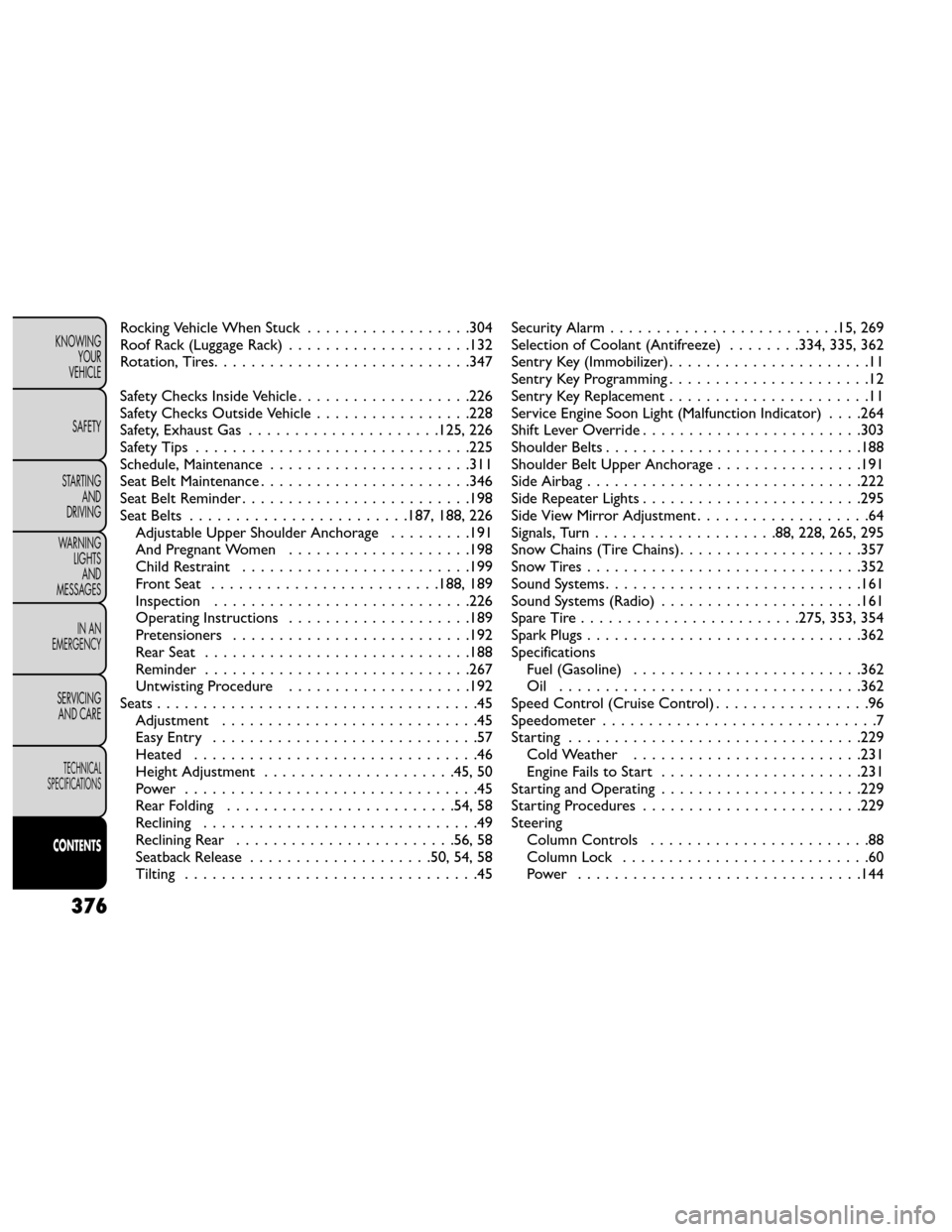
Rocking Vehicle When Stuck..................304
Roof Rack (Luggage Rack) ....................132
Rotation, Tires ............................347
Safety Checks Inside Vehicle ...................226
Safety Checks Outside Vehicle .................228
Safety, Exhaust Gas .....................125, 226
Safety Tips ..............................225
Schedule, Maintenance ......................311
Seat Belt Maintenance .......................346
Seat Belt Reminder .........................198
Seat Belts ........................ 187, 188, 226
Adjustable Upper Shoulder Anchorage .........191
And Pregnant Women ....................198
Child Restraint .........................199
Front Seat .........................188, 189
Inspection ............................226
Operating Instructions ....................189
Pretensioners ..........................192
Rear Seat .............................188
Reminder .............................267
Untwisting Procedure ....................192
Seats ...................................45
Adjustment ............................45
Easy Entry .............................57
Heated ...............................46
Height Adjustment .....................45, 50
Power ................................45
Rear Folding .........................54, 58
Reclining ..............................49
Reclining Rear ........................56, 58
Seatback Release ....................50, 54, 58
Tilting ................................45 Security Alarm
.........................15, 269
Selection of Coolant (Antifreeze) ........334, 335, 362
Sentry Key (Immobilizer) ......................11
Sentry Key Programming ......................12
Sentry Key Replacement ......................11
Service Engine Soon Light (Malfunction Indicator) ....264
Shift Lever Override ........................303
Shoulder Belts ............................188
Shoulder Belt Upper Anchorage ................191
Side Airbag ..............................22
2
Side Repeater Lights ........................295
Side View Mirror Adjustment ...................64
Signals, Turn ....................88, 228, 265, 295
Snow Chains (Tire Chains) ....................357
SnowTires..............................352
Sound Systems ............................161
Sound Systems (Radio) ......................161
Spare Tire ........................275, 353, 354
Spark Plugs ..............................362
Specifications Fuel (Gasoline) .........................362
Oil .................................362
Speed Control (Cruise Control) .................96
Speedometer ..............................7
Starting ................................229
Cold Weather .........................231
Engine Fails to Start ......................231
Starting and Operating ......................229
Starting Procedures ........................229
Steering Column Controls ........................88
Column Lock ...........................60
Power ...............................144
376
KNOWING YOUR
VEHICLE
SAFETY
STARTING AND
DRIVING
WARNING LIGHTSAND
MESSAGES
IN AN
EMERGENCY
SERVICING AND CARE
TECHNICAL
SPECIFICATIONS
CONTENTS
Page 384 of 388
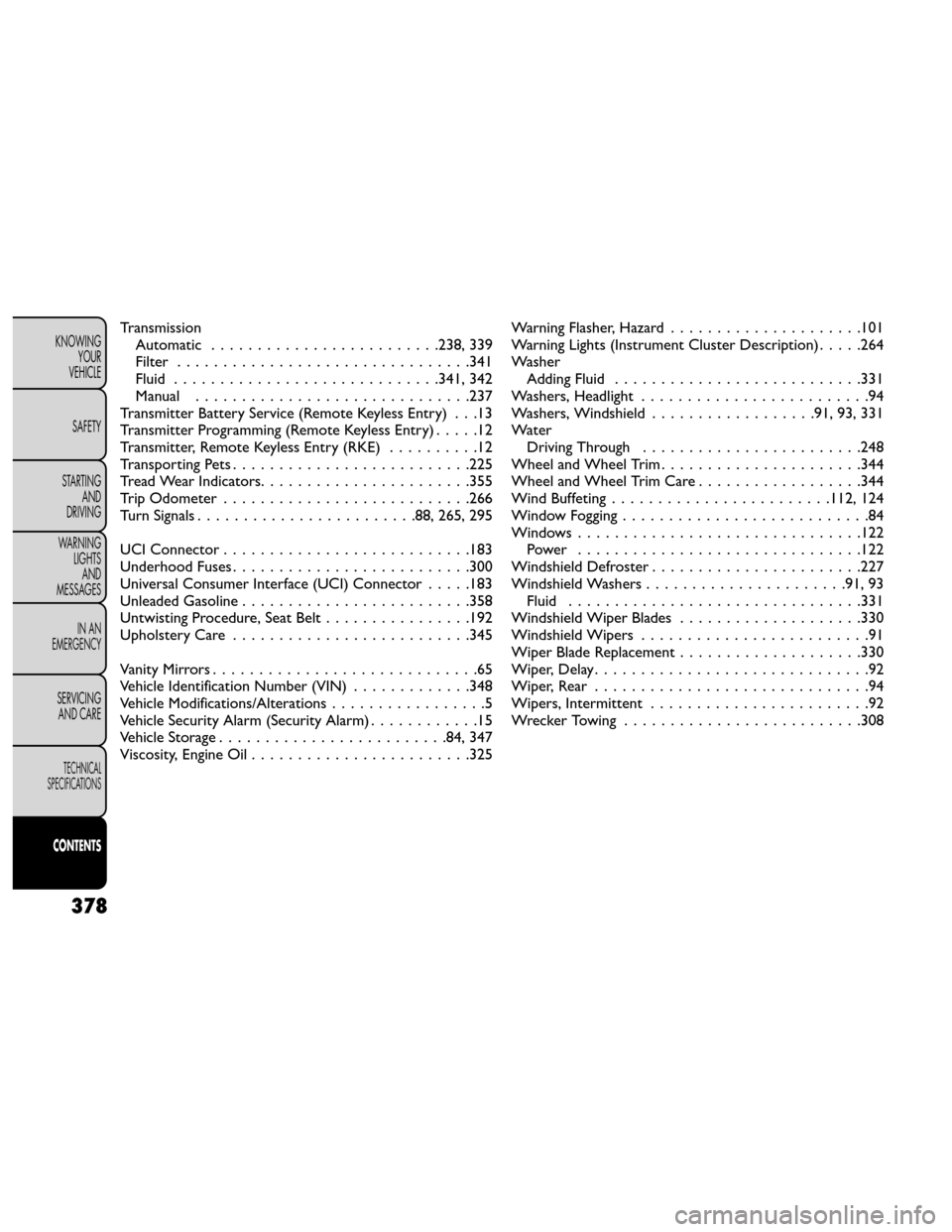
TransmissionAutomatic .........................238, 339
Filter ................................341
Fluid .............................341, 342
Manual ..............................237
Transmitter Battery Service (Remote Keyless Entry) . . .13
Transmitter Programming (Remote Keyless Entry) .....12
Transmitter, Remote Keyless Entry (RKE) ..........12
Transporting Pets ..........................225
Tread Wear Indicators .......................355
TripOdometer ...........................266
Turn Signals ........................88, 265, 295
UCI Connector ...........................183
Underhood Fuses ..........................300
Universal Consumer Interface (UCI) Connector .....183
Unleaded Gasoline .........................358
Untwisting Procedure, Seat Belt ................192
Upholstery Care ..........................345
Vanity Mirrors .............................65
Vehicle Identification Number (VIN) .............348
Vehicle Modifications/Alterations .................5
Vehicle Security Alarm (Security Alarm) ............15
Vehicle Storage .........................84, 347
Viscosity, Engine Oil ........................325 Warning Flasher, Hazard
.....................101
Warning Lights (Instrument Cluster Description) .....264
Washer Adding Fluid ...........................331
Washers, Headlight .........................94
Washers, Windshield ..................91,93,331
Wa te r Driving Through ........................248
Wheel and Wheel Trim ......................344
Wheel and Wheel Trim Care ..................344
Wind Buffeting ........................ 112, 124
Window Fogging ...........................84
Windows...............................122 Power ...............................122
Windshield Defroster .......................227
Windshield Washers ......................91, 93
Fluid ................................331
Windshield Wiper Blades ....................330
Windshield Wipers .........................91
Wiper Blade R
eplacement ....................330
Wiper,Delay..............................92
Wiper,Rear ..............................94
Wipers, Intermittent ........................92
WreckerTowing ..........................308
378
KNOWING YOUR
VEHICLE
SAFETY
STARTING AND
DRIVING
WARNING LIGHTSAND
MESSAGES
IN AN
EMERGENCY
SERVICING AND CARE
TECHNICAL
SPECIFICATIONS
CONTENTS