fuel cap FIAT FREEMONT 2014 1.G Owners Manual
[x] Cancel search | Manufacturer: FIAT, Model Year: 2014, Model line: FREEMONT, Model: FIAT FREEMONT 2014 1.GPages: 388, PDF Size: 4.13 MB
Page 28 of 388
• Left/Right Front Door Ajar (one or more doorsopen, with a single chime if speed is above 1.6 km/h)
• Left/Right Rear Door Ajar (one or more doors open, with a single chime if speed is above 1.6 km/h)
• Door(s) Ajar (with a single chime if vehicle is in motion)
• Liftgate Ajar (with a single chime)
• Low Washer Fluid (with a single chime)
• Ignition or Accessory On
• Vehicle Not in Park (for versions/markets, where provided)
• Key Left Vehicle
• Key Not Detected
• Low Tire Pressure (with a single chime). Refer to information on “Tire Pressure” and “Tire Pressure
Monitor” in “Knowing Your Vehicle”.
• Inflate Tire to XXX. Refer to information on "Tire Pressure" and "Tire Pressure Monitor" in "Knowing
Your Vehicle."
• Service TPM System (with a single chime). Refer to information on “Tire Pressure Monitor” in “Knowing
Your Vehicle”. • Oil Change Required (with a single chime)
• Check Gascap (refer to “Adding Fuel” in “Knowing
Your Vehicle”)
• Oil Change Due (with a single chime)
• Exhaust System — Regeneration Required Now. Under conditions of exclusive short duration and
low speed driving and low speed driving cycles, the
engine and exhaust after-treatment system may
never reach the conditions required to remove the
trapped PM. If this occurs the “Exhaust System Re-
generation Required Now” message will be displayed
on the EVIC. By driving your vehicle at highway
speeds for as little as 30 minutes, you can remedy the
condition in the particulate filter system by allowing
the trapped PM to be removed to restore the system
to normal operating condition.
• Exhaust Service Required — See Dealer Now. The engine will be de-rated to prevent permanent dam-
age to the after-treatment system. If this condition
occurs, it is necessary to have your vehicle serviced
by your local authorized dealer.
22
KNOWING YOUR
VEHICLE
SAFETY
STARTING AND
DRIVING
W
ARNING LIGHTS AND
MESSAGES
IN AN
EMERGENCY
SERVICING AND CARE
TECHNICAL
SPECIFICATIONS
CONTENTS
Page 29 of 388
EVIC WHITE TELLTALE LIGHTS
This area will show reconfigurable white caution tell-
tales. These telltales include:
• Shift Lever Status — Automatic Transmission
Only
The shift lever status “P,R,N,D,6,5,4,3,2,1” are displayed
indicating the shift lever position. Telltales “6, 5,4,3,2,1”
indicate the Autostick™ feature has been engaged and
the gear selected is displayed. For further information on
Autostick™, refer to “Starting And Driving.”
• Electronic Speed Control ONThis light will turn on when the electronic
speed control is ON. For further informa-
tion, refer to “Electronic Speed Control” in
“Knowing Your Vehicle.”
• Electronic Speed Control SET This light will turn on when the electronic
speed control is SET. For further information,
refer to “Electronic Speed Control” in
“Knowing Your Vehicle.” EVIC AMBER TELLTALE LIGHTS
This area will show reconfigurable amber caution tell-
tales. These telltales include:
• Low Fuel Light
When the fuel level reaches approximately
11.0 L this light will turn on, and remain on until
fuel is added.
• Loose Gascap Indicator (for versions/markets,
where provided) If the vehicle diagnostic system determines
that the fuel filler cap is loose, improperly
installed, or damaged, a loose gascap indica-
tor will display in the telltale display area.
Tighten the fuel filler cap properly and press the SE-
LECT button to turn off the message. If the problem
continues, the message will appear the next time the
vehicle is started.
A loose, improperly installed, or damaged fuel filler cap
may also turn on the Malfunction Indicator Light (MIL).
• Windshield Washer Fluid Low Indicator This light will turn on to indicate the wind-
shield washer fluid is low.
23
KNOWING
YOUR
VEHICLE
SAFETY
STARTING
AND
DRIVING
W
ARNING
LIGHTS
AND
MESSAGES
IN AN
EMERGENCY
SERVICING
AND CARE
TECHNICAL
SPECIFICATIONS
CONTENTS
Page 149 of 388
ONBOARD DIAGNOSTIC SYSTEM —
OBD II
Your vehicle is equipped with a sophisticated onboard
diagnostic system called OBD II. This system monitors
the performance of the emissions, engine, and auto-
matic transmission control systems. When these sys-
tems are operating properly, your vehicle will provide
excellent performance and fuel economy, as well as
engine emissions well within current government regu-
lations.
If any of these systems require service, the OBD II
system will turn on the “Malfunction Indicator Light”
(MIL). It will also store diagnostic codes and other
information to assist your service technician in making
repairs. Although your vehicle will usually be drivable
and not need towing, see your authorized dealer for
service as soon as possible.
•Prolonged driving with the MIL on
could cause further damage to the emis-
sion control system. It could also affect
fuel economy and driveability.The vehicle must be
serviced before any emissions tests can be per-
formed.
• If the MIL is flashing while the engine is running,
severe catalytic converter damage and power loss
will soon occur. Immediate service is required.
LOOSE FUEL FILLER CAP MESSAGE
(for versions/markets, where provided)
If the vehicle diagnostic system determines that the
fuel filler cap is loose, improperly installed, or damaged,
a “Check Gascap” message will display in the Electronic
Vehicle Information Center (EVIC). If this occurs,
tighten the fuel filler cap properly and press the TRIP
ODOMETER button to turn off the message. If the
problem continues, the message will appear the next
time the vehicle is started.
A loose, improperly installed, or damaged fuel filler cap
may also turn on the MIL.
143
KNOWING
YOUR
VEHICLE
SAFETY
STARTING
AND
DRIVING
W
ARNING
LIGHTS
AND
MESSAGES
IN AN
EMERGENCY
SERVICING
AND CARE
TECHNICAL
SPECIFICATIONS
CONTENTS
Page 191 of 388
ADDING FUEL
FUEL FILLER CAP (GAS CAP)
(for versions/markets, where provided)
The gas cap is located behind the fuel filler door on the
left side of the vehicle. If the gas cap is lost or damaged,
be sure the replacement cap has been designed for use
with this vehicle.
(fig. 128)
Locking Fuel Filler Cap (for versions/markets,
where provided)
Your vehicle may be equipped with a locking fuel cap.
Use the specific blade key to lock/unlock this fuel cap.
NOTE:When removing the fuel filler cap, lay the cap
tether in the hook, located on the fuel filler door
reinforcement.
•Damage to the fuel system or emis-
sions control system could result from
using an improper fuel tank filler tube
cap (gas cap).
• A poorly fitting gas cap could let impurities into
thefuelsystem.
• A poorly fitting gas cap may cause the “Mal-
function Indicator Light (MIL)” to turn on.
• To avoid fuel spillage and overfilling, do not “top
off ” the fuel tank after filling. When the fuel
nozzle “clicks” or shuts off, the fuel tank is full.
WARNING!
• Never have any smoking materials lit
in or n
ear the vehicle when the gas cap is
removed or the tank is being filled.
(Continued)
(fig. 128)Fuel Filler Cap (Gas Cap)
185
KNOWING
YOUR
VEHICLE
SAFETY
STARTING
AND
DRIVING
W
ARNING
LIGHTS
AND
MESSAGES
IN AN
EMERGENCY
SERVICING
AND CARE
TECHNICAL
SPECIFICATIONS
CONTENTS
Page 192 of 388
(Continued)
• Never add fuel to the vehicle when the engine is
running.
• A fire may result if gasoline is pumped into a
portable container that is inside of a vehicle.You
could be burned. Always place gas containers on
the ground while filling.
• Failure to follow this warning may result in
serious injury or death.
NOTE:
• When the fuel nozzle “clicks” or shuts off, the fuel tank is full.
• Tighten the gas cap until you hear a “clicking” sound. This is an indication that the gas cap is tightened
properly. The MIL in the instrument cluster may turn
on if the gas cap is not secured properly. Make sure
that the gas cap is tightened each time the vehicle is
refueled. LOOSE FUEL FILLER CAP MESSAGE
(for versions/markets, where provided)
If the vehicle diagnostic system determines that the
fuel filler cap is loose, improperly installed, or damaged,
a “Check Gascap” message will display in the Electronic
Vehicle Information Center (EVIC). If this occurs,
tighten the fuel filler cap properly and press the TRIP
ODOMETER button to turn off the message. If the
problem continues, the message will appear the next
time the vehicle is started.
186
KNOWING
YOUR
VEHICLE
SAFETY
STARTING AND
DRIVING
W
ARNING LIGHTS AND
MESSAGES
IN AN
EMERGENCY
SERVICING AND CARE
TECHNICAL
SPECIFICATIONS
CONTENTS
Page 270 of 388
INSTRUMENT CLUSTER
DESCRIPTIONS
1. Air Bag Warning LightThis light will turn on for four to eight sec-
onds as a bulb check when the ignition switch
is first turned to ON/RUN. If the light is
either not on during starting, stays on, or
turns on while driving, have the system inspected at an
authorized dealer as soon as possible. Refer to “Occu-
pant Restraints” in “Safety” for further information.
2. Malfunction Indicator Light (MIL) The Malfunction Indicator Light (MIL) is part of
an onboard diagnostic system, called OBD, that
monitors engine and transmission control sys-
tems. The light will illuminate when the key is in the
ON/RUN position, before engine start. If the bulb does
not come on when turning the key from OFF to
ON/RUN, have the condition checked promptly. Certain conditions, such as a loose or missing gas cap,
poor fuel quality, etc., may illuminate the MIL after
engine start. The vehicle should be serviced if the MIL
stays on through several of your typical driving cycles.
In most situations, the vehicle will drive normally and
will not require towing.
Prolonged driving with the Malfunction
Indicator Light (MIL) on could cause
damage to the engine control system.
It also could affect fuel economy and driveability.
If the MIL is flashing, severe catalytic converter
damage and power loss will soon occur. Immedi-
ate service is required.
WARNING!
A malfunctioning catalytic converter, as
referenc ed
above, can reach higher tem-
peratures than in normal operating conditions.
This can cause a fire if you drive slowly or park
over flammable substances such as dry plants,
wood, cardboard, etc .This could result in death or
serious injury to the driver, occupants or others.
264
KNOWING YOUR
VEHICLE
SAFETY
STARTING AND
DRIVING
WARNING LIGHTSAND
MESSAGES
IN AN
EMERGENCY
SERVICING AND CARE
TECHNICAL
SPECIFICATIONS
CONTENTS
Page 275 of 388
The light also will turn on when the parking brake is
applied with the ignition switch in the ON/RUN position.
NOTE:This light shows only that the parking brake is
applied. It does not show the degree of brake
application.
12. Anti-Lock Brake (ABS) Light This light monitors the Anti-Lock Brake Sys-
tem (ABS). The light will turn on when the
ignition switch is turned to the ON/RUN
position and may stay on for as long as four
seconds.
If the ABS light remains on or turns on while driving, it
indicates that the Anti-Lock portion of the brake sys-
tem is not functioning and that service is required.
However, the conventional brake system will continue
to operate normally if the Brake System Warning Light
is not on.
If the ABS light is on, the brake system should be
serviced as soon as possible to restore the benefit of
Anti-Lock brakes. Furthermore, the ABS light should
be checked frequently to assure that it is operating
properly. If the light does not turn on, have the system
checked by an authorized dealer. (Refer to “Electronic
Brake Control System” in “Knowing Your Vehicle” for
further information). 13. Fuel Cap Indicator
This symbol indicates the side of the vehicle
where the fuel filler cap is located.
14. Rear Fog Light Indicator
This indicator will illuminate when the rear fog
lights are on. (Refer to “Rear Fog Lights” in
“Knowing Your Vehicle” for further information).
15. Vehicle Security Light This light will flash rapidly for approximately
16 seconds when the vehicle security system
is arming and then flash slowly when the
system is armed. The light will also turn on
for about three seconds when the ignition switch is
first turned to ON/RUN. (Refer to “Vehicle Security
Alarm” or “Premium Security System” in “Knowing
Your Vehicle” for further information).
269
KNOWING
YOUR
VEHICLE
SAFETY
STARTING
AND
DRIVING
WARNING
LIGHTS
AND
MESSAGES
IN AN
EMERGENCY
SERVICING
AND CARE
TECHNICAL
SPECIFICATIONS
CONTENTS
Page 330 of 388
ENGINE OIL
Checking Oil Level – Gasoline Engine
To assure proper engine lubrication, the engine oil
must be maintained at the correct level. Check the oil
level at regular intervals, such as every fuel stop.
The best time to check the engine oil level is about five
minutes after a fully warmed engine is shut off. Do not
check oil level before starting the engine after it has sat
overnight. Checking engine oil level when the engine is
cold will give you an incorrect reading.
Checking the oil while the vehicle is on level ground
and only when the engine is hot, will improve the
accuracy of the oil level readings. Maintain the oil level
between the range markings on the dipstick. Either the
range markings consist of a crosshatch zone marked
SAFE or a crosshatch zone marked with MIN at the low
end of the range and MAX at the high end of the range.
Adding 1 Quart or 1 Liter of oil when the reading is at
the low end of the range marking will raise the oil level
to the high end of the range marking.Do not overfill the engine. Overfilling the
engine will cause oil aeration, which can
lead to loss of oil pressure and an in-
crease in oil temperature.This could damage your
engine.Also, be sure the oil fill cap is replaced and
tightened after adding oil.
Checking Oil Level – Diesel Engine
To assure proper engine lubrication, the engine oil
must be maintained at the correct level. Check the oil
level at regular intervals, such as every fuel stop.
The best time to check the engine oil level is about five
minutes after a fully warmed engine is shut off or
before starting the engine after it has sat overnight.
Checking the oil while the vehicle is on level ground will
improve the accuracy of the oil level readings. Maintain
the oil level between the MIN and MAX markings on
the dipstick. Adding 1 Quart or 1 Liter of oil when the
reading is at the MIN mark will result in a MAX reading
on these engines.
324
KNOWING YOUR
VEHICLE
SAFETY
STARTING AND
DRIVING
WARNING LIGHTSAND
MESSAGES
IN AN
EMERGENCY
SERVICING AND CARE
TECHNICAL
SPECIFICATIONS
CONTENTS
Page 367 of 388
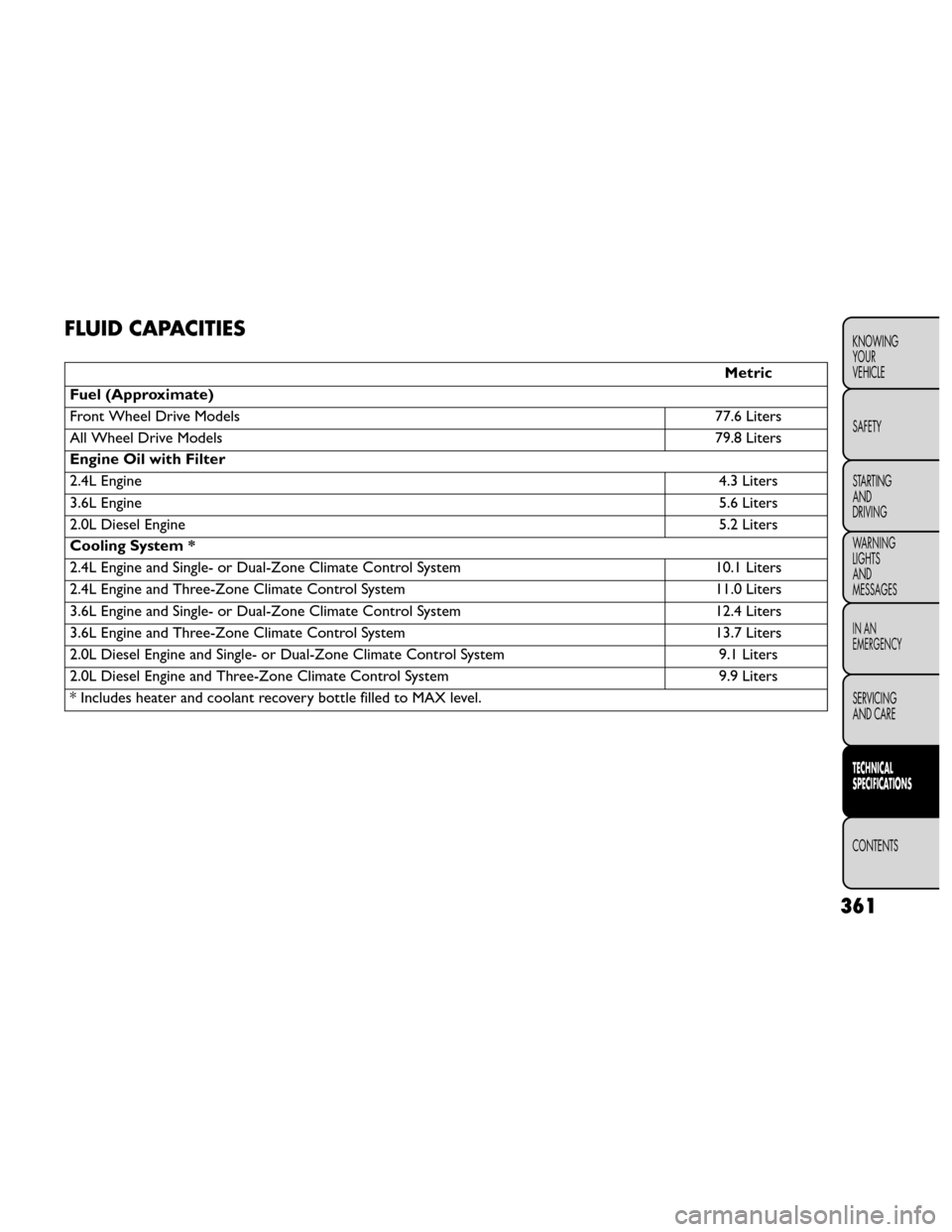
FLUID CAPACITIES
Metric
Fuel (Approximate)
Front Wheel Drive Models 77.6 Liters
All Wheel Drive Models 79.8 Liters
Engine Oil with Filter
2.4L Engine 4.3 Liters
3.6L Engine 5.6 Liters
2.0L Diesel Engine 5.2 Liters
Cooling System *
2.4L Engine and Single- or Dual-Zone Climate Control System 10.1 Liters
2.4L Engine and Three-Zone Climate Control System 11.0 Liters
3.6L Engine and Single- or Dual-Zone Climate Control System 12.4 Liters
3.6L Engine and Three-Zone Climate Control System 13.7 Liters
2.0L Diesel Engine and Single- or Dual-Zone Climate Control System 9.1 Liters
2.0L Diesel Engine and Three-Zone Climate Control System 9.9 Liters
* Includes heater and coolant recovery bottle filled to MAX level.
361
KNOWING
YOUR
VEHICLE
SAFETY
STARTING
AND
DRIVING
WARNING
LIGHTS
AND
MESSAGES
IN AN
EMERGENCY
SERVICING
AND CARE
TECHNICAL
SPECIFICATIONS
CONTENTS
Page 375 of 388
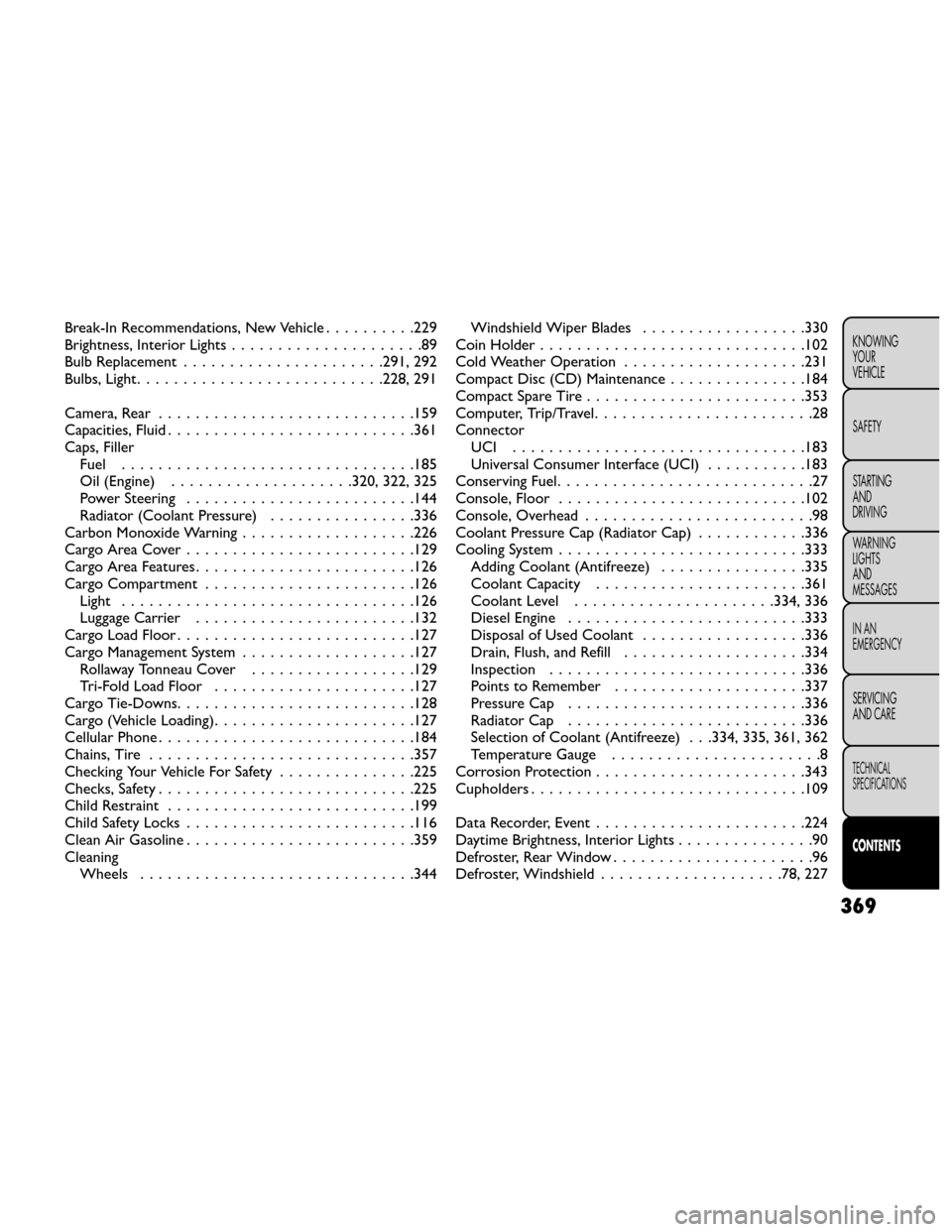
Break-In Recommendations, New Vehicle..........229
Brightness, Interior Lights .....................89
Bulb Replacement ...................... 291, 292
Bulbs, Light ...........................228, 291
Camera, Rear ............................159
Capacities, Fluid ...........................361
Caps, Filler Fuel ................................185
Oil (Engine) ....................320, 322, 325
Power Steering .........................144
Radiator (Coolant Pressure) ................336
Carbon Monoxide Warning ...................226
CargoAreaCover.........................129
Cargo Area Features ........................126
CargoCompartment .......................126 Light ................................126
Luggage Carrier ........................132
Cargo Load Floor ..........................127
Cargo Management System ...................127
Rollaway Tonneau Cover ..................129
Tri-Fold Load Floor ......................127
Cargo Tie-Downs ..........................128
Cargo (Vehicle Loading) ......................127
Cellular Phone ............................184
Chains, Tire .............................357
Checking Your Vehicle For Safety ...............225
Checks, Safety ............................225
Child Restraint ...........................199
Child Safety Locks .........................116
Clean Air Gasoline .........................359
Cleaning Wheels ..............................344 Windshield Wiper Blades
..................330
Coin Holder .............................102
Cold Weather Operation ....................231
Compact Disc (CD) Maintenance ...............184
Compact Spare Tire ........................353
Computer, Trip/Travel ........................28
Connector UCI ............................... .183
Universal Consumer Int
erface (UCI) ...........183
Conserving Fuel ............................27
Console, Floor ...........................102
Console, Overhead .........................98
Coolant Pressure Cap (Radiator Cap) ............336
Cooling System ...........................333
Adding Coolant (Antifreeze) ................335
Coolant Capacity .......................361
Coolant Level ......................334, 336
Diesel Engine ..........................333
Disposal of Used Coolant ..................336
Drain, Flush, and Refill ....................334
Inspection ............................336
Points to Remember .....................337
Pressure Cap ..........................336
Radiator Cap ..........................336
Selection of Coolant (Antifreeze) . . .334, 335, 361, 362
Temperature Gauge .......................8
Corrosion Protection .......................343
Cupholders ..............................109
Data Recorder, Event .......................224
Daytime Brightness, Interior Lights ...............90
Defroster, Rear Window ......................96
Defroster, Windshield ....................78, 227
369
KNOWING
YOUR
VEHICLE
SAFETY
STARTING
AND
DRIVING
WARNING
LIGHTS
AND
MESSAGES
IN AN
EMERGENCY
SERVICING
AND CARE
TECHNICAL
SPECIFICATIONS
CONTENTS