ECU FIAT FREEMONT 2015 1.G User Guide
[x] Cancel search | Manufacturer: FIAT, Model Year: 2015, Model line: FREEMONT, Model: FIAT FREEMONT 2015 1.GPages: 412, PDF Size: 3.37 MB
Page 126 of 412
WARNING!
• For personal security and safety in the
e v
ent of a collision, lock the vehicle
doors before you drive as well as when you park
and leave the vehicle.
• When leaving the vehicle, always remove the
Key Fob from the vehicle and lock your vehicle.
Unsupervised use of vehicle equipment may
cause severe personal injuries or death.
• Never leave children alone in a vehicle, or with
access to an unlocked vehicle. Allowing children
to be in a vehicle unattended is dangerous for a
number of reasons. A child or others could be
seriously or fatally injured. Children should be
warned not to touch the parking brake, brake
pedal or the transmission gear selector.
• Do not leave the Key Fob in or near the vehicle,
or in a location accessible to children, and do not
leave the ignition of a vehicle equipped with
Keyless Enter-N-Go™ in the ACC or ON/RUN
mode. A child could operate power windows,
other controls, or move the vehicle. POWER DOOR LOCKS
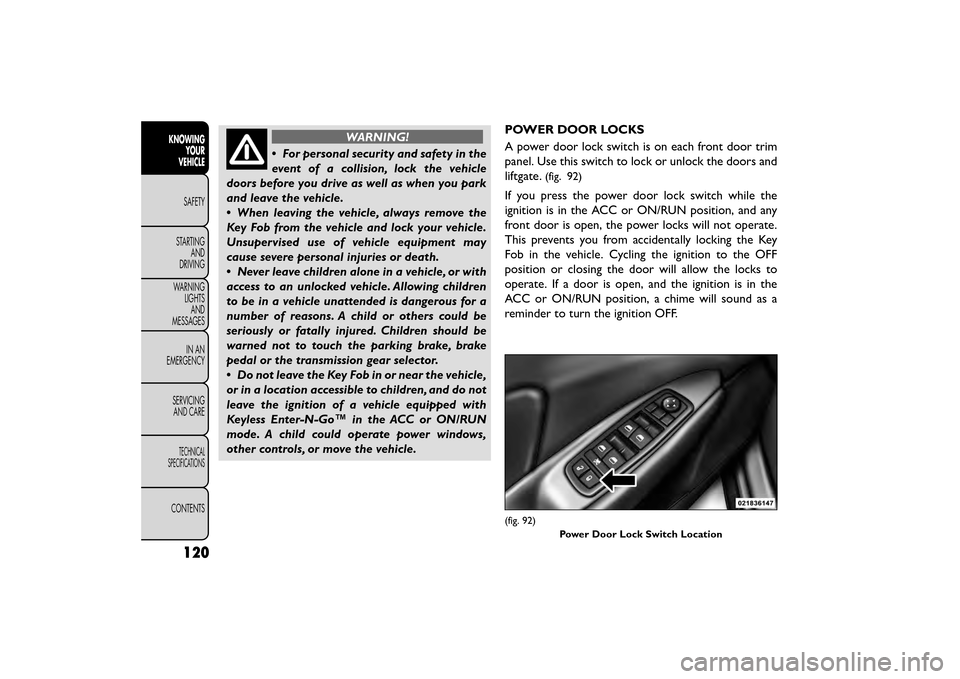
A power door lock switch is on each front door trim
panel. Use this switch to lock or unlock the doors and
liftgate.
(fig. 92)
If you press the power door lock switch while the
ignition is in the ACC or ON/RUN position, and any
front door is open, the power locks will not operate.
This prevents you from accidentally locking the Key
Fob in the vehicle. Cycling the ignition to the OFF
position or closing the door will allow the locks to
operate. If a door is open, and the ignition is in the
ACC or ON/RUN position, a chime will sound as a
reminder to turn the ignition OFF.
(fig. 92)
Power Door Lock Switch Location
120
KNOWINGYOUR
VEHICLE
SAFETY
STAR
TINGAND
DRIVING
WARNING LIGHTSAND
MESSAGES
IN AN
EMERGENCY
SERVICINGAND CARE
TECHNICAL
SPECIFICATIONS
CONTENTS
Page 129 of 412
To Disengage The Child-Protection Door Lock
System
1. Open the rear door.
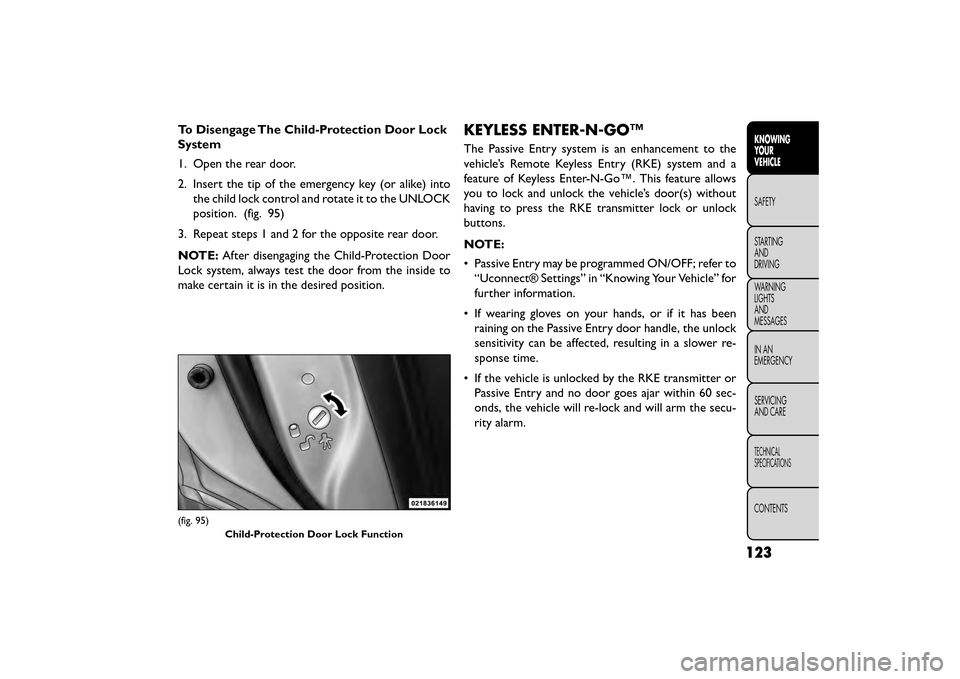
2. Insert the tip of the emergency key (or alike) intothe child lock control and rotate it to the UNLOCK
position. (fig. 95)
3. Repeat steps 1 and 2 for the opposite rear door.
NOTE: After disengaging the Child-Protection Door
Lock system, always test the door from the inside to
make certain it is in the desired position.KEYLESS ENTER-N-GO™
The Passive Entry system is an enhancement to the
vehicle’s Remote Keyless Entry (RKE) system and a
feature of Keyless Enter-N-Go™. This feature allows
you to lock and unlock the vehicle’s door(s) without
having to press the RKE transmitter lock or unlock
buttons.
NOTE:
• Passive Entry may be programmed ON/OFF; refer to “Uconnect® Settings” in “Knowing Your Vehicle” for
further information.
• If wearing gloves on your hands, or if it has been raining on the Passive Entry door handle, the unlock
sensitivity can be affected, resulting in a slower re-
sponse time.
• If the vehicle is unlocked by the RKE transmitter or Passive Entry and no door goes ajar within 60 sec-
onds, the vehicle will re-lock and will arm the secu-
rity alarm.
(fig. 95)
Child-Protection Door Lock Function
123
KNOWING
YOUR
VEHICLE
SAFETY
STAR
TING
AND
DRIVING
WARNING
LIGHTS
AND
MESSAGES
IN AN
EMERGENCY
SERVICING
AND CARE
TECHNICAL
SPECIFICATIONS
CONTENTS
Page 139 of 412
CARGO TIE-DOWNS
WARNING!
Cargo tie-downs are not safe anchors for
a child seat
tether strap. In a sudden stop
or collision, a tie-down could pull loose and allow
the child seat to come loose. A child could be
badly injured. Use only the anchors provided for
child seat tethers.
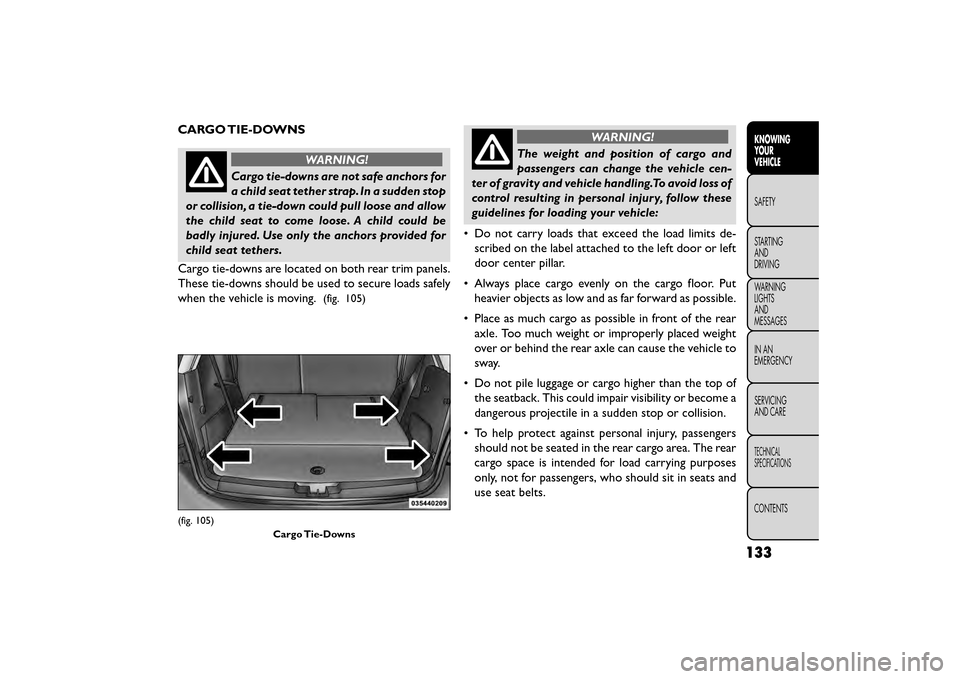
Cargo tie-downs are located on both rear trim panels.
These tie-downs should be used to secure loads safely
when the vehicle is moving.
(fig. 105)
WARNING!
The weight and position of cargo and
passenger s
can change the vehicle cen-
ter of gravity and vehicle handling.To avoid loss of
control resulting in personal injury, follow these
guidelines for loading your vehicle:
• Do not carry loads that exceed the load limits de- scribed on the label attached to the left door or left
door center pillar.
• Always place cargo evenly on the cargo floor. Put heavier objects as low and as far forward as possible.
• Place as much cargo as possible in front of the rear axle. Too much weight or improperly placed weight
over or behind the rear axle can cause the vehicle to
sway.
• Do not pile luggage or cargo higher than the top of the seatback. This could impair visibility or become a
dangerous projectile in a sudden stop or collision.
• To help protect against personal injury, passengers should not be seated in the rear cargo area. The rear
cargo space is intended for load carrying purposes
only, not for passengers, who should sit in seats and
use seat belts.
(fig. 105)
Cargo Tie-Downs
133
KNOWING
YOUR
VEHICLE
SAFETY
STAR
TING
AND
DRIVING
WARNING
LIGHTS
AND
MESSAGES
IN AN
EMERGENCY
SERVICING
AND CARE
TECHNICAL
SPECIFICATIONS
CONTENTS
Page 140 of 412
RETRACTABLE CARGO AREA COVER —
FIVE PASSENGER MODELS (for
versions/markets, where provided)
NOTE:The purpose of this cover is for privacy, not to
secure loads. It will not prevent cargo from shifting or
protect passengers from loose cargo.
The removable retractable cargo area cover mounts in
the cargo area behind the top of the rear seats.
The cover, when extended, covers the cargo area to
keep items out of sight. Notches in the trim panels near
the liftgate opening secure the extended cover in place.
The cover rolls away neatly inside its housing when not
in use. You can also remove the cover from the vehicle
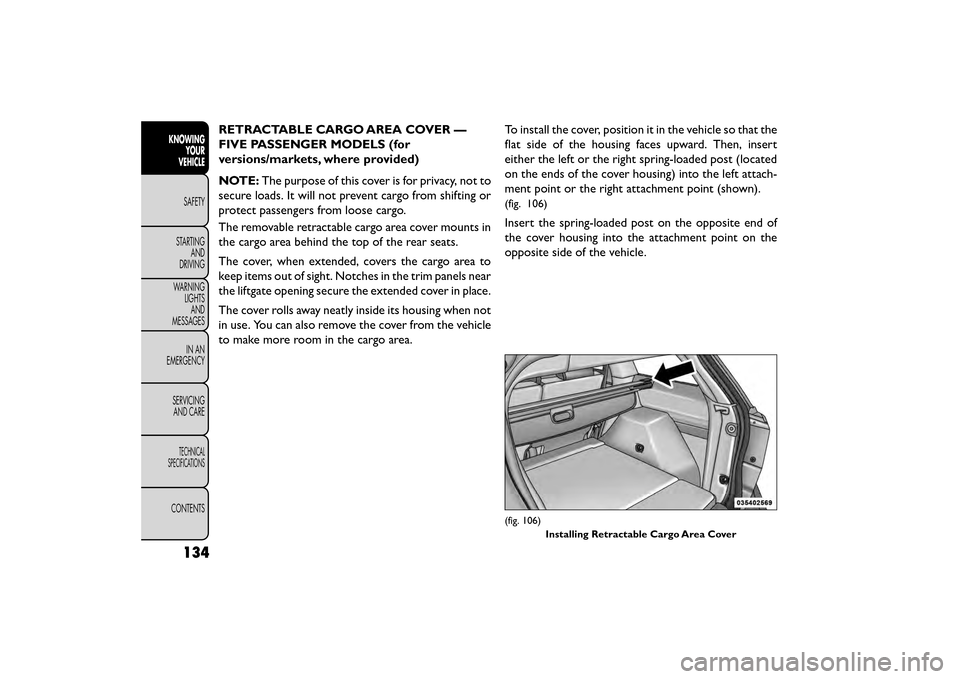
to make more room in the cargo area. To install the cover, position it in the vehicle so that the
flat side of the housing faces upward. Then, insert
either the left or the right spring-loaded post (located
on the ends of the cover housing) into the left attach-
ment point or the right attachment point (shown).
(fig. 106)
Insert the spring-loaded post on the opposite end of
the cover housing into the attachment point on the
opposite side of the vehicle.
(fig. 106)
Installing Retractable Cargo Area Cover
134
KNOWINGYOUR
VEHICLE
SAFETY
STAR
TINGAND
DRIVING
WARNING LIGHTSAND
MESSAGES
IN AN
EMERGENCY
SERVICINGAND CARE
TECHNICAL
SPECIFICATIONS
CONTENTS
Page 141 of 412
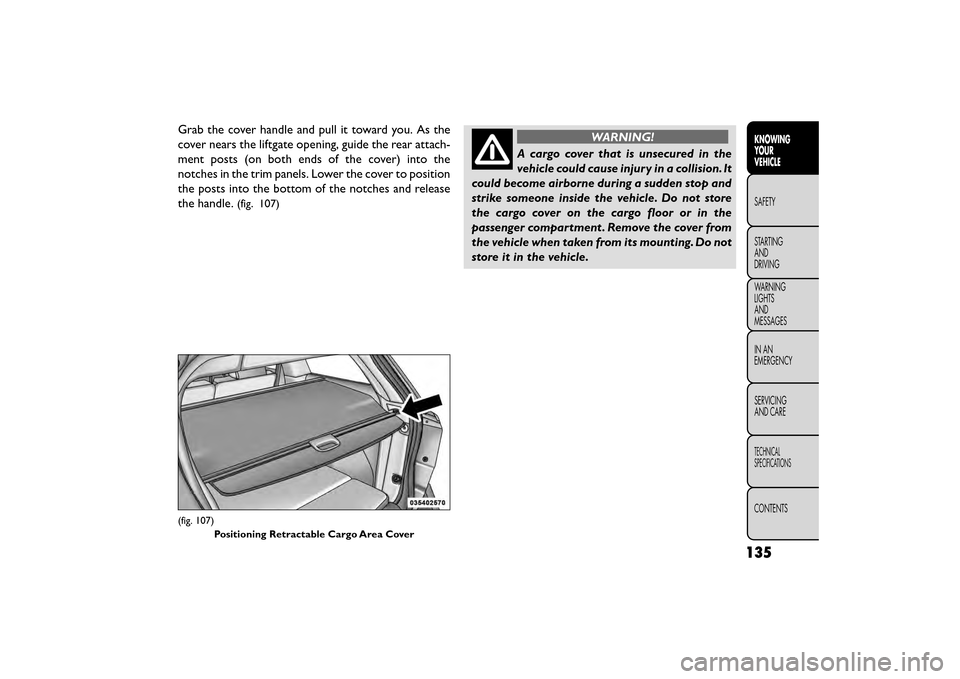
Grab the cover handle and pull it toward you. As the
cover nears the liftgate opening, guide the rear attach-
ment posts (on both ends of the cover) into the
notches in the trim panels. Lower the cover to position
the posts into the bottom of the notches and release
the handle.
(fig. 107)
WARNING!
A cargo cover that is unsecured in the
vehi cle
could cause injury in a collision. It
could become airborne during a sudden stop and
strike someone inside the vehicle. Do not store
the cargo cover on the cargo floor or in the
passenger compartment . Remove the cover from
the vehicle when taken from its mounting. Do not
store it in the vehicle.
(fig. 107)
Positioning Retractable Cargo Area Cover
135
KNOWING
YOUR
VEHICLE
SAFETY
STAR
TING
AND
DRIVING
WARNING
LIGHTS
AND
MESSAGES
IN AN
EMERGENCY
SERVICING
AND CARE
TECHNICAL
SPECIFICATIONS
CONTENTS
Page 142 of 412
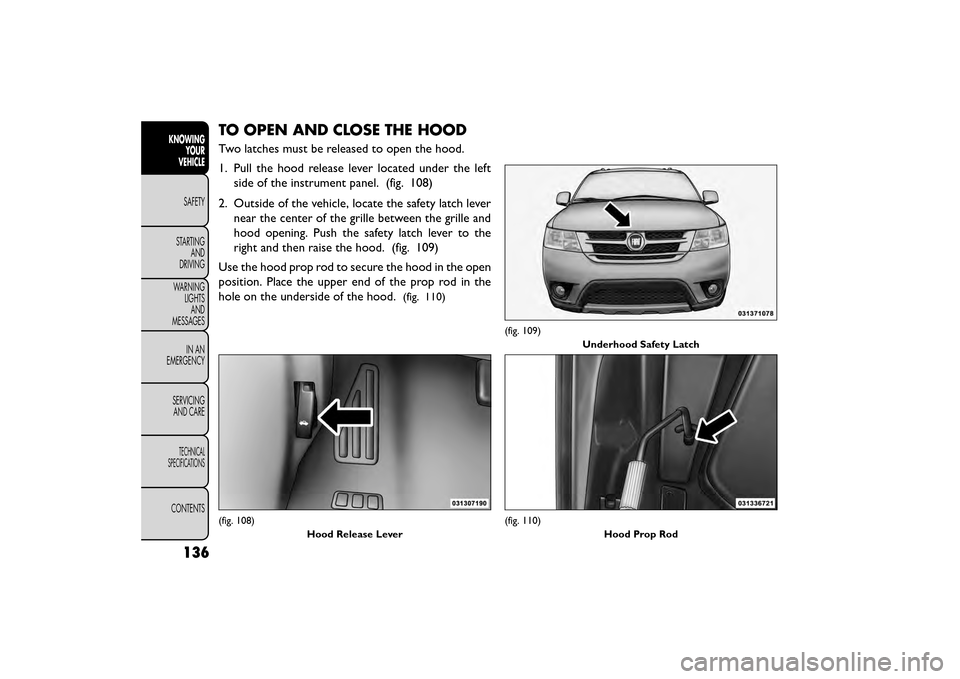
TO OPEN AND CLOSE THE HOOD
Two latches must be released to open the hood.
1. Pull the hood release lever located under the leftside of the instrument panel. (fig. 108)
2. Outside of the vehicle, locate the safety latch lever near the center of the grille between the grille and
hood opening. Push the safety latch lever to the
right and then raise the hood. (fig. 109)
Use the hood prop rod to secure the hood in the open
position. Place the upper end of the prop rod in the
hole on the underside of the hood.
(fig. 110)
(fig. 108) Hood Release Lever
(fig. 109)Underhood Safety Latch
(fig. 110) Hood Prop Rod
136
KNOWINGYOUR
VEHICLE
SAFETY
STAR
TINGAND
DRIVING
WARNING LIGHTSAND
MESSAGES
IN AN
EMERGENCY
SERVICINGAND CARE
TECHNICAL
SPECIFICATIONS
CONTENTS
Page 144 of 412
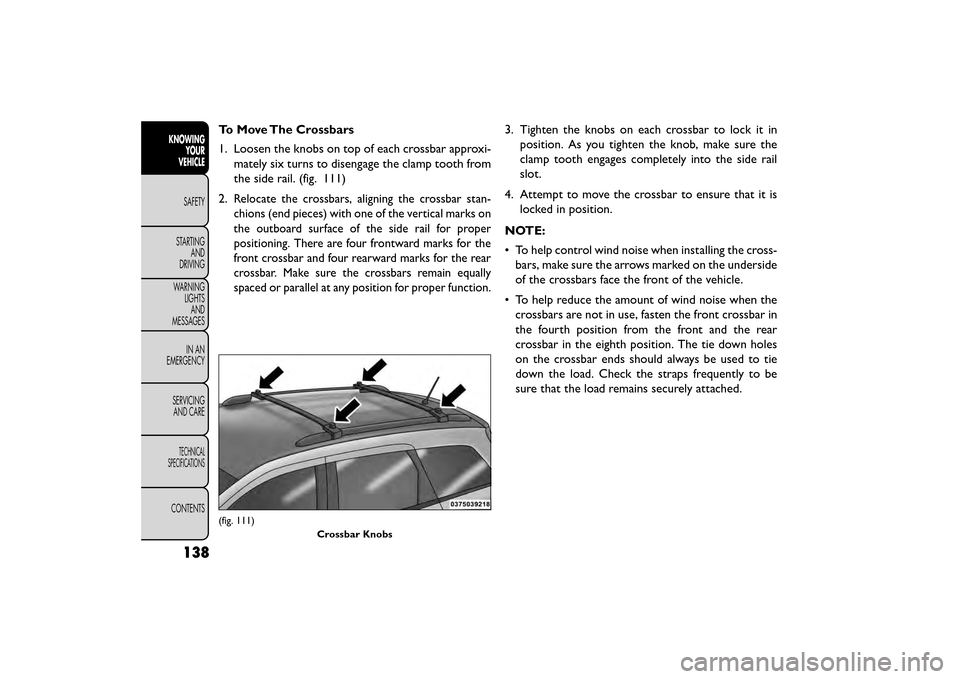
To Move The Crossbars
1. Loosen the knobs on top of each crossbar approxi-mately six turns to disengage the clamp tooth from
the side rail. (fig. 111)
2.
Relocate the crossbars, aligning the crossbar stan-
chions (end pieces) with one of the vertical marks on
the outboard surface of the side rail for proper
positioning. There are four frontward marks for the
front crossbar and four rearward marks for the rear
crossbar. Make sure the crossbars remain equally
spaced or parallel at any position for proper function.
3. Tighten the knobs on each crossbar to lock it in position. As you tighten the knob, make sure the
clamp tooth engages completely into the side rail
slot.
4. Attempt to move the crossbar to ensure that it is locked in position.
NOTE:
• To help control wind noise when installing the cross- bars, make sure the arrows marked on the underside
of the crossbars face the front of the vehicle.
• To help reduce the amount of wind noise when the crossbars are not in use, fasten the front crossbar in
the fourth position from the front and the rear
crossbar in the eighth position. The tie down holes
on the crossbar ends should always be used to tie
down the load. Check the straps frequently to be
sure that the load remains securely attached.
(fig. 111)
Crossbar Knobs
138
KNOWINGYOUR
VEHICLE
SAFETY
STAR
TINGAND
DRIVING
WARNING LIGHTSAND
MESSAGES
IN AN
EMERGENCY
SERVICINGAND CARE
TECHNICAL
SPECIFICATIONS
CONTENTS
Page 145 of 412
•To prevent damage to the roof of your
vehicle, DO NOT carry any loads on the
roof rack without the crossbars installed.
The load should be secured and placed on top of
the crossbars, not directly on the roof. If it is
necessary to place the load on the roof, place a
blanket or other protective layer between the
load and the roof surface.
• Crossbars should remain equally spaced or par-
allel at any roof rack position for proper function.
Noncompliance could result in damage to the
roof rack, cargo, and vehicle.
• To avoid damage to the roof rack and vehicle,
do not exceed the maximum roof rack load ca-
pacity of 68 kg. Always distribute heavy loads as
evenly as possible and secure the load appropri-
ately.
• Long loads, which extend over the windshield,
such as wood panels or surfboards, should be
secured to both the front and rear of the vehicle.
• Travel at reduced speeds and turn corners care-
fully when carrying large or heavy loads on the
roof rack. Wind forces, due to natural causes or
nearby truck traffic , can add sudden upward
loads.This is especially true on large flat loads and
may result in damage to the cargo or your vehicle.WARNING!
Cargo must be securely tied before driv-
ing y
our vehicle. Improperly secured
loads can fly off the vehicle, particularly at high
speeds, resulting in personal injury or property
damage. Follow the roof rack cautions when
carrying cargo on your roof rack.
139
KNOWING
YOUR
VEHICLE
SAFETY
STAR
TING
AND
DRIVING
WARNING
LIGHTS
AND
MESSAGES
IN AN
EMERGENCY
SERVICING
AND CARE
TECHNICAL
SPECIFICATIONS
CONTENTS
Page 197 of 412
NOTE:When removing the fuel filler cap, lay the cap
tether in the hook, located on the fuel filler door
reinforcement.
•Damage to the fuel system or emissions
control system could result from using an
improper fuel tank filler tube cap.
• A poorly fitting fuel filler cap could let impuri-
ties into the fuel system.
• A poorly fitting fuel filler cap may cause the
“Malfunction Indicator Light (MIL)” to turn on.
• To avoid fuel spillage and overfilling, do not “top
off ” the fuel tank after filling. When the fuel
nozzle “clicks” or shuts off, the fuel tank is full.
WARNING!
• Never have any smoking materials lit
in or
near the vehicle when the gas cap is
removed or the tank is being filled.
• Never add fuel to the vehicle when the engine is
running.
• A fire may result if gasoline is pumped into a
portable container that is inside of a vehicle.You
could be burned. Always place gas containers on
the ground while filling.
• Failure to follow this warning may result in
serious injury or death. NOTE:
• When the fuel nozzle “clicks” or shuts off, the fuel
tank is full.
• Tighten the gas cap until you hear a “clicking” sound. This is an indication that the gas cap is tightened
properly. The MIL in the instrument cluster may turn
on if the gas cap is not secured properly. Make sure
that the gas cap is tightened each time the vehicle is
refueled.
LOOSE FUEL FILLER CAP MESSAGE (for
versions/markets, where provided)
If the vehicle diagnostic system determines that the
fuel filler cap is loose, improperly installed, or damaged,
a “Check Gascap” message will display in the Electronic
Vehicle Information Center (EVIC). If this occurs,
tighten the fuel filler cap properly and press the TRIP
ODOMETER button to turn off the message. If the
problem continues, the message will appear the next
time the vehicle is started.
191
KNOWING
YOUR
VEHICLE
SAFETY
STAR
TING
AND
DRIVING
WARNING
LIGHTS
AND
MESSAGES
IN AN
EMERGENCY
SERVICING
AND CARE
TECHNICAL
SPECIFICATIONS
CONTENTS
Page 198 of 412
SAFETY
OCCUPANT RESTRAINT SYSTEMS
Some of the most important safety features in your
vehicle are the restraint systems:
• Seat Belt Systems
• Supplemental Restraint Systems (SRS) Air Bags
• Supplemental Active Head Restraints
• Active Hood System
• Child Restraints
IMPORTANT SAFETY PRECAUTIONS:
Please pay close attention to the information in this
section. It tells you how to use your restraint system
properly, to keep you and your passengers as safe as
possible.
Here are some simple steps you can take to minimize
the risk of harm from a deploying air bag:
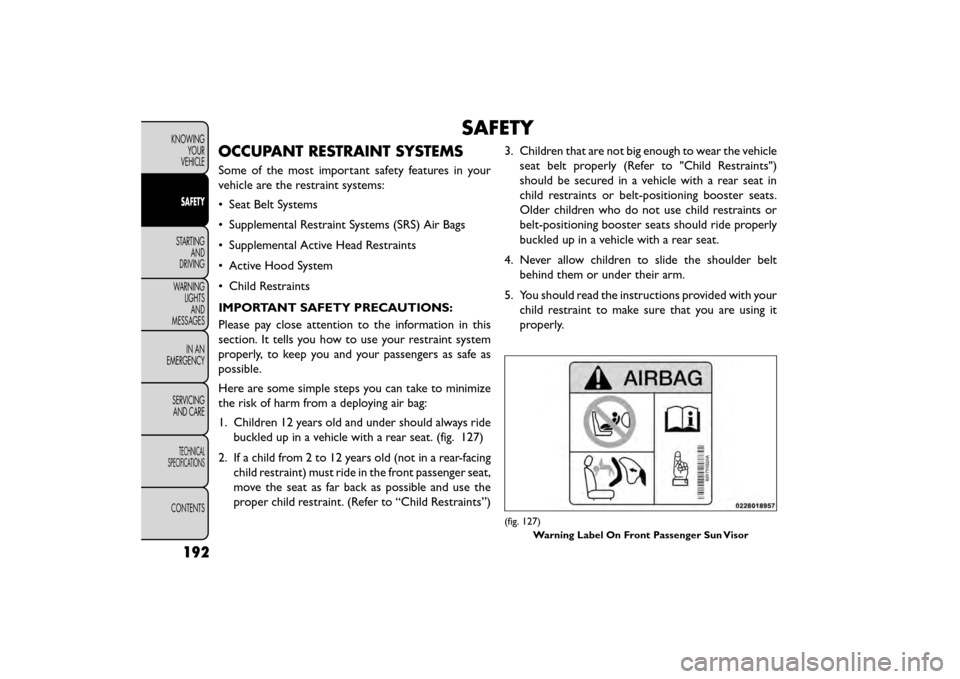
1. Children 12 years old and under should always ridebuckled up in a vehicle with a rear seat. (fig. 127)
2. If a child from 2 to 12 years old (not in a rear-facing child restraint) must ride in the front passenger seat,
move the seat as far back as possible and use the
proper child restraint. (Refer to “Child Restraints”) 3. Children that are not big enough to wear the vehicle
seat belt properly (Refer to "Child Restraints")
should be secured in a vehicle with a rear seat in
child restraints or belt-positioning booster seats.
Older children who do not use child restraints or
belt-positioning booster seats should ride properly
buckled up in a vehicle with a rear seat.
4. Never allow children to slide the shoulder belt behind them or under their arm.
5. You should read the instructions provided with your child restraint to make sure that you are using it
properly.
(fig. 127)
Warning Label On Front Passenger Sun Visor
192
KNOWINGYOUR
VEHICLE
SAFETY
STARTING AND
DRIVING
WARNING LIGHTSAND
MESSAGES
IN
AN
EMERGENCY
SERVICINGAND CARE
TECHNICAL
SPECIFICATIONS
CONTENTS