ECU FIAT FREEMONT 2015 1.G Owner's Guide
[x] Cancel search | Manufacturer: FIAT, Model Year: 2015, Model line: FREEMONT, Model: FIAT FREEMONT 2015 1.GPages: 412, PDF Size: 3.37 MB
Page 269 of 412
NOTE:Remember that everything put into or on the
trailer adds to the load on your vehicle. Also, additional
factory-installed options or dealer-installed options
must be considered as part of the total load on your
vehicle. Refer to the Tire and Loading Information
placard, located on the face of the driver's door or on
the driver's side “B” pillar, for the maximum combined
weight of occupants and cargo for your vehicle.
TOWING REQUIREMENTS
To promote proper break-in of your new vehicle drive-
train components the following guidelines are recom-
mended:
• Do not tow a trailer at all during the
first 805 km the new vehicle is driven.The
engine, axle or other parts could be dam-
aged.
• Then, during the first 805 km that a trailer is
towed, do not drive over 80 km/h and do not make
starts at full throttle. This helps the engine and
other parts of the vehicle wear in at the heavier
loads.
Perform the maintenance listed in the Maintenance
Schedule. When towing a trailer, never exceed the
GAWR ratings.
WARNING!
Improper towing can lead to an injury
acci den
t . Follow these guidelines to
make your trailer towing as safe as possible:
• Make certain that the load is secured in the
trailer and that it will not shift during travel.
When trailering cargo that is not fully secured,
dynamic load shifts can occur that may be diffi-
cult for the driver to control.You could lose con-
trol of your vehicle and have an accident .
• All trailer hitches should be professionally in-
stalled on your vehicle.
• When hauling cargo or towing a trailer, do not
overload your vehicle or trailer. Overloading can
cause a loss of control, poor performance, or
damage to brakes, axle, engine, transmission,
steering, suspension, chassis structure, or tires.
• Safety chains must always be used between
your vehicle and trailer. Always connect the
chains to the frame or hook retainers of the
vehicle hitch. Cross the chains under the trailer
tongue and allow enough slack for turning cor-
ners.
(Continued)
263
KNOWING
YOUR
VEHICLE
SAFETY
STARTING
AND
DRIVING
WARNING
LIGHTS
AND
MESSAGES
INAN
EMERGENC
Y
SERVICING
AND CARE
TECHNICAL
SPECIFICATIONS
CONTENTS
Page 284 of 412
12. Anti-Lock Brake (ABS) LightThis light monitors the Anti-Lock Brake Sys-
tem (ABS). The light will turn on when the
ignition switch is turned to the ON/RUN
position and may stay on for as long as four
seconds.
If the ABS light remains on or turns on while driving, it
indicates that the Anti-Lock portion of the brake sys-
tem is not functioning and that service is required.
However, the conventional brake system will continue
to operate normally if the Brake System Warning Light
is not on.
If the ABS light is on, the brake system should be
serviced as soon as possible to restore the benefit of
Anti-Lock brakes. Furthermore, the ABS light should
be checked frequently to assure that it is operating
properly. If the light does not turn on, have the system
checked by an authorized dealer. (Refer to “Electronic
Brake Control System” in “Knowing Your Vehicle” for
further information). 13. Fuel Cap Indicator
This symbol indicates the side of the vehicle
where the fuel filler cap is located.
14. Rear Fog Light Indicator This indicator will illuminate when the rear fog
lights are on. (Refer to “Rear Fog Lights” in
“Knowing Your Vehicle” for further
information).
15. Vehicle Security Light This light will flash rapidly for approximately
16 seconds when the vehicle security system
is arming and then flash slowly when the
system is armed. The light will also turn on
for about three seconds when the ignition switch is
first turned to ON/RUN. (Refer to “Vehicle Security
Alarm” or “Premium Security System” in “Knowing
Your Vehicle” for further information).
278
KNOWING YOUR
VEHICLE
SAFETY
STARTING AND
DRIVING
WARNING LIGHTSAND
MESSAGES
INAN
EMERGENC
Y
SERVICING AND
CARE
TECHNICAL
SPECIFICATIONS
CONTENTS
Page 292 of 412
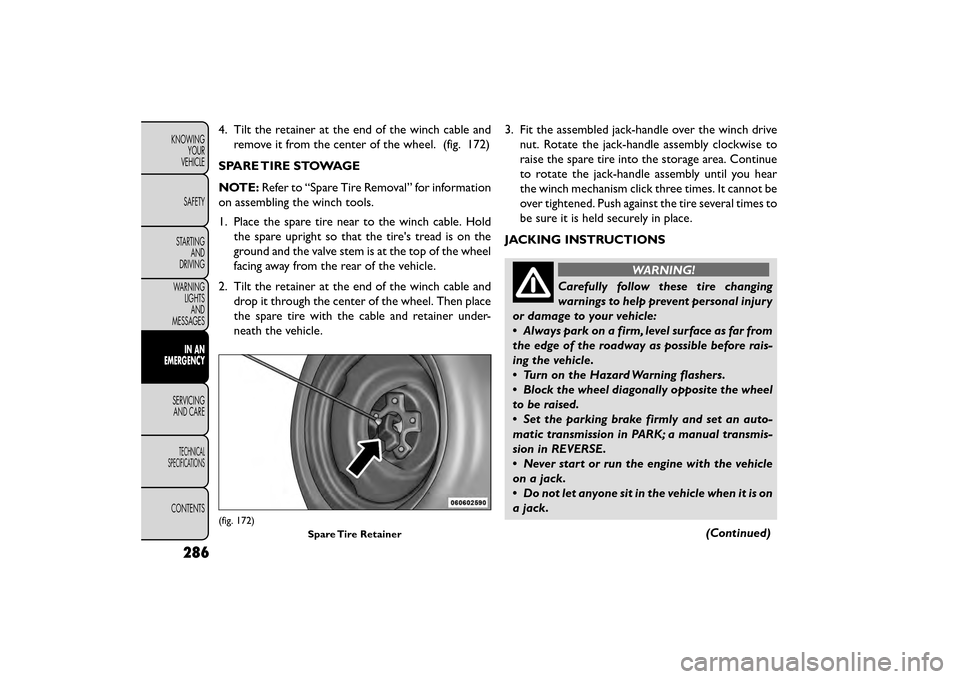
4. Tilt the retainer at the end of the winch cable andremove it from the center of the wheel. (fig. 172)
SPARE TIRE STOWAGE
NOTE: Refer to “Spare Tire Removal” for information
on assembling the winch tools.
1. Place the spare tire near to the winch cable. Hold the spare upright so that the tire's tread is on the
ground and the valve stem is at the top of the wheel
facing away from the rear of the vehicle.
2. Tilt the retainer at the end of the winch cable and drop it through the center of the wheel. Then place
the spare tire with the cable and retainer under-
neath the vehicle. 3. Fit the assembled jack-handle over the winch drive
nut. Rotate the jack-handle assembly clockwise to
raise the spare tire into the storage area. Continue
to rotate the jack-handle assembly until you hear
the winch mechanism click three times. It cannot be
over tightened. Push against the tire several times to
be sure it is held securely in place.
JACKING INSTRUCTIONS
WARNING!
Carefully follow these tire changing
warnin gs
to help prevent personal injury
or damage to your vehicle:
• Always park on a firm, level surface as far from
the edge of the roadway as possible before rais-
ing the vehicle.
• Turn on the Hazard Warning flashers.
• Block the wheel diagonally opposite the wheel
to be raised.
• Set the parking brake firmly and set an auto-
matic transmission in PARK; a manual transmis-
sion in REVERSE.
• Never start or run the engine with the vehicle
on a jack.
• Do not let anyone sit in the vehicle when it is on
a jack.
(Continued)
(fig. 172)Spare Tire Retainer
286
KNOWINGYOUR
VEHICLE
SAFETY
STARTING AND
DRIVING
WARNING LIGHTSAND
MESSAGES
IN AN
EMERGENCY
SER VICING
AND
CARE
TECHNICAL
SPECIFICATIONS
CONTENTS
Page 293 of 412
WARNING! (Continued)
• Do not get under the vehicle when it is on a
jack. If you need to get under a raised vehicle,
take it to a service center where it can be raised
on a lift .
• Only use the jack in the positions indicated and
for lifting this vehicle during a tire change.
• If working on or near a roadway, be extremely
careful of motor traffic .
• To assure that spare tires, flat or inflated, are
securely stowed, spares must be stowed with the
valve stem facing the ground.
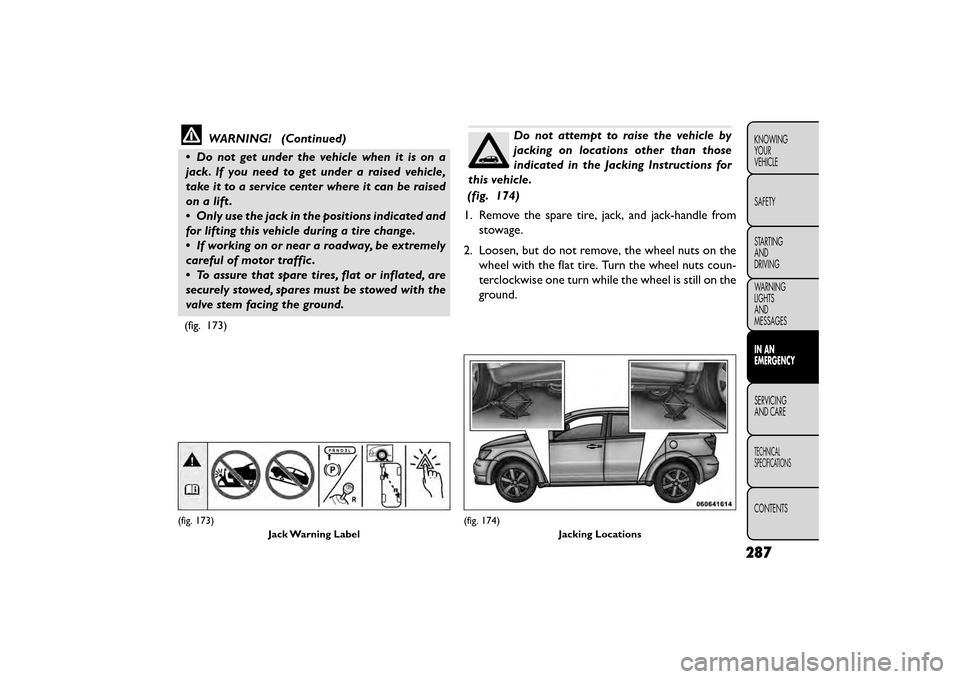
(fig. 173)
Do not attempt to raise the vehicle by
jacking on locations other than those
indicated in the Jacking Instructions for
this vehicle.
(fig. 174)
1. Remove the spare tire, jack, and jack-handle from stowage.
2. Loosen, but do not remove, the wheel nuts on the wheel with the flat tire. Turn the wheel nuts coun-
terclockwise one turn while the wheel is still on the
ground.
(fig. 173)
Jack Warning Label(fig. 174) Jacking Locations
287
KNOWING
YOUR
VEHICLE
SAFETY
STARTING
AND
DRIVING
WARNING
LIGHTS
AND
MESSAGES
IN AN
EMERGENCY
SERVICING
AND
CARE
TECHNICAL
SPECIFICATIONS
CONTENTS
Page 322 of 412
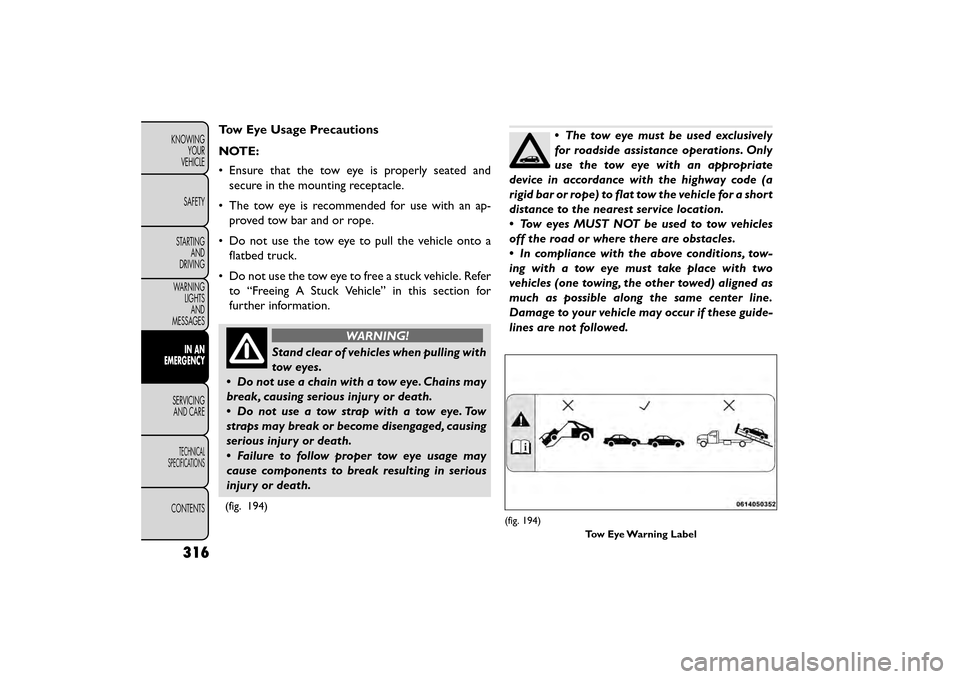
Tow Eye Usage Precautions
NOTE:
• Ensure that the tow eye is properly seated andsecure in the mounting receptacle.
• The tow eye is recommended for use with an ap- proved tow bar and or rope.
• Do not use the tow eye to pull the vehicle onto a flatbed truck.
• Do not use the tow eye to free a stuck vehicle. Refer to “Freeing A Stuck Vehicle” in this section for
further information.
WARNING!
Stand clear of vehicles when pulling with
tow e
yes.
• Do not use a chain with a tow eye. Chains may
break, causing serious injury or death.
• Donotuseatowstrapwithatoweye.Tow
straps may break or become disengaged, causing
serious injury or death.
• Failure to follow proper tow eye usage may
cause components to break resulting in serious
injury or death.
(fig. 194)
• The tow eye must be used exclusively
for roadside assistance operations. Only
use the tow eye with an appropriate
device in accordance with the highway code (a
rigid bar or rope) to flat tow the vehicle for a shor t
distance to the nearest service location.
• Tow eyes MUST NOT be used to tow vehicles
off the road or where there are obstacles.
• In compliance with the above conditions, tow-
ing with a tow eye must take place with two
vehicles (one towing, the other towed) aligned as
much as possible along the same center line.
Damage to your vehicle may occur if these guide-
lines are not followed.
(fig. 194)
Tow Eye Warning Label
316
KNOWINGYOUR
VEHICLE
SAFETY
STARTING AND
DRIVING
WARNING LIGHTSAND
MESSAGES
IN AN
EMERGENCY
SER VICING
AND
CARE
TECHNICAL
SPECIFICATIONS
CONTENTS
Page 325 of 412
•Do not use sling type equipment when
towing.Vehicle damage may occur.
• When securing the vehicle to a flat bed
truck, do not attach to front or rear suspension
components. Damage to your vehicle may result
from improper towing.
• Do not push or tow this vehicle with another
vehicle as damage to the bumper fascia and trans-
mission may result .
• If the vehicle being towed requires steering, the
ignition switch must be in the ACC or ON/RUN
position, not in the LOCK/OFF position.
WITHOUT THE KEY FOB
Special care must be taken when the vehicle is towed
with the ignition in the OFF position. Flatbed towing is
the preferred towing method. However, if a flatbed
towing vehicle is not available, wheel lift towing equip-
ment may be used. Rear towing (with the front wheels
on the ground) is not allowed, as transmission damage
will occur. If rear towing is the only alternative, the
front wheels must be placed on a towing dolly. Proper
towing equipment is necessary to prevent damage to
the vehicle. ALL-WHEEL DRIVE (AWD) MODELS
The manufacturer requires towing with all four wheels
OFF
the ground. Acceptable methods are to tow the
vehicle on a flatbed, or with one end of vehicle raised
and the opposite end on a towing dolly.
Towing this vehicle in violation of the
above requirements can cause severe
transmission and/or power transfer unit
damage. Damage from improper towing is not
covered under the New Vehicle Limited Warranty.
FRONT WHEEL DRIVE (FWD) MODELS —
MANUAL TRANSMISSION
The manufacturer recommends towing your vehicle
with all four wheels OFF the ground using a flatbed.
Your vehicle may also be towed in the forward direc-
tion, with all four wheels on the ground, the transmis-
sion in NEUTRAL, and the ignition in the ACC or
ON/RUN position. If the transmission is not operative,
the vehicle must be towed with the front wheels OFF
the ground (using a flatbed truck, towing dolly, or
wheel lift equipment with the front wheels raised).
319
KNOWING
YOUR
VEHICLE
SAFETY
STARTING
AND
DRIVING
WARNING
LIGHTS
AND
MESSAGES
IN AN
EMERGENCY
SER VICING
AND
CARE
TECHNICAL
SPECIFICATIONS
CONTENTS
Page 347 of 412
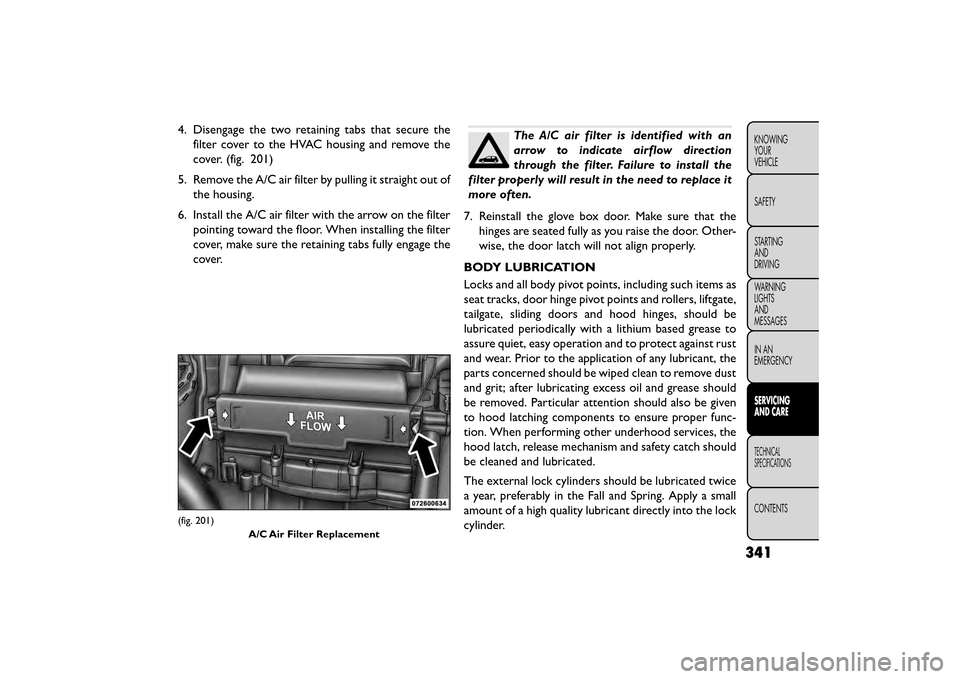
4. Disengage the two retaining tabs that secure thefilter cover to the HVAC housing and remove the
cover. (fig. 201)
5. Remove the A/C air filter by pulling it straight out of the housing.
6. Install the A/C air filter with the arrow on the filter pointing toward the floor. When installing the filter
cover, make sure the retaining tabs fully engage the
cover.The A/C air filter is identified with an
arrow to indicate airflow direction
through the filter. Failure to install the
filter properly will result in the need to replace it
more often.
7. Reinstall the glove box door. Make sure that the hinges are seated fully as you raise the door. Other-
wise, the door latch will not align properly.
BODY LUBRICATION
Locks and all body pivot points, including such items as
seat tracks, door hinge pivot points and rollers, liftgate,
tailgate, sliding doors and hood hinges, should be
lubricated periodically with a lithium based grease to
assure quiet, easy operation and to protect against rust
and wear. Prior to the application of any lubricant, the
parts concerned should be wiped clean to remove dust
and grit; after lubricating excess oil and grease should
be removed. Particular attention should also be given
to hood latching components to ensure proper func-
tion. When performing other underhood services, the
hood latch, release mechanism and safety catch should
be cleaned and lubricated.
The external lock cylinders should be lubricated twice
a year, preferably in the Fall and Spring. Apply a small
amount of a high quality lubricant directly into the lock
cylinder.
(fig. 201) A/C Air Filter Replacement
341
KNOWING
YOUR
VEHICLE
SAFETY
STARTING
AND
DRIVING
WARNING
LIGHTS
AND
MESSAGES
IN AN
EMERGENCY
SERVICING
AND CARE
TECHNICAL
SPECIFICATIONS
CONTENTS
Page 357 of 412
WARNING! (Continued)
• To avoid contamination from foreign matter or
moisture, use only new brake fluid or fluid that
has been in a tightly closed container. Keep the
master cylinder reservoir cap secured at all
times. Brake fluid in a open container absorbs
moisture from the air resulting in a lower boiling
point . This may cause it to boil unexpectedly
during hard or prolonged braking, resulting in
sudden brake failure. This could result in a acci-
dent .
• Overfilling the brake fluid reservoir can result
in spilling brake fluid on hot engine parts, causing
the brake fluid to catch fire. Brake fluid can also
damage painted and vinyl surfaces, care should
be taken to avoid its contact with these surfaces.
• Do not allow petroleum based fluid to con-
taminate the brake fluid. Brake seal components
could be damaged, causing partial or complete
brake failure.This could result in an accident . AUTOMATIC TRANSMISSION (for
versions/markets, where provided)
Selection Of Lubricant
It is important to use the proper transmission fluid to
ensure optimum transmission performance and life.
Use only the manufacturer’s specified transmission
fluid. Refer to “Fluids, Lubricants, and Genuine Parts”
in “Technical Specifications” for fluid specifications. It is
important to maintain the transmission fluid at the
correct level using the recommended fluid. No chemi-
cal flushes should be used in any transmission; only the
approved lubricant should be used.
Using a transmission fluid other than the
manufacturer ’s recommended fluid may
cause deterioration in transmission shift
quality and/or torque converter shudder, and will
require more frequent fluid and filter changes.
Refer to “Fluids, Lubricants, and Genuine Parts” in
"Technical Specifications" for fluid specifica-
tions.
351
KNOWING
YOUR
VEHICLE
SAFETY
STARTING
AND
DRIVING
WARNING
LIGHTS
AND
MESSAGES
IN AN
EMERGENCY
SERVICING
AND C ARE
TECHNICAL
SPECIFICATIONS
CONTENTS
Page 397 of 412
CONTENTS
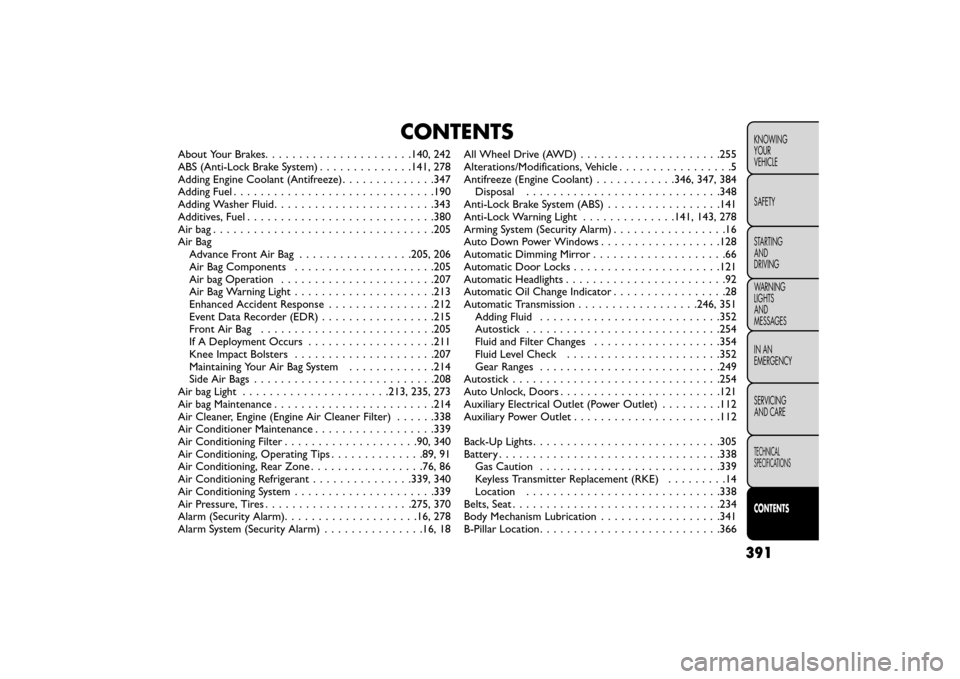
About Your Brakes..................... .140, 242
ABS (Anti-Lock Brake System) . . . . . .........141, 278
Adding Engine Coolant (Antifreeze) . . ............347
Adding Fuel ............................. .190
Adding Washer Fluid . . . .................... .343
Additives, Fuel . .......................... .380
Airbag................................ .205
Air Bag Advance Front Air Bag . ................205, 206
Air Bag Components . ................... .205
Air bag Operation ...................... .207
Air Bag Warning Light . ................... .213
Enhanced Accident Response . . . . ............212
Event Data Recorder (EDR) . . . . . ............215
FrontAirBag ......................... .205
If A Deployment Occurs . . . . . . .............211
Knee Impact Bolsters . . . . . . . . .............207
Maintaining Your Air Bag System .............214
Side Air Bags . . . . . . . . .................. .208
Air bag Light ..................... .213, 235, 273
Air bag Maintenance ....................... .214
Air Cleaner, Engine (Engine Air Cleaner Filter) ......338
Air Conditioner Maintenance . . . . . . . ...........339
Air Conditioning Filter . . . .................90, 340
Air Conditioning, Operating Tips . . . . ..........89, 91
Air Conditioning, Rear Zone . . . . . . . . .........76, 86
Air Conditioning Refrigerant . . . ............339, 340
Air Conditioning System . ................... .339
Air Pressure, Tires ..................... .275, 370
Alarm (Security Alarm) ................... .16, 278
Alarm System (Security Alarm) ...............16, 18All Wheel Drive (AWD)
.................... .255
Alterations/Modifications, Vehicle .................5
Antifreeze (Engine Coolant) ............346, 347, 384
Disposal ............................ .348
Anti-Lock Brake System (ABS) .................141
Anti-Lock War
ning Light ..............141, 143, 278
Arming System (Security Alarm) .................16
Auto Down Power Windows ..................128
Automatic Dimming Mirror ....................66
Automatic Door Locks ..................... .121
Automatic Headlights ........................92
Automatic Oil Change Indicator .................28
Automatic Transmission ................. .246, 351
Adding Fluid .......................... .352
Autostick ............................ .254
Fluid and Filter Changes .................. .354
Fluid Level Check ...................... .352
Gear Ranges .......................... .249
Autostick .............................. .254
Auto Unlock, Doors ....................... .121
Auxiliary Electrical Outlet (Power Outlet) .........112
Auxiliary Power Outlet ..................... .112
Back-Up Lights ........................... .305
Battery ................................ .338
Gas Caution .......................... .339
Keyless Transmitter Replacement (RKE) .........14
Location ............................ .338
Belts, Seat .............................. .234
Body Mechanism Lubrication ..................341
B-Pillar Location .......................... .366
391
KNOWING
YOUR
VEHICLE
SAFETY
STARTING
AND
DRIVING
WARNING
LIGHTS
AND
MESSAGES
IN AN
EMERGENCY
SERVICING
AND CARE
TECHNICAL
SPECIFICATIONS
CONTENTS
Page 405 of 412
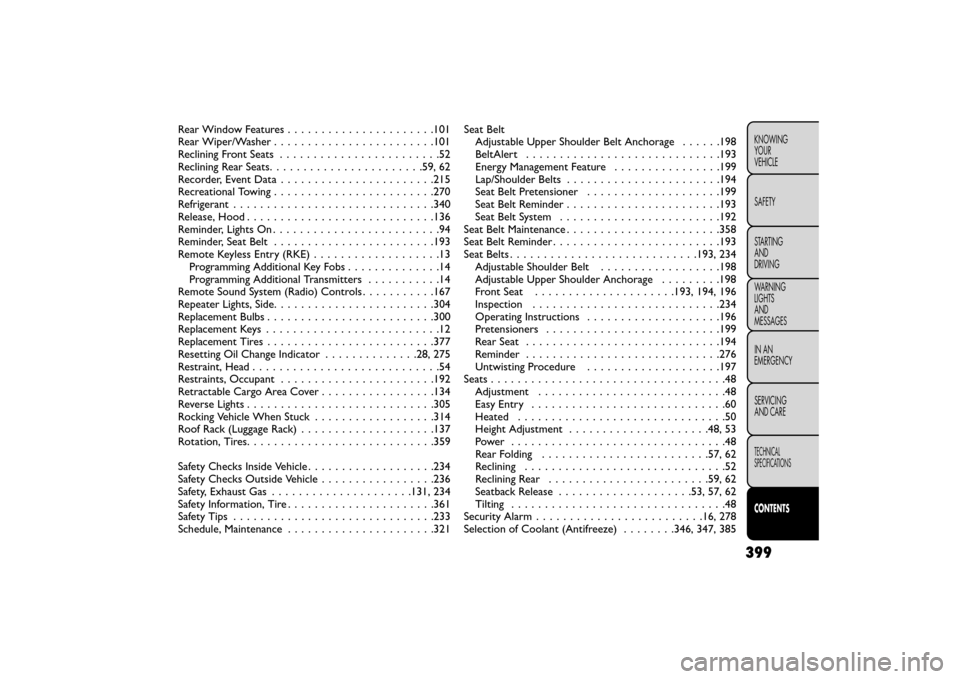
Rear Window Features . . . . . . . ...............101
Rear Wiper/Washer . . . . . . . . . . . . . ...........101
Reclining Front Seats . . . .....................52
Reclining Rear Seats ...................... .59, 62
Recorder, Event Data ...................... .215
Recreational Towing . . . . . . . . . ...............270
Refrigerant . . . .......................... .340
Release, Hood ........................... .136
Reminder, Lights On .........................94
Reminder, Seat Belt ....................... .193
Remote Keyless Entry (RKE) . . . . . . .............13
Programming Additional Key Fobs ..............14
Programming Additional Transmitters ...........14
Remote Sound System (Radio) Controls ...........167
Repeater Lights, Side ....................... .304
Replacement Bulbs ........................ .300
Replacement Keys . . . . ......................12
Replacement Tires ........................ .377
Resetting Oil Change Indicator . . . ...........28, 275
Restraint, Head . . ..........................54
Restraints, Occupant . . . ................... .192
Retractable Cargo Area Cover . . . . . . ...........134
Reverse Lights ........................... .305
Rocking Vehicle When Stuck . . . . . .............314
Roof Rack (Luggage Rack) . . . . ................137
Rotation, Tires. . . . ....................... .359
Safety Checks Inside Vehicle . . . . . . . ............234
Safety Checks Outside Vehicle .................236
Safety, Exhaust Gas . . . . . . . . .............131, 234
Safety Information, Tire . . ................... .361
Safety Tips . . . . . ........................ .233
Schedule, Maintenance . .................... .321Seat Belt
Adjustable Upper Shoulder Belt Anchorage ......198
BeltAlert ............................ .193
Energy Management Feature ................199
Lap/Shoulder Belts .......................194
Seat Belt Pr
etensioner ................... .199
Seat Belt Reminder ...................... .193
Seat Belt System ....................... .192
Seat Belt Maintenance ...................... .358
Seat Belt Reminder ........................ .193
Seat Belts ........................... .193, 234
Adjustable Shoulder Belt ..................198
Adjustable Upper Shoulder Anchorage .........198
Front Seat .................... .193, 194, 196
Inspection ........................... .234
Operating Instructions ................... .196
Pretensioners ......................... .199
Rear Seat ............................ .194
Reminder ............................ .276
Untwisting Procedure ................... .197
Seats ...................................48
Adjustment ............................48
Easy Entry .............................60
Heated ...............................50
Height Adjustment . . .................. .48, 53
Power ................................48
Rear Folding ........................ .57, 62
Reclining ..............................52
Reclining Rear ....................... .59, 62
Seatback Release ................... .53, 57, 62
Tilting ................................48
Security Alarm ........................ .16, 278
Selection of Coolant (Antifreeze) ........346, 347, 385
399
KNOWING
YOUR
VEHICLE
SAFETY
STARTING
AND
DRIVING
WARNING
LIGHTS
AND
MESSAGES
IN AN
EMERGENCY
SERVICING
AND CARE
TECHNICAL
SPECIFICATIONS
CONTENTS