towing FIAT FREEMONT 2015 1.G Owner's Manual
[x] Cancel search | Manufacturer: FIAT, Model Year: 2015, Model line: FREEMONT, Model: FIAT FREEMONT 2015 1.GPages: 412, PDF Size: 3.37 MB
Page 325 of 412
•Do not use sling type equipment when
towing.Vehicle damage may occur.
• When securing the vehicle to a flat bed
truck, do not attach to front or rear suspension
components. Damage to your vehicle may result
from improper towing.
• Do not push or tow this vehicle with another
vehicle as damage to the bumper fascia and trans-
mission may result .
• If the vehicle being towed requires steering, the
ignition switch must be in the ACC or ON/RUN
position, not in the LOCK/OFF position.
WITHOUT THE KEY FOB
Special care must be taken when the vehicle is towed
with the ignition in the OFF position. Flatbed towing is
the preferred towing method. However, if a flatbed
towing vehicle is not available, wheel lift towing equip-
ment may be used. Rear towing (with the front wheels
on the ground) is not allowed, as transmission damage
will occur. If rear towing is the only alternative, the
front wheels must be placed on a towing dolly. Proper
towing equipment is necessary to prevent damage to
the vehicle. ALL-WHEEL DRIVE (AWD) MODELS
The manufacturer requires towing with all four wheels
OFF
the ground. Acceptable methods are to tow the
vehicle on a flatbed, or with one end of vehicle raised
and the opposite end on a towing dolly.
Towing this vehicle in violation of the
above requirements can cause severe
transmission and/or power transfer unit
damage. Damage from improper towing is not
covered under the New Vehicle Limited Warranty.
FRONT WHEEL DRIVE (FWD) MODELS —
MANUAL TRANSMISSION
The manufacturer recommends towing your vehicle
with all four wheels OFF the ground using a flatbed.
Your vehicle may also be towed in the forward direc-
tion, with all four wheels on the ground, the transmis-
sion in NEUTRAL, and the ignition in the ACC or
ON/RUN position. If the transmission is not operative,
the vehicle must be towed with the front wheels OFF
the ground (using a flatbed truck, towing dolly, or
wheel lift equipment with the front wheels raised).
319
KNOWING
YOUR
VEHICLE
SAFETY
STARTING
AND
DRIVING
WARNING
LIGHTS
AND
MESSAGES
IN AN
EMERGENCY
SER VICING
AND
CARE
TECHNICAL
SPECIFICATIONS
CONTENTS
Page 326 of 412
Towing this vehicle in violation of the
above requirements can cause severe en-
gine and/or transmission damage. Dam-
age from improper towing is not covered under
the New Vehicle Limited Warranty.
FRONT WHEEL DRIVE (FWD) MODELS —
AUTOMATIC TRANSMISSION
The manufacturer recommends towing your vehicle
with all four wheels OFF the ground using a flatbed.
If flatbed equipment is not available, and the transmis-
sion is operable, the vehicle may be flat towed (with all
four wheels on the ground) under the following condi-
tions:
• The transmission must be in NEUTRAL.
• The towing distance must not exceed 24 km.
• The towing speed must not exceed 40 km/h. If the transmission is not operable, or the ve-
hicle must be towed faster than 40 km/h or
farther than 24 km, it must be towed with the
front wheels OFF the ground (using a flatbed
truck, towing dolly, or wheel lift equipment with
the front wheels raised).
•
Towing this vehicle in violation of the
above requirements can cause severe
transmission damage. Damage from im-
proper towing is not covered under the New Ve-
hicle Limited Warranty.
320
KNOWING YOUR
VEHICLE
SAFETY
STARTING AND
DRIVING
WARNING LIGHTSAND
MESSAGES
IN AN
EMERGENCY
SER VICING
AND
CARE
TECHNICAL
SPECIFICATIONS
CONTENTS
Page 330 of 412
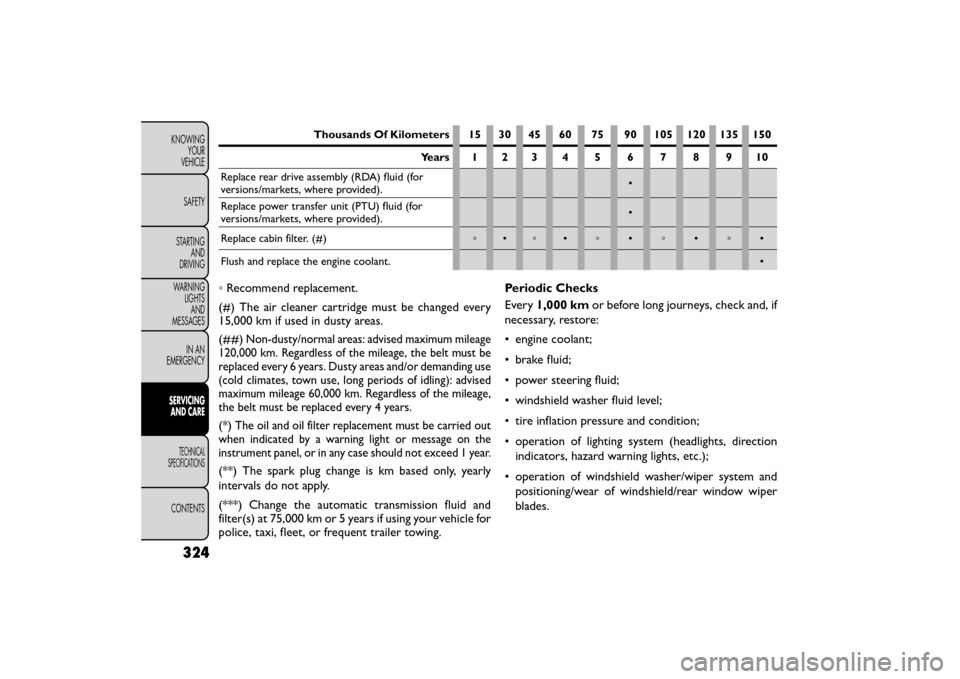
Thousands Of Kilometers 15 30 45 60 75 90 105 120 135 150Years 1 2 3 4 5678910
Replace rear drive assembly (RDA) fluid (for
versions/markets, where provided). •
Replace power transfer unit (PTU) fluid (for
versions/markets, where provided). •
Replace cabin filter. (#) ◦•◦ • ◦ •◦•◦•
Flush and replace the engine coolant. •
◦Recommend replacement.
(#) The air cleaner cartridge must be changed every
15,000 km if used in dusty areas.
(##)
Non-dusty/normal areas: advised maximum mileage
120,000 km. Regardless of the mileage, the belt must be
replaced every 6 years. Dusty areas and/or demanding use
(cold climates, town use, long periods of idling): advised
maximum mileage 60,000 km. Regardless of the mileage,
the belt must be replaced every 4 years.
(*)The oil and oil filter replacement must be carried out
when indicated by a warning light or message on the
instrument panel, or in any case should not exceed 1 year.
(**) The spark plug change is km based only, yearly
intervals do not apply.
(***) Change the automatic transmission fluid and
filter(s) at 75,000 km or 5 years if using your vehicle for
police, taxi, fleet, or frequent trailer towing. Periodic Checks
Every
1,000 km or before long journeys, check and, if
necessary, restore:
• engine coolant;
• brake fluid;
• power steering fluid;
• windshield washer fluid level;
• tire inflation pressure and condition;
• operation of lighting system (headlights, direction indicators, hazard warning lights, etc.);
• operation of windshield washer/wiper system and positioning/wear of windshield/rear window wiper
blades.
324
KNOWING YOUR
VEHICLE
SAFETY
STARTING AND
DRIVING
WARNING LIGHTSAND
MESSAGES
IN AN
EMERGENCY
SERVICINGAND C ARE
TECHNICAL
SPECIFICATIONS
CONTENTS
Page 331 of 412
Every3,000 km, check and top up, if required, the
engine oil level and automatic transmission fluid level
(four-speed automatic only).
Heavy-Duty Use Of The Car
If the car is used mainly under one of the following
conditions:
• towing a trailer or caravan;
• dusty roads;
• short, repeated journeys (less than 7-8 km) at sub- zero outside temperatures;
• engine often idling or driving long distances at low speeds or long periods of idleness.
You should perform the following inspections more
frequently than shown on the Scheduled Servicing Plan:
• check front disc brake pad conditions and wear;
• check cleanliness of hood and trunk locks, cleanli- ness and lubrication of linkage;
• visually inspect conditions of: engine, transmission, pipes and hoses (exhaust - fuel system - brakes) and
rubber elements (boots - sleeves - bushes - etc.);
• check battery charge and battery fluid level (electro- lyte); • visually inspect condition of the accessory drive
belts;
• check and, if necessary, change engine oil and replace oil filter;
• check and, if necessary, replace pollen filter;
• check and, if necessary, replace air cleaner.
MAINTENANCE SCHEDULE — DIESEL
ENGINE
To help you have the best driving experience possible,
the manufacturer has identified the specific vehicle
maintenance service intervals that are required to keep
your vehicle operating properly and safely.
The manufacturer recommends that these mainte-
nance intervals be performed at your selling dealer. The
technicians at your dealership know your vehicle best,
and have access to factory trained information, genuine
FIAT parts, and specially designed electronic and me-
chanical tools that can help prevent future costly re-
pairs.
The maintenance intervals shown should be performed
as indicated in this section.
325
KNOWING
YOUR
VEHICLE
SAFETY
STARTING
AND
DRIVING
WARNING
LIGHTS
AND
MESSAGES
IN AN
EMERGENCY
SERVICING
AND C ARE
TECHNICAL
SPECIFICATIONS
CONTENTS
Page 336 of 412
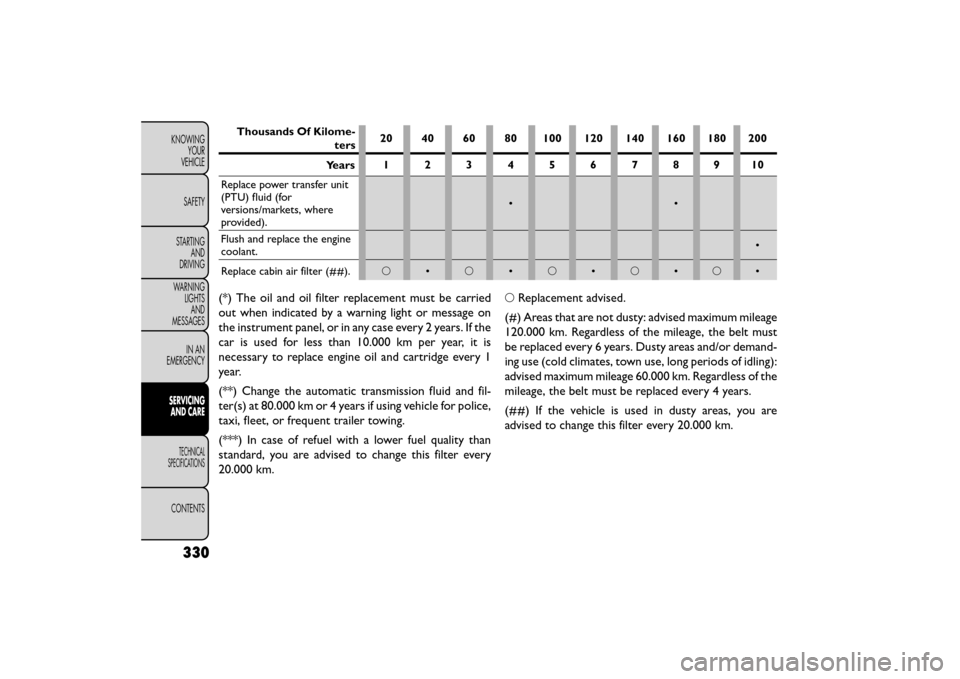
Thousands Of Kilome-
ters20 40 60 80 100 120 140 160 180 200
12345678910
Replace power transfer unit
(PTU) fluid (for
versions/markets, where
provided).
••
Flush and replace the engine
coolant.•
Replace cabin air filter (##).○•○•○•○•○•
(*) The oil and oil filter replacement must be carried
out when indicated by a warning light or message on
the instrument panel, or in any case every 2 years. If the
car is used for less than 10.000 km per year, it is
necessary to replace engine oil and cartridge every 1
year.
(**) Change the automatic transmission fluid and fil-
ter(s) at 80.000 km or 4 years if using vehicle for police,
taxi, fleet, or frequent trailer towing.
(***) In case of refuel with a lower fuel quality than
standard, you are advised to change this filter every
20.000 km.
○Replacement advised.
(#) Areas that are not dusty: advised maximum mileage
120.000 km. Regardless of the mileage, the belt must
be replaced every 6 years. Dusty areas and/or demand-
ing use (cold climates, town use, long periods of idling):
advised maximum mileage 60.000 km. Regardless of the
mileage, the belt must be replaced every 4 years.
(##) If the vehicle is used in dusty areas, you are
advised to change this filter every 20.000 km.
330
KNOWINGYOURVEHICLE
SAFETY
STARTINGANDDRIVING
WARNINGLIGHTSANDMESSAGES
IN ANEMERGENCY
SERVICINGAND CARE
TECHNICALSPECIFICATIONS
CONTENTS
Years
Page 337 of 412
Failure to perform the required mainte-
nance items may result in damage to the
vehicle.
Periodic Checks
Every 1,000 km or before long journeys, check and, if
necessary, restore:
• engine coolant;
• brake fluid;
• power steering fluid;
• windshield washer fluid level;
• tire inflation pressure and condition;
• operation of lighting system (headlights, direction indicators, hazard warning lights, etc.);
• operation of windshield washer/wiper system and positioning/wear of windshield/rear window wiper
blades.
Every 3,000 km, check and top up, if required, the
engine oil level.
Heavy-Duty Use Of The Car
If the car is used mainly under one of the following
conditions:
• towing a trailer or caravan; • dusty roads;
• short, repeated journeys (less than 7-8 km) at sub-
zero outside temperatures;
• engine often idling or driving long distances at low speeds or long periods of idleness.
You should perform the following inspections more
frequently than shown on the Scheduled Servicing Plan:
• check front disc brake pad conditions and wear;
• check cleanliness of hood and trunk locks, cleanli- ness and lubrication of linkage;
• visually inspect conditions of: engine, transmission, pipes and hoses (exhaust - fuel system - brakes) and
rubber elements (boots - sleeves - bushes - etc.);
• check battery charge and battery fluid level (electro- lyte);
• visually inspect condition of the accessory drive belts;
• check and, if necessary, change engine oil and replace oil filter;
• check and, if necessary, replace pollen filter;
• check and, if necessary, replace air cleaner.
331
KNOWING
YOUR
VEHICLE
SAFETY
STARTING
AND
DRIVING
WARNING
LIGHTS
AND
MESSAGES
IN AN
EMERGENCY
SERVICING
AND C ARE
TECHNICAL
SPECIFICATIONS
CONTENTS
Page 351 of 412
NOTE:Intentional tampering with emissions control
systems can result in civil penalties being assessed
against you.
WARNING!
A hot exhaust system can start a fire if you
park over materials that can burn. Such
materials might be grass or leaves coming into
contact with your exhaust system. Do not park or
operate your vehicle in areas where your exhaust
system can contact anything that can burn.
In unusual situations involving grossly malfunctioning
engine operation, a scorching odor may indicate severe
and abnormal catalyst overheating. If this occurs, safely
bring the vehicle to a complete stop, shut the engine
OFF, and allow the vehicle to cool. Thereafter, obtain
service, including a tune-up to manufacturer’s specifi-
cations immediately.
To minimize the possibility of catalyst damage:
• Do not shut OFF the engine or interrupt the ignition when the transmission is in gear and the vehicle is in
motion.
• Do not try to start the engine by pushing or towing the vehicle.
• Do not idle the engine with any ignition coil connec- tors disconnected for prolonged periods. COOLING SYSTEM
WARNING!
• When working near the radiator cool-
in g
fan, disconnect the fan motor lead or
turn the ignition switch to the LOCK position.The
fan is temperature controlled and can start at
any time the ignition switch is in the ON position.
• You or others can be badly burned by hot
engine coolant (antifreeze) or steam from your
radiator. If you see or hear steam coming from
under the hood, do not open the hood until the
radiator has had time to cool. Never tr y to open a
cooling system pressure cap when the radiator is
hot .
Car maintenance should be done at a
FIAT Dealership. For routine and minor
maintenance operations you wish to
carry out yourself, we do recommend you have
the proper equipment , genuine FIAT spare parts
and the necessary fluids; do not however carry out
these operations if you have no experience.
345
KNOWING
YOUR
VEHICLE
SAFETY
STARTING
AND
DRIVING
WARNING
LIGHTS
AND
MESSAGES
IN AN
EMERGENCY
SERVICING
AND C ARE
TECHNICAL
SPECIFICATIONS
CONTENTS
Page 373 of 412
NOTE:Under a maximum loaded vehicle condition,
gross axle weight ratings (GAWRs) for the front and
rear axles must not be exceeded. For further informa-
tion on GAWRs, vehicle loading, and trailer towing,
refer to “Vehicle Loading” in this section.
To determine the maximum loading conditions of your
vehicle, locate the statement “The combined weight of
occupants and cargo should never exceed XXX lbs or
XXX kg” on the Tire and Loading Information placard.
The combined weight of occupants, cargo/luggage and
trailer tongue weight (if applicable) should never ex-
ceed the weight referenced here.
Steps For Determining Correct Load Limit
1. Locate the statement “The combined weight of occupants and cargo should never exceed XXX lbs
or XXX kg” on your vehicle's placard.
2. Determine the combined weight of the driver and passengers that will be riding in your vehicle.
3. Subtract the combined weight of the driver and passengers from XXX kg. 4. The resulting figure equals the available amount of
cargo and luggage load capacity. For example, if
“XXX” amount equals 635 kg and there will be five
68 kg passengers in your vehicle, the amount of
available cargo and luggage load capacity is 295 kg
(since5x68kg=340kg,and635kg–340kg=
295 kg).
5. Determine the combined weight of luggage and cargo being loaded on the vehicle. That weight may
not safely exceed the available cargo and luggage
load capacity calculated in step 4.
NOTE:
• If your vehicle will be towing a trailer, load from your trailer will be transferred to your vehicle. The follow-
ing table shows examples on how to calculate total
load, cargo/luggage, and towing capacities of your
vehicle with varying seating configurations and num-
ber and size of occupants. This table is for illustration
purposes only and may not be accurate for the
seating and load carry capacity of your vehicle.
367
KNOWING
YOUR
VEHICLE
SAFETY
STARTING
AND
DRIVING
WARNING
LIGHTS
AND
MESSAGES
IN AN
EMERGENCY
SERVICING
AND CARE
TECHNICAL
SPECIFICATIONS
CONTENTS
Page 399 of 412
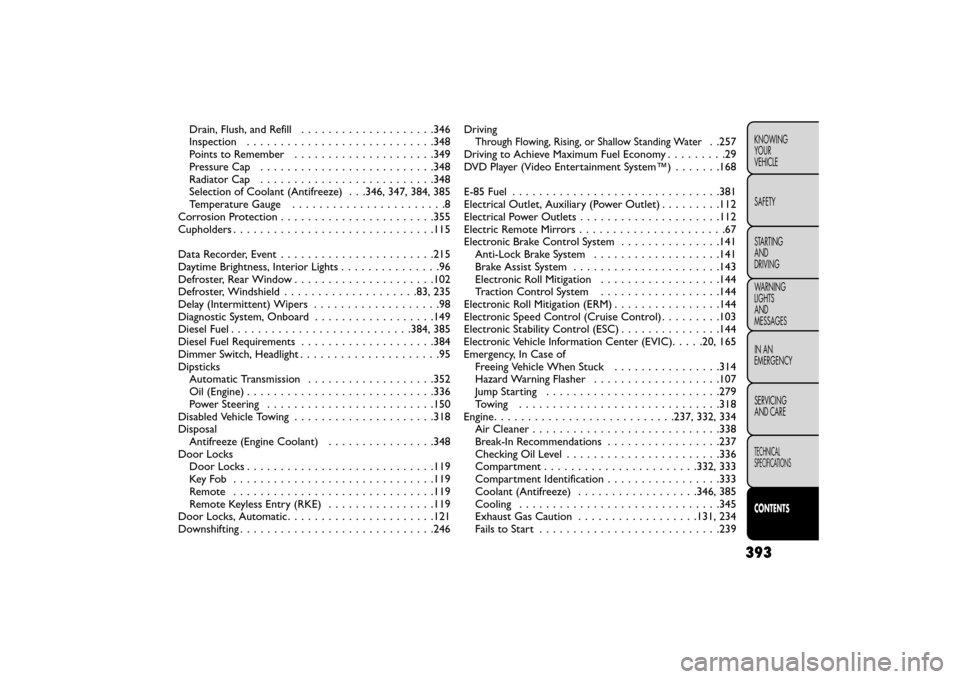
Drain, Flush, and Refill . . . . . . . .............346
Inspection ........................... .348
Points to Remember . . . . . . . . . ............349
Pressure Cap . . . . . . . . . . . . . . . ...........348
Radiator Cap ......................... .348
Selection of Coolant (Antifreeze) . . .346, 347, 384, 385
Temperature Gauge . ......................8
Corrosion Protection . . . ................... .355
Cupholders ............................. .115
Data Recorder, Event ...................... .215
Daytime Brightness, Interior Lights . ..............96
Defroster, Rear Window . . . . .................102
Defroster, Windshield ................... .83, 235
Delay (Intermittent) Wipers . . . . . ..............98
Diagnostic System, Onboard ..................149
Diesel Fuel . . . . . . . . .................. .384, 385
Diesel Fuel Requirements . . . . . . . . . ...........384
Dimmer Switch, Headlight .....................95
Dipsticks Automatic Transmission . . . ................352
Oil (Engine) . . . . . . . . . .................. .336
Power Steering . . . . . . . ..................150
Disabled Vehicle Towing . ................... .318
Disposal Antifreeze (Engine Coolant) . . . . . ...........348
Door Locks Door Locks ........................... .119
KeyFob ............................. .119
Remote . . . . . . . . . . . . . . . ...............119
Remote Keyless Entry (RKE) ................119
Door Locks, Automatic . . . . . . . . . . ............121
Downshifting . . . ......................... .246Driving
Through Flowing, Rising, or Shallow Standing Water. .257
Driving to Achieve Maximum Fuel Economy .........29
DVD Player (Video Entertainment System™) .......168
E-85 Fuel .............................. .381
Electrical Outlet, Auxiliary (Power Outlet) .........112
Electrical Power Outlets .................... .112
Electric Remote Mirrors ......................67
Electronic Brake Control System ...............141
Anti-Lock Brake System .................. .141
Brake Assist System ..................... .143
Electronic Roll Mitigation ..................144
Traction Control System ..................144
Electronic Roll Mitigation (ERM) ................144
Electronic Speed Control (Cruise Control) .........103
Electronic Stability Control (ESC) ...............144
Electronic Vehicle Information Center (EVIC) .....20, 165
Emergency, In Case of Freeing Vehicle When Stuck ................314
Hazard Warning Flasher .................. .107
Jump Starting ......................... .279
Towing ............................. .318
Engine .......................... .237, 332, 334
Air Cleaner ........................... .338
Break-In Recommendations .................237
Checking Oil Level ...................... .336
Compartment ...................... .332, 333
Compartment Identification .................333
Coolant (Antifreeze) ................. .346, 385
Cooling ............................. .345
Exhaust Gas Caution ................. .131, 234
Fails to Start .......................... .239
393
KNOWING
YOUR
VEHICLE
SAFETY
STARTING
AND
DRIVING
WARNING
LIGHTS
AND
MESSAGES
IN AN
EMERGENCY
SERVICING
AND CARE
TECHNICAL
SPECIFICATIONS
CONTENTS
Page 405 of 412
Rear Window Features . . . . . . . ...............101
Rear Wiper/Washer . . . . . . . . . . . . . ...........101
Reclining Front Seats . . . .....................52
Reclining Rear Seats ...................... .59, 62
Recorder, Event Data ...................... .215
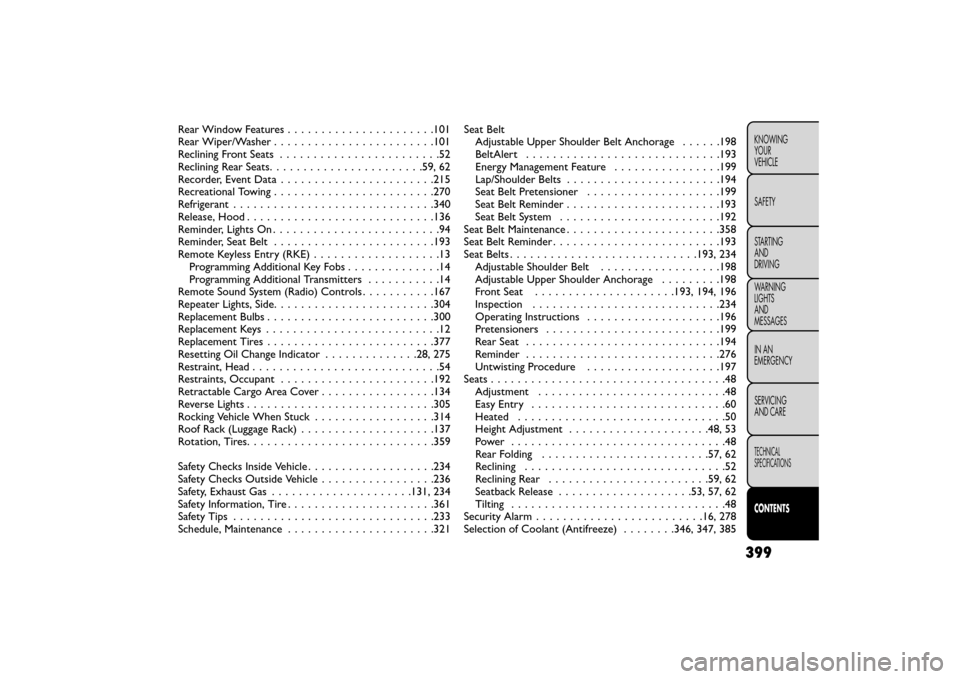
Recreational Towing . . . . . . . . . ...............270
Refrigerant . . . .......................... .340
Release, Hood ........................... .136
Reminder, Lights On .........................94
Reminder, Seat Belt ....................... .193
Remote Keyless Entry (RKE) . . . . . . .............13
Programming Additional Key Fobs ..............14
Programming Additional Transmitters ...........14
Remote Sound System (Radio) Controls ...........167
Repeater Lights, Side ....................... .304
Replacement Bulbs ........................ .300
Replacement Keys . . . . ......................12
Replacement Tires ........................ .377
Resetting Oil Change Indicator . . . ...........28, 275
Restraint, Head . . ..........................54
Restraints, Occupant . . . ................... .192
Retractable Cargo Area Cover . . . . . . ...........134
Reverse Lights ........................... .305
Rocking Vehicle When Stuck . . . . . .............314
Roof Rack (Luggage Rack) . . . . ................137
Rotation, Tires. . . . ....................... .359
Safety Checks Inside Vehicle . . . . . . . ............234
Safety Checks Outside Vehicle .................236
Safety, Exhaust Gas . . . . . . . . .............131, 234
Safety Information, Tire . . ................... .361
Safety Tips . . . . . ........................ .233
Schedule, Maintenance . .................... .321Seat Belt
Adjustable Upper Shoulder Belt Anchorage ......198
BeltAlert ............................ .193
Energy Management Feature ................199
Lap/Shoulder Belts .......................194
Seat Belt Pr
etensioner ................... .199
Seat Belt Reminder ...................... .193
Seat Belt System ....................... .192
Seat Belt Maintenance ...................... .358
Seat Belt Reminder ........................ .193
Seat Belts ........................... .193, 234
Adjustable Shoulder Belt ..................198
Adjustable Upper Shoulder Anchorage .........198
Front Seat .................... .193, 194, 196
Inspection ........................... .234
Operating Instructions ................... .196
Pretensioners ......................... .199
Rear Seat ............................ .194
Reminder ............................ .276
Untwisting Procedure ................... .197
Seats ...................................48
Adjustment ............................48
Easy Entry .............................60
Heated ...............................50
Height Adjustment . . .................. .48, 53
Power ................................48
Rear Folding ........................ .57, 62
Reclining ..............................52
Reclining Rear ....................... .59, 62
Seatback Release ................... .53, 57, 62
Tilting ................................48
Security Alarm ........................ .16, 278
Selection of Coolant (Antifreeze) ........346, 347, 385
399
KNOWING
YOUR
VEHICLE
SAFETY
STARTING
AND
DRIVING
WARNING
LIGHTS
AND
MESSAGES
IN AN
EMERGENCY
SERVICING
AND CARE
TECHNICAL
SPECIFICATIONS
CONTENTS