power FIAT FREEMONT 2015 1.G Repair Manual
[x] Cancel search | Manufacturer: FIAT, Model Year: 2015, Model line: FREEMONT, Model: FIAT FREEMONT 2015 1.GPages: 412, PDF Size: 3.37 MB
Page 305 of 412
(E) After Driving:
Pull over to a safe location. Refer to “Whenever You
Stop to Use Tire Service Kit” before continuing.
1. Turn the Mode Select Knob (5) to the Air Modeposition.
2. Uncoil the power plug and insert the plug into the vehicle's 12 Volt power outlet.
3. Uncoil the Air Pump Hose (7) (black in color) and screw the fitting at the end of hose (7) onto the
valve stem.
4. Check the pressure in the tire by reading the Pres- sure Gauge (3).
If tire pressure is less than 1.3 Bar, the tire is too
badly damaged. Do not attempt to drive the vehicle
further. Call for assistance.
If the tire pressure is 1.3 bar or higher:
1. Press the Power Button (4) to turn on Tire Service Kit and inflate the tire to the pressure indicated on
the tire and loading information label on the driver-
side door opening. NOTE:
If the tire becomes over-inflated, press the
Deflation Button to reduce the tire pressure to the
recommended inflation pressure before continuing.
2. Disconnect the Tire Service Kit from the valve stem, reinstall the cap on the valve stem and unplug
from 12 Volt outlet.
3. Place the Tire Service Kit in its proper storage area in the vehicle.
4. Have the tire inspected and repaired or replaced at the earliest opportunity at an authorized dealer or
tire service center.
5. Replace the Sealant Bottle (1) and Sealant Hose (6) assembly at your authorized dealer as soon as pos-
sible. Refer to “(F) Sealant Bottle and Hose Replace-
ment.”
NOTE: When having the tire serviced, advise the
authorized dealer or service center that the tire has
been sealed using the Tire Service Kit.
299
KNOWING
YOUR
VEHICLE
SAFETY
STARTING
AND
DRIVING
WARNING
LIGHTS
AND
MESSAGES
IN AN
EMERGENCY
SER VICING
AND
CARE
TECHNICAL
SPECIFICATIONS
CONTENTS
Page 307 of 412
LIGHTS BULBS – OutsideBulb No.
Low Beam Headlamp....................H11
High Beam Headlamp ................HB3/9005
Front Turn Signal ..............PY27W/3757AK
Front Position Lamp ...................W5W
Front Fog Lamp ..................... PSX24W
Rear Fog Lamp ....................... PS19W
Side Repeater Lamp ................... WY5W
Center High Mounted Stop Lamp (CHMSL)....LED (Serviced at Authorized Dealer)
Rear Tail/Stop..........................LED(Serviced at Authorized Dealer)
RearTailLiftgate........................LED (Serviced at Authorized Dealer)
Rear Turn Signal ..................... WY21W
Backup Lamp ........................ W21W
License Lamp .........................W5W
BULB REPLACEMENT
NOTE:Lens fogging can occur under certain atmo-
spheric conditions. This will usually clear as atmo-
spheric conditions change to allow the condensation to
change back into a vapor. Turning the lamps on will
usually accelerate the clearing process.
Where possible, it is advisable to have
bulbs changed at a FIAT Dealership.
Proper operation and orientation of the
external lights are essential for driving safety and
complying with the law.
LOW BEAM/HIGH BEAM/FRONT TURN
SIGNAL AND FRONT POSITION LAMP
1. Open the hood.
NOTE: It may be necessary to remove the air cleaner
filter housing and position the Totally Integrated Power
Module (TIPM) aside to replace certain lamps in the left
headlamp housing.
301
KNOWING
YOUR
VEHICLE
SAFETY
STARTING
AND
DRIVING
WARNING
LIGHTS
AND
MESSAGES
IN AN
EMERGENCY
SER VICING
AND
CARE
TECHNICAL
SPECIFICATIONS
CONTENTS
Page 313 of 412
LICENSE PLATE LAMP
1. Push the small locking tab sticking out of the end ofthe lens toward the side of the vehicle and hold it in
that position.
2. Insert a small flat-blade tool between the end of the lens with the locking tab and the surrounding hous-
ing and then pivot the tool to separate the lens from
the housing.
3. Hold the lens with one hand and rotate the bulb's electrical connector ¼ turn counterclockwise with
the other hand and then separate the bulb and
connector assembly from the lens.
4. Remove the bulb from the connector socket and install the replacement bulb.
5. Install the bulb and connector assembly into the lens and rotate the connector ¼ turn clockwise to
lock it in place.
6. Insert the end of the lens without the locking tab into the housing on the liftgate and then push the
opposite end of the lens into the housing, making
sure it locks in the housing.FUSES
WARNING!
• When replacing a blown fuse, always
use an
appropriate replacement fuse
with the same amp rating as the original fuse.
Never replace a fuse with another fuse of higher
amp rating. Never replace a blown fuse with
metal wires or any other material. Failure to use
proper fuses may result in serious personal in-
jury, fire and/or property damage.
• Before replacing a fuse, make sure that the
ignition is off and that all the other services are
switched off and/or disengaged.
• If the replaced fuse blows again, contact an
authorized dealer.
• If a general protection fuse for safety systems
(air bag system, braking system), power unit sys-
tems (engine system, gearbox system) or steering
system blows, contact an authorized dealer.
307
KNOWING
YOUR
VEHICLE
SAFETY
STARTING
AND
DRIVING
WARNING
LIGHTS
AND
MESSAGES
IN AN
EMERGENCY
SER VICING
AND
CARE
TECHNICAL
SPECIFICATIONS
CONTENTS
Page 314 of 412
INTERIOR FUSES
The interior fuse panel is located on the passenger side
under the instrument panel.
CavityCartridge Fuse Mini-Fuse Description
F100 30 Amp Pink 110V AC Inverter – For Versions/Markets,
Where Provided
F101 10 Amp RedInterior Lights
F102 20 Amp YellowCigar Lighter in Instrument Panel/Left Rear
Power Outlet
F103 20 Amp YellowPower Outlet in Console Bin/Power Outlet
in Rear of Console
F105 20 Amp YellowHeated Seats – For Versions/Markets, Where
Provided
F106 20 Amp YellowRear Power Outlet
F107 10 Amp RedRear Camera – For Versions/Markets, Where
Provided
F108 15 Amp BlueInstrument Panel
F109 10 Amp RedClimate Control/HVAC
F110 10 Amp RedOccupant Restraint Controller
F112 10 Amp RedSpare
F114 20 Amp YellowRear HVAC Blower/Motor
F115 20 Amp YellowRear Wiper Motor
F116 30 Amp Pink Rear Defroster (EBL)
F117 10 Amp RedHeated Mirrors
F118 10 Amp RedOccupant Restraint Controller
308
KNOWING
YOUR
VEHICLE
SAFETY
STARTING AND
DRIVING
WARNING LIGHTSAND
MESSAGES
IN AN
EMERGENCY
SER VICING
AND
CARE
TECHNICAL
SPECIFICATIONS
CONTENTS
Page 316 of 412
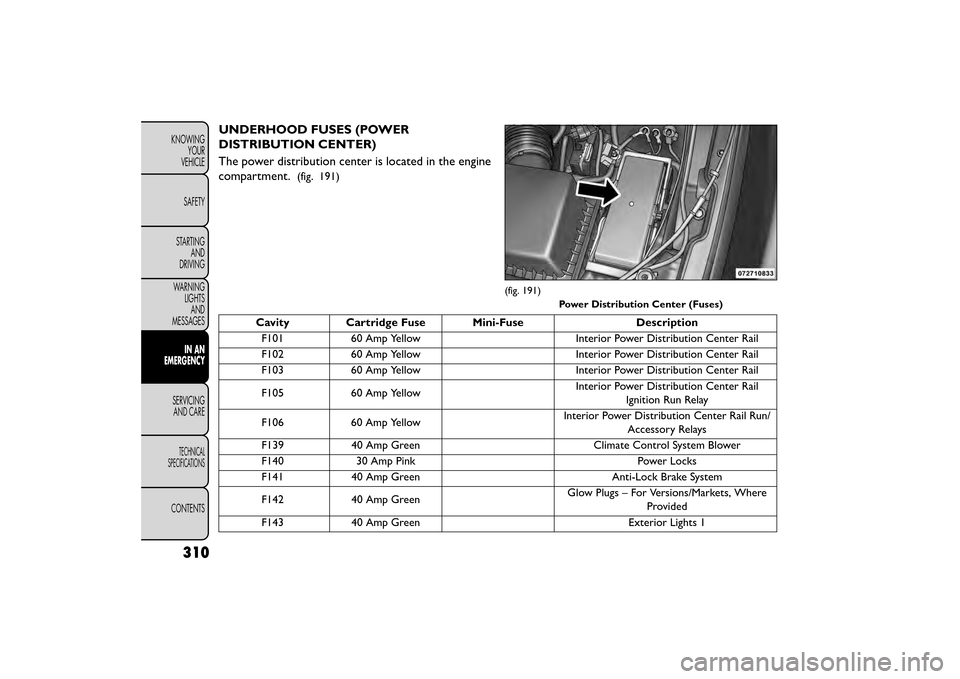
UNDERHOOD FUSES (POWER
DISTRIBUTION CENTER)
The power distribution center is located in the engine
compartment.
(fig. 191)
Cavity Cartridge Fuse Mini-FuseDescription
F101 60 Amp Yellow Interior Power Distribution Center Rail
F102 60 Amp Yellow Interior Power Distribution Center Rail
F103 60 Amp Yellow Interior Power Distribution Center Rail
F105 60 Amp Yellow Interior Power Distribution Center Rail
Ignition Run Relay
F106 60 Amp Yellow Interior Power Distribution Center Rail Run/
Accessory Relays
F139 40 Amp Green Climate Control System Blower
F140 30 Amp Pink Power Locks
F141 40 Amp Green Anti-Lock Brake System
F142 40 Amp Green Glow Plugs – For Versions/Markets, Where
Provided
F143 40 Amp Green Exterior Lights 1
(fig. 191)
Power Distribution Center (Fuses)
310
KNOWINGYOUR
VEHICLE
SAFETY
STARTING AND
DRIVING
WARNING LIGHTSAND
MESSAGES
IN AN
EMERGENCY
SER VICING
AND
CARE
TECHNICAL
SPECIFICATIONS
CONTENTS
Page 317 of 412
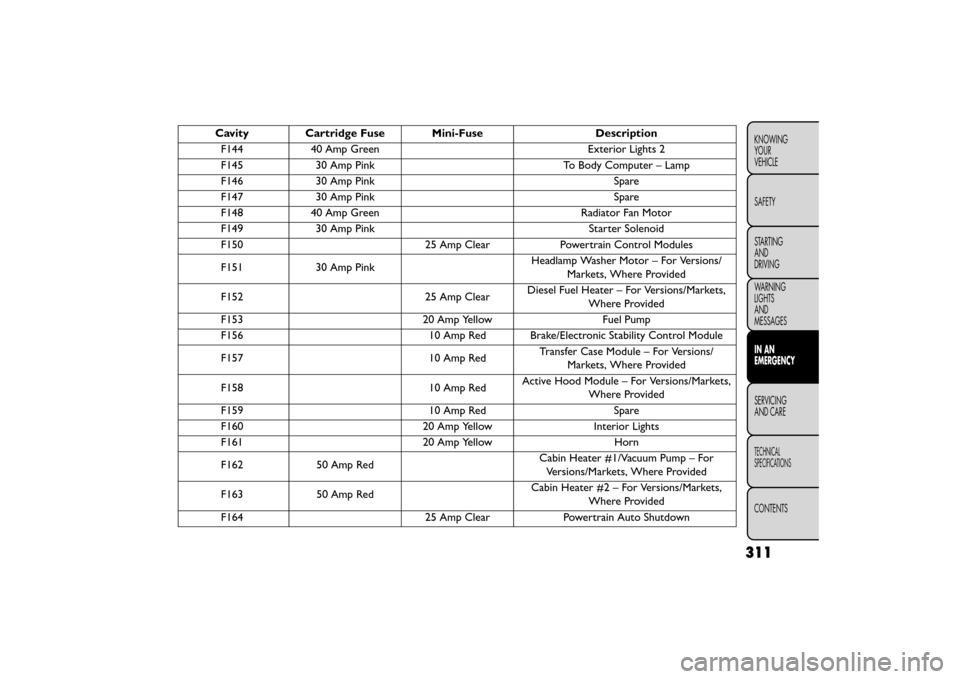
Cavity Cartridge Fuse Mini-FuseDescription
F144 40 Amp Green Exterior Lights 2
F145 30 Amp Pink To Body Computer – Lamp
F146 30 Amp Pink Spare
F147 30 Amp Pink Spare
F148 40 Amp Green Radiator Fan Motor
F149 30 Amp Pink Starter Solenoid
F150 25 Amp ClearPowertrain Control Modules
F151 30 Amp Pink Headlamp Washer Motor – For Versions/
Markets, Where Provided
F152 25 Amp ClearDiesel Fuel Heater – For Versions/Markets,
Where Provided
F153 20 Amp YellowFuel Pump
F156 10 Amp Red Brake/Electronic Stability Control Module
F157 10 Amp RedTransfer Case Module – For Versions/
Markets, Where Provided
F158 10 Amp RedActive Hood Module – For Versions/Markets,
Where Provided
F159 10 Amp RedSpare
F160 20 Amp YellowInterior Lights
F161 20 Amp YellowHorn
F162 50 Amp Red Cabin Heater #1/Vacuum Pump – For
Versions/Markets, Where Provided
F163 50 Amp Red Cabin Heater #2 – For Versions/Markets,
Where Provided
F164 25 Amp ClearPowertrain Auto Shutdown
311
KNOWING
YOUR
VEHICLE
SAFETY
STARTING
AND
DRIVING
WARNING
LIGHTS
AND
MESSAGES
IN AN
EMERGENCY
SERVICING
AND
CARE
TECHNICAL
SPECIFICATIONS
CONTENTS
Page 318 of 412
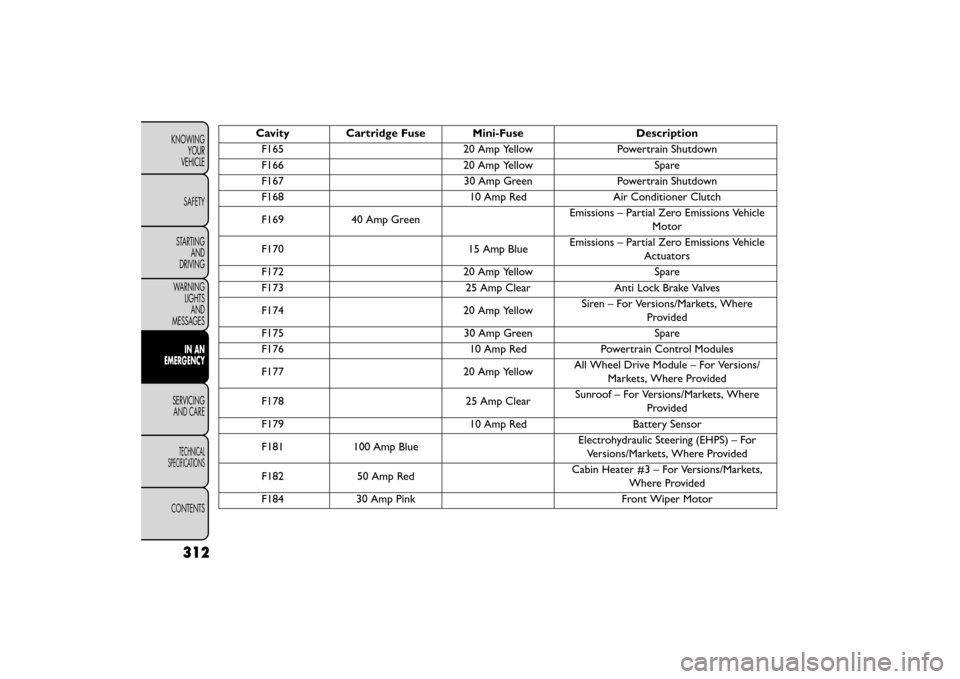
Cavity Cartridge Fuse Mini-FuseDescription
F165 20 Amp YellowPowertrain Shutdown
F166 20 Amp YellowSpare
F167 30 Amp GreenPowertrain Shutdown
F168 10 Amp RedAir Conditioner Clutch
F169 40 Amp Green Emissions – Partial Zero Emissions Vehicle
Motor
F170 15 Amp BlueEmissions – Partial Zero Emissions Vehicle
Actuators
F172 20 Amp YellowSpare
F173 25 Amp ClearAnti Lock Brake Valves
F174 20 Amp YellowSiren – For Versions/Markets, Where
Provided
F175 30 Amp GreenSpare
F176 10 Amp RedPowertrain Control Modules
F177 20 Amp YellowAll Wheel Drive Module – For Versions/
Markets, Where Provided
F178 25 Amp ClearSunroof – For Versions/Markets, Where
Provided
F179 10 Amp RedBattery Sensor
F181 100 Amp Blue Electrohydraulic Steering (EHPS) – For
Versions/Markets, Where Provided
F182 50 Amp Red Cabin Heater #3 – For Versions/Markets,
Where Provided
F184 30 Amp Pink Front Wiper Motor
312
KNOWING
YOUR
VEHICLE
SAFETY
STARTING AND
DRIVING
WARNING LIGHTSAND
MESSAGES
IN AN
EMERGENCY
SER VICING
AND
CARE
TECHNICAL
SPECIFICATIONS
CONTENTS
Page 325 of 412
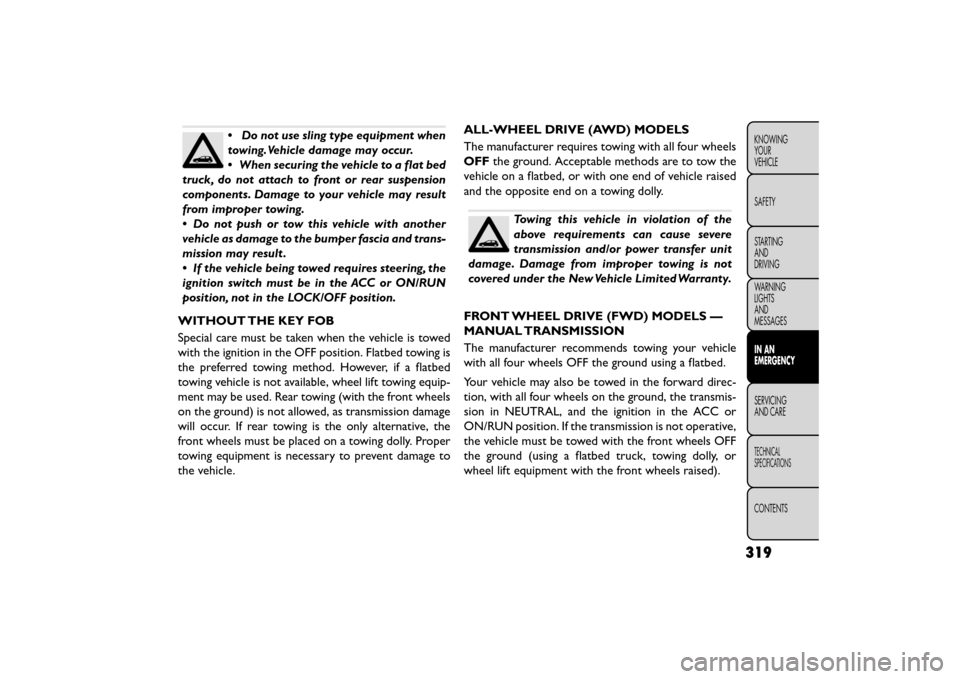
•Do not use sling type equipment when
towing.Vehicle damage may occur.
• When securing the vehicle to a flat bed
truck, do not attach to front or rear suspension
components. Damage to your vehicle may result
from improper towing.
• Do not push or tow this vehicle with another
vehicle as damage to the bumper fascia and trans-
mission may result .
• If the vehicle being towed requires steering, the
ignition switch must be in the ACC or ON/RUN
position, not in the LOCK/OFF position.
WITHOUT THE KEY FOB
Special care must be taken when the vehicle is towed
with the ignition in the OFF position. Flatbed towing is
the preferred towing method. However, if a flatbed
towing vehicle is not available, wheel lift towing equip-
ment may be used. Rear towing (with the front wheels
on the ground) is not allowed, as transmission damage
will occur. If rear towing is the only alternative, the
front wheels must be placed on a towing dolly. Proper
towing equipment is necessary to prevent damage to
the vehicle. ALL-WHEEL DRIVE (AWD) MODELS
The manufacturer requires towing with all four wheels
OFF
the ground. Acceptable methods are to tow the
vehicle on a flatbed, or with one end of vehicle raised
and the opposite end on a towing dolly.
Towing this vehicle in violation of the
above requirements can cause severe
transmission and/or power transfer unit
damage. Damage from improper towing is not
covered under the New Vehicle Limited Warranty.
FRONT WHEEL DRIVE (FWD) MODELS —
MANUAL TRANSMISSION
The manufacturer recommends towing your vehicle
with all four wheels OFF the ground using a flatbed.
Your vehicle may also be towed in the forward direc-
tion, with all four wheels on the ground, the transmis-
sion in NEUTRAL, and the ignition in the ACC or
ON/RUN position. If the transmission is not operative,
the vehicle must be towed with the front wheels OFF
the ground (using a flatbed truck, towing dolly, or
wheel lift equipment with the front wheels raised).
319
KNOWING
YOUR
VEHICLE
SAFETY
STARTING
AND
DRIVING
WARNING
LIGHTS
AND
MESSAGES
IN AN
EMERGENCY
SER VICING
AND
CARE
TECHNICAL
SPECIFICATIONS
CONTENTS
Page 330 of 412
Thousands Of Kilometers 15 30 45 60 75 90 105 120 135 150Years 1 2 3 4 5678910
Replace rear drive assembly (RDA) fluid (for
versions/markets, where provided). •
Replace power transfer unit (PTU) fluid (for
versions/markets, where provided). •
Replace cabin filter. (#) ◦•◦ • ◦ •◦•◦•
Flush and replace the engine coolant. •
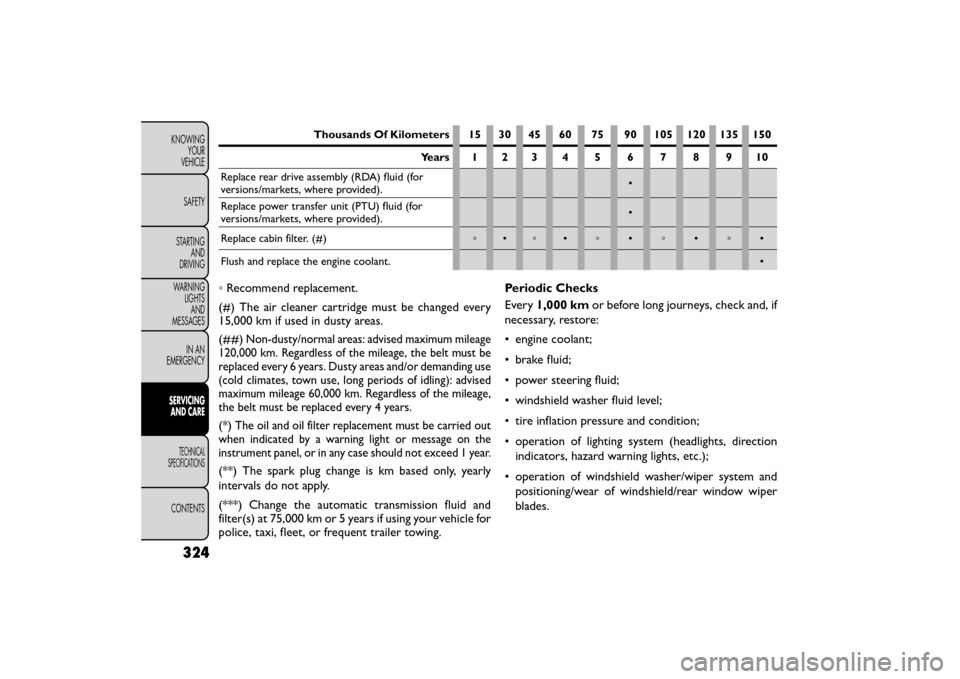
◦Recommend replacement.
(#) The air cleaner cartridge must be changed every
15,000 km if used in dusty areas.
(##)
Non-dusty/normal areas: advised maximum mileage
120,000 km. Regardless of the mileage, the belt must be
replaced every 6 years. Dusty areas and/or demanding use
(cold climates, town use, long periods of idling): advised
maximum mileage 60,000 km. Regardless of the mileage,
the belt must be replaced every 4 years.
(*)The oil and oil filter replacement must be carried out
when indicated by a warning light or message on the
instrument panel, or in any case should not exceed 1 year.
(**) The spark plug change is km based only, yearly
intervals do not apply.
(***) Change the automatic transmission fluid and
filter(s) at 75,000 km or 5 years if using your vehicle for
police, taxi, fleet, or frequent trailer towing. Periodic Checks
Every
1,000 km or before long journeys, check and, if
necessary, restore:
• engine coolant;
• brake fluid;
• power steering fluid;
• windshield washer fluid level;
• tire inflation pressure and condition;
• operation of lighting system (headlights, direction indicators, hazard warning lights, etc.);
• operation of windshield washer/wiper system and positioning/wear of windshield/rear window wiper
blades.
324
KNOWING YOUR
VEHICLE
SAFETY
STARTING AND
DRIVING
WARNING LIGHTSAND
MESSAGES
IN AN
EMERGENCY
SERVICINGAND C ARE
TECHNICAL
SPECIFICATIONS
CONTENTS
Page 336 of 412
Thousands Of Kilome-
ters20 40 60 80 100 120 140 160 180 200
12345678910
Replace power transfer unit
(PTU) fluid (for
versions/markets, where
provided).
••
Flush and replace the engine
coolant.•
Replace cabin air filter (##).○•○•○•○•○•
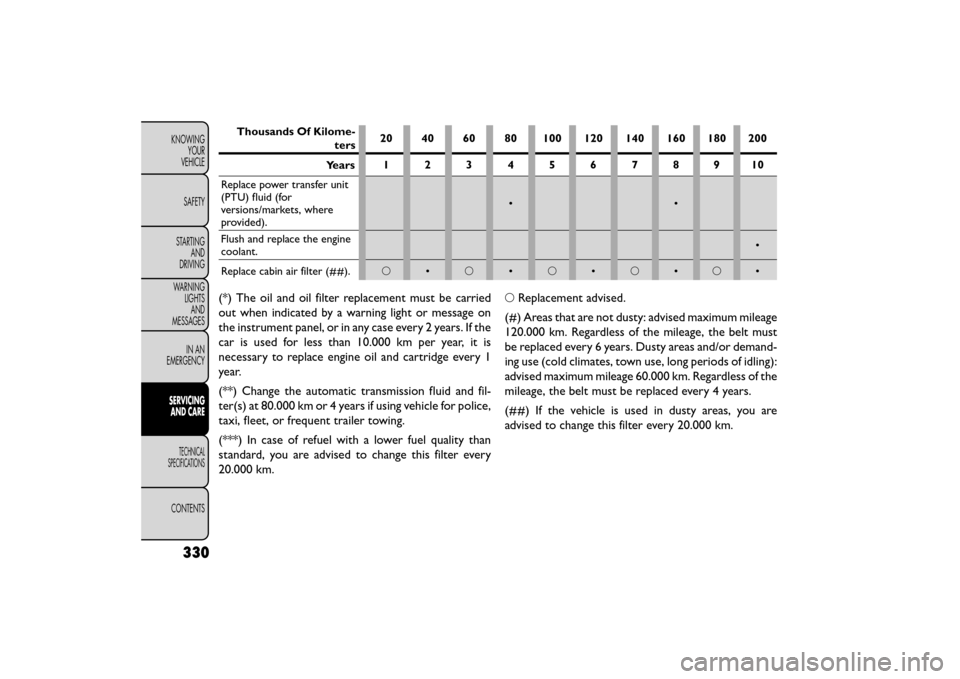
(*) The oil and oil filter replacement must be carried
out when indicated by a warning light or message on
the instrument panel, or in any case every 2 years. If the
car is used for less than 10.000 km per year, it is
necessary to replace engine oil and cartridge every 1
year.
(**) Change the automatic transmission fluid and fil-
ter(s) at 80.000 km or 4 years if using vehicle for police,
taxi, fleet, or frequent trailer towing.
(***) In case of refuel with a lower fuel quality than
standard, you are advised to change this filter every
20.000 km.
○Replacement advised.
(#) Areas that are not dusty: advised maximum mileage
120.000 km. Regardless of the mileage, the belt must
be replaced every 6 years. Dusty areas and/or demand-
ing use (cold climates, town use, long periods of idling):
advised maximum mileage 60.000 km. Regardless of the
mileage, the belt must be replaced every 4 years.
(##) If the vehicle is used in dusty areas, you are
advised to change this filter every 20.000 km.
330
KNOWINGYOURVEHICLE
SAFETY
STARTINGANDDRIVING
WARNINGLIGHTSANDMESSAGES
IN ANEMERGENCY
SERVICINGAND CARE
TECHNICALSPECIFICATIONS
CONTENTS
Years