Media FIAT FREEMONT 2016 1.G User Guide
[x] Cancel search | Manufacturer: FIAT, Model Year: 2016, Model line: FREEMONT, Model: FIAT FREEMONT 2016 1.GPages: 412, PDF Size: 3.36 MB
Page 202 of 412
WARNING! (Continued)
• A seat belt that is too loose will not protect you
properly. In a sudden stop, you could move too far
forward, increasing the possibility of injury.Wear
your seat belt snugly.
• A seat belt that is worn under your arm is
dangerous.Your body could strike the inside sur-
faces of the vehicle in a collision, increasing head
and neck injury. A seat belt worn under the arm
can cause internal injuries. Ribs aren’t as strong
as shoulder bones. Wear the seat belt over your
shoulder so that your strongest bones will take
the force in a collision.
• A shoulder belt placed behind you will not
protect you from injury during a collision.You are
more likely to hit your head in a collision if you do
not wear your shoulder belt .The lap and shoulder
belt are meant to be used together.
• A frayed or torn seat belt could rip apart in a
collision and leave you with no protection. In-
spect the seat belt system periodically, checking
for cuts, frays, or loose parts. Damaged parts
must be replaced immediately. Do not disas-
semble or modify the seat belt system. Seat belt
assemblies must be replaced after a collision. LAP/SHOULDER BELT OPERATING
INSTRUCTIONS
1. Enter the vehicle and close the door. Sit back and
adjust the seat.
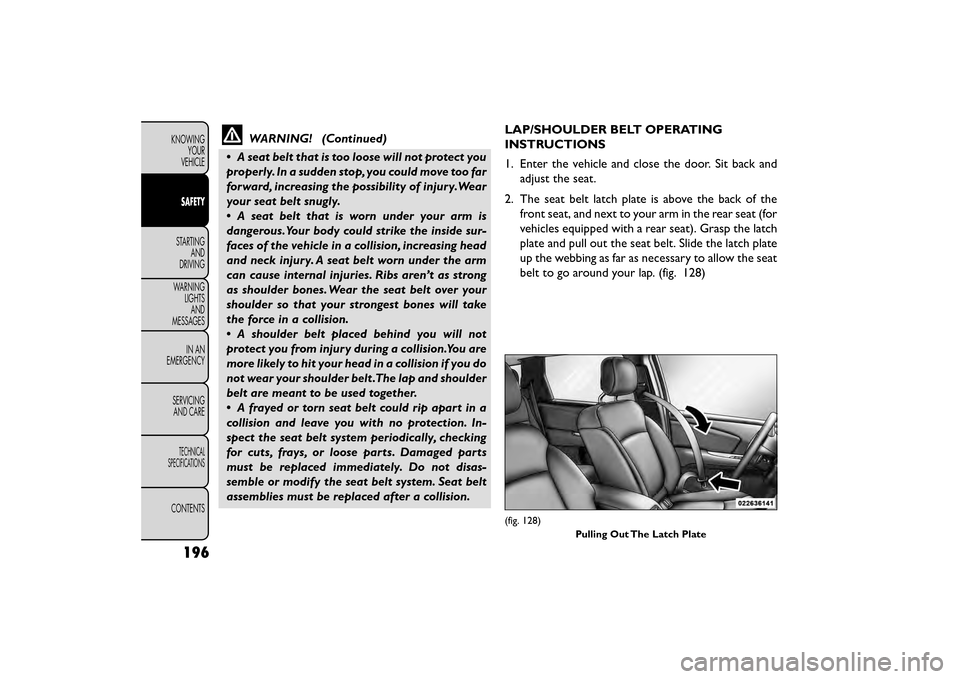
2. The seat belt latch plate is above the back of the front seat, and next to your arm in the rear seat (for
vehicles equipped with a rear seat). Grasp the latch
plate and pull out the seat belt. Slide the latch plate
up the webbing as far as necessary to allow the seat
belt to go around your lap. (fig. 128)
(fig. 128)
Pulling Out The Latch Plate
196
KNOWINGYOUR
VEHICLE
SAFETY
STARTING AND
DRIVING
WARNING LIGHTSAND
MESSAGES
IN
AN
EMERGENCY
SERVICINGAND CARE
TECHNICAL
SPECIFICATIONS
CONTENTS
Page 203 of 412
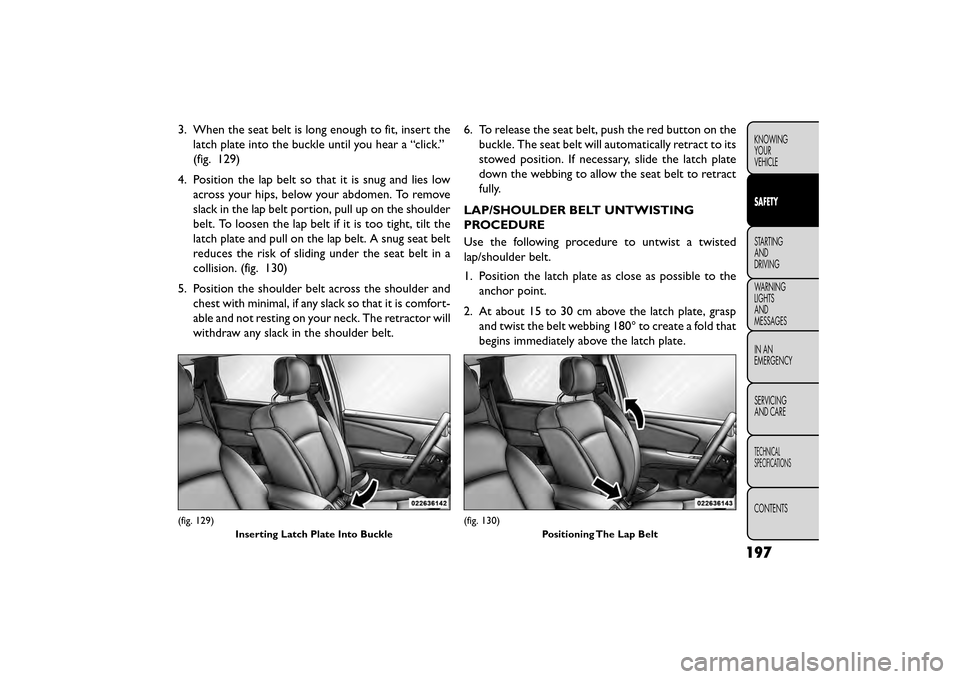
3. When the seat belt is long enough to fit, insert thelatch plate into the buckle until you hear a “click.”
(fig. 129)
4. Position the lap belt so that it is snug and lies low across your hips, below your abdomen. To remove
slack in the lap belt portion, pull up on the shoulder
belt. To loosen the lap belt if it is too tight, tilt the
latch plate and pull on the lap belt. A snug seat belt
reduces the risk of sliding under the seat belt in a
collision. (fig. 130)
5. Position the shoulder belt across the shoulder and chest with minimal, if any slack so that it is comfort-
able and not resting on your neck. The retractor will
withdraw any slack in the shoulder belt. 6. To release the seat belt, push the red button on the
buckle. The seat belt will automatically retract to its
stowed position. If necessary, slide the latch plate
down the webbing to allow the seat belt to retract
fully.
LAP/SHOULDER BELT UNTWISTING
PROCEDURE
Use the following procedure to untwist a twisted
lap/shoulder belt.
1. Position the latch plate as close as possible to the anchor point.
2. At about 15 to 30 cm above the latch plate, grasp and twist the belt webbing 180° to create a fold that
begins immediately above the latch plate.
(fig. 129)
Inserting Latch Plate Into Buckle(fig. 130) Positioning The Lap Belt
197
KNOWING
YOUR
VEHICLE
SAFETY
STARTING
AND
DRIVING
WARNING
LIGHTS
AND
MESSAGES
IN
AN
EMERGENCY
SERVICING
AND CARE
TECHNICAL
SPECIFICATIONS
CONTENTS
Page 205 of 412
SEAT BELT PRETENSIONER
The front seat belt system is equipped with pretension-
ing devices that are designed to remove slack from the
seat belt in the event of a collision. These devices may
improve the performance of the seat belt by removing
slack from the seat belt early in a collision. Pretension-
ers work for all size occupants, including those in child
restraints.
NOTE:These devices are not a substitute for proper
seat belt placement by the occupant. The seat belt still
must be worn snugly and positioned properly.
The pretensioners are triggered by the Occupant Re-
straint Controller (ORC). Like the air bags, the preten-
sioners are single use items. A deployed pretensioner
or a deployed air bag must be replaced immediately.
ENERGY MANAGEMENT FEATURE
This vehicle has a seat belt system with an Energy
Management feature in the front seating positions that
may help further reduce the risk of injury in the event
of a collision. This seat belt system has a retractor
assembly that is designed to release webbing in a
controlled manner. SUPPLEMENTAL ACTIVE HEAD
RESTRAINTS (AHR)
These head restraints are passive, deployable compo-
nents, and vehicles with this equipment cannot be
readily identified by any markings, only through visual
inspection of the head restraint. The head restraint will
be split in two halves, with the front half being soft
foam and trim, the back half being decorative plastic.
How The Active Head Restraints (AHR) Work
The Occupant Restraint Controller (ORC) determines
whether the severity, or type of rear impact will require
the Active Head Restraints (AHR) to deploy. If a rear
impact requires deployment, both the driver and front
passenger seat AHRs will be deployed.
When AHRs deploy during a rear impact, the front half
of the head restraint extends forward to minimize the
gap between the back of the occupant’s head and the
AHR. This system is designed to help prevent or
reduce the extent of injuries to the driver and front
passenger in certain types of rear impacts.
199
KNOWING
YOUR
VEHICLE
SAFETY
STARTING
AND
DRIVING
WARNING
LIGHTS
AND
MESSAGES
IN
AN
EMERGENCY
SERVICING
AND CARE
TECHNICAL
SPECIFICATIONS
CONTENTS
Page 209 of 412
SERVICE ACTIVE HOOD SYSTEM
If the system has deployed the Active Hood, or if it
detects a malfunction in any part of the system, it turns
on the Air Bag Warning Light and it will display the
“SERVICE ACTIVE HOOD” message in the Electronic
Vehicle Information Center (EVIC), if equipped. A
single chime will sound if the Air Bag Warning Light
comes on again after initial startup. It also includes
diagnostics that will illuminate the Air Bag Warning
Light if a malfunction is noted that could affect the
Active Hood system. The diagnostics also record the
nature of the malfunction. If the Air Bag Warning Light
is illuminated, or if “SERVICE ACTIVE HOOD” ap-
pears in the EVIC, if equipped, see your authorized
dealer.
In the event of an Active Hood deployment, the vehicle
should be serviced by an authorized dealer. The hood
hinges must be serviced and the actuator assemblies
replaced to restore system functionality. Following an
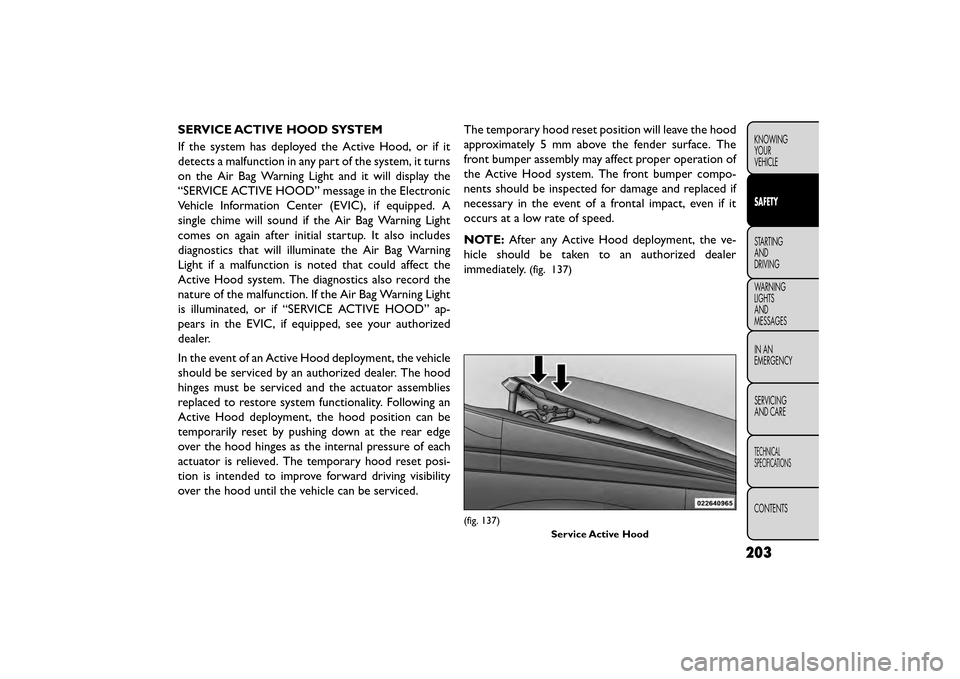
Active Hood deployment, the hood position can be
temporarily reset by pushing down at the rear edge
over the hood hinges as the internal pressure of each
actuator is relieved. The temporary hood reset posi-
tion is intended to improve forward driving visibility
over the hood until the vehicle can be serviced.The temporary hood reset position will leave the hood
approximately 5 mm above the fender surface. The
front bumper assembly may affect proper operation of
the Active Hood system. The front bumper compo-
nents should be inspected for damage and replaced if
necessary in the event of a frontal impact, even if it
occurs at a low rate of speed.
NOTE:
After any Active Hood deployment, the ve-
hicle should be taken to an authorized dealer
immediately.
(fig. 137)
(fig. 137)
Service Active Hood
203
KNOWING
YOUR
VEHICLE
SAFETY
STARTING
AND
DRIVING
WARNING
LIGHTS
AND
MESSAGES
IN
AN
EMERGENCY
SERVICING
AND CARE
TECHNICAL
SPECIFICATIONS
CONTENTS
Page 212 of 412
WARNING!
• Being too close to the steering wheel
or ins
trument panel during Advanced
Front Air Bag deployment could cause serious
injury, including death. Air bags need room to
inflate. Sit back, comfortably extending your
arms to reach the steering wheel or instrument
panel.
• Never place a rear-facing child restraint in
front of an air bag. A deploying Passenger Ad-
vanced Front Air Bag can cause death or serious
injury to a child 12 years or younger, including a
child in a rear-facing child restraint .
• Only use a rear-facing child restraint in a ve-
hicle with a rear seat .
ADVANCED FRONT AIR BAG FEATURES
The Advanced Front Air Bag system has multistage
driver and front passenger air bags. This system pro-
vides output appropriate to the severity and type of
collision as determined by the Occupant Restraint
Controller (ORC), which may receive information
from the front impact sensors or other system com-
ponents.
The first stage inflator is triggered immediately during
an impact that requires air bag deployment. A low energy output is used in less severe collisions. A higher
energy output is used for more severe collisions.
This vehicle may be equipped with a driver and/or front
passenger seat belt buckle switch that detects whether
the driver or front passenger seat belt is buckled. The
seat belt buckle switch may adjust the inflation rate of
the Advanced Front Air Bags.
WARNING!
• No objects should be placed over or
n ear
the air bag on the instrument panel
or steering wheel, because any such objects could
cause harm if the vehicle is in a collision severe
enough to cause the air bags to inflate.
• Do not put anything on or around the air bag
covers or attempt to open them manually. You
may damage the air bags and you could be
injured because the air bags may no longer be
functional. The protective covers for the air bag
cushions are designed to open only when the air
bags are inflating.
• Relying on the air bags alone could lead to
more severe injuries in a collision. The air bags
work with your seat belt to restrain you properly.
In some collisions, air bags won’t deploy at all.
Always wear your seat belts even though you
have air bags.
206
KNOWING YOUR
VEHICLE
SAFETY
STARTING AND
DRIVING
WARNING LIGHTSAND
MESSAGES
IN
AN
EMERGENCY
SERVICINGAND CARE
TECHNICAL
SPECIFICATIONS
CONTENTS
Page 217 of 412
The Side Air Bags will not deploy in all side collisions,
including some collisions at certain angles, or some
side collisions that do not impact the area of the
passenger compartment. The Side Air Bags may deploy
during angled or offset frontal collisions where the
Advanced Front Air Bags deploy.
Rollover Events
Side Air Bags are designed to activate in certain roll-
over events. The ORC determines whether the de-
ployment of the Side Air Bags in a particular rollover
event is appropriate, based on the severity and type of
collision. Vehicle damage by itself is not a good indica-
tor of whether or not Side Air Bags should have
deployed.
The Side Air Bags will not deploy in all rollover events.
The rollover sensing-system determines if a rollover
event may be in progress and whether deployment is
appropriate. A slower-developing event may deploy the
seat belt pretensioners on both sides of the vehicle. A
faster-developing event may deploy the seat belt pre-
tensioners as well as the SABs and SABICs on both
sides of the vehicle. The rollover sensing-system may
also deploy the seat belt pretensioners, with or with-
out the SABs and SABICs, on both sides of the vehicle
if the vehicle experiences a near rollover event.IF A DEPLOYMENT OCCURS
The Advanced Front Air Bags are designed to deflate
immediately after deployment.
NOTE:
Front and/or side air bags will not deploy in all
collisions. This does not mean something is wrong with
the air bag system.
If you do have a collision, which deploys the air bags,
any or all of the following may occur:
• The air bag material may sometimes cause abrasions and/or skin reddening to the occupants as the air
bags deploy and unfold. The abrasions are similar to
friction rope burns or those you might get sliding
along a carpet or gymnasium floor. They are not
caused by contact with chemicals. They are not
permanent and normally heal quickly. However, if you
haven’t healed significantly within a few days, or if you
have any blistering, see your doctor immediately.
• As the air bags deflate, you may see some smoke-like particles. The particles are a normal by-product of
the process that generates the non-toxic gas used for
air bag inflation. These airborne particles may irritate
the skin, eyes, nose, or throat. If you have skin or eye
irritation, rinse the area with cool water. For nose or
throat irritation, move to fresh air. If the irritation
continues, see your doctor. If these particles settle
on your clothing, follow the garment manufacturer’s
instructions for cleaning.
211
KNOWING
YOUR
VEHICLE
SAFETY
STARTING
AND
DRIVING
WARNING
LIGHTS
AND
MESSAGES
IN
AN
EMERGENCY
SERVICING
AND CARE
TECHNICAL
SPECIFICATIONS
CONTENTS
Page 218 of 412
Do not drive your vehicle after the air bags have
deployed. If you are involved in another collision, the
air bags will not be in place to protect you.
WARNING!
Deployed air bags and seat belt preten-
sion er
s cannot protect you in another
collision. Have the air bags, seat belt pretension-
ers, and the seat belt retractor assemblies re-
placed by an authorized dealer immediately.
Also, have the Occupant Restraint Controller Sys-
tem serviced as well.
NOTE:
• Air bag covers may not be obvious in the interior trim, but they will open during air bag deployment.
• After any collision, the vehicle should be taken to an authorized dealer immediately. ENHANCED ACCIDENT RESPONSE
SYSTEM
In the event of an impact, if the communication net-
work remains intact, and the power remains intact,
depending on the nature of the event, the ORC will
determine whether to have the Enhanced Accident
Response System perform the following functions:
• Cut off fuel to the engine.
• Flash hazard lights as long as the battery has power
or until the ignition switch is turned to the “OFF”
position.
• Turn on the interior lights, which remain on as long as the battery has power or until the ignition switch
is turned to the “OFF” position.
• Unlock the doors automatically.
SYSTEM RESET PROCEDURE
In order to reset the Enhanced Accident Response
System functions after an event, the ignition switch
must be changed from ignition START or ON/RUN to
ignition OFF.
212
KNOWING YOUR
VEHICLE
SAFETY
STARTING AND
DRIVING
WARNING LIGHTSAND
MESSAGES
IN
AN
EMERGENCY
SERVICINGAND CARE
TECHNICAL
SPECIFICATIONS
CONTENTS
Page 219 of 412
AIR BAG WARNING LIGHTThe air bags must be ready to inflate for your
protection in a collision. The Occupant Re-
straint Controller (ORC) monitors the inter-
nal circuits and interconnecting wiring asso-
ciated with air bag system electrical components.
The ORC monitors the readiness of the electronic
parts of the air bag system whenever the ignition
switch is in the START or ON/RUN position. If the
ignition switch is in the OFF position or in the ACC
position, the air bag system is not on and the air bags
will not inflate
The ORC contains a backup power supply system that
may deploy the air bags even if the battery loses power
or it becomes disconnected prior to deployment.
The ORC turns on the Air Bag Warning Light
in the
instrument panel for approximately four to eight sec-
onds for a self-check when the ignition switch is first
turned to the ON/RUN position. After the self-check,
the Air Bag Warning Light will turn off. If the ORC
detects a malfunction in any part of the system, it turns
on the Air Bag Warning Light, either momentarily or
continuously. A single chime will sound to alert you if
the light comes on again after initial startup. The ORC also includes diagnostics that will illuminate
the instrument panel Air Bag Warning Light if a mal-
function is detected that could affect the air bag sys-
tem. The diagnostics also record the nature of the
malfunction. While the air bag system is designed to be
maintenance free, if any of the following occurs, have an
authorized dealer service the air bag system immedi-
ately.
• The Air Bag Warning Light does not come on during
the four to eight seconds when the ignition switch is
first turned to the ON/RUN position.
• The Air Bag Warning Light remains on after the four to eight-second interval.
• The Air Bag Warning Light comes on intermittently or remains on while driving.
NOTE: If the speedometer, tachometer, or any engine
related gauges are not working, the Occupant Re-
straint Controller (ORC) may also be disabled. In this
condition the air bags may not be ready to inflate for
your protection. Have an authorized dealer service the
air bag system immediately.
213
KNOWING
YOUR
VEHICLE
SAFETY
STARTING
AND
DRIVING
WARNING
LIGHTS
AND
MESSAGES
IN
AN
EMERGENCY
SERVICING
AND CARE
TECHNICAL
SPECIFICATIONS
CONTENTS
Page 220 of 412
WARNING!
Ignoring the Air Bag Warning Light in
your ins
trument panel could mean you
won’t have the air bags to protect you in a
collision. If the light does not come on as a bulb
check when the ignition is first turned on, stays
on after you start the vehicle, or if it comes on as
you drive, have an authorized dealer service the
air bag system immediately.
MAINTAINING YOUR AIR BAG SYSTEM
WARNING!
• Modifications to any part of the air
bag sys
tem could cause it to fail when
you need it . You could be injured if the air bag
system is not there to protect you. Do not modify
the components or wiring, including adding any
kind of badges or stickers to the steering wheel
hub trim cover or the upper right side of the
instrument panel. Do not modify the front bum-
per, vehicle body structure, or add aftermarket
side steps or running boards.
(Continued)
WARNING! (Continued)
• It is dangerous to try to repair any part of the
air bag system yourself. Be sure to tell anyone
who works on your vehicle that it has an air bag
system.
• Do not attempt to modify any part of your air
bag system.The air bag may inflate accidentally
or may not function properly if modifications are
made.Take your vehicle to an authorized dealer
for any air bag system service. If your seat , includ-
ing your trim cover and cushion, needs to be
serviced in any way (including removal or
loosening/tightening of seat attachment bolts),
take the vehicle to your authorized dealer. Only
manufacturer approved seat accessories may be
used. If it is necessary to modify the air bag
system for persons with disabilities, contact your
authorized dealer.
214
KNOWING YOUR
VEHICLE
SAFETY
STARTING AND
DRIVING
WARNING LIGHTSAND
MESSAGES
IN
AN
EMERGENCY
SERVICINGAND CARE
TECHNICAL
SPECIFICATIONS
CONTENTS
Page 229 of 412
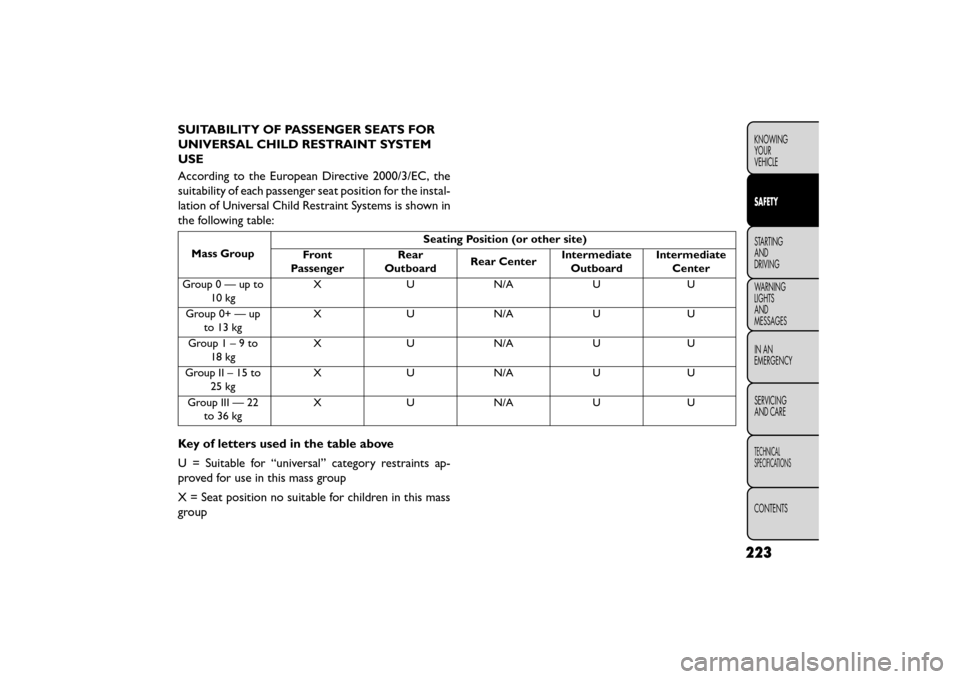
SUITABILITY OF PASSENGER SEATS FOR
UNIVERSAL CHILD RESTRAINT SYSTEM
USE
According to the European Directive 2000/3/EC, the
suitability of each passenger seat position for the instal-
lation of Universal Child Restraint Systems is shown in
the following table:
Mass GroupSeating Position (or other site)
Front
Passenger Rear
Outboard Rear Center Intermediate
Outboard Intermediate
Center
Group0—upto 10 kg X U N/A U U
Group 0+ — up to 13 kg X U N/A U U
Group1–9to 18 kg X U N/A U U
Group II – 15 to 25 kg X U N/A U U
Group III — 22 to 36 kg X U N/A U U
Key of letters used in the table above
U = Suitable for “universal” category restraints ap-
proved for use in this mass group
X = Seat position no suitable for children in this mass
group
223
KNOWING
YOUR
VEHICLE
SAFETY
STARTING
AND
DRIVING
WARNING
LIGHTS
AND
MESSAGES
IN
AN
EMERGENCY
SERVICING
AND CARE
TECHNICAL
SPECIFICATIONS
CONTENTS