Media FIAT FREEMONT 2016 1.G Owner's Guide
[x] Cancel search | Manufacturer: FIAT, Model Year: 2016, Model line: FREEMONT, Model: FIAT FREEMONT 2016 1.GPages: 412, PDF Size: 3.36 MB
Page 354 of 412
NOTE:Mixing coolant types will decrease the life of
the engine coolant (antifreeze) and will require more
frequent coolant changes.
Cooling System Pressure Cap
The cap must be fully tightened to prevent loss of
engine coolant (antifreeze), and to ensure that engine
coolant (antifreeze) will return to the radiator from the
coolant recovery tank.
The cap should be inspected and cleaned if there is any
accumulation of foreign material on the sealing sur-
faces.
WARNING!
• Do not open hot engine cooling sys-
tem. N
ever add engine coolant (anti-
freeze) when the engine is overheated. Do not
loosen or remove the cap to cool an overheated
engine. Heat causes pressure to build up in the
cooling system. To prevent scalding or injury, do
not remove the pressure cap while the system is
hot or under pressure.
• Do not use a pressure cap other than the one
specified for your vehicle. Personal injury or en-
gine damage may result . Disposal Of Used Coolant
Used ethylene glycol-based engine coolant is a regu-
lated substance requiring proper disposal. Check with
your local authorities to determine the disposal rules
for your community. To prevent ingestion by animals or
children, do not store ethylene glycol-based engine
coolant in open containers or allow it to remain in
puddles on the ground. If ingested by a child, contact a
physician immediately. Clean up any ground spills im-
mediately.
Coolant Level
The radiator normally remains completely full, so there
is no need to remove the radiator cap unless checking
for coolant freeze point or replacing coolant. Advise
your service attendant of this. As long as the engine
operating temperature is satisfactory, the coolant
bottle need only be checked once a month. When
additional coolant is needed to maintain the proper
level, it should be added to the coolant bottle. Do not
overfill.
348
KNOWING
YOUR
VEHICLE
SAFETY
STARTING AND
DRIVING
WARNING LIGHTSAND
MESSAGES
IN AN
EMERGENCY
SERVICINGAND C ARE
TECHNICAL
SPECIFICATIONS
CONTENTS
Page 356 of 412
Master Cylinder — Brake Fluid Level Check
Check the fluid level in the master cylinder immediately
if the “Brake Warning Light” indicates system failure.
Check the fluid level in the master cylinder when
performing underhood services.
Clean the top of the master cylinder area before
removing the cap. If necessary, add fluid to bring the
fluid level up to the requirements described on the
brake fluid reservoir.
Overfilling of fluid is not recommended because it may
cause leaking in the system.
Fluid level can be expected to fall as the brake pads
wear. Brake fluid level should be checked when pads are
replaced. However, low fluid level may be caused by a
leak and a checkup may be needed.NOTE:
If your vehicle is equipped with a manual
transmission, the brake fluid reservoir supplies fluid
to both the brake system and the clutch release sys-
tem. The two systems are separated in the reservoir,
and a leak in one system will not affect the other
system. The manual transmission clutch release
system should not require fluid replacement during the
life of the vehicle. If the brake fluid reservoir is low and
the brake system does not indicate any leaks or other
problems, it may be a result of a leak in the hydraulic
clutch release system. See your local authorized dealer
for service.
Use only manufacturer's recommended brake fluid.
Refer to “Fluids, Lubricants, and Genuine Parts” in
“Technical Specifications” for further information.
WARNING!
• Use only manufacturer's recom-
m en
ded brake fluid. Refer to “Fluids, Lu-
bricants, and Genuine Parts” in “Technical Speci-
fications” for further information. Using the
wrong type of brake fluid can severely damage
your brake system and/or impair its perfor-
mance. The proper type of brake fluid for your
vehicle is also identified on the original factory
installed hydraulic master cylinder reservoir.
(Continued)
350
KNOWINGYOUR
VEHICLE
SAFETY
STARTING AND
DRIVING
WARNING LIGHTSAND
MESSAGES
IN AN
EMERGENCY
SERVICINGAND C ARE
TECHNICAL
SPECIFICATIONS
CONTENTS
Page 358 of 412
Special Additives
The manufacturer strongly recommends against using any
special additives in the transmission. Automatic Transmis-
sion Fluid (ATF) is an engineered product and its perfor-
mance may be impaired by supplemental additives. There-
fore, do not add any fluid additives to the transmission.
The only exception to this policy is the use of special dyes
for diagnosing fluid leaks. Avoid using transmission sealers
as they may adversely affect seals.
Do not use chemical flushes in your
transmission as the chemicals can dam-
age your transmission components. Such
damage is not covered by the New Vehicle Limited
Warranty.
Fluid Level Check - Six-Speed Transmission
The fluid level is preset at the factory and does not
require adjustment under normal operating conditions.
Routine fluid level checks are not required, therefore
the transmission filler tube is capped and no dipstick is
provided. Your authorized dealer can check your trans-
mission fluid level using a special service dipstick. If you
notice fluid leakage or transmission malfunction, visit
your authorized dealer immediately to have the trans-
mission fluid level checked. Operating the vehicle with
an improper fluid level can cause severe transmission
damage.
If a transmission fluid leak occurs, visit
your authorized dealer immediately. Se-
vere transmission damage may occur.
Your authorized dealer has the proper tools to
adjust the fluid level accurately.
Car maintenance should be done at a
FIAT Dealership. For routine and minor
maintenance operations you wish to
carry out yourself, we do recommend you have
the proper equipment , genuine FIAT spare parts
and the necessary fluids; do not however carry out
these operations if you have no experience.
Fluid Level Check — Four-Speed Automatic
Use the following procedure to check the transmission
fluid level properly:
1. Park the vehicle on level ground.
2. Run the engine at normal idle speed for at least 60 seconds, and leave the engine running for the rest of
this procedure.
3. Fully apply the parking brake, and press the brake pedal.
352
KNOWING YOUR
VEHICLE
SAFETY
STARTING AND
DRIVING
WARNING LIGHTSAND
MESSAGES
IN AN
EMERGENCY
SERVICINGAND C ARE
TECHNICAL
SPECIFICATIONS
CONTENTS
Page 362 of 412
Special Care
• If you drive on salted or dusty roads or if you drivenear the ocean, hose off the undercarriage at least
once a month.
• It is important that the drain holes in the lower edges of the doors, rocker panels, and cargo area be kept
clear and open.
• If you detect any stone chips or scratches in the paint, touch them up immediately. The cost of such
repairs is considered the responsibility of the owner.
• If your vehicle is damaged due to an accident or similar cause, which destroys the paint and protec-
tive coating, have your vehicle repaired as soon as
possible. The cost of such repairs is considered the
responsibility of the owner.
• If you carry special cargo such as chemicals, fertiliz- ers, de-icer salt, etc., be sure that such materials are
well packaged and sealed.
• If a lot of driving is done on gravel roads, consider mud or stone shields behind each wheel.
• Use Touch Up Paint or equivalent on scratches as soon as possible. Your authorized dealer has touch
up paint to match the color of your vehicle. Wheel And Wheel Trim Care
All wheels and wheel trim, especially aluminum and
chrome-plated wheels should be cleaned regularly with
a mild soap and water to prevent corrosion. To remove
heavy soil and/or excessive brake dust, use a nonabra-
sive, non-acidic cleaner. Do not use scouring pads, steel
wool, a bristle brush, or metal polishes. Do not use
oven cleaner. Avoid automatic car washes that use
acidic solutions or harsh brushes that may damage the
wheels’ protective finish.
Stain Repel Fabric Cleaning Procedure (for
versions/markets, where provided)
Stain Repel seats may be cleaned in the following
manner:
• Remove as much of the stain as possible by blotting
with a clean, dry towel.
• Blot any remaining stain with a clean, damp towel.
• For tough stains, apply a mild soap solution to a clean, damp cloth and remove the stain. Use a fresh,
damp towel to remove soap residue.
•
For grease stains, apply a Multi-Purpose Cleaner or
equivalent to a clean, damp cloth and remove the stain.
Use a fresh, damp towel to remove soap residue.
• Do not use any harsh solvents or any other form of protectants on Stain Repel products.
356
KNOWING YOUR
VEHICLE
SAFETY
STARTING AND
DRIVING
WARNING LIGHTSAND
MESSAGES
IN AN
EMERGENCY
SERVICINGAND C ARE
TECHNICAL
SPECIFICATIONS
CONTENTS
Page 364 of 412
Glass Surfaces
All glass surfaces should be cleaned on a regular basis
with any commercial household-type glass cleaner.
Never use an abrasive type cleaner. Use caution when
cleaning the inside rear window equipped with an
electric defroster. Do not use scrapers or other sharp
instruments that may scratch the elements.
When cleaning the rear view mirror, spray cleaner on
the towel or rag that you are using. Do not spray
cleaner directly on the mirror.
Cleaning Plastic Instrument Cluster Lenses
The lenses in front of the instruments in this vehicle are
molded in clear plastic. When cleaning the lenses, care
must be taken to avoid scratching the plastic.
1. Clean with a wet soft rag. A mild soap solution maybe used, but do not use high alcohol content or
abrasive cleaners. If soap is used, wipe clean with a
clean damp rag.
2. Dry with a soft cloth. Seat Belt Maintenance
Do not bleach, dye or clean the belts with chemical
solvents or abrasive cleaners. This will weaken the
fabric. Sun damage can also weaken the fabric.
If the belts need cleaning, use a mild soap solution or
lukewarm water. Do not remove the belts from the car
to wash them. Dry with a soft cloth.
Replace the belts if they appear frayed or worn or if the
buckles do not work properly.
WARNING!
A frayed or torn belt could rip apart in a
collisi on
and leave you with no protec-
tion. Inspect the belt system periodically, check-
ing for cuts, frays, or loose parts. Damaged parts
must be replaced immediately. Do not disas-
semble or modify the system. Seat belt assem-
blies must be replaced after a collision if they
have been damaged (i.e., bent retractor, torn
webbing, etc .).
CLEANING THE CUP HOLDERS
Clean with a damp cloth or towel using a mild deter-
gent.
358
KNOWING YOUR
VEHICLE
SAFETY
STARTING AND
DRIVING
WARNING LIGHTSAND
MESSAGES
IN AN
EMERGENCY
SERVICINGAND C ARE
TECHNICAL
SPECIFICATIONS
CONTENTS
Page 379 of 412
RUN FLAT TIRES (for versions/markets,
where provided)
Run Flat tires allow you the capability to drive 80 km at
80 km/h after a rapid loss of inflation pressure. This
rapid loss of inflation is referred to as the Run Flat
mode. A Run Flat mode occurs when the tire inflation
pressure is of/or below 0.96 bar. Once a Run Flat tire
reaches the run flat mode it has limited driving capa-
bilities and needs to be replaced immediately. A Run
Flat tire is not repairable.
It is not recommended driving a vehicle loaded at full
capacity or to tow a trailer while a tire is in the run flat
mode.
See the tire pressure monitoring section for more
information.
SPARE TIRES (for versions/markets, where
provided)
NOTE:For vehicles equipped with Tire Service Kit
instead of a spare tire, please refer to “Tire Service Kit”
in “What To Do In Emergencies” for further informa-
tion.Because of the reduced ground clear-
ance, do not take your vehicle through an
automatic car wash with a compact , full
size or limited-use temporary spare installed.
Damage to the vehicle may result .
Spare Tire Matching Original Equipped Tire
And Wheel (for versions/markets, where
provided)
Your vehicle may be equipped with a spare tire and
wheel equivalent in look and function to the original
equipment tire and wheel found on the front or rear
axle of your vehicle. This spare tire may be used in the
tire rotation for your vehicle. If your vehicle has this
option, refer to an authorized tire dealer for the
recommended tire rotation pattern.
373
KNOWING
YOUR
VEHICLE
SAFETY
STARTING
AND
DRIVING
WARNING
LIGHTS
AND
MESSAGES
IN AN
EMERGENCY
SERVICING
AND CARE
TECHNICAL
SPECIFICATIONS
CONTENTS
Page 385 of 412
To avoid damage to your vehicle or tires,
observe the following precautions:
•Because of restricted traction device
clearance between tires and other suspension
components, it is important that only traction
devices in good condition are used. Broken devices
can cause serious damage. Stop the vehicle imme-
diately if noise occurs that could indicate device
breakage. Remove the damaged parts of the de-
vice before further use.
• Install device as tightly as possible and then
retighten after driving about 0.8 km.
• Do not exceed 48 km/h.
• Drive cautiously and avoid severe turns and
large bumps, especially with a loaded vehicle.
• Do not drive for a prolonged period on dry
pavement .
• Observe the traction device manufacturer ’s in-
structions on the method of installation, operat-
ing speed, and conditions for use. Always use the
suggested operating speed of the device manufac-
turer ’s if it is less than 48 km/h.
• Do not use traction devices on a compact spare
tire.FUEL REQUIREMENTS — GASOLINE
ENGINE
All engines are designed to meet all emissions regula-
tions and provide excellent fuel economy and perfor-
mance when using high quality unleaded gasoline with a
minimum Research Octane Number (RON) of 91.
Light spark knock at low engine speeds is not harmful
to your engine. However, continued heavy spark knock
at high speeds can cause damage and immediate service
is required. Poor quality gasoline can cause problems
such as hard starting, stalling, and hesitations. If you
experience these symptoms, try another brand of
gasoline before considering service for the vehicle.
Over 40 auto manufacturer's world wide have issued
and endorsed consistent gasoline specifications (the
Worldwide Fuel Charter, WWFC) which define fuel
properties necessary to deliver enhanced emissions,
performance, and durability for your vehicle. The
manufacturer recommends the use of gasoline that
meets the WWFC specifications if they are available.
Besides using unleaded gasoline with the proper octane
rating, gasolines that contain detergents, corrosion and
stability additives are recommended. Using gasolines
that have these additives may help improve fuel
economy, reduce emissions, and maintain vehicle per-
formance.
379
KNOWING
YOUR
VEHICLE
SAFETY
STARTING
AND
DRIVING
WARNING
LIGHTS
AND
MESSAGES
IN AN
EMERGENCY
SERVICING
AND CARE
TECHNICAL
SPECIFICATIONS
CONTENTS
Page 388 of 412
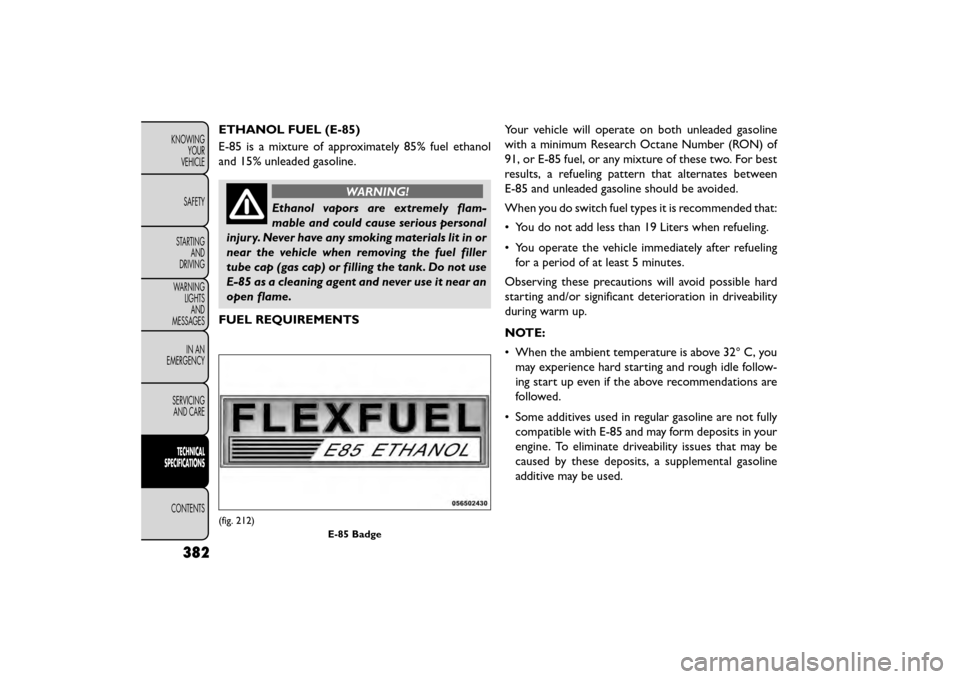
ETHANOL FUEL (E-85)
E-85 is a mixture of approximately 85% fuel ethanol
and 15% unleaded gasoline.
WARNING!
Ethanol vapors are extremely flam-
mable an
d could cause serious personal
injury. Never have any smoking materials lit in or
near the vehicle when removing the fuel filler
tube cap (gas cap) or filling the tank. Do not use
E-85 as a cleaning agent and never use it near an
open flame.
FUEL REQUIREMENTS Your vehicle will operate on both unleaded gasoline
with a minimum Research Octane Number (RON) of
91, or E-85 fuel, or any mixture of these two. For best
results, a refueling pattern that alternates between
E-85 and unleaded gasoline should be avoided.
When you do switch fuel types it is recommended that:
• You do not add less than 19 Liters when refueling.
• You operate the vehicle immediately after refueling
for a period of at least 5 minutes.
Observing these precautions will avoid possible hard
starting and/or significant deterioration in driveability
during warm up.
NOTE:
• When the ambient temperature is above 32° C, you may experience hard starting and rough idle follow-
ing start up even if the above recommendations are
followed.
• Some additives used in regular gasoline are not fully compatible with E-85 and may form deposits in your
engine. To eliminate driveability issues that may be
caused by these deposits, a supplemental gasoline
additive may be used.
(fig. 212)
E-85 Badge
382
KNOWINGYOUR
VEHICLE
SAFETY
STARTING AND
DRIVING
WARNING LIGHTSAND
MESSAGES
IN AN
EMERGENCY
SERVICINGAND CARE
TECHNICAL
SPECIFICATIONS
CONTENTS