tire size FIAT FREEMONT 2016 1.G User Guide
[x] Cancel search | Manufacturer: FIAT, Model Year: 2016, Model line: FREEMONT, Model: FIAT FREEMONT 2016 1.GPages: 412, PDF Size: 3.36 MB
Page 373 of 412
NOTE:Under a maximum loaded vehicle condition,
gross axle weight ratings (GAWRs) for the front and
rear axles must not be exceeded. For further informa-
tion on GAWRs, vehicle loading, and trailer towing,
refer to “Vehicle Loading” in this section.
To determine the maximum loading conditions of your
vehicle, locate the statement “The combined weight of
occupants and cargo should never exceed XXX lbs or
XXX kg” on the Tire and Loading Information placard.
The combined weight of occupants, cargo/luggage and
trailer tongue weight (if applicable) should never ex-
ceed the weight referenced here.
Steps For Determining Correct Load Limit
1. Locate the statement “The combined weight of occupants and cargo should never exceed XXX lbs
or XXX kg” on your vehicle's placard.
2. Determine the combined weight of the driver and passengers that will be riding in your vehicle.
3. Subtract the combined weight of the driver and passengers from XXX kg. 4. The resulting figure equals the available amount of
cargo and luggage load capacity. For example, if
“XXX” amount equals 635 kg and there will be five
68 kg passengers in your vehicle, the amount of
available cargo and luggage load capacity is 295 kg
(since5x68kg=340kg,and635kg–340kg=
295 kg).
5. Determine the combined weight of luggage and cargo being loaded on the vehicle. That weight may
not safely exceed the available cargo and luggage
load capacity calculated in step 4.
NOTE:
• If your vehicle will be towing a trailer, load from your trailer will be transferred to your vehicle. The follow-
ing table shows examples on how to calculate total
load, cargo/luggage, and towing capacities of your
vehicle with varying seating configurations and num-
ber and size of occupants. This table is for illustration
purposes only and may not be accurate for the
seating and load carry capacity of your vehicle.
367
KNOWING
YOUR
VEHICLE
SAFETY
STARTING
AND
DRIVING
WARNING
LIGHTS
AND
MESSAGES
IN AN
EMERGENCY
SERVICING
AND CARE
TECHNICAL
SPECIFICATIONS
CONTENTS
Page 378 of 412
Summer Or Three Season Tires (for
versions/markets, where provided)
Summer tires provide traction in both wet and dry
conditions, and are not intended to be driven in snow
or on ice. If your vehicle is equipped with summer tires,
be aware these tires are not designed for winter or cold
driving conditions. Install winter tires on your vehicle
when ambient temperatures are less than 5°C or if
roads are covered with ice or snow. For more informa-
tion, contact an authorized dealer.
Summer tires do not contain the all season designation
or mountain/snowflake symbol on the tire sidewall.
Use summer tires only in sets of four; failure to do so
may adversely affect the safety and handling of your
vehicle.
WARNING!
Do not use summer tires in snow/ice
con di
tions.You could lose vehicle control,
resulting in severe injury or death. Driving too
fast for conditions also creates the possibility of
loss of vehicle control. Snow Tires
Some areas of the country require the use of snow
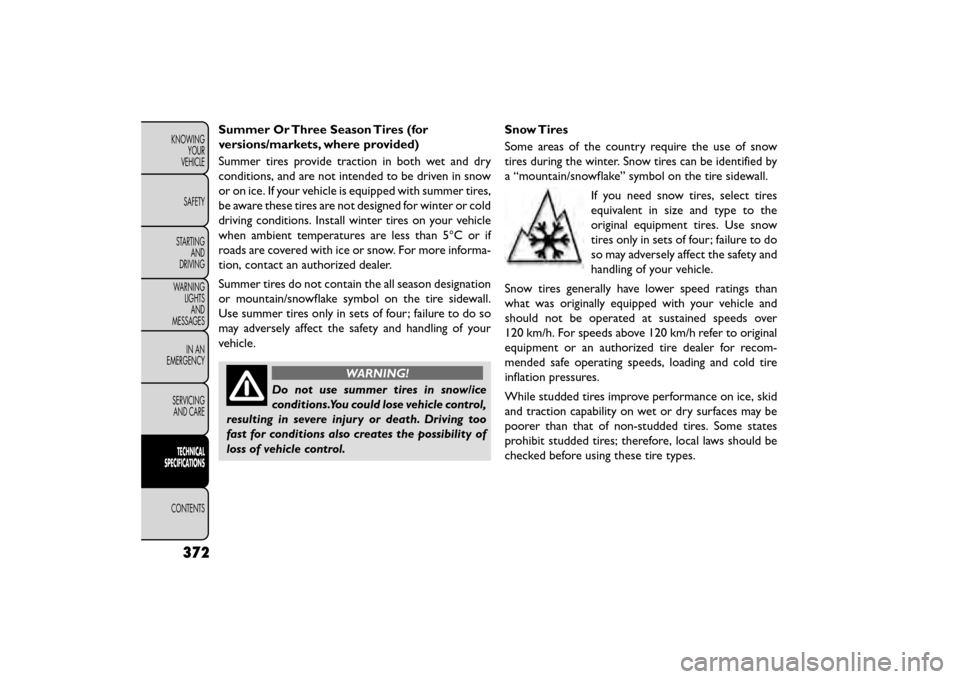
tires during the winter. Snow tires can be identified by
a “mountain/snowflake” symbol on the tire sidewall.
If you need snow tires, select tires
equivalent in size and type to the
original equipment tires. Use snow
tires only in sets of four; failure to do
so may adversely affect the safety and
handling of your vehicle.
Snow tires generally have lower speed ratings than
what was originally equipped with your vehicle and
should not be operated at sustained speeds over
120 km/h. For speeds above 120 km/h refer to original
equipment or an authorized tire dealer for recom-
mended safe operating speeds, loading and cold tire
inflation pressures.
While studded tires improve performance on ice, skid
and traction capability on wet or dry surfaces may be
poorer than that of non-studded tires. Some states
prohibit studded tires; therefore, local laws should be
checked before using these tire types.
372
KNOWING YOUR
VEHICLE
SAFETY
STARTING AND
DRIVING
WARNING LIGHTSAND
MESSAGES
IN AN
EMERGENCY
SERVICINGAND CARE
TECHNICAL
SPECIFICATIONS
CONTENTS
Page 379 of 412
RUN FLAT TIRES (for versions/markets,
where provided)
Run Flat tires allow you the capability to drive 80 km at
80 km/h after a rapid loss of inflation pressure. This
rapid loss of inflation is referred to as the Run Flat
mode. A Run Flat mode occurs when the tire inflation
pressure is of/or below 0.96 bar. Once a Run Flat tire
reaches the run flat mode it has limited driving capa-
bilities and needs to be replaced immediately. A Run
Flat tire is not repairable.
It is not recommended driving a vehicle loaded at full
capacity or to tow a trailer while a tire is in the run flat
mode.
See the tire pressure monitoring section for more
information.
SPARE TIRES (for versions/markets, where
provided)
NOTE:For vehicles equipped with Tire Service Kit
instead of a spare tire, please refer to “Tire Service Kit”
in “What To Do In Emergencies” for further informa-
tion.Because of the reduced ground clear-
ance, do not take your vehicle through an
automatic car wash with a compact , full
size or limited-use temporary spare installed.
Damage to the vehicle may result .
Spare Tire Matching Original Equipped Tire
And Wheel (for versions/markets, where
provided)
Your vehicle may be equipped with a spare tire and
wheel equivalent in look and function to the original
equipment tire and wheel found on the front or rear
axle of your vehicle. This spare tire may be used in the
tire rotation for your vehicle. If your vehicle has this
option, refer to an authorized tire dealer for the
recommended tire rotation pattern.
373
KNOWING
YOUR
VEHICLE
SAFETY
STARTING
AND
DRIVING
WARNING
LIGHTS
AND
MESSAGES
IN AN
EMERGENCY
SERVICING
AND CARE
TECHNICAL
SPECIFICATIONS
CONTENTS
Page 380 of 412
Compact Spare Tire (for versions/markets,
where provided)
The compact spare is for temporary emergency use
only. You can identify if your vehicle is equipped with a
compact spare by looking at the spare tire description
on the Tire and Loading Information Placard located on
the driver’s side door opening or on the sidewall of the
tire. Compact spare tire descriptions begin with the
letter “T” or “S” preceding the size designation. Ex-
ample: T145/80D18 103M.
T,S=Temporary Spare Tire
Since this tire has limited tread life, the original equip-
ment tire should be repaired (or replaced) and rein-
stalled on your vehicle at the first opportunity.
Do not install a wheel cover or attempt to mount a
conventional tire on the compact spare wheel, since
the wheel is designed specifically for the compact spare
tire. Do not install more than one compact spare tire
and wheel on the vehicle at any given time.WARNING!
Compact spares are for temporary
emergen cy
use only. With these spares,
do not drive more than 80 km/h. Temporary use
spares have limited tread life. When the tread is
worn to the tread wear indicators, the temporary
use spare tire needs to be replaced. Be sure to
follow the warnings, which apply to your spare.
Failure to do so could result in spare tire failure
and loss of vehicle control.
Full Size Spare (for versions/markets, where
provided)
The full size spare is for temporary emergency use only.
This tire may look like the originally equipped tire on
the front or rear axle of your vehicle, but it is not. This
spare tire may have limited tread life. When the tread is
worn to the tread wear indicators, the temporary use
full size spare tire needs to be replaced. Since it is not
the same as your original equipment tire, replace (or
repair) the original equipment tire and reinstall on the
vehicle at the first opportunity.
374
KNOWING YOUR
VEHICLE
SAFETY
STARTING AND
DRIVING
WARNING LIGHTSAND
MESSAGES
IN AN
EMERGENCY
SERVICINGAND CARE
TECHNICAL
SPECIFICATIONS
CONTENTS
Page 383 of 412
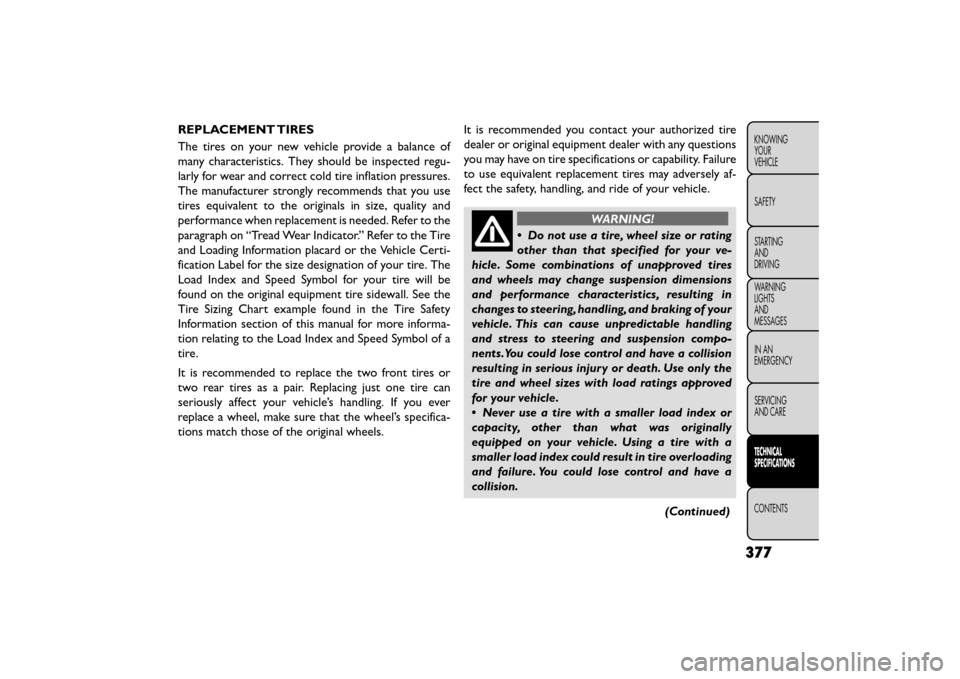
REPLACEMENT TIRES
The tires on your new vehicle provide a balance of
many characteristics. They should be inspected regu-
larly for wear and correct cold tire inflation pressures.
The manufacturer strongly recommends that you use
tires equivalent to the originals in size, quality and
performance when replacement is needed. Refer to the
paragraph on “Tread Wear Indicator.” Refer to the Tire
and Loading Information placard or the Vehicle Certi-
fication Label for the size designation of your tire. The
Load Index and Speed Symbol for your tire will be
found on the original equipment tire sidewall. See the
Tire Sizing Chart example found in the Tire Safety
Information section of this manual for more informa-
tion relating to the Load Index and Speed Symbol of a
tire.
It is recommended to replace the two front tires or
two rear tires as a pair. Replacing just one tire can
seriously affect your vehicle’s handling. If you ever
replace a wheel, make sure that the wheel’s specifica-
tions match those of the original wheels.It is recommended you contact your authorized tire
dealer or original equipment dealer with any questions
you may have on tire specifications or capability. Failure
to use equivalent replacement tires may adversely af-
fect the safety, handling, and ride of your vehicle.
WARNING!
• Do not use a tire, wheel size or rating
ot h
er than that specified for your ve-
hicle. Some combinations of unapproved tires
and wheels may change suspension dimensions
and performance characteristics, resulting in
changes to steering, handling, and braking of your
vehicle. This can cause unpredictable handling
and stress to steering and suspension compo-
nents.You could lose control and have a collision
resulting in serious injury or death. Use only the
tire and wheel sizes with load ratings approved
for your vehicle.
• Never use a tire with a smaller load index or
capacity, other than what was originally
equipped on your vehicle. Using a tire with a
smaller load index could result in tire overloading
and failure. You could lose control and have a
collision.
(Continued)
377
KNOWING
YOUR
VEHICLE
SAFETY
STARTING
AND
DRIVING
WARNING
LIGHTS
AND
MESSAGES
IN AN
EMERGENCY
SERVICING
AND CARE
TECHNICAL
SPECIFICATIONS
CONTENTS
Page 384 of 412
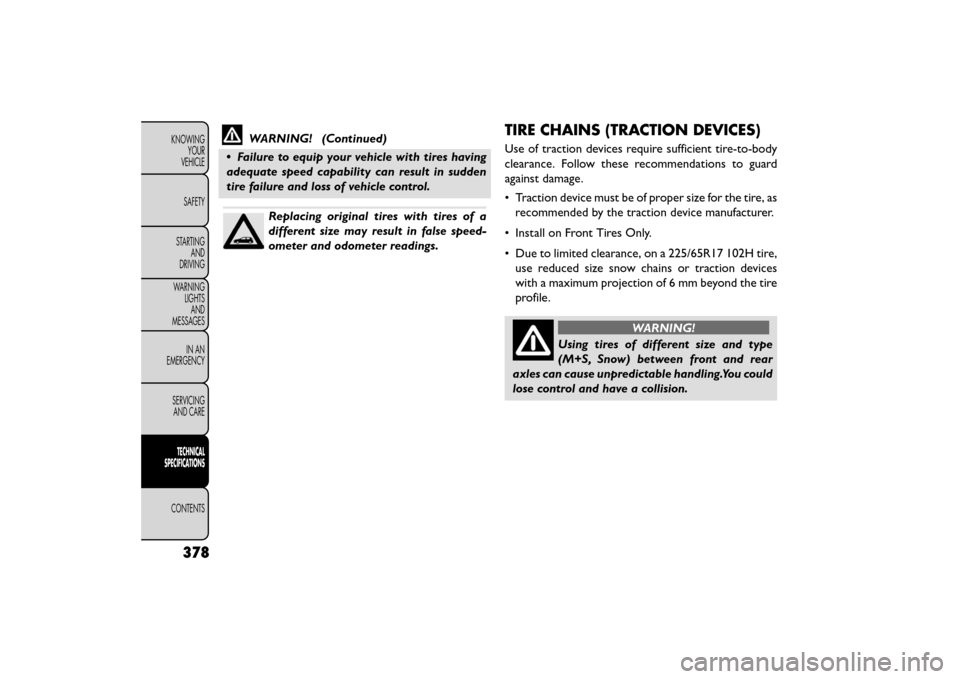
WARNING! (Continued)
• Failure to equip your vehicle with tires having
adequate speed capability can result in sudden
tire failure and loss of vehicle control.
Replacing original tires with tires of a
different size may result in false speed-
ometer and odometer readings.
TIRE CHAINS (TRACTION DEVICES)
Use of traction devices require sufficient tire-to-body
clearance. Follow these recommendations to guard
against damage.
• Traction device must be of proper size for the tire, as recommended by the traction device manufacturer.
• Install on Front Tires Only.
• Due to limited clearance, on a 225/65R17 102H tire, use reduced size snow chains or traction devices
with a maximum projection of 6 mm beyond the tire
profile.
WARNING!
Using tires of different size and type
(M+S, Sn
ow) between front and rear
axles can cause unpredictable handling.You could
lose control and have a collision.
378
KNOWING YOUR
VEHICLE
SAFETY
STARTING AND
DRIVING
WARNING LIGHTSAND
MESSAGES
IN AN
EMERGENCY
SERVICINGAND CARE
TECHNICAL
SPECIFICATIONS
CONTENTS
Page 407 of 412
Replacement . . ....................... .377
Rotation . . . . . . . . . ................... .359
Safety ........................... .361, 369
Sizes ............................... .362
SnowTires ............................372
Spare Tire ........................... .284
Spinning . . . . . . ....................... .375
Trailer Towing ........................ .264
Tread Wear Indicators ................... .376
Tire Safety Information . .................... .361
Tire Service Kit .......................... .293
Tongue Weight/Trailer Weight . . . . . ............262
To Open Hood .......................... .136
Towing . ............................... .258
Disabled Vehicle . . . . . . . .................318
Guide . . . . . . . . . . . . . . . . ...............262
Recreational .......................... .270
Weight . . . . . . . . . . . . . .................262
Towing Eyes ............................ .315
Towing Vehicle Behind a Motorhome . ............270
Traction . . . . . . ......................... .256
Traction Control ......................... .144
Trailer Sway Control (TSC) . . . . . . . ............149
Trailer Towing ........................... .258
Cooling System Tips . . . . .................269
Hitches ............................. .269
Minimum Requirements . . . . ...............263
Tips ............................... .268
Trailer and Tongue Weight .................262
Wiring . . . . . . . . . . . . . . . ...............265
Trailer Towing Guide . . . . . . . . . . .............262
Trailer Weight . . . ........................ .262Transaxle
Manual ............................. .354
Transmission Automatic ........................ .246, 351
Filter ............................... .354
Fluid ............................... .354
Man
ual ............................. .245
Transmitter Battery Service (Remote Keyless Entry) . . .14
Transmitter Programming (Remote Keyless Entry) . .13, 14
Transmitter, Remote Keyless Entry (RKE) ..........13
Transporting Pets ......................... .233
Tread Wear Indicators ...................... .376
Trip Odometer .......................... .275
Turn Signals ....................... .95, 274, 305
UCI Connector .......................... .189
Uconnect® Screen Activated Features ...................31
Underhood Fuses ......................... .310
Universal Consumer Interface (UCI) Connector .....189
Unleaded Gasoline ........................ .379
Untwisting Procedure, Seat Belt ................197
Upholstery Care ......................... .357
Vanity Mirrors .............................69
Vehicle Identification Number (VIN) .............360
Vehicle Loading .......................... .366
Vehicle Modifications/Alterations .................5
Vehicle Security Alarm (Security Alarm) ............16
Vehicle Storage ........................ .89, 359
Video Entertainment System™ (Rear Seat Video System)...............................168
Viscosity, Engine Oil ....................... .337
401
KNOWING
YOUR
VEHICLE
SAFETY
STARTING
AND
DRIVING
WARNING
LIGHTS
AND
MESSAGES
IN AN
EMERGENCY
SERVICING
AND CARE
TECHNICAL
SPECIFICATIONS
CONTENTS