weight FIAT FREEMONT 2016 1.G User Guide
[x] Cancel search | Manufacturer: FIAT, Model Year: 2016, Model line: FREEMONT, Model: FIAT FREEMONT 2016 1.GPages: 412, PDF Size: 3.36 MB
Page 265 of 412
Gross Trailer Weight (GTW)
The GTW is the weight of the trailer plus the weight of
all cargo, consumables and equipment (permanent or
temporary) loaded in or on the trailer in its "loaded and
ready for operation" condition. The recommended way
to measure GTW is to put your fully loaded trailer on
a vehicle scale. The entire weight of the trailer must be
supported by the scale.
Gross Combination Weight Rating (GCWR)
The GCWR is the total permissible weight of your
vehicle and trailer when weighed in combination.
NOTE:The GCWR rating includes a 68 kg allowance
for the presence of a driver.
Gross Axle Weight Rating (GAWR)
The GAWR is the maximum capacity of the front and
rear axles. Distribute the load over the front and rear
axles evenly. Make sure that you do not exceed either
front or rear GAWR.
WARNING!
It is important that you do not exceed
th e
maximum front or rear GAWR. A
dangerous driving condition can result if either
rating is exceeded. You could lose control of the
vehicle and have an accident . Tongue Weight (TW)
The tongue weight is the downward force exerted on
the hitch ball by the trailer. In most cases, it should not
be less than 7% or more than 10% of the trailer load.
Tongue weight must not exceed the lesser of either the
hitch certification rating, or the trailer tongue chassis
rating. It should never be less than 4% of the trailer
load, and not less than 25 kg. You must consider tongue
load as part of the load on your vehicle and its’ GAWR.
WARNING!
An improperly adjusted hitch system
may redu
ce handling, stability and brak-
ing performance and could result in an accident .
Consult with your hitch and trailer manufacturer
or a reputable trailer/dealer for additional infor-
mation.
Frontal Area
The frontal area is the maximum height multiplied by
the maximum width of the front of a trailer.
Trailer Sway Control
Refer to “TSC (Trailer Sway Control)” under “Knowing
Your Vehicle/Electronic Brake Control System” for
further information.
259
KNOWING
YOUR
VEHICLE
SAFETY
STARTING
AND
DRIVING
WARNING
LIGHTS
AND
MESSAGES
IN AN
EMERGENC
Y
SERVICING
AND CARE
TECHNICAL
SPECIFICATIONS
CONTENTS
Page 268 of 412
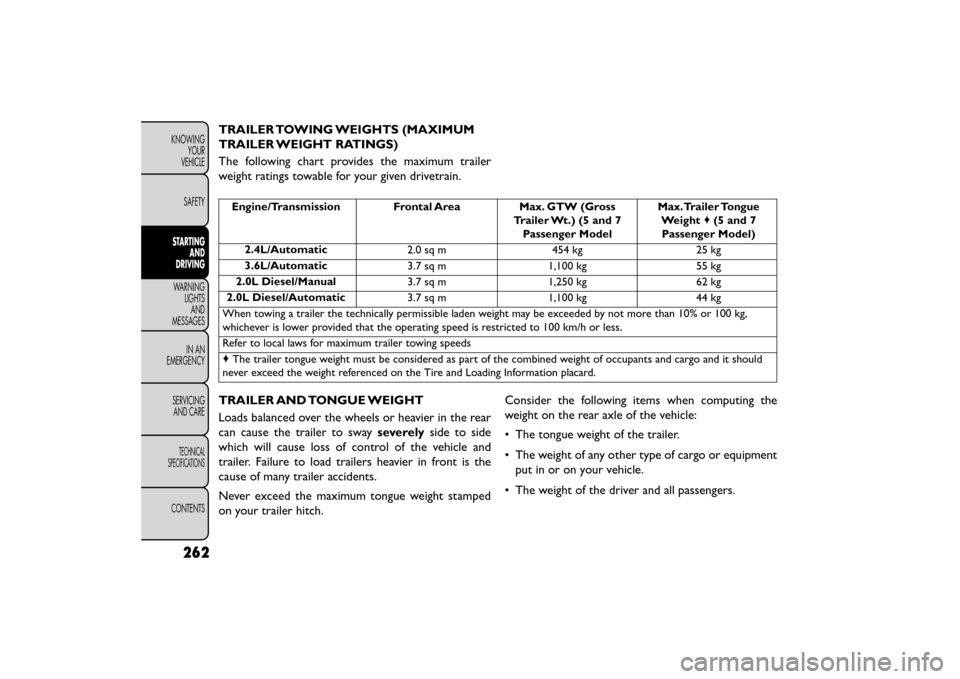
TRAILER TOWING WEIGHTS (MAXIMUM
TRAILER WEIGHT RATINGS)
The following chart provides the maximum trailer
weight ratings towable for your given drivetrain.
Engine/Transmission Frontal AreaMax. GTW (Gross
Trailer Wt.) (5 and 7 Passenger Model Max.Trailer Tongue
Weight ♦(5 and 7
Passenger Model)
2.4L/Automatic 2.0 sq m454 kg25 kg
3.6L/Automatic 3.7 sq m1,100 kg 55 kg
2.0L Diesel/Manual 3.7 sq m1,250 kg 62 kg
2.0L Diesel/Automatic 3.7 sq m1,100 kg 44 kg
When towing a trailer the technically permissible laden weight may be exceeded by not more than 10% or 100 kg,
whichever is lower provided that the operating speed is restricted to 100 km/h or less.
Refer to local laws for maximum trailer towing speeds
♦ The trailer tongue weight must be considered as part of the combined weight of occupants and cargo and it should
never exceed the weight referenced on the Tire and Loading Information placard.
TRAILER AND TONGUE WEIGHT
Loads balanced over the wheels or heavier in the rear
can cause the trailer to sway severelyside to side
which will cause loss of control of the vehicle and
trailer. Failure to load trailers heavier in front is the
cause of many trailer accidents.
Never exceed the maximum tongue weight stamped
on your trailer hitch. Consider the following items when computing the
weight on the rear axle of the vehicle:
• The tongue weight of the trailer.
• The weight of any other type of cargo or equipment
put in or on your vehicle.
• The weight of the driver and all passengers.
262
KNOWING YOUR
VEHICLE
SAFETY
STARTING AND
DRIVING
WARNING LIGHTSAND
MESSAGES
INAN
EMERGENC
Y
SERVICING AND CARE
TECHNICAL
SPECIFICATIONS
CONTENTS
Page 269 of 412
NOTE:Remember that everything put into or on the
trailer adds to the load on your vehicle. Also, additional
factory-installed options or dealer-installed options
must be considered as part of the total load on your
vehicle. Refer to the Tire and Loading Information
placard, located on the face of the driver's door or on
the driver's side “B” pillar, for the maximum combined
weight of occupants and cargo for your vehicle.
TOWING REQUIREMENTS
To promote proper break-in of your new vehicle drive-
train components the following guidelines are recom-
mended:
• Do not tow a trailer at all during the
first 805 km the new vehicle is driven.The
engine, axle or other parts could be dam-
aged.
• Then, during the first 805 km that a trailer is
towed, do not drive over 80 km/h and do not make
starts at full throttle. This helps the engine and
other parts of the vehicle wear in at the heavier
loads.
Perform the maintenance listed in the Maintenance
Schedule. When towing a trailer, never exceed the
GAWR ratings.
WARNING!
Improper towing can lead to an injury
acci den
t . Follow these guidelines to
make your trailer towing as safe as possible:
• Make certain that the load is secured in the
trailer and that it will not shift during travel.
When trailering cargo that is not fully secured,
dynamic load shifts can occur that may be diffi-
cult for the driver to control.You could lose con-
trol of your vehicle and have an accident .
• All trailer hitches should be professionally in-
stalled on your vehicle.
• When hauling cargo or towing a trailer, do not
overload your vehicle or trailer. Overloading can
cause a loss of control, poor performance, or
damage to brakes, axle, engine, transmission,
steering, suspension, chassis structure, or tires.
• Safety chains must always be used between
your vehicle and trailer. Always connect the
chains to the frame or hook retainers of the
vehicle hitch. Cross the chains under the trailer
tongue and allow enough slack for turning cor-
ners.
(Continued)
263
KNOWING
YOUR
VEHICLE
SAFETY
STARTING
AND
DRIVING
WARNING
LIGHTS
AND
MESSAGES
INAN
EMERGENC
Y
SERVICING
AND CARE
TECHNICAL
SPECIFICATIONS
CONTENTS
Page 270 of 412
WARNING! (Continued)
• Vehicles with trailers should not be parked on a
grade.When parking, apply the parking brake on
the tow vehicle. Always, block or "chock" the
trailer wheels.
• GCWR must not be exceeded.
• Total weight must be distributed between
the tow vehicle and the trailer such that the
following four ratings are not exceeded:1.
GVWR 2. GTW 3. GAWR 4.Tongue weight rating
for the trailer hitch utilized.
Towing Requirements — Tires
• Do not attempt to tow a trailer while using a com- pact spare tire.
• Proper tire inflation pressures are essential for the safe and satisfactory operation of your vehicle. Refer
to “Tires – General Information” in “Technical Speci-
fications” for proper tire inflation procedures.
• Check the trailer tires for proper tire inflation pres- sures before trailer usage.
• Check for signs of tire wear or visible tire damage before towing a trailer. Refer to “Tires – General
Information” in “Technical Specifications” for the
proper tire inspection procedures. • When replacing tires, refer to “Tires – General
Information” in “Technical Specifications” for proper
tire replacement procedures. Replacing tires with a
higher load carrying capacity will not increase the
vehicle's GVWR and GAWR limits.
Towing Requirements — Trailer Brakes
•Do notinterconnect the hydraulic brake system or
vacuum system of your vehicle with that of the
trailer. This could cause inadequate braking and pos-
sible personal injury.
• When towing a trailer equipped with a hydraulic surge actuated brake system, an electronic brake
controller is not required.
• Trailer brakes are recommended for trailers over 450 kg and required for trailers in excess of 750 kg.
If the trailer weighs more than 450 kg
loaded, it should have its own brakes, and
they should be of adequate capacity. Fail-
ure to do this could lead to accelerated brake
lining wear, higher brake pedal effort , and longer
stopping distances.
264
KNOWING YOUR
VEHICLE
SAFETY
STARTING AND
DRIVING
WARNING LIGHTSAND
MESSAGES
INAN
EMERGENC
Y
SERVICING AND CARE
TECHNICAL
SPECIFICATIONS
CONTENTS
Page 372 of 412
TIRE LOADING AND TIRE PRESSURE
Tire And Loading Information Placard
Location
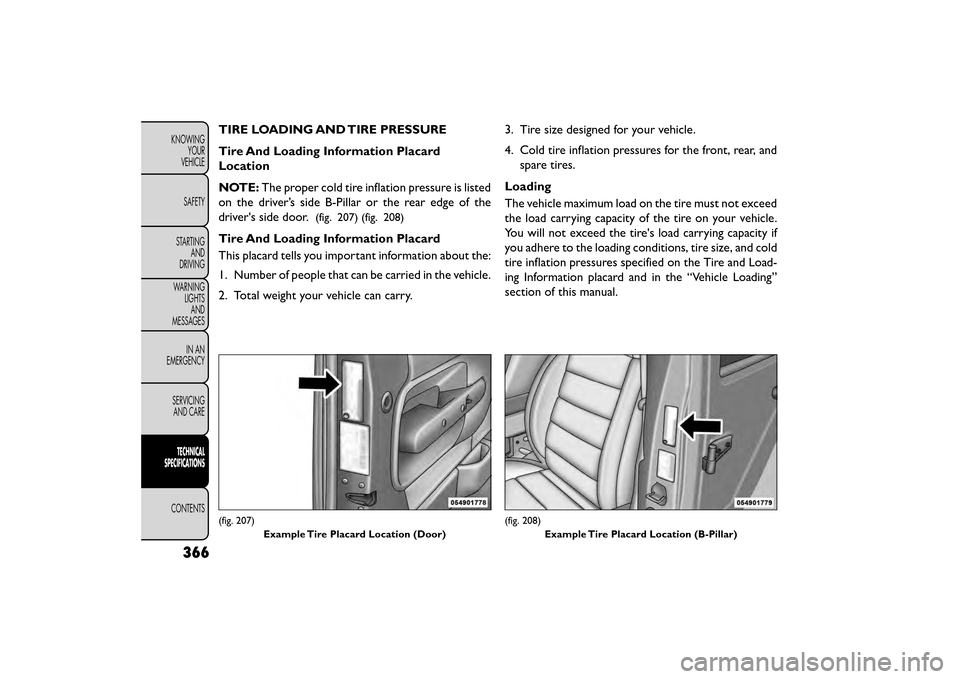
NOTE:The proper cold tire inflation pressure is listed
on the driver’s side B-Pillar or the rear edge of the
driver's side door.
(fig. 207) (fig. 208)
Tire And Loading Information Placard
This placard tells you important information about the:
1. Number of people that can be carried in the vehicle.
2. Total weight your vehicle can carry. 3. Tire size designed for your vehicle.
4. Cold tire inflation pressures for the front, rear, and
spare tires.
Loading
The vehicle maximum load on the tire must not exceed
the load carrying capacity of the tire on your vehicle.
You will not exceed the tire's load carrying capacity if
you adhere to the loading conditions, tire size, and cold
tire inflation pressures specified on the Tire and Load-
ing Information placard and in the “Vehicle Loading”
section of this manual.
(fig. 207) Example Tire Placard Location (Door)(fig. 208)Example Tire Placard Location (B-Pillar)
366
KNOWINGYOUR
VEHICLE
SAFETY
STARTING AND
DRIVING
WARNING LIGHTSAND
MESSAGES
IN AN
EMERGENCY
SERVICINGAND CARE
TECHNICAL
SPECIFICATIONS
CONTENTS
Page 373 of 412
NOTE:Under a maximum loaded vehicle condition,
gross axle weight ratings (GAWRs) for the front and
rear axles must not be exceeded. For further informa-
tion on GAWRs, vehicle loading, and trailer towing,
refer to “Vehicle Loading” in this section.
To determine the maximum loading conditions of your
vehicle, locate the statement “The combined weight of
occupants and cargo should never exceed XXX lbs or
XXX kg” on the Tire and Loading Information placard.
The combined weight of occupants, cargo/luggage and
trailer tongue weight (if applicable) should never ex-
ceed the weight referenced here.
Steps For Determining Correct Load Limit
1. Locate the statement “The combined weight of occupants and cargo should never exceed XXX lbs
or XXX kg” on your vehicle's placard.
2. Determine the combined weight of the driver and passengers that will be riding in your vehicle.
3. Subtract the combined weight of the driver and passengers from XXX kg. 4. The resulting figure equals the available amount of
cargo and luggage load capacity. For example, if
“XXX” amount equals 635 kg and there will be five
68 kg passengers in your vehicle, the amount of
available cargo and luggage load capacity is 295 kg
(since5x68kg=340kg,and635kg–340kg=
295 kg).
5. Determine the combined weight of luggage and cargo being loaded on the vehicle. That weight may
not safely exceed the available cargo and luggage
load capacity calculated in step 4.
NOTE:
• If your vehicle will be towing a trailer, load from your trailer will be transferred to your vehicle. The follow-
ing table shows examples on how to calculate total
load, cargo/luggage, and towing capacities of your
vehicle with varying seating configurations and num-
ber and size of occupants. This table is for illustration
purposes only and may not be accurate for the
seating and load carry capacity of your vehicle.
367
KNOWING
YOUR
VEHICLE
SAFETY
STARTING
AND
DRIVING
WARNING
LIGHTS
AND
MESSAGES
IN AN
EMERGENCY
SERVICING
AND CARE
TECHNICAL
SPECIFICATIONS
CONTENTS
Page 374 of 412
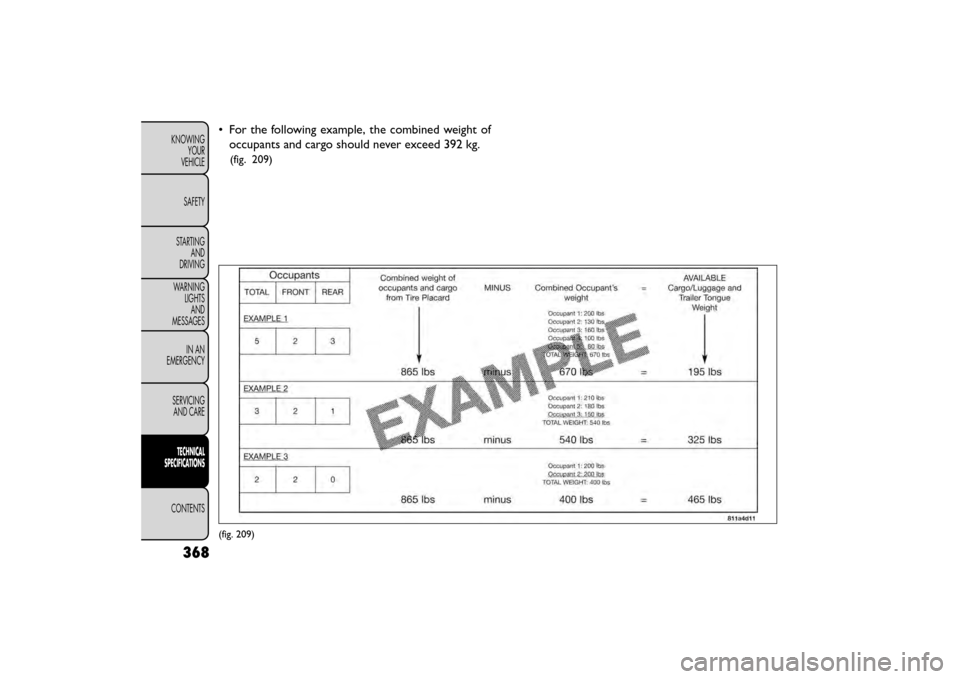
• For the following example, the combined weight ofoccupants and cargo should never exceed 392 kg.
(fig. 209)
(fig. 209)
368
KNOWING YOUR
VEHICLE
SAFETY
STARTING AND
DRIVING
WARNING LIGHTSAND
MESSAGES
IN AN
EMERGENCY
SERVICINGAND CARE
TECHNICAL
SPECIFICATIONS
CONTENTS
Page 394 of 412
ARRANGEMENTS FOR DEALING WITH THE VEHICLE AT THE END OF ITS LIFE
FIAT has been committed for many years to safeguarding the environment through the constant improvement of its
production processes and manufacturing products that are increasingly “eco-compatible”.
To give customers the best possible service in terms of respecting environmental laws and in response to European
Directive 2000/53/EC governing vehicles at the end of their life, FIAT is offering its customers the opportunity of handing
over their vehicle* at the end of its life without incurring any additional costs.
The European Directive sets out that when the vehicle is handed over the last keeper or owner should not incur any
expenses as a result of it having a zero or negative market value.
In all European Union countries, until 1st January 2007, only vehicles registered after 1st July 2002 were collected free of
charge, while since 2007 collection has been free of charge irrespective of the year of registration as long as the vehicle
contains its basic components (in particular, the engine and bodywork) and has no additional waste.
To hand your vehicle over at the end of its life without extra cost, go to one of our Dealerships or FIAT-authorized
collection and scrapping centres.
These centres have been carefully chosen to offer high quality service for the collection, treatment and recycling of unused
vehicles with respect to the environment.
You can find further information on these collection and scrapping centres either from a FIAT or FIAT Commercial Vehicle
Dealership or by calling the freephone number 00800 3428 0000 or by going on the FIAT website.
(*) Vehicle for transporting passengers with a maximum of nine seats and a total permitted weight of 3.5 t
388
Page 401 of 412
Requirements......................... .379
Saver Mode ............................29
Specifications . . . . . .................... .385
Tank Capacity . . . . . . . . . . . ...............384
Fuel, Flexible . . . . . . . . . . . . . ................381
Fueling . . . . . . . . ........................ .190
Fuel Optimizer ............................29
Fuel Saver ................................29
Fuel System Caution . ...................... .191
Fuses . ................................ .307
Gas Cap (Fuel Filler Cap) .................... .190
Gas Gauge (Fuel Gauge) .......................7
Gasoline, Clean Air ....................... .380
Gasoline (Fuel) .......................... .379
Conserving ............................29
Gauges Coolant Temperature . .....................8
Fuel . . ................................7
Speedometer ............................7
Tachometer .............................7
Gear Ranges . . . . . . . . . . . . . . . . . ............249
Gear Select Lever Override . . . . . . . ............313
General Information . . . . . . . . . . . . . ........12, 158
General Maintenance ...................... .335
Glass Cleaning . . ......................... .358
Gross Axle Weight Rating . . . . . . . .............259
Gross Vehicle Weight Rating . . . . . . . ...........258
Hazard Driving Through Flowing, Rising, or Shallow Standing
Water .............................. .257
Hazard Warning Flasher . ................... .107Headlights
Automatic .............................92
Bulb Replacement ...................... .301
Cleaning ............................ .357
Delay ................................93
High Beam ........................... .301
High Beam/Low Beam Select Switch ............95
Leveling ...............................92
Lights On Reminder ......................94
On With Wipers .................... .93, 100
Passing ...............................95
Switch ................................92
Time Dela y............................
93
Washers ............................ .100
Headlight Washers ........................ .100
Head Restraints ............................54
Heated Mirrors ............................69
Heated Seats ..............................50
High Beam Indicator ....................... .274
High Beam/Low Beam Select (Dimmer) Switch .......95
Hill Start Assist .......................... .147
Holder, Coin ............................ .108
Holder, Cup ............................ .115
Hood Release ........................... .136
Ignition Key ..................................8
Illuminated Entry ...........................97
Immobilizer (Sentry Key) ......................11
Inflation Pressure Tires ..................... .275
Information Center, Vehicle ....................20
Inside Rearview Mirror .......................66
Instrument Cluster ........................ .273
395
KNOWING
YOUR
VEHICLE
SAFETY
STARTING
AND
DRIVING
WARNING
LIGHTS
AND
MESSAGES
IN AN
EMERGENCY
SERVICING
AND CARE
TECHNICAL
SPECIFICATIONS
CONTENTS
Page 407 of 412
Replacement . . ....................... .377
Rotation . . . . . . . . . ................... .359
Safety ........................... .361, 369
Sizes ............................... .362
SnowTires ............................372
Spare Tire ........................... .284
Spinning . . . . . . ....................... .375
Trailer Towing ........................ .264
Tread Wear Indicators ................... .376
Tire Safety Information . .................... .361
Tire Service Kit .......................... .293
Tongue Weight/Trailer Weight . . . . . ............262
To Open Hood .......................... .136
Towing . ............................... .258
Disabled Vehicle . . . . . . . .................318
Guide . . . . . . . . . . . . . . . . ...............262
Recreational .......................... .270
Weight . . . . . . . . . . . . . .................262
Towing Eyes ............................ .315
Towing Vehicle Behind a Motorhome . ............270
Traction . . . . . . ......................... .256
Traction Control ......................... .144
Trailer Sway Control (TSC) . . . . . . . ............149
Trailer Towing ........................... .258
Cooling System Tips . . . . .................269
Hitches ............................. .269
Minimum Requirements . . . . ...............263
Tips ............................... .268
Trailer and Tongue Weight .................262
Wiring . . . . . . . . . . . . . . . ...............265
Trailer Towing Guide . . . . . . . . . . .............262
Trailer Weight . . . ........................ .262Transaxle
Manual ............................. .354
Transmission Automatic ........................ .246, 351
Filter ............................... .354
Fluid ............................... .354
Man
ual ............................. .245
Transmitter Battery Service (Remote Keyless Entry) . . .14
Transmitter Programming (Remote Keyless Entry) . .13, 14
Transmitter, Remote Keyless Entry (RKE) ..........13
Transporting Pets ......................... .233
Tread Wear Indicators ...................... .376
Trip Odometer .......................... .275
Turn Signals ....................... .95, 274, 305
UCI Connector .......................... .189
Uconnect® Screen Activated Features ...................31
Underhood Fuses ......................... .310
Universal Consumer Interface (UCI) Connector .....189
Unleaded Gasoline ........................ .379
Untwisting Procedure, Seat Belt ................197
Upholstery Care ......................... .357
Vanity Mirrors .............................69
Vehicle Identification Number (VIN) .............360
Vehicle Loading .......................... .366
Vehicle Modifications/Alterations .................5
Vehicle Security Alarm (Security Alarm) ............16
Vehicle Storage ........................ .89, 359
Video Entertainment System™ (Rear Seat Video System)...............................168
Viscosity, Engine Oil ....................... .337
401
KNOWING
YOUR
VEHICLE
SAFETY
STARTING
AND
DRIVING
WARNING
LIGHTS
AND
MESSAGES
IN AN
EMERGENCY
SERVICING
AND CARE
TECHNICAL
SPECIFICATIONS
CONTENTS