maintenance FIAT FREEMONT 2016 1.G Owner's Manual
[x] Cancel search | Manufacturer: FIAT, Model Year: 2016, Model line: FREEMONT, Model: FIAT FREEMONT 2016 1.GPages: 412, PDF Size: 3.36 MB
Page 351 of 412
NOTE:Intentional tampering with emissions control
systems can result in civil penalties being assessed
against you.
WARNING!
A hot exhaust system can start a fire if you
park over materials that can burn. Such
materials might be grass or leaves coming into
contact with your exhaust system. Do not park or
operate your vehicle in areas where your exhaust
system can contact anything that can burn.
In unusual situations involving grossly malfunctioning
engine operation, a scorching odor may indicate severe
and abnormal catalyst overheating. If this occurs, safely
bring the vehicle to a complete stop, shut the engine
OFF, and allow the vehicle to cool. Thereafter, obtain
service, including a tune-up to manufacturer’s specifi-
cations immediately.
To minimize the possibility of catalyst damage:
• Do not shut OFF the engine or interrupt the ignition when the transmission is in gear and the vehicle is in
motion.
• Do not try to start the engine by pushing or towing the vehicle.
• Do not idle the engine with any ignition coil connec- tors disconnected for prolonged periods. COOLING SYSTEM
WARNING!
• When working near the radiator cool-
in g
fan, disconnect the fan motor lead or
turn the ignition switch to the LOCK position.The
fan is temperature controlled and can start at
any time the ignition switch is in the ON position.
• You or others can be badly burned by hot
engine coolant (antifreeze) or steam from your
radiator. If you see or hear steam coming from
under the hood, do not open the hood until the
radiator has had time to cool. Never tr y to open a
cooling system pressure cap when the radiator is
hot .
Car maintenance should be done at a
FIAT Dealership. For routine and minor
maintenance operations you wish to
carry out yourself, we do recommend you have
the proper equipment , genuine FIAT spare parts
and the necessary fluids; do not however carry out
these operations if you have no experience.
345
KNOWING
YOUR
VEHICLE
SAFETY
STARTING
AND
DRIVING
WARNING
LIGHTS
AND
MESSAGES
IN AN
EMERGENCY
SERVICING
AND C ARE
TECHNICAL
SPECIFICATIONS
CONTENTS
Page 352 of 412
Coolant Checks
Check engine coolant (antifreeze) protection every 1
year (before the onset of freezing weather, where
applicable). If coolant is dirty or rusty in appearance,
the system should be drained, flushed, and refilled with
fresh coolant. Check the front of the A/C condenser
for any accumulation of bugs, leaves, etc. If dirty, clean
by gently spraying water from a garden hose vertically
down the face of the condenser.
Check the coolant recovery bottle tubing for brittle
rubber, cracking, tears, cuts, and tightness of the con-
nection at the bottle and radiator. Inspect the entire
system for leaks.
Cooling System — Drain, Flush, And Refill
Refer to the “Maintenance Schedule” for the proper
maintenance intervals.
If the solution is dirty or contains a considerable
amount of sediment, clean and flush with a reliable
cooling system cleaner. Follow with a thorough rinsing
to remove all deposits and chemicals. Properly dispose
of the old engine coolant (antifreeze) solution.Selection Of Coolant — Gasoline Engine
Use only the manufacturer's recommended coolant.
Refer to “Fluids, Lubricants, and Genuine Parts” in
“Technical Specifications” for further information.
•
Mixing of engine coolant (antifreeze)
other than specified engine coolant (an-
tifreeze), may result in engine damage
and may decrease corrosion protection. If a non-
specified engine coolant (antifreeze) is intro-
duced into the cooling system in an emergency, it
should be replaced with the specified engine cool-
ant (antifreeze) as soon as possible.
• Do not use plain water alone or alcohol-based
engine coolant (antifreeze) products. Do not use
additional rust inhibitors or antirust products, as
they may not be compatible with the radiator
engine coolant (antifreeze) and may plug the
radiator.
• This vehicle has not been designed for use with
Propylene Glycol based engine coolant (anti-
freeze). Use of Propylene Glycol based engine
coolant (antifreeze) is not recommended.
346
KNOWING YOUR
VEHICLE
SAFETY
STARTING AND
DRIVING
WARNING LIGHTSAND
MESSAGES
IN AN
EMERGENCY
SERVICINGAND C ARE
TECHNICAL
SPECIFICATIONS
CONTENTS
Page 353 of 412
Selection Of Coolant — Diesel Engine
Use only the manufacturer's recommended coolant
(antifreeze). Refer to “Fluids, Lubricants, and Genuine
Parts” in “Technical Specifications” for further informa-
tion.
•Do not use HOAT (Hybrid Organic Ad-
ditive Technology) products in the Diesel
Engine.
• Do not use OAT (Organic Additive Technology)
products containing 2-EH (2–ethyl hexanol).
• Do not use plain water alone or alcohol base
engine coolant (antifreeze) products. Do not use
additional rust inhibitors or antirust products, as
they may not be compatible with the radiator
engine coolant and may plug the radiator.
• This vehicle has not been designed for use with
Propylene Glycol based coolants. Use of Propyl-
ene Glycol based coolants is not recommended.
Adding Coolant — Gasoline Engine
Your vehicle has been built with an improved engine
coolant (antifreeze) that allows extended maintenance
intervals. This coolant (antifreeze) can be used up to 10
years or 240 000 km before replacement. To prevent
reducing this extended maintenance period, it is impor-
tant that you use the same coolant throughout the life
of your vehicle. Use only high purity water such as distilled or deion-
ized water when mixing the water/engine coolant (an-
tifreeze) solution. The use of lower quality water will
reduce the amount of corrosion protection in the
engine cooling system.
Please note that it is the owner's responsibility to
maintain the proper level of protection against freezing
according to the temperatures occurring in the area
where the vehicle is operated.
NOTE:
Mixing coolant types will decrease the life of
the engine coolant (antifreeze) and will require more
frequent coolant changes.
Adding Coolant — Diesel Engine
Your vehicle has been built with an improved engine
coolant (antifreeze) that allows extended maintenance
intervals. To prevent reducing this extended mainte-
nance period, it is important that you use the same
coolant throughout the life of your vehicle.
Please note that it is the owner's responsibility to
maintain the proper level of protection against freezing
according to the temperatures occurring in the area
where the vehicle is operated.
347
KNOWING
YOUR
VEHICLE
SAFETY
STARTING
AND
DRIVING
WARNING
LIGHTS
AND
MESSAGES
IN AN
EMERGENCY
SERVICING
AND C ARE
TECHNICAL
SPECIFICATIONS
CONTENTS
Page 355 of 412
Points To Remember
NOTE:When the vehicle is stopped after a few
kilometers of operation, you may observe vapor com-
ing from the front of the engine compartment. This is
normally a result of moisture from rain, snow, or high
humidity accumulating on the radiator and being vapor-
ized when the thermostat opens, allowing hot coolant
to enter the radiator.
If an examination of your engine compartment shows
no evidence of radiator or hose leaks, the vehicle may
be safely driven. The vapor will soon dissipate.
• Do not overfill the coolant recovery bottle.
• Check coolant freeze point in the radiator and in the coolant recovery bottle. If antifreeze needs to be
added, contents of coolant recovery bottle must also
be protected against freezing.
• If frequent coolant additions are required, or if the level in the coolant recovery bottle does not drop
when the engine cools, the cooling system should be
pressure tested for leaks.
• Make sure that the radiator and coolant recovery bottle overflow hoses are not kinked or obstructed.
• Keep the front of the radiator clean. If your vehicle is equipped with air conditioning, keep the front of the
condenser clean. • Do not change the thermostat for Summer or Win-
ter operation. If replacement is ever necessary, install
ONLY the correct type thermostat. Other designs
may result in unsatisfactory coolant performance,
poor gas mileage, and increased emissions.
BRAKE SYSTEM
In order to assure brake system performance, all brake
system components should be inspected periodically.
Refer to the “Maintenance Schedule” for the proper
maintenance intervals.
WARNING!
Riding the brakes can lead to brake fail-
ure an d
possibly an accident . Driving
with your foot resting or riding on the brake
pedal can result in abnormally high brake tem-
peratures, excessive lining wear, and possible
brake damage.You would not have your full brak-
ing capacity in an emergency.
Car maintenance should be done at a
FIAT Dealership. For routine and minor
maintenance operations you wish to
carry out yourself, we do recommend you have
the proper equipment , genuine FIAT spare parts
and the necessary fluids; do not however carry out
these operations if you have no experience.
349
KNOWING
YOUR
VEHICLE
SAFETY
STARTING
AND
DRIVING
WARNING
LIGHTS
AND
MESSAGES
IN AN
EMERGENCY
SERVICING
AND C ARE
TECHNICAL
SPECIFICATIONS
CONTENTS
Page 358 of 412
Special Additives
The manufacturer strongly recommends against using any
special additives in the transmission. Automatic Transmis-
sion Fluid (ATF) is an engineered product and its perfor-
mance may be impaired by supplemental additives. There-
fore, do not add any fluid additives to the transmission.
The only exception to this policy is the use of special dyes
for diagnosing fluid leaks. Avoid using transmission sealers
as they may adversely affect seals.
Do not use chemical flushes in your
transmission as the chemicals can dam-
age your transmission components. Such
damage is not covered by the New Vehicle Limited
Warranty.
Fluid Level Check - Six-Speed Transmission
The fluid level is preset at the factory and does not
require adjustment under normal operating conditions.
Routine fluid level checks are not required, therefore
the transmission filler tube is capped and no dipstick is
provided. Your authorized dealer can check your trans-
mission fluid level using a special service dipstick. If you
notice fluid leakage or transmission malfunction, visit
your authorized dealer immediately to have the trans-
mission fluid level checked. Operating the vehicle with
an improper fluid level can cause severe transmission
damage.
If a transmission fluid leak occurs, visit
your authorized dealer immediately. Se-
vere transmission damage may occur.
Your authorized dealer has the proper tools to
adjust the fluid level accurately.
Car maintenance should be done at a
FIAT Dealership. For routine and minor
maintenance operations you wish to
carry out yourself, we do recommend you have
the proper equipment , genuine FIAT spare parts
and the necessary fluids; do not however carry out
these operations if you have no experience.
Fluid Level Check — Four-Speed Automatic
Use the following procedure to check the transmission
fluid level properly:
1. Park the vehicle on level ground.
2. Run the engine at normal idle speed for at least 60 seconds, and leave the engine running for the rest of
this procedure.
3. Fully apply the parking brake, and press the brake pedal.
352
KNOWING YOUR
VEHICLE
SAFETY
STARTING AND
DRIVING
WARNING LIGHTSAND
MESSAGES
IN AN
EMERGENCY
SERVICINGAND C ARE
TECHNICAL
SPECIFICATIONS
CONTENTS
Page 360 of 412
Fluid And Filter Changes
Refer to the “Maintenance Schedule” for the proper
maintenance intervals.
In addition, change the fluid and filter if the fluid
becomes contaminated (with water, etc.), or if the
transmission is disassembled for any reason.
MANUAL TRANSMISSION (for versions/
markets, where provided)
Lubricant Selection
Use only manufacturers recommended transmission
fluid. Do not add any materials (other than leak detec-
tion dyes). Refer to “Fluids, Lubricants, and Genuine
Parts” in “Technical Specifications” for further informa-
tion.
Frequency Of Fluid Change
Change the manual transmission fluid at the intervals
shown in the “Maintenance Schedule” in this manual.
REAR DRIVE ASSEMBLY (RDA) – AWD
MODELS ONLY
Lubricant Selection
Use only the manufacturer's recommended fluid. Refer
to “Fluids, Lubricants, and Genuine Parts” in “Technical
Specifications” for further information.Fluid Level Check
Visually inspect the unit at each oil change for leakage.
If leakage is detected, check the fluid level by removing
the fill plug. The fluid level should be maintained be-
tween the bottom of the fill hole to 4 mm below the fill
hole.
Add fluid, if necessary, to maintain the proper level.
Frequency Of Fluid Change
Refer to the “Maintenance Schedule” for the proper
maintenance intervals.
POWER TRANSFER UNIT (PTU) – AWD
MODELS ONLY
Lubricant Selection
Use only the manufacturer's recommended fluid. Refer
to “Fluids, Lubricants, and Genuine Parts” in “Technical
Specifications” for further information.
Fluid Level Check
Visually inspect the unit at each oil change for leakage.
If leakage is detected, Check the fluid level by removing
the fill plug. The fluid level should be maintained be-
tween the bottom of the fill hole to 4 mm below the fill
hole.
Add fluid, if necessary, to maintain the proper level.
354
KNOWING
YOUR
VEHICLE
SAFETY
STARTING AND
DRIVING
WARNING LIGHTSAND
MESSAGES
IN AN
EMERGENCY
SERVICINGAND C ARE
TECHNICAL
SPECIFICATIONS
CONTENTS
Page 361 of 412
Frequency Of Fluid Change
Refer to the “Maintenance Schedule” for the proper
maintenance intervals.
APPEARANCE CARE AND PROTECTION
FROM CORROSION
Protection Of Body And Paint From Corrosion
Vehicle body care requirements vary according to geo-
graphic locations and usage. Chemicals that make roads
passable in snow and ice and those that are sprayed on
trees and road surfaces during other seasons are highly
corrosive to the metal in your vehicle. Outside parking,
which exposes your vehicle to airborne contaminants,
road surfaces on which the vehicle is operated, ex-
treme hot or cold weather and other extreme condi-
tions will have an adverse effect on paint, metal trim,
and underbody protection.
The following maintenance recommendations will en-
able you to obtain maximum benefit from the corro-
sion resistance built into your vehicle.What Causes Corrosion?
Corrosion is the result of deterioration or removal of
paint and protective coatings from your vehicle.
The most common causes are:
• Road salt, dirt and moisture accumulation.
• Stone and gravel impact.
• Insects, tree sap and tar.
• Salt in the air near seacoast localities.
• Atmospheric fallout/industrial pollutants.
Washing
• Wash your vehicle regularly. Always wash your ve-
hicle in the shade using a mild car wash soap, and
rinse the panels completely with clear water.
• Use a high quality cleaner wax to protect your paint finish. Take care never to scratch the paint.
• Avoid using abrasive compounds and power buffing that may diminish the gloss or thin out the paint
finish.
Do not use abrasive or strong cleaning
materials such as steel wool or scouring
powder that will scratch metal and
painted surfaces.
355
KNOWING
YOUR
VEHICLE
SAFETY
STARTING
AND
DRIVING
WARNING
LIGHTS
AND
MESSAGES
IN AN
EMERGENCY
SERVICING
AND C ARE
TECHNICAL
SPECIFICATIONS
CONTENTS
Page 364 of 412
Glass Surfaces
All glass surfaces should be cleaned on a regular basis
with any commercial household-type glass cleaner.
Never use an abrasive type cleaner. Use caution when
cleaning the inside rear window equipped with an
electric defroster. Do not use scrapers or other sharp
instruments that may scratch the elements.
When cleaning the rear view mirror, spray cleaner on
the towel or rag that you are using. Do not spray
cleaner directly on the mirror.
Cleaning Plastic Instrument Cluster Lenses
The lenses in front of the instruments in this vehicle are
molded in clear plastic. When cleaning the lenses, care
must be taken to avoid scratching the plastic.
1. Clean with a wet soft rag. A mild soap solution maybe used, but do not use high alcohol content or
abrasive cleaners. If soap is used, wipe clean with a
clean damp rag.
2. Dry with a soft cloth. Seat Belt Maintenance
Do not bleach, dye or clean the belts with chemical
solvents or abrasive cleaners. This will weaken the
fabric. Sun damage can also weaken the fabric.
If the belts need cleaning, use a mild soap solution or
lukewarm water. Do not remove the belts from the car
to wash them. Dry with a soft cloth.
Replace the belts if they appear frayed or worn or if the
buckles do not work properly.
WARNING!
A frayed or torn belt could rip apart in a
collisi on
and leave you with no protec-
tion. Inspect the belt system periodically, check-
ing for cuts, frays, or loose parts. Damaged parts
must be replaced immediately. Do not disas-
semble or modify the system. Seat belt assem-
blies must be replaced after a collision if they
have been damaged (i.e., bent retractor, torn
webbing, etc .).
CLEANING THE CUP HOLDERS
Clean with a damp cloth or towel using a mild deter-
gent.
358
KNOWING YOUR
VEHICLE
SAFETY
STARTING AND
DRIVING
WARNING LIGHTSAND
MESSAGES
IN AN
EMERGENCY
SERVICINGAND C ARE
TECHNICAL
SPECIFICATIONS
CONTENTS
Page 382 of 412
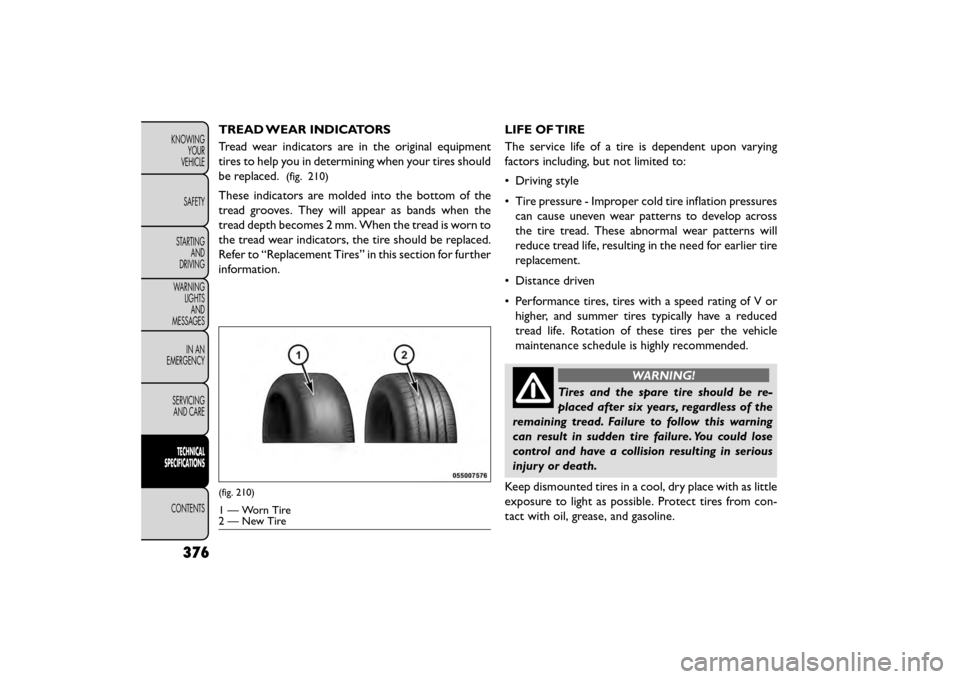
TREAD WEAR INDICATORS
Tread wear indicators are in the original equipment
tires to help you in determining when your tires should
be replaced.
(fig. 210)
These indicators are molded into the bottom of the
tread grooves. They will appear as bands when the
tread depth becomes 2 mm. When the tread is worn to
the tread wear indicators, the tire should be replaced.
Refer to “Replacement Tires” in this section for further
information.LIFE OF TIRE
The service life of a tire is dependent upon varying
factors including, but not limited to:
• Driving style
• Tire pressure - Improper cold tire inflation pressures
can cause uneven wear patterns to develop across
the tire tread. These abnormal wear patterns will
reduce tread life, resulting in the need for earlier tire
replacement.
• Distance driven
• Performance tires, tires with a speed rating of V or higher, and summer tires typically have a reduced
tread life. Rotation of these tires per the vehicle
maintenance schedule is highly recommended.
WARNING!
Tires and the spare tire should be re-
placed af
ter six years, regardless of the
remaining tread. Failure to follow this warning
can result in sudden tire failure. You could lose
control and have a collision resulting in serious
injury or death.
Keep dismounted tires in a cool, dry place with as little
exposure to light as possible. Protect tires from con-
tact with oil, grease, and gasoline.
(fig. 210)
1 — Worn Tire
2 — New Tire
376
KNOWING YOUR
VEHICLE
SAFETY
STARTING AND
DRIVING
WARNING LIGHTSAND
MESSAGES
IN AN
EMERGENCY
SERVICINGAND CARE
TECHNICAL
SPECIFICATIONS
CONTENTS
Page 387 of 412
WARNING!
Carbon monoxide (CO) in exhaust gases
is deadly .
Follow the precautions below
to prevent carbon monoxide poisoning:
• Do not inhale exhaust gases.They contain car-
bon monoxide, a colorless and odorless gas which
can kill. Never run the engine in a closed area,
such as a garage, and never sit in a parked vehicle
with the engine running for an extended period.
If the vehicle is stopped in an open area with the
engine running for more than a short period,
adjust the ventilation system to force fresh, out-
side air into the vehicle.
• Guard against carbon monoxide with proper
maintenance. Have the exhaust system inspected
every time the vehicle is raised. Have any abnor-
mal conditions repaired promptly. Until re-
paired, drive with all side windows fully open.
• Keep the liftgate closed when driving your ve-
hicle to prevent carbon monoxide and other poi-
sonous exhaust gases from entering the vehicle.
FLEXIBLE FUEL — 3.6L ENGINE
ONLY (for versions/markets where
provided)
E-85 GENERAL INFORMATION
The information in this section is for Flexible Fuel
vehicles only. These vehicles may be identified by a
unique fuel filler door label that states Ethanol (E-85)
or Unleaded Gasoline Only. This section only cov-
ers those subjects that are unique to these vehicles.
Please refer to the other sections of this manual for
information on features that are common between
Flexible Fuel and gasoline-only powered vehicles.
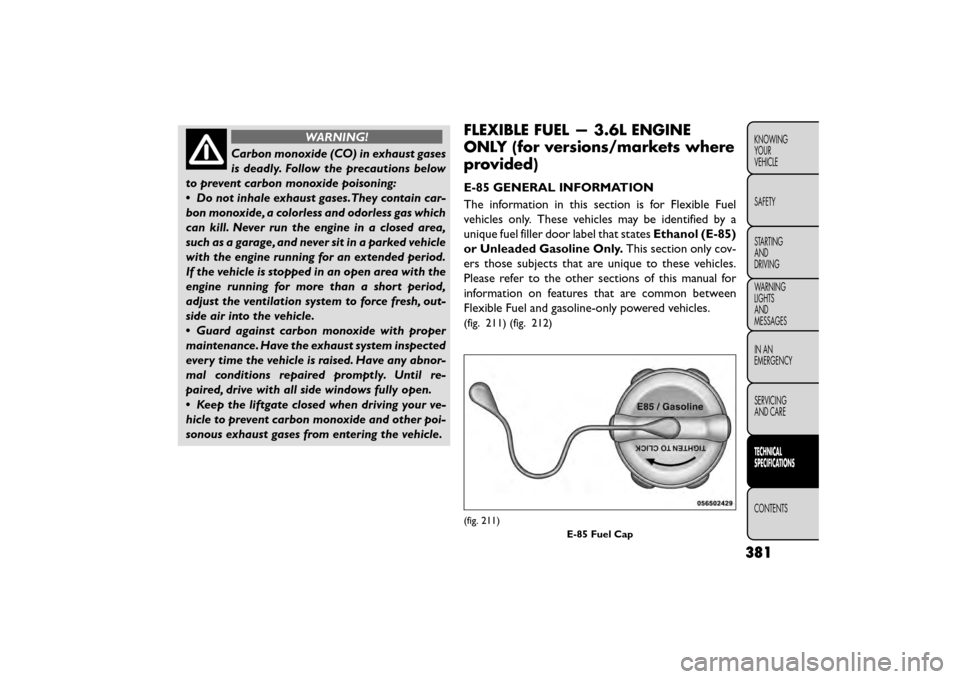
(fig. 211) (fig. 212)
(fig. 211)
E-85 Fuel Cap
381
KNOWING
YOUR
VEHICLE
SAFETY
STARTING
AND
DRIVING
WARNING
LIGHTS
AND
MESSAGES
IN AN
EMERGENCY
SERVICING
AND CARE
TECHNICAL
SPECIFICATIONS
CONTENTS