change battery FIAT FREEMONT 2016 1.G Owners Manual
[x] Cancel search | Manufacturer: FIAT, Model Year: 2016, Model line: FREEMONT, Model: FIAT FREEMONT 2016 1.GPages: 412, PDF Size: 3.36 MB
Page 15 of 412
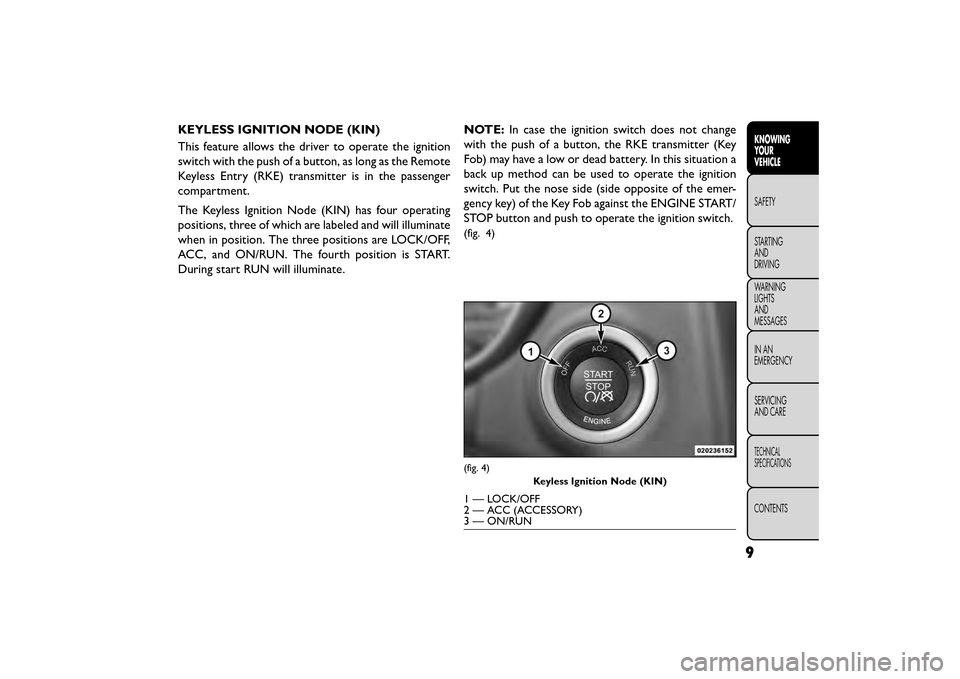
KEYLESS IGNITION NODE (KIN)
This feature allows the driver to operate the ignition
switch with the push of a button, as long as the Remote
Keyless Entry (RKE) transmitter is in the passenger
compartment.
The Keyless Ignition Node (KIN) has four operating
positions, three of which are labeled and will illuminate
when in position. The three positions are LOCK/OFF,
ACC, and ON/RUN. The fourth position is START.
During start RUN will illuminate.NOTE:
In case the ignition switch does not change
with the push of a button, the RKE transmitter (Key
Fob) may have a low or dead battery. In this situation a
back up method can be used to operate the ignition
switch. Put the nose side (side opposite of the emer-
gency key) of the Key Fob against the ENGINE START/
STOP button and push to operate the ignition switch.
(fig. 4)
(fig. 4)
Keyless Ignition Node (KIN)
1 — LOCK/OFF
2 — ACC (ACCESSORY)
3 — ON/RUN
9
KNOWING
YOUR
VEHICLE
SAFETY
STAR
TING
AND
DRIVING
WARNING
LIGHTS
AND
MESSAGES
IN AN
EMERGENCY
SERVICING
AND CARE
TECHNICAL
SPECIFICATIONS
CONTENTS
Page 20 of 412
Turn Headlights On With Remote Key Unlock
This feature activates the headlights for up to 90
seconds when the doors are unlocked with the RKE
transmitter. The time for this feature is programmable
on vehicles equipped through Uconnect®. To change
the current setting, refer to “Uconnect® Settings” in
“Knowing Your Vehicle” for further information.
To Lock The Doors And Liftgate
Press and release the LOCK button on the RKE trans-
mitter to lock all doors and liftgate. The turn signal
lights will flash to acknowledge the signal.
If the vehicle is equipped with Passive Entry, refer to
“Keyless Enter-N-Go™” under “Knowing Your Ve-
hicle” for further information.
Programming Additional Transmitters
Programming Key Fobs or RKE transmitters may be
performed at an authorized dealer.
Transmitter Battery Replacement
The recommended replacement battery is one
CR2032 battery.NOTE:
• Perchlorate Material — special handling may apply.
Batteries could contain dangerous materials. Please
dispose of them according to respect for environ-
ment and local laws.
• Used batteries are harmful to the environment. You can dispose of them either in the correct containers
as specified by law or by taking them to a Dealership,
which will deal with their disposal.
• Do not touch the battery terminals that are on the back housing or the printed circuit board.
1. Remove the emergency key by sliding the mechani- cal latch on the back of the RKE transmitter side-
ways with your thumb and then pull the key out with
your other hand.
14
KNOWING YOUR
VEHICLE
SAFETY
STAR
TINGAND
DRIVING
WARNING LIGHTSAND
MESSAGES
IN AN
EMERGENCY
SERVICINGAND CARE
TECHNICAL
SPECIFICATIONS
CONTENTS
Page 29 of 412
Left Front Turn Signal Light Out (with a single chime)
Left Rear Turn Signal Light Out (with a single chime)
Right Front Turn Signal Light Out (with a single chime)
Right Rear Turn Signal Light Out (with a single chime)
RKE Battery Low (with a single chime)
Personal Settings Not Available – Vehicle Not in PARK
(for versions/markets, where provided)
Left/Right Front Door Ajar (one or more doors open,
with a single chime if speed is above 1.6 km/h)
Left/Right Rear Door Ajar (one or more doors open,
with a single chime if speed is above 1.6 km/h)
Door(s) Ajar (with a single chime if vehicle is in motion)
Liftgate Ajar (with a single chime)
Low Washer Fluid (with a single chime)
Ignition or Accessory On
Vehicle Not in Park (for versions/markets, where pro-
vided)
Key Left Vehicle
Key Not Detected
Low Tire Pressure (with a single chime). Refer to
information on “Tire Pressure” and “Tire Pressure
Monitor” in “Knowing Your Vehicle”.Inflate Tire to XXX. Refer to information on "Tire
Pressure" and "Tire Pressure Monitor" in "Knowing
Your Vehicle."
Service TPM System (with a single chime). Refer to
information on “Tire Pressure Monitor” in “Knowing
Your Vehicle”.
Oil Change Required (with a single chime)
Check Gascap (refer to “Adding Fuel” in “Knowing
Your Vehicle”)
Oil Change Due (with a single chime)
Exhaust System — Regeneration Required Now. Un-
der conditions of exclusive short duration and low
speed driving and low speed driving cycles, the engine
and exhaust after-treatment system may never reach
the conditions required to remove the trapped PM. If
this occurs the “Exhaust System Regeneration Re-
quired Now” message will be displayed on the EVIC. By
driving your vehicle at highway speeds for as little as 30
minutes, you can remedy the condition in the particu-
late filter system by allowing the trapped PM to be
removed to restore the system to normal operating
condition.
23
KNOWING
YOUR
VEHICLE
SAFETY
STAR
TING
AND
DRIVING
WARNING
LIGHTS
AND
MESSAGES
IN AN
EMERGENCY
SERVICING
AND CARE
TECHNICAL
SPECIFICATIONS
CONTENTS
Page 218 of 412
Do not drive your vehicle after the air bags have
deployed. If you are involved in another collision, the
air bags will not be in place to protect you.
WARNING!
Deployed air bags and seat belt preten-
sion er
s cannot protect you in another
collision. Have the air bags, seat belt pretension-
ers, and the seat belt retractor assemblies re-
placed by an authorized dealer immediately.
Also, have the Occupant Restraint Controller Sys-
tem serviced as well.
NOTE:
• Air bag covers may not be obvious in the interior trim, but they will open during air bag deployment.
• After any collision, the vehicle should be taken to an authorized dealer immediately. ENHANCED ACCIDENT RESPONSE
SYSTEM
In the event of an impact, if the communication net-
work remains intact, and the power remains intact,
depending on the nature of the event, the ORC will
determine whether to have the Enhanced Accident
Response System perform the following functions:
• Cut off fuel to the engine.
• Flash hazard lights as long as the battery has power
or until the ignition switch is turned to the “OFF”
position.
• Turn on the interior lights, which remain on as long as the battery has power or until the ignition switch
is turned to the “OFF” position.
• Unlock the doors automatically.
SYSTEM RESET PROCEDURE
In order to reset the Enhanced Accident Response
System functions after an event, the ignition switch
must be changed from ignition START or ON/RUN to
ignition OFF.
212
KNOWING YOUR
VEHICLE
SAFETY
STARTING AND
DRIVING
WARNING LIGHTSAND
MESSAGES
IN
AN
EMERGENCY
SERVICINGAND CARE
TECHNICAL
SPECIFICATIONS
CONTENTS
Page 245 of 412
NOTE:If the ignition switch is left in the ACC or RUN
(engine not running) position and the transmission is in
PARK, the system will automatically time out after 30
minutes of inactivity and the ignition will switch to the
OFF position.
ENGINE START/STOP Button Functions –
With Driver’s Foot OFF The Brake Pedal (In
PARK Or NEUTRAL Position)
The ENGINE START/STOP button operates similar to
an ignition switch. It has four positions, OFF, ACC,
RUN and START. To change the ignition switch posi-
tions without starting the vehicle and use the accesso-
ries follow these steps.
• Starting with the ignition switch in the OFF position:
• Press the ENGINE START/STOP button once to change the ignition switch to the ACC position,
• Press the ENGINE START/STOP button a second time to change the ignition switch to the RUN
position,
• Press the ENGINE START/STOP button a third time to return the ignition switch to the OFF position. EXTREME COLD WEATHER
(BELOW −29°C)
To ensure reliable starting at these temperatures, use
of an externally powered electric engine block heater is
recommended.
IF ENGINE FAILS TO START
WARNING!
• Never pour fuel or other flammable
li qui
ds into the throttle body air inlet
opening in an attempt to start the vehicle. This
could result in a flash fire causing serious per-
sonal injury.
• Do not attempt to push or tow your vehicle to
get it started. Unburned fuel could enter the
catalytic converter and once the engine has
started, ignite and damage the converter and
vehicle. If the vehicle has a discharged battery,
booster cables may be used to obtain a start from
a booster battery or the battery in another ve-
hicle.This type of start can be dangerous if done
improperly. Refer to “Jump Starting” in “In An
Emergency” for further information.
239
KNOWING
YOUR
VEHICLE
SAFETY
STARTING
AND
DRIVING
WARNING
LIGHTS
AND
MESSAGES
IN AN
EMERGENC
Y
SERVICING
AND CARE
TECHNICAL
SPECIFICATIONS
CONTENTS
Page 331 of 412
Every3,000 km, check and top up, if required, the
engine oil level and automatic transmission fluid level
(four-speed automatic only).
Heavy-Duty Use Of The Car
If the car is used mainly under one of the following
conditions:
• towing a trailer or caravan;
• dusty roads;
• short, repeated journeys (less than 7-8 km) at sub- zero outside temperatures;
• engine often idling or driving long distances at low speeds or long periods of idleness.
You should perform the following inspections more
frequently than shown on the Scheduled Servicing Plan:
• check front disc brake pad conditions and wear;
• check cleanliness of hood and trunk locks, cleanli- ness and lubrication of linkage;
• visually inspect conditions of: engine, transmission, pipes and hoses (exhaust - fuel system - brakes) and
rubber elements (boots - sleeves - bushes - etc.);
• check battery charge and battery fluid level (electro- lyte); • visually inspect condition of the accessory drive
belts;
• check and, if necessary, change engine oil and replace oil filter;
• check and, if necessary, replace pollen filter;
• check and, if necessary, replace air cleaner.
MAINTENANCE SCHEDULE — DIESEL
ENGINE
To help you have the best driving experience possible,
the manufacturer has identified the specific vehicle
maintenance service intervals that are required to keep
your vehicle operating properly and safely.
The manufacturer recommends that these mainte-
nance intervals be performed at your selling dealer. The
technicians at your dealership know your vehicle best,
and have access to factory trained information, genuine
FIAT parts, and specially designed electronic and me-
chanical tools that can help prevent future costly re-
pairs.
The maintenance intervals shown should be performed
as indicated in this section.
325
KNOWING
YOUR
VEHICLE
SAFETY
STARTING
AND
DRIVING
WARNING
LIGHTS
AND
MESSAGES
IN AN
EMERGENCY
SERVICING
AND C ARE
TECHNICAL
SPECIFICATIONS
CONTENTS
Page 337 of 412
Failure to perform the required mainte-
nance items may result in damage to the
vehicle.
Periodic Checks
Every 1,000 km or before long journeys, check and, if
necessary, restore:
• engine coolant;
• brake fluid;
• power steering fluid;
• windshield washer fluid level;
• tire inflation pressure and condition;
• operation of lighting system (headlights, direction indicators, hazard warning lights, etc.);
• operation of windshield washer/wiper system and positioning/wear of windshield/rear window wiper
blades.
Every 3,000 km, check and top up, if required, the
engine oil level.
Heavy-Duty Use Of The Car
If the car is used mainly under one of the following
conditions:
• towing a trailer or caravan; • dusty roads;
• short, repeated journeys (less than 7-8 km) at sub-
zero outside temperatures;
• engine often idling or driving long distances at low speeds or long periods of idleness.
You should perform the following inspections more
frequently than shown on the Scheduled Servicing Plan:
• check front disc brake pad conditions and wear;
• check cleanliness of hood and trunk locks, cleanli- ness and lubrication of linkage;
• visually inspect conditions of: engine, transmission, pipes and hoses (exhaust - fuel system - brakes) and
rubber elements (boots - sleeves - bushes - etc.);
• check battery charge and battery fluid level (electro- lyte);
• visually inspect condition of the accessory drive belts;
• check and, if necessary, change engine oil and replace oil filter;
• check and, if necessary, replace pollen filter;
• check and, if necessary, replace air cleaner.
331
KNOWING
YOUR
VEHICLE
SAFETY
STARTING
AND
DRIVING
WARNING
LIGHTS
AND
MESSAGES
IN AN
EMERGENCY
SERVICING
AND C ARE
TECHNICAL
SPECIFICATIONS
CONTENTS
Page 397 of 412
CONTENTS
About Your Brakes..................... .140, 242
ABS (Anti-Lock Brake System) . . . . . .........141, 278
Adding Engine Coolant (Antifreeze) . . ............347
Adding Fuel ............................. .190
Adding Washer Fluid . . . .................... .343
Additives, Fuel . .......................... .380
Airbag................................ .205
Air Bag Advance Front Air Bag . ................205, 206
Air Bag Components . ................... .205
Air bag Operation ...................... .207
Air Bag Warning Light . ................... .213
Enhanced Accident Response . . . . ............212
Event Data Recorder (EDR) . . . . . ............215
FrontAirBag ......................... .205
If A Deployment Occurs . . . . . . .............211
Knee Impact Bolsters . . . . . . . . .............207
Maintaining Your Air Bag System .............214
Side Air Bags . . . . . . . . .................. .208
Air bag Light ..................... .213, 235, 273
Air bag Maintenance ....................... .214
Air Cleaner, Engine (Engine Air Cleaner Filter) ......338
Air Conditioner Maintenance . . . . . . . ...........339
Air Conditioning Filter . . . .................90, 340
Air Conditioning, Operating Tips . . . . ..........89, 91
Air Conditioning, Rear Zone . . . . . . . . .........76, 86
Air Conditioning Refrigerant . . . ............339, 340
Air Conditioning System . ................... .339
Air Pressure, Tires ..................... .275, 370
Alarm (Security Alarm) ................... .16, 278
Alarm System (Security Alarm) ...............16, 18All Wheel Drive (AWD)
.................... .255
Alterations/Modifications, Vehicle .................5
Antifreeze (Engine Coolant) ............346, 347, 384
Disposal ............................ .348
Anti-Lock Brake System (ABS) .................141
Anti-Lock War
ning Light ..............141, 143, 278
Arming System (Security Alarm) .................16
Auto Down Power Windows ..................128
Automatic Dimming Mirror ....................66
Automatic Door Locks ..................... .121
Automatic Headlights ........................92
Automatic Oil Change Indicator .................28
Automatic Transmission ................. .246, 351
Adding Fluid .......................... .352
Autostick ............................ .254
Fluid and Filter Changes .................. .354
Fluid Level Check ...................... .352
Gear Ranges .......................... .249
Autostick .............................. .254
Auto Unlock, Doors ....................... .121
Auxiliary Electrical Outlet (Power Outlet) .........112
Auxiliary Power Outlet ..................... .112
Back-Up Lights ........................... .305
Battery ................................ .338
Gas Caution .......................... .339
Keyless Transmitter Replacement (RKE) .........14
Location ............................ .338
Belts, Seat .............................. .234
Body Mechanism Lubrication ..................341
B-Pillar Location .......................... .366
391
KNOWING
YOUR
VEHICLE
SAFETY
STARTING
AND
DRIVING
WARNING
LIGHTS
AND
MESSAGES
IN AN
EMERGENCY
SERVICING
AND CARE
TECHNICAL
SPECIFICATIONS
CONTENTS
Page 403 of 412
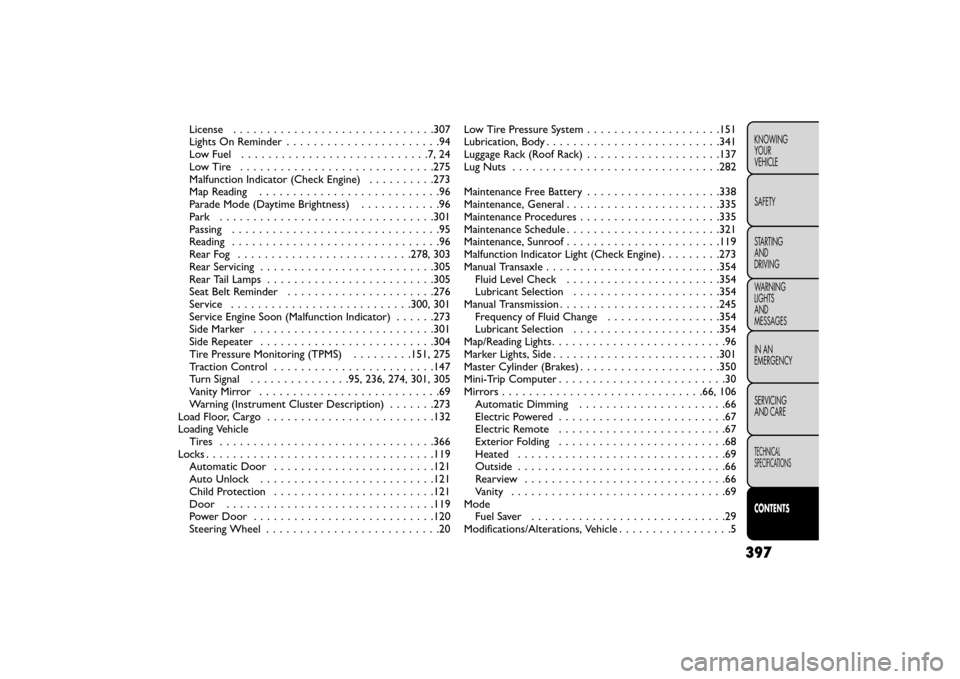
License . . . . . . . . . . . . ..................307
Lights On Reminder . . . . . . . . . . . ............94
Low Fuel ............................7,24
LowTire .............................275
Malfunction Indicator (Check Engine) ..........273
Map Reading . . . . . . . . . . . . ...............96
Parade Mode (Daytime Brightness) ............96
Park ............................... .301
Passing ...............................95
Reading ...............................96
RearFog ..........................278, 303
Rear Servicing . ........................ .305
Rear Tail Lamps ........................ .305
Seat Belt Reminder ..................... .276
Service .......................... .300, 301
Service Engine Soon (Malfunction Indicator) ......273
Side Marker .......................... .301
Side Repeater . . . ...................... .304
Tire Pressure Monitoring (TPMS) .........151, 275
Traction Control . . . .................... .147
Turn Signal ...............95, 236, 274, 301, 305
Vanity Mirror ...........................69
Warning (Instrument Cluster Description) .......273
Load Floor, Cargo ........................ .132
Loading Vehicle Tires ................................366
Locks . ................................ .119
Automatic Door . . . . . . . .................121
Auto Unlock ......................... .121
Child Protection . . . . . . ..................121
Door .............................. .119
Power Door . . . . . . . . . ..................120
Steering Wheel ..........................20 Low Tire Pressure System
................... .151
Lubrication, Body ......................... .341
LuggageRack(RoofRack)................... .137
Lug Nuts .............................. .282
Maintenance Free Battery ................... .338
Maintenance, General ...................... .335
Maintenance Pr
ocedures .................... .335
Maintenance Schedule . . . ................... .321
Maintenance, Sunroof ...................... .119
Malfunction Indicator Light (Check Engine) .........273
Manual Transaxle ......................... .354
Fluid Level Check ...................... .354
Lubricant Selection ..................... .354
Manual Transmission ....................... .245
Frequency of Fluid Change .................354
Lubricant Selection ..................... .354
Map/Reading Lights ..........................96
Marker Lights, Side ........................ .301
Master Cylinder (Brakes) .................... .350
Mini-Trip Computer .........................30
Mirrors............................. .66, 106
Automatic Dimming ......................66
Electric Powered .........................67
Electric Remote .........................67
Exterior Folding .........................68
Heated ...............................69
Outside ...............................66
Rearview ..............................66
Vanity ................................69
Mode Fuel Saver .............................29
Modifications/Alterations, Vehicle .................5
397
KNOWING
YOUR
VEHICLE
SAFETY
STARTING
AND
DRIVING
WARNING
LIGHTS
AND
MESSAGES
IN AN
EMERGENCY
SERVICING
AND CARE
TECHNICAL
SPECIFICATIONS
CONTENTS