BED FIAT FULLBACK 2016 1.G User Guide
[x] Cancel search | Manufacturer: FIAT, Model Year: 2016, Model line: FULLBACK, Model: FIAT FULLBACK 2016 1.GPages: 312, PDF Size: 13.67 MB
Page 176 of 312
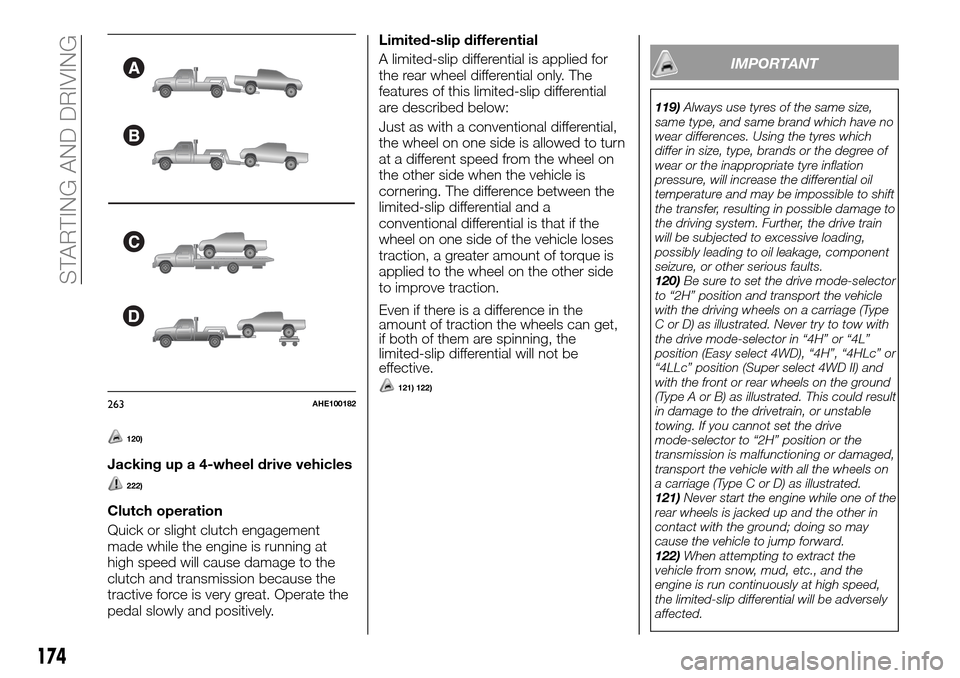
120)
Jacking up a 4-wheel drive vehicles
222)
Clutch operation
Quick or slight clutch engagement
made while the engine is running at
high speed will cause damage to the
clutch and transmission because the
tractive force is very great. Operate the
pedal slowly and positively.Limited-slip differential
A limited-slip differential is applied for
the rear wheel differential only. The
features of this limited-slip differential
are described below:
Just as with a conventional differential,
the wheel on one side is allowed to turn
at a different speed from the wheel on
the other side when the vehicle is
cornering. The difference between the
limited-slip differential and a
conventional differential is that if the
wheel on one side of the vehicle loses
traction, a greater amount of torque is
applied to the wheel on the other side
to improve traction.
Even if there is a difference in the
amount of traction the wheels can get,
if both of them are spinning, the
limited-slip differential will not be
effective.
121) 122)
IMPORTANT
119)Always use tyres of the same size,
same type, and same brand which have no
wear differences. Using the tyres which
differ in size, type, brands or the degree of
wear or the inappropriate tyre inflation
pressure, will increase the differential oil
temperature and may be impossible to shift
the transfer, resulting in possible damage to
the driving system. Further, the drive train
will be subjected to excessive loading,
possibly leading to oil leakage, component
seizure, or other serious faults.
120)Be sure to set the drive mode-selector
to “2H” position and transport the vehicle
with the driving wheels on a carriage (Type
C or D) as illustrated. Never try to tow with
the drive mode-selector in “4H” or “4L”
position (Easy select 4WD), “4H”, “4HLc” or
“4LLc” position (Super select 4WD II) and
with the front or rear wheels on the ground
(Type A or B) as illustrated. This could result
in damage to the drivetrain, or unstable
towing. If you cannot set the drive
mode-selector to “2H” position or the
transmission is malfunctioning or damaged,
transport the vehicle with all the wheels on
a carriage (Type C or D) as illustrated.
121)Never start the engine while one of the
rear wheels is jacked up and the other in
contact with the ground; doing so may
cause the vehicle to jump forward.
122)When attempting to extract the
vehicle from snow, mud, etc., and the
engine is run continuously at high speed,
the limited-slip differential will be adversely
affected.
B
C
D
A
263AHE100182
174
STARTING AND DRIVING
Page 181 of 312
The set speed driving is deactivated
automatically in any of the following
ways.
When you depress the clutch pedal
(on vehicles with M/T).
When your speed slows to about
15 km/h or more below the set speed
because of a hill, etc.
When your speed slows to about
40 km/h or less.
When the active stability & traction
control (ASTC) starts operating. Refer to
“Active stability & traction control
(ASTC)”.
227)
Also, the set speed driving may be
deactivated as follow:
When the engine speed rises and
approaches the tachometer’s red zone
(the red-coloured part of the
tachometer dial).
127)
To resume the set speed
If the set speed driving is deactivated
by the condition described in “To
deactivate”, you can resume the
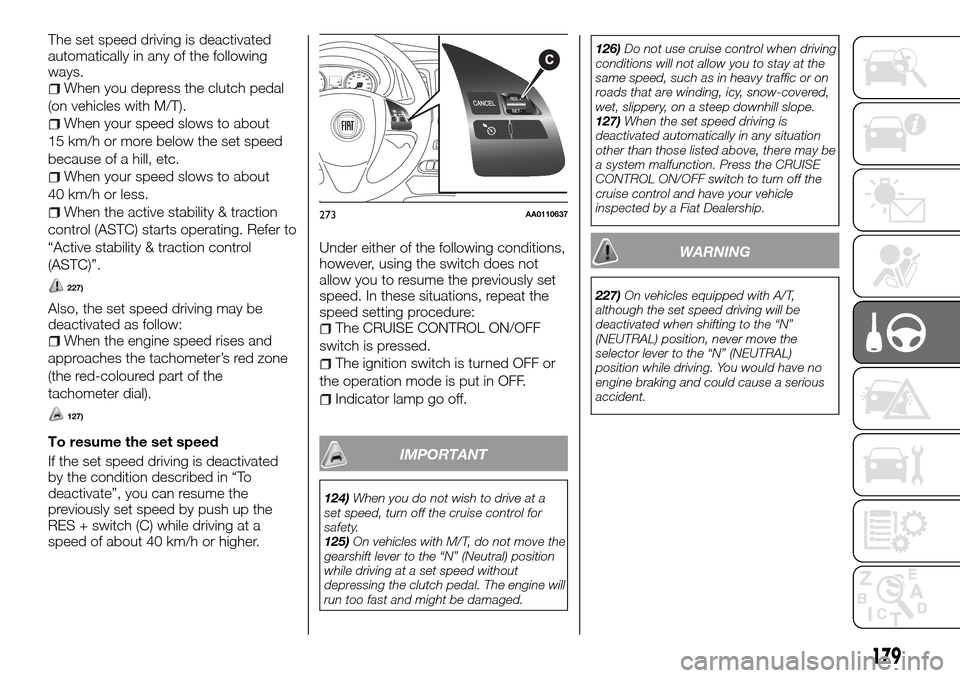
previously set speed by push up the
RES + switch (C) while driving at a
speed of about 40 km/h or higher.Under either of the following conditions,
however, using the switch does not
allow you to resume the previously set
speed. In these situations, repeat the
speed setting procedure:
The CRUISE CONTROL ON/OFF
switch is pressed.
The ignition switch is turned OFF or
the operation mode is put in OFF.
Indicator lamp go off.
IMPORTANT
124)When you do not wish to drive at a
set speed, turn off the cruise control for
safety.
125)On vehicles with M/T, do not move the
gearshift lever to the “N” (Neutral) position
while driving at a set speed without
depressing the clutch pedal. The engine will
run too fast and might be damaged.126)Do not use cruise control when driving
conditions will not allow you to stay at the
same speed, such as in heavy traffic or on
roads that are winding, icy, snow-covered,
wet, slippery, on a steep downhill slope.
127)When the set speed driving is
deactivated automatically in any situation
other than those listed above, there may be
a system malfunction. Press the CRUISE
CONTROL ON/OFF switch to turn off the
cruise control and have your vehicle
inspected by a Fiat Dealership.
WARNING
227)On vehicles equipped with A/T,
although the set speed driving will be
deactivated when shifting to the “N”
(NEUTRAL) position, never move the
selector lever to the “N” (NEUTRAL)
position while driving. You would have no
engine braking and could cause a serious
accident.
273AA0110637
179
Page 190 of 312
IMPORTANT
131)Do not add coolant while the engine is
hot. Suddenly adding cold coolant could
damage the engine. Wait for the engine to
cool down, then add coolant a little at a
time.
BLEEDING THE FUEL
SYSTEM
The fuel system should be bled to
remove air as described below if the
fuel supply is exhausted during travel.
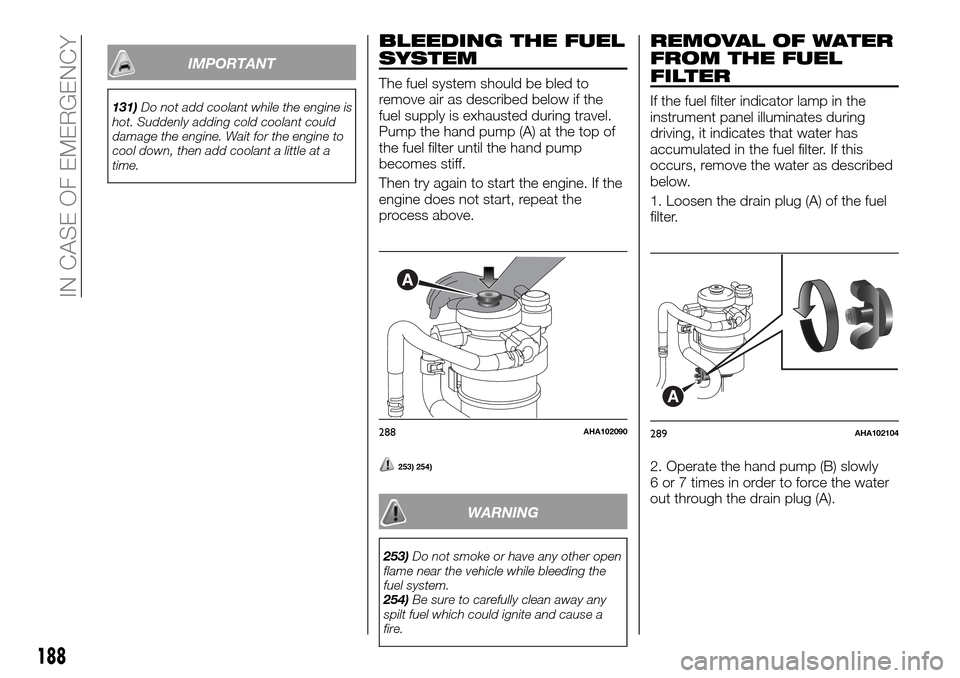
Pump the hand pump (A) at the top of
the fuel filter until the hand pump
becomes stiff.
Then try again to start the engine. If the
engine does not start, repeat the
process above.
253) 254)
WARNING
253)Do not smoke or have any other open
flame near the vehicle while bleeding the
fuel system.
254)Be sure to carefully clean away any
spilt fuel which could ignite and cause a
fire.
REMOVAL OF WATER
FROM THE FUEL
FILTER
If the fuel filter indicator lamp in the
instrument panel illuminates during
driving, it indicates that water has
accumulated in the fuel filter. If this
occurs, remove the water as described
below.
1. Loosen the drain plug (A) of the fuel
filter.
2. Operate the hand pump (B) slowly
6 or 7 times in order to force the water
out through the drain plug (A).
A
288AHA102090
A
289AHA102104
188
IN CASE OF EMERGENCY
Page 196 of 312
HOW TO CHANGE A
TYRE
132) 133)
Before changing a tyre, first stop your
vehicle in a safe, flat location.
1. Park the vehicle on level and stable
ground, free of loose pebbles, etc.
2. Set the parking brake firmly.
3. On vehicles with manual
transmission, turn the ignition switch to
the “LOCK” position or put the
operation mode in OFF, and move the
gearshift lever to the “R” (Reverse)
position. On vehicles with automatic
transmission, move the selector lever to
the “P” (PARK) position, and turn the
ignition switch to the “LOCK” position
or put the operation mode in OFF.
4. Turn on the hazard flashers and set
up a warning triangle, flashing signal
lamp, etc., at an adequate distance
from the vehicle, and have all your
passengers leave the vehicle.
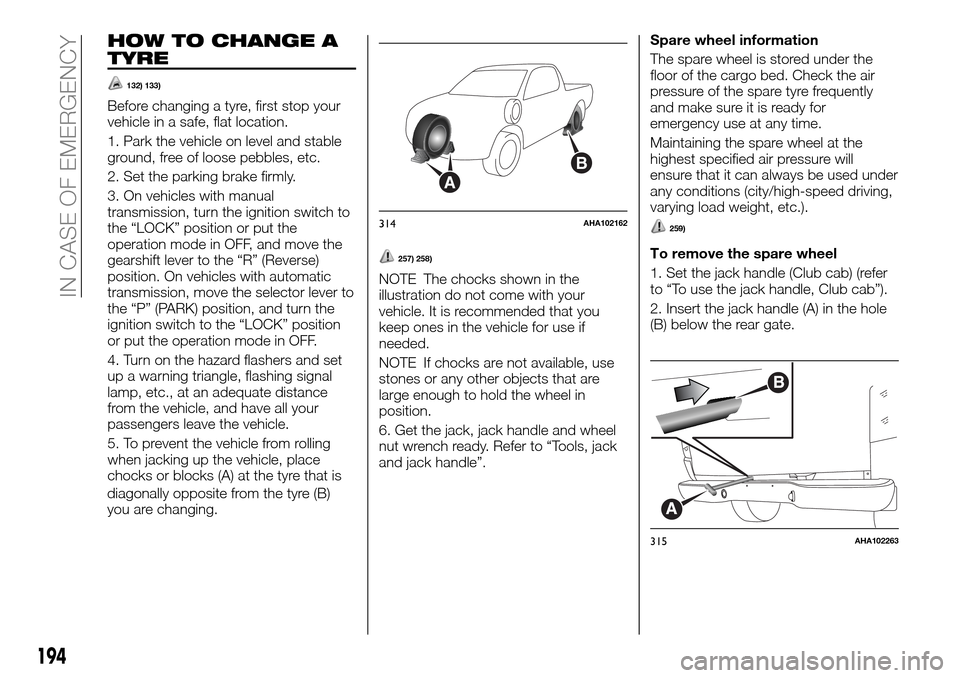
5. To prevent the vehicle from rolling
when jacking up the vehicle, place
chocks or blocks (A) at the tyre that is
diagonally opposite from the tyre (B)
you are changing.
257) 258)
NOTE The chocks shown in the
illustration do not come with your
vehicle. It is recommended that you
keep ones in the vehicle for use if
needed.
NOTE If chocks are not available, use
stones or any other objects that are
large enough to hold the wheel in
position.
6. Get the jack, jack handle and wheel
nut wrench ready. Refer to “Tools, jack
and jack handle”.Spare wheel information
The spare wheel is stored under the
floor of the cargo bed. Check the air
pressure of the spare tyre frequently
and make sure it is ready for
emergency use at any time.
Maintaining the spare wheel at the
highest specified air pressure will
ensure that it can always be used under
any conditions (city/high-speed driving,
varying load weight, etc.).
259)
To remove the spare wheel
1. Set the jack handle (Club cab) (refer
to “To use the jack handle, Club cab”).
2. Insert the jack handle (A) in the hole
(B) below the rear gate.
A
B
314AHA102162
A
B
315AHA102263
194
IN CASE OF EMERGENCY
Page 226 of 312
SERVICE
PRECAUTIONS
305) 306) 307) 308) 309) 310) 311)
Adequate care of your vehicle at regular
intervals serves to preserve the value
and appearance as long as possible.
Maintenance items as described in this
owner’s manual can be performed by
the owner.
We recommend you to have the
periodic inspection and maintenance
performed by a Fiat dealership or
another specialist.
In the event a malfunction or a problem
is discovered, we recommend you to
have it checked and repaired. This
section contains information on
inspection maintenance procedures
that you can do yourself. Follow the
instructions and cautions for each of
the various procedures.
WARNING
305)When checking or servicing the inside
of the engine compartment, make sure the
engine is switched off and has had a
chance to cool down.
306)If it is necessary to do work in the
engine compartment with the engine
running, be especially careful that your
clothing, hair, etc., does not become
caught by the cooling fan, drive belts, or
other moving parts.307)The cooling fan can turn on
automatically even if the engine is not
running. Turn the ignition switch to “LOCK”
position or put the operation mode in OFF
to be safe while you work in the engine
compartment.
308)Do not smoke, cause sparks or allow
open flames around fuel or battery. The
fumes are flammable.
309)Be extremely cautious when working
around the battery. It contains poisonous
and corrosive sulphuric acid.
310)Do not get under your vehicle with
just the body jack supporting it. Always use
automotive jack stands.
311)Improper handling of components
and materials used in the vehicle can
endanger your personal safety. We
recommend you to consult a specialist for
necessary information.
224
SERVICING AND MAINTENANCE
Page 274 of 312
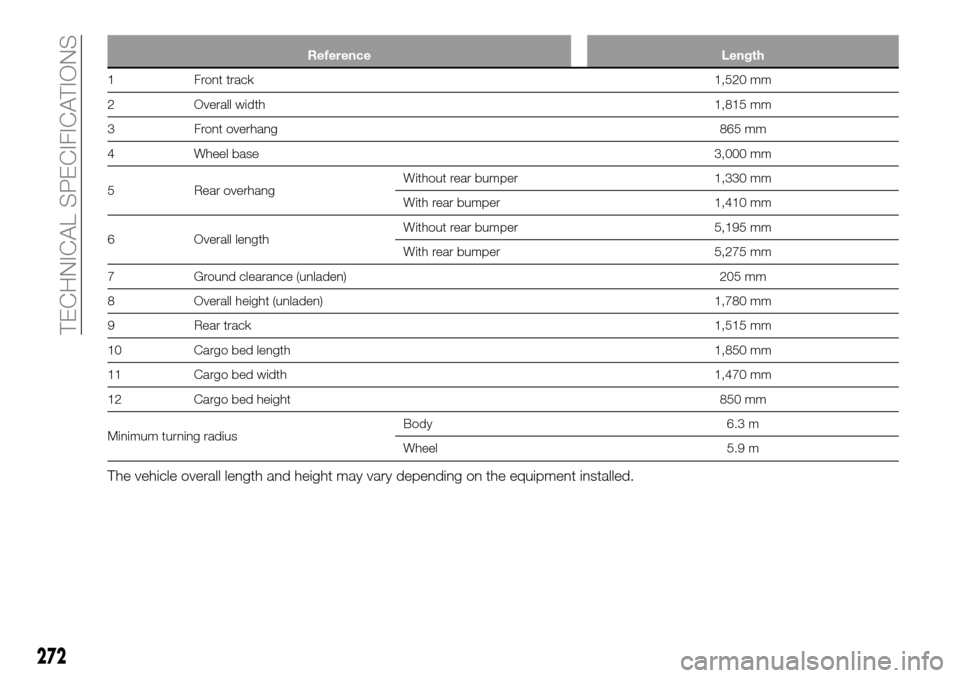
Reference Length
1 Front track1,520 mm
2 Overall width1,815 mm
3 Front overhang865 mm
4 Wheel base3,000 mm
5 Rear overhangWithout rear bumper 1,330 mm
With rear bumper 1,410 mm
6 Overall lengthWithout rear bumper 5,195 mm
With rear bumper 5,275 mm
7 Ground clearance (unladen) 205 mm
8 Overall height (unladen) 1,780 mm
9 Rear track1,515 mm
10 Cargo bed length1,850 mm
11 Cargo bed width1,470 mm
12 Cargo bed height850 mm
Minimum turning radiusBody 6.3 m
Wheel 5.9 m
The vehicle overall length and height may vary depending on the equipment installed.
272
TECHNICAL SPECIFICATIONS
Page 276 of 312
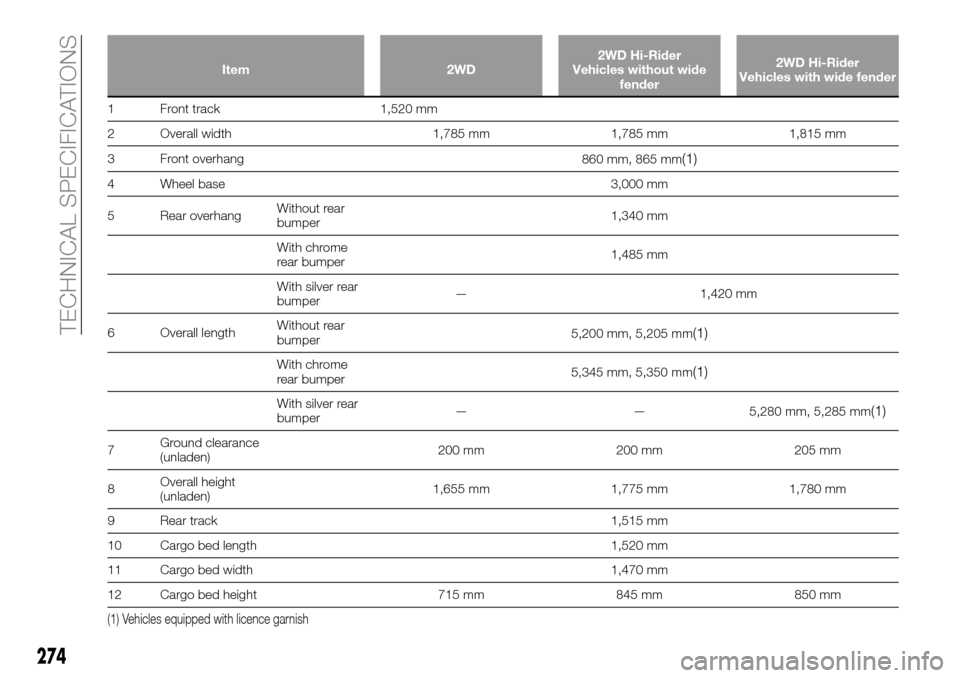
Item 2WD2WD Hi-Rider
Vehicles without wide
fender2WD Hi-Rider
Vehicles with wide fender
1 Front track 1,520 mm
2 Overall width 1,785 mm 1,785 mm 1,815 mm
3 Front overhang
860 mm, 865 mm
(1)
4 Wheel base 3,000 mm
5 Rear overhangWithout rear
bumper1,340 mm
With chrome
rear bumper1,485 mm
With silver rear
bumper— 1,420 mm
6 Overall lengthWithout rear
bumper5,200 mm, 5,205 mm
(1)
With chrome
rear bumper5,345 mm, 5,350 mm(1)
With silver rear
bumper——
5,280 mm, 5,285 mm(1)
7Ground clearance
(unladen)200 mm 200 mm 205 mm
8Overall height
(unladen)1,655 mm 1,775 mm 1,780 mm
9 Rear track 1,515 mm
10 Cargo bed length 1,520 mm
11 Cargo bed width 1,470 mm
12 Cargo bed height 715 mm 845 mm 850 mm
(1) Vehicles equipped with licence garnish
274
TECHNICAL SPECIFICATIONS
Page 278 of 312
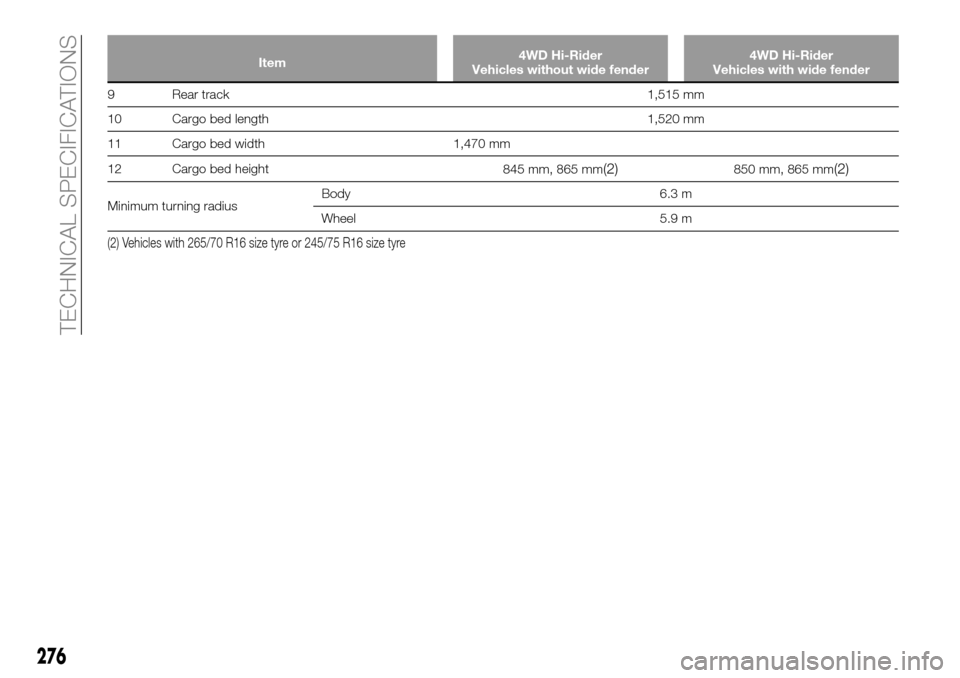
Item4WD Hi-Rider
Vehicles without wide fender4WD Hi-Rider
Vehicles with wide fender
9 Rear track1,515 mm
10 Cargo bed length 1,520 mm
11 Cargo bed width 1,470 mm
12 Cargo bed height
845 mm, 865 mm
(2)850 mm, 865 mm(2)
Minimum turning radiusBody 6.3 m
Wheel 5.9 m
(2) Vehicles with 265/70 R16 size tyre or 245/75 R16 size tyre
276
TECHNICAL SPECIFICATIONS
Page 280 of 312
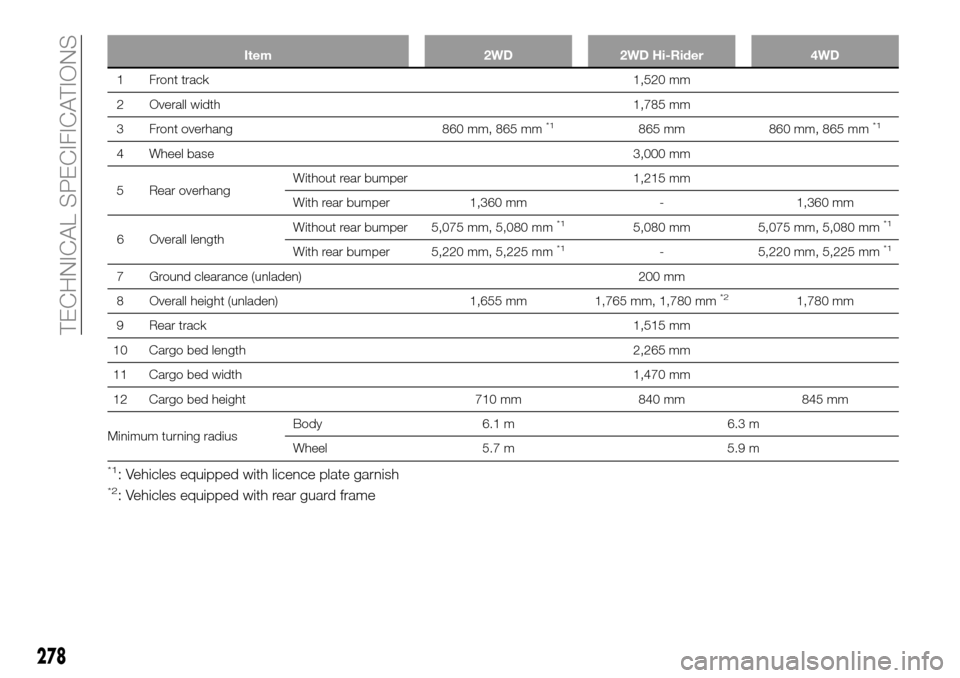
Item 2WD 2WD Hi-Rider 4WD
1 Front track1,520 mm
2 Overall width1,785 mm
3 Front overhang 860 mm, 865 mm
*1865 mm 860 mm, 865 mm*1
4 Wheel base3,000 mm
5 Rear overhangWithout rear bumper 1,215 mm
With rear bumper 1,360 mm - 1,360 mm
6 Overall lengthWithout rear bumper 5,075 mm, 5,080 mm
*15,080 mm 5,075 mm, 5,080 mm*1
With rear bumper 5,220 mm, 5,225 mm*1- 5,220 mm, 5,225 mm*1
7 Ground clearance (unladen) 200 mm
8 Overall height (unladen) 1,655 mm 1,765 mm, 1,780 mm
*21,780 mm
9 Rear track1,515 mm
10 Cargo bed length 2,265 mm
11 Cargo bed width 1,470 mm
12 Cargo bed height 710 mm 840 mm 845 mm
Minimum turning radiusBody 6.1 m 6.3 m
Wheel 5.7 m 5.9 m
*1: Vehicles equipped with licence plate garnish*2: Vehicles equipped with rear guard frame
278
TECHNICAL SPECIFICATIONS
Page 302 of 312
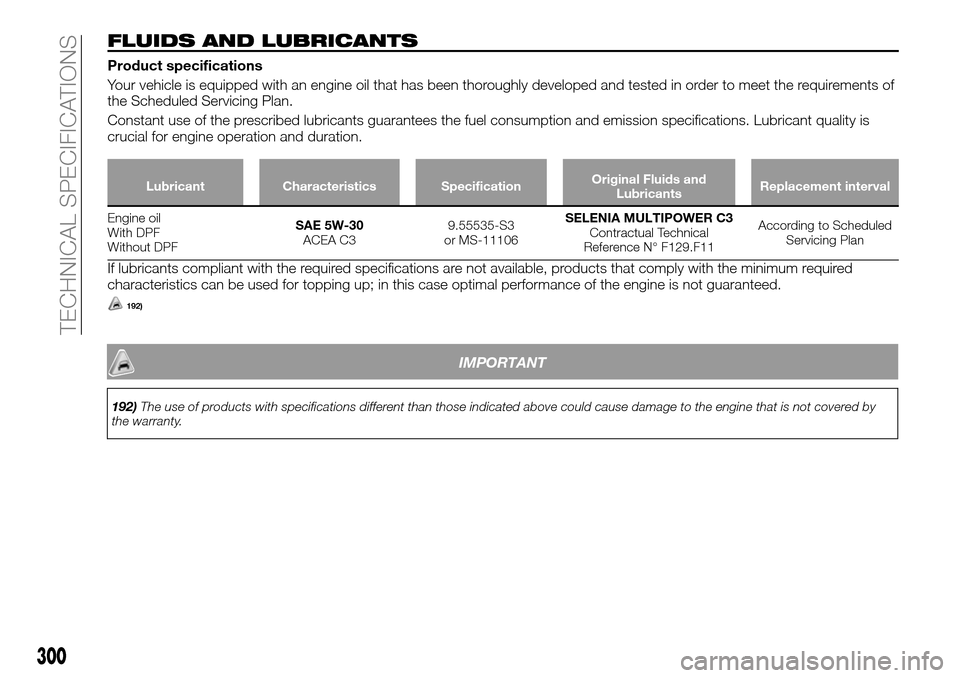
FLUIDS AND LUBRICANTS
Product specifications
Your vehicle is equipped with an engine oil that has been thoroughly developed and tested in order to meet the requirements of
the Scheduled Servicing Plan.
Constant use of the prescribed lubricants guarantees the fuel consumption and emission specifications. Lubricant quality is
crucial for engine operation and duration.
Lubricant Characteristics SpecificationOriginal Fluids and
LubricantsReplacement interval
Engine oil
With DPF
Without DPFSAE 5W-30
ACEA C39.55535-S3
or MS-11106SELENIA MULTIPOWER C3
Contractual Technical
Reference N° F129.F11According to Scheduled
Servicing Plan
If lubricants compliant with the required specifications are not available, products that comply with the minimum required
characteristics can be used for topping up; in this case optimal performance of the engine is not guaranteed.
192)
300
TECHNICAL SPECIFICATIONS
IMPORTANT
192)The use of products with specifications different than those indicated above could cause damage to the engine that is not covered by
the warranty.