Brakes FIAT FULLBACK 2016 1.G User Guide
[x] Cancel search | Manufacturer: FIAT, Model Year: 2016, Model line: FULLBACK, Model: FIAT FULLBACK 2016 1.GPages: 312, PDF Size: 13.67 MB
Page 178 of 312
IMPORTANT
123)Avoid driving habits that cause heavy
braking and never “ride” the brakes by
resting your foot on the brake pedal while
driving. It causes brake overheating and
fade.
WARNING
223)Do not turn off the engine while your
vehicle is in motion. If you turn off the
engine while driving, the power assistance
for the braking system will stop working
and your brakes will not work effectively.
224)If the power assist is lost or if either
brake hydraulic system stops working
properly, have your vehicle checked
immediately.
225)Do not leave any objects near the
brake pedal or let a floor mat slide under it;
doing so could prevent the full pedal stroke
that would be necessary in an emergency.
Make sure that the pedal can be operated
freely at all times. Make sure the floor mat
is securely held in place.
226)Driving with worn brake pads will
make it harder to stop, and can cause an
accident.
CRUISE CONTROL
(where provided)
Cruise control is an automatic speed
control system that keeps a set speed.
It can be activated at about 40 km/h or
more.
124) 125) 126)
Cruise control may not be able to keep
your speed on uphills or downhills.
Your speed may decrease on a steep
uphill. You may use the accelerator
pedal if you want to stay at your set
speed.
Your speed may increase to more than
the set speed on a steep downhill. You
have to use the brake to control your
speed. As a result, the set speed
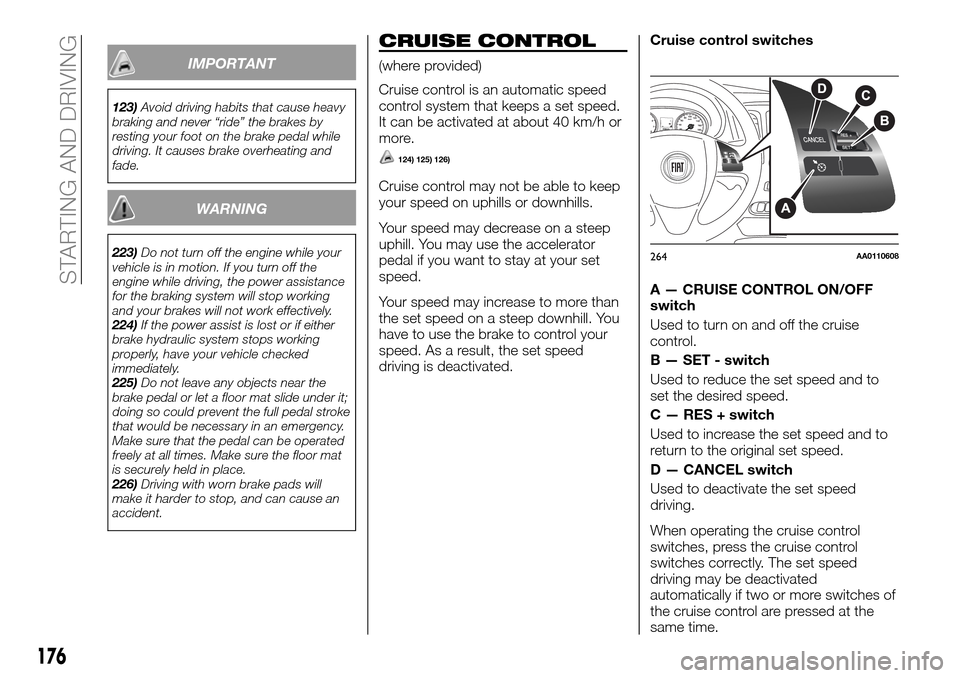
driving is deactivated.Cruise control switches
A — CRUISE CONTROL ON/OFF
switch
Used to turn on and off the cruise
control.
B — SET - switch
Used to reduce the set speed and to
set the desired speed.
C — RES + switch
Used to increase the set speed and to
return to the original set speed.
D — CANCEL switch
Used to deactivate the set speed
driving.
When operating the cruise control
switches, press the cruise control
switches correctly. The set speed
driving may be deactivated
automatically if two or more switches of
the cruise control are pressed at the
same time.
264AA0110608
176
STARTING AND DRIVING
Page 205 of 312
WARNING
281)If the vehicle is towed with the ignition
switch in the “ON” position or the operation
mode in ON and only the front wheels or
only the rear wheels raised off the ground,
the active traction control system may
operate, resulting in an accident.
282)If your vehicle equipped with the
Active Stability & Traction Control system
(ASTC), if the vehicle is towed with the
ignition switch in the “ON” position or the
operation mode in ON and only the front
wheels or only the rear wheels raised off
the ground, the active traction control
system may operate, resulting in an
accident.
283)Avoid sudden braking, acceleration
and steering wheel movements; such
driving operation could cause damage to
the towing hook or towing rope. People in
the vicinity could be injured as a result.284)When going down a long slope, the
brakes may overheat, reducing
effectiveness. Have your vehicle transport
by a tow truck.
285)The person in the vehicle being towed
must pay attention to the brake lamps of
the towing vehicle and make sure the rope
never becomes slack.
286)Do not use flexible cables for towing
and avoid jerking. During towing
operations, make sure that the fastened
joint does not damage adjoining
components.
287)When towing the vehicle comply with
the specific rules of the Highway Code
regarding the towing device and the
behaviour on the road.
288)Do not start the engine while towing
the vehicle.
289)Towing must be made exclusively on
roads/streets; the device must not be used
to recover the vehicle if it got off the road.
290)Towing must not be made for getting
past significant obstacles on the road (e.g.
heaps of snow or material on the road
surface).
291)Towing must take place with the two
vehicles (one towing, the other towed)
aligned as much as possible; towing by
roadside assistance vehicles, too, must
take place with the two vehicles aligned as
much as possible.
IMPORTANT
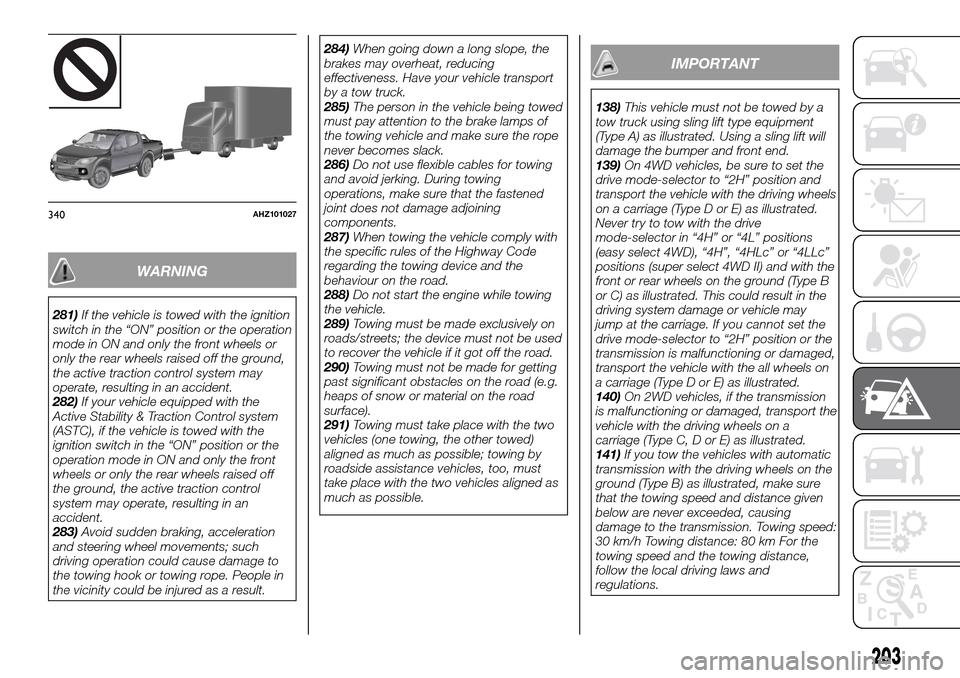
138)This vehicle must not be towed by a
tow truck using sling lift type equipment
(Type A) as illustrated. Using a sling lift will
damage the bumper and front end.
139)On 4WD vehicles, be sure to set the
drive mode-selector to “2H” position and
transport the vehicle with the driving wheels
on a carriage (Type D or E) as illustrated.
Never try to tow with the drive
mode-selector in “4H” or “4L” positions
(easy select 4WD), “4H”, “4HLc” or “4LLc”
positions (super select 4WD II) and with the
front or rear wheels on the ground (Type B
or C) as illustrated. This could result in the
driving system damage or vehicle may
jump at the carriage. If you cannot set the
drive mode-selector to “2H” position or the
transmission is malfunctioning or damaged,
transport the vehicle with the all wheels on
a carriage (Type D or E) as illustrated.
140)On 2WD vehicles, if the transmission
is malfunctioning or damaged, transport the
vehicle with the driving wheels on a
carriage (Type C, D or E) as illustrated.
141)If you tow the vehicles with automatic
transmission with the driving wheels on the
ground (Type B) as illustrated, make sure
that the towing speed and distance given
below are never exceeded, causing
damage to the transmission. Towing speed:
30 km/h Towing distance: 80 km For the
towing speed and the towing distance,
follow the local driving laws and
regulations.
340AHZ101027
203
Page 206 of 312
142)Never tow an automatic transmission
vehicle with the front wheels up (and the
rear wheels on the ground) (Type B) when
the automatic transmission fluid level is low.
This may cause serious and expensive
damage to the transmission.
143)When the engine is not running, the
brake booster and power steering pump do
not operate. This means higher brake
depression force and higher steering effort
are required. Therefore, vehicle operation is
very difficult.
144)Do not leave the ignition switch in the
“LOCK” position or the operation mode in
OFF. The steering wheel will lock, causing
loss of control.
145)On vehicles with super select 4WD II,
when you are going to tow another vehicle,
set the drive mode-selector to “4H”
position. Selecting “2H” drive may increase
the differential oil temperature, resulting in
possible damage to the driving system.
Further, the drive train will be subjected to
excessive loading possibly leading to oil
leakage, component seizure, or other
serious faults.OPERATION UNDER
ADVERSE DRIVING
CONDITIONS
On a flooded road
Avoid flooded roads. Water could enter
the brake discs, resulting in temporarily
ineffective brakes. In such cases, lightly
depress the brake pedal to see if the
brakes operate properly. If they do not,
lightly depress the pedal several times
while driving in order to dry the brake
pads.
When driving in rain or on a road with
many puddles a layer of water may
form between the tyres and the road
surface. This reduces a tyre’s frictional
resistance on the road, resulting in loss
of steering stability and braking
capability.
To cope with this, observe the following
items:
(a) Drive your vehicle at a slow speed.
(b) Do not drive on worn tyres.
(c) Always maintain the specified tyre
inflation pressures.On a snow-covered or frozen road
When driving on a snow-covered or
frozen road, it is recommended that you
use snow tyres or snow traction device
(tyre chains). Refer to the “Snow tyres”
and “Snow traction device (tyre chains)”
sections.
Avoid high-speed operation, sudden
acceleration, abrupt brake application
and sharp cornering.
Depressing the brake pedal during
travel on snowy or icy roads may cause
tyre slippage and skidding. When
traction between the tyres and the road
is reduced the wheels may skid and the
vehicle cannot readily be brought to a
stop by conventional braking
techniques. Braking will differ,
depending upon whether you have
anti-lock brake system (ABS). If you do
have ABS, brake by pressing the brake
pedal hard, and keeping it pressed. If
you do not have ABS, pump the brake
pedal with short rapid jabs, each time
fully applying and fully releasing for
greatest effect.
Allow extra distance between your
vehicle and the vehicle in front of you,
and avoid sudden braking.
Accumulation of ice on the braking
system can cause the wheels to lock.
Pull away from a standstill slowly after
confirming safety around the vehicle.
292)
204
IN CASE OF EMERGENCY
Page 242 of 312
PERIODIC CHECKS
Before long journeys, check and, if
necessary, restore:
engine coolant level;
brake fluid level;
windscreen washer fluid level;
operation of lighting system
(headlamps, direction indicators, hazard
warning lights, etc.);
tyre inflation pressure and condition;
tyre alignment;
operation of screen washer/wiper
system and positioning/wear of
windscreen/rear window wiper blades.
To ensure that the vehicle is always
efficient and well maintained, it is
advisable to make sure that you carry
out the above operations regularly
(approximately every 1000 km and
every 3000 km for checking and
topping up engine oil is advisable).
DEMANDING
VEHICLE USE
If the vehicle is mostly used in one of
the following conditions:
towing a trailer or caravan;
dusty roads;
short, repeated journeys (less than
7-8 km) at sub-zero outside
temperatures;
engine often idling or driving long
distances at low speeds or long periods
of inactivity;
the following checks must be carried
out more often than indicated in the
Scheduled Servicing Plan:
check front disc brake pad
conditions and wear;
check cleanliness of bonnet and
boot locks, cleanliness and lubrication
of linkage;
visually inspect conditions of: engine,
gearbox, transmission, pipes and hoses
(exhaust - fuel system - brakes) and
rubber elements (boots - sleeves -
bushes - etc.);
check battery charge and battery
fluid level (electrolyte);
visually inspect condition of the
accessory drive belts;
check and, if necessary, change
engine oil and replace oil filter;
check and, if necessary, replace
pollen filter.
240
SERVICING AND MAINTENANCE
Page 261 of 312
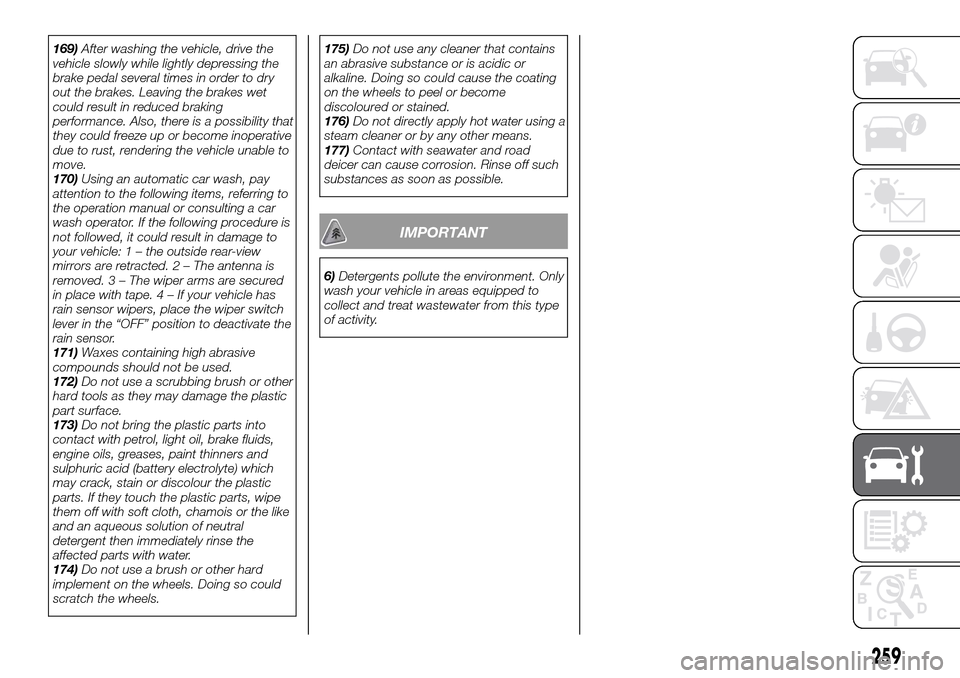
169)After washing the vehicle, drive the
vehicle slowly while lightly depressing the
brake pedal several times in order to dry
out the brakes. Leaving the brakes wet
could result in reduced braking
performance. Also, there is a possibility that
they could freeze up or become inoperative
due to rust, rendering the vehicle unable to
move.
170)Using an automatic car wash, pay
attention to the following items, referring to
the operation manual or consulting a car
wash operator. If the following procedure is
not followed, it could result in damage to
your vehicle: 1 – the outside rear-view
mirrors are retracted. 2 – The antenna is
removed. 3 – The wiper arms are secured
in place with tape.4–Ifyour vehicle has
rain sensor wipers, place the wiper switch
lever in the “OFF” position to deactivate the
rain sensor.
171)Waxes containing high abrasive
compounds should not be used.
172)Do not use a scrubbing brush or other
hard tools as they may damage the plastic
part surface.
173)Do not bring the plastic parts into
contact with petrol, light oil, brake fluids,
engine oils, greases, paint thinners and
sulphuric acid (battery electrolyte) which
may crack, stain or discolour the plastic
parts. If they touch the plastic parts, wipe
them off with soft cloth, chamois or the like
and an aqueous solution of neutral
detergent then immediately rinse the
affected parts with water.
174)Do not use a brush or other hard
implement on the wheels. Doing so could
scratch the wheels.175)Do not use any cleaner that contains
an abrasive substance or is acidic or
alkaline. Doing so could cause the coating
on the wheels to peel or become
discoloured or stained.
176)Do not directly apply hot water using a
steam cleaner or by any other means.
177)Contact with seawater and road
deicer can cause corrosion. Rinse off such
substances as soon as possible.
IMPORTANT
6)Detergents pollute the environment. Only
wash your vehicle in areas equipped to
collect and treat wastewater from this type
of activity.
259
Page 304 of 312
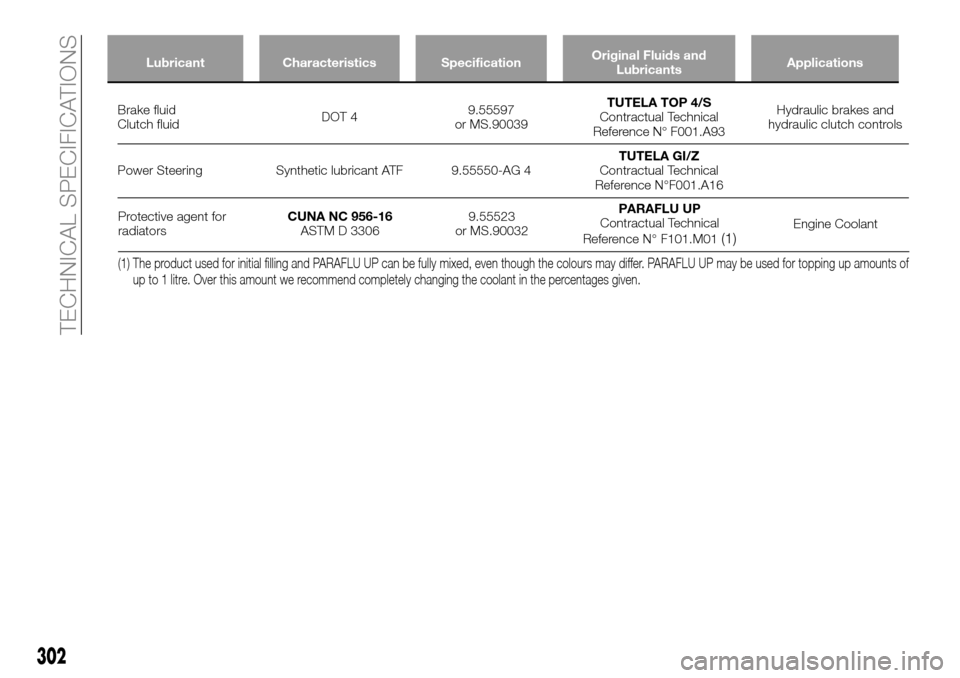
Lubricant Characteristics SpecificationOriginal Fluids and
LubricantsApplications
Protective agent for
radiatorsCUNA NC 956-16
ASTM D 33069.55523
or MS.90032PARAFLU UP
Contractual Technical
Reference N° F101.M01
(1)Engine Coolant
(1) The product used for initial filling and PARAFLU UP can be fully mixed, even though the colours may differ. PARAFLU UP may be used for topping up amounts of
up to 1 litre. Over this amount we recommend completely changing the coolant in the percentages given.
302
TECHNICAL SPECIFICATIONS
Brake fluid
Clutch fluidDOT 49.55597
or MS.90039TUTELA TOP 4/S
Contractual Technical
Reference N° F001.A93Hydraulic brakes and
hydraulic clutch controls
Power Steering Synthetic lubricant ATF 9.55550-AG 4TUTELA GI/Z
Contractual Technical
Reference N°F001.A16