clutch FIAT FULLBACK 2016 1.G User Guide
[x] Cancel search | Manufacturer: FIAT, Model Year: 2016, Model line: FULLBACK, Model: FIAT FULLBACK 2016 1.GPages: 312, PDF Size: 13.67 MB
Page 163 of 312
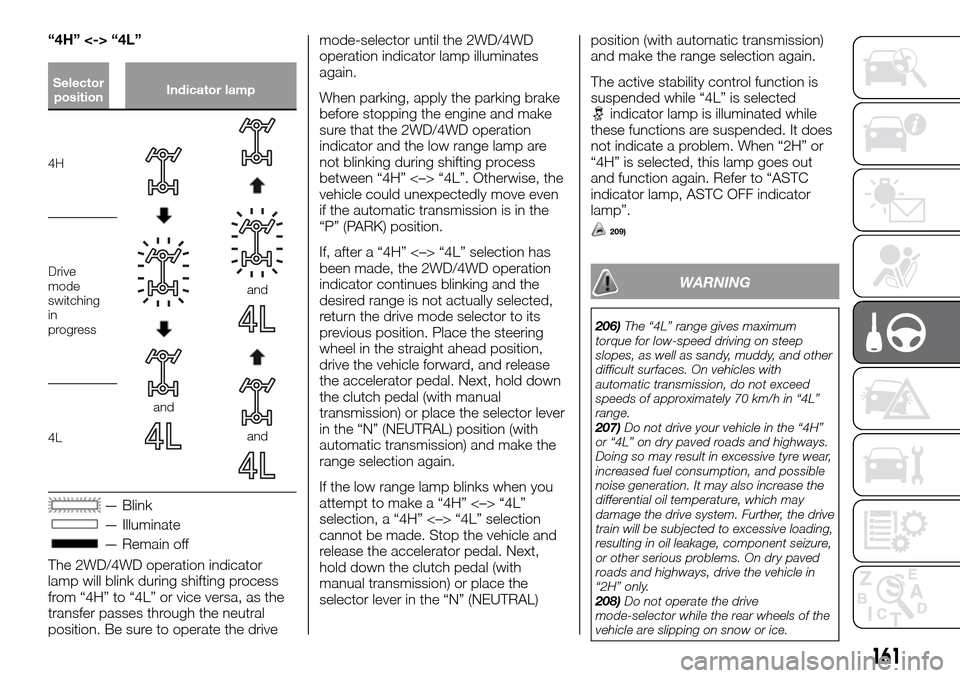
“4H” <-> “4L”
Selector
positionIndicator lamp
4H
and
and
and
Drive
mode
switching
in
progress
4L
— Blink
— Illuminate
— Remain off
The 2WD/4WD operation indicator
lamp will blink during shifting process
from “4H” to “4L” or vice versa, as the
transfer passes through the neutral
position. Be sure to operate the drivemode-selector until the 2WD/4WD
operation indicator lamp illuminates
again.
When parking, apply the parking brake
before stopping the engine and make
sure that the 2WD/4WD operation
indicator and the low range lamp are
not blinking during shifting process
between “4H” <–> “4L”. Otherwise, the
vehicle could unexpectedly move even
if the automatic transmission is in the
“P” (PARK) position.
If, after a “4H” <–> “4L” selection has
been made, the 2WD/4WD operation
indicator continues blinking and the
desired range is not actually selected,
return the drive mode selector to its
previous position. Place the steering
wheel in the straight ahead position,
drive the vehicle forward, and release
the accelerator pedal. Next, hold down
the clutch pedal (with manual
transmission) or place the selector lever
in the “N” (NEUTRAL) position (with
automatic transmission) and make the
range selection again.
If the low range lamp blinks when you
attempt to make a “4H” <–> “4L”
selection, a “4H” <–> “4L” selection
cannot be made. Stop the vehicle and
release the accelerator pedal. Next,
hold down the clutch pedal (with
manual transmission) or place the
selector lever in the “N” (NEUTRAL)position (with automatic transmission)
and make the range selection again.
The active stability control function is
suspended while “4L” is selected
indicator lamp is illuminated while
these functions are suspended. It does
not indicate a problem. When “2H” or
“4H” is selected, this lamp goes out
and function again. Refer to “ASTC
indicator lamp, ASTC OFF indicator
lamp”.
209)
WARNING
206)The “4L” range gives maximum
torque for low-speed driving on steep
slopes, as well as sandy, muddy, and other
difficult surfaces. On vehicles with
automatic transmission, do not exceed
speeds of approximately 70 km/h in “4L”
range.
207)Do not drive your vehicle in the “4H”
or “4L” on dry paved roads and highways.
Doing so may result in excessive tyre wear,
increased fuel consumption, and possible
noise generation. It may also increase the
differential oil temperature, which may
damage the drive system. Further, the drive
train will be subjected to excessive loading,
resulting in oil leakage, component seizure,
or other serious problems. On dry paved
roads and highways, drive the vehicle in
“2H” only.
208)Do not operate the drive
mode-selector while the rear wheels of the
vehicle are slipping on snow or ice.
161
Page 167 of 312
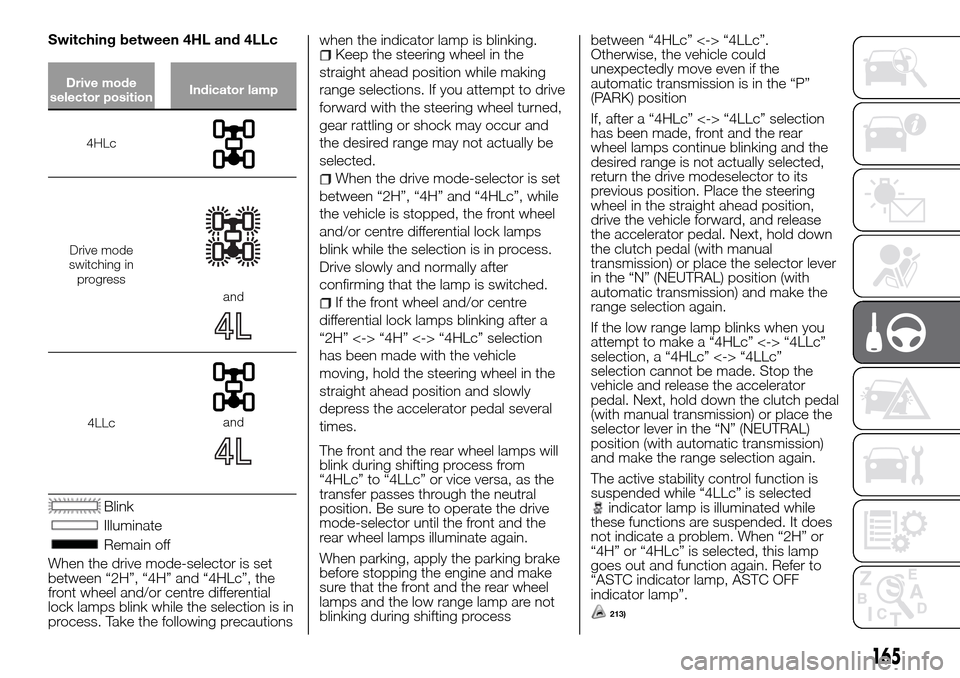
Switching between 4HL and 4LLc
Drive mode
selector positionIndicator lamp
4HLc
Drive mode
switching in
progress
and
4LLcand
Blink
Illuminate
Remain off
When the drive mode-selector is set
between “2H”, “4H” and “4HLc”, the
front wheel and/or centre differential
lock lamps blink while the selection is in
process. Take the following precautionswhen the indicator lamp is blinking.
Keep the steering wheel in the
straight ahead position while making
range selections. If you attempt to drive
forward with the steering wheel turned,
gear rattling or shock may occur and
the desired range may not actually be
selected.
When the drive mode-selector is set
between “2H”, “4H” and “4HLc”, while
the vehicle is stopped, the front wheel
and/or centre differential lock lamps
blink while the selection is in process.
Drive slowly and normally after
confirming that the lamp is switched.
If the front wheel and/or centre
differential lock lamps blinking after a
“2H” <-> “4H” <-> “4HLc” selection
has been made with the vehicle
moving, hold the steering wheel in the
straight ahead position and slowly
depress the accelerator pedal several
times.
The front and the rear wheel lamps will
blink during shifting process from
“4HLc” to “4LLc” or vice versa, as the
transfer passes through the neutral
position. Be sure to operate the drive
mode-selector until the front and the
rear wheel lamps illuminate again.
When parking, apply the parking brake
before stopping the engine and make
sure that the front and the rear wheel
lamps and the low range lamp are not
blinking during shifting processbetween “4HLc” <-> “4LLc”.
Otherwise, the vehicle could
unexpectedly move even if the
automatic transmission is in the “P”
(PARK) position
If, after a “4HLc” <-> “4LLc” selection
has been made, front and the rear
wheel lamps continue blinking and the
desired range is not actually selected,
return the drive modeselector to its
previous position. Place the steering
wheel in the straight ahead position,
drive the vehicle forward, and release
the accelerator pedal. Next, hold down
the clutch pedal (with manual
transmission) or place the selector lever
in the “N” (NEUTRAL) position (with
automatic transmission) and make the
range selection again.
If the low range lamp blinks when you
attempt to make a “4HLc” <-> “4LLc”
selection, a “4HLc” <-> “4LLc”
selection cannot be made. Stop the
vehicle and release the accelerator
pedal. Next, hold down the clutch pedal
(with manual transmission) or place the
selector lever in the “N” (NEUTRAL)
position (with automatic transmission)
and make the range selection again.
The active stability control function is
suspended while “4LLc” is selected
indicator lamp is illuminated while
these functions are suspended. It does
not indicate a problem. When “2H” or
“4H” or “4HLc” is selected, this lamp
goes out and function again. Refer to
“ASTC indicator lamp, ASTC OFF
indicator lamp”.
213)
165
Page 173 of 312
Driving on sandy or muddy roads
Set the drive mode-selector to “4H” or
“4L” position (Easy select 4WD), “4HLc”
or “4LLc” position (Super select 4WD II)
and then gradually depress the
accelerator pedal for a smooth start.
Keep the pressure on the accelerator
pedal as constant as possible, and
drive at low speed.
115) 116)
218)
Avoid sudden braking, acceleration,
and turning; such operations could
result in the vehicle becoming stuck.
If the vehicle becomes stuck in sandy
or muddy roads, it can often be moved
a rocking motion. Move the selector
lever rhythmically between the “D”
(DRIVE) and “R” (REVERSE) position
(with manual transmission, between 1st
and Reverse), while applying slight
pressure to the accelerator pedal.
It is recommended to start the vehicle
with parking brake partially, but not
completely, applied by slightly pulling
the parking brake lever. After the vehicle
has become free, do not forget to
release the parking brake.
If it is necessary to drive in extremely
muddy conditions, the use of tyre
chains is recommended. Because the
extent of muddy conditions is difficult to
judge and the vehicle could become
bogged down very deeply, operationshould be at a low speed. If possible,
get out of the vehicle and check the
conditions ahead before proceeding.
Driving over roads in coastal areas or
roads on which anti-skid preparations
have been spread can cause rust on
the vehicle; wash the vehicle thoroughly
as soon as possible after such use.
Climbing sharp grades
Set the drive mode-selector to “4L”
position (Easy select 4WD), “4LLc”
position (Super select 4WD II) to
maximize the engine torque.
219) 220)
Choose as smooth a slope as possible
with few stones or other obstacles.
Before attempting to drive up the slope,
walk up it to confirm that the vehicle
can handle the grade.Descending sharp grades
Set the drive mode-selector to “4L”
position (Easy select 4WD), “4LLc”
position (Super select 4WD II), use the
engine brake (downshifting) and
descend slowly.
221)
When descending a sharp grade, if the
brakes are applied suddenly because of
an obstacle encountered, control of the
vehicle could be lost. Before
descending the slope, walk down it and
confirm the path.
Before descending a grade, it is
necessary to choose the appropriate
gear. Avoid changing gears or
depressing the clutch while descending
the grade.
Fiat. is not responsible to the operator
for any damage or injury caused or
liability incurred by the improper and
negligent operation of a vehicle. All
techniques of vehicle operation
described herein depend on the skill
and experience of the operator and
other participating parties and any
deviation from the recommended
operation instructions above is at their
own risk.
171
Page 176 of 312
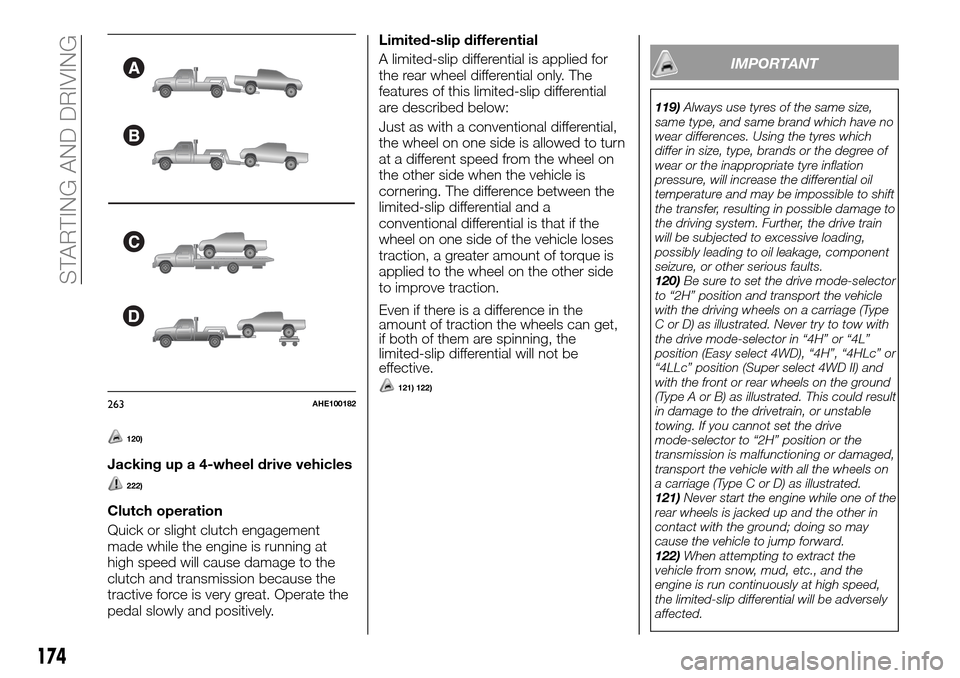
120)
Jacking up a 4-wheel drive vehicles
222)
Clutch operation
Quick or slight clutch engagement
made while the engine is running at
high speed will cause damage to the
clutch and transmission because the
tractive force is very great. Operate the
pedal slowly and positively.Limited-slip differential
A limited-slip differential is applied for
the rear wheel differential only. The
features of this limited-slip differential
are described below:
Just as with a conventional differential,
the wheel on one side is allowed to turn
at a different speed from the wheel on
the other side when the vehicle is
cornering. The difference between the
limited-slip differential and a
conventional differential is that if the
wheel on one side of the vehicle loses
traction, a greater amount of torque is
applied to the wheel on the other side
to improve traction.
Even if there is a difference in the
amount of traction the wheels can get,
if both of them are spinning, the
limited-slip differential will not be
effective.
121) 122)
IMPORTANT
119)Always use tyres of the same size,
same type, and same brand which have no
wear differences. Using the tyres which
differ in size, type, brands or the degree of
wear or the inappropriate tyre inflation
pressure, will increase the differential oil
temperature and may be impossible to shift
the transfer, resulting in possible damage to
the driving system. Further, the drive train
will be subjected to excessive loading,
possibly leading to oil leakage, component
seizure, or other serious faults.
120)Be sure to set the drive mode-selector
to “2H” position and transport the vehicle
with the driving wheels on a carriage (Type
C or D) as illustrated. Never try to tow with
the drive mode-selector in “4H” or “4L”
position (Easy select 4WD), “4H”, “4HLc” or
“4LLc” position (Super select 4WD II) and
with the front or rear wheels on the ground
(Type A or B) as illustrated. This could result
in damage to the drivetrain, or unstable
towing. If you cannot set the drive
mode-selector to “2H” position or the
transmission is malfunctioning or damaged,
transport the vehicle with all the wheels on
a carriage (Type C or D) as illustrated.
121)Never start the engine while one of the
rear wheels is jacked up and the other in
contact with the ground; doing so may
cause the vehicle to jump forward.
122)When attempting to extract the
vehicle from snow, mud, etc., and the
engine is run continuously at high speed,
the limited-slip differential will be adversely
affected.
B
C
D
A
263AHE100182
174
STARTING AND DRIVING
Page 181 of 312
The set speed driving is deactivated
automatically in any of the following
ways.
When you depress the clutch pedal
(on vehicles with M/T).
When your speed slows to about
15 km/h or more below the set speed
because of a hill, etc.
When your speed slows to about
40 km/h or less.
When the active stability & traction
control (ASTC) starts operating. Refer to
“Active stability & traction control
(ASTC)”.
227)
Also, the set speed driving may be
deactivated as follow:
When the engine speed rises and
approaches the tachometer’s red zone
(the red-coloured part of the
tachometer dial).
127)
To resume the set speed
If the set speed driving is deactivated
by the condition described in “To
deactivate”, you can resume the
previously set speed by push up the
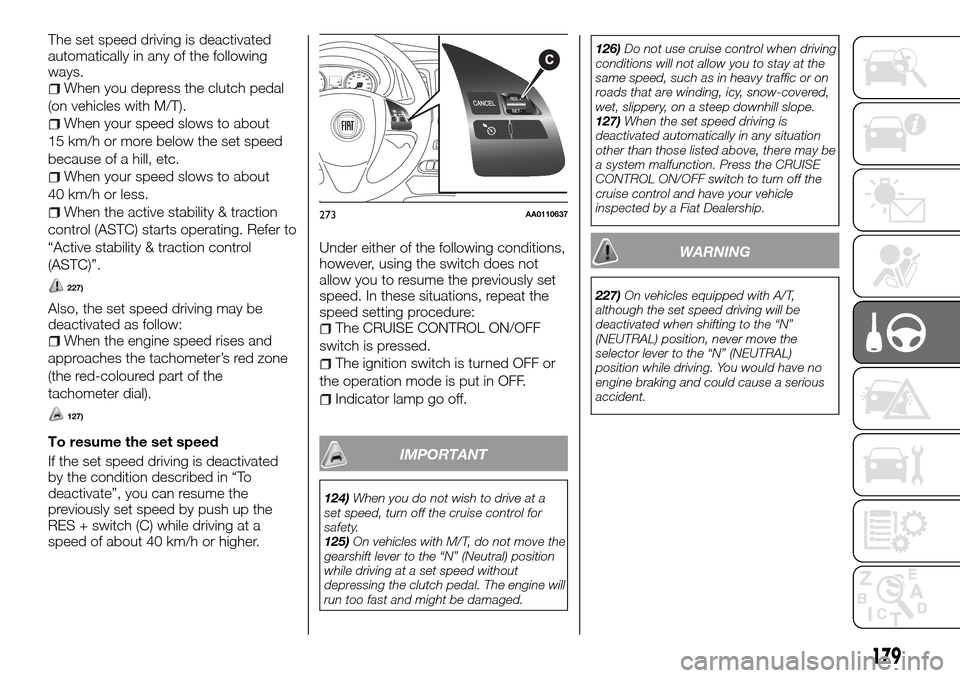
RES + switch (C) while driving at a
speed of about 40 km/h or higher.Under either of the following conditions,
however, using the switch does not
allow you to resume the previously set
speed. In these situations, repeat the
speed setting procedure:
The CRUISE CONTROL ON/OFF
switch is pressed.
The ignition switch is turned OFF or
the operation mode is put in OFF.
Indicator lamp go off.
IMPORTANT
124)When you do not wish to drive at a
set speed, turn off the cruise control for
safety.
125)On vehicles with M/T, do not move the
gearshift lever to the “N” (Neutral) position
while driving at a set speed without
depressing the clutch pedal. The engine will
run too fast and might be damaged.126)Do not use cruise control when driving
conditions will not allow you to stay at the
same speed, such as in heavy traffic or on
roads that are winding, icy, snow-covered,
wet, slippery, on a steep downhill slope.
127)When the set speed driving is
deactivated automatically in any situation
other than those listed above, there may be
a system malfunction. Press the CRUISE
CONTROL ON/OFF switch to turn off the
cruise control and have your vehicle
inspected by a Fiat Dealership.
WARNING
227)On vehicles equipped with A/T,
although the set speed driving will be
deactivated when shifting to the “N”
(NEUTRAL) position, never move the
selector lever to the “N” (NEUTRAL)
position while driving. You would have no
engine braking and could cause a serious
accident.
273AA0110637
179
Page 225 of 312
SERVICING AND MAINTENANCE
Correct maintenance permits the
performance of the car to be
maintained over time, as well as limited
running costs and safeguarding the
efficiency of the safety systems.
This chapter explains how.SERVICE PRECAUTIONS.......224
SCHEDULED SERVICING PLAN . .225
PERIODIC CHECKS..........240
DEMANDING VEHICLE USE.....240
CHECKING LEVELS..........241
CATALYTIC CONVERTER.......245
ENGINE OIL...............245
ENGINE COOLANT...........247
WASHER FLUID.............249
BRAKE FLUID..............249
CLUTCH FLUID.............250
POWER STEERING FLUID......251
BATTERY.................252
WIPER BLADE RUBBER
REPLACEMENT.............254
GENERAL MAINTENANCE......255
VEHICLE CARE PRECAUTIONS. . .255
CLEANING THE INTERIOR OF
YOUR VEHICLE.............256
CLEANING THE EXTERIOR OF
YOUR VEHICLE.............257
TYRES...................260
223
Page 230 of 312
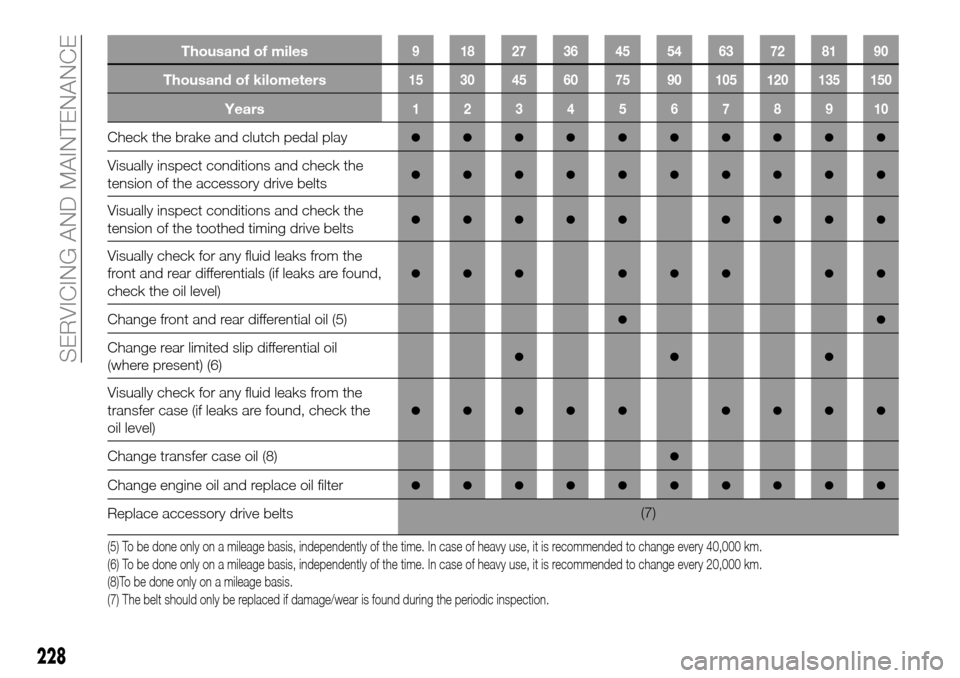
Thousand of miles9 182736455463728190
Thousand of kilometers15 30 45 60 75 90 105 120 135 150
Years12345678910
Check the brake and clutch pedal play●●●●●●●●●●
Visually inspect conditions and check the
tension of the accessory drive belts●●●●●●●●●●
Visually inspect conditions and check the
tension of the toothed timing drive belts●●●●● ●●●●
Visually check for any fluid leaks from the
front and rear differentials (if leaks are found,
check the oil level)
●●● ●●● ●●
Change front and rear differential oil (5)●●
Change rear limited slip differential oil
(where present) (6)●●●
Visually check for any fluid leaks from the
transfer case (if leaks are found, check the
oil level)
●●●●● ●●●●
Change transfer case oil (8)●
Change engine oil and replace oil filter●●●●●●●●●●
Replace accessory drive belts(7)
(5) To be done only on a mileage basis, independently of the time. In case of heavy use, it is recommended to change every 40,000 km.
(6) To be done only on a mileage basis, independently of the time. In case of heavy use, it is recommended to change every 20,000 km.
(8)To be done only on a mileage basis.
(7) The belt should only be replaced if damage/wear is found during the periodic inspection.
228
SERVICING AND MAINTENANCE
Page 235 of 312
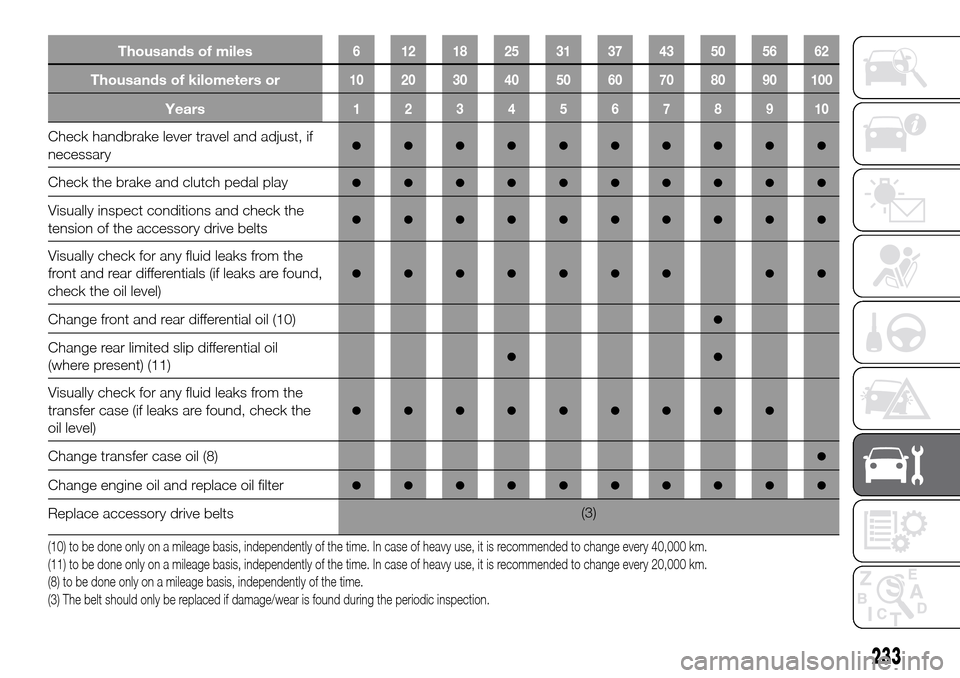
Thousands of miles6 121825313743505662
Thousands of kilometers or10 20 30 40 50 60 70 80 90 100
Years12345678910
Check handbrake lever travel and adjust, if
necessary●●●●●●●●●●
Check the brake and clutch pedal play●●●●●●●●●●
Visually inspect conditions and check the
tension of the accessory drive belts●●●●●●●●●●
Visually check for any fluid leaks from the
front and rear differentials (if leaks are found,
check the oil level)
●●●●●●● ●●
Change front and rear differential oil (10)●
Change rear limited slip differential oil
(where present) (11)●●
Visually check for any fluid leaks from the
transfer case (if leaks are found, check the
oil level)
●●●●●●●●●
Change transfer case oil (8)●
Change engine oil and replace oil filter●●●●●●●●●●
Replace accessory drive belts(3)
(10) to be done only on a mileage basis, independently of the time. In case of heavy use, it is recommended to change every 40,000 km.
(11) to be done only on a mileage basis, independently of the time. In case of heavy use, it is recommended to change every 20,000 km.
(8) to be done only on a mileage basis, independently of the time.
(3) The belt should only be replaced if damage/wear is found during the periodic inspection.
233
Page 240 of 312
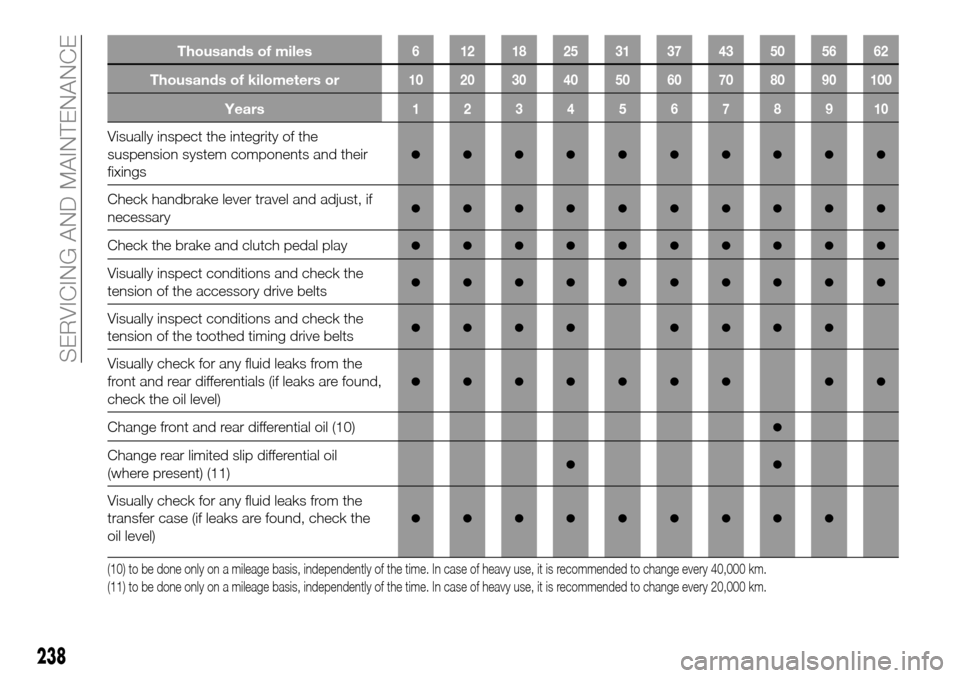
Thousands of miles6 121825313743505662
Thousands of kilometers or10 20 30 40 50 60 70 80 90 100
Years12345678910
Visually inspect the integrity of the
suspension system components and their
fixings
●●●●●●●●●●
Check handbrake lever travel and adjust, if
necessary●●●●●●●●●●
Check the brake and clutch pedal play●●●●●●●●●●
Visually inspect conditions and check the
tension of the accessory drive belts●●●●●●●●●●
Visually inspect conditions and check the
tension of the toothed timing drive belts●●●● ●●●●
Visually check for any fluid leaks from the
front and rear differentials (if leaks are found,
check the oil level)
●●●●●●● ●●
Change front and rear differential oil (10)●
Change rear limited slip differential oil
(where present) (11)●●
Visually check for any fluid leaks from the
transfer case (if leaks are found, check the
oil level)
●●●●●●●●●
(10) to be done only on a mileage basis, independently of the time. In case of heavy use, it is recommended to change every 40,000 km.
(11) to be done only on a mileage basis, independently of the time. In case of heavy use, it is recommended to change every 20,000 km.
238
SERVICING AND MAINTENANCE
Page 243 of 312
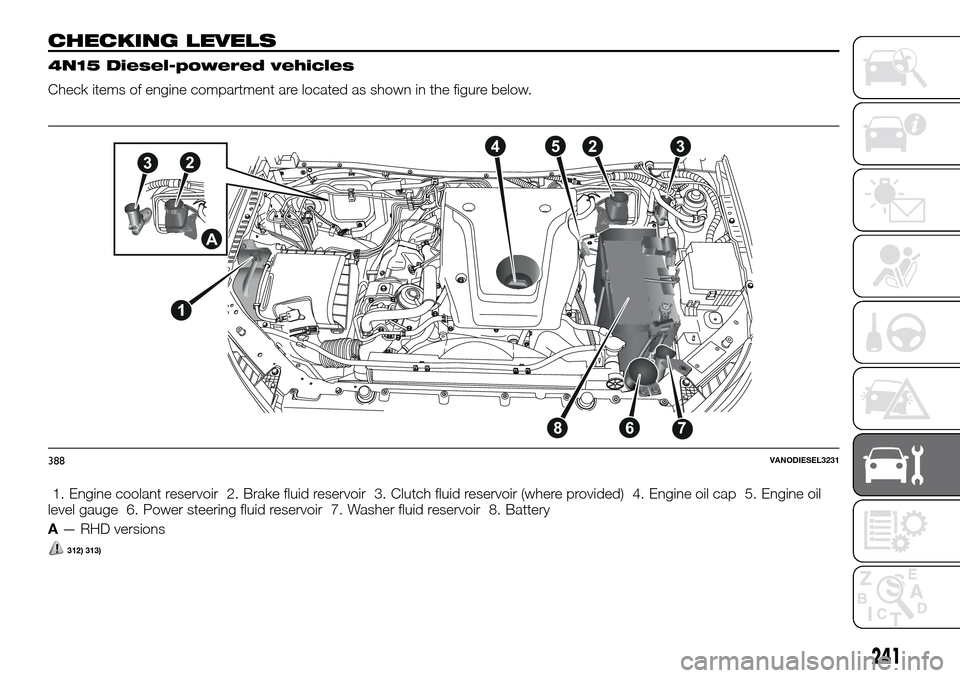
CHECKING LEVELS
4N15 Diesel-powered vehicles
Check items of engine compartment are located as shown in the figure below.
1. Engine coolant reservoir 2. Brake fluid reservoir 3. Clutch fluid reservoir (where provided) 4. Engine oil cap 5. Engine oil
level gauge 6. Power steering fluid reservoir 7. Washer fluid reservoir 8. Battery
A— RHD versions
312) 313)
A
1
42253
3
678
388VANODIESEL3231
241