ECU FIAT FULLBACK 2016 1.G Owners Manual
[x] Cancel search | Manufacturer: FIAT, Model Year: 2016, Model line: FULLBACK, Model: FIAT FULLBACK 2016 1.GPages: 312, PDF Size: 13.67 MB
Page 18 of 312
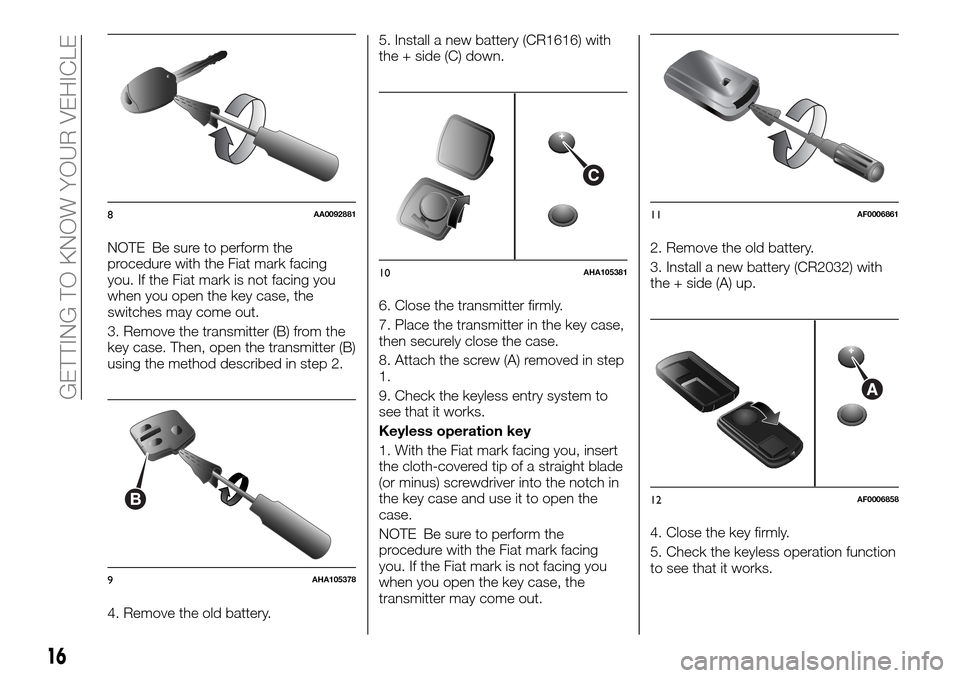
NOTE Be sure to perform the
procedure with the Fiat mark facing
you. If the Fiat mark is not facing you
when you open the key case, the
switches may come out.
3. Remove the transmitter (B) from the
key case. Then, open the transmitter (B)
using the method described in step 2.
4. Remove the old battery.5. Install a new battery (CR1616) with
the + side (C) down.
6. Close the transmitter firmly.
7. Place the transmitter in the key case,
then securely close the case.
8. Attach the screw (A) removed in step
1.
9. Check the keyless entry system to
see that it works.
Keyless operation key
1. With the Fiat mark facing you, insert
the cloth-covered tip of a straight blade
(or minus) screwdriver into the notch in
the key case and use it to open the
case.
NOTE Be sure to perform the
procedure with the Fiat mark facing
you. If the Fiat mark is not facing you
when you open the key case, the
transmitter may come out.2. Remove the old battery.
3. Install a new battery (CR2032) with
the + side (A) up.
4. Close the key firmly.
5. Check the keyless operation function
to see that it works.
8AA0092881
B
9AHA105378
C
10AHA105381
11AF0006861
A
12AF0006858
16
GETTING TO KNOW YOUR VEHICLE
Page 31 of 312
CHILD PROTECTION
REAR DOORS (Double
Cab)
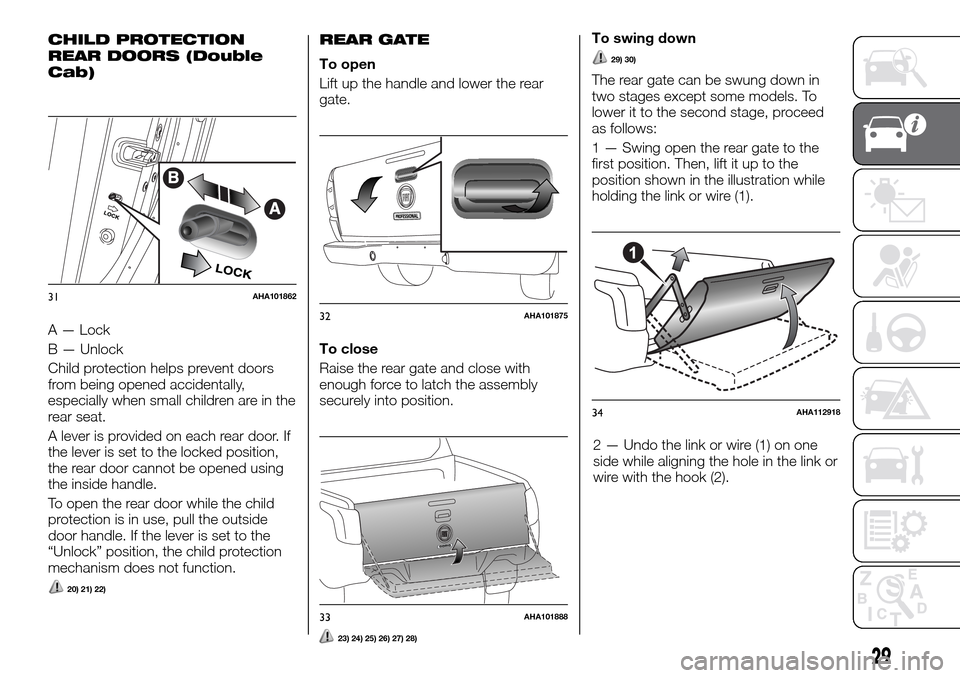
A — Lock
B — Unlock
Child protection helps prevent doors
from being opened accidentally,
especially when small children are in the
rear seat.
A lever is provided on each rear door. If
the lever is set to the locked position,
the rear door cannot be opened using
the inside handle.
To open the rear door while the child
protection is in use, pull the outside
door handle. If the lever is set to the
“Unlock” position, the child protection
mechanism does not function.
20) 21) 22)
REAR GATE
To open
Lift up the handle and lower the rear
gate.
To close
Raise the rear gate and close with
enough force to latch the assembly
securely into position.
23) 24) 25) 26) 27) 28)
To swing down
29) 30)
The rear gate can be swung down in
two stages except some models. To
lower it to the second stage, proceed
as follows:
1 — Swing open the rear gate to the
first position. Then, lift it up to the
position shown in the illustration while
holding the link or wire (1).
31AHA101862
32AHA101875
33AHA101888
34AHA112918
29
2 — Undo the link or wire (1) on one
side while aligning the hole in the link or
wire with the hook (2).
Page 32 of 312
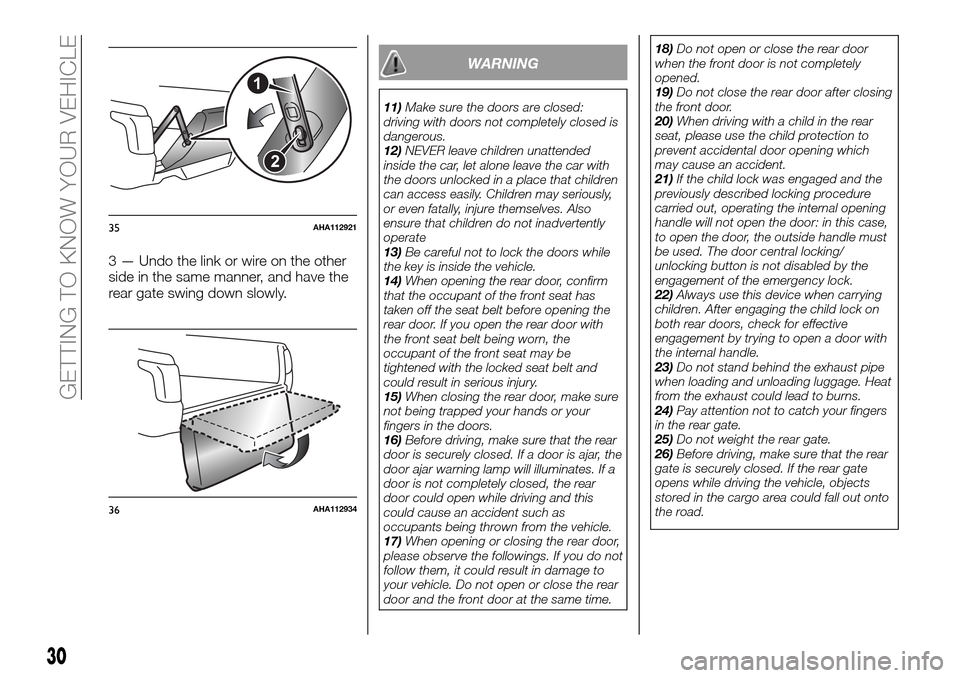
3 — Undo the link or wire on the other
side in the same manner, and have the
rear gate swing down slowly.
WARNING
11)Make sure the doors are closed:
driving with doors not completely closed is
dangerous.
12)NEVER leave children unattended
inside the car, let alone leave the car with
the doors unlocked in a place that children
can access easily. Children may seriously,
or even fatally, injure themselves. Also
ensure that children do not inadvertently
operate
13)Be careful not to lock the doors while
the key is inside the vehicle.
14)When opening the rear door, confirm
that the occupant of the front seat has
taken off the seat belt before opening the
rear door. If you open the rear door with
the front seat belt being worn, the
occupant of the front seat may be
tightened with the locked seat belt and
could result in serious injury.
15)When closing the rear door, make sure
not being trapped your hands or your
fingers in the doors.
16)Before driving, make sure that the rear
door is securely closed. If a door is ajar, the
door ajar warning lamp will illuminates. If a
door is not completely closed, the rear
door could open while driving and this
could cause an accident such as
occupants being thrown from the vehicle.
17)When opening or closing the rear door,
please observe the followings. If you do not
follow them, it could result in damage to
your vehicle. Do not open or close the rear
door and the front door at the same time.18)Do not open or close the rear door
when the front door is not completely
opened.
19)Do not close the rear door after closing
the front door.
20)When driving with a child in the rear
seat, please use the child protection to
prevent accidental door opening which
may cause an accident.
21)If the child lock was engaged and the
previously described locking procedure
carried out, operating the internal opening
handle will not open the door: in this case,
to open the door, the outside handle must
be used. The door central locking/
unlocking button is not disabled by the
engagement of the emergency lock.
22)Always use this device when carrying
children. After engaging the child lock on
both rear doors, check for effective
engagement by trying to open a door with
the internal handle.
23)Do not stand behind the exhaust pipe
when loading and unloading luggage. Heat
from the exhaust could lead to burns.
24)Pay attention not to catch your fingers
in the rear gate.
25)Do not weight the rear gate.
26)Before driving, make sure that the rear
gate is securely closed. If the rear gate
opens while driving the vehicle, objects
stored in the cargo area could fall out onto
the road.
1
2
35AHA112921
36AHA112934
30
GETTING TO KNOW YOUR VEHICLE
Page 34 of 312
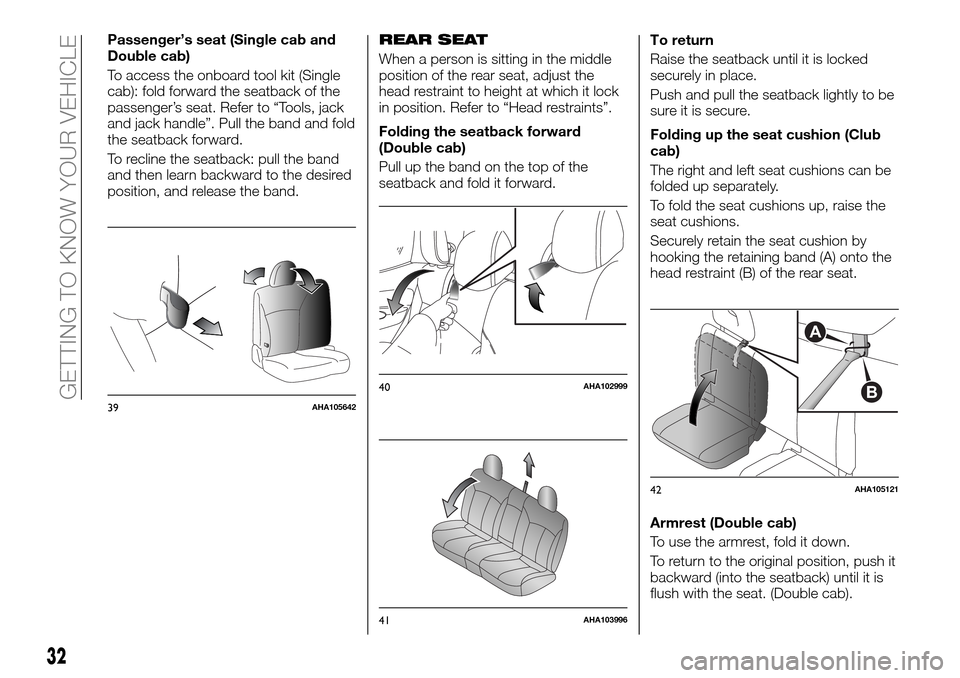
Passenger’s seat (Single cab and
Double cab)
To access the onboard tool kit (Single
cab): fold forward the seatback of the
passenger’s seat. Refer to “Tools, jack
and jack handle”. Pull the band and fold
the seatback forward.
To recline the seatback: pull the band
and then learn backward to the desired
position, and release the band.REAR SEAT
When a person is sitting in the middle
position of the rear seat, adjust the
head restraint to height at which it lock
in position. Refer to “Head restraints”.
Folding the seatback forward
(Double cab)
Pull up the band on the top of the
seatback and fold it forward.To return
Raise the seatback until it is locked
securely in place.
Push and pull the seatback lightly to be
sure it is secure.
Folding up the seat cushion (Club
cab)
The right and left seat cushions can be
folded up separately.
To fold the seat cushions up, raise the
seat cushions.
Securely retain the seat cushion by
hooking the retaining band (A) onto the
head restraint (B) of the rear seat.
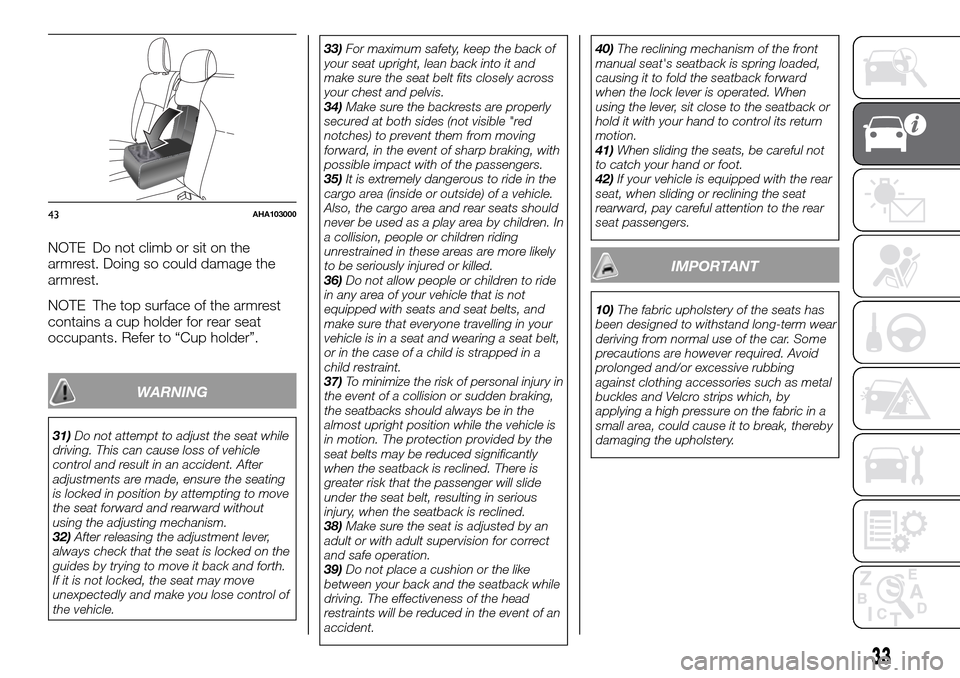
Armrest (Double cab)
To use the armrest, fold it down.
To return to the original position, push it
backward (into the seatback) until it is
flush with the seat. (Double cab).
39AHA105642
40AHA102999
41AHA103996
A
B
42AHA105121
32
GETTING TO KNOW YOUR VEHICLE
Page 35 of 312
NOTE Do not climb or sit on the
armrest. Doing so could damage the
armrest.
NOTE The top surface of the armrest
contains a cup holder for rear seat
occupants. Refer to “Cup holder”.
WARNING
31)Do not attempt to adjust the seat while
driving. This can cause loss of vehicle
control and result in an accident. After
adjustments are made, ensure the seating
is locked in position by attempting to move
the seat forward and rearward without
using the adjusting mechanism.
32)After releasing the adjustment lever,
always check that the seat is locked on the
guides by trying to move it back and forth.
If it is not locked, the seat may move
unexpectedly and make you lose control of
the vehicle.33)For maximum safety, keep the back of
your seat upright, lean back into it and
make sure the seat belt fits closely across
your chest and pelvis.
34)Make sure the backrests are properly
secured at both sides (not visible "red
notches) to prevent them from moving
forward, in the event of sharp braking, with
possible impact with of the passengers.
35)It is extremely dangerous to ride in the
cargo area (inside or outside) of a vehicle.
Also, the cargo area and rear seats should
never be used as a play area by children. In
a collision, people or children riding
unrestrained in these areas are more likely
to be seriously injured or killed.
36)Do not allow people or children to ride
in any area of your vehicle that is not
equipped with seats and seat belts, and
make sure that everyone travelling in your
vehicle is in a seat and wearing a seat belt,
or in the case of a child is strapped in a
child restraint.
37)To minimize the risk of personal injury in
the event of a collision or sudden braking,
the seatbacks should always be in the
almost upright position while the vehicle is
in motion. The protection provided by the
seat belts may be reduced significantly
when the seatback is reclined. There is
greater risk that the passenger will slide
under the seat belt, resulting in serious
injury, when the seatback is reclined.
38)Make sure the seat is adjusted by an
adult or with adult supervision for correct
and safe operation.
39)Do not place a cushion or the like
between your back and the seatback while
driving. The effectiveness of the head
restraints will be reduced in the event of an
accident.40)The reclining mechanism of the front
manual seat's seatback is spring loaded,
causing it to fold the seatback forward
when the lock lever is operated. When
using the lever, sit close to the seatback or
hold it with your hand to control its return
motion.
41)When sliding the seats, be careful not
to catch your hand or foot.
42)If your vehicle is equipped with the rear
seat, when sliding or reclining the seat
rearward, pay careful attention to the rear
seat passengers.
IMPORTANT
10)The fabric upholstery of the seats has
been designed to withstand long-term wear
deriving from normal use of the car. Some
precautions are however required. Avoid
prolonged and/or excessive rubbing
against clothing accessories such as metal
buckles and Velcro strips which, by
applying a high pressure on the fabric in a
small area, could cause it to break, thereby
damaging the upholstery.
43AHA103000
33
Page 37 of 312
WARNING
43)All adjustments must only be carried
out with the vehicle stationary and the
engine off. Head restraints must be
adjusted so that the head, rather than the
neck, rests on them. Only in this case can
they protect your head correctly. To take
best advantage of the protection provided
by the head restraint, adjust the seat back
so that you are sitting up straight and your
head is as close to the head restraint as
possible.
44)Driving without the head restraints in
place can cause you and your passengers
serious injury or death in an accident. To
reduce the risk of injury in an accident,
always make sure the head restraints are
installed and properly positioned when the
seat is occupied.45)Never place a cushion or similar device
on the seatback. This can adversely affect
head restraint performance by increasing
the distance between your head and the
restraint.
46)When a person sits in the middle
seating position of the rear seat, pull up the
head restraint to a height at which it locks
in position. Be sure to make this
adjustment before starting to drive. Serious
injuries could otherwise be suffered in the
result of an impact (Double cab).
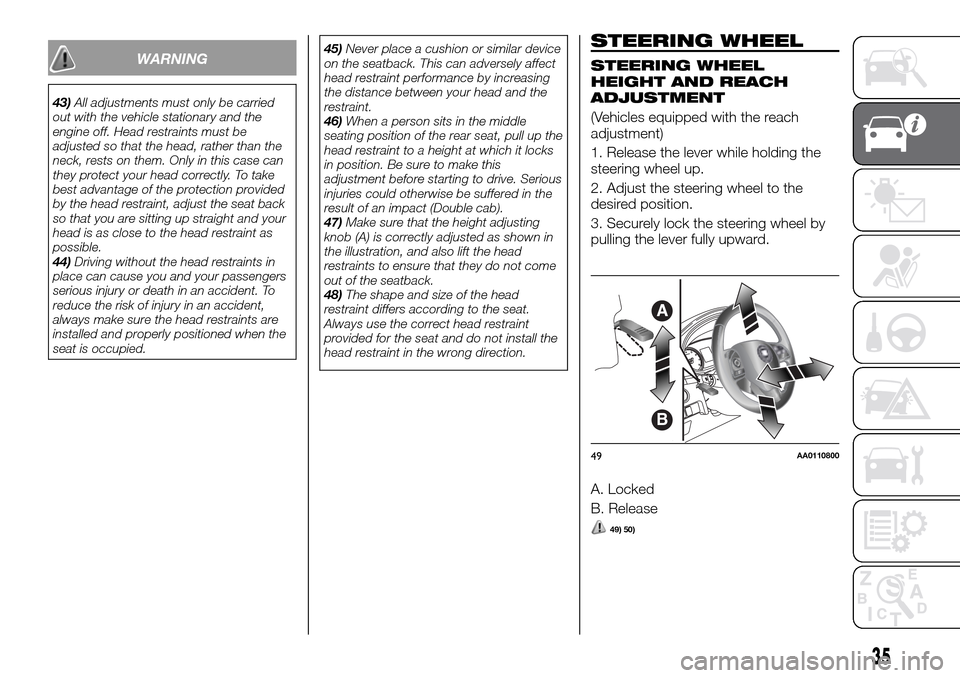
47)Make sure that the height adjusting
knob (A) is correctly adjusted as shown in
the illustration, and also lift the head
restraints to ensure that they do not come
out of the seatback.
48)The shape and size of the head
restraint differs according to the seat.
Always use the correct head restraint
provided for the seat and do not install the
head restraint in the wrong direction.
STEERING WHEEL
STEERING WHEEL
HEIGHT AND REACH
ADJUSTMENT
(Vehicles equipped with the reach
adjustment)
1. Release the lever while holding the
steering wheel up.
2. Adjust the steering wheel to the
desired position.
3. Securely lock the steering wheel by
pulling the lever fully upward.
A. Locked
B. Release
49) 50)
A
B
49AA0110800
35
Page 75 of 312
NOTE Only open the bonnet when the
wipers are in the parked position.
Failure to do so may cause damage to
the bonnet, wiper arms or front
windscreen.
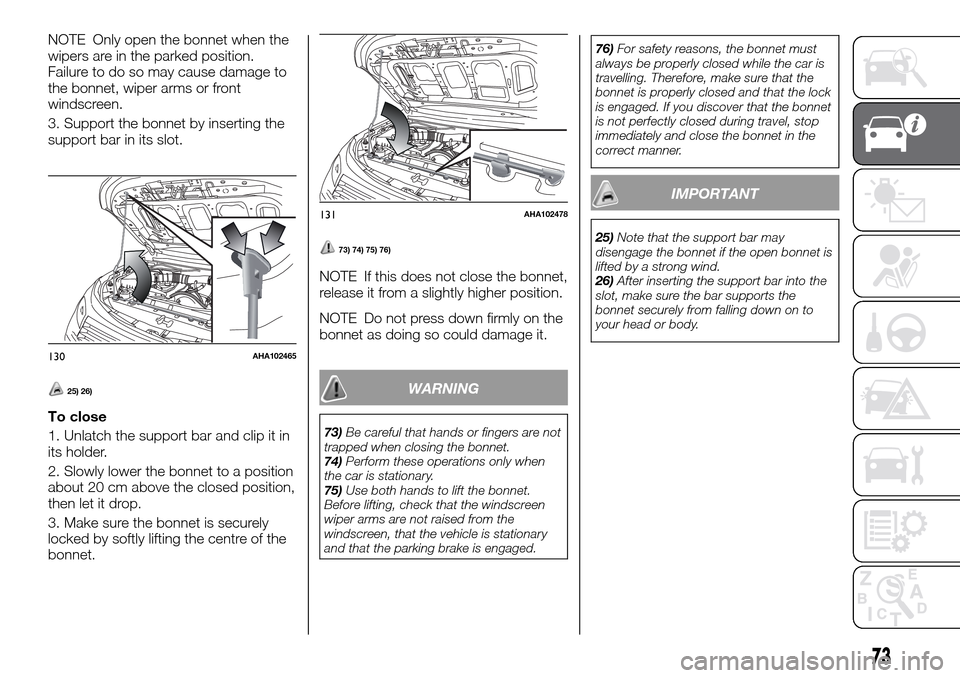
3. Support the bonnet by inserting the
support bar in its slot.
25) 26)
To close
1. Unlatch the support bar and clip it in
its holder.
2. Slowly lower the bonnet to a position
about 20 cm above the closed position,
then let it drop.
3. Make sure the bonnet is securely
locked by softly lifting the centre of the
bonnet.
73) 74) 75) 76)
NOTE If this does not close the bonnet,
release it from a slightly higher position.
NOTE Do not press down firmly on the
bonnet as doing so could damage it.
WARNING
73)Be careful that hands or fingers are not
trapped when closing the bonnet.
74)Perform these operations only when
the car is stationary.
75)Use both hands to lift the bonnet.
Before lifting, check that the windscreen
wiper arms are not raised from the
windscreen, that the vehicle is stationary
and that the parking brake is engaged.76)For safety reasons, the bonnet must
always be properly closed while the car is
travelling. Therefore, make sure that the
bonnet is properly closed and that the lock
is engaged. If you discover that the bonnet
is not perfectly closed during travel, stop
immediately and close the bonnet in the
correct manner.
IMPORTANT
25)Note that the support bar may
disengage the bonnet if the open bonnet is
lifted by a strong wind.
26)After inserting the support bar into the
slot, make sure the bar supports the
bonnet securely from falling down on to
your head or body.
130AHA102465
131AHA102478
73
Page 76 of 312
CARGO AREA
CARGO LOADS
77) 78)
Cargo loads precautions
When loading luggage, be careful to the
following.
Stow cargo and luggage in the cargo
area whenever possible.
Distribute cargo or luggage evenly
not to be unbalanced in weight of a
load.
Do not place cargo or luggage on
the instrument panel. Also, do not stack
up cargo or luggage on the front
passenger’s seat or the rear seat.
Having the driver’s vision blocked, and
your cargo being thrown inside the
cabin if you suddenly have to brake can
cause a serious accident or injury.
WARNING
77)If a vehicle is parked on a very steep
gradient or with a side gradient, opening
the rear door or side door could cause any
unsecured items to emerge suddenly.
78)If you wish to carry a reserve of petrol
in a can, observe the legal restrictions and
only use a can that is type-approved and
properly secured to the load anchorage
eyebolts. Anyway, by doing so, you
increase the risk of fire in the event of an
accident with your vehicle.
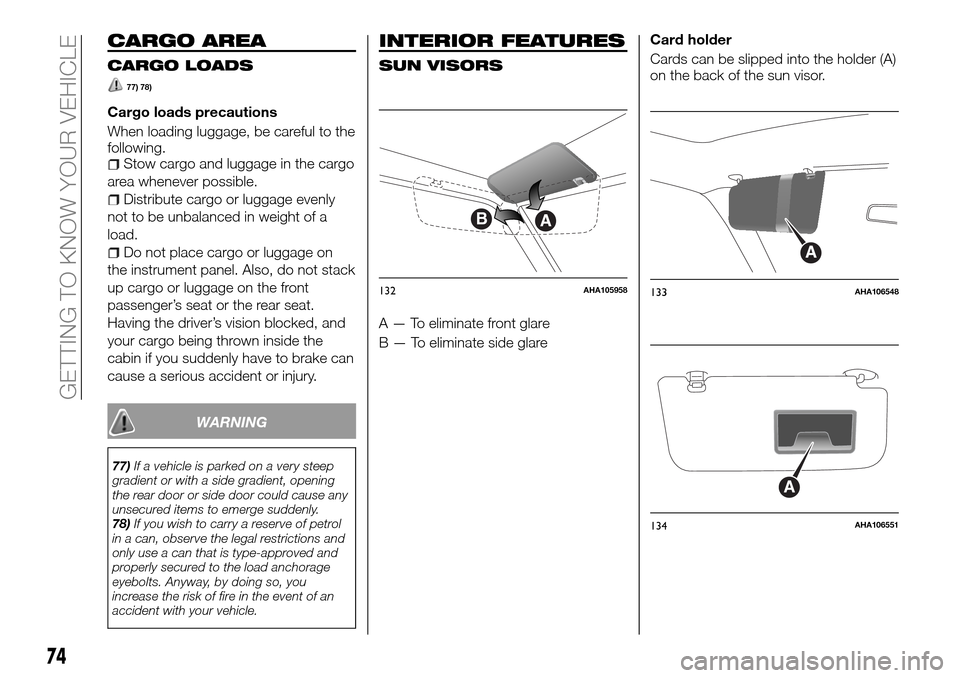
INTERIOR FEATURES
SUN VISORS
A — To eliminate front glare
B — To eliminate side glareCard holder
Cards can be slipped into the holder (A)
on the back of the sun visor.
AB
132AHA105958
A
133AHA106548
A
134AHA106551
74
GETTING TO KNOW YOUR VEHICLE
Page 110 of 312
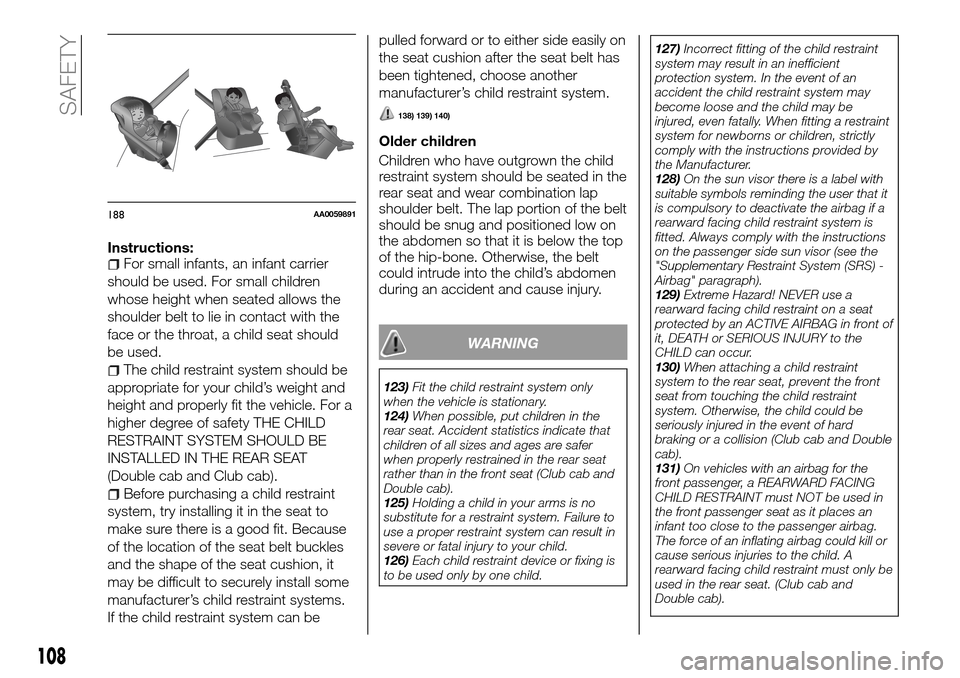
Instructions:For small infants, an infant carrier
should be used. For small children
whose height when seated allows the
shoulder belt to lie in contact with the
face or the throat, a child seat should
be used.
The child restraint system should be
appropriate for your child’s weight and
height and properly fit the vehicle. For a
higher degree of safety THE CHILD
RESTRAINT SYSTEM SHOULD BE
INSTALLED IN THE REAR SEAT
(Double cab and Club cab).
Before purchasing a child restraint
system, try installing it in the seat to
make sure there is a good fit. Because
of the location of the seat belt buckles
and the shape of the seat cushion, it
may be difficult to securely install some
manufacturer’s child restraint systems.
If the child restraint system can bepulled forward or to either side easily on
the seat cushion after the seat belt has
been tightened, choose another
manufacturer’s child restraint system.
138) 139) 140)
Older children
Children who have outgrown the child
restraint system should be seated in the
rear seat and wear combination lap
shoulder belt. The lap portion of the belt
should be snug and positioned low on
the abdomen so that it is below the top
of the hip-bone. Otherwise, the belt
could intrude into the child’s abdomen
during an accident and cause injury.
WARNING
123)Fit the child restraint system only
when the vehicle is stationary.
124)When possible, put children in the
rear seat. Accident statistics indicate that
children of all sizes and ages are safer
when properly restrained in the rear seat
rather than in the front seat (Club cab and
Double cab).
125)Holding a child in your arms is no
substitute for a restraint system. Failure to
use a proper restraint system can result in
severe or fatal injury to your child.
126)Each child restraint device or fixing is
to be used only by one child.127)Incorrect fitting of the child restraint
system may result in an inefficient
protection system. In the event of an
accident the child restraint system may
become loose and the child may be
injured, even fatally. When fitting a restraint
system for newborns or children, strictly
comply with the instructions provided by
the Manufacturer.
128)On the sun visor there is a label with
suitable symbols reminding the user that it
is compulsory to deactivate the airbag if a
rearward facing child restraint system is
fitted. Always comply with the instructions
on the passenger side sun visor (see the
"Supplementary Restraint System (SRS) -
Airbag" paragraph).
129)Extreme Hazard! NEVER use a
rearward facing child restraint on a seat
protected by an ACTIVE AIRBAG in front of
it, DEATH or SERIOUS INJURY to the
CHILD can occur.
130)When attaching a child restraint
system to the rear seat, prevent the front
seat from touching the child restraint
system. Otherwise, the child could be
seriously injured in the event of hard
braking or a collision (Club cab and Double
cab).
131)On vehicles with an airbag for the
front passenger, a REARWARD FACING
CHILD RESTRAINT must NOT be used in
the front passenger seat as it places an
infant too close to the passenger airbag.
The force of an inflating airbag could kill or
cause serious injuries to the child. A
rearward facing child restraint must only be
used in the rear seat. (Club cab and
Double cab).
188AA0059891
108
SAFETY
Page 111 of 312
132)Do not move the front or rear seat if a
child is seated on it or on the dedicated
child restraint system.
133)A FORWARD FACING CHILD
RESTRAINT should be used in the rear
seat whenever possible; if it must be used
in the front passenger seat, adjust the seat
to the most rearward position. Failure to do
so could kill or cause serious injuries to the
child.
134)Always make sure that the diagonal
section of the seat belt does not pass
under the arms or behind the back of the
child. In the event of an accident the seat
belt will not be able to secure the child,
with the risk of injury, including fatal injury.
Therefore the child must always wear the
seat belt correctly.
135)Do not use the same lower
anchorage to install more than one child
restraint system.
136)If a Universal ISOFIX child seat system
is not fixed to all three anchorages, it will
not be able to protect the child correctly. In
a crash, the child could be seriously or
fatally injured. 86)
137)Fit the child restraint system when the
car is stationary. The child restraint system
is correctly fixed to the brackets when you
hear the click. Follow the instructions for
assembly, disassembly and positioning that
the Manufacturer must supply with the
child restraint system.
138)After installation, push and pull the
child restraint system back and forth, and
side to side, to see that it is positively
secured. If the child restraint system is not
installed securely, it may cause injury to the
child or other occupants in the case of
accident or sudden stops.139)When the child restraint system is not
in use, keep your child restraint system
secured with the seat belt or remove it
from the vehicle in order to prevent it from
being thrown around inside the vehicle
during an accident.
140)After installing a child restraint system,
do not move the seat: always remove the
child restraint system before making any
adjustment.
109