instrument panel FIAT FULLBACK 2016 1.G User Guide
[x] Cancel search | Manufacturer: FIAT, Model Year: 2016, Model line: FULLBACK, Model: FIAT FULLBACK 2016 1.GPages: 312, PDF Size: 13.67 MB
Page 92 of 312
NOTE If fuel is added with the ignition
switch or the operation mode is ON,
the fuel gauge may incorrectly indicate
the fuel level.
NOTE The fuel lid mark (A) indicates
that the fuel tank filler door is located on
the left side of the vehicle.
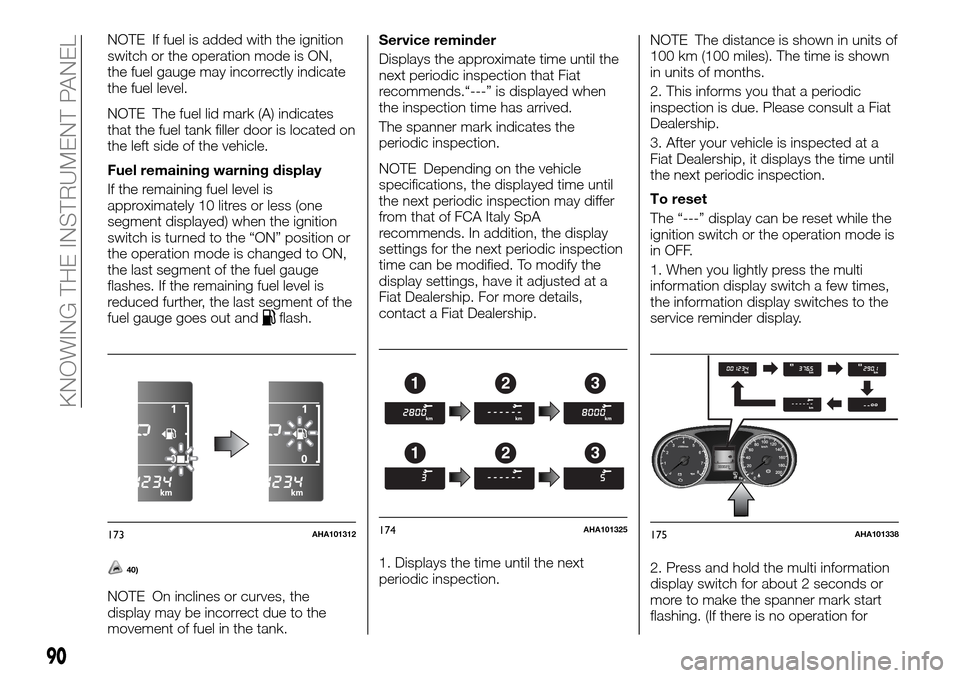
Fuel remaining warning display
If the remaining fuel level is
approximately 10 litres or less (one
segment displayed) when the ignition
switch is turned to the “ON” position or
the operation mode is changed to ON,
the last segment of the fuel gauge
flashes. If the remaining fuel level is
reduced further, the last segment of the
fuel gauge goes out and
flash.
40)
NOTE On inclines or curves, the
display may be incorrect due to the
movement of fuel in the tank.Service reminder
Displays the approximate time until the
next periodic inspection that Fiat
recommends.“---” is displayed when
the inspection time has arrived.
The spanner mark indicates the
periodic inspection.
NOTE Depending on the vehicle
specifications, the displayed time until
the next periodic inspection may differ
from that of FCA Italy SpA
recommends. In addition, the display
settings for the next periodic inspection
time can be modified. To modify the
display settings, have it adjusted at a
Fiat Dealership. For more details,
contact a Fiat Dealership.
1. Displays the time until the next
periodic inspection.NOTE The distance is shown in units of
100 km (100 miles). The time is shown
in units of months.
2. This informs you that a periodic
inspection is due. Please consult a Fiat
Dealership.
3. After your vehicle is inspected at a
Fiat Dealership, it displays the time until
the next periodic inspection.
To reset
The “---” display can be reset while the
ignition switch or the operation mode is
in OFF.
1. When you lightly press the multi
information display switch a few times,
the information display switches to the
service reminder display.
2. Press and hold the multi information
display switch for about 2 seconds or
more to make the spanner mark start
flashing. (If there is no operation for
173AHA101312
123
123
174AHA101325175AHA101338
90
KNOWING THE INSTRUMENT PANEL
Page 94 of 312
Auto reset modeWhen the average fuel consumption
is being displayed, if you hold down the
multi information display switch, the
average fuel consumption displayed at
that time are reset.
When the engine switch or the
operation mode is in the following
conditions, the average fuel
consumption display is automatically
reset. Except for vehicles equipped with
the keyless operation system: the
ignition switch is in the “ACC” or
“LOCK” position for about 4 hours or
longer. For vehicles equipped with the
keyless operation system: the operation
mode is in ACC or OFF for about
4 hours or longer.
IMPORTANT The average fuel
consumption display can be reset
separately for the auto reset mode and
for the manual reset mode.
IMPORTANT The memory of the
manual reset mode or auto reset mode
for the average fuel consumption
display is erased if the battery is
disconnected.
The initial (default) setting is “Auto reset
mode”.Changing the fuel consumption
display unit
The display unit for fuel consumption
can be switched. The distance and
amount units are also switched to
match the selected fuel consumption
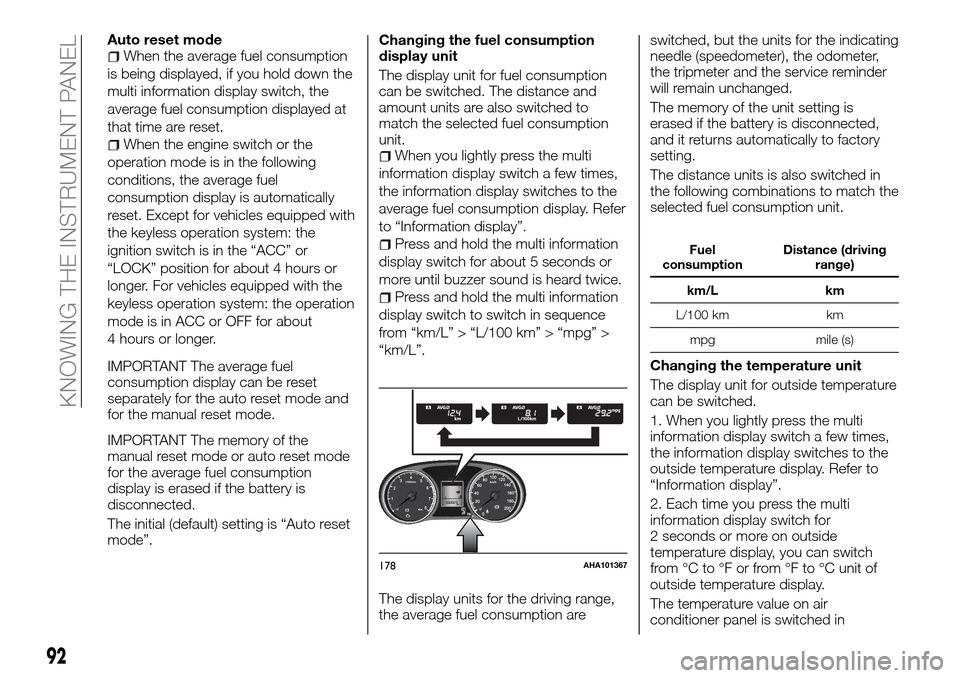
unit.When you lightly press the multi
information display switch a few times,
the information display switches to the
average fuel consumption display. Refer
to “Information display”.
Press and hold the multi information
display switch for about 5 seconds or
more until buzzer sound is heard twice.
Press and hold the multi information
display switch to switch in sequence
from “km/L” > “L/100 km” > “mpg” >
“km/L”.
The display units for the driving range,
the average fuel consumption areswitched, but the units for the indicating
needle (speedometer), the odometer,
the tripmeter and the service reminder
will remain unchanged.
The memory of the unit setting is
erased if the battery is disconnected,
and it returns automatically to factory
setting.
The distance units is also switched in
the following combinations to match the
selected fuel consumption unit.
Fuel
consumptionDistance (driving
range)
km/L km
L/100 km km
mpg mile (s)
Changing the temperature unit
The display unit for outside temperature
can be switched.
1. When you lightly press the multi
information display switch a few times,
the information display switches to the
outside temperature display. Refer to
“Information display”.
2. Each time you press the multi
information display switch for
2 seconds or more on outside
temperature display, you can switch
from °C to °F or from °F to °C unit of
outside temperature display.
The temperature value on air
conditioner panel is switched in
178AHA101367
92
KNOWING THE INSTRUMENT PANEL
Page 96 of 312
INDICATOR AND WARNING LAMPS
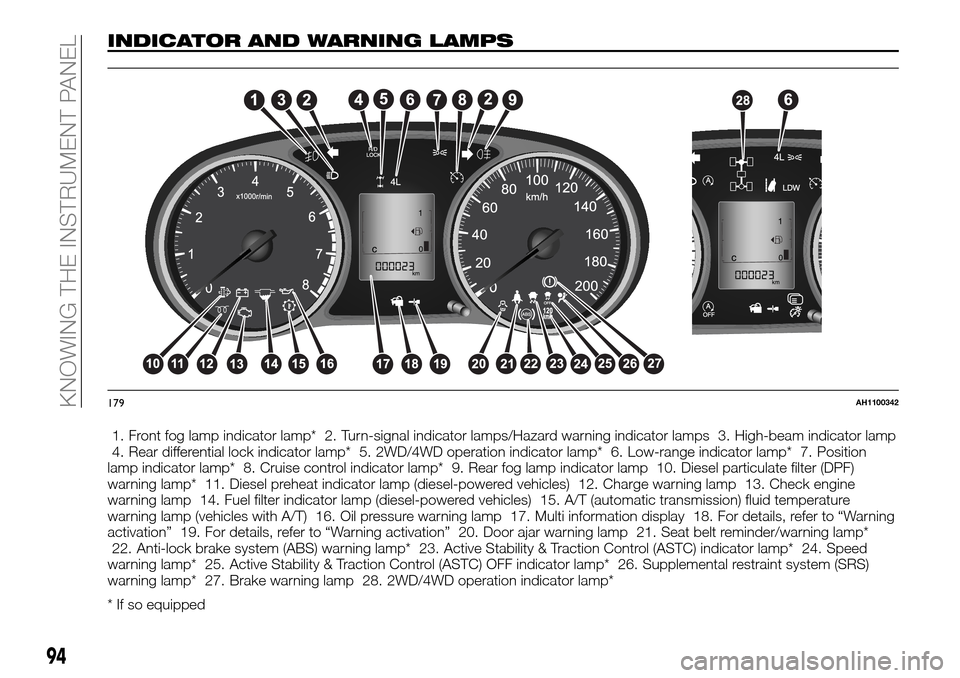
1. Front fog lamp indicator lamp* 2. Turn-signal indicator lamps/Hazard warning indicator lamps 3. High-beam indicator lamp
4. Rear differential lock indicator lamp* 5. 2WD/4WD operation indicator lamp* 6. Low-range indicator lamp* 7. Position
lamp indicator lamp* 8. Cruise control indicator lamp* 9. Rear fog lamp indicator lamp 10. Diesel particulate filter (DPF)
warning lamp* 11. Diesel preheat indicator lamp (diesel-powered vehicles) 12. Charge warning lamp 13. Check engine
warning lamp 14. Fuel filter indicator lamp (diesel-powered vehicles) 15. A/T (automatic transmission) fluid temperature
warning lamp (vehicles with A/T) 16. Oil pressure warning lamp 17. Multi information display 18. For details, refer to “Warning
activation” 19. For details, refer to “Warning activation” 20. Door ajar warning lamp 21. Seat belt reminder/warning lamp*
22. Anti-lock brake system (ABS) warning lamp* 23. Active Stability & Traction Control (ASTC) indicator lamp* 24. Speed
warning lamp* 25. Active Stability & Traction Control (ASTC) OFF indicator lamp* 26. Supplemental restraint system (SRS)
warning lamp* 27. Brake warning lamp 28. 2WD/4WD operation indicator lamp*
* If so equipped
179AH1100342
94
KNOWING THE INSTRUMENT PANEL
Page 98 of 312
Indicator lamps What it means
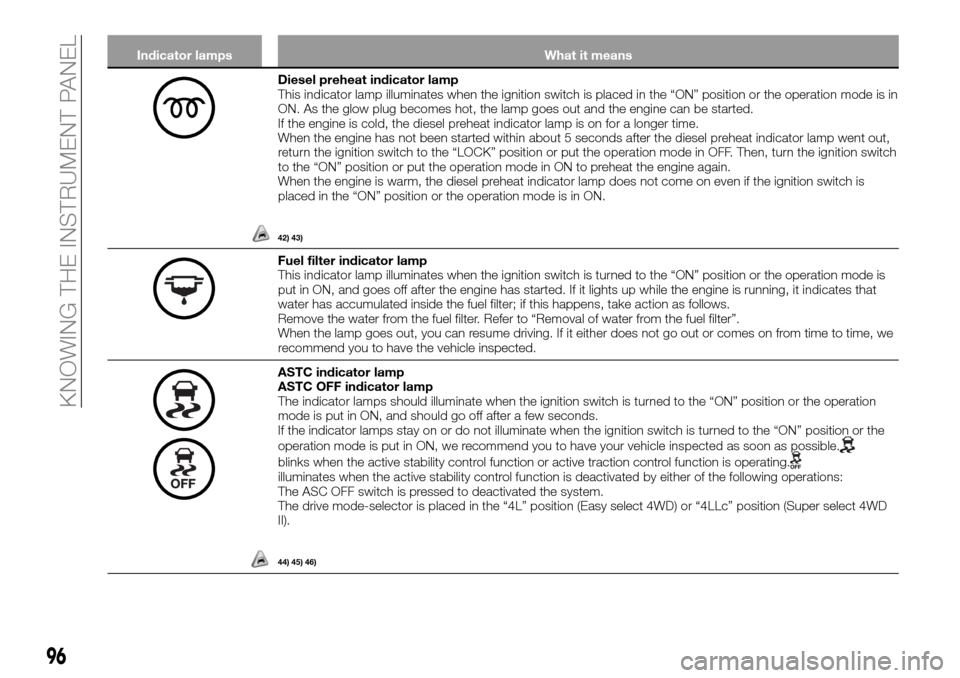
Diesel preheat indicator lamp
This indicator lamp illuminates when the ignition switch is placed in the “ON” position or the operation mode is in
ON. As the glow plug becomes hot, the lamp goes out and the engine can be started.
If the engine is cold, the diesel preheat indicator lamp is on for a longer time.
When the engine has not been started within about 5 seconds after the diesel preheat indicator lamp went out,
return the ignition switch to the “LOCK” position or put the operation mode in OFF. Then, turn the ignition switch
to the “ON” position or put the operation mode in ON to preheat the engine again.
When the engine is warm, the diesel preheat indicator lamp does not come on even if the ignition switch is
placed in the “ON” position or the operation mode is in ON.
42) 43)
Fuel filter indicator lamp
This indicator lamp illuminates when the ignition switch is turned to the “ON” position or the operation mode is
put in ON, and goes off after the engine has started. If it lights up while the engine is running, it indicates that
water has accumulated inside the fuel filter; if this happens, take action as follows.
Remove the water from the fuel filter. Refer to “Removal of water from the fuel filter”.
When the lamp goes out, you can resume driving. If it either does not go out or comes on from time to time, we
recommend you to have the vehicle inspected.
ASTC indicator lamp
ASTC OFF indicator lamp
The indicator lamps should illuminate when the ignition switch is turned to the “ON” position or the operation
mode is put in ON, and should go off after a few seconds.
If the indicator lamps stay on or do not illuminate when the ignition switch is turned to the “ON” position or the
operation mode is put in ON, we recommend you to have your vehicle inspected as soon as possible.
blinks when the active stability control function or active traction control function is operating.illuminates when the active stability control function is deactivated by either of the following operations:
The ASC OFF switch is pressed to deactivated the system.
The drive mode-selector is placed in the “4L” position (Easy select 4WD) or “4LLc” position (Super select 4WD
II).
44) 45) 46)
96
KNOWING THE INSTRUMENT PANEL
Page 100 of 312
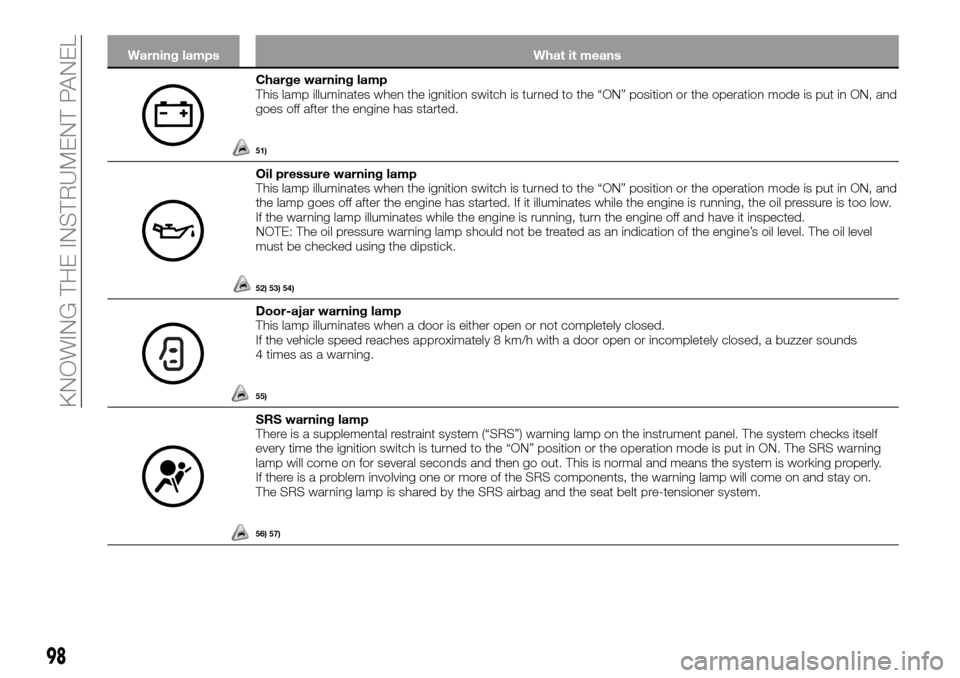
Warning lamps What it means
Charge warning lamp
This lamp illuminates when the ignition switch is turned to the “ON” position or the operation mode is put in ON, and
goes off after the engine has started.
51)
Oil pressure warning lamp
This lamp illuminates when the ignition switch is turned to the “ON” position or the operation mode is put in ON, and
the lamp goes off after the engine has started. If it illuminates while the engine is running, the oil pressure is too low.
If the warning lamp illuminates while the engine is running, turn the engine off and have it inspected.
NOTE: The oil pressure warning lamp should not be treated as an indication of the engine’s oil level. The oil level
must be checked using the dipstick.
52) 53) 54)
Door-ajar warning lamp
This lamp illuminates when a door is either open or not completely closed.
If the vehicle speed reaches approximately 8 km/h with a door open or incompletely closed, a buzzer sounds
4 times as a warning.
55)
SRS warning lamp
There is a supplemental restraint system (“SRS”) warning lamp on the instrument panel. The system checks itself
every time the ignition switch is turned to the “ON” position or the operation mode is put in ON. The SRS warning
lamp will come on for several seconds and then go out. This is normal and means the system is working properly.
If there is a problem involving one or more of the SRS components, the warning lamp will come on and stay on.
The SRS warning lamp is shared by the SRS airbag and the seat belt pre-tensioner system.
56) 57)
98
KNOWING THE INSTRUMENT PANEL
Page 102 of 312
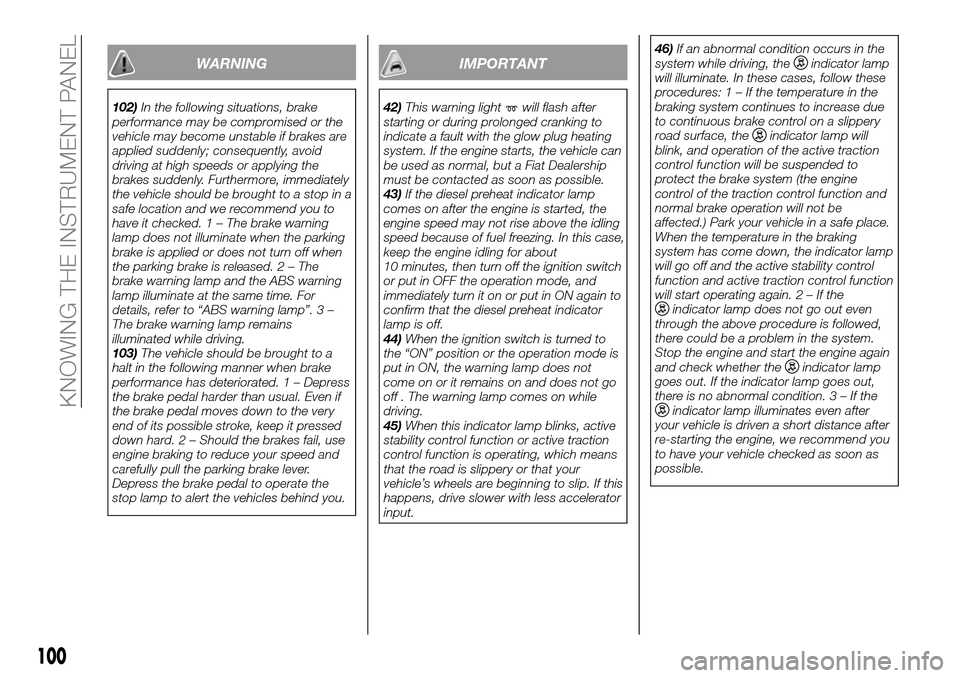
WARNING
102)In the following situations, brake
performance may be compromised or the
vehicle may become unstable if brakes are
applied suddenly; consequently, avoid
driving at high speeds or applying the
brakes suddenly. Furthermore, immediately
the vehicle should be brought to a stop in a
safe location and we recommend you to
have it checked. 1 – The brake warning
lamp does not illuminate when the parking
brake is applied or does not turn off when
the parking brake is released.2–The
brake warning lamp and the ABS warning
lamp illuminate at the same time. For
details, refer to “ABS warning lamp”. 3 –
The brake warning lamp remains
illuminated while driving.
103)The vehicle should be brought to a
halt in the following manner when brake
performance has deteriorated. 1 – Depress
the brake pedal harder than usual. Even if
the brake pedal moves down to the very
end of its possible stroke, keep it pressed
down hard. 2 – Should the brakes fail, use
engine braking to reduce your speed and
carefully pull the parking brake lever.
Depress the brake pedal to operate the
stop lamp to alert the vehicles behind you.
IMPORTANT
42)This warning lightwill flash after
starting or during prolonged cranking to
indicate a fault with the glow plug heating
system. If the engine starts, the vehicle can
be used as normal, but a Fiat Dealership
must be contacted as soon as possible.
43)If the diesel preheat indicator lamp
comes on after the engine is started, the
engine speed may not rise above the idling
speed because of fuel freezing. In this case,
keep the engine idling for about
10 minutes, then turn off the ignition switch
or put in OFF the operation mode, and
immediately turn it on or put in ON again to
confirm that the diesel preheat indicator
lamp is off.
44)When the ignition switch is turned to
the “ON” position or the operation mode is
put in ON, the warning lamp does not
come on or it remains on and does not go
off . The warning lamp comes on while
driving.
45)When this indicator lamp blinks, active
stability control function or active traction
control function is operating, which means
that the road is slippery or that your
vehicle’s wheels are beginning to slip. If this
happens, drive slower with less accelerator
input.46)If an abnormal condition occurs in the
system while driving, the
indicator lamp
will illuminate. In these cases, follow these
procedures:1–Ifthetemperature in the
braking system continues to increase due
to continuous brake control on a slippery
road surface, the
indicator lamp will
blink, and operation of the active traction
control function will be suspended to
protect the brake system (the engine
control of the traction control function and
normal brake operation will not be
affected.) Park your vehicle in a safe place.
When the temperature in the braking
system has come down, the indicator lamp
will go off and the active stability control
function and active traction control function
will start operating again.2–Ifthe
indicator lamp does not go out even
through the above procedure is followed,
there could be a problem in the system.
Stop the engine and start the engine again
and check whether the
indicator lamp
goes out. If the indicator lamp goes out,
there is no abnormal condition.3–Ifthe
indicator lamp illuminates even after
your vehicle is driven a short distance after
re-starting the engine, we recommend you
to have your vehicle checked as soon as
possible.
100
KNOWING THE INSTRUMENT PANEL
Page 106 of 312
WARNING
104)Seat belts should always be worn by
every adult who drives or rides in this
vehicle, and by all children who are large
enough to wear seat belts properly. Other
children should always use proper child
restraint systems.
105)Always place the shoulder belt over
your shoulder and across your chest.
Never put it behind you or under your arm.
106)One seat belt should be used by only
one person. Doing otherwise can be
dangerous.
107)The seat belt will provide maximum
protection if the recliner seatback is placed
in fully upright position. When the seatback
is reclined, there is greater risk that the
passenger will slide under the belt,
especially in a forward impact accident,
and may be injured by the belt or by
striking the instrument panel or seatbacks.
108)Remove any twists when using the
belt.
109)Never hold a child in your arms or on
your lap when riding in this vehicle, even if
you are wearing your seat belt. To do so
risks severe or fatal injury to your child in a
collision or sudden stop.
110)Always adjust the seat belt to a snug
fit.
111)Always wear the lap portion of the
belt over your hips.
112)Never push the button on the buckle
when travelling.113)Seat belts work for everyone,
including pregnant women. Pregnant
women should use the available seat belts.
This will reduce the likelihood of injury to
both the woman and the unborn child. The
lap belt should be worn across the thighs
and as snug against the hips as possible,
but not across the waist. Consult your
doctor if you have any additional questions
or concerns.
114)Never wear the lap portion of the belt
across your abdomen. During accidents it
can press sharply against abdomen and
increase the risk of injury.
115)Do not attempt to repair or replace
any part of the seat belt assemblies; we
recommend you to have this work done by
a Fiat Dealership. Incorrect repair or
replacement could reduce the
effectiveness of the belts and could result
in serious injury in the event of a collision.
116)Remember that, in the event of an
accident, the rear seat passengers not
wearing seat belts are exposed to a very
serious risk and also represent a serious
danger for the front seat occupants.
117)Make height adjustment of the seat
belts when the car is stationary.
IMPORTANT
59)No modifications or additions should be
made which will either prevent the seat belt
adjusting devices from operating to remove
slack, or prevent the seat belt assembly
from being adjusted to remove slack.
60)The seat belts must not be twisted
when worn.61)We recommend you to have all seat
belt assemblies including retractors and
attaching hardware inspected after any
collision. We recommend that seat belt
assemblies in use during a collision be
replaced unless the collision was minor and
the belts show no damage and continue to
operate properly.
62)Once the pre-tensioner has activated, it
cannot be re-used. It must be replaced
together with the retractor.
104
SAFETY
Page 121 of 312
temporary irritation from chemicals
used to produce the deployment; open
the windows after airbag deployment, if
safe to do so.
The airbags deflate very rapidly after
deployment, so there is little danger of
obscured vision.
145) 146) 147) 148) 149) 150) 151) 152)
Caution for installing the child
restraint on vehicle with front
passenger’s airbag
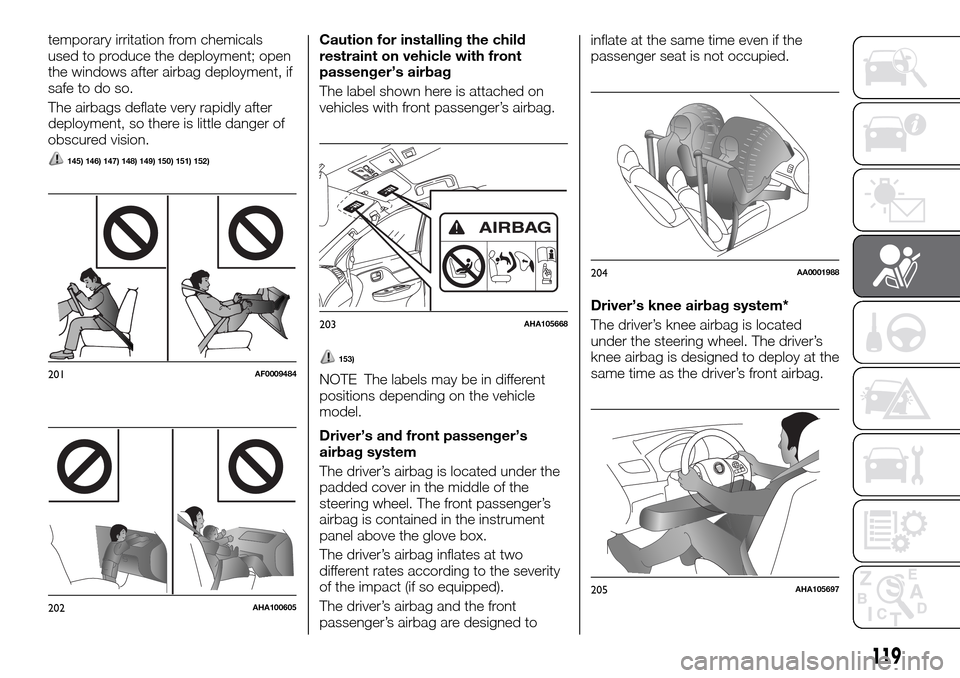
The label shown here is attached on
vehicles with front passenger’s airbag.
153)
NOTE The labels may be in different
positions depending on the vehicle
model.
Driver’s and front passenger’s
airbag system
The driver’s airbag is located under the
padded cover in the middle of the
steering wheel. The front passenger’s
airbag is contained in the instrument
panel above the glove box.
The driver’s airbag inflates at two
different rates according to the severity
of the impact (if so equipped).
The driver’s airbag and the front
passenger’s airbag are designed toinflate at the same time even if the
passenger seat is not occupied.
Driver’s knee airbag system*
The driver’s knee airbag is located
under the steering wheel. The driver’s
knee airbag is designed to deploy at the
same time as the driver’s front airbag.201AF0009484
202AHA100605
203AHA105668
204AA0001988
205AHA105697
119
Page 122 of 312
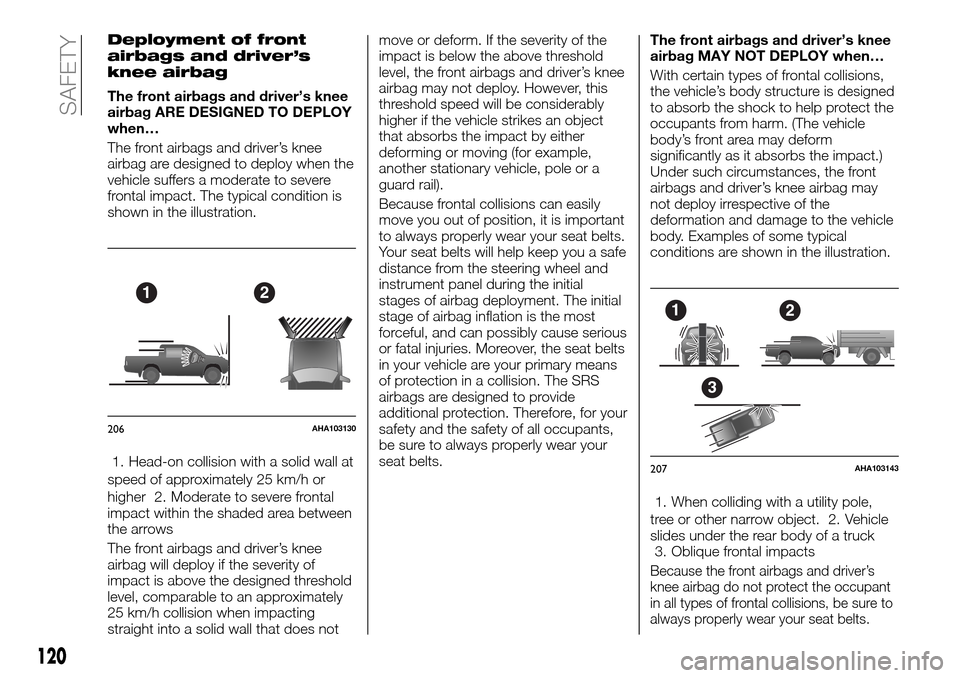
Deployment of front
airbags and driver’s
knee airbag
The front airbags and driver’s knee
airbag ARE DESIGNED TO DEPLOY
when…
The front airbags and driver’s knee
airbag are designed to deploy when the
vehicle suffers a moderate to severe
frontal impact. The typical condition is
shown in the illustration.
1. Head-on collision with a solid wall at
speed of approximately 25 km/h or
higher 2. Moderate to severe frontal
impact within the shaded area between
the arrows
The front airbags and driver’s knee
airbag will deploy if the severity of
impact is above the designed threshold
level, comparable to an approximately
25 km/h collision when impacting
straight into a solid wall that does notmove or deform. If the severity of the
impact is below the above threshold
level, the front airbags and driver’s knee
airbag may not deploy. However, this
threshold speed will be considerably
higher if the vehicle strikes an object
that absorbs the impact by either
deforming or moving (for example,
another stationary vehicle, pole or a
guard rail).
Because frontal collisions can easily
move you out of position, it is important
to always properly wear your seat belts.
Your seat belts will help keep you a safe
distance from the steering wheel and
instrument panel during the initial
stages of airbag deployment. The initial
stage of airbag inflation is the most
forceful, and can possibly cause serious
or fatal injuries. Moreover, the seat belts
in your vehicle are your primary means
of protection in a collision. The SRS
airbags are designed to provide
additional protection. Therefore, for your
safety and the safety of all occupants,
be sure to always properly wear your
seat belts.The front airbags and driver’s knee
airbag MAY NOT DEPLOY when…
With certain types of frontal collisions,
the vehicle’s body structure is designed
to absorb the shock to help protect the
occupants from harm. (The vehicle
body’s front area may deform
significantly as it absorbs the impact.)
Under such circumstances, the front
airbags and driver’s knee airbag may
not deploy irrespective of the
deformation and damage to the vehicle
body. Examples of some typical
conditions are shown in the illustration.
1. When colliding with a utility pole,
tree or other narrow object. 2. Vehicle
slides under the rear body of a truck
3. Oblique frontal impacts
Because the front airbags and driver’s
knee airbag do not protect the occupant
in all types of frontal collisions, be sure to
always properly wear your seat belts.
12
206AHA103130
2
3
1
207AHA103143
120
SAFETY
Page 123 of 312
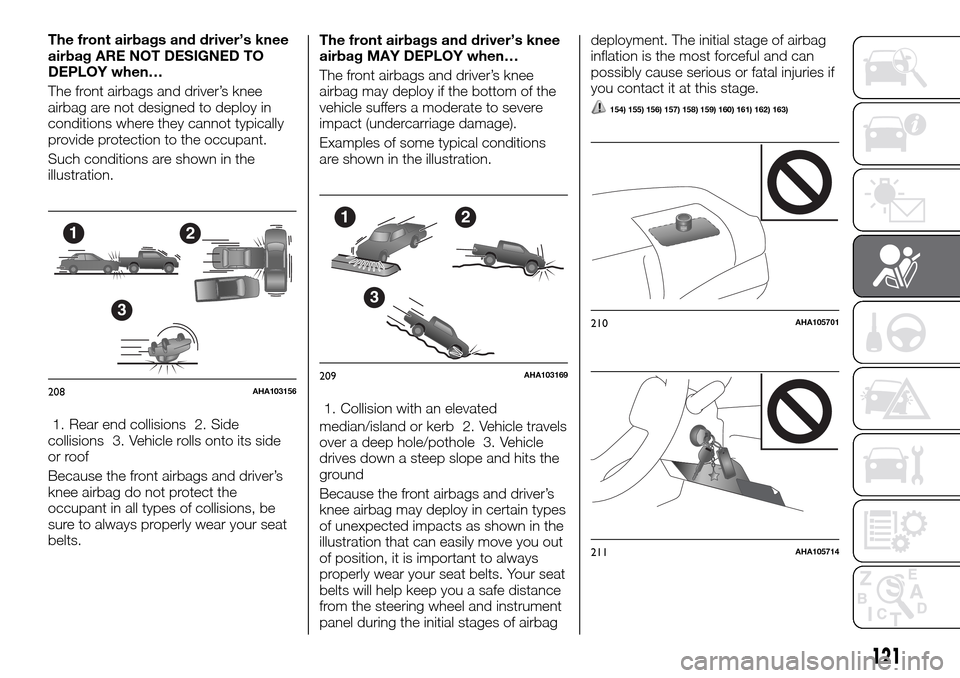
The front airbags and driver’s knee
airbag ARE NOT DESIGNED TO
DEPLOY when…
The front airbags and driver’s knee
airbag are not designed to deploy in
conditions where they cannot typically
provide protection to the occupant.
Such conditions are shown in the
illustration.
1. Rear end collisions 2. Side
collisions 3. Vehicle rolls onto its side
or roof
Because the front airbags and driver’s
knee airbag do not protect the
occupant in all types of collisions, be
sure to always properly wear your seat
belts.The front airbags and driver’s knee
airbag MAY DEPLOY when…
The front airbags and driver’s knee
airbag may deploy if the bottom of the
vehicle suffers a moderate to severe
impact (undercarriage damage).
Examples of some typical conditions
are shown in the illustration.
1. Collision with an elevated
median/island or kerb 2. Vehicle travels
over a deep hole/pothole 3. Vehicle
drives down a steep slope and hits the
ground
Because the front airbags and driver’s
knee airbag may deploy in certain types
of unexpected impacts as shown in the
illustration that can easily move you out
of position, it is important to always
properly wear your seat belts. Your seat
belts will help keep you a safe distance
from the steering wheel and instrument
panel during the initial stages of airbagdeployment. The initial stage of airbag
inflation is the most forceful and can
possibly cause serious or fatal injuries if
you contact it at this stage.
154) 155) 156) 157) 158) 159) 160) 161) 162) 163)
2
3
1
208AHA103156
2
3
1
209AHA103169
210AHA105701
211AHA105714
121