tow FIAT FULLBACK 2016 1.G User Guide
[x] Cancel search | Manufacturer: FIAT, Model Year: 2016, Model line: FULLBACK, Model: FIAT FULLBACK 2016 1.GPages: 312, PDF Size: 13.67 MB
Page 99 of 312
Warning lamps What it means
Brake warning lamp
This lamp illuminates when the ignition switch is turned to the “ON” position or the operation mode is put in ON, and
goes off after a few seconds. Always make sure that the lamp goes off before driving.
With the ignition switch or the operation mode in ON, the brake warning lamp illuminates under the following
conditions:
When the parking brake has been applied.
When the brake fluid level in the reservoir falls to a low level.
When the brake force distribution function is not operating correctly.With the ignition switch or the operation mode in ON, a buzzer sounds under the following condition:
The vehicle speed exceeds 8 km/h with the parking brake applied.
102) 103)
47)
Check engine warning lamp
This lamp is a part of an onboard diagnostic system which monitors the emissions, engine control system or A/T
control system.
If a problem is detected in one of these systems, this lamp illuminates or flashes. Although your vehicle will usually
be drivable and not need towing, we recommend you to have the system checked as soon as possible.
This lamp will also illuminate when the ignition switch is turned “ON” or the operation mode is put in ON, and goes
off after the engine has started. If it does not go off after the engine has started, we recommend you to have the
vehicle checked.
NOTE: The engine electronic control module accommodating the onboard diagnostic system has various fault data
(especially about the exhaust emission) stored.
This data will be erased if a battery cable is disconnected which will make a rapid diagnosis difficult. Do not
disconnect a battery cable when the check engine warning lamp is ON.
48) 49) 50)
97
Page 103 of 312
47)If the vehicle is towed with the ignition
switch in the “ON” position or the operation
mode in ON and only the front wheels or
only the rear wheels raised off the ground,
the ASTC may operate, resulting in an
accident. When towing the vehicle with the
front wheels raised, keep the ignition switch
in the “LOCK” or “ACC” position or the
operation mode in ACC or OFF. When
towing the vehicle with the rear wheels
raised, keep the ignition switch in the
“ACC” position or the operation mode in
ACC. Refer to “Towing”.
48)Prolonged driving with this lamp on
may cause further damage to the emission
control system. It could also affect fuel
economy and drivability.
49)If the lamp does not illuminate when the
ignition switch is turned to the “ON”
position or the operation mode is put in
ON, we recommend you to have the
system checked.
50)If the lamp illuminates while the engine
is running, avoid driving at high speeds and
have the system inspected by a Fiat
Dealership as soon as possible. Accelerator
pedal and brake pedal response may be
negatively influenced under these
conditions.
51)If it illuminates while the engine is
running, there is a problem in the charging
system. Immediately park your vehicle in a
safe place and we recommend you to have
it checked.
52)If this lamp illuminates when the engine
oil level is not low, have it inspected.
53)This warning lamp does not indicate
the amount of oil in the crankcase. This
must be determined by checking the oil
level on the dipstick, while the engine is
switched off.54)If you continue driving with low engine
oil level or with this warning lamp
illuminated, engine seizure may occur.
55)Before moving your vehicle, check that
the warning lamp is OFF.
56)If any of the following conditions occur,
there may be a problem with the SRS
airbags and/or seat belt pre-tensioners,
and they may not function properly in a
collision or may suddenly activate without a
collision: 1 – Even when the ignition switch
or the operation mode is in ON, the SRS
warning lamp does not come on or it
remains on. 2 – The SRS warning lamp
comes on while driving.
57)The SRS airbags and seat belt
pre-tensioners are designed to help reduce
the risk of serious injury or death in certain
collisions. If either of the above conditions
occurs, immediately have your vehicle
checked by a Fiat Dealership.
58)Any of the following indicates that the
ABS is not functioning and only the
standard brake system is working. (The
standard brake system is functioning
normally.) If this happens, take your vehicle
to a Fiat Dealership.
101
Page 105 of 312
SEAT BELTS
To protect you and your passengers in
the event of an accident, it is the most
important that the seat belts be worn
correctly while driving.
The driver’s and front passenger’s seat
belt equipped with an airbag each have
a pre-tensioner system and the rear
seat belts equipped with a dual stage
airbag system each have a
pre-tensioner system. These belts are
used the same way as a conventional
seat belt.
Refer to “Seat belt pre-tensioner
system and force limiter system”.
104) 105) 106) 107) 108) 109) 110) 111) 112) 113)
3-point type seat belt (with
emergency locking mechanism)
This type of belt requires no length
adjustment. Once worn, the belt
adjusts itself to the movement of
wearer, but in the event of a sudden or
strong shock, the belt automatically
locks to hold the wearer’s body.
NOTE You can check if the belt locks
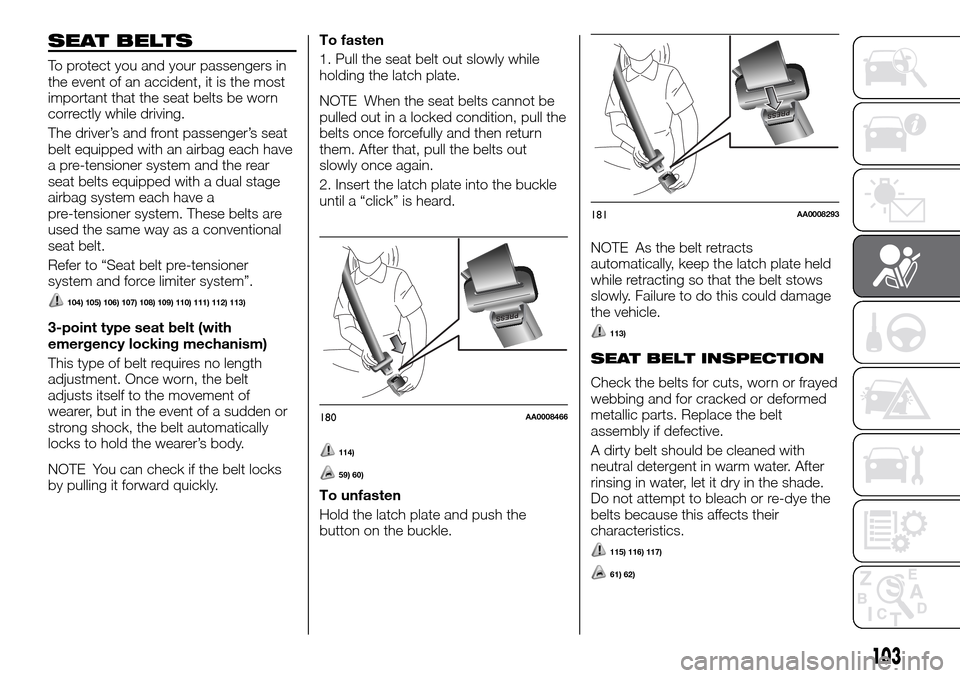
by pulling it forward quickly.To fasten
1. Pull the seat belt out slowly while
holding the latch plate.
NOTE When the seat belts cannot be
pulled out in a locked condition, pull the
belts once forcefully and then return
them. After that, pull the belts out
slowly once again.
2. Insert the latch plate into the buckle
until a “click” is heard.
114)
59) 60)
To unfasten
Hold the latch plate and push the
button on the buckle.NOTE As the belt retracts
automatically, keep the latch plate held
while retracting so that the belt stows
slowly. Failure to do this could damage
the vehicle.
113)
SEAT BELT INSPECTION
Check the belts for cuts, worn or frayed
webbing and for cracked or deformed
metallic parts. Replace the belt
assembly if defective.
A dirty belt should be cleaned with
neutral detergent in warm water. After
rinsing in water, let it dry in the shade.
Do not attempt to bleach or re-dye the
belts because this affects their
characteristics.
115) 116) 117)
61) 62)
180AA0008466
181AA0008293
103
Page 117 of 312
Child restraint
anchorage points
(Double cab)
(where provided)
When fitting a child restraint, always
follow the manufacturer’s instructions
using the approved anchorage points
shown and install the child restraint
fitting package.
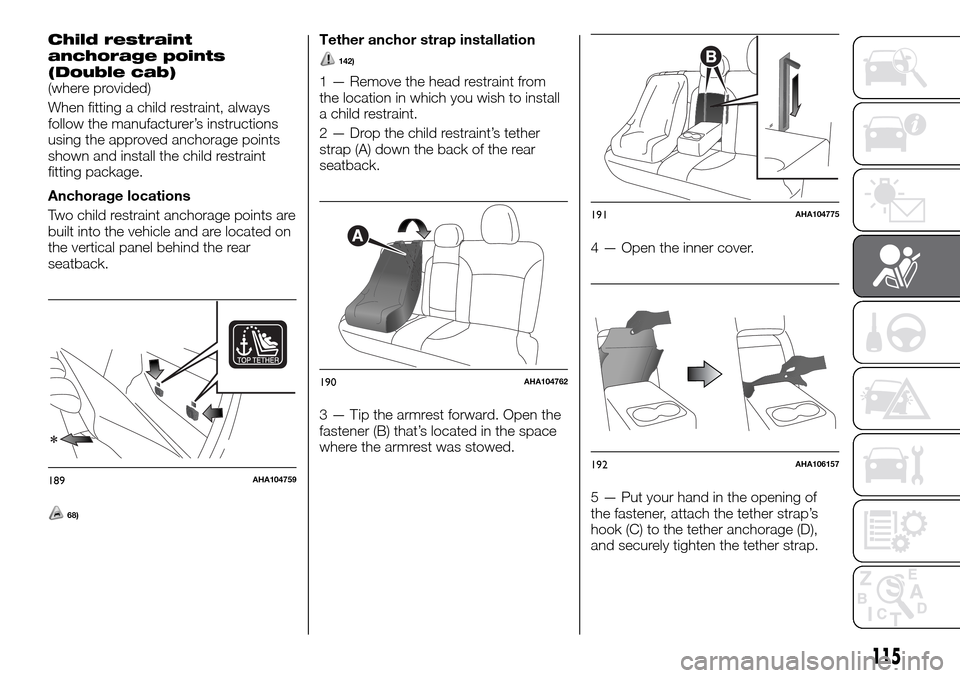
Anchorage locations
Two child restraint anchorage points are
built into the vehicle and are located on
the vertical panel behind the rear
seatback.
68)
Tether anchor strap installation
142)
1 — Remove the head restraint from
the location in which you wish to install
a child restraint.
2 — Drop the child restraint’s tether
strap (A) down the back of the rear
seatback.
3 — Tip the armrest forward. Open the
fastener (B) that’s located in the space
where the armrest was stowed.4 — Open the inner cover.
5 — Put your hand in the opening of
the fastener, attach the tether strap’s
hook (C) to the tether anchorage (D),
and securely tighten the tether strap.
189AHA104759
A
190AHA104762
B
191AHA104775
192AHA106157
115
Page 133 of 312
198)Do not turn the ignition switch to the
“LOCK” or “ACC” position or the operation
mode in ACC or OFF while the hill start
assist is operating. The hill start assist
could stop operating, which could result in
an accident.
IMPORTANT
69)Do not over-rely on the hill start assist
to prevent backwards movement of the
vehicle. Under certain circumstances, even
when hill start assist is activated, the
vehicle may move backwards if the brake
pedal is not sufficiently depressed, if the
vehicle is heavily loaded, if the road is very
steep or slippery or if the vehicle tows a
trailer, etc.
70)The hill start assist is not designed to
keep the vehicle stopped in place on uphill
slopes for more than 2 seconds.
71)If the warning is turn on, the hill start
assist will not operate. Start off carefully.
72)Park your vehicle in a safe place and
stop the engine. Restart the engine and
check whether the warning indicator went
out, in which case the hill start assist is
again working normally. If they warning
remains displayed or reappear frequently, it
is not necessary to stop the vehicle
immediately, but the vehicle should be
inspected by a Fiat Dealership.
73)Do not stop the engine while the
vehicle is moving. Stopping the engine
would make the steering wheel extremely
hard to turn, possibly resulting in an
accident.74)Do not leave the steering wheel turned
all the way in one direction. This can cause
damage to the power steering system.
131
Page 137 of 312
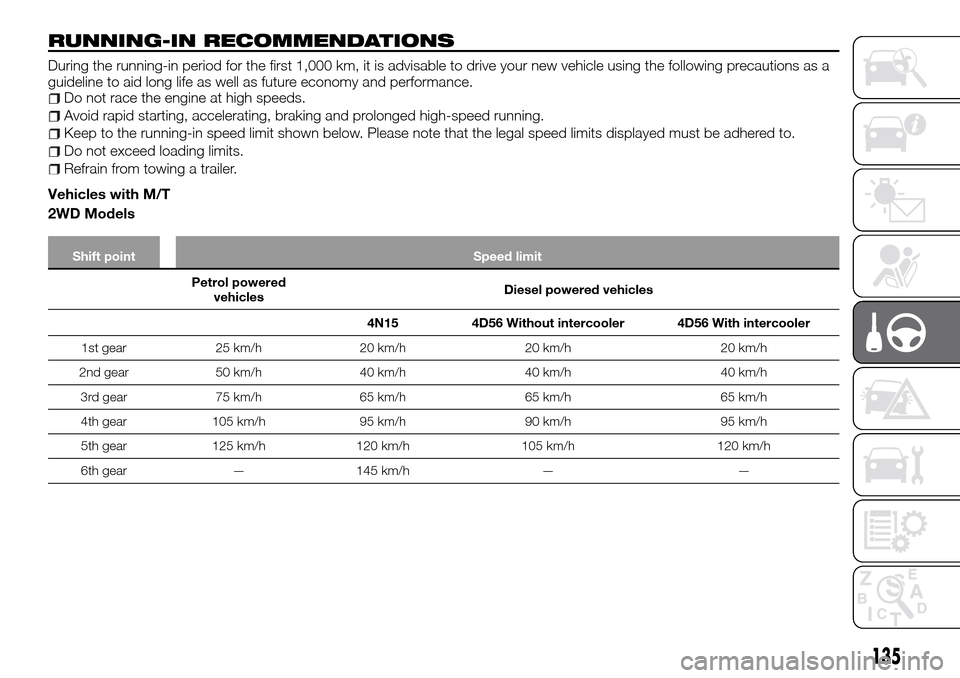
RUNNING-IN RECOMMENDATIONS
During the running-in period for the first 1,000 km, it is advisable to drive your new vehicle using the following precautions as a
guideline to aid long life as well as future economy and performance.
Do not race the engine at high speeds.
Avoid rapid starting, accelerating, braking and prolonged high-speed running.
Keep to the running-in speed limit shown below. Please note that the legal speed limits displayed must be adhered to.
Do not exceed loading limits.
Refrain from towing a trailer.
Vehicles with M/T
2WD Models
Shift point Speed limit
Petrol powered
vehiclesDiesel powered vehicles
4N15 4D56 Without intercooler 4D56 With intercooler
1st gear 25 km/h 20 km/h 20 km/h 20 km/h
2nd gear 50 km/h 40 km/h 40 km/h 40 km/h
3rd gear 75 km/h 65 km/h 65 km/h 65 km/h
4th gear 105 km/h 95 km/h 90 km/h 95 km/h
5th gear 125 km/h 120 km/h 105 km/h 120 km/h
6th gear — 145 km/h — —
135
Page 142 of 312
PARKING
To park the vehicle, fully engage the
parking brake, and then move the
gearshift lever to 1st or “R” (Reverse)
position for vehicles equipped with M/T,
or set the selector lever to “P” (PARK)
position for vehicles equipped with A/T.
Parking on a hill
To prevent the vehicle from rolling,
follow these procedures:
Parking on a downhill slope
Turn the front wheels towards the kerb
and move the vehicle forward until the
kerb side wheel gently touches the
kerb.
On vehicles equipped with M/T, apply
the parking brake and place the
gearshift lever into the “R” (Reverse)
position.
On vehicles equipped with A/T, apply
the parking brake and place the
selector lever into the “P” (PARK)
position. If necessary, apply chocks to
wheels.
Parking on a uphill slope
Turn the front wheels away from the
kerb and move the vehicle back until
the kerb side wheel gently touches the
kerb.
On vehicles equipped with M/T, apply
the parking brake and place the
gearshift lever into the 1st position.
On vehicles equipped with A/T, apply
the parking brake and place theselector lever into the “P” (PARK)
position. If necessary, apply chocks to
wheels.
If your vehicle is equipped with A/T, be
sure to apply the parking brake before
moving selector lever to the “P” (PARK)
position. If you move selector lever to
the “P” (PARK) position before applying
the parking brake, it may be difficult to
disengage selector lever from the “P”
(PARK) position when next you drive the
vehicle, requiring application of a strong
force the selector lever to move from
the “P” (PARK) position.
Parking with the engine running
Never leave the engine running while
you take a short sleep/rest. Also, never
leave the engine running in a closed or
poorly ventilated place.
When leaving the vehicle
Always carry the key and lock all doors
when leaving the vehicle unattended.
Always try to park your vehicle in a well
lit area.
201) 202)
WARNING
201)Leaving the engine running risks injury
or death from accidentally moving the
gearshift lever (with M/T) or the selector
lever (with A/T) or the accumulation of toxic
exhaust fumes on the passenger
compartment.202)Do not park your vehicle in areas
where combustible materials such as dry
grass or leaves can come in contact with a
hot exhaust, since a fire could occur.
140
STARTING AND DRIVING
Page 153 of 312
Selector lever positions
“P” PARK
This position locks the transmission to
prevent the vehicle from moving. The
engine can be started in this position.
“R” REVERSE
This position is to back up.
93)
“N” NEUTRAL
At this position the transmission is
disengaged. It is the same as the
neutral position on a manual
transmission, and should only be used
when the vehicle is stationary for an
extended length of time during driving,
such as in a traffic jam.
94) 95) 96)
“D” DRIVE
This position is used for most city and
highway driving. The transmission will
automatically change its gear
depending on road and driving
conditions.
97)
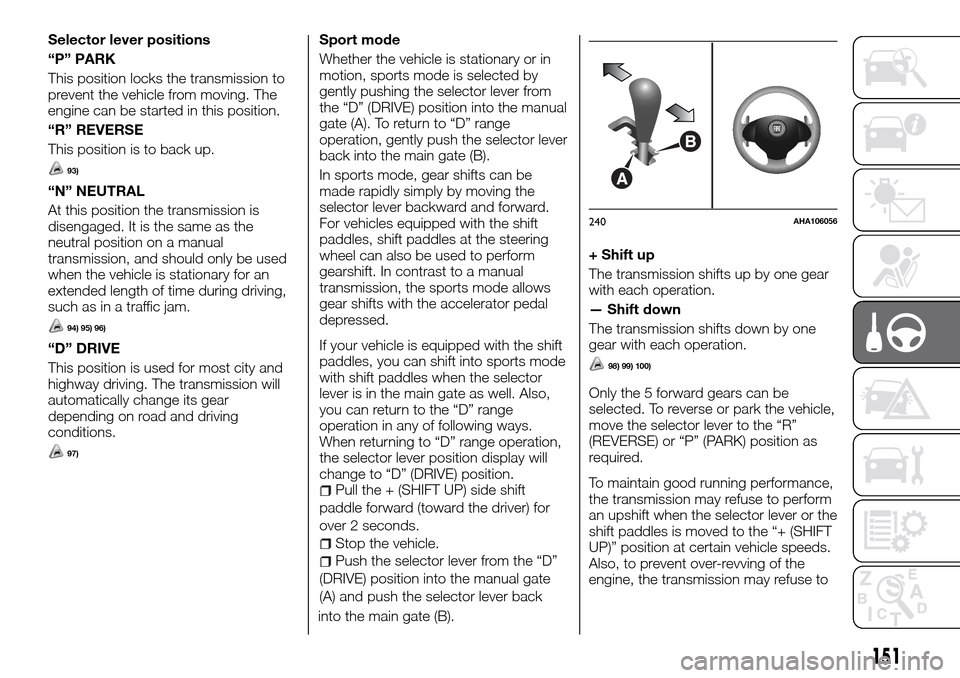
Sport mode
Whether the vehicle is stationary or in
motion, sports mode is selected by
gently pushing the selector lever from
the “D” (DRIVE) position into the manual
gate (A). To return to “D” range
operation, gently push the selector lever
back into the main gate (B).
In sports mode, gear shifts can be
made rapidly simply by moving the
selector lever backward and forward.
For vehicles equipped with the shift
paddles, shift paddles at the steering
wheel can also be used to perform
gearshift. In contrast to a manual
transmission, the sports mode allows
gear shifts with the accelerator pedal
depressed.
If your vehicle is equipped with the shift
paddles, you can shift into sports mode
with shift paddles when the selector
lever is in the main gate as well. Also,
you can return to the “D” range
operation in any of following ways.
When returning to “D” range operation,
the selector lever position display will
change to “D” (DRIVE) position.
Pull the + (SHIFT UP) side shift
paddle forward (toward the driver) for
over 2 seconds.
Stop the vehicle.
Push the selector lever from the “D”
(DRIVE) position into the manual gate
(A) and push the selector lever back
into the main gate (B).
+ Shift up
The transmission shifts up by one gear
with each operation.
— Shift down
The transmission shifts down by one
gear with each operation.
98) 99) 100)
Only the 5 forward gears can be
selected. To reverse or park the vehicle,
move the selector lever to the “R”
(REVERSE) or “P” (PARK) position as
required.
To maintain good running performance,
the transmission may refuse to perform
an upshift when the selector lever or the
shift paddles is moved to the “+ (SHIFT
UP)” position at certain vehicle speeds.
Also, to prevent over-revving of the
engine, the transmission may refuse to
B
A
240AHA106056
151
Page 175 of 312
117)Never cross a stream where the water
is deep. Do not change gears while
crossing the stream. Frequent crossing of
streams can adversely affect the life span
of the vehicle; we recommend you to take
the necessary measures to prepare,
inspect, and repair the vehicle.
118)After crossing a stream, apply the
brakes to be sure they are functioning
properly. If the brakes are wet and not
functioning properly, dry them out by
driving slowly while lightly depressing the
brake pedal. Inspect each part of the
vehicle carefully.
WARNING
218)When attempting to rock your vehicle
out of a stuck position, be sure that the
area around the vehicle is clear of people
and physical objects. The rocking motion
may cause the vehicle to suddenly launch
forward or backward, causing injury or
damage to nearby people or objects.
219)Go straight up. Do not try to traverse
across a steep slope.
220)If you begin to lose traction, ease off
the accelerator pedal and gently turn the
steering wheel alternatively left and right to
regain adequate traction again.
221)Avoid snaking down a sharp grade.
Descend the grade as straight as possible.
CAUTIONS ON
HANDLING OF
4 WHEEL DRIVE
VEHICLES
Tyres and wheels
Since the driving torque can be applied
to the 4 wheels, the performance of the
vehicle when operating in 4-wheel drive
is greatly affected by the condition of
the tyres.
Pay close attention to the tyres.
Install specified tyres on all wheels.
Refer to “Tyres and wheels”.
Be sure to the appropriate tyre
inflation pressure according to no cargo
or cargo. Refer to “Tyre inflation
pressures”.
Be sure to fit all 4 tyres and wheels of
the same size and type. When
replacement of any of the tyres or
wheels is necessary, replace all of them.
All tyres should be rotated whenever
the wear difference between the front
and rear tyres is recognizable.
Good vehicle performance cannot be
expected if there is a difference in wear
between tyres. Refer to “Tyre rotation”.
Check the tyre inflation pressure
regularly.
119)
Towing
If towing is necessary, we recommend
you to have it done by a Fiat Dealership
or a commercial tow truck service. In
the following cases, transport the
vehicle using a tow truck.
The engine runs but the vehicle does
not move or abnormal noise is
produced.
Inspection of the vehicle’s underside
reveals that oil or some other fluid is
leaking.
Only when you cannot receive a towing
service from a Fiat Dealership or
commercial tow truck service, tow your
vehicle carefully in accordance with the
instructions given in “Towing”.
173
Page 176 of 312
120)
Jacking up a 4-wheel drive vehicles
222)
Clutch operation
Quick or slight clutch engagement
made while the engine is running at
high speed will cause damage to the
clutch and transmission because the
tractive force is very great. Operate the
pedal slowly and positively.Limited-slip differential
A limited-slip differential is applied for
the rear wheel differential only. The
features of this limited-slip differential
are described below:
Just as with a conventional differential,
the wheel on one side is allowed to turn
at a different speed from the wheel on
the other side when the vehicle is
cornering. The difference between the
limited-slip differential and a
conventional differential is that if the
wheel on one side of the vehicle loses
traction, a greater amount of torque is
applied to the wheel on the other side
to improve traction.
Even if there is a difference in the
amount of traction the wheels can get,
if both of them are spinning, the
limited-slip differential will not be
effective.
121) 122)
IMPORTANT
119)Always use tyres of the same size,
same type, and same brand which have no
wear differences. Using the tyres which
differ in size, type, brands or the degree of
wear or the inappropriate tyre inflation
pressure, will increase the differential oil
temperature and may be impossible to shift
the transfer, resulting in possible damage to
the driving system. Further, the drive train
will be subjected to excessive loading,
possibly leading to oil leakage, component
seizure, or other serious faults.
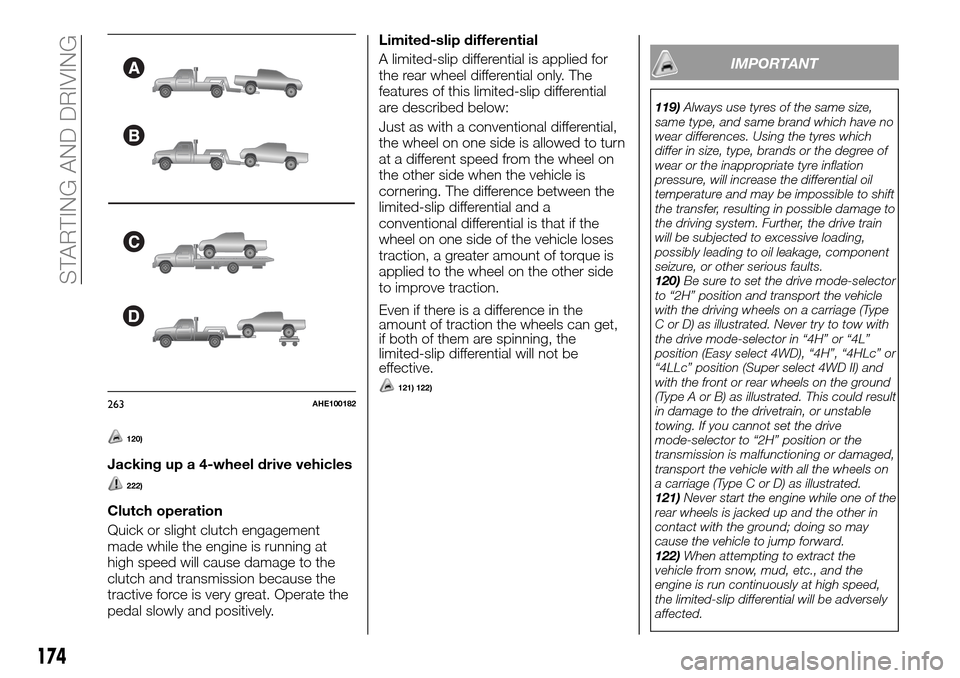
120)Be sure to set the drive mode-selector
to “2H” position and transport the vehicle
with the driving wheels on a carriage (Type
C or D) as illustrated. Never try to tow with
the drive mode-selector in “4H” or “4L”
position (Easy select 4WD), “4H”, “4HLc” or
“4LLc” position (Super select 4WD II) and
with the front or rear wheels on the ground
(Type A or B) as illustrated. This could result
in damage to the drivetrain, or unstable
towing. If you cannot set the drive
mode-selector to “2H” position or the
transmission is malfunctioning or damaged,
transport the vehicle with all the wheels on
a carriage (Type C or D) as illustrated.
121)Never start the engine while one of the
rear wheels is jacked up and the other in
contact with the ground; doing so may
cause the vehicle to jump forward.
122)When attempting to extract the
vehicle from snow, mud, etc., and the
engine is run continuously at high speed,
the limited-slip differential will be adversely
affected.
B
C
D
A
263AHE100182
174
STARTING AND DRIVING