air condition FIAT FULLBACK 2016 1.G Owner's Manual
[x] Cancel search | Manufacturer: FIAT, Model Year: 2016, Model line: FULLBACK, Model: FIAT FULLBACK 2016 1.GPages: 312, PDF Size: 13.67 MB
Page 84 of 312
engine warning lamp flashes, have the
system checked as soon as possible at
an authorised Fiat Dealership.
In diesel-powered vehicles, in case
cetane number (EN590) 51 or higher is
not available, use cetane number 45 or
higher.
In diesel-powered vehicles, poor-quality
diesel fuel can cause deposits form in
the injector, resulting in black smoke
and rough idling. If these problems
occur, you are advised to add a
cleaning additive to the diesel fuel when
you refuel the vehicle. The additive will
break up and remove the deposits,
thereby returning the engine to a normal
condition. Be sure to use a FCA
GENUINE DIESEL FUEL SYSTEM
CLEANER. Using an unsuitable additive
could make the engine malfunction. For
detailed, please contact the nearest
authorised Fiat Dealership.
IMPORTANT
33)For unleaded petrol-powered vehicles,
the use of leaded fuel can result in serious
damage to the engine and catalytic
converter. Do not use the leaded fuel.
34)Do not use more than 10 %
concentration of ethanol (grain alcohol) by
volume. Use of more than 10 %
concentration may lead to damage to your
vehicle fuel system, engine, engine sensors
and exhaust system.35)Do not operate your vehicle on petrol
containing methanol. Using this type of
alcohol could adversely affect the vehicle’s
performance and damage critical parts of
the vehicle’s fuel system.
36)Diesel-powered vehicles to comply with
the Euro 4 and Euro 5 regulation are
designed to use only diesel fuel that meets
the EN 590 standard. Use of any other type
of diesel fuel would adversely affect the
engine’s performance and durability.
37)Your vehicle is designed to use only
diesel fuel that meets the EN 590 standard.
Use of any other type of diesel fuel (bio
diesel, methylester, etc.) would adversely
affect the engine’s performance and
durability.
38)For diesel engines, only use diesel fuel
for motor vehicles in accordance with EN
590 European specifications. The use of
other products or mixtures may damage
the engine beyond repair and consequently
invalidate the warranty, due to the damage
caused. If you accidentally introduce other
types of fuel into the tank, do not start the
engine. Empty the tank. If the engine has
been run for even an extremely limited
amount of time, you must not only drain the
fuel tank, but the rest of the supply circuit
as well.
FILLING THE FUEL
TANK
86) 87) 88) 89) 90) 91) 92) 93) 94) 95) 96)
Fuel tank capacity: 75 litres.
1. Before filling with fuel, stop the
engine.
2. The fuel tank filler is located on the
rear left side of your vehicle.
Type 1,2
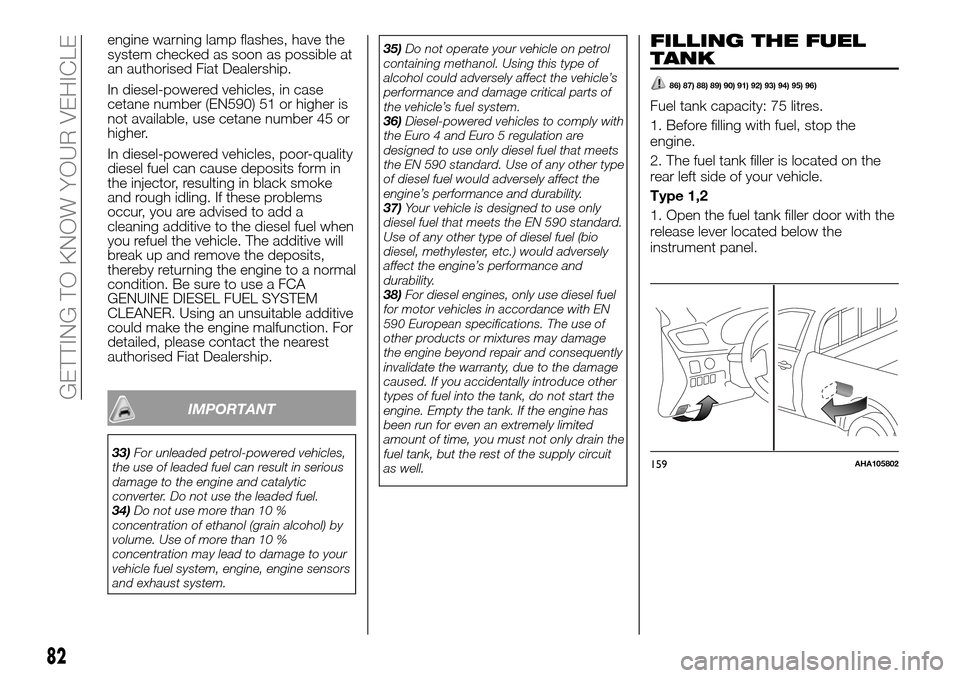
1. Open the fuel tank filler door with the
release lever located below the
instrument panel.
159AHA105802
82
GETTING TO KNOW YOUR VEHICLE
Page 91 of 312
between “Auto reset” and “Manual
reset”.
For information on how to change the
average fuel consumption display
setting, refer to “Changing the function
settings”.
NOTE The average fuel consumption
display can be reset separately for the
auto reset mode and for the manual
reset mode.
NOTE “---” is displayed when the
average fuel consumption cannot be
measured.
NOTE The initial (default) setting is
“Auto reset mode”.
NOTE The average fuel consumption
will depend on the driving conditions
(road conditions, how you drive, etc.).
The displayed fuel consumption may
vary from the actual fuel consumption.
Treat the fuel consumption displayed as
just a rough guideline.
NOTE The memory of the manual reset
mode or auto reset mode for the
average fuel consumption display is
erased if the battery is disconnected.
NOTE The display setting can be
changed to the preferred units {km/L,
L/100 km, mpg}. Refer to “Changing
the function settings”.Outside temperature display (if so
equipped)
This displays the temperature outside
the vehicle.
NOTE The display setting can be
changed to the preferred units (°C or
°F). Refer to “Changing the function
settings”.
NOTE Depending on factors such as
the driving conditions, the displayed
temperature may vary from the actual
outside temperature.
Frozen road warning (if so
equipped)
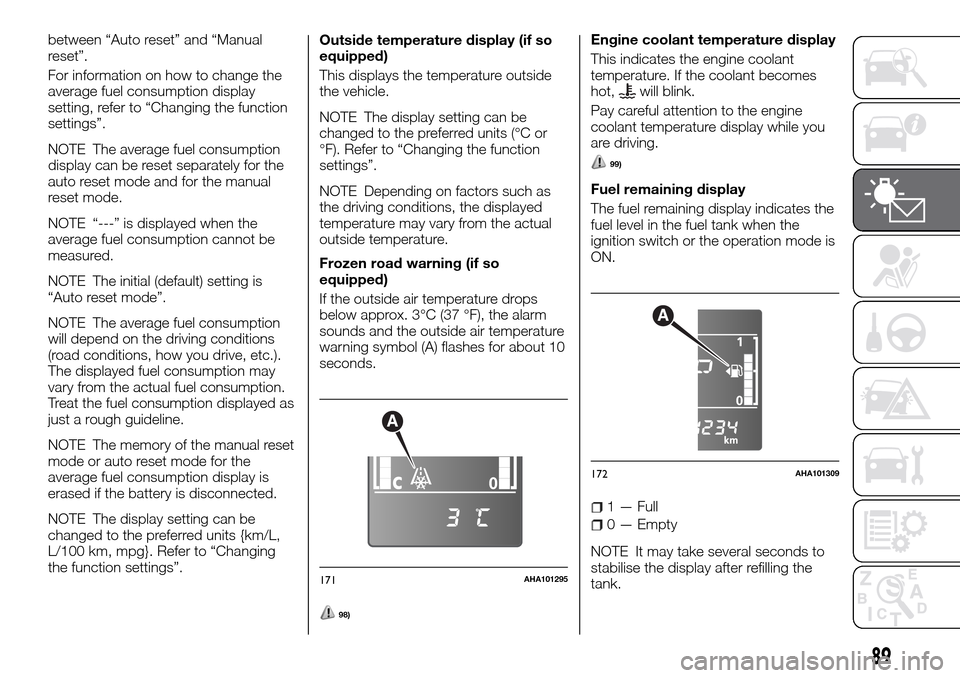
If the outside air temperature drops
below approx. 3°C (37 °F), the alarm
sounds and the outside air temperature
warning symbol (A) flashes for about 10
seconds.
98)
Engine coolant temperature display
This indicates the engine coolant
temperature. If the coolant becomes
hot,
will blink.
Pay careful attention to the engine
coolant temperature display while you
are driving.
99)
Fuel remaining display
The fuel remaining display indicates the
fuel level in the fuel tank when the
ignition switch or the operation mode is
ON.
1 — Full
0 — Empty
NOTE It may take several seconds to
stabilise the display after refilling the
tank.
A
171AHA101295
A
172AHA101309
89
Page 94 of 312
Auto reset modeWhen the average fuel consumption
is being displayed, if you hold down the
multi information display switch, the
average fuel consumption displayed at
that time are reset.
When the engine switch or the
operation mode is in the following
conditions, the average fuel
consumption display is automatically
reset. Except for vehicles equipped with
the keyless operation system: the
ignition switch is in the “ACC” or
“LOCK” position for about 4 hours or
longer. For vehicles equipped with the
keyless operation system: the operation
mode is in ACC or OFF for about
4 hours or longer.
IMPORTANT The average fuel
consumption display can be reset
separately for the auto reset mode and
for the manual reset mode.
IMPORTANT The memory of the
manual reset mode or auto reset mode
for the average fuel consumption
display is erased if the battery is
disconnected.
The initial (default) setting is “Auto reset
mode”.Changing the fuel consumption
display unit
The display unit for fuel consumption
can be switched. The distance and
amount units are also switched to
match the selected fuel consumption
unit.When you lightly press the multi
information display switch a few times,
the information display switches to the
average fuel consumption display. Refer
to “Information display”.
Press and hold the multi information
display switch for about 5 seconds or
more until buzzer sound is heard twice.
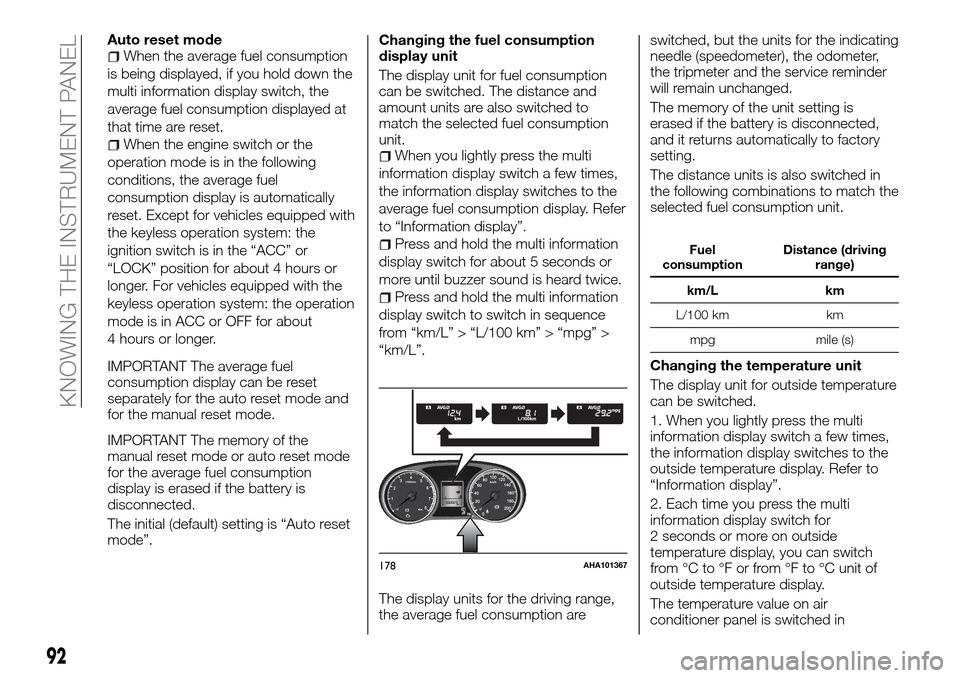
Press and hold the multi information
display switch to switch in sequence
from “km/L” > “L/100 km” > “mpg” >
“km/L”.
The display units for the driving range,
the average fuel consumption areswitched, but the units for the indicating
needle (speedometer), the odometer,
the tripmeter and the service reminder
will remain unchanged.
The memory of the unit setting is
erased if the battery is disconnected,
and it returns automatically to factory
setting.
The distance units is also switched in
the following combinations to match the
selected fuel consumption unit.
Fuel
consumptionDistance (driving
range)
km/L km
L/100 km km
mpg mile (s)
Changing the temperature unit
The display unit for outside temperature
can be switched.
1. When you lightly press the multi
information display switch a few times,
the information display switches to the
outside temperature display. Refer to
“Information display”.
2. Each time you press the multi
information display switch for
2 seconds or more on outside
temperature display, you can switch
from °C to °F or from °F to °C unit of
outside temperature display.
The temperature value on air
conditioner panel is switched in
178AHA101367
92
KNOWING THE INSTRUMENT PANEL
Page 95 of 312
conjunction with outside temperature
display unit of the multi information
display. However, “°C” or “°F” are not
shown to temperature display of an air
conditioner.
WARNING
98)There is a danger the road might be
icy, even when this symbol is not flashing,
so please take care when driving.
99)If the engine is overheating, “
” will
blink. In this case, the bar graph is on the
red zone. Immediately park the vehicle in a
safe place and take the required measures.
Refer to “Engine overheating”.
100)The driver should not operate the
display while the vehicle is in motion.
101)When operating the system, stop the
vehicle in a safe area.
IMPORTANT
40)For petrol-powered vehicles with
catalytic converter and for diesel-powered
vehicles: do not drive with an extremely low
fuel level, running out of fuel could cause
damage to the fuel system.
41)The customer is responsible for making
sure that periodic inspection and
maintenance are performed. Inspections
and maintenance must be performed to
prevent accidents and malfunctions.
93
Page 103 of 312
47)If the vehicle is towed with the ignition
switch in the “ON” position or the operation
mode in ON and only the front wheels or
only the rear wheels raised off the ground,
the ASTC may operate, resulting in an
accident. When towing the vehicle with the
front wheels raised, keep the ignition switch
in the “LOCK” or “ACC” position or the
operation mode in ACC or OFF. When
towing the vehicle with the rear wheels
raised, keep the ignition switch in the
“ACC” position or the operation mode in
ACC. Refer to “Towing”.
48)Prolonged driving with this lamp on
may cause further damage to the emission
control system. It could also affect fuel
economy and drivability.
49)If the lamp does not illuminate when the
ignition switch is turned to the “ON”
position or the operation mode is put in
ON, we recommend you to have the
system checked.
50)If the lamp illuminates while the engine
is running, avoid driving at high speeds and
have the system inspected by a Fiat
Dealership as soon as possible. Accelerator
pedal and brake pedal response may be
negatively influenced under these
conditions.
51)If it illuminates while the engine is
running, there is a problem in the charging
system. Immediately park your vehicle in a
safe place and we recommend you to have
it checked.
52)If this lamp illuminates when the engine
oil level is not low, have it inspected.
53)This warning lamp does not indicate
the amount of oil in the crankcase. This
must be determined by checking the oil
level on the dipstick, while the engine is
switched off.54)If you continue driving with low engine
oil level or with this warning lamp
illuminated, engine seizure may occur.
55)Before moving your vehicle, check that
the warning lamp is OFF.
56)If any of the following conditions occur,
there may be a problem with the SRS
airbags and/or seat belt pre-tensioners,
and they may not function properly in a
collision or may suddenly activate without a
collision: 1 – Even when the ignition switch
or the operation mode is in ON, the SRS
warning lamp does not come on or it
remains on. 2 – The SRS warning lamp
comes on while driving.
57)The SRS airbags and seat belt
pre-tensioners are designed to help reduce
the risk of serious injury or death in certain
collisions. If either of the above conditions
occurs, immediately have your vehicle
checked by a Fiat Dealership.
58)Any of the following indicates that the
ABS is not functioning and only the
standard brake system is working. (The
standard brake system is functioning
normally.) If this happens, take your vehicle
to a Fiat Dealership.
101
Page 105 of 312
SEAT BELTS
To protect you and your passengers in
the event of an accident, it is the most
important that the seat belts be worn
correctly while driving.
The driver’s and front passenger’s seat
belt equipped with an airbag each have
a pre-tensioner system and the rear
seat belts equipped with a dual stage
airbag system each have a
pre-tensioner system. These belts are
used the same way as a conventional
seat belt.
Refer to “Seat belt pre-tensioner
system and force limiter system”.
104) 105) 106) 107) 108) 109) 110) 111) 112) 113)
3-point type seat belt (with
emergency locking mechanism)
This type of belt requires no length
adjustment. Once worn, the belt
adjusts itself to the movement of
wearer, but in the event of a sudden or
strong shock, the belt automatically
locks to hold the wearer’s body.
NOTE You can check if the belt locks
by pulling it forward quickly.To fasten
1. Pull the seat belt out slowly while
holding the latch plate.
NOTE When the seat belts cannot be
pulled out in a locked condition, pull the
belts once forcefully and then return
them. After that, pull the belts out
slowly once again.
2. Insert the latch plate into the buckle
until a “click” is heard.
114)
59) 60)
To unfasten
Hold the latch plate and push the
button on the buckle.NOTE As the belt retracts
automatically, keep the latch plate held
while retracting so that the belt stows
slowly. Failure to do this could damage
the vehicle.
113)
SEAT BELT INSPECTION
Check the belts for cuts, worn or frayed
webbing and for cracked or deformed
metallic parts. Replace the belt
assembly if defective.
A dirty belt should be cleaned with
neutral detergent in warm water. After
rinsing in water, let it dry in the shade.
Do not attempt to bleach or re-dye the
belts because this affects their
characteristics.
115) 116) 117)
61) 62)
180AA0008466
181AA0008293
103
Page 108 of 312
WARNING
118)When adjusting the seat belt anchor,
set it at a position that is sufficiently high so
that the belt will make full contact with your
shoulder but will not touch your neck.
PRETENSIONERS
AND FORCE LIMITER
SYSTEM
(where provided)
119) 120) 121) 122)
64) 65) 66) 67)
The driver’s and front passenger’s seat
equipped with airbags each have a
pretensioner seat belt and force limiter
system.
Pretensioner system
When the ignition switch or the
operation mode is under the following
conditions, if there is a frontal impact or
a side impact (vehicles equipped with
SRS side airbags and SRS curtain
airbags) severe enough to injure the
driver and/or front passenger, the
pretensioner system will retract their
respective seat belts instantaneously,
thus maximizing the seat belt’s
effectiveness.
Except for vehicles equipped with the
keyless operation system: the ignition
switch is in the “ON” or “START”
position.
Vehicles equipped with the keyless
operation system: the operation mode
is in ON.
NOTE The pretensioner seat belts will
be activated if the vehicle suffers a
severe impact, even if the seat belts are
not worn.NOTE The pretensioner seat belts are
designed to work only once. After the
pretensioner seat belts have been
activated, we recommend you to have
them replaced by a Fiat Dealership.
SRS warning lamp (where provided)
This warning lamp is shared by the SRS
airbags and the pre-tensioner seat
belts. Refer to “SRS warning lamp”.
Force limiter system
In the event of a collision, each force
limiter system will effectively absorb the
load applied to the seat belt so as to
minimize the impact to the passenger.
WARNING
119)The pretensioner may be used only
once. After it is triggered, have it replaced
at a Fiat Dealership.
120)Removing or otherwise tampering
with pretensioner and seat belt
components is strictly prohibited. Any
intervention on these components must be
performed by qualified and authorised
technicians. Always go to a Fiat Dealership.
121)For maximum safety, keep the
backrest upright, lean back into it and
make sure the seat belt fits closely across
your chest and pelvis. Always fasten the
seat belts for both the front and rear seats!
Travelling without wearing seat belts will
increase the risk of serious injury and even
death in the event of an accident.
106
SAFETY
Page 120 of 312
SUPPLEMENTAL
RESTRAINT SYSTEM
AIRBAG
The information for SRS airbags
includes important information
concerning the driver’s and front
passenger’s airbags, the driver’s knee
airbag, the side airbags and the curtain
airbags.
The SRS driver’s and front passenger’s
airbags are designed to supplement the
primary protection of the driver and
front passenger side seat belt systems
by providing those occupants with
protection against head and chest
injuries in certain moderate-to-severe
frontal collisions.
The SRS driver airbag employ a dual
stage airbag system (if so equipped).
The SRS driver and front passenger
airbag is controlled by the impact
sensors (at the front of the vehicle) and
the control unit (near the centre of the
vehicle at floor level).
The SRS driver’s knee airbag (if so
equipped) is designed to supplement
the primary protection of the driver’s
seat belt system. It can reduce the
forward movement of the driver’s lower
legs and provide increased overall body
protection in certain moderate-to-
severe frontal collisions.
The SRS side airbags (if so equipped)
are designed to supplement properly
worn seat belts and provide the driver
and front passenger with protectionagainst chest injuries in certain
moderate-to-severe side impact
collisions.
The SRS curtain airbags (if so
equipped) are designed to supplement
properly worn seat belts and provide
the driver and passenger with
protection against head injuries in
certain moderate-to-severe side impact
collisions.
The SRS is NOT a substitute for the
seat belts. To ensure the maximum
protection during all types of collisions
and accidents, all occupants, including
the passengers as well as the driver,
must wear their seat belts.
How the supplemental restraint
system works
The SRS includes the following
components:
1. Airbag module (Driver)*
2. Airbag module (Passenger)*3. Driver’s knee airbag module*
* If so equipped
4. Side airbag modules*
5. Curtain airbag modules*
* If so equipped
Only when the ignition switch or the
operation mode is under the following
conditions, the airbags will operate.
Except for vehicles equipped with the
keyless operation system: the ignition
switch is in the “ON” or “START”
position.
Vehicles equipped with the keyless
operation system: the operation mode
is in ON.
The airbags deployment produces a
sudden, loud noise, and releases some
smoke and powder, but these
conditions are not injurious, and do not
indicate a fire in the vehicle. People with
respiratory problems may feel some
56
7
8120
140
160
180
200
LROFF3 2 14
3
2
1
199AHA105684
5
4
200AHA103101
118
SAFETY
Page 122 of 312
Deployment of front
airbags and driver’s
knee airbag
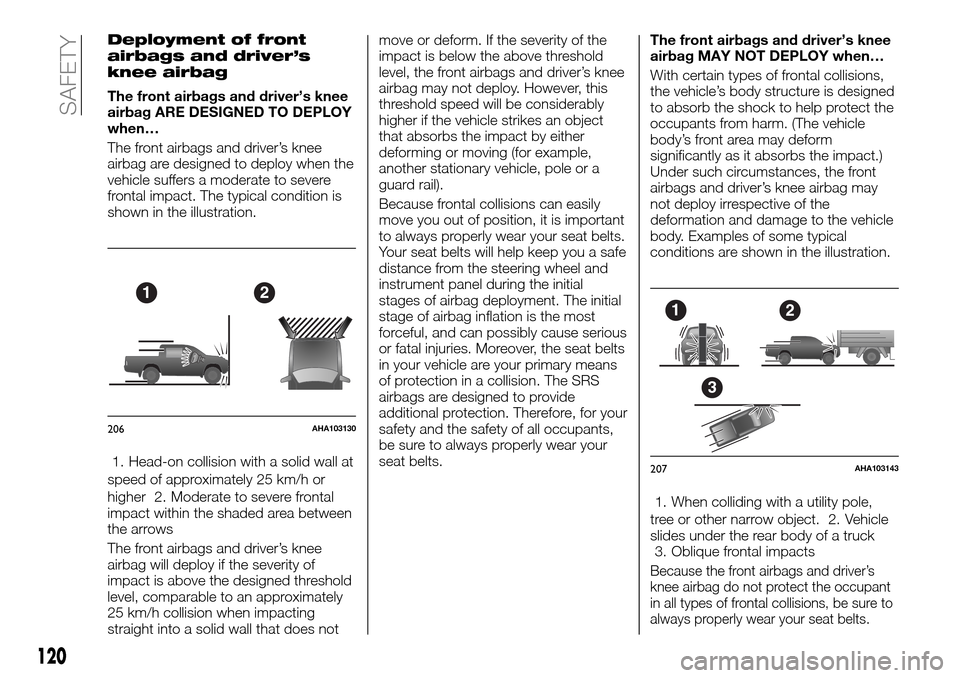
The front airbags and driver’s knee
airbag ARE DESIGNED TO DEPLOY
when…
The front airbags and driver’s knee
airbag are designed to deploy when the
vehicle suffers a moderate to severe
frontal impact. The typical condition is
shown in the illustration.
1. Head-on collision with a solid wall at
speed of approximately 25 km/h or
higher 2. Moderate to severe frontal
impact within the shaded area between
the arrows
The front airbags and driver’s knee
airbag will deploy if the severity of
impact is above the designed threshold
level, comparable to an approximately
25 km/h collision when impacting
straight into a solid wall that does notmove or deform. If the severity of the
impact is below the above threshold
level, the front airbags and driver’s knee
airbag may not deploy. However, this
threshold speed will be considerably
higher if the vehicle strikes an object
that absorbs the impact by either
deforming or moving (for example,
another stationary vehicle, pole or a
guard rail).
Because frontal collisions can easily
move you out of position, it is important
to always properly wear your seat belts.
Your seat belts will help keep you a safe
distance from the steering wheel and
instrument panel during the initial
stages of airbag deployment. The initial
stage of airbag inflation is the most
forceful, and can possibly cause serious
or fatal injuries. Moreover, the seat belts
in your vehicle are your primary means
of protection in a collision. The SRS
airbags are designed to provide
additional protection. Therefore, for your
safety and the safety of all occupants,
be sure to always properly wear your
seat belts.The front airbags and driver’s knee
airbag MAY NOT DEPLOY when…
With certain types of frontal collisions,
the vehicle’s body structure is designed
to absorb the shock to help protect the
occupants from harm. (The vehicle
body’s front area may deform
significantly as it absorbs the impact.)
Under such circumstances, the front
airbags and driver’s knee airbag may
not deploy irrespective of the
deformation and damage to the vehicle
body. Examples of some typical
conditions are shown in the illustration.
1. When colliding with a utility pole,
tree or other narrow object. 2. Vehicle
slides under the rear body of a truck
3. Oblique frontal impacts
Because the front airbags and driver’s
knee airbag do not protect the occupant
in all types of frontal collisions, be sure to
always properly wear your seat belts.
12
206AHA103130
2
3
1
207AHA103143
120
SAFETY
Page 123 of 312
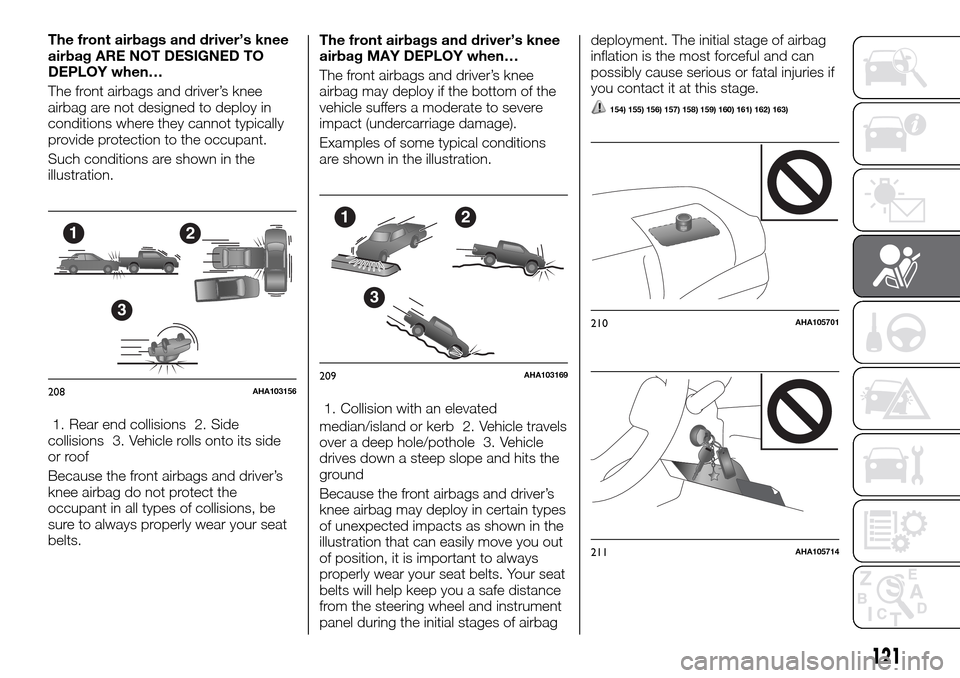
The front airbags and driver’s knee
airbag ARE NOT DESIGNED TO
DEPLOY when…
The front airbags and driver’s knee
airbag are not designed to deploy in
conditions where they cannot typically
provide protection to the occupant.
Such conditions are shown in the
illustration.
1. Rear end collisions 2. Side
collisions 3. Vehicle rolls onto its side
or roof
Because the front airbags and driver’s
knee airbag do not protect the
occupant in all types of collisions, be
sure to always properly wear your seat
belts.The front airbags and driver’s knee
airbag MAY DEPLOY when…
The front airbags and driver’s knee
airbag may deploy if the bottom of the
vehicle suffers a moderate to severe
impact (undercarriage damage).
Examples of some typical conditions
are shown in the illustration.
1. Collision with an elevated
median/island or kerb 2. Vehicle travels
over a deep hole/pothole 3. Vehicle
drives down a steep slope and hits the
ground
Because the front airbags and driver’s
knee airbag may deploy in certain types
of unexpected impacts as shown in the
illustration that can easily move you out
of position, it is important to always
properly wear your seat belts. Your seat
belts will help keep you a safe distance
from the steering wheel and instrument
panel during the initial stages of airbagdeployment. The initial stage of airbag
inflation is the most forceful and can
possibly cause serious or fatal injuries if
you contact it at this stage.
154) 155) 156) 157) 158) 159) 160) 161) 162) 163)
2
3
1
208AHA103156
2
3
1
209AHA103169
210AHA105701
211AHA105714
121