check engine FIAT FULLBACK 2016 1.G Owner's Manual
[x] Cancel search | Manufacturer: FIAT, Model Year: 2016, Model line: FULLBACK, Model: FIAT FULLBACK 2016 1.GPages: 312, PDF Size: 13.67 MB
Page 144 of 312
If the engine still will not start, the
engine could be flooded with too much
petrol. While depressing the clutch
pedal, push the accelerator pedal all the
way down and hold it there, then crank
the engine for 5 to 6 seconds. Return
the ignition switch to the “LOCK”
position and release the accelerator
pedal. Wait a few seconds, and then
crank the engine again for 5 to
6 seconds while depressing the clutch
pedal, but do not push the accelerator
pedal. Release the ignition key if the
engine starts. If the engine fails to start,
repeat these procedures. If the engine
still will not start, we recommend you to
have the vehicle checked.
To protect the engine, the high-speed
mode may not be selected while the
engine coolant temperature is low. In
such a case, the engine revolutions do
not rise to over 5,000 rpm even if the
accelerator pedal is depressed.For vehicles equipped with the
keyless operation system
Your vehicles equipped with an
electronically controlled fuel injection
system. When starting the engine, do
not depress the accelerator pedal.
The starting procedure is as follows:
Fasten the seat belt.
Make sure the parking brake is
applied.
Press and hold the brake pedal
down firmly with your right foot.
Depress the clutch pedal all the way
and place the gearshift lever in the “N”
(Neutral) position.
Press the engine switch.
Make certain that all warning lamps
are functioning properly.
When the engine is not started, it may
become hard to depress the brake
pedal and the vehicle may not be able
to detect the pedal operation. Therefore
the engine may not be started. In such
a case, depress the brake pedal more
firmly than usual.
A ticking noise may be heard after
starting the engine. This is not an
abnormal condition. The noise will
disappear after a short time of engine
running. If the ticking noise continues
after the engine is warmed up, have
your vehicle checked at a Fiat
Dealership.
Minor noises may be heard on engine
startup. These will disappear as the
engine warms up.When the engine is hard to start
After several attempts, you may
experience that the engine still does not
start.
Make sure that all electric devices,
such as lamps, air conditioning blower
and rear window demister, are turned
off.
While depressing the clutch pedal,
press the accelerator pedal halfway and
hold it there, then crank the engine.
Release the accelerator pedal,
immediately after the engine starts.
If the engine still will not start, the
engine could be flooded with too much
petrol. While depressing the clutch
pedal, push the accelerator pedal all the
way down and hold it there, then press
the engine switch to crank the engine. If
the engine does not start after 5 to
6 seconds, press the engine switch to
stop the engine, and release the
accelerator pedal. Put the operation
mode in OFF. Wait a few seconds, and
then press the engine switch to crank
the engine again while depressing the
brake pedal or the clutch pedal, but do
not push the accelerator pedal. If the
engine fails to start, repeat these
procedures. If the engine still will not
start, we recommend you to have the
vehicle checked.
To protect the engine, the high-speed
mode may not be selected while the
142
STARTING AND DRIVING
Page 155 of 312
Operation of the A/T
103) 104) 105) 106) 107) 108)
Passing acceleration
To gain extra acceleration in “D” (DRIVE)
position, push the accelerator to the
floor. The A/T will automatically
downshift.
In sport mode, downshifts do not take
place when the accelerator is
depressed all the way to the floor.
Waiting
For short waiting periods, such as at
traffic signals the vehicle can be left in
gear and held stationary with the
service brake. For longer waiting
periods with the engine running, place
the selector lever in the “N” (NEUTRAL)
position and apply the parking brake,
while holding the vehicle stationary with
the service brake.
109)
Parking
To park the vehicle, first bring it to a
complete stop, fully engage the parking
brake, and then move the selector lever
to the “P” (PARK) position.
If you are going to leave the vehicle
unattended, always switch off the
engine and carry the key.
On a slope, be sure to apply the
parking brake before moving the
selector lever to the “P” (PARK)
position. If you move the selector lever
to the “P” (PARK) position beforeapplying the parking brake, it may be
difficult to disengage the selector lever
from the “P” (PARK) position when next
you drive the vehicle, requiring
application of a strong force to the
selector lever to move from the “P”
(PARK) position.
When the A/T makes no speed
change
If the transmission does not change
speeds while driving, or your vehicle
does not pick up enough speed when
starting on an uphill slope, it may be
that there is something unusual
happening in the transmission, causing
a safety device to activate. Have your
vehicle checked by a Fiat Dealership as
soon as possible.
1. If your vehicle has difficulty moving
uphill, shift the selector lever into 2nd
gear of the sports mode. This method
might not work depending on the
transmission malfunction.
2. Once the vehicle is moving on a level
road, move the selector lever back to
“D” (DRIVE).
When the selector lever position display
in the instrument panel blinks, it means
that there is an abnormal condition in
the transmission. Refer to “When the
selector lever position display blinks”.
IMPORTANT
92)Always depress the brake pedal when
shifting the selector lever into a gear from
the “P” (PARK) or “N” (NEUTRAL) position.
Never put your foot on the accelerator
pedal while shifting the selector lever from
the “P” (PARK) or “N” (NEUTRAL) position.
93)Never shift into the “P” (PARK) or “R”
(REVERSE) position while the vehicle is in
motion to avoid a transmission damage.
94)Never move the selector lever to the
“N” (NEUTRAL) position while driving. A
serious accident could occur since you
could accidentally move the lever into the
“P” (PARK) or “R” (REVERSE) position or
you will lose engine braking.
95)On a gradient, the engine should be
started in the “P” (PARK) position, not in the
“N” (NEUTRAL) position.
96)To prevent rolling, always keep your
foot on the brake pedal when the vehicle is
in “N” (NEUTRAL) position, or when shifting
into or out of “N” (NEUTRAL) position.
97)To prevent transmission damage, never
shift into the “D” (DRIVE) position from the
“R” (REVERSE) position while the vehicle is
in motion.
98)In sports mode, the driver must
execute upward shifts in accordance with
prevailing road conditions, taking care to
keep the engine speed below the red zone.
99)Repeated continuous operation of the
selector lever or the shift paddles will
continuously switch shift position.
153
Page 164 of 312
209)If a problem is detected in the transfer
system, a safety device will activate. The
2WD/4WD operation indicator blinks (twice
per second), and transfer shifting will
become impossible. Park your vehicle in a
safe place, turn off the engine for a few
moments. Restart the engine. The lamp
should resume normal operation. If the
lamp continue to blink, have the vehicle
checked by a Fiat Dealership as soon as
possible.SUPER SELECT 4WD
II
(where provided)
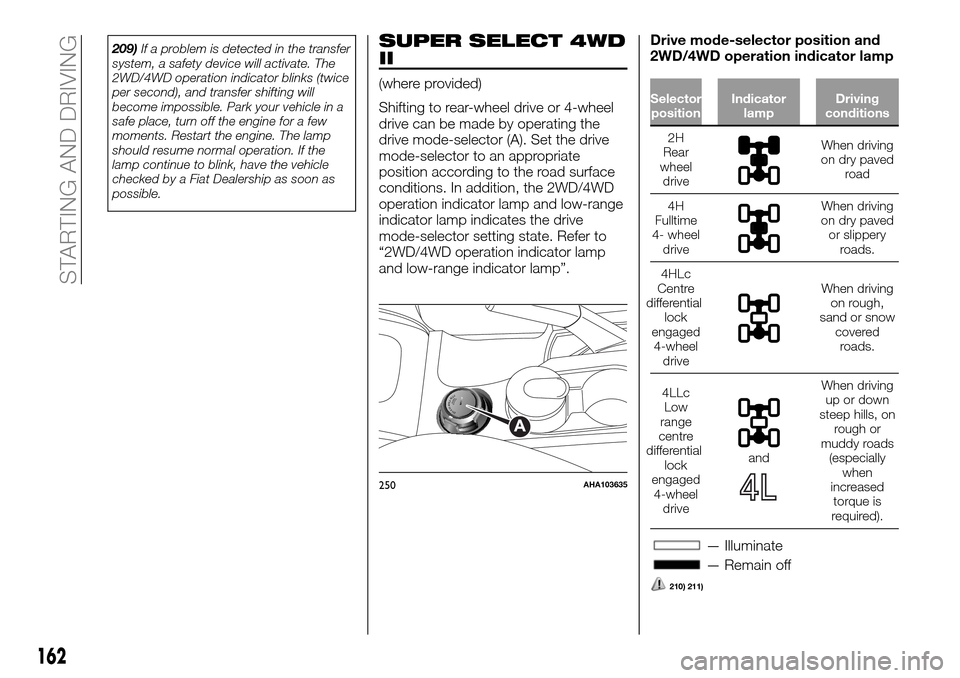
Shifting to rear-wheel drive or 4-wheel
drive can be made by operating the
drive mode-selector (A). Set the drive
mode-selector to an appropriate
position according to the road surface
conditions. In addition, the 2WD/4WD
operation indicator lamp and low-range
indicator lamp indicates the drive
mode-selector setting state. Refer to
“2WD/4WD operation indicator lamp
and low-range indicator lamp”.Drive mode-selector position and
2WD/4WD operation indicator lampSelector
positionIndicator
lampDriving
conditions
2H
Rear
wheel
driveWhen driving
on dry paved
road
4H
Fulltime
4- wheel
drive
When driving
on dry paved
or slippery
roads.
4HLc
Centre
differential
lock
engaged
4-wheel
drive
When driving
on rough,
sand or snow
covered
roads.
4LLc
Low
range
centre
differential
lock
engaged
4-wheel
drive
and
When driving
up or down
steep hills, on
rough or
muddy roads
(especially
when
increased
torque is
required).
— Illuminate
— Remain off
210) 211)
250AHA103635
162
STARTING AND DRIVING
Page 168 of 312
WARNING
210)The “4LLc” range gives maximum
torque for low-speed driving on steep
slopes, as well as sandy, muddy, and other
difficult surfaces. On vehicles with
automatic transmission, do not exceed
speeds of approximately 70 km/h in “4LLc”
range.
211)Do not drive your vehicle in the
“4HLc” or “4LLc” position on dry paved
roads and highways. Doing so may result
in excessive tyre wear, increased fuel
consumption, and possible noise
generation. It may also increase the
differential oil temperature, which may
damage the drive system. Further, the drive
train will be subjected to excessive loading,
resulting in oil leakage, component seizure,
or other serious problems. On dry paved
roads and highways, drive the vehicle in
“2H” or “4H” only.212)Do not operate the drive
mode-selector while the rear wheels of the
vehicle are slipping on snow or ice.
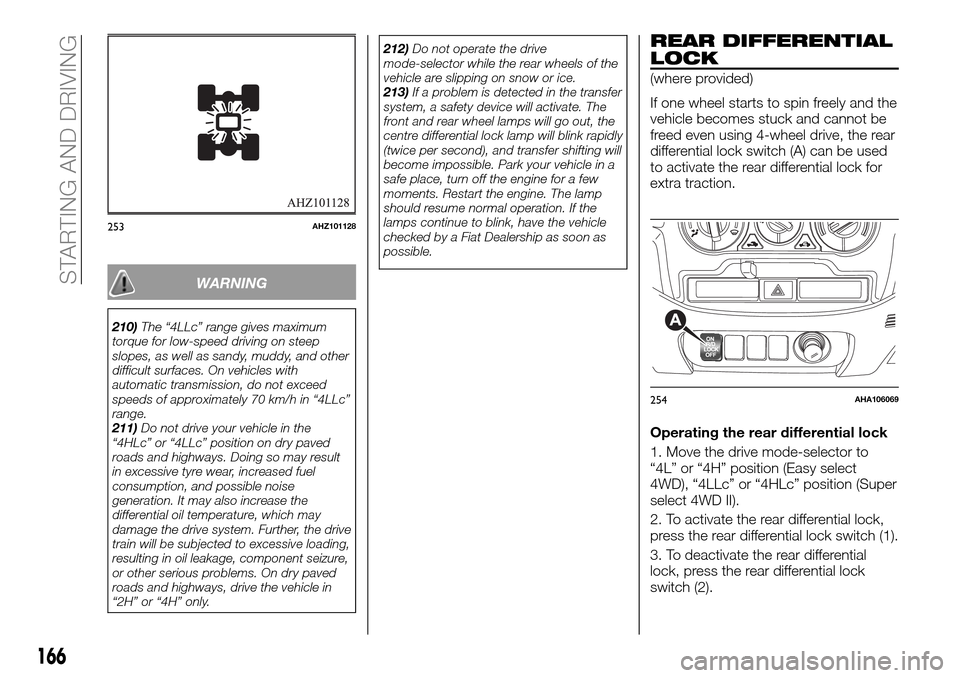
213)If a problem is detected in the transfer
system, a safety device will activate. The
front and rear wheel lamps will go out, the
centre differential lock lamp will blink rapidly
(twice per second), and transfer shifting will
become impossible. Park your vehicle in a
safe place, turn off the engine for a few
moments. Restart the engine. The lamp
should resume normal operation. If the
lamps continue to blink, have the vehicle
checked by a Fiat Dealership as soon as
possible.
REAR DIFFERENTIAL
LOCK
(where provided)
If one wheel starts to spin freely and the
vehicle becomes stuck and cannot be
freed even using 4-wheel drive, the rear
differential lock switch (A) can be used
to activate the rear differential lock for
extra traction.
Operating the rear differential lock
1. Move the drive mode-selector to
“4L” or “4H” position (Easy select
4WD), “4LLc” or “4HLc” position (Super
select 4WD II).
2. To activate the rear differential lock,
press the rear differential lock switch (1).
3. To deactivate the rear differential
lock, press the rear differential lock
switch (2).
253AHZ101128
254AHA106069
166
STARTING AND DRIVING
Page 171 of 312
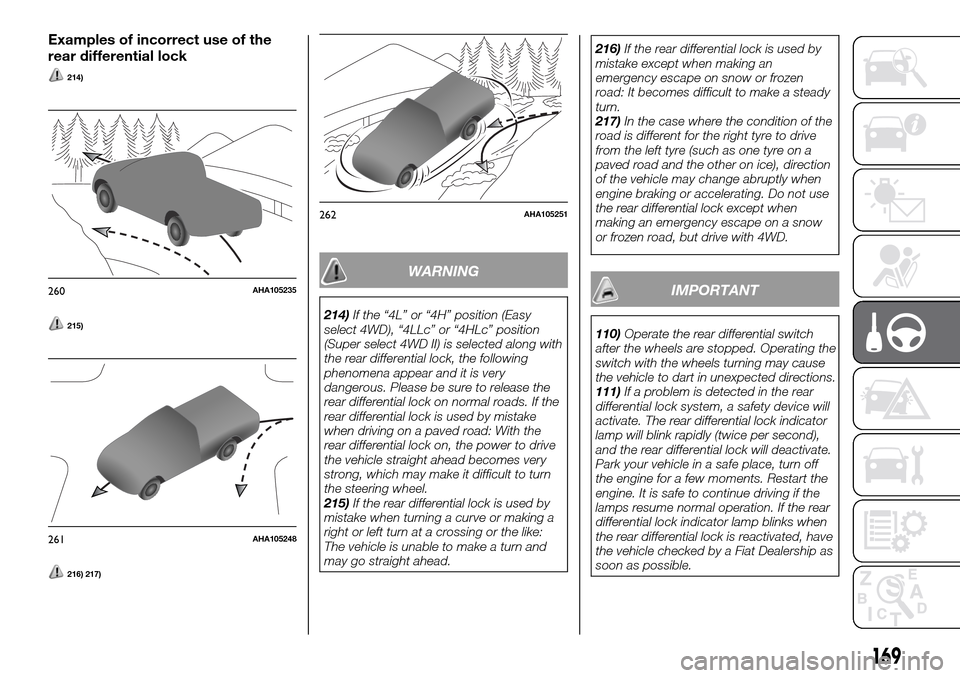
Examples of incorrect use of the
rear differential lock
214)
215)
216) 217)
WARNING
214)If the “4L” or “4H” position (Easy
select 4WD), “4LLc” or “4HLc” position
(Super select 4WD II) is selected along with
the rear differential lock, the following
phenomena appear and it is very
dangerous. Please be sure to release the
rear differential lock on normal roads. If the
rear differential lock is used by mistake
when driving on a paved road: With the
rear differential lock on, the power to drive
the vehicle straight ahead becomes very
strong, which may make it difficult to turn
the steering wheel.
215)If the rear differential lock is used by
mistake when turning a curve or making a
right or left turn at a crossing or the like:
The vehicle is unable to make a turn and
may go straight ahead.216)If the rear differential lock is used by
mistake except when making an
emergency escape on snow or frozen
road: It becomes difficult to make a steady
turn.
217)In the case where the condition of the
road is different for the right tyre to drive
from the left tyre (such as one tyre on a
paved road and the other on ice), direction
of the vehicle may change abruptly when
engine braking or accelerating. Do not use
the rear differential lock except when
making an emergency escape on a snow
or frozen road, but drive with 4WD.
IMPORTANT
110)Operate the rear differential switch
after the wheels are stopped. Operating the
switch with the wheels turning may cause
the vehicle to dart in unexpected directions.
111)If a problem is detected in the rear
differential lock system, a safety device will
activate. The rear differential lock indicator
lamp will blink rapidly (twice per second),
and the rear differential lock will deactivate.
Park your vehicle in a safe place, turn off
the engine for a few moments. Restart the
engine. It is safe to continue driving if the
lamps resume normal operation. If the rear
differential lock indicator lamp blinks when
the rear differential lock is reactivated, have
the vehicle checked by a Fiat Dealership as
soon as possible.
260AHA105235
261AHA105248
262AHA105251
169
Page 172 of 312
112)Use the rear differential lock only as an
emergency measure when the vehicle is
stuck and cannot be freed with the drive
mode-selector in “4L” or “4H” position
(Easy select 4WD) or in “4LLc” or “4HLc”
position (Super select 4WD II). Deactivate
the rear differential lock immediately after
using it.4 WHEEL DRIVE
OPERATION
By selecting 4-wheel drive, both axles
of the vehicle are rigidly connected with
each other. This improves the traction
characteristics. When turning sharp
corners or moving forward and
backward repeatedly, however, the
drive line is stressed, which is felt as a
braking effect. A 4-wheel drive vehicle
can accelerate more quickly and
smoothly.
However, note that the braking distance
is not shorter than that of a rear-wheel
drive vehicle.
When using 4-wheel drive on rough
roads (snow, mud, sand, etc.), it is
important to operate the vehicle
correctly.
The driving posture should be more
upright and closer to the wheel than
usual; adjust the seat to a good
position for easy steering and pedal
operation. Be sure to wear the seat belt
After driving on rough roads, check
each part of the vehicle and wash it
thoroughly with water. Refer to the
“Vehicle care” section and “Inspection
and maintenance following rough road
operation”.Driving on dry paved road and
highway
Select “2H” position (Easy select 4WD),
“2H” or “4H” position (Super select
4WD II) to drive on the dry paved road.
Especially on dry highway, never select
the “4H” or “4L” position (Easy select
4WD), “4HLc” or “4LLc” position (Super
select 4WD II).
113)
Driving on snowy or icy roads
Set the drive mode-selector to “4H”
position (Easy select 4WD), “4H” or
“4HLc” position in accordance with the
road conditions (Super select 4WD II)
and then gradually depress the
accelerator pedal for a smooth start.
Keep the pressure on the accelerator
pedal as constant as possible, and
drive at low speed. The use of snow
tyres and/or tyre chains is
recommended.
Maintain a safe distance between
vehicles, avoid sudden braking, and
use engine braking (downshifting).
114)
170
STARTING AND DRIVING
Page 173 of 312
Driving on sandy or muddy roads
Set the drive mode-selector to “4H” or
“4L” position (Easy select 4WD), “4HLc”
or “4LLc” position (Super select 4WD II)
and then gradually depress the
accelerator pedal for a smooth start.
Keep the pressure on the accelerator
pedal as constant as possible, and
drive at low speed.
115) 116)
218)
Avoid sudden braking, acceleration,
and turning; such operations could
result in the vehicle becoming stuck.
If the vehicle becomes stuck in sandy
or muddy roads, it can often be moved
a rocking motion. Move the selector
lever rhythmically between the “D”
(DRIVE) and “R” (REVERSE) position
(with manual transmission, between 1st
and Reverse), while applying slight
pressure to the accelerator pedal.
It is recommended to start the vehicle
with parking brake partially, but not
completely, applied by slightly pulling
the parking brake lever. After the vehicle
has become free, do not forget to
release the parking brake.
If it is necessary to drive in extremely
muddy conditions, the use of tyre
chains is recommended. Because the
extent of muddy conditions is difficult to
judge and the vehicle could become
bogged down very deeply, operationshould be at a low speed. If possible,
get out of the vehicle and check the
conditions ahead before proceeding.
Driving over roads in coastal areas or
roads on which anti-skid preparations
have been spread can cause rust on
the vehicle; wash the vehicle thoroughly
as soon as possible after such use.
Climbing sharp grades
Set the drive mode-selector to “4L”
position (Easy select 4WD), “4LLc”
position (Super select 4WD II) to
maximize the engine torque.
219) 220)
Choose as smooth a slope as possible
with few stones or other obstacles.
Before attempting to drive up the slope,
walk up it to confirm that the vehicle
can handle the grade.Descending sharp grades
Set the drive mode-selector to “4L”
position (Easy select 4WD), “4LLc”
position (Super select 4WD II), use the
engine brake (downshifting) and
descend slowly.
221)
When descending a sharp grade, if the
brakes are applied suddenly because of
an obstacle encountered, control of the
vehicle could be lost. Before
descending the slope, walk down it and
confirm the path.
Before descending a grade, it is
necessary to choose the appropriate
gear. Avoid changing gears or
depressing the clutch while descending
the grade.
Fiat. is not responsible to the operator
for any damage or injury caused or
liability incurred by the improper and
negligent operation of a vehicle. All
techniques of vehicle operation
described herein depend on the skill
and experience of the operator and
other participating parties and any
deviation from the recommended
operation instructions above is at their
own risk.
171
Page 174 of 312
Turning sharp corners
When turning a sharp corner in “4H” or
“4L” position (Easy select 4WD), “4HLc”
or “4LLc” position (Super select 4WD II)
at low speed, a slight difference in
steering may be experienced similar to
as if the brakes were applied. This is
called tight corner braking and results
from each of the 4 tyres being at a
different distance from the corner.
Crossing a stream
4-wheel drive vehicles are not
necessarily waterproof. If the electrical
circuits become wet, further operation
of the vehicle will be impossible;
therefore, avoid crossing streams
unless absolutely necessary. If crossing
a stream is unavoidable, use the
following procedure:
Check depths of a stream and
geographical features before
attempting to cross a stream and
ford the stream where the water is
as shallow as practicable.Set the
drive mode-selector to “4L”
position (Easy select 4WD), “4LLc”
position (Super select 4WD II).Drive
slowly at a speed of approximately
5 km/h to avoid splashing too
much water.
117) 118)
Inspection and maintenance
following rough road operation
After operating the vehicle in rough road
conditions, be sure to perform the
following inspection and maintenance
procedures:
Check that the vehicle has not been
damaged by rocks, gravel, etc.
Carefully wash the vehicle with water.
Drive the vehicle slowly while lightly
depressing the brake pedal in order to
dry out the brakes. If the brakes still do
not function properly, we recommend
you to have the brakes checked as
soon as possible.
Remove the insects, dried grass, etc.
clogging the radiator core.
After crossing a stream, be sure to have
the following items inspected at a Fiat
Dealership and take the necessary
measures:
Check the brake system and, if
necessary, have it serviced.
Check the engine, transmission,
transfer, and differential oil or grease
level and turbidity. If the oil or grease is
milky, it indicates water contamination.
Replace it with new oil or grease.
Grease the propeller shaft.
Check the inside of the vehicle. If
water is found, dry the carpet etc.
Inspect the headlamps. If the
headlamp bulb is flooded with water,
have the headlamp drained off.
IMPORTANT
113)Selecting “4H” or “4L” position (Easy
select 4WD), “4HLc” or “4LLc” position
(Super select 4WD II) to drive on dry paved
road will increase the fuel consumption with
possible noise generation and early tyre
wear. It may also increase the differential oil
temperature, resulting in possible damage
to the driving system. Further, the drive
train will be subjected to excessive loading,
possibly leading to oil leakage, component
seizure, or other serious faults.
114)Avoid sudden braking, sudden
acceleration, and sharp turning; such
operations could cause skidding and
spinouts.
115)Do not force the vehicle or drive
recklessly on sandy surfaces. In
comparison with normal road surfaces, the
engine and other drive-system components
are put under excessive strain when driving
on such a surface, and this could lead to
accidents.
116)If any of following conditions occur
while the vehicle is being driven,
immediately park your vehicle in a safe
place and follow these procedures: the
needle in the temperature gauge
approaches the overheating zone. Refer to
“Engine overheating”; automatic
transmission fluid temperature warning
lamp comes on. Refer to “When the A/T
(automatic transmission) fluid temperature
warning lamp comes on”.
172
STARTING AND DRIVING
Page 175 of 312
117)Never cross a stream where the water
is deep. Do not change gears while
crossing the stream. Frequent crossing of
streams can adversely affect the life span
of the vehicle; we recommend you to take
the necessary measures to prepare,
inspect, and repair the vehicle.
118)After crossing a stream, apply the
brakes to be sure they are functioning
properly. If the brakes are wet and not
functioning properly, dry them out by
driving slowly while lightly depressing the
brake pedal. Inspect each part of the
vehicle carefully.
WARNING
218)When attempting to rock your vehicle
out of a stuck position, be sure that the
area around the vehicle is clear of people
and physical objects. The rocking motion
may cause the vehicle to suddenly launch
forward or backward, causing injury or
damage to nearby people or objects.
219)Go straight up. Do not try to traverse
across a steep slope.
220)If you begin to lose traction, ease off
the accelerator pedal and gently turn the
steering wheel alternatively left and right to
regain adequate traction again.
221)Avoid snaking down a sharp grade.
Descend the grade as straight as possible.
CAUTIONS ON
HANDLING OF
4 WHEEL DRIVE
VEHICLES
Tyres and wheels
Since the driving torque can be applied
to the 4 wheels, the performance of the
vehicle when operating in 4-wheel drive
is greatly affected by the condition of
the tyres.
Pay close attention to the tyres.
Install specified tyres on all wheels.
Refer to “Tyres and wheels”.
Be sure to the appropriate tyre
inflation pressure according to no cargo
or cargo. Refer to “Tyre inflation
pressures”.
Be sure to fit all 4 tyres and wheels of
the same size and type. When
replacement of any of the tyres or
wheels is necessary, replace all of them.
All tyres should be rotated whenever
the wear difference between the front
and rear tyres is recognizable.
Good vehicle performance cannot be
expected if there is a difference in wear
between tyres. Refer to “Tyre rotation”.
Check the tyre inflation pressure
regularly.
119)
Towing
If towing is necessary, we recommend
you to have it done by a Fiat Dealership
or a commercial tow truck service. In
the following cases, transport the
vehicle using a tow truck.
The engine runs but the vehicle does
not move or abnormal noise is
produced.
Inspection of the vehicle’s underside
reveals that oil or some other fluid is
leaking.
Only when you cannot receive a towing
service from a Fiat Dealership or
commercial tow truck service, tow your
vehicle carefully in accordance with the
instructions given in “Towing”.
173
Page 177 of 312
WARNING
222)Do not crank the engine while jacking
up the vehicle. The tyre on the ground may
turn and the vehicle may roll off the jack.
BRAKING SYSTEM
All the parts of the brake system are
critical to safety. We recommend you to
have the vehicle checked at regular
intervals.
123)
Brake system
The service brake is divided into two
brake circuits. And your vehicle is
equipped with power brakes. If one
brake circuit fails, the other is available
to stop the vehicle. If your vehicle
should lose the power assist for some
reason, the brakes will still work.
In these situations even if the brake
pedal moves down to the very end of
its possible stroke or resists being
depressed, keep depressing the brake
pedal down harder and further than
usual; stop driving as soon as possible
and have the brake system repaired.
223) 224)
Warning lamp
The brake warning lamp illuminates to
indicate a fault in the braking system.
Refer to “Brake warning lamp”.When brakes are wet
Check the brake system while driving at
a low speed immediately after starting,
especially when the brakes are wet, to
confirm they work normally.
A film of water can be formed on the
brake discs or brake drums and
prevent normal braking after driving in
heavy rain or through large puddles, or
after the vehicle is washed. If this
occurs, dry the brakes out by driving
slowly while lightly depressing the brake
pedal.
When driving downhill
It is important to take advantage of the
engine braking by shifting to a lower
shift position while driving on steep
downhill roads in order to prevent the
brakes from overheating.
225)
Brake pads and linings
Avoid hard braking situations. New
brakes need to be broken-in by
moderate use for the first 200 km.
The disc brakes are provided with a
warning device which emits a shrieking
metallic sound while braking if the brake
pads have reached their wear limit. If
you hear this sound, have the brake
pads replaced.
226)
175