check engine FIAT FULLBACK 2016 1.G User Guide
[x] Cancel search | Manufacturer: FIAT, Model Year: 2016, Model line: FULLBACK, Model: FIAT FULLBACK 2016 1.GPages: 312, PDF Size: 13.67 MB
Page 96 of 312
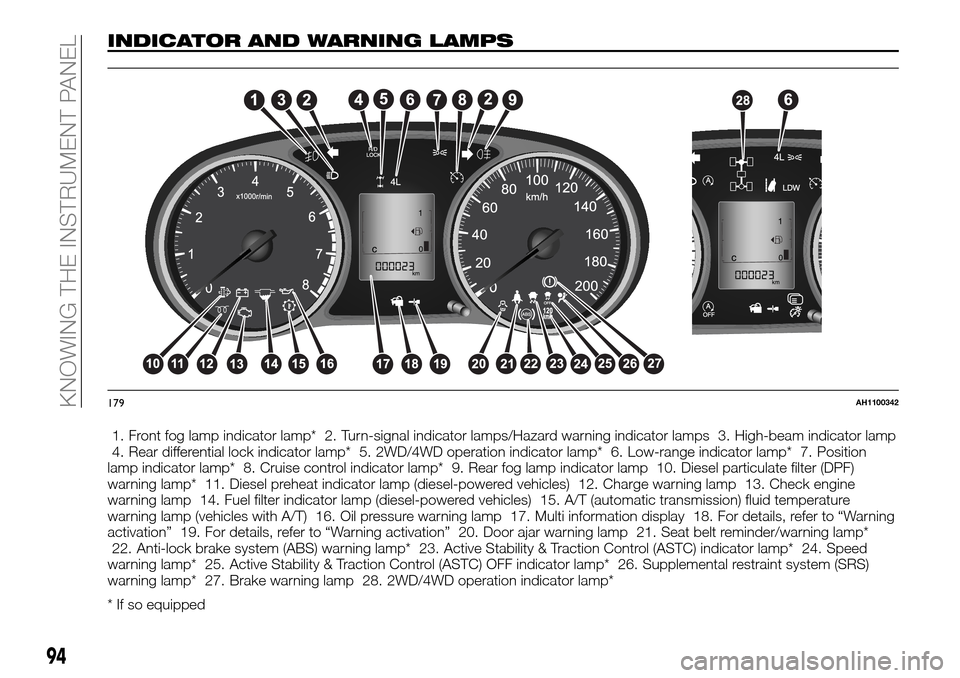
INDICATOR AND WARNING LAMPS
1. Front fog lamp indicator lamp* 2. Turn-signal indicator lamps/Hazard warning indicator lamps 3. High-beam indicator lamp
4. Rear differential lock indicator lamp* 5. 2WD/4WD operation indicator lamp* 6. Low-range indicator lamp* 7. Position
lamp indicator lamp* 8. Cruise control indicator lamp* 9. Rear fog lamp indicator lamp 10. Diesel particulate filter (DPF)
warning lamp* 11. Diesel preheat indicator lamp (diesel-powered vehicles) 12. Charge warning lamp 13. Check engine
warning lamp 14. Fuel filter indicator lamp (diesel-powered vehicles) 15. A/T (automatic transmission) fluid temperature
warning lamp (vehicles with A/T) 16. Oil pressure warning lamp 17. Multi information display 18. For details, refer to “Warning
activation” 19. For details, refer to “Warning activation” 20. Door ajar warning lamp 21. Seat belt reminder/warning lamp*
22. Anti-lock brake system (ABS) warning lamp* 23. Active Stability & Traction Control (ASTC) indicator lamp* 24. Speed
warning lamp* 25. Active Stability & Traction Control (ASTC) OFF indicator lamp* 26. Supplemental restraint system (SRS)
warning lamp* 27. Brake warning lamp 28. 2WD/4WD operation indicator lamp*
* If so equipped
179AH1100342
94
KNOWING THE INSTRUMENT PANEL
Page 99 of 312
Warning lamps What it means
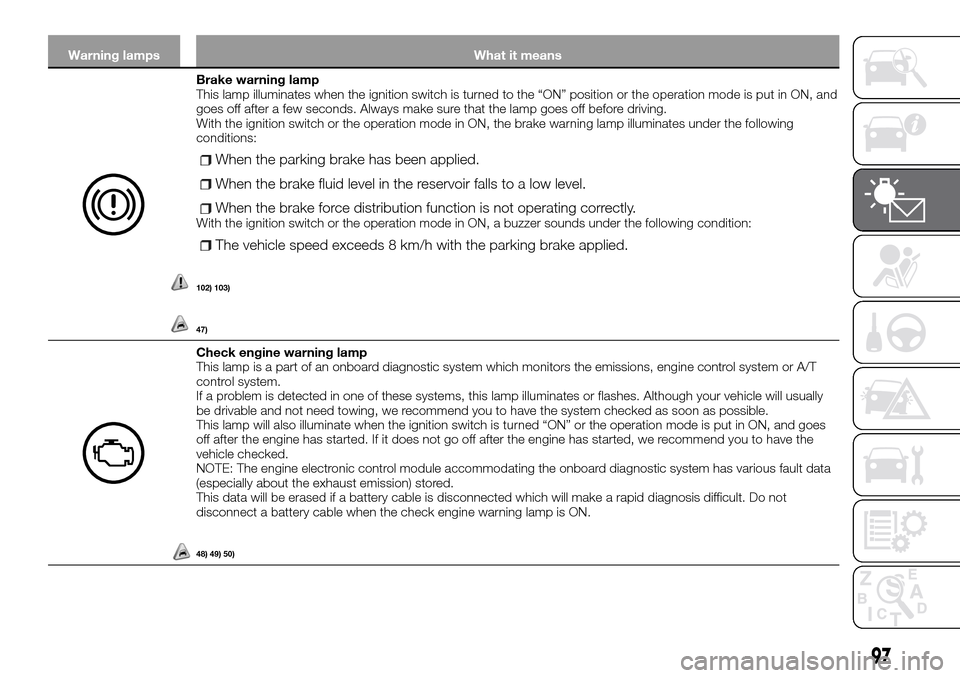
Brake warning lamp
This lamp illuminates when the ignition switch is turned to the “ON” position or the operation mode is put in ON, and
goes off after a few seconds. Always make sure that the lamp goes off before driving.
With the ignition switch or the operation mode in ON, the brake warning lamp illuminates under the following
conditions:
When the parking brake has been applied.
When the brake fluid level in the reservoir falls to a low level.
When the brake force distribution function is not operating correctly.With the ignition switch or the operation mode in ON, a buzzer sounds under the following condition:
The vehicle speed exceeds 8 km/h with the parking brake applied.
102) 103)
47)
Check engine warning lamp
This lamp is a part of an onboard diagnostic system which monitors the emissions, engine control system or A/T
control system.
If a problem is detected in one of these systems, this lamp illuminates or flashes. Although your vehicle will usually
be drivable and not need towing, we recommend you to have the system checked as soon as possible.
This lamp will also illuminate when the ignition switch is turned “ON” or the operation mode is put in ON, and goes
off after the engine has started. If it does not go off after the engine has started, we recommend you to have the
vehicle checked.
NOTE: The engine electronic control module accommodating the onboard diagnostic system has various fault data
(especially about the exhaust emission) stored.
This data will be erased if a battery cable is disconnected which will make a rapid diagnosis difficult. Do not
disconnect a battery cable when the check engine warning lamp is ON.
48) 49) 50)
97
Page 100 of 312
Warning lamps What it means
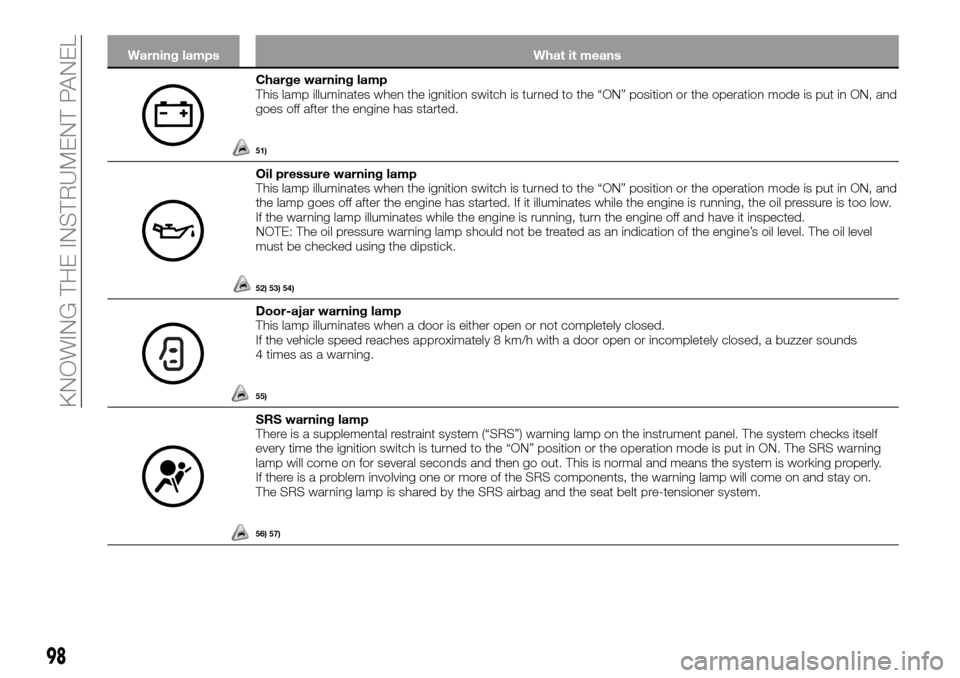
Charge warning lamp
This lamp illuminates when the ignition switch is turned to the “ON” position or the operation mode is put in ON, and
goes off after the engine has started.
51)
Oil pressure warning lamp
This lamp illuminates when the ignition switch is turned to the “ON” position or the operation mode is put in ON, and
the lamp goes off after the engine has started. If it illuminates while the engine is running, the oil pressure is too low.
If the warning lamp illuminates while the engine is running, turn the engine off and have it inspected.
NOTE: The oil pressure warning lamp should not be treated as an indication of the engine’s oil level. The oil level
must be checked using the dipstick.
52) 53) 54)
Door-ajar warning lamp
This lamp illuminates when a door is either open or not completely closed.
If the vehicle speed reaches approximately 8 km/h with a door open or incompletely closed, a buzzer sounds
4 times as a warning.
55)
SRS warning lamp
There is a supplemental restraint system (“SRS”) warning lamp on the instrument panel. The system checks itself
every time the ignition switch is turned to the “ON” position or the operation mode is put in ON. The SRS warning
lamp will come on for several seconds and then go out. This is normal and means the system is working properly.
If there is a problem involving one or more of the SRS components, the warning lamp will come on and stay on.
The SRS warning lamp is shared by the SRS airbag and the seat belt pre-tensioner system.
56) 57)
98
KNOWING THE INSTRUMENT PANEL
Page 101 of 312
Warning lamps What it means
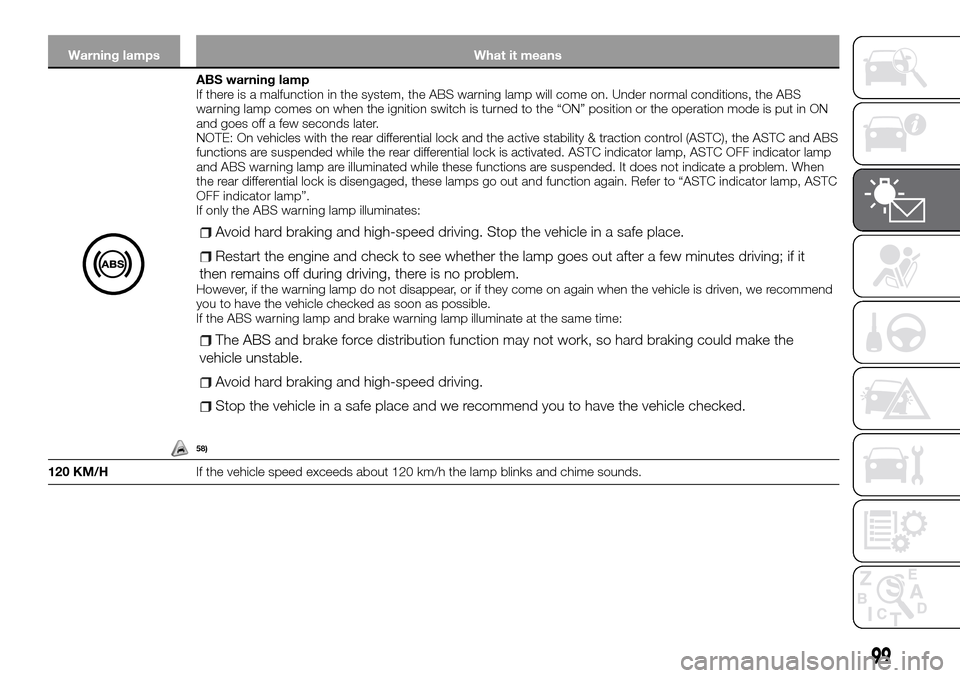
ABS warning lamp
If there is a malfunction in the system, the ABS warning lamp will come on. Under normal conditions, the ABS
warning lamp comes on when the ignition switch is turned to the “ON” position or the operation mode is put in ON
and goes off a few seconds later.
NOTE: On vehicles with the rear differential lock and the active stability & traction control (ASTC), the ASTC and ABS
functions are suspended while the rear differential lock is activated. ASTC indicator lamp, ASTC OFF indicator lamp
and ABS warning lamp are illuminated while these functions are suspended. It does not indicate a problem. When
the rear differential lock is disengaged, these lamps go out and function again. Refer to “ASTC indicator lamp, ASTC
OFF indicator lamp”.
If only the ABS warning lamp illuminates:
Avoid hard braking and high-speed driving. Stop the vehicle in a safe place.
Restart the engine and check to see whether the lamp goes out after a few minutes driving; if it
then remains off during driving, there is no problem.
However, if the warning lamp do not disappear, or if they come on again when the vehicle is driven, we recommend
you to have the vehicle checked as soon as possible.
If the ABS warning lamp and brake warning lamp illuminate at the same time:
The ABS and brake force distribution function may not work, so hard braking could make the
vehicle unstable.
Avoid hard braking and high-speed driving.
Stop the vehicle in a safe place and we recommend you to have the vehicle checked.
58)
120 KM/HIf the vehicle speed exceeds about 120 km/h the lamp blinks and chime sounds.
99
Page 102 of 312
WARNING
102)In the following situations, brake
performance may be compromised or the
vehicle may become unstable if brakes are
applied suddenly; consequently, avoid
driving at high speeds or applying the
brakes suddenly. Furthermore, immediately
the vehicle should be brought to a stop in a
safe location and we recommend you to
have it checked. 1 – The brake warning
lamp does not illuminate when the parking
brake is applied or does not turn off when
the parking brake is released.2–The
brake warning lamp and the ABS warning
lamp illuminate at the same time. For
details, refer to “ABS warning lamp”. 3 –
The brake warning lamp remains
illuminated while driving.
103)The vehicle should be brought to a
halt in the following manner when brake
performance has deteriorated. 1 – Depress
the brake pedal harder than usual. Even if
the brake pedal moves down to the very
end of its possible stroke, keep it pressed
down hard. 2 – Should the brakes fail, use
engine braking to reduce your speed and
carefully pull the parking brake lever.
Depress the brake pedal to operate the
stop lamp to alert the vehicles behind you.
IMPORTANT
42)This warning lightwill flash after
starting or during prolonged cranking to
indicate a fault with the glow plug heating
system. If the engine starts, the vehicle can
be used as normal, but a Fiat Dealership
must be contacted as soon as possible.
43)If the diesel preheat indicator lamp
comes on after the engine is started, the
engine speed may not rise above the idling
speed because of fuel freezing. In this case,
keep the engine idling for about
10 minutes, then turn off the ignition switch
or put in OFF the operation mode, and
immediately turn it on or put in ON again to
confirm that the diesel preheat indicator
lamp is off.
44)When the ignition switch is turned to
the “ON” position or the operation mode is
put in ON, the warning lamp does not
come on or it remains on and does not go
off . The warning lamp comes on while
driving.
45)When this indicator lamp blinks, active
stability control function or active traction
control function is operating, which means
that the road is slippery or that your
vehicle’s wheels are beginning to slip. If this
happens, drive slower with less accelerator
input.46)If an abnormal condition occurs in the
system while driving, the
indicator lamp
will illuminate. In these cases, follow these
procedures:1–Ifthetemperature in the
braking system continues to increase due
to continuous brake control on a slippery
road surface, the
indicator lamp will
blink, and operation of the active traction
control function will be suspended to
protect the brake system (the engine
control of the traction control function and
normal brake operation will not be
affected.) Park your vehicle in a safe place.
When the temperature in the braking
system has come down, the indicator lamp
will go off and the active stability control
function and active traction control function
will start operating again.2–Ifthe
indicator lamp does not go out even
through the above procedure is followed,
there could be a problem in the system.
Stop the engine and start the engine again
and check whether the
indicator lamp
goes out. If the indicator lamp goes out,
there is no abnormal condition.3–Ifthe
indicator lamp illuminates even after
your vehicle is driven a short distance after
re-starting the engine, we recommend you
to have your vehicle checked as soon as
possible.
100
KNOWING THE INSTRUMENT PANEL
Page 103 of 312
47)If the vehicle is towed with the ignition
switch in the “ON” position or the operation
mode in ON and only the front wheels or
only the rear wheels raised off the ground,
the ASTC may operate, resulting in an
accident. When towing the vehicle with the
front wheels raised, keep the ignition switch
in the “LOCK” or “ACC” position or the
operation mode in ACC or OFF. When
towing the vehicle with the rear wheels
raised, keep the ignition switch in the
“ACC” position or the operation mode in
ACC. Refer to “Towing”.
48)Prolonged driving with this lamp on
may cause further damage to the emission
control system. It could also affect fuel
economy and drivability.
49)If the lamp does not illuminate when the
ignition switch is turned to the “ON”
position or the operation mode is put in
ON, we recommend you to have the
system checked.
50)If the lamp illuminates while the engine
is running, avoid driving at high speeds and
have the system inspected by a Fiat
Dealership as soon as possible. Accelerator
pedal and brake pedal response may be
negatively influenced under these
conditions.
51)If it illuminates while the engine is
running, there is a problem in the charging
system. Immediately park your vehicle in a
safe place and we recommend you to have
it checked.
52)If this lamp illuminates when the engine
oil level is not low, have it inspected.
53)This warning lamp does not indicate
the amount of oil in the crankcase. This
must be determined by checking the oil
level on the dipstick, while the engine is
switched off.54)If you continue driving with low engine
oil level or with this warning lamp
illuminated, engine seizure may occur.
55)Before moving your vehicle, check that
the warning lamp is OFF.
56)If any of the following conditions occur,
there may be a problem with the SRS
airbags and/or seat belt pre-tensioners,
and they may not function properly in a
collision or may suddenly activate without a
collision: 1 – Even when the ignition switch
or the operation mode is in ON, the SRS
warning lamp does not come on or it
remains on. 2 – The SRS warning lamp
comes on while driving.
57)The SRS airbags and seat belt
pre-tensioners are designed to help reduce
the risk of serious injury or death in certain
collisions. If either of the above conditions
occurs, immediately have your vehicle
checked by a Fiat Dealership.
58)Any of the following indicates that the
ABS is not functioning and only the
standard brake system is working. (The
standard brake system is functioning
normally.) If this happens, take your vehicle
to a Fiat Dealership.
101
Page 129 of 312
An operation noise is emitted from the
engine compartment or feel a shock
from the brake pedal when start driving
immediately after starting the engine.
These are normal sound or operation
that the ABS makes when performing a
self-check. It does not indicate a
malfunction.
The ABS can be used after the vehicle
has reached a speed over
approximately 10 km/h. It stops
working when the vehicle slows below
7 km/h.
181) 182) 183) 184) 185) 186) 187) 188) 189)
After driving on icy roads
After driving on snow or icy roads,
remove any snow and ice which may
have be left around the wheels. On
vehicles that have an ABS, be careful
not to damage the wheel speed
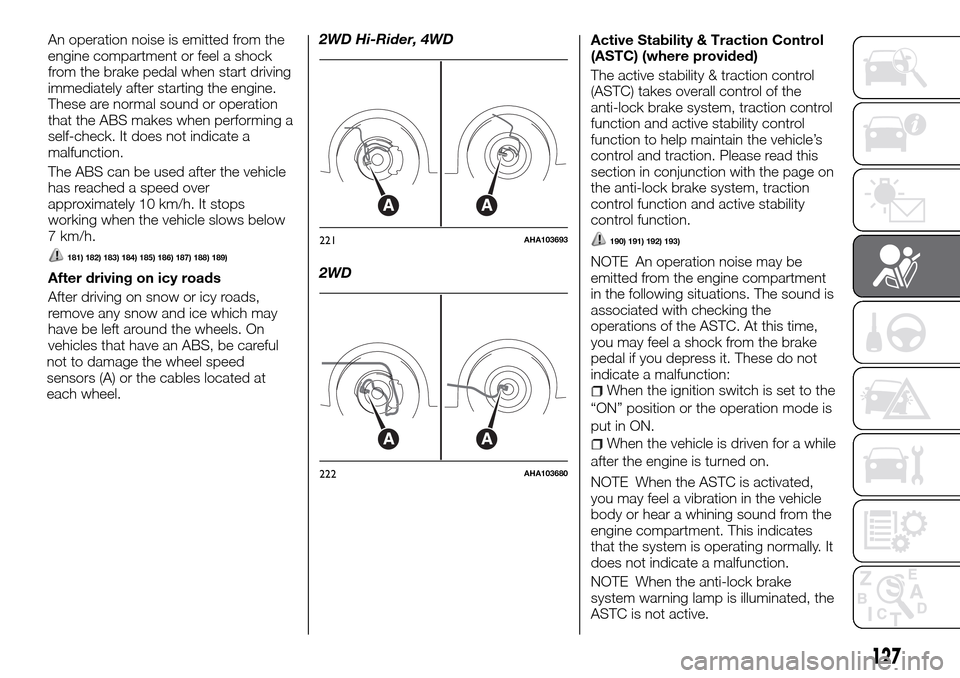
sensors (A) or the cables located at
each wheel.2WD Hi-Rider, 4WD
2WDActive Stability & Traction Control
(ASTC) (where provided)
The active stability & traction control
(ASTC) takes overall control of the
anti-lock brake system, traction control
function and active stability control
function to help maintain the vehicle’s
control and traction. Please read this
section in conjunction with the page on
the anti-lock brake system, traction
control function and active stability
control function.
190) 191) 192) 193)
NOTE An operation noise may be
emitted from the engine compartment
in the following situations. The sound is
associated with checking the
operations of the ASTC. At this time,
you may feel a shock from the brake
pedal if you depress it. These do not
indicate a malfunction:
When the ignition switch is set to the
“ON” position or the operation mode is
put in ON.
When the vehicle is driven for a while
after the engine is turned on.
NOTE When the ASTC is activated,
you may feel a vibration in the vehicle
body or hear a whining sound from the
engine compartment. This indicates
that the system is operating normally. It
does not indicate a malfunction.
NOTE When the anti-lock brake
system warning lamp is illuminated, the
ASTC is not active.
AA
221AHA103693
AA
222AHA103680
127
Page 133 of 312
198)Do not turn the ignition switch to the
“LOCK” or “ACC” position or the operation
mode in ACC or OFF while the hill start
assist is operating. The hill start assist
could stop operating, which could result in
an accident.
IMPORTANT
69)Do not over-rely on the hill start assist
to prevent backwards movement of the
vehicle. Under certain circumstances, even
when hill start assist is activated, the
vehicle may move backwards if the brake
pedal is not sufficiently depressed, if the
vehicle is heavily loaded, if the road is very
steep or slippery or if the vehicle tows a
trailer, etc.
70)The hill start assist is not designed to
keep the vehicle stopped in place on uphill
slopes for more than 2 seconds.
71)If the warning is turn on, the hill start
assist will not operate. Start off carefully.
72)Park your vehicle in a safe place and
stop the engine. Restart the engine and
check whether the warning indicator went
out, in which case the hill start assist is
again working normally. If they warning
remains displayed or reappear frequently, it
is not necessary to stop the vehicle
immediately, but the vehicle should be
inspected by a Fiat Dealership.
73)Do not stop the engine while the
vehicle is moving. Stopping the engine
would make the steering wheel extremely
hard to turn, possibly resulting in an
accident.74)Do not leave the steering wheel turned
all the way in one direction. This can cause
damage to the power steering system.
131
Page 135 of 312
ECONOMICAL
DRIVING
For economical driving, there are some
technical requirements that have to be
met. The prerequisite for low fuel
consumption is a properly adjusted
engine. In order to achieve longer life of
the vehicle and the most economical
operation, we recommend you to have
the vehicle checked at regular intervals
in accordance with the service
standards.
Fuel economy and generation of
exhaust gas and noise are highly
influenced by personal driving habits as
well as the particular operating
conditions. The following points should
be observed in order to minimize wear
of brakes, tyres and engine as well as
to reduce environmental pollution.
Starting the engine
Avoid sudden acceleration and sudden
starts, as they will increase fuel
consumption.
Shifting
Shift only at an appropriate speed and
engine speed. Always use the highest
shift position possible.
The transfer shift lever or the drive
modeselector should be set to “2H”
when driving 4WD vehicles on normal
roads and express ways to obtain best
possible fuel economy.City traffic
Frequent starting and stopping
increases the average fuel
consumption. Use roads with smooth
traffic flow whenever possible. When
driving on congested roads, avoid use
of a low shift position at high engine
speeds.
Idling
The vehicle consumes fuel even during
idling. Avoid extended idling whenever
possible.
Speed
At higher the vehicle speed, more fuel is
consumed. Avoid driving at full speed.
Even a slight release of the accelerator
pedal will save a significant amount of
fuel.
Tyre inflation pressure
Check the tyre inflation pressures at
regular intervals. Low tyre inflation
pressure increases road resistance and
fuel consumption. In addition, low tyre
pressures adversely affect tyre wear
and driving stability.Cargo loads
Do not drive with unnecessary articles
in the luggage compartment. Especially
during city driving where frequent
starting and stopping is necessary, the
increased weight of the vehicle will
greatly affect fuel consumption. Also
avoid driving with unnecessary luggage
or carriers, etc., on the roof; the
increased air resistance will increase
fuel consumption.
Cold engine starting
Starting of a cold engine consumes
more fuel. Unnecessary fuel
consumption is also caused by keeping
a hot engine running. After the engine is
started, commence driving as soon as
possible.
Cooler or air conditioning
The use of the air conditioner will
increase the fuel consumption.
133
Page 143 of 312
STARTING AND
STOPPING THE
ENGINE
Tips for starting
Except for vehicles equipped with
the keyless operation system
Do not operate the starter motor
continuously longer than 10 seconds;
doing so could run down the battery. If
the engine does not start, turn the
ignition switch back to “LOCK”, wait a
few seconds, and then try again. Trying
repeatedly with the starter motor still
turning will damage the starter
mechanism.
203)
79) 80) 81) 82) 83) 84)
For vehicles equipped with the
keyless operation system
The operation mode can be in any
mode to start the engine.
The starter motor will be turning for up
to approximately 15 seconds if the
engine switch is released at once.
Pressing the engine switch again while
the starter motor is still turning will stop
the starter motor. The starter motor will
be turning for up to approximately
30 seconds while the engine switch is
pressed. If the engine does not start,
wait for a while and then attempt to
start the engine again. Trying repeatedly
with the starter motor still turning will
damage the starter mechanism.
203)
80) 81) 82)
Starting the engine (petrol-powered
vehicles)
Except for vehicles equipped with
the keyless operation system
Your vehicles equipped with an
electronically controlled fuel injection
system. When starting the engine, do
not depress the accelerator pedal.
The starting procedure is as follows:
Insert the ignition key and fasten the
seat belt.
Make sure the parking brake is
applied.
Depress and hold the brake pedal.
Depress the clutch pedal all the way
and place the gearshift lever in the “N”
(Neutral) position.
After turning the ignition key to the
“ON” position, make certain that all
warning lamps are functioning properly
before starting the engine
Turn the ignition key to the “START”
position without depressing the
accelerator pedal, and release it when
the engine starts.A ticking noise may be heard after
starting the engine. This is not an
abnormal condition. The noise will
disappear after a short time of engine
running. If the ticking noise continues
after the engine is warmed up, have
your vehicle checked at a Fiat
Dealership.
Minor noises may be heard on engine
startup. These will disappear as the
engine warms up.
When the engine is hard to start
After several attempts, you may
experience that the engine still does not
start.
Make sure that all electric devices,
such as lamps, air conditioning blower
and rear window demister, are turned
off.
While depressing the clutch pedal,
press the accelerator pedal halfway and
hold it there, then crank the engine.
Release the accelerator pedal,
N
227AHA106001
141
immediately after the engine starts.