door lock FIAT FULLBACK 2016 1.G Owner's Manual
[x] Cancel search | Manufacturer: FIAT, Model Year: 2016, Model line: FULLBACK, Model: FIAT FULLBACK 2016 1.GPages: 312, PDF Size: 13.67 MB
Page 44 of 312
![FIAT FULLBACK 2016 1.G Owners Manual Lamp monitor buzzer
If the following operation is performed,
a buzzer will sound to remind the driver
to turn off the lamps. [Except for
vehicles equipped with the keyless
operation system]
If the dri](/img/10/4601/w960_4601-43.png "FIAT FULLBACK 2016 1.G Owners Manual Lamp monitor buzzer
If the following operation is performed,
a buzzer will sound to remind the driver
to turn off the lamps. [Except for
vehicles equipped with the keyless
operation system]
If the dri")
Lamp monitor buzzer
If the following operation is performed,
a buzzer will sound to remind the driver
to turn off the lamps. [Except for
vehicles equipped with the keyless
operation system]
If the driver’s door is opened when the
key is in the “LOCK” or “ACC” position
or removed from the ignition switch
while the lamps are on. [For vehicles
equipped with the keyless operation
system] If the driver’s door is opened
when the operation mode is in ACC or
OFF while the lamps are on. In both
cases, the buzzer will automatically
stop if the auto-cutoff function is
activated, the lamp switch is turned off,
or the door is closed.
Daytime running lamp
The daytime running lamps comes on
when the engine is running and the
lamp switch is in the “OFF” or “AUTO”
position and the tail lamps are off.
55) 56)
Dipper (High/Low beam change)
When the lamp switch is in the
position, the beam changes from
high to low (or low to high) each time
the lever is pulled fully (A). While the
high beam is on, the high beam
indicator lamp in the instrument cluster
will also illuminate.Headlamp flasher
The high beams flash when the lever is
pulled slightly (B), and will go off when it
is released. When the high beam is on,
the high beam indicator lamp in the
instrument cluster will illuminate.
NOTE The high beams can also flash
when the lamp switch is OFF.
NOTE If you turn the lamps off with the
headlamps set to high beam, the
headlamps are automatically returned
to their low-beam setting when the
lamp switch is next turned to theposition.
HEADLAMP LEVELLING
SWITCH
(where provided)
57)
The angle of the headlamp beam varies
depending upon the load carried by the
vehicle. The headlamp levelling switch
can be used to adjust the headlamp
illumination distance (when the lower
beam is illuminated) so that the
headlamps’ glare does not distract the
drivers of approaching vehicles. Set the
switch (referring to the following table)
to the appropriate position according to
the number of people and the load in
the vehicle.
NOTE When adjusting the beam
position, first put the dial in the “0”
position (the highest beam position).
63AA0061218
64AHA105525
42
GETTING TO KNOW YOUR VEHICLE
Page 49 of 312
INTERIOR LAMPS
INTERIOR LAMPS
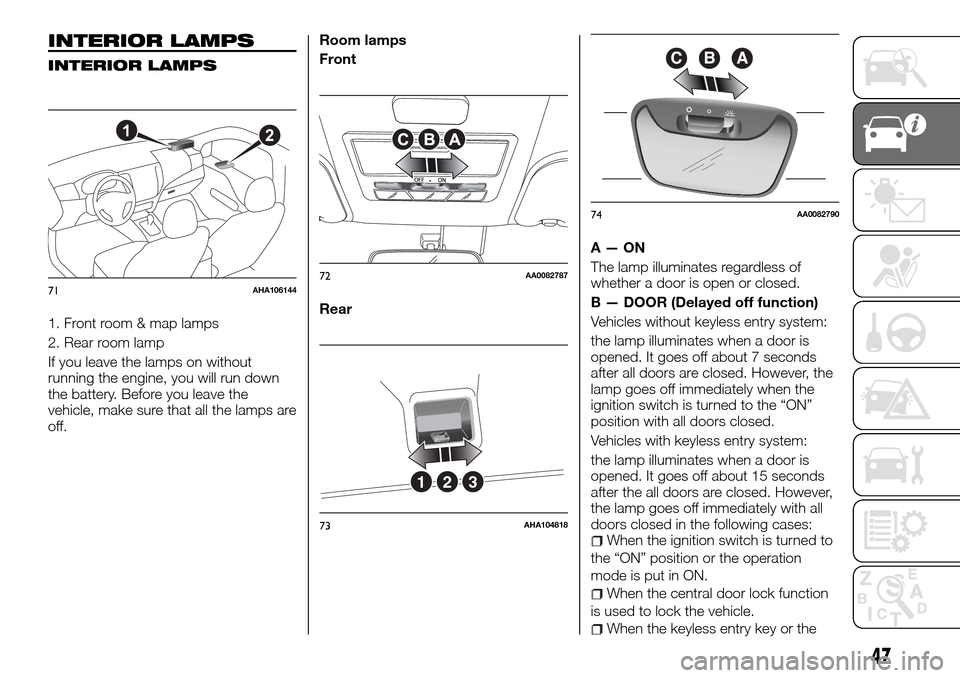
1. Front room & map lamps
2. Rear room lamp
If you leave the lamps on without
running the engine, you will run down
the battery. Before you leave the
vehicle, make sure that all the lamps are
off.Room lamps
Front
RearA—ON
The lamp illuminates regardless of
whether a door is open or closed.
B — DOOR (Delayed off function)
Vehicles without keyless entry system:
the lamp illuminates when a door is
opened. It goes off about 7 seconds
after all doors are closed. However, the
lamp goes off immediately when the
ignition switch is turned to the “ON”
position with all doors closed.
Vehicles with keyless entry system:
the lamp illuminates when a door is
opened. It goes off about 15 seconds
after the all doors are closed. However,
the lamp goes off immediately with all
doors closed in the following cases:
When the ignition switch is turned to
the “ON” position or the operation
mode is put in ON.
When the central door lock function
is used to lock the vehicle.
When the keyless entry key or the
21
71AHA10614472AA0082787
321
73AHA104818
ABC
74AA0082790
47
Page 50 of 312
keyless operation key is used to lock
the vehicle.
If the vehicle is equipped with the
keyless operation system, when the
keyless operation function is used to
lock the vehicle.
Auto cut-out function:
if the lamp is left switched on with the
ignition switch is in the “LOCK” or
“ACC” position or the operation mode
is in OFF or ACC, and a door is
opened, it goes off automatically after
approximately 30 minutes. The lamp will
illuminate again after it automatically
goes off in the following cases:
When the ignition switch is turned to
the “ON” position or the operation
mode is put in ON.
When the keyless entry system or
the keyless operation system is
operated.
When all doors are closed.
C — OFF
The lamp goes off regardless of
whether a door is open or closed.
NOTE When the key was used to start
the engine, if the key is removed while
the doors are closed, the lamp is
illuminated and after a few seconds it
goes off.
NOTE When the keyless operation
function was used to start the engine, if
the operation mode is put in OFF while
the door are closed, the lampilluminates and after about 15 seconds
it goes off (if so equipped).
NOTE The time until the lamp goes off
(delayed off) can be adjusted. For
details, please consult a Fiat Dealership.
NOTE The auto cut-out function
cannot be operated when the room
lamp switch is in the “ON” position (1).
Also, this function can be deactivated.
For details, please consult a Fiat
Dealership.
Map lamps
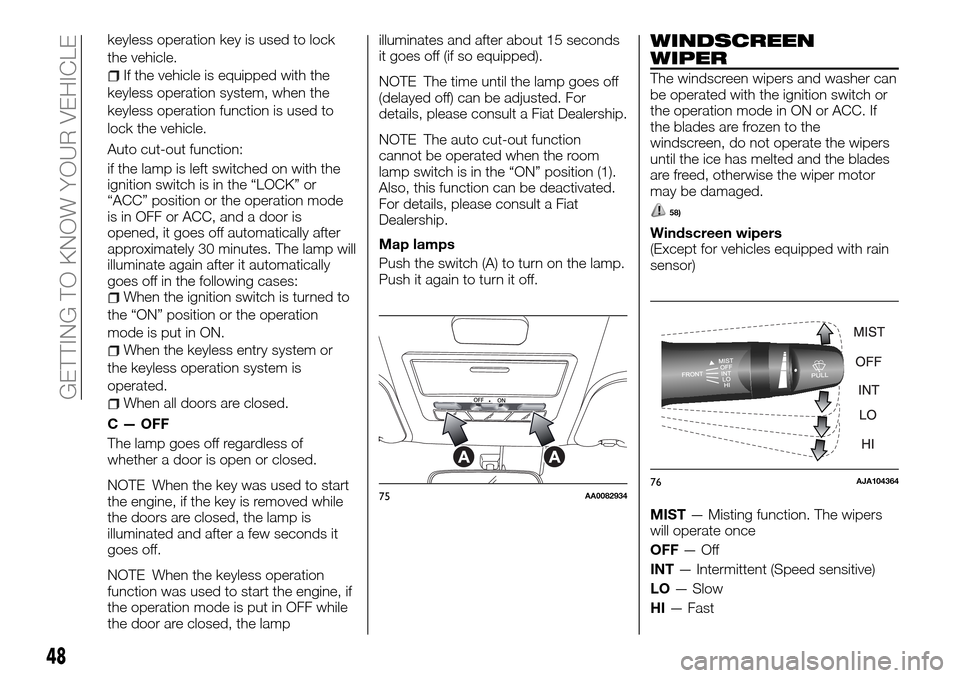
Push the switch (A) to turn on the lamp.
Push it again to turn it off.
WINDSCREEN
WIPER
The windscreen wipers and washer can
be operated with the ignition switch or
the operation mode in ON or ACC. If
the blades are frozen to the
windscreen, do not operate the wipers
until the ice has melted and the blades
are freed, otherwise the wiper motor
may be damaged.
58)
Windscreen wipers
(Except for vehicles equipped with rain
sensor)
MIST— Misting function. The wipers
will operate once
OFF—Off
INT— Intermittent (Speed sensitive)
LO— Slow
HI— Fast
75AA008293476AJA104364
48
GETTING TO KNOW YOUR VEHICLE
Page 71 of 312
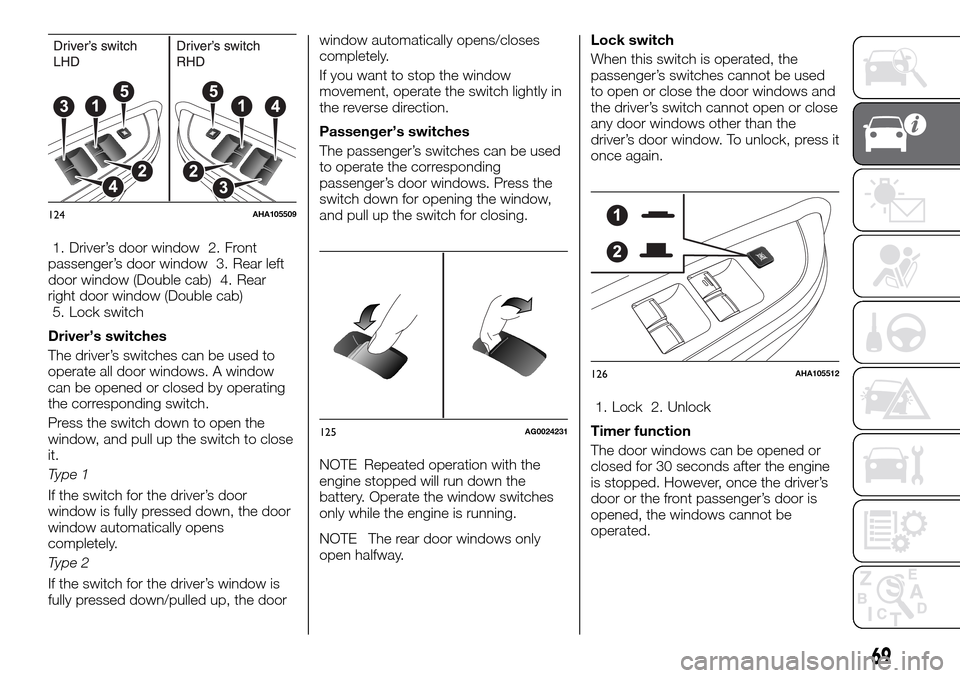
1. Driver’s door window 2. Front
passenger’s door window 3. Rear left
door window (Double cab) 4. Rear
right door window (Double cab)
5. Lock switch
Driver’s switches
The driver’s switches can be used to
operate all door windows. A window
can be opened or closed by operating
the corresponding switch.
Press the switch down to open the
window, and pull up the switch to close
it.
Type 1
If the switch for the driver’s door
window is fully pressed down, the door
window automatically opens
completely.
Type 2
If the switch for the driver’s window is
fully pressed down/pulled up, the doorwindow automatically opens/closes
completely.
If you want to stop the window
movement, operate the switch lightly in
the reverse direction.
Passenger’s switches
The passenger’s switches can be used
to operate the corresponding
passenger’s door windows. Press the
switch down for opening the window,
and pull up the switch for closing.
NOTE Repeated operation with the
engine stopped will run down the
battery. Operate the window switches
only while the engine is running.
NOTE The rear door windows only
open halfway.Lock switch
When this switch is operated, the
passenger’s switches cannot be used
to open or close the door windows and
the driver’s switch cannot open or close
any door windows other than the
driver’s door window. To unlock, press it
once again.
1. Lock 2. Unlock
Timer function
The door windows can be opened or
closed for 30 seconds after the engine
is stopped. However, once the driver’s
door or the front passenger’s door is
opened, the windows cannot be
operated.
124AHA105509
125AG0024231
126AHA105512
69
Page 72 of 312
Safety mechanism (driver’s window
and Type 2 only)
66) 67) 68) 69) 70)
When the door window is automatically
closed by pulling up the switch fully, if a
hand or head is trapped in the closing
window, it will lower automatically.
Nonetheless, make sure that nobody
puts their head or hand out of the
window when closing the driver’s door
window. The lowered window will
become operational after a few
seconds.
NOTE The safety mechanism can be
activated if the driving conditions or
other circumstances cause the driver’s
door window to be subjected to a
physical shock similar to that caused by
a trapped hand or head.
WARNING
61)Incorrect use of the electric windows
may be dangerous. Before and during
operation, always check that nobody is
exposed to the risk of being injured either
directly by the moving window or through
objects getting caught or by being hit.
When leaving the vehicle, always remove
the key from the ignition switch to avoid the
risk of injury to anyone remaining in the car
due to accidental operation of the electric
windows.
62)Before operating the electric window
control, make sure that nothing is capable
of being trapped (head, hand, finger, etc.).63)Never leave the vehicle without
removing the key. Never leave a child (or
other person who might not be capable of
safe operation of the electric window
control) in the vehicle alone.
64)The child may tamper with the switch
at the risk of its hands or head being
trapped in the window.
65)A child may tamper with the switch at
the risk of its hands or head being trapped
in the window. When driving with a child in
the vehicle, please press the window lock
switch to disable the passenger’s switches.
66)If the battery terminals are
disconnected or the fuse for electric
window is replaced, the safety mechanism
will be cancelled. If a hand or head got
trapped, a serious injury could result.
67)The safety mechanism is cancelled just
before the window is fully closed. This
allows the window to close completely.
Therefore be especially careful that no
fingers are trapped in the window.
68)The safety mechanism is deactivated
while the switch is pulled up. Therefore be
especially careful that fingers are not
trapped in the door window opening.
69)If the safety mechanism is activated
five or more times in a row, the safety
mechanism will be cancelled and the door
window will not close correctly. In such a
case, the following procedure should be
implemented to rectify this situation. If the
window is open, repeatedly raise the
driver’s door window switch until that
window has been fully closed. Following
this, release the switch, raise the switch
once again and hold it in this condition for
at least 1 second, then release it. You
should now be able to operate in the
normal way.70)If the battery terminals are
disconnected or the fuse for electric
window is replaced, the safety mechanism
will be cancelled and the door window will
not automatically open/close completely. If
the window is open, repeatedly raise the
driver’s door window switch until the
window has been fully closed. Following
this, release the switch, raise the switch
once again and hold it in this condition for
at least 1 second, then release it. You
should now be able to operate the driver’s
door window in the normal way.
70
GETTING TO KNOW YOUR VEHICLE
Page 76 of 312
CARGO AREA
CARGO LOADS
77) 78)
Cargo loads precautions
When loading luggage, be careful to the
following.
Stow cargo and luggage in the cargo
area whenever possible.
Distribute cargo or luggage evenly
not to be unbalanced in weight of a
load.
Do not place cargo or luggage on
the instrument panel. Also, do not stack
up cargo or luggage on the front
passenger’s seat or the rear seat.
Having the driver’s vision blocked, and
your cargo being thrown inside the
cabin if you suddenly have to brake can
cause a serious accident or injury.
WARNING
77)If a vehicle is parked on a very steep
gradient or with a side gradient, opening
the rear door or side door could cause any
unsecured items to emerge suddenly.
78)If you wish to carry a reserve of petrol
in a can, observe the legal restrictions and
only use a can that is type-approved and
properly secured to the load anchorage
eyebolts. Anyway, by doing so, you
increase the risk of fire in the event of an
accident with your vehicle.
INTERIOR FEATURES
SUN VISORS
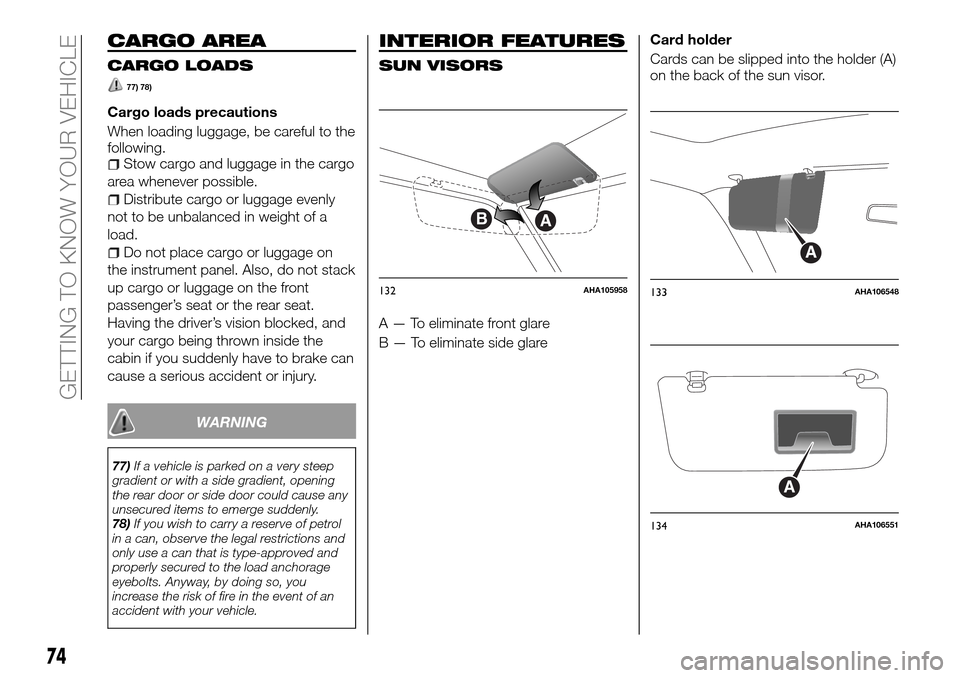
A — To eliminate front glare
B — To eliminate side glareCard holder
Cards can be slipped into the holder (A)
on the back of the sun visor.
AB
132AHA105958
A
133AHA106548
A
134AHA106551
74
GETTING TO KNOW YOUR VEHICLE
Page 85 of 312
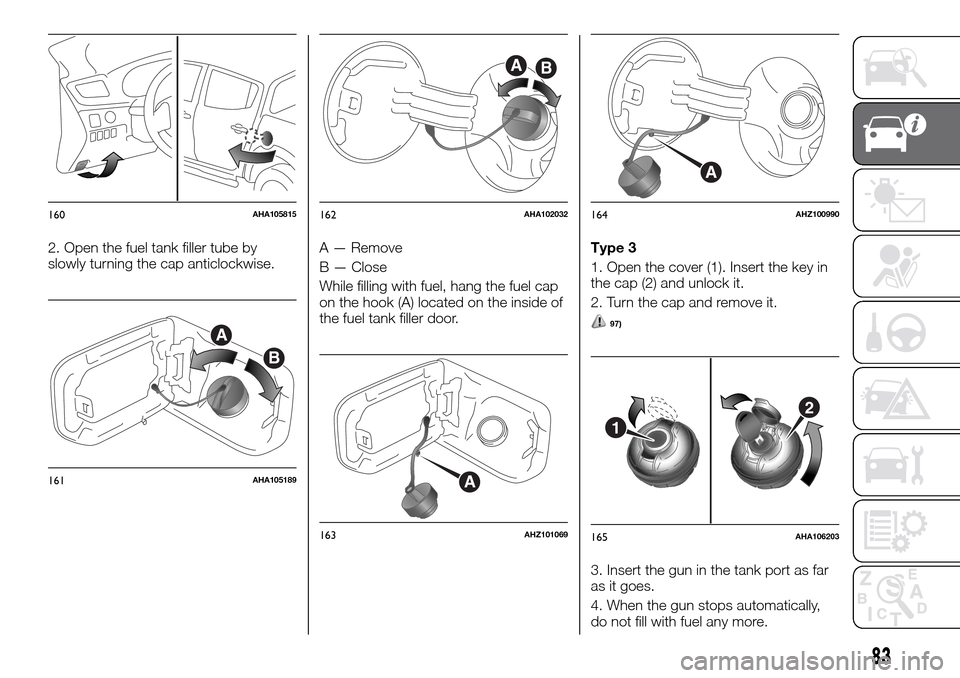
2. Open the fuel tank filler tube by
slowly turning the cap anticlockwise.A — Remove
B — Close
While filling with fuel, hang the fuel cap
on the hook (A) located on the inside of
the fuel tank filler door.Type 3
1. Open the cover (1). Insert the key in
the cap (2) and unlock it.
2. Turn the cap and remove it.
97)
3. Insert the gun in the tank port as far
as it goes.
4. When the gun stops automatically,
do not fill with fuel any more.
160AHA105815
A
B
161AHA105189
AB
162AHA102032
A
163AHZ101069
A
164AHZ100990
1
2
165AHA106203
83
Page 86 of 312
5. To close, turn the fuel cap slowly
clockwise until you hear clicking
sounds, then gently push the fuel tank
filler door closed.
WARNING
86)When handling fuel, comply with the
safety regulations displayed by garages
and filling stations.
87)Fuel is highly flammable and explosive.
You could be burned or seriously injured
when handling it. When refueling your
vehicle, always turn the engine off and
keep away from flames, sparks and
smoking materials. Always handle fuel in
well ventilated outdoor areas.
88)Before removing the fuel cap, be sure
to get rid of your body’s static electricity by
touching a metal part of the vehicle or fuel
pump. Any static electricity on your body
could create a spark that ignites fuel vapor.
89)Perform the whole refueling process
(opening the fuel tank filler door, removing
the fuel cap, etc.) by yourself. Do not let
any other person come near the fuel tank
filler. If you allowed a person to help you
and that person was carrying static
electricity, fuel vapor could be ignited.
90)Do not move away from the fuel tank
filler until refueling is finished. If you moved
away and did something else (for example,
sitting on a seat) part-way through the
refueling process, you could pick up a
fresh charge of static electricity.
91)Be careful not to inhale fuel vapor. Fuel
contains toxic substances.92)Keep the doors and windows closed
while refueling the vehicle. If they were
open, fuel vapor could get into the cabin.
93)If the fuel cap must be replaced, use
only a Fiat genuine part.
94)Since the fuel system may be under
pressure, remove the fuel cap slowly. This
relieves any pressure or vacuum that might
have built up in the fuel tank. If you hear a
hissing sound, wait until it stops before
removing the cap. Otherwise, fuel may
spray out, injuring you or others.
95)Do not apply any object/plug to the
end of the filler which is not provided for
the car. The use of non-compliant
objects/plugs could cause a pressure
increase inside the tank, resulting in
dangerous situations.
96)Do not use a mobile phone near the
refuelling pump: risk of fire.
97)Do not tilt the gun.
84
GETTING TO KNOW YOUR VEHICLE
Page 96 of 312
INDICATOR AND WARNING LAMPS
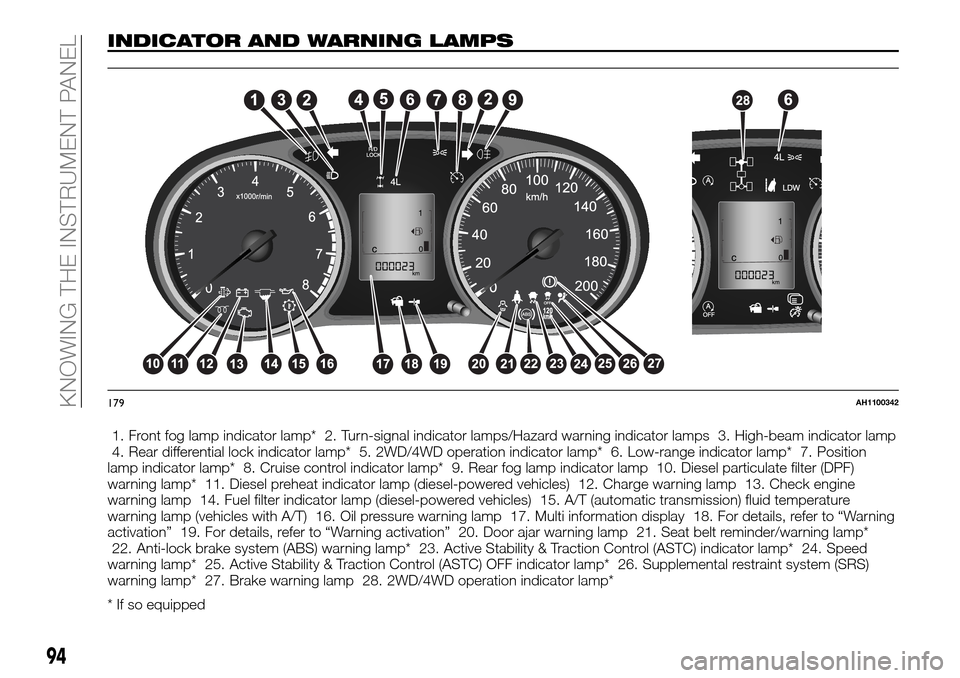
1. Front fog lamp indicator lamp* 2. Turn-signal indicator lamps/Hazard warning indicator lamps 3. High-beam indicator lamp
4. Rear differential lock indicator lamp* 5. 2WD/4WD operation indicator lamp* 6. Low-range indicator lamp* 7. Position
lamp indicator lamp* 8. Cruise control indicator lamp* 9. Rear fog lamp indicator lamp 10. Diesel particulate filter (DPF)
warning lamp* 11. Diesel preheat indicator lamp (diesel-powered vehicles) 12. Charge warning lamp 13. Check engine
warning lamp 14. Fuel filter indicator lamp (diesel-powered vehicles) 15. A/T (automatic transmission) fluid temperature
warning lamp (vehicles with A/T) 16. Oil pressure warning lamp 17. Multi information display 18. For details, refer to “Warning
activation” 19. For details, refer to “Warning activation” 20. Door ajar warning lamp 21. Seat belt reminder/warning lamp*
22. Anti-lock brake system (ABS) warning lamp* 23. Active Stability & Traction Control (ASTC) indicator lamp* 24. Speed
warning lamp* 25. Active Stability & Traction Control (ASTC) OFF indicator lamp* 26. Supplemental restraint system (SRS)
warning lamp* 27. Brake warning lamp 28. 2WD/4WD operation indicator lamp*
* If so equipped
179AH1100342
94
KNOWING THE INSTRUMENT PANEL
Page 142 of 312
PARKING
To park the vehicle, fully engage the
parking brake, and then move the
gearshift lever to 1st or “R” (Reverse)
position for vehicles equipped with M/T,
or set the selector lever to “P” (PARK)
position for vehicles equipped with A/T.
Parking on a hill
To prevent the vehicle from rolling,
follow these procedures:
Parking on a downhill slope
Turn the front wheels towards the kerb
and move the vehicle forward until the
kerb side wheel gently touches the
kerb.
On vehicles equipped with M/T, apply
the parking brake and place the
gearshift lever into the “R” (Reverse)
position.
On vehicles equipped with A/T, apply
the parking brake and place the
selector lever into the “P” (PARK)
position. If necessary, apply chocks to
wheels.
Parking on a uphill slope
Turn the front wheels away from the
kerb and move the vehicle back until
the kerb side wheel gently touches the
kerb.
On vehicles equipped with M/T, apply
the parking brake and place the
gearshift lever into the 1st position.
On vehicles equipped with A/T, apply
the parking brake and place theselector lever into the “P” (PARK)
position. If necessary, apply chocks to
wheels.
If your vehicle is equipped with A/T, be
sure to apply the parking brake before
moving selector lever to the “P” (PARK)
position. If you move selector lever to
the “P” (PARK) position before applying
the parking brake, it may be difficult to
disengage selector lever from the “P”
(PARK) position when next you drive the
vehicle, requiring application of a strong
force the selector lever to move from
the “P” (PARK) position.
Parking with the engine running
Never leave the engine running while
you take a short sleep/rest. Also, never
leave the engine running in a closed or
poorly ventilated place.
When leaving the vehicle
Always carry the key and lock all doors
when leaving the vehicle unattended.
Always try to park your vehicle in a well
lit area.
201) 202)
WARNING
201)Leaving the engine running risks injury
or death from accidentally moving the
gearshift lever (with M/T) or the selector
lever (with A/T) or the accumulation of toxic
exhaust fumes on the passenger
compartment.202)Do not park your vehicle in areas
where combustible materials such as dry
grass or leaves can come in contact with a
hot exhaust, since a fire could occur.
140
STARTING AND DRIVING